Sample Category Title

USD/CAD Weekly Outlook

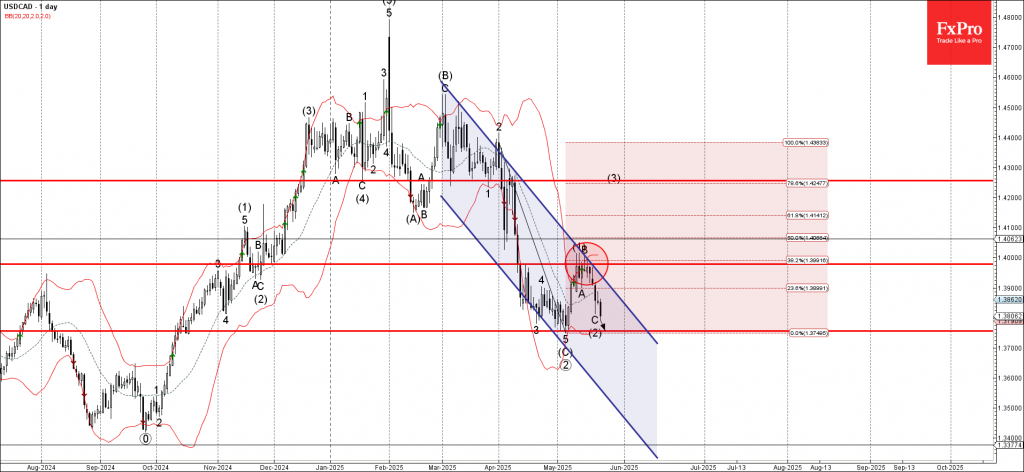
USD/CAD gyrated lower last week but recovered after breaching 1.4238 support very briefly. Initial bias stays neutral this week first. Overall, corrective pattern from 1.4791 is still extending. On the upside, break of 1.4400 will argue that it's still in the second leg, and turn bias to the upside for 1.4541 resistance. On the downside, break of 1.4238 will suggest that the third leg has already started for 1.4150 and below.

In the bigger picture, long term up trend is tentatively seen as resuming with prior breach of 1.4667/89 key resistance zone (2020/2015 highs). Next target is 100% projection of 1.2401 to 1.3976 from 1.3418 at 1.4993. This will remain the favored case as long as 1.3976 resistance turned support holds (2022 high), even in case of deep pullback.

In the longer term picture, up trend from 0.9506 (2007 low) is in progress and possibly resuming. Next target is 61.8% projections of 0.9406 to 1.4689 from 1.2005 at 1.5270. While rejection by 1.4689 will delay the bullish case, further rally will remain in favor as long as 55 M EMA (1.3463) holds.

GBP/JPY Weekly Outlook

GBP/JPY's rise from 187.04 resumed last week, but retreated after hitting 195.95. Initial bias is turned neutral this week first. On the upside, break of 195.95 will extend the rally once again, to 198.94 resistance. However, firm break of 192.00 support will turn bias back to the downside for deeper fall. Overall, corrective pattern from 180.00 is still extending.

In the bigger picture, price actions from 208.09 are seen as a correction to rally from 123.94 (2020 low). Strong support should be seen from 38.2% retracement of 123.94 to 208.09 at 175.94 to contain downside. However, sustained break of 152.11 will bring deeper fall even still as a correction.

In the longer term picture, while a medium term top was formed at 208.09 (2024 high), it's still early to conclude that the up trend from 122.75 (2016 low) has completed. But GBP/JPY is at least in a medium term corrective phase, with risk of correction to 55 M EMA (now at 174.68).

EUR/JPY Weekly Outlook

EUR/JPY stayed in sideway trading below 164.16 last week and outlook is unchanged. Initial bias remains neutral this week first. Further rise is in favor as long as 160.73 support holds. Above 164.16 will resume the rally from 154.77 to 164.89 resistance, and then 166.67. However, break of 160.73 will turn bias back to the downside for 158.87 support and below. Overall, sideway consolidation pattern from 154.40 is still extending.

In the bigger picture, price actions from 175.41 are seen as correction to rally from 114.42 (2020 low). Strong support should be seen from 38.2% retracement of 114.42 to 175.41 at 152.11 to contain downside. However, sustained break of 152.11 will bring deeper fall even still as a correction.

In the long term picture, while 175.41 is at least a medium term top, it's still early to conclude that up trend from 94.11 (2012 low) has completed. A medium term corrective phase is in progress with risk of deeper fall back to 55 M EMA (now at 148.94).

EUR/GBP Weekly Outlook

EUR/GBP gyrated lower last week and broke 55 D EMA (now at 0.8347). But subsequent strong recovery mixed up the near term outlook. Initial bias is turned neutral this week first. On the downside, below 08314 will bring deeper fall back to 0.8239 support. However, firm break of 0.8373 minor resistance will argue that fall from 0.8448 is merely a correction and has completed. Retest of 0.8448 should be seen next.

In the bigger picture, EUR/GBP is still bounded inside medium term falling channel. While rebound from 0.8221 might extend higher, it could still develop into a corrective pattern. Overall outlook will be neutral at best and down trend from 0.9267 (2022 high) could extend, at least until decisive break of channel resistance (now at 0.8495).

In the long term picture, price action from 0.9499 (2020 high) is seen as part of the long term range pattern from 0.9799 (2008 high). Range trading should continue between 0.8201 and 0.9499, until there is clear signal of imminent breakout.

EUR/AUD Weekly Outlook

EUR/AUD's correction from 1.7417 extended lower last week but was supported by 1.6900 support as expected so far. Initial bias remains neutral this week and further rise is expected. On the upside, above 1.7270 resistance will argue that the correction has completed, and bring retest of 1.7417. Firm break there will resume larger rise from 1.6335.

In the bigger picture, the breach of 1.7180 key resistance (2024 high) suggests that up trend from 1.4281 (2022 low) is resuming. Sustained trading above 1.7180 will confirm and target 61.8% projection of 1.4281 to 1.7062 from 1.5963 at 1.7682, which is also close to 61.8% retracement of 1.9799 (2020 high) to 1.4281 at 1.7691. For now, this will remain the favored case as long as 1.6800 resistance turned support holds, even in case of deep pullback.

In the longer term picture, rise from 1.4281 is seen as the second leg of the pattern from 1.9799 (2020 high), which is part of the pattern from 2.1127 (2008 high). As long as 55 M EMA (now at 1.6099) holds, this second leg could still extend higher. However, sustained trading below 55 M EMA will open up the bearish case for extending the decline through 1.4281 low.

EUR/CHF Weekly Outlook

EUR/CHF gyrated lower as corrective fall from 0.9660 extended, but recovered after drawing support from 0.9489. Initial bias stays neutral first and further rally is expected. On the upside, above 0.9581 minor resistance will indicate that the pullback has completed and bring retest of 0.9660 high. Firm break there will resume whole rise from 0.9204. However, sustained break of 0.9489 will dampen this view, and bring deeper fall back to 0.9331 support next.

In the bigger picture, prior strong break of 55 W EMA (now at 0.9491) is a medium term bullish sign. Sustained break trading above long-term falling channel resistance (at around 0.9610) would suggest that the downtrend from 1.2004 (2018 high) has bottomed at 0.9204. Stronger rally should then be seen to 0.9928 key resistance at least.

In the long term picture, bullish signs are emerging. However, the important hurdle at 0.9928 resistance, which is close to 55 M EMA (now at 0.9960), is needed to be taken out decisively before considering long term trend reversal. Otherwise, outlook is neutral at best.

Markets Rush to Safe Haven as Tariff Clock Ticks Down

While US investors managed to stay relatively composed through most of last week, the calm cracked heading into the weekend. Stocks saw extended selloffs, Treasury yields dropped, and Gold surged to yet another record high — all classic signs of a decisive flight to safety. With risk appetite now clearly under pressure, traders are no longer waiting to see what happens next. They’ve begun positioning defensively ahead of April 2, dubbed “Liberation Day,” when the US is expected to announce sweeping reciprocal tariffs.

That looming event, along with inevitable retaliatory measures from trading partners, has injected a fresh wave of uncertainty into the outlook. Risk-off sentiment is likely to dominate US markets in the near term, at least until the full scale of the tariff fallout becomes clear — including possible re-retaliations.

A big question is whether European markets, which showed notable resilience through March, can continue to defy the global jitters. Stocks in Germany and the UK have largely outperformed US peers, and Euro has led major currencies higher for the month. But the divergence might be tested soon, especially if the trade conflict spills into sectors crucial to the Eurozone's export-heavy economy.

Meanwhile, forex markets have remained relatively stable, with most major pairs stuck inside the prior week's ranges. Kiwi was the lone exception. However, late-week price action across several currency pairs — particularly EUR/USD — suggests that breakouts may be imminent. The common currency is showing signs of bullish potential, with traders watching closely to see whether March strength can evolve into something even more meaningful.

Ultimately, April could be a make-or-break month for the Euro. Either it confirms a genuine bullish turn, reversing the multi-decade downtrend, or it becomes just another short-lived bounce in a longer-term bearish cycle. Otherwise, the March rally risks being remembered as another false dawn in the common currency’s struggle to reverse its long-term decline.

Wall Street Sinks as Markets Front-Run Trump's "Liberation Day" Tariff Blitz

US equities closed out the week with sharp losses, as fears over the looming escalation in trade tensions and persistent inflation sent risk sentiment spiraling. S&P 500 fell -1.53% on the week, while DOW dropped -0.96%. Tech bore the brunt of the selloff, with NASDAQ sliding -2.59%. That puts the NASDAQ on track for a painful monthly decline of over -8%, which would mark its worst monthly performance since December 2022.

The market is being squeezed from two ends. On one side, uncertainty over the scope and scale of US tariffs is weighing on sentiment. On the other, resilient inflation data, especially in core readings, is reinforcing expectations that Fed will keep interest rates higher for longer. Together, these twin pressures are raising fears of a broader slowdown in consumer spending, business investment, and overall economic growth, with the risk of tipping the US into recession.

Trump’s steel and aluminum tariffs have already been in place, but tensions intensified last week as he announced a fresh 25% levy on imported cars and auto parts. That was a mere prelude to what he has dubbed “Liberation Day” on April 2, when the broader reciprocal tariff regime is expected to be unveiled. Stock markets may already be bracing for impact, with traders possibly front-running the announcement, despite the usual quarter-end rebalancing flows.

The broader concern is that even after the April 2 announcement, the tariff saga won’t be over. Canada and the EU are almost certain to respond with retaliations, and China’s stance remains unclear. Others, like the UK and Australia, are expected to hold back. But should retaliation begin to pile up, there is every chance that Trump will double down with even more aggressive measures, setting off a full-blown global trade war.

Still, there is a glimmer of hope. If current market anxiety is more about the "uncertainty" surrounding tariffs rather than the "actual impact" of tariffs themselves, there may be room for a sentiment rebound once the details are made clear — hopefully sometime in Q2.

But that’s a big assumption, and one that relies heavily on the scope, implementation, and global response to the tariffs.

Technically, S&P 500's rebound from 5504.65 should have completed at 5786.95, ahead of falling 55 D EMA (now at 5833.15). Focus for the next few days will be back on 5504.65 support. Firm break there will resume the corrective decline from 6147.47 high to 38.2% retracement of 3491.58 to 6147.43 at 5132.89. Strong support should be seen there to contain downside and bring rebound, at least on first attempt.

Similarly, NASDAQ's corrective recovery from 17238.23 should have completed at 18281.13, ahead of falling 55 D EMA (now at 18608.86). Break of 17238.23 in the next week days will resume the corrective fall from 20204.58 to 38.2% retracement of 10088.82 to 20204.58 at 16340.36. Strong support should be seen there to bring rebound, at least on first attempt. However, firm break there will pave the way to 15708.53 support next.

Yields Tumble on Safe Haven Flows, Dollar Index Relatively Resilient

US 10-year Treasury yields fell sharply on Friday, even as core PCE inflation surprised to the upside. The data highlighted persistent inflationary pressures, with the core PCE accelerating to 2.8% yoy, above expectations and well above Fed’s 2% target. Typically, such data would push yields higher as markets price out rate cuts. However, Friday’s yield decline suggests a different narrative dominated—one of risk aversion.

Technically, corrective recovery from 4.106 could have already completed at 4.387 after hitting falling 55 D EMA (now at 4.3650). Break of 4.174 support will argue that the whole decline from 4.809 is ready to resume through 4.106 short term bottom. Next target will then be 61.8% projection of 4.809 to 4.106 from 4.387 at 3.952, which is below 4% psychological level.

More importantly, the next fall will solidify that decline from 4.809 is another leg inside the medium term pattern from 4.997 (2023 high) with risk of extending to 3.603 (2024 low) and below.

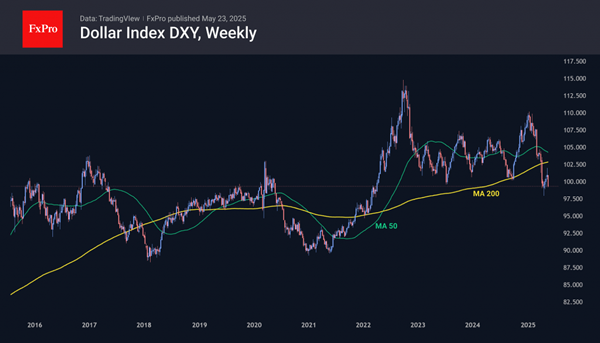
Dollar Index only dipped slightly on Friday and the development argues that corrective recovery from 103.19 might still extend. But even in case of another rise, upside should be limited by 55 D EMA (now at 105.64). Break of 103.19 will resume the fall from 110.17 to 100.15 support next.

Crucially, the next fall will further solidify the case that decline from 110.17 is the third leg of the pattern from 114.77 (2022 high). Break of 100.15 support will pave the way through 99.57 (2023 low) to 100% projection of 114.77 to 99.57 from 110.17 at 94.97.

March Belongs to Europe, But Can Momentum Survive April’s Storm?

Despite rising global trade tensions and the looming threat of reciprocal US tariffs, European currencies and assets have emerged as the standout performers for March. In the equity space, major European indices like Germany’s DAX and the UK’s FTSE have remained relatively insulated from the sharp selloff seen on Wall Street.

Meanwhile, Euro has led the charge in the currency markets, with Sterling and, to a lesser extent, Swiss Franc following closely. The coming weeks will be critical in determining whether this resilience in European markets can be sustained or even turn into renewed momentum.

Technically, with 8474.41 resistance turned support intact, FTSE's price actions from 8908.82 are viewed as a sideway consolidation pattern only. Larger up trend is expected resume through 8908.82 to 100% projection of 7404.08 to 8474.41 from 8002.34 at 9072.67 at a later stage.

As for the stronger DAX, outlook is staying bullish with 22226.34 support intact, which is close to 55 D EMA (now at 22150.63). Another rise is till expected to 161.8% projection of 14630.21 to 18892.92 from 17024.82 at 23921.87, or even further to 24000 psychological level.

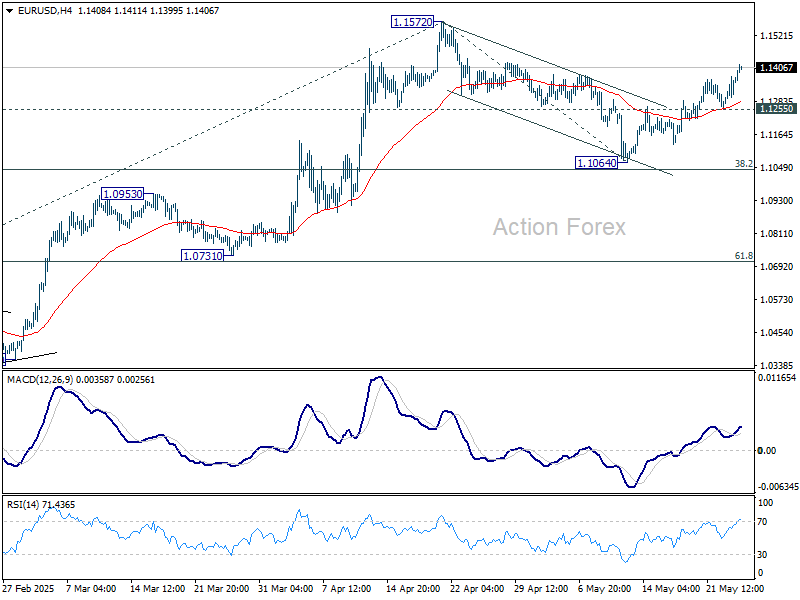
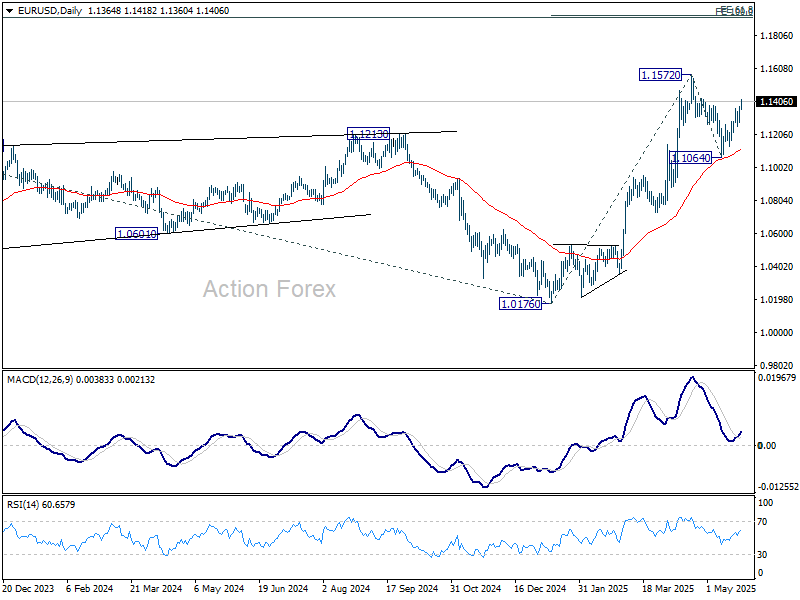
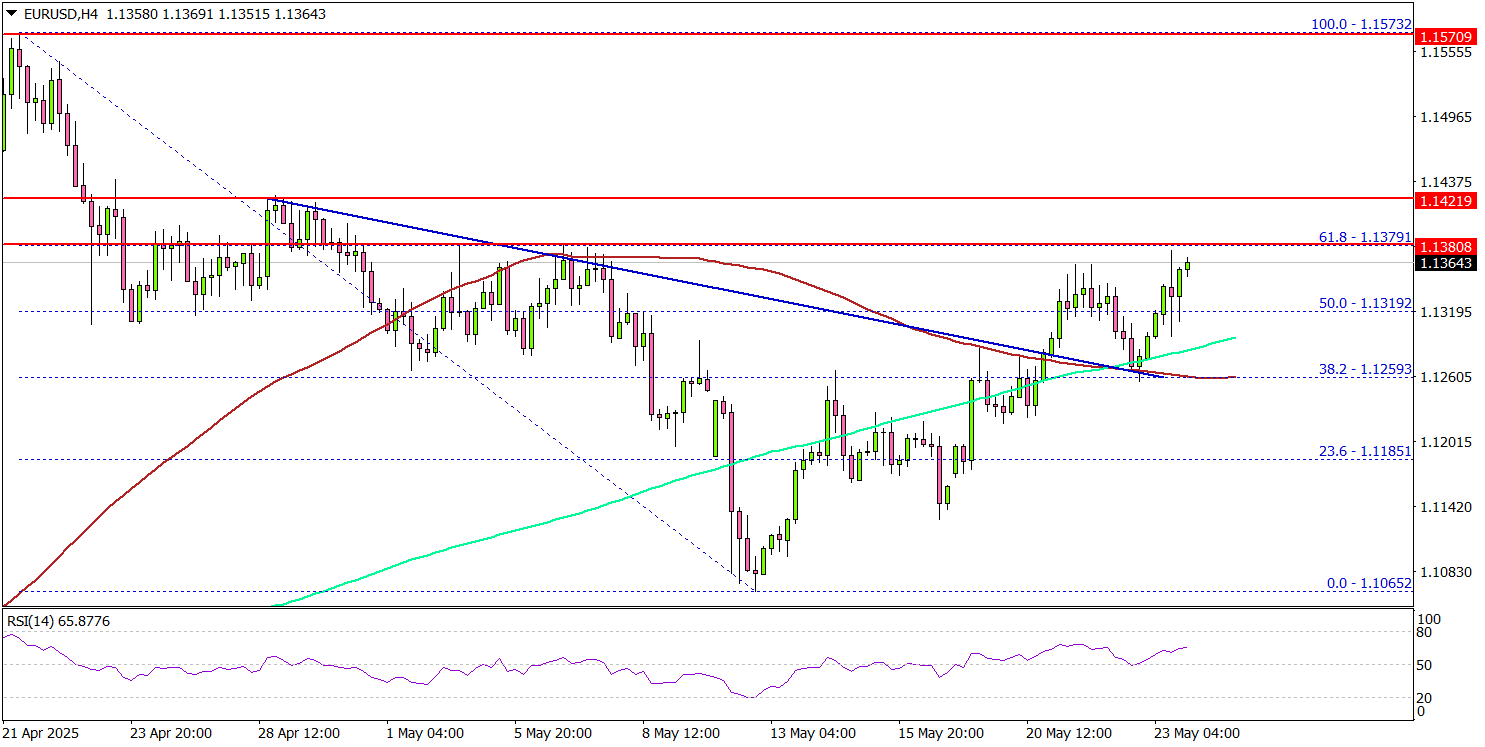
It's also important for EUR/USD. The near term pull back from 1.0953 could have already completed at 1.0731, ahead of 38.2% retracement of 1.0358 to 1.0953 at 1.0726. Break of 1.0857 minor resistance should affirm this bullish case, and push EUR/USD through 1.0953 to resume the whole rally from 1.0176.

More significantly, the next rally would set up EUR/USD for a test on key resistance between 1.1274 (2023 high) and multi-decade falling channel resistance (now at around 1.1380). This resistance zone is crucial to determine whether EUR/USD is reversing the long term down trend.

USD/JPY Weekly Outlook

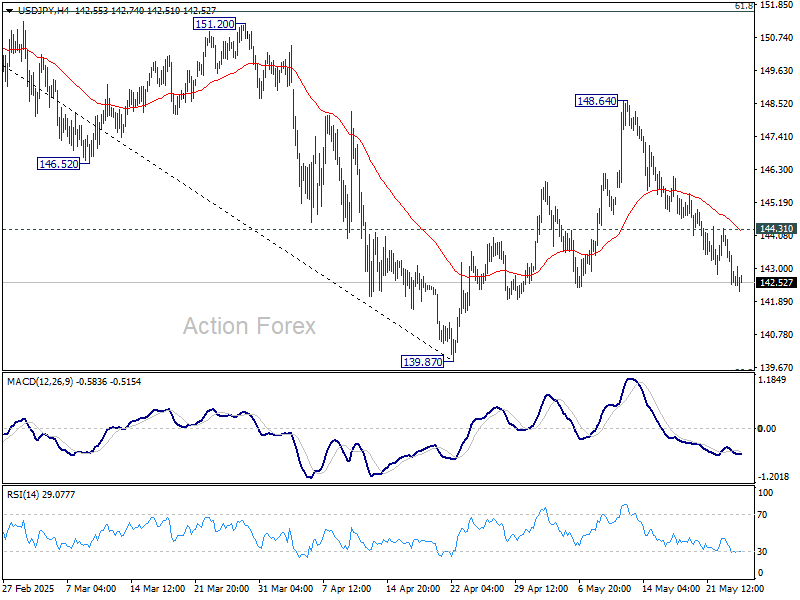
USD/JPY recovered further to 151.20 last week but retreated sharply ahead of 151.29 cluster resistance (38.2% retracement of 158.86 to 146.52 at 151.23). Initial bias remains neutral first and outlook stay bearish. On the downside, below 149.53 minor support will argue that the corrective recovery has completed and bring retest of 146.52 low. Firm break there will resume whole fall from 158.86. However, firm break of 151.23/9 will turn bias back to the upside for 154.79 resistance instead.

In the bigger picture, price actions from 161.94 are seen as a corrective pattern to rise from 102.58 (2021 low), with fall from 158.86 as the third leg. Strong support should be seen from 38.2% retracement of 102.58 to 161.94 at 139.26 to bring rebound. However, sustained break of 139.26 would open up deeper medium term decline to 61.8% retracement at 125.25.
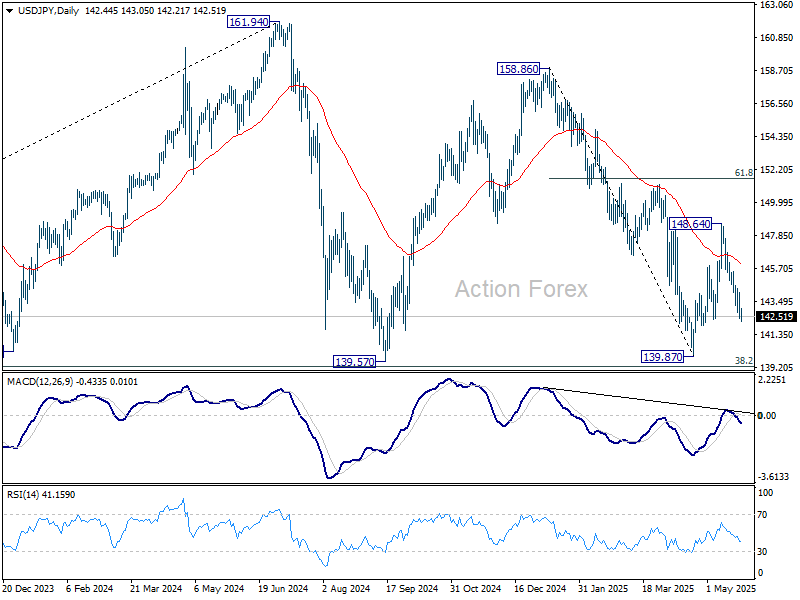
In the long term picture, it's still early to conclude that up trend from 75.56 (2011 low) has completed. A medium term corrective phase should have commenced, with risk of deep correction towards 55 M EMA (now at 136.94).

Summary 3/31 – 4/4

Monday, Mar 31, 2025
GMT Ccy Events Consensus Previous
23:50 JPY Industrial Production M/M Feb P 1.90% -1.10%
23:50 JPY Retail Trade Y/Y Feb 2.40% 4.40%
00:00 NZD ANZ Business Confidence Mar 58.4
00:30 AUD Private Sector Credit M/M Feb 0.50% 0.50%
01:30 CNY NBS Manufacturing PMI Mar 50.5 50.2
01:30 CNY NBS Non-Manufacturing PMI Mar 50.4
05:00 JPY Housing Starts Y/Y Feb -1.90% -4.60%
06:00 EUR Germany Import Price Index M/M Feb -0.10% 1.10%
06:00 EUR Germany Retail Sales M/M Feb 0.00% 0.20%
08:30 GBP M4 Money Supply M/M Feb 1.10% 1.30%
08:30 GBP Mortgage Approvals Feb 66K 66K
12:00 EUR Germany CPI M/M Mar P 0.30% 0.40%
12:00 EUR Germany CPI Y/Y Mar P 2.30%
13:45 USD Chicago PMI Mar 45.4 45.5
GMT Ccy Events
23:50 JPY Industrial Production M/M Feb P
    Forecast: Previous: 1.90%
23:50 JPY Retail Trade Y/Y Feb
    Forecast: Previous: 2.40%
00:00 NZD ANZ Business Confidence Mar
    Forecast: Previous:
00:30 AUD Private Sector Credit M/M Feb
    Forecast: Previous: 0.50%
01:30 CNY NBS Manufacturing PMI Mar
    Forecast: Previous: 50.5
01:30 CNY NBS Non-Manufacturing PMI Mar
    Forecast: Previous:
05:00 JPY Housing Starts Y/Y Feb
    Forecast: Previous: -1.90%
06:00 EUR Germany Import Price Index M/M Feb
    Forecast: Previous: -0.10%
06:00 EUR Germany Retail Sales M/M Feb
    Forecast: Previous: 0.00%
08:30 GBP M4 Money Supply M/M Feb
    Forecast: Previous: 1.10%
08:30 GBP Mortgage Approvals Feb
    Forecast: Previous: 66K
12:00 EUR Germany CPI M/M Mar P
    Forecast: Previous: 0.30%
12:00 EUR Germany CPI Y/Y Mar P
    Forecast: Previous:
13:45 USD Chicago PMI Mar
    Forecast: Previous: 45.4
Tuesday, Apr 1, 2025
GMT Ccy Events Consensus Previous
00:30 AUD Retail Sales M/M Feb 0.30% 0.30%
00:30 JPY Manufacturing PMI Mar F 48.3 48.3
01:45 CNY Caixin Manufacturing PMI Mar 50.5 50.8
03:30 AUD RBA Interest Rate Decision 4.10% 4.10%
04:30 AUD RBA Press Conference
06:30 CHF Real Retail Sales Y/Y Feb 1.50% 1.30%
07:30 CHF Manufacturing PMI Mar 50.5 49.6
07:50 EUR France Manufacturing PMI Mar F 48.9 48.9
07:55 EUR Germany Manufacturing PMI Mar F 48.7 48.3
08:00 EUR Eurozone Manufacturing PMI Mar F 48.7 48.7
08:30 GBP Manufacturing PMI Mar 44.6 44.6
09:00 EUR Eurozone Unemployment Rate Feb 6.20% 6.20%
09:00 EUR CPI Y/Y Mar P 2.20% 2.30%
09:00 EUR CPI Core Y/Y Mar P 2.50% 2.60%
13:30 CAD Manufacturing PMI Mar 47.8
13:45 USD Manufacturing PMI Mar F 49.8 49.8
14:00 USD ISM Manufacturing PMI Mar 49.9 50.3
14:00 USD ISM Manufacturing Prices Paid Mar 65 62.4
14:00 USD ISM Manufacturing Employment Mar 47.6
14:00 USD ISM Manufacturing New Orders Index Mar 48.6
14:00 USD Construction Spending M/M Feb 0.20% -0.20%
21:45 NZD Building Permits M/M Feb 2.60%
23:50 JPY Monetary Base Y/Y Mar -1.50% -1.80%
GMT Ccy Events
00:30 AUD Retail Sales M/M Feb
    Forecast: 0.30% Previous: 0.30%
00:30 JPY Manufacturing PMI Mar F
    Forecast: 48.3 Previous: 48.3
01:45 CNY Caixin Manufacturing PMI Mar
    Forecast: 50.5 Previous: 50.8
03:30 AUD RBA Interest Rate Decision
    Forecast: 4.10% Previous: 4.10%
04:30 AUD RBA Press Conference
    Forecast: Previous:
06:30 CHF Real Retail Sales Y/Y Feb
    Forecast: 1.50% Previous: 1.30%
07:30 CHF Manufacturing PMI Mar
    Forecast: 50.5 Previous: 49.6
07:50 EUR France Manufacturing PMI Mar F
    Forecast: 48.9 Previous: 48.9
07:55 EUR Germany Manufacturing PMI Mar F
    Forecast: 48.7 Previous: 48.3
08:00 EUR Eurozone Manufacturing PMI Mar F
    Forecast: 48.7 Previous: 48.7
08:30 GBP Manufacturing PMI Mar
    Forecast: 44.6 Previous: 44.6
09:00 EUR Eurozone Unemployment Rate Feb
    Forecast: 6.20% Previous: 6.20%
09:00 EUR CPI Y/Y Mar P
    Forecast: 2.20% Previous: 2.30%
09:00 EUR CPI Core Y/Y Mar P
    Forecast: 2.50% Previous: 2.60%
13:30 CAD Manufacturing PMI Mar
    Forecast: Previous: 47.8
13:45 USD Manufacturing PMI Mar F
    Forecast: 49.8 Previous: 49.8
14:00 USD ISM Manufacturing PMI Mar
    Forecast: 49.9 Previous: 50.3
14:00 USD ISM Manufacturing Prices Paid Mar
    Forecast: 65 Previous: 62.4
14:00 USD ISM Manufacturing Employment Mar
    Forecast: Previous: 47.6
14:00 USD ISM Manufacturing New Orders Index Mar
    Forecast: Previous: 48.6
14:00 USD Construction Spending M/M Feb
    Forecast: 0.20% Previous: -0.20%
21:45 NZD Building Permits M/M Feb
    Forecast: Previous: 2.60%
23:50 JPY Monetary Base Y/Y Mar
    Forecast: -1.50% Previous: -1.80%
Wednesday, Apr 2, 2025
GMT Ccy Events Consensus Previous
00:30 AUD Building Permits M/M Feb -1.40% 6.30%
12:15 USD ADP Employment Change Mar 120K 77K
14:00 USD Factory Orders M/M Feb 0.50% 1.70%
14:30 USD Crude Oil Inventories -3.3M
GMT Ccy Events
00:30 AUD Building Permits M/M Feb
    Forecast: -1.40% Previous: 6.30%
12:15 USD ADP Employment Change Mar
    Forecast: 120K Previous: 77K
14:00 USD Factory Orders M/M Feb
    Forecast: 0.50% Previous: 1.70%
14:30 USD Crude Oil Inventories
    Forecast: Previous: -3.3M
Thursday, Apr 3, 2025
GMT Ccy Events Consensus Previous
00:30 JPY Services PMI Mar F 49.5 49.5
01:30 AUD Trade Balance (AUD) Feb 5.40B 5.62B
01:45 CNY Caixin Services PMI Mar 51.6 51.4
06:30 CHF CPI M/M Mar 0.10% 0.60%
06:30 CHF CPI Y/Y Mar 0.30%
07:50 EUR France Services PMI Mar 46.6 46.6
07:55 EUR Germany Services PMI Mar 50.2 50.2
08:00 EUR Eurozone Services PMI Mar 50.4 50.4
08:30 GBP Services PMI Mar 53.2 53.2
09:00 EUR Eurozone PPI M/M Feb 0.40% 0.80%
09:00 EUR Eurozone PPI Y/Y Feb 1.80%
11:30 EUR ECB Meeting Accounts
11:30 USD Challenger Job Cuts Y/Y Mar 103.20%
12:30 CAD Trade Balance (CAD) Feb 2.5B 4.0B
12:30 USD Initial Jobless Claims (Mar 28) 225K 224K
12:30 USD Trade Balance (USD) Feb -110.0B -131.4B
13:45 USD Services PMI Mar F 54.3 54.3
14:00 USD ISM Services PMI Mar 53.1 53.5
14:30 USD Natural Gas Storage 37B
23:30 JPY Overall Household Spending Y/Y Feb -0.70% 0.80%
GMT Ccy Events
00:30 JPY Services PMI Mar F
    Forecast: 49.5 Previous: 49.5
01:30 AUD Trade Balance (AUD) Feb
    Forecast: 5.40B Previous: 5.62B
01:45 CNY Caixin Services PMI Mar
    Forecast: 51.6 Previous: 51.4
06:30 CHF CPI M/M Mar
    Forecast: 0.10% Previous: 0.60%
06:30 CHF CPI Y/Y Mar
    Forecast: Previous: 0.30%
07:50 EUR France Services PMI Mar
    Forecast: 46.6 Previous: 46.6
07:55 EUR Germany Services PMI Mar
    Forecast: 50.2 Previous: 50.2
08:00 EUR Eurozone Services PMI Mar
    Forecast: 50.4 Previous: 50.4
08:30 GBP Services PMI Mar
    Forecast: 53.2 Previous: 53.2
09:00 EUR Eurozone PPI M/M Feb
    Forecast: 0.40% Previous: 0.80%
09:00 EUR Eurozone PPI Y/Y Feb
    Forecast: Previous: 1.80%
11:30 EUR ECB Meeting Accounts
    Forecast: Previous:
11:30 USD Challenger Job Cuts Y/Y Mar
    Forecast: Previous: 103.20%
12:30 CAD Trade Balance (CAD) Feb
    Forecast: 2.5B Previous: 4.0B
12:30 USD Initial Jobless Claims (Mar 28)
    Forecast: 225K Previous: 224K
12:30 USD Trade Balance (USD) Feb
    Forecast: -110.0B Previous: -131.4B
13:45 USD Services PMI Mar F
    Forecast: 54.3 Previous: 54.3
14:00 USD ISM Services PMI Mar
    Forecast: 53.1 Previous: 53.5
14:30 USD Natural Gas Storage
    Forecast: Previous: 37B
23:30 JPY Overall Household Spending Y/Y Feb
    Forecast: -0.70% Previous: 0.80%
Friday, Apr 4, 2025
GMT Ccy Events Consensus Previous
06:00 EUR Germany Factory Orders M/M Feb 3.30% -7.00%
06:45 EUR France Industrial Output M/M Feb 0.50% -0.60%
08:30 GBP Construction PMI Mar 46.7 44.6
12:30 USD Nonfarm Payrolls Mar 128K 151K
12:30 USD Average Hourly Earnings M/M Mar 0.30% 0.30%
12:30 USD Unemployment Rate Mar 4.10% 4.10%
12:30 CAD Net Change in Employment Mar 1.1K
12:30 CAD Unemployment Rate Mar 6.60%
GMT Ccy Events
06:00 EUR Germany Factory Orders M/M Feb
    Forecast: 3.30% Previous: -7.00%
06:45 EUR France Industrial Output M/M Feb
    Forecast: 0.50% Previous: -0.60%
08:30 GBP Construction PMI Mar
    Forecast: 46.7 Previous: 44.6
12:30 USD Nonfarm Payrolls Mar
    Forecast: 128K Previous: 151K
12:30 USD Average Hourly Earnings M/M Mar
    Forecast: 0.30% Previous: 0.30%
12:30 USD Unemployment Rate Mar
    Forecast: 4.10% Previous: 4.10%
12:30 CAD Net Change in Employment Mar
    Forecast: Previous: 1.1K
12:30 CAD Unemployment Rate Mar
    Forecast: Previous: 6.60%

The Weekly Bottom Line: Waiting for April 2nd

Canadian Highlights

  • The announcement of U.S. tariffs on the auto sector this week could be a major downside risk for the Canadian economy. Attention now turns to the April 2nd “reciprocal tariff” announcement and Canada’s response.
  • Not surprisingly, a major survey of businesses showed that business confidence took a tumble in March.
  • Before trade tensions emerged as the most important issue for the Canadian economy, the latest data show the economy had held up in January, although the service sector did show some weakness.

U.S. Highlights

  • This week’s announcement of new automobile tariffs caught markets by surprise. But now all eyes are focused on updates on reciprocal tariffs next week.
  • The U.S. economy had been humming, but as uncertainty ramps up and consumer confidence continues to dip, the risks of a slowdown are building.
  • Worryingly, inflation momentum picked up again in February suggesting price growth could be stickier than anticipated.

Canada – Bracing for Impact

Going into this week, April 2nd, the day that the United States is expected to announce reciprocal tariffs on all its trading partners, already loomed large over the Canadian economy. Many questions remained, such as the coverage of countries and goods, and the size of the tariff. Then the Trump administration surprised markets this week with an announcement of a 25% tariffs on the auto sector, scheduled to take effect on April 3rd. We covered what we know about these tariffs in our report yesterday but many questions remain, including exactly how high the tariff will be for Canada. As of now, there are some indications that Canada and Mexico may receive a lower tariff on autos than other countries. We expect that the full picture of U.S. tariff measures will remain somewhat in flux at least until April 2nd, and the same is likely true for any response from the Canadian government.

But the world still turns, and the data still come in. We released our commentary on today’s Canadian GDP by industry earlier this morning, which showed that Canada’s economy surged in January, on top of a healthy pace in December. The major driver of January’s pickup was mining and oil and gas extraction, which accounted for nearly a third of all growth in January. Manufacturing and construction also did well, while the major laggard was retail. These data show the state of the economy through January 2025, much of it from before the world realized tariff uncertainty would be omnipresent for the next two months. These data suggest that the goods-producing sector in Canada was on solid footing in January, as we can see in Chart 1. But much of that likely represented firms’ attempt to get ahead of impending tariffs. The next release may tell a different story, as the advance estimate for February is already pointing to no growth in monthly GDP.

We don’t have to wait to see some indication that tariffs are taking a toll already. After all, last week we saw soft retail sales and housing sales in February, the first major hard data prints for the month. This week, the CFIB Business Barometer for March was released, and it showed that business confidence in Canada has taken a major hit, falling to the lowest in ten years and lower than at any point during the COVID-19 pandemic. It seems businesses are bracing for a difficult year ahead.

The new Quebec budget released earlier this week underscored that these concerns are top of mind across Canada. It included measures to give relief to consumers and businesses hurt by tariffs, and to support infrastructure investment, as we discussed in our report earlier this week. The Bank of Canada also released their summary of deliberations from their las interest rate cut decision. These emphasized how much tariff threats are weighing on their outlook. The BoC likely would not have cut interest rates in March were it not for tariff threats and elevated uncertainty. Next week, we’ll see how the Canadian labour market has held up through March, and we’ll receive international trade data, which may also contain some clues about how businesses have been managing the shifting trade environment. But all eyes and ears are going to be on the April 2nd tariff announcement and Canada’s response.

U.S. – Waiting for April 2nd

After steadily rallying since mid-March, markets took a step back this week when new U.S. tariffs on automobiles and parts were announced. The news comes ahead of next week’s much anticipated update on reciprocal tariffs that are expected to cover major U.S. trading partners. In the meantime, February’s Personal Income and Outlays report showed that core inflation picked up again, while spending growth failed to recover from last month’s decline. The U.S. economy had been humming, but as uncertainty ramps up and consumer confidence continues to dip, the risks of a slowdown are building. All eyes are now firmly focused on next week’s tariff announcement for more clarity on the operating environment going forward.

The big news this week was President Trump’s announcement of new tariffs on automobile imports of 25%, set to take effect on April 3rd. This comes ahead of the expected announcement next week on reciprocal tariffs that markets had been bracing for. At the time of writing, most countries had held off on any new retaliation, likely opting to wait and see what’s in store from next week’s announcements before proceeding. As we wrote, the full impact of the autos tariffs will depend on their duration and how much of the cost firms pass along to their customers.

Yet, while we await more clarity on the import taxes, consumer confidence continues to dip, and the darkening moods appear to be flowing through to behavior. The Conference Board measure of consumer confidence has fallen to its lowest level since early-2021. With sinking sentiment, an adjustment in consumer spending appears to be unfolding as real outlays in February failed to recover from the tumble they took in January (Chart 1). This leaves the three-month annualized change in real consumer spending at 0.2%, well short of the 4.6% clip recorded in December. First quarter consumer spending is now tracking only a 0.5% annualized pace, a downgrade from our recent forecast. Importantly, the pullback in real spending is coming at a time of still-healthy income growth, so with the savings rate ticking up to 4.6% (its highest level since June of last year), this suggests that some precautionary savings could be taking place.

Part of the story is that inflation looks to be heating up again. Higher price growth is cutting into consumers’ purchasing power, restraining real outlays. The core personal consumption expenditures price index saw its biggest monthly gain since January of last year, taking the annual pace to 2.8% (Chart 2). Inflation momentum appears to be gaining steam, and consumer are noticing. Inflation expectations for the year ahead jumped to their highest levels since late-2022.

For the Fed, the combination of softening growth and rising inflation are troublesome. Yet, what could make it more complicated is if inflation expectations continue to rise, creating a self-reinforcing loop of greater price pressures. For now, though, we wait for next week for more clarity on the next set of tariffs to better guide our assumptions around the forecast.

Weekly Economic & Financial Commentary: Tariff Policy Remains Top of Mind

Summary

United States: They Say Waiting Is the Hardest Part

  • Next week should bring clarity about details of tariff policies. Economic data released this week are shaping up in an ugly way for Q1. Advance goods trade data combined with only a modest rebound in February consumer spending put growth on track for the weakest quarterly print in two-and-a-half years. It's unclear if this can all be chalked up to “temporary” tariff effects.
  • Next week: ISM Manufacturing & Services (Tue. & Thu.), Trade Balance (Thu.), Employment (Fri.)

International: Tariff Policy Remains Top of Mind

  • Tariffs are a major influence over the global economic, policy and FX outlook. While our global GDP forecast is unchanged, tariff sensitivity is affecting economies around the world. At the same time, FX markets seem somewhat immune to tariffs, at least for now. Could that change on reciprocal tariff day? Time will tell.
  • Next week: Colombia Central Bank (Mon.), Eurozone Inflation (Tue.), April 2 Tariff Deadline (Wed.)

Credit Market Insights: You Can't Always Get What You Want: Consumers Report Worsening in Credit Access Expectations

  • Last week, the Federal Reserve Bank of New York released the February 2025 Credit Access Survey. While overall credit demand has held up, a peek underneath the hood reveals an increasing share of consumers that are becoming discouraged from applying for credit. Expectations about credit conditions in the future also appear to be souring.

Topic of the Week: Livin' La Auto Local: U.S. Announces Auto Tariffs

  • The U.S. auto industry, yet to fully recover from the pandemic, is facing renewed headwinds due to the prospect of a trade war on the horizon. This week, the Trump administration unveiled plans to enact 25% tariffs on motor vehicle and part imports to the United States.

Full report here.