Sample Category Title
Australian Dollar Hits New 2025 High, CPI Looms
The Australian dollar is lower on Tuesday. In the European session, AUD/USD is trading at 0.6398, down 0.49% on the day.
Australian CPI expected to fall
Australia's inflation rate has been dropping and we'll get a look at first-quarter CPI on Wednesday. Annualized, inflation is expected to ease to 2.3% from 2.4% in Q4.
The Q4 gain of 2.4% was the lowest reading since Q1 2021, driven by government subsidies for electricity and fuel, which dampened goods inflation.
The RBA's trimmed mean CPI, a key core inflation gauge, is expected to drop to 2.9%, down from 3.2% in Q4 which was the lowest rate in three years. Core CPI remains well above the central bank's target of 2% but another decline will make a stronger case for a rate cut. The Reserve Bank of Australia left the cash rate unchanged at 4.10% and meets again in May.
The RBA is satisfied that inflation is moving lower but remains concerned about the unclear economic outlook, as US President Trump has zig-zagged in his tariff policy. Australia is particularly concerned that the high tariffs rates on China will chill China's economy, leading to less demand for Australian exports.
US employment data eyed
In the US, the focus will be on employment data in the second half of the week. JOLTS Job Openings, which will be released later today, is expected to ease to 7.48 million from 7.56 million. This would mark a second consecutive deceleration and point to a weakening labor market.
All eyes are on Friday's nonfarm payrolls, which surprised on the upside last month with a gain of 228 thousand, blowing past the forecast of 140 thousand. The markets are braced for a weak nonfarm payrolls release of 135 thousand.
AUD/USD Technical
- AUD/USD is testing support at 0.6412. Below, there is support at 0.6389
- There is resistance at 0.6456 and 0.6479
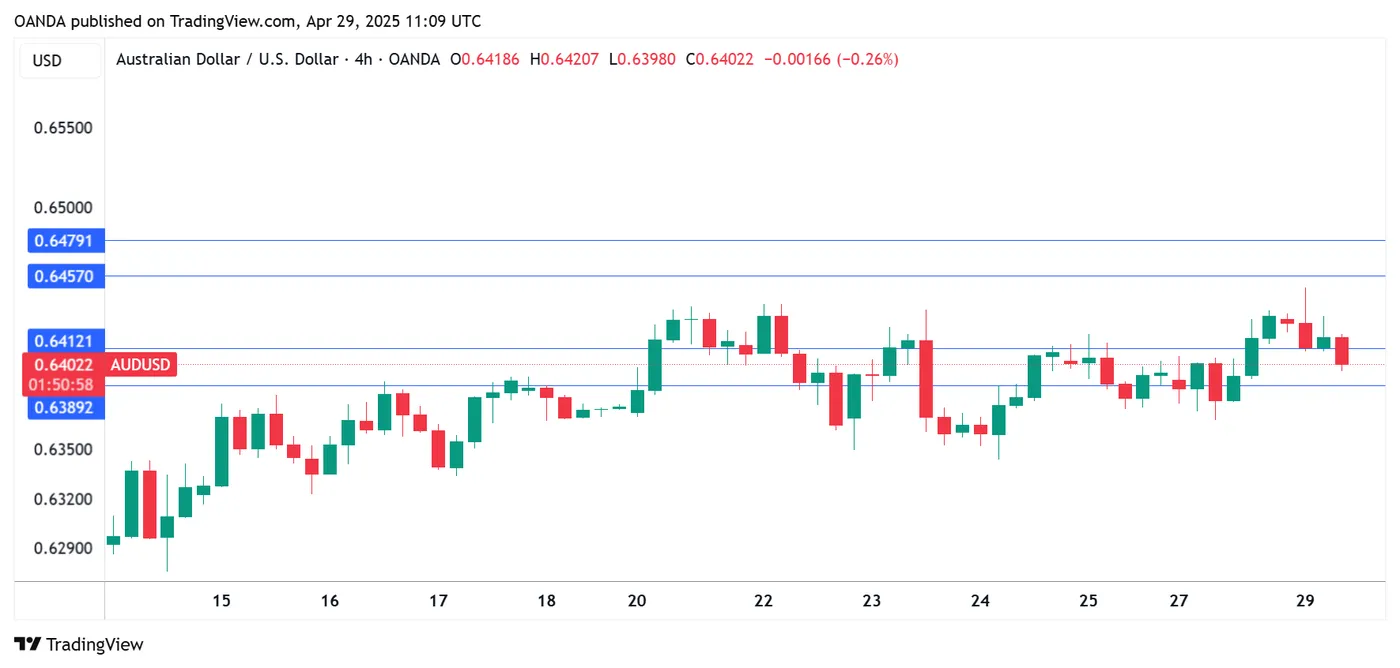
AUDUSD 1-Day Chart, April 29, 2025
Euro Lower, German Consumer Confidence Improves
The euro is slightly lower on Tuesday. In the European session, EUR/USD is trading at 1.1392, down 0.31% on the day.
German consumer climate hits 6-month high
German consumer confidence remains weak but showed some improvement in April, rising to -20.6. This was higher than the revised -24.3 in March and easily beat the market estimate of -26.0. This was the highest reading since Nov. 2024.
Consumers remain anxious about the negative impact of US tariffs but the domestic political situation has stabilized as a new government is taking shape.
Business confidence also improved in April, rising to 86.9 from 86.7 and beating expectations. This was the highest level since July 2024, as the business sector has reacted positively to the government's pledge to increase spending on infrastructure and defense. As with consumers, businesses expressed concern about the escalation in global trade tensions.
Markets eye German inflation, retail sales
Germany releases the April inflation on Wednesday. CPI is expected to remain at 0.4% m/m. Annualized, CPI is projected to ease to 2.1% from 2.3% in March and 2.6% in February. Germany's retail sales are expected to decline by 0.4% m/m in March, after a strong gain of 0.7% a month earlier. A drop in inflation and retail sales would support the case for the European Central Bank continuing lower interest rates.
In the US, the focus will be on employment data in the second half of the week. JOLTS Job Openings, which will be released later today, is expected to ease to 7.48 million from 7.56 million. This would mark a second consecutive deceleration and point to a weakening labor market.
All eyes are on Friday's nonfarm payrolls, which surprised on the upside last month with a gain of 228 thousand, blowing past the forecast of 140 thousand. The market estimate for April nonfarm payrolls stands at 135 thousand.
EUR/USD Technical
- EUR/USD is testing support at 1.1391. Below, there is support at 1.1358
- 1.1454 and 1.1487 are the next resistance lines
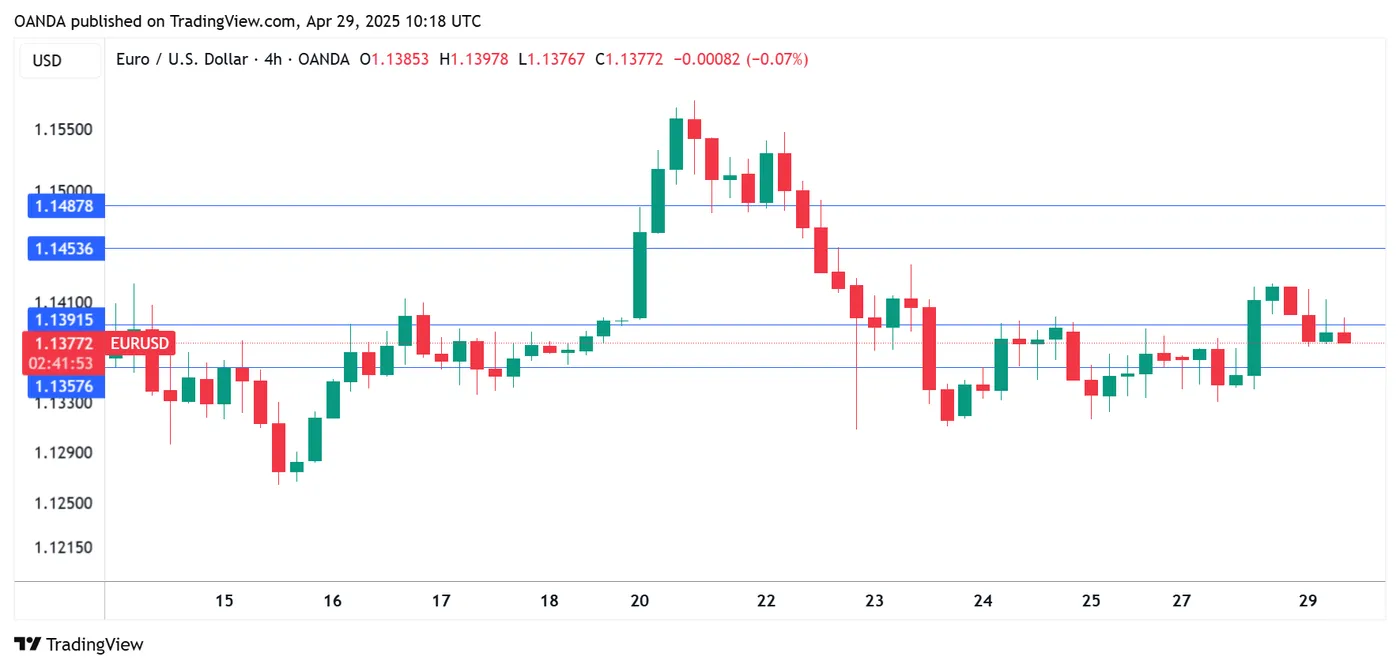
EURUSD 4-Hour Chart, April 29, 2025
USD/JPY: Repeated Upside Rejections Keep Downside at Risk
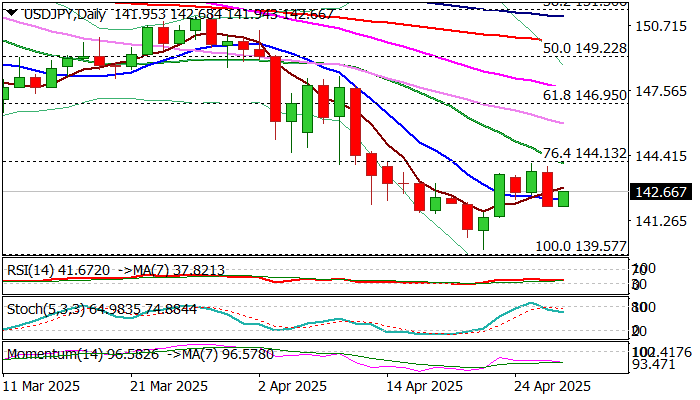
USDJPY edged higher on Tuesday morning after 1.1% drop on Monday which added pressure on the pair, following repeated upside rejection under double Fibo barriers at 144.13/21 (broken 76.4% of 139.57/158.87 / 38.2% of 151.20/139.88).
Strong negative momentum on daily chart and most of MA’s in bearish setup suggest that the downside remains vulnerable and high possibility of recovery stall in play as long as Fibo barriers cap.
Persisting risk of US tariffs is likely to keep the yen supported which would also contribute to scenario of limited or healthy correction before larger downtrend resumes.
Bank of Japan will deliver its policy decision on Thursday, with wide expectations to keep interest rates unchanged, as policymakers want to assess all scenarios caused by impact of tariffs before deciding to modify its monetary policy.
Markets also focus on US April labor report that will be released this week (JOLTS, ADP, NFP) which is expected to provide fresh signals.
Res: 144.13; 144.21; 144.55; 145.00.
Sup: 141.94; 141.42; 140.47; 140.00.
WTI Oil Price Falls Further as Sentiment Sours on Fading Trade Talks
WTI oil holds in red for the second consecutive and fell further on Tuesday as signals stalling US / China trade talks soured the sentiment.
Traders sold oil contracts on growing uncertainty after initial optimism was replaced by fears of escalation of trade war between two world’s biggest oil consumers that would further hurt global oil demand outlook.
The latest OPEC’s decision to further increase oil output from June adds to negative factors, keeping traders in defensive.
Fresh extension lower after recovery from four-year low at $55.12 (Apr 9 low) was repeatedly rejected at the zone of 50% retracement of $72.27/$55.12 bear-leg, broke below Fibo 38.2% retracement of $55.12/$64.85 recovery leg ($61.13).
This generated fresh bearish signal (validation of signal requires daily close below this level) and adds to bearish near-term outlook, as bears eye target at $60.00 (psychological / 50% retracement).
Firm break of $60 trigger to turn near-term picture negative and signal an end of corrective phase.
Conversely, failure to clearly break $61.13 pivot would ease immediate downside risk and keep in play hopes of a healthy correction, although such scenario would require more work at the upside to be validated (lift and close above daily Tenkan-sen at $62.35)
Daily studies are mixed as Tenkan/Kijun-sen are in bearish configuration, but momentum is positive and strengthening, and stochastic at the border of oversold territory.
Markets eye releases of weekly crude stocks reports (API today and EIA on Wednesday) for further signals.
Res: 61.13; 62.35; 62.55; 63.69.
Sup: 60.00; 59.42; 58.84; 57.42.
EUR/USD Turns Neutral as a Flood of Data Awaits
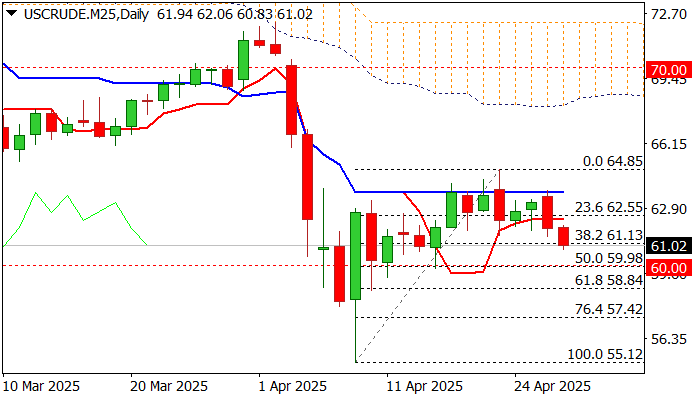
- EURUSD remains range-bound; struggles to close above 1.1415.
- Technical signals have weakened, but some optimism persists.
EURUSD opened the week with moderate gains, as bullish momentum lacked sufficient follow-through to push the price above the upper boundary of the bullish channel near 1.1415.
With the RSI turning lower after peaking in overbought territory and the MACD slipping below its red signal line, the outlook for a decisive rally in the coming sessions appears limited. Still, hopes for another bullish move have not entirely faded, as the stochastic oscillator has just posted a positive crossover near its 20-level oversold area.
A slew of US data, including nonfarm payrolls, along with Eurozone CPI inflation figures, are scheduled for release and could influence market direction.
Sellers may remain on the sidelines as long as the pair trades above the 1.1290–1.1300 support zone. The 20-day simple moving average (SMA) is also approaching this area, while slightly lower, the 1.1175–1.1200 territory may help absorb downside pressure, potentially delaying a drop into the 1.0970–1.1020 region. A continuation below the 50-day SMA could intensify selling, possibly leading to further declines toward the 200-day SMA and a tentative support trendline, both located around the 1.0765–1.0800 area.
On the upside, if the pair breaks above 1.1415, resistance may emerge near the 1.1513 barrier. A successful move beyond this level could lead to a critical test of the former support-turned-resistance line from June 2024, situated around 1.1600. An advance through the 1.1670–1.1700 resistance zone could unlock additional upside momentum toward the next hurdle at 1.1835.
In summary, EURUSD is maintaining a neutral stance in the very short term. A decisive move above 1.1415 or below 1.1290 is needed to clarify the next directional bias.
GBP/USD Hits New High: The Pound Defies Market Pressures
The British pound has reached another three-year peak against the US dollar, stabilising around 1.3400.
Key factors driving GBP/USD strength
Sterling is closing April with its strongest monthly performance since November 2023, gaining over 3% against the US dollar.
Two key factors support the pound’s resilience:
- Monetary policy divergence – Markets expect the Bank of England (BoE) to slow the pace of interest rate cuts compared to other central banks. Current projections suggest the BoE will reduce rates by 85 basis points in 2025, roughly in line with expectations for the US Federal Reserve.
- Dollar alternatives in demand – Investors seek alternatives to the US dollar, and the UK appears less vulnerable to US tariff risks. A 90-day moratorium on increased US tariffs expires in late July, renewing global economic uncertainties.
Against this backdrop, the UK and its currency appear more stable than many peers.
Technical analysis: GBP/USD
H4 chart
- GBP/USD continues to consolidate around 1.3344, with the range now extending to 1.3440.
- A downside retest of 1.3344 is expected, followed by potential upward momentum towards 1.3455, defining the range boundaries.
- A break below consolidation could trigger a downward wave targeting 1.3080 as the initial objective.
- The MACD indicator supports this outlook, with its signal line above zero but poised for a decline.

H1 chart
- The pair has broken above 1.3344, achieving a local target at 1.3440
- A corrective decline towards 1.3344 is anticipated before potential renewed growth towards 1.3455
- The Stochastic oscillator aligns with this scenario, with its signal line below 20 and primed for an upward move towards 80

Conclusion
The pound remains defensive yet strong, buoyed by relative monetary policy stability and its appeal as a dollar alternative. Technically, the pair is testing key levels, with further direction contingent on consolidation breaks.
ECB consumer survey shows inflation expectations ticking higher
ECB’s Consumer Expectations Survey for March showed that consumers are raising their inflation views in a relatively measured manner rather than in a panic. Overall, the results present a slight inflationary concern on one side, but still subdued growth prospects on the other.
Median expectations for inflation over the next 12 months rose by 0.3% to 2.9%, the highest level since April 2024.
Looking further ahead, expectations for inflation three years out edged up by 0.1% to 2.5%, also hitting a one-year high.
Newly introduced five-year inflation expectations remained stable at 2.1%, suggesting longer-term expectations remain relatively anchored.
Uncertainty about the inflation outlook remained at its lowest level since January 2022.
On the broader economic front, the survey indicated that consumers’ income growth expectations stayed unchanged at a modest 1.0% over the next year, while expected nominal spending growth edged down to 3.4%.
Economic growth expectations remained weak, steady at -1.2% for the next 12 months.
AUD/USD Consolidates Gains While NZD/USD Dips
AUD/USD is consolidating gains near the 0.6420 zone. NZD/USD is trimming gains and struggling to stay above the 0.5945 pivot zone.
Important Takeaways for AUD/USD and NZD/USD Analysis Today
- The Aussie Dollar started a downside correction from 0.6450 against the US Dollar.
- There was a break above a key bearish trend line with resistance near 0.6400 on the hourly chart of AUD/USD at FXOpen.
- NZD/USD is declining from the 0.6030 resistance zone.
- There is a major bearish trend line forming with resistance near 0.5970 on the hourly chart of NZD/USD at FXOpen.
AUD/USD Technical Analysis
On the hourly chart of AUD/USD at FXOpen, the pair started a fresh increase from the 0.6345 support. The Aussie Dollar was able to clear the 0.6375 resistance to move into a positive zone against the US Dollar.
There was also a move above the 0.6400 resistance and the 50-hour simple moving average. There was also a break above a key bearish trend line with resistance near 0.6400. Finally, the pair tested the 0.6450 zone. A high was formed near 0.6450 and the pair is now correcting gains.
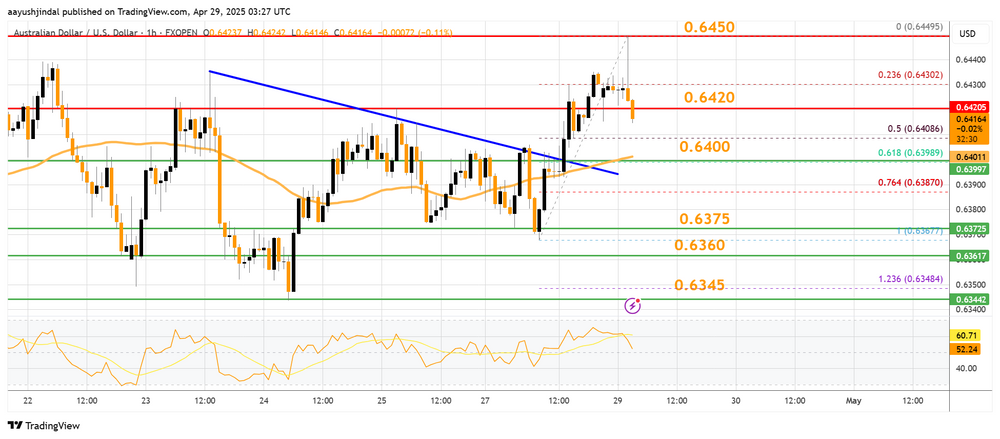
There was a move below the 0.6420 level. The pair declined below the 23.6% Fib retracement level of the upward move from the 0.6367 swing low to the 0.6449 high.
On the downside, initial support is near the 0.6400 level. It is close to the 61.8% Fib retracement level of the upward move from the 0.6367 swing low to the 0.6449 high. The next major support is near the 0.6360 level.
If there is a downside break below the 0.6360 support, the pair could extend its decline toward the 0.6345 level. Any more losses might signal a move toward 0.6300.
On the upside, the AUD/USD chart indicates that the pair is now facing resistance near 0.6420. The first major resistance might be 0.6450. An upside break above the 0.6450 resistance might send the pair further higher.
The next major resistance is near the 0.6485 level. Any more gains could clear the path for a move toward the 0.6550 resistance zone.
NZD/USD Technical Analysis
On the hourly chart of NZD/USD on FXOpen, the pair attempted another wave above the 0.6000 zone but failed. The New Zealand Dollar started another downward move from 0.6000 and dipped below 0.5980 against the US Dollar.
The pair settled below the 0.5970 level and the 50-hour simple moving average. It tested the 0.5930 zone and is currently consolidating losses near the 50% Fib retracement level of the downward move from the 0.6000 swing high to the 0.5928 low.
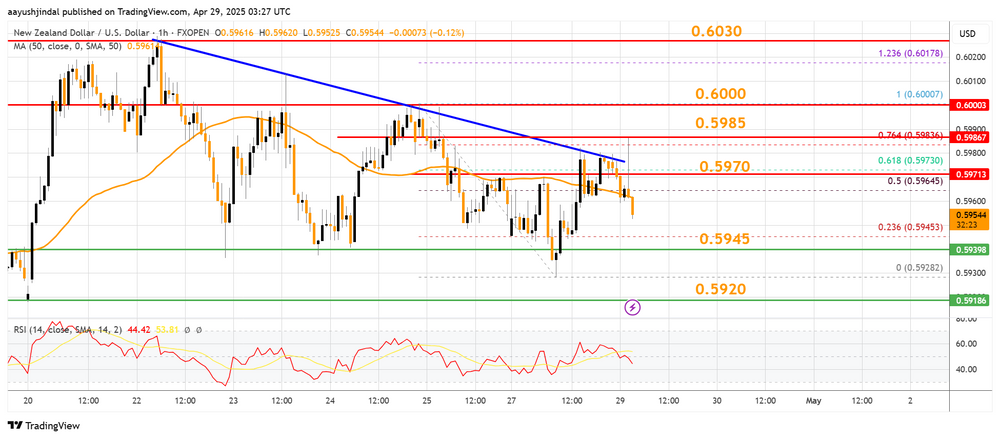
The NZD/USD chart suggests that the RSI is now well below 50 and signaling more downsides. On the downside, there is major support forming near 0.5945.
The next major support is near the 0.5920 level. If there is a downside break below the 0.5920 support, the pair might slide toward the 0.5880 support. Any more losses could lead NZD/USD in a bearish zone to 0.5840.
On the upside, the pair might struggle near 0.5970 and the 61.8% Fib retracement level of the downward move from the 0.6000 swing high to the 0.5928 low.
There is also a major bearish trend line forming with resistance near 0.5970. The next major resistance is near the 0.5985 level. A clear move above the 0.5985 level might even push the pair toward the 0.6000 level. Any more gains might clear the path for a move toward the 0.6030 resistance zone in the coming days.
Trade over 50 forex markets 24 hours a day with FXOpen. Take advantage of low commissions, deep liquidity, and spreads from 0.0 pips. Open your FXOpen account now or learn more about trading forex with FXOpen.
This article represents the opinion of the Companies operating under the FXOpen brand only. It is not to be construed as an offer, solicitation, or recommendation with respect to products and services provided by the Companies operating under the FXOpen brand, nor is it to be considered financial advice.
ECB’s Cipollone warns trade fragmentation could severely hit global and Eurozone growth
ECB Executive Board member Piero Cipollone warned today that the recent surge in trade policy uncertainty poses a material risk to Eurozone growth. In a speech, he highlighted internal ECB research suggesting that rising uncertainty could trim Eurozone business investment by -1.1% in the first year, while real GDP growth could fall by about -0.2% in 2025-26.
Financial market volatility, elevated due to the global trade tensions, could further drag on growth. ECB staff estimate that the observed increase in volatility alone could shave an additional -0.2% off Eurozone GDP in 2025.
Cipollone emphasized that over the medium term, tariffs will have an "unambiguously recessionary effect" across both economies imposing and receiving restrictions, and noted that the ability of exchange rates to "absorb tariff shocks" appears to have diminished.
ECB’s analysis of fragmentation scenarios paints an even bleaker picture. In a mild East-West decoupling, global output could drop by nearly -2%. In a severe decoupling where trade between blocs halts entirely, global output could plunge by up to -9%.
Trade-dependent economies would bear the heaviest losses, with the EU facing a GDP decline of between -2.4% and -9.5% depending on the severity. Notably, the US itself could suffer a near -11% contraction in the most extreme case if it "imposed additional trade restrictions against western and neutral economies".
While the growth impact of trade fragmentation is clear, the inflationary effects remain less certain. For the Eurozone, recessionary forces, stronger real interest rates, and Euro appreciation could generate a "disinflationary: trend in the near to medium term.
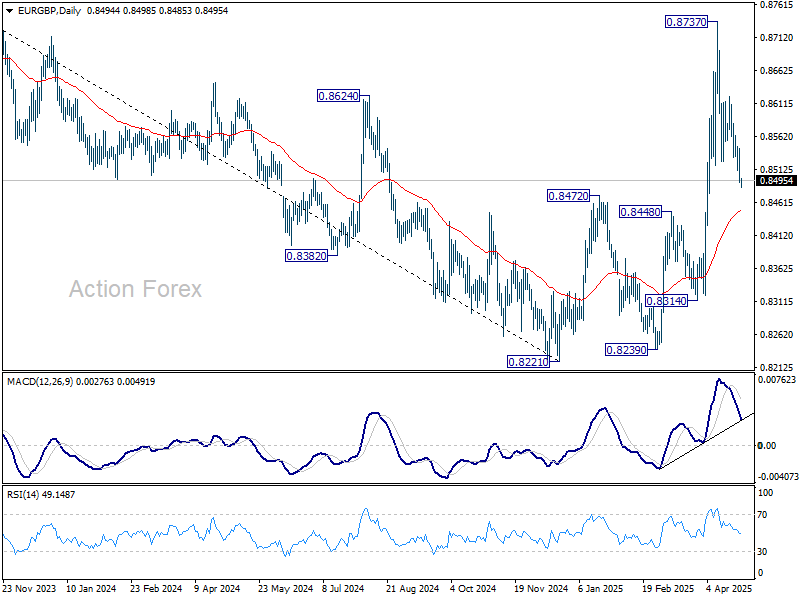
EUR/GBP Daily Outlook
Daily Pivots: (S1) 0.8478; (P) 0.8512; (R1) 0.8529; More...
EUR/GBP's break of 0.8737 suggests that deeper pullback is underway. Intraday bias is back on the downside for 55 D EMA (now at 0.8448). Sustained break there will argue that whole rebound from 0.8221 has completed and turn near term outlook bearish. On the upside, though, break of 0.8622 resistance will bring retest of 0.8737.
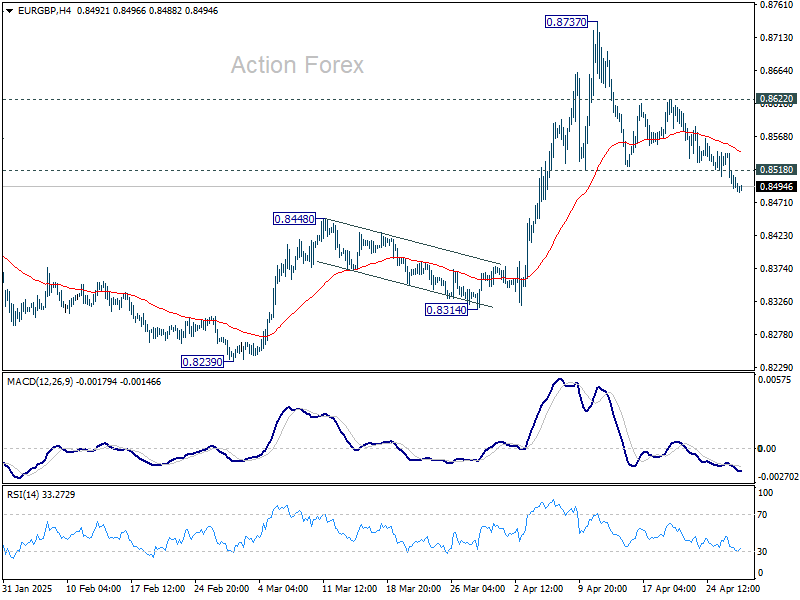
In the bigger picture, down trend from 0.9267 (2022 high) should have completed at 0.8221, just ahead of 0.9201 key support (2024 low). Rise from 0.8221 is likely reversing the whole fall. Further rise should be seen to 61.8% retracement of 0.9267 to 0.8221 at 0.8867 next. This will remain the favored case as long as 0.8472 resistance turned support holds.