Sample Category Title
RBI Keeps Policy Steady In A Surprise Move, Italy Officials Keep Up Anti-EU Rhetoric
Notes/Observations
- Focus on US jobs report in the aftermath of a strong ADP private payrolls data and a record-high ISM manufacturing survey this week
- Swiss inflation data misses expectations and remains ultra low; keeps SNB in no rush to hike rates
- Germany Aug Factory Orders beats expectations
- Anti-EU rhetoric by Italy Dep PM Salvini pushes BTP yields higher RBI keeps policy steady in a surprise hold but changes stance from neutral to calibrated tightening; INR currency stays near record lows
Asia:
- Australia Aug Retail sales registers a small beat (MoM: 0.3% v 0.2%e)
- Japan Aug Household Spending saw its largest rise since 2015 (YoY: 2.8% v 0.1%e)
- Bank of Japan (BOJ) Quarterly Public Opinion of Household Sentiment was unchanged q/q: Households saw 3% inflation in 1-year and 2% inflation in 5-years' time
- South Korea Sept CPI saw its highest annual pace since Sept 2017 and opens the door for a another rate hike
Europe:
- Italy govt draft 2019 fiscal plan hoped for open, constructive dialogue over budget. Cuts 2018 GDP growth forecast from 1.5% to 1.2% and forecasted 2019 GDP growth at 1.5%, 2020 growth at 1.6% and 2021 growth at 1.4%. Targeted its budget deficit-to-GDP at 1.8% in 2018 and a structural deficit of 1.7% of GDP for 3-years.
- ECB's Coeure (France): ECB was seeing a gradual buildup in price pressures. ECB policy should remain accommodative with rates low as need a little more time to stabilize inflation around 2% target
- France stats agency INSEE cuts 2018 GDP growth outlook from 1.7% to 1.6%
Americas
- US Senate judiciary chairman Grassley: Kavanaugh should be confirmed to supreme court on Saturday; Kavanaugh confirmation process was fair, thorough
- US Senate Republican Corker stated that he planned to vote for Kavanaugh for supreme court
Macro
- (GE) Germany: Factory orders increased 2.0% m/m in August, following two months of contraction, with export orders finally rebounding after falling in the prior two months. Ongoing contraction in orders from the rest of the Eurozone though, and a drop in domestic orders suggest that conditions are not improving. Confidence indicators are not showing a major recovery in export orders and most recent manufacturing PMI's have pointed to slowing growth ahead.
- (GE) Germany: PPI inflation increased to 3.1% y/y as energy price inflation continues to drive prices higher. Destatis reported that energy price inflation jumped 7.3% y/y in August, the highest rate since December 2011. Light heating oil prices were up 34.5% y/y, aviation industry fuel 44.3% y/y and petrol prices increased in double digits. Electricity prices also increased 7.9%. These price increases won't impact core inflation rates, but will feed through the product chain and eventually impact real disposable income and subsequently consumption trends further down the line.
- (UK) United Kingdom: Halifax measure of house prices unexpectedly fell -1.4% m/m in September following a revision to a -0.2% decline in August. This translated into a Q3 increase of 1.8 %, unchanged from the rate for the three months to July but reduced annual inflation over the same period from 3.7 %to 2.5 %, its lowest print since June. Still supply remains very tight and stock of homes available for sale remains close to record lows which should underpin prices.
SPEAKERS/FIXED INCOME/FX/COMMODITIES/ERRATUM
- Indices [Stoxx600 -0.7% at 377.2, FTSE -0.8% at 7359, DAX -0.8% at 12142, CAC-40 -0.5% at 5385, IBEX-35 -0.5% at 9264, FTSE MIB -0.9% at 20438, SMI -0.5% at 9053, S&P 500 Futures -0.2%]
- Market Focal Points/Key Themes: European Indices trade lower across the board continuing the downtrend of late as yields continue to rise with Gilt Yields reaching a 22 month high, while Sterling reached a month high against the Euro. UK Commerical Real Estate stocks outperform after Brookfield Property Group is said to consider a takeover of Intu, with Hammerson, British Land and Land Sec all rising in sympathy. Shares of Stratec medical and PQR and Spain fall sharply after profit warnings, with Wessanen and Scout 24 also declining after analyst downgrades. Danske Bank continues its downward trajectory after reports of up to €8.5B mirror trades for Russia. In the US shares of Costco trades under pressure in the premarket after reporting a Q4 Rev miss; Tesla falls after further tweets from Elon Musk seeming to take aim at the SEC only days after he had settled fraud claims.
Equities
- Consumer discretionary: Scout 24 [G24.DE] -6.8% (Analyst downgrade), Wessanen [WES.NL] -13.5% (Analyst downgrade), Motorpoint [MTOR.UK] +4.1% (Trading update)
- Financials: Danske Bank [DANSKE.DK] -9% (Reports of up to €8.5B mirror trades for Russia customers, Analyst downgrade)
- Industrials: EMS Chemie [EMSN.CH] -1.8% (Earnings)
- Healthcare: Scratec Medical [SBS.DE] -27% (Cuts outlook)
- Real Estate: Intu Properties [INTU.UK] +29% ( Brookfield consortium confirms possible bid), Land Securities [LAND.UK] +2.8%, Hammerson [HMSO.UK] +4.0%, British Land [BLND.UK] +1.8% (In sympathy with Intu Properties)
Speakers
- EU Brexit negotiators said to believe that an agreement with Britain was 'very close'
- ECB's De Cos (Spain): Non-performing loans (NPLs) have declined significantly and should continue to do so as domestic economy grew rise in US yields has entered a new phase
- Italy Interior min Salvini (Dep PM): Juncker, Moscovici have 'ruined Europe':
- UK Govt official Lidington (de facto Dep PM): Position on Gibraltar sovereignty will not change
- Italy Stats Agency (ISTAT) Monthly Economic Note saw the domestic economy slowing in coming months
- Czech Central Bank Sept Minutes noted that the vote was not unanimous to hike by 25bps with dissenter (Dedek) seeking steady rates. Board noted that some caution was warranted on its next steps. Board gave preference to smaller gradual steps. It debated and decided against a 50bps hike. CZK currency (Crown) could begin strengthening relatively quickly after financial markets calm down
- India Central Bank (RBI) Policy Statement changed its policy stance from neutral to calibrated tightening. To keep close vigil on inflation outlook for the coming months as outlook was clouded with several uncertainties
Currencies
- USD was maintaining a constructive firm tone ahead of the US payroll data with the greenback at 10-week highs against some pairs as rise in US yields has entered a new phase.
- EUR/USD holding around the 1.15 handle with analysts noting that the details of the Italian draft budget were emerging and they're not good. Anti-EU rhetoric by Italy Dep PM Salvini was a headwind for the Euro and helped to Italian 10-year yields to rise over 5bps
- GBP/USD held above the 1.30 level as EU Brexit negotiators were said to believe that an agreement with Britain was 'very close'
- USD/JPY remained below the 114 level after testing above it earlier in the week due to higher US Treasury rates
- USD/INR (rupee) was near record lows above the 74 handle after RBI kept its policy steady in a surprise hold. RBI did change its policys stance from neutral to calibrated tightening
Fixed Income
- Bund Futures trades at 158.02 down 2 ticks as the 10-year Bund continues to move further away from 0.50% level. A downside break of 157.25 sees 155.69 initially. To the upside 158.50 remains initial resistance.
- Gilt futures trades at 120.12 down 77 ticks following the move in Treasuries. Continued support at 120.50, with a continued move higher targeting 123.93 then 124.00.
- Friday's liquidity report showed Thursday's excess liquidity rose from €1.889T to €1.8T. Use of the marginal lending facility stayed fell from €88M to €M.
- Corporate issuance saw primary pace slow, earlier on Tuesday, Comcast sold $27B in bonds in the second biggest deal of the year; Lipper fund flows IG saw $1.2B inflows; High Yield had $1.4B inflows
Economic Data:
- (DE) Germany Aug Factory Orders M/M: 2.0% v 0.8%e; Y/Y: -2.1% v -3.0%e
- (DE) Germany Aug PPI M/M: 0.3% v 0.2%e; Y/Y: 3.1% v 2.9%e
- (ZA) South Africa Sept Gross Reserves: $50.4B v $49.8B prior; Net Reserves: $42.2B v $42.3Be
- (DK) Denmark Aug Industrial Production M/M: -1.2% v -0.8%
- (FR) France Aug Trade Balance: -€5.6B v -€4.9Be
- (FR) France Aug YTD Budget Balance: -€97.3B v -€82.8B prior
- (FR) France Aug Current Account: -€1.6B v +€0.3B prior
- (CH) Swiss Sept Foreign Currency Reserves (CHF): 739.7B v 730.8B prior
- (ES) Spain Aug Industrial Output NSA Y/Y: 1.2% v 3.6% prior; Industrial Output SA Y/Y: 1.2% v 0.5%e, Industrial Production M/M: 0.7% v 0.7%e
- (HU) Hungary Aug Industrial Production M/M: 3.8% v 3.8%e; Y/Y: 4.5% v 3.5%e
- (MY) Malaysia End- Sept Foreign Reserves: $103.0B v $103.9B prior
- (CH) Swiss Sept CPI M/M: 0.1% v 0.2%e; Y/Y: 1.0% v 1.1%e
- (CH) Swiss Sept CPI EU Harmonized M/M: 0.0% v 0.0% prior; Y/Y: 1.1 v 1.3% prior
- (UK) Sept Halifax House Prices M/M: -1.4% v +0.2%e; 3M/Y: 2.3% v 3.4%e
- (SE) Sweden Aug Private Sector Production M/M: 0.3% v 0.5%e; Y/Y: 2.3% v 3.1%e
- (SE) Sweden Aug Industrial Orders M/M: -4.9% v +10.0% prior; Y/Y: 2.0% v 8.4% prior
- (SE) Sweden Aug Industry Production Value Y/Y: 2.9% v 5.0%e, Service Production Value Y/Y: 3.2% v 2.8% prior
- (SE) Sweden Sept Budget Balance (SEK): 6.7B v 24.9B prior
- (TW) Taiwan Sept CPI Y/Y: 1.7% v 1.8%e; CPI Core Y/Y: 1.2% v 1.5%e; WPI Y/Y: 6.6% v 6.9% prior
- (IT) Italy Aug Retail Sales M/M: 0.7% v 0.1%e; Y/Y: 2.2% v 0.2%e
- (RU) Russia Narrow Money Supply w/e Sept 28th: 10.29T v 10.41T prior
- (TW) Taiwan Sept Foreign Reserves: $460.4B v $459.9B prior
- (UK) Q2 Unit Labor Costs Y/Y: 2.0 v 2.7% prior
- (IN) India Central Bank (RBI) left the Repurchase Rate unchanged at 6.50% (not expected)
Fixed Income Issuance
- (IN) India sold total INR110B vs. IBR110B indicated in 2020, 2026, 2031, 2034 and 2045 bonds
Looking Ahead
- (IT) Bank of Italy (BOI) Aug Balance sheet aggregates
- 05:30 (ZA) South Africa to sell ZAR600M in I/ L bonds - 05:35 (NL) ECB's Knot (Netherlands)
- 06:00 (IE) Ireland Aug Industrial Production M/M: No est v 2.9% prior; Y/Y: No est v -5.4% prior
- 06:00 (UK) DMO to sell €4.0B in 1-month, 3-month and 6-month bills (£0.5B, £2.0B and £1.5B respectively)
- 06:45 (ES) ECB's De Guindos (Spain) - 06:45 (US) Daily Libor Fixing
- 07:30 (CL) Chile Aug Economic Activity Index (monthly GDP) M/M: 0.1%e v 0.2% prior; Y/Y: 3.4%e v 3.3% prior, Economic Activity (ex-mining) Y/Y: No est v 3.8% prior
- 07:30 (IN) India Weekly Forex Reserves
- 08:00 (BR) Brazil Sept IBGE Inflation IPCA M/M: +0.4%e v -0.1% prior; Y/Y: 4.5%e v 4.2% prior
- 08:00 (CL) Chile Aug Nominal Wage M/M: No est v 0.5% prior; Y/Y: No est v 2.6% prior
- 08:00 (PL) Poland Sept Official Reserves: No est v $113.3B prior
- 08:00 (IN) India announces upcoming bill issuance (held on Wed)
- 08:15 (UK) Baltic Dry Bulk Index
- 08:30 (US) Sept Change in Nonfarm Payrolls: +185Ke v +201K prior, Private Payrolls: +180Ke v +204K prior, Manufacturing Payrolls: +15Ke v -3K prior
- 08:30 (US) Sept Unemployment Rate: 3.8%e v 3.9% prior; Underemployment rate: No est v 7.4% prior
- 08:30 (US) Sept Average Hourly Earnings M/M: 0.3%e v 0.4% prior; Y/Y: 2.8%e v 2.9% prior; Average Weekly Hours: 34.5e v 34.5 prior
- 08:30 (US) Aug Trade Balance: -$53.5Be v -$50.1B prior
- 08:30 (CA) Canada Sept Net Change in Employment: +25.0Ke v -51.6K prior; Unemployment Rate: 5.9%e v 6.0% prior
- 08:30 (CA) Canada Aug Int'l Merchandise Trade (CAD): -0.5Be v -0.1B prior
- 09:00 (MX) Mexico July Gross Fixed Investment: 7.0%e v 1.4% prior
- 09:00 (RU) Russia Sept Official Reserve Assets: $462.0Be v $460.6B prior
- 10:30 (TR) Turkey Sept Cash Budget Balance (TUR): No est v -3.7B prior
- 11:00 (CO) Colombia Aug Exports: $3.7Be v $3.6B prior
- 11:00 (EU) Potential Sovereign ratings after European close (S&P on France; Moody's on Ireland and Spain; Fitch on Estonia)
- 12:30 (US) Fed's Kaplan (non-noter, dove)
- 12:40 (US) Fed's Bostic (voter, dove)
- 13:00 (US) Weekly Baker Hughes Rig Count data
- 14:00 (CO) Colombia Central Bank Sept Minutes
- 15:00 (US) Aug Consumer Credit: $15.0Be v $16.6B prior
- 15:00 (MX) Mexico Citibanamex Survey of Economists
- 20:00 (CO) Colombia Sept CPI M/M: 0.2%e v 0.1% prior; Y/Y: 3.2%e v 3.1% prior, CPI Core M/M: No est v 0.2% prior; Y/Y: No est v 3.8% prior
NFP – What To Expect
Friday October 5: Five things the market is talking about
The granddaddy of economic indicators – U.S non-farm payrolls (NFP) for September – will be released later this morning (8:30 am EDT) along with the Canadian jobs report.
Today’s U.S number is ‘big,’ especially with this week’s aggressive backing up of the U.S yield curve. The sell-off in Treasuries, in part, has been justified by U.S data supporting the strength of their economy and the markets future inflation fears.
This morning’s payrolls headline print, coupled with wage growth numbers, will provide substance to what investors should expect, from an interest rate perspective in particular. Does the Fed’s dot-plot line up neatly or will the Fed push its benchmark past the neutral level?
Consensus is looking for a September headline print of +185K new jobs and an unemployment rate to ease another one-tenth to +3.8%. However, expect dealers to look beyond the headline and focus intently on the increase in average hourly earnings.
The August wage growth print at +2.9% was the largest y/y gain in nearly a decade. If September’s number comes in even stronger, will justify some dealers fears that inflation pressures are building, maybe faster than originally perceived.
Current expectations for wage growth m/m are +0.3%, which would equate to approximately +2.8% y/y.
1. Stocks mixed reactions ahead of payrolls
Euro equities are struggling for traction after the Asian session ended the week with a further sell-off overnight as the region’s tech companies were battered by concerns about their U.S business.
In Japan, the Nikkei fell to its lowest close in a fortnight, tracking Wall Street’s slide yesterday as rising U.S Treasury yields have reduced the attraction of most stocks except financial ones. The Nikkei share average ended -0.8%, while the broader Topix dropped -0.5%.
Down-under, Aussie shares edged higher on Friday, supported by gains from the financial sector, which managed to advance for a second session. The S&P/ASX 200 index closed +0.2% higher. The benchmark is off -0.4% for the week. In S. Korea, Kospi stock index also ended lower this morning (-0.31%) on fears of foreign fund outflows after U.S yields surged to a new seven-year high.
Note: China’s financial markets are closed for the National Day holiday and will resume trade on Oct. 8.
In Hong Kong, stocks fell for a fourth consecutive session, dragged by a selloff in tech stocks on fears that these companies will be the latest casualties in the Sino-U.S trade war. The Hang Seng Index was down -0.42%.
In Europe, regional bourses trade lower across the board, pressured by rising sovereign yields. Investors will take their cue from this mornings N. American employment reports.
U.S stocks are set to open in the ‘red’ (-0.2%).
Indices: Stoxx600 -0.7% at 377.2, FTSE -0.8% at 7359, DAX -0.8% at 12142, CAC-40 -0.5% at 5385, IBEX-35 -0.5% at 9264, FTSE MIB -0.9% at 20438, SMI -0.5% at 9053, S&P 500 Futures -0.2%
2. Oil prices rise on Iran sanctions, gold little changed
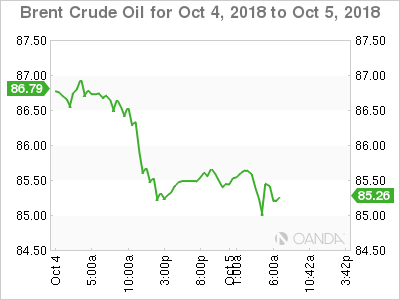
Oil prices trade atop of their four-year highs this morning as traders predict a tighter market due to U.S sanctions on Iran’s crude exports.
Brent crude oil is up +10c a barrel at +$84.68. Yesterday, Brent fell by -$1.34 a barrel or -1.6% – the contract is on course for a gain of +2.5% on the week. U.S light crude is up +30c at +$74.63, a gain of +2% on the week.
The market remains very ‘bullish’ with speculators gunning for $100 a barrel on fears that the U.S demands for an Iran oil embargo will create a significant supply shortfall.
Both benchmarks retreated yesterday following a rise in U.S oil indicated that they would raise output, however, pullbacks have been aggressively bought.
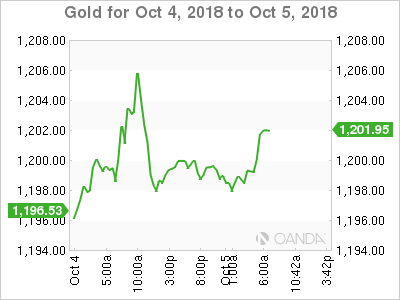
Ahead of the U.S open, gold prices are little changed as the market remains cautious after U.S Treasury yields hit seven year high yesterday and on expectations that a strong U.S payrolls report could boost the Fed case for a tighter monetary policy. Spot gold has inched down -0.1% to +$1,197.64 an ounce, while U.S gold futures are flat at $1,201.3 an ounce.
3. Reserve Bank of India (RBI) surprises
The RBI kept its policy steady in a surprise hold this morning, but changes its stance from “neutral” to “calibrated” tightening.
The central bank left the Reverse Repo Rate (RRR) unchanged at +6.25% (not expected) and the Cash Reserve Ratio (CRR) at +4.00% (as expected).
It’s the first pause in three-decisions in the current tightening cycle. Governor Patel is to keep a ‘close vigil’ on inflation outlook for the coming months, as the outlook is clouded with several uncertainties. He indicated that the benefits of a weaker INR currency would become somewhat muted from a slowdown in global trade and escalating tariff war.
INR stays near record lows as the ‘big’ dollar hit a fresh record high of $74.05 vs. $73.65 before the statement.
The euro area bond market is heading for its worst week in five-months, with fears about tighter central bank monetary policy and strong U.S economic data will push borrowing costs to new highs.
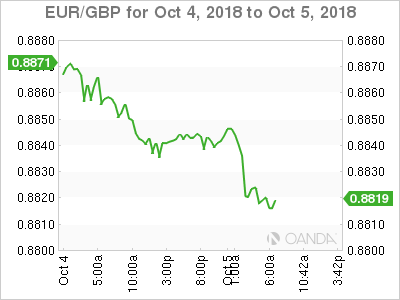
Germany’s 10-year Bund yield has gained +2 bps to +0.55%. In the U.K, the 10-year Gilt yield has climbed +3 bps to +1.697%, the highest in almost three-years. While further anti-E.U. rhetoric by Italy’s Deputy PM Salvini is again pushing BTP yields higher. Italy’s 10-year yield has jumped +3 bps to +3.363%.
4. Dollar remains strong ahead of payrolls
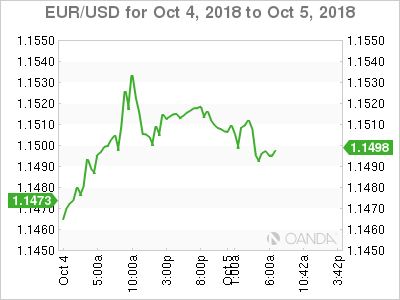
The ‘big’ dollar is maintaining a firm tone, trading atop of its three-month high, against G10 currency pairs ahead of this morning’s NFP print.
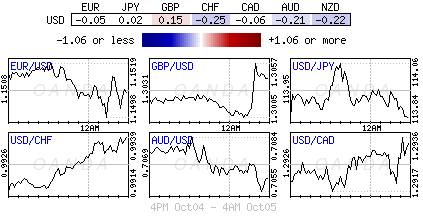
EUR/USD (€1.1497) remains within striking distance of this week’s low outright. Italian anti-E.U rhetoric coupled disappointing Italian draft budget details is again providing EUR ‘bears’ with further ammo.
GBP/USD (£1.3034) is holding above the psychological £1.30 handle as EU Brexit negotiators were said to believe that an agreement with Britain was ‘very close.’
USD/JPY (¥113.88) remained below the ¥114 level after testing above it earlier in the week due to higher U.S Treasury rates.
5 German factory orders
Data this morning showed that factory orders in Germany rose strongly in August after two months of declines, boosted by strong foreign demand from outside the eurozone.
Orders, seasonally adjusted, rose +2% m/m. That follows a -0.9% drop in July and a -3.9% drop in June.
Note: Orders are still down -2.1% on the year, however, current data would suggest solid German growth has appeared in H2, 2018.
Digging deeper, domestic orders dropped -2.9% in August, but that was offset by a +5.8% rise in foreign orders.
Foreign orders from countries using the EUR dropped -2.2%, but those from non-eurozone countries rose +11.1%.
US Interest Climbs
US interest climbs
Analysts are attributing the increase to a strong US economy, hawkish Fed comments, technical factors or even possible demand for return premia. Yet, significant corporate issuance, higher dollar funding basis and even mortgage convexity hedging issues could all have pushed the curve. Given the expected heavy US issuances between sovereign and corporate we suspect that markets are getting crowded and solid US data just provided a push.
The Fed has softened its language around estimates of neutral rate, which has given the market room to re-forecast key levels. The rise in rates is not just a US phenomenon. European yields have general kept pace. The correlation between US yield and USD and equities will eventually turn negative. Higher interest rates (US 10-year yields around 3.50%) also pressure financial conditions, which should weigh on stock valuations. Historically, equities do not rise in harmony with rates. Perhaps this is why we see the S&P 500 falling.
Mexico holds
The Bank of Mexico held its overnight rate at 7.75%, as expected. The trade deal between Mexico, Canada and US and higher interest rate yields suggest we should see further improvement in MXN. The next inflation read will be critical in forecasting Banxico’s next move.
US economy healthy
Markets expect the USA unemployment rate to have eased to 3.8% in September. Non-Farm payrolls should have eased to 185,000 from 204,000 in the previous month. Average hourly earnings are expected to have edged down to 2.8% from 2.9% in August. All indicators have been on green in the job market.
Unemployment is at its lowest level since the millennium. Inflation has been moving in the right direction. This goldilocks scenario has allowed the Federal Reserve to hike interest rates eight times over the last three years. According to the latest projections, this cycle would most likely stop in 2020. By then the Fed funds rate would reach around 3.4%. So what will drive exchange rates? The US dollar has had a nice ride since the beginning of the year but has been unable to extend gains despite widening interest rate differential against most of its currency peers. One can argue that the Federal Reserve’s balance sheet unwinding will become the main driver for the buck, but we believe that developments in the job market and inflation will remain key drivers.
Could US Jobs Data Trigger Another Pop In Yields?
- US jobs report could add to abundance of positive data this week;
- Higher rates raise more concerns for emerging markets
- Was Amazon commitment on wages a sign of an end to low earnings growth?
- GBP jumps on EU optimism of a Brexit deal.
Equity markets are trading in the red again on Friday, with bond yields continuing to edge higher as investors price in a more aggressive tightening from the Federal Reserve and possibly others.
There's been an abundance of strong data points out from the US this week which strongly supports the view that the economy is booming at the moment. Combined with comments earlier in the week from Fed Chairman Jerome Powell, all of this points to higher interest rates for the US – much to the fury, I'm sure, of President Donald Trump – and this is quickly being reflected in the bond markets.
Perhaps there is an element of overly aggressive knee jerk reactions occurring here and possibly even some stops being triggered along the way, further exacerbating the problem, but this is taking its toll on stock markets. That may be a reflection of some portfolio rebalancing or a natural response to rapid increases in yields prompting some profit taking, but we are seeing further declines in Europe and Asia already and US futures are also a tad lower.
The sell-off in commodity stocks is playing a big part of the declines, which may simply be a reflection of the risk-off tone or concerns about growth in emerging markets given the growing number of countries that are coming under the spotlight for all the wrong reasons – with India attracting particular attention this week. There has long been concerns about the impact of US rate hikes on the region but until it starts to drag more on the global economy or offer a much greater risk for the US, I don't expect it to deter the Fed from going about its business.
The US jobs report today may offer another opportunity for traders to get excited about higher interest rates and trigger another wave of selling, with expectations ahead the release being quite high. The ADP number on Wednesday did nothing to temper expectations and if we get an NFP number in line with that, combined with another drop in the unemployment – taking it to an 18 and a half year low – we could see further gains for the dollar and perhaps a little more risk aversion into the weekend.
As always though, the most important number in the release will be the earnings number given that a tight labour market without wage growth raises significant questions about hidden slack in the economy. In a week in which Amazon has promised to raise its minimum wage and urged others to follow though, we may not have to wait long for that to follow and I think a wage growth number starting with a three – not happened since before the financial crisis - could get people quite excited.
In the UK, we were given some reasons to be optimistic this morning – albeit mildly – following reports that a member of EU negotiator Michel Barnier's team claimed a divorce deal is very close. Traders have become very sensitive to reported comments on the progress of negotiations and while this morning's response was a little smaller than what we've seen previously, it was enough to drive the pound significantly above 1.30 against the dollar and hold there, for now.
With time fast running out, the optimist – and, I hope, realist – in me thinks we should start to hear some positive news on a compromise quite soon as a no deal Brexit is in no one's best interest, even if the UK would be much worse off in that scenario. How that agreement will look and whether we should prepare for other obstacles once such a deal reaches the parliament stage is another thing. For now, the pound is responding very positively to good Brexit news and unless talks take a dramatic turn for the worse, it may be well supported as we near the eleventh hour deal negotiators love to embrace.
Stagflation? Growth Slows, While Inflation Pushes Higher
Key points
- Global growth is slowing…
- …but inflation pressure is rising
- US bond yields at new high
- Italy reignites debt crisis fears
- Trump closes deal with Canada and Mexico but likely to escalate versus China
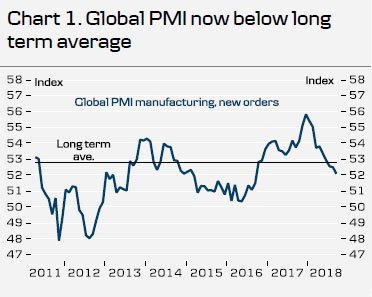
Global growth continues to slow. Global PMI for September showed another drop, pointing to further slowing of the global economy (Chart 1). The weakness was most pronounced in the euro area and China. The US is still a pillar of growth but it is also pretty much the only region with robust activity. This most likely reflects the big fiscal boost this year that has lifted both investment and consumer spending. We expect global growth to stabilise soon and continue at cruising speed. The euro area is set to bottom out and despite the US-China trade war, we believe both monetary and fiscal easing in China will serve as a cushion to growth. We expect US growth rates to slow down from the 4+% in Q2 but to remain above trend over the next year.
Inflation pressures rising. Despite slower growth, we have witnessed rising inflation pressure over the past months. The oil price is pushed higher as Iran oil exports are hit by US sanctions. In addition, the labour markets in the US, the euro area and Japan are getting tighter, thereby pushing up wage growth. As unemployment falls further, this trend is set to continue.
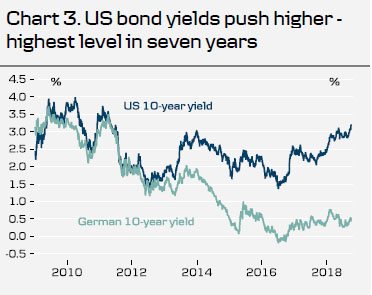
US bond yields at new cycle high, the Fed on autopilot. The robust US economy and rising inflation pressure led to a new high in US bond yields this week. The 10-year treasury yield rose sharply on Wednesday and increased to 3.23%, the highest level in seven years (Chart 3). Fed chair Jerome Power this week continued to signal that policy rates are more or less on autopilot in the coming quarters until the long-term neutral rate around 3% is reached in mid-2019. In an interview, he said, ‘interest rates are still accommodative, but we're gradually moving to a place where they will be neutral', see CNBC. The surge in bond yields put pressure on the stock markets on Thursday.
Italy reigniting fears in the bond markets. Italy put itself in the limelight again as the initial budget proposal pointed to a 2.4% budget deficit over the next three years – much higher than expectations. It led to a big sell-off in the Italian bond market, which took the bond yield spread to Germany to a five-year high at 3 percentage points (Chart 4). The EUR also took a hit. During the week, the Italian government signalled that the deficit for 2020 and 2021 would be 2.1% and 1.8%, respectively, which led to some relief in the market, see Bloomberg. However, bond yields are still at elevated levels signalling a fear that Italy could get on an unsustainable debt path and face downgrades. Part of the concern is that the government is much too optimistic in its growth assumptions (rumoured to be 1.6% versus a rate currently around 1.0%). A failure to realise the assumed growth rates could push the deficit above the EU's 3% limit. On the positive side, there is so far limited contagion to other markets such as the Spanish bond market or the credit market. 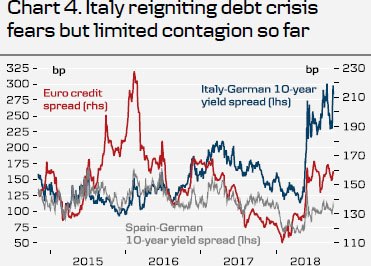
Trump closes trade deal with Canada and Mexico but likely to escalate versus China. US President Donald Trump finally closed the deal with Canada leading to the new USMCA agreement, which replaces the old NAFTA deal. Trump called it ‘the most important trade deal we've made so far'. While Trump is getting a win out of it in the short term, it may backfire in the end. President of the Canadian Chamber of Commerce, Perrin Beatty, thus said ‘Canada must remember the lesson this turbulent period has provided: we must never again allow ourselves to be overly dependent on one trading partner'. A similar lesson is learnt in China. Hence, countries may now start to diversify their trade away from the US. Similarly, many countries have signalled a wish to reduce the dependence on the USD, as it gives the US a powerful instrument to put pressure on other countries to follow its line. It is an instrument that no one expected would be used but now the fear about too much dependency on the US economically and financially has grown. China's President has also stated clearly that China will need to be more selfsufficient and maybe that is not a bad thing, see SCMP. Speaking of China, the remaining big battle on the trade front is between US and China. It is a much bigger challenge, though, and we see a high risk of more escalation with US tariffs on all Chinese imports next year. Eventually it will hurt both countries, though, and a deal should be reached during 2019.
USDJPY Outlook: Bulls In Play Above 200WMA, US NFP Data To Provide Fresh Direction Signal
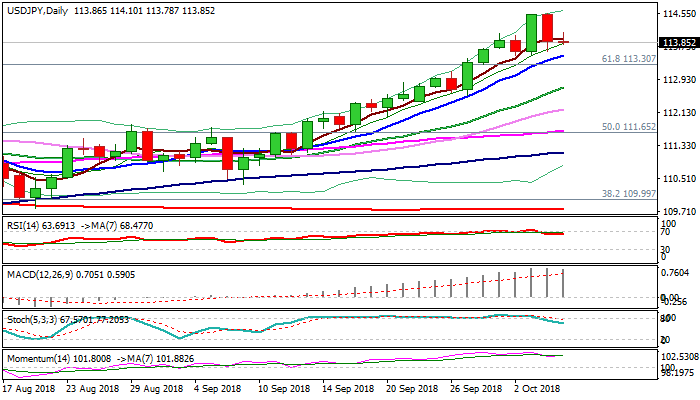
Thursday's close in in red on pullback from double upside rejection at 114.54 (11-month high) was so far seen as positioning for fresh advance, as dip found footstep above initial support at 113.52 (rising 10SMA).
Overall picture remains biased higher as bulls are comfortable above broken weekly 200SMA (113.18) which marks key near-term support.
The greenback remains supported by recent strong US data and US / Japan interest rate gap expected to widen further.
Friday's action holds within narrow range, awaiting release of US jobs data for fresh signal.
Upbeat release would prompt bulls for test of initial target at 114.73 (06 Nov 2017 high) with 115+ gains seen on stronger acceleration higher.
Conversely, extension and close below 200SMA would sideline bulls and signal deeper pullback.
Res: 114.10, 114.54, 114.73, 115.00
Sup: 113.78, 113.52, 113.30, 113.18
EUR/USD – Euro Drops Below 1.15 Despite Strong German Factory Orders
EUR/USD has posted slight losses in the Friday session. Currently, the pair is trading at 1.1494, down -0.18% on the day. On the release front, German data was positive. Factory Orders jumped 2.0% in August, rebounding from a 0.9% decline in July. German PPI edged up from 0.2% to 0.3% in September. In the U.S, the focus will be on key employment data, with the markets braced for some soft numbers. Nonfarm payrolls is expected to fall from 201 thousand to 185 thousand, while wage growth is forecast to drop from 0.4% to 0.3%. The unemployment rate is expected to drop from 3.9% to 3.8%.
All eyes will be on U.S job numbers on Friday, which should be treated as market-movers. Nonfarm payrolls have shown an average increase of 207,000 in 2018, and the September forecast of 185,000 would be significantly softer. Investors will also be monitoring the increase in wage growth. The August release showed a year-over-year gain of 2.9%, and a similar reading for September could bolster the odds of December rate hike. Currently, the likelihood of a December rise is pegged at 80%, according to the CME Group.
Fed Chair Jerome Powell had a hawkish message for the markets on Wednesday. Powell said that interest rates were still accommodative, but were “gradually moving to a place where they will be neutral”. Powell said that extremely accommodative low interest rates were no longer needed, since the economy has strengthened. The hawkish comments helped push the U.S dollar higher on Wednesday. Analysts have noted that there is no precise definition of a neutral rate, but the Fed tends to use the 3 percent level as its yardstick. With the Fed expected to continue its gradual increase in rates, this level could be reached in 2019.
The Analytical Overview Of The Main Currency Pairs
The EUR/USD currency pair
Technical indicators of the currency pair:
Prev Open: 1.14732
Open: 1.15147
% chg. over the last day: +0.34
Day's range: 1.14972 – 1.15197
52 wk range: 1.0571 – 1.2557
Yesterday, the EUR/USD quotes moved away from local lows. At the moment, the technical pattern is ambiguous. The trading instrument is consolidating near the “mirror” resistance of 1.15150. The key support is the 1.14650 mark. Investors took a wait-and-see attitude before the publication of report on the US labor market. We recommend paying attention to the difference between the actual and forecasted values. Positions should be opened from the key levels.
At 15:30 (GMT+3:00) we expect statistics on the US labor market.
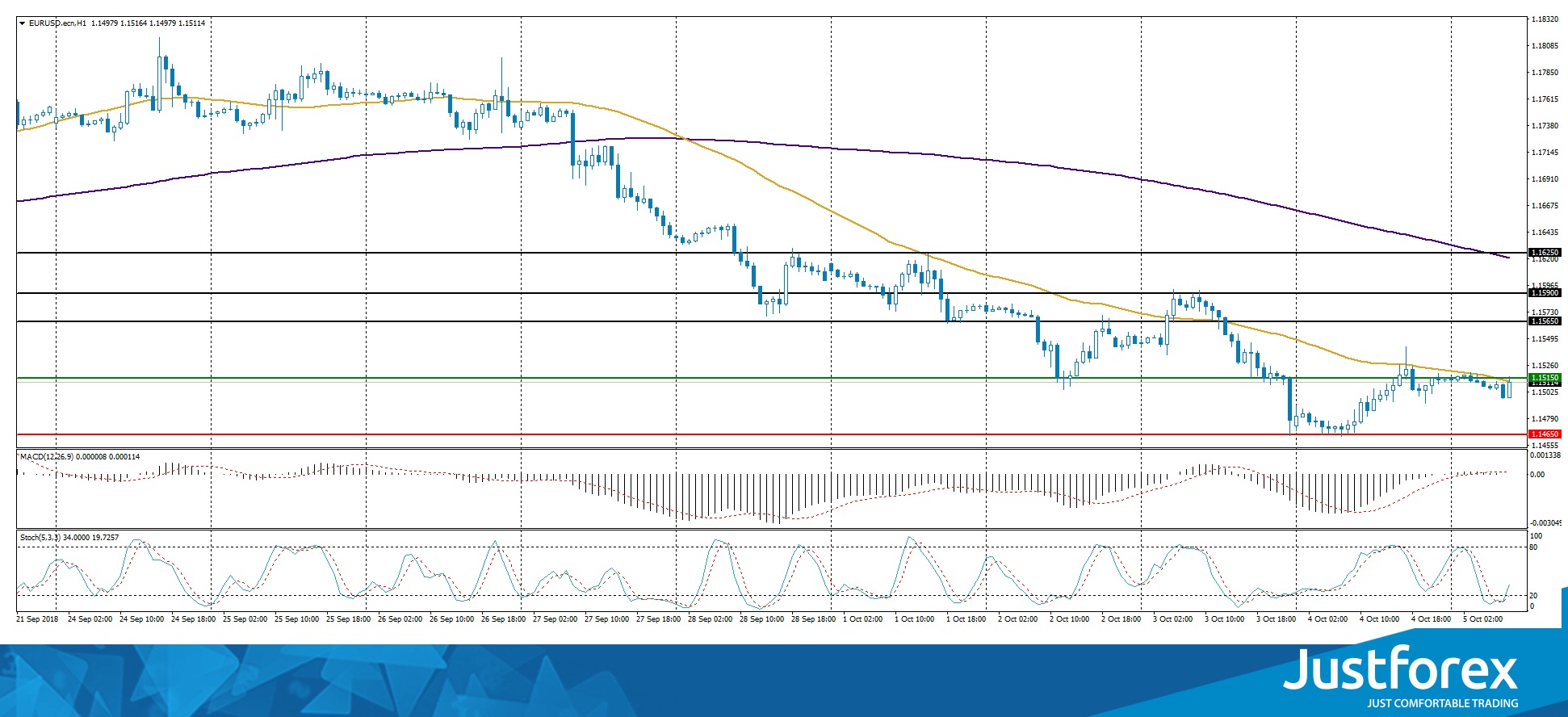
Indicators do not send accurate signals: the price is testing 50 MA.
The MACD histogram is near the 0 mark.
Stochastic Oscillator has started moving out of the oversold zone, the %K line is above the %D line, which gives a signal to buy EUR/USD.
Trading recommendations
Support levels: 1.14650, 1.14250, 1.14000
Resistance levels: 1.15150, 1.15650, 1.15900
If the price fixes above the resistance level of 1.15150, the EUR/USD quotes are expected to recover. The movement is tending to 1.15750-1.16000.
An alternative may be a further decrease in the EUR/USD currency pair to the level of 1.14500-1.14250.
The GBP/USD currency pair
Technical indicators of the currency pair:
Prev Open: 1.29363
Open: 1.30190
% chg. over the last day: +0.63
Day's range: 1.30031 – 1.30594
52 wk range: 1.2361 – 1.4345
The GBP/USD currency pair has begun to recover. Yesterday, the growth of quotes exceeded 80 points. At the moment, the trading instrument is consolidating. Financial market participants expect a report on the US labor market. The key support and resistance levels are 1.30000 and 1.30600, respectively. Positions should be opened from these marks.
Today, the news feed on the UK economy is calm.
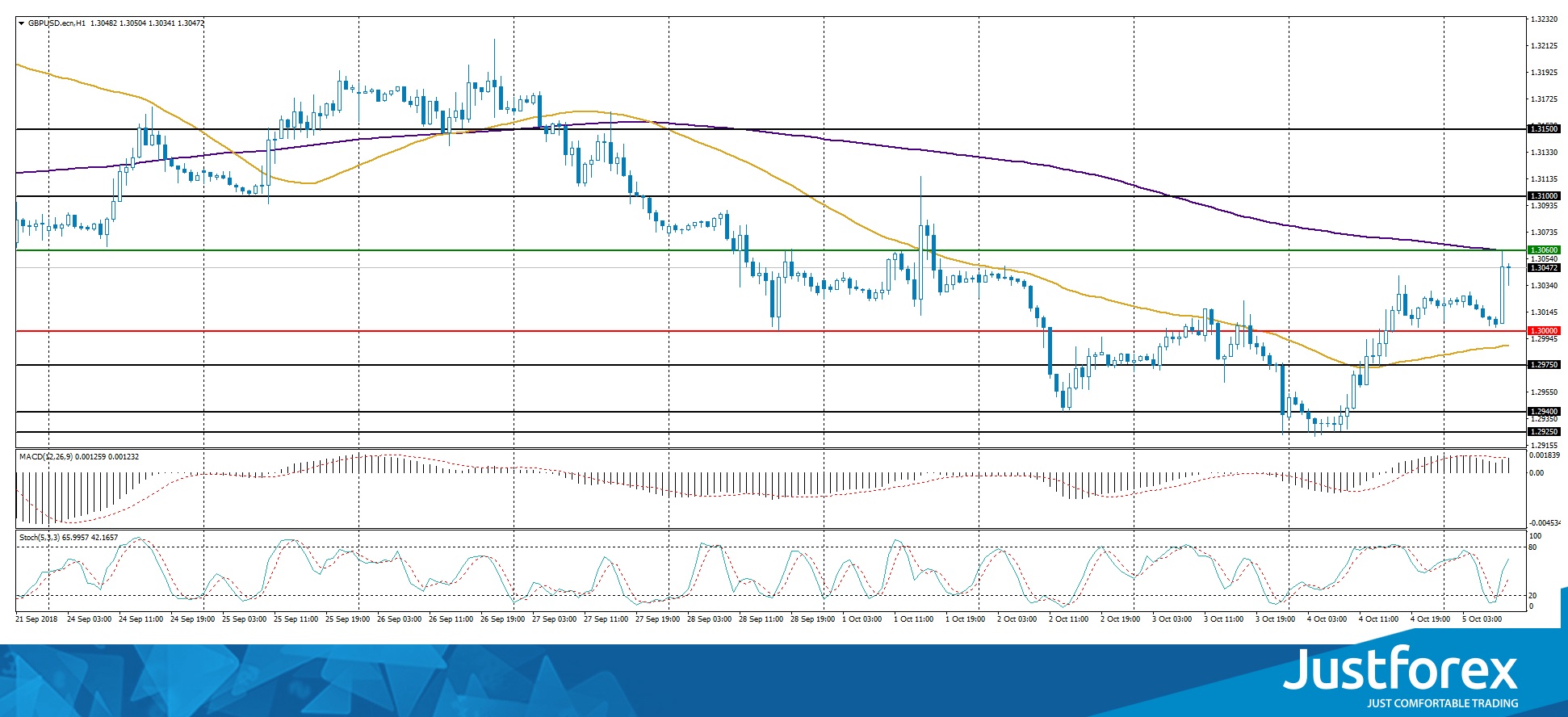
The price has fixed between 50 MA and 200 MA, which are strong dynamic support and resistance levels.
The MACD histogram is in the positive zone and continues to rise, which indicates the growth of the GBP/USD currency pair.
Stochastic Oscillator is in the neutral zone, the %K line is above the %D line, which gives a signal to buy GBP/USD.
Trading recommendations
Support levels: 1.30000, 1.29400
Resistance levels: 1.30600, 1.31000, 1.31500
If the price fixes above the resistance level of 1.30600, further correction of the GBP/USD quotes is expected. The movement is tending to 1.31000-1.31300.
An alternative may be the decrease of the GBP/USD currency pair to the level of 1.29750-1.29500.
The USD/CAD currency pair
Technical indicators of the currency pair:
Prev Open: 1.28656
Open: 1.29207
% chg. over the last day: +0.40
Day's range: 1.29157 – 1.29353
52 wk range: 1.2059 – 1.3795
The USD/CAD currency pair continues to show positive dynamics. Yesterday, the Canadian dollar weakened against the US dollar by more than 60 points. Weak statistics on the Ivey purchasing managers' index in Canada put pressure on Loonie. At the moment, the trading instrument is consolidating in the range of 1.29000-1.29400. Investors expect reports on labor markets of the US and Canada. Positions should be opened from the key levels.
At 15:30 (GMT+3:00) statistics on the labor market will be published in Canada.
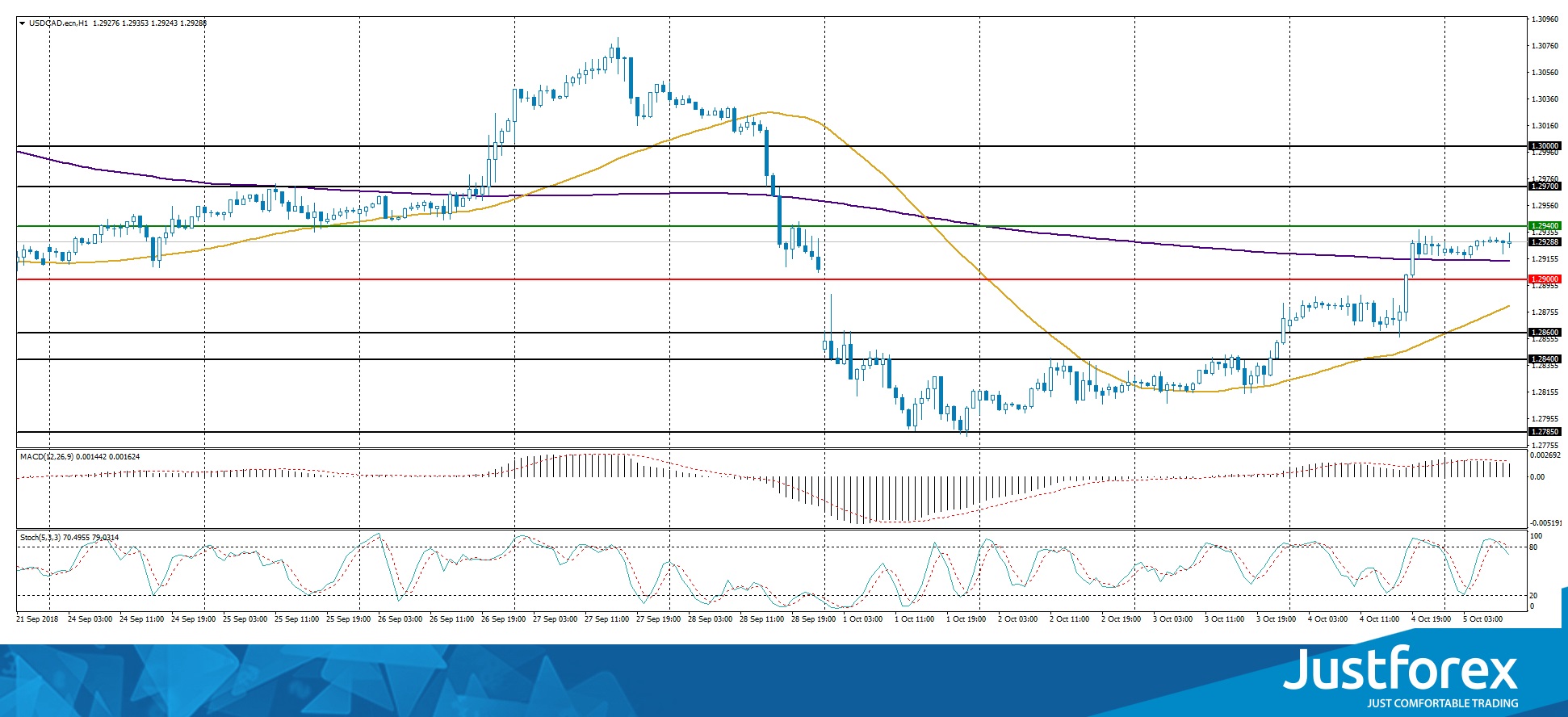
The price has fixed above 200 MA, which indicates the power of buyers.
The MACD histogram is in the positive zone, but below the signal line, which gives a weak signal to buy USD/CAD.
Stochastic Oscillator has started moving out of the overbought zone, the %K line is below the %D line, which indicates the bearish sentiment.
Trading recommendations
Support levels: 1.29000, 1.28600, 1.28400
Resistance levels: 1.29400, 1.29700, 1.30000
If the price fixes above the resistance level of 1.29400, further growth of the USD/CAD currency pair is expected. The movement is tending to 1.29700-1.30000.
Alternative option. If the price fixes below the round level of 1.29000, it is necessary to consider sales of USD/CAD. The movement is tending to 1.28600-1.28400.
The USD/JPY currency pair
Technical indicators of the currency pair:
Prev Open: 114.503
Open: 113.868
% chg. over the last day: -0.55
Day's range: 113.786 – 114.101
52 wk range: 104.56 – 114.74
Yesterday, sales prevailed on the USD/JPY currency pair. Quotes moved away from annual highs and updated local extremes. At the moment, the trading instrument is moving in the flat. Investors expect labor statistics from the United States. The key support and resistance levels are 113.650 and 114.000, respectively. The USD/JPY currency pair has the potential for further correction. Positions should be opened from the key levels.
The news feed on the economy of Japan is quite calm.
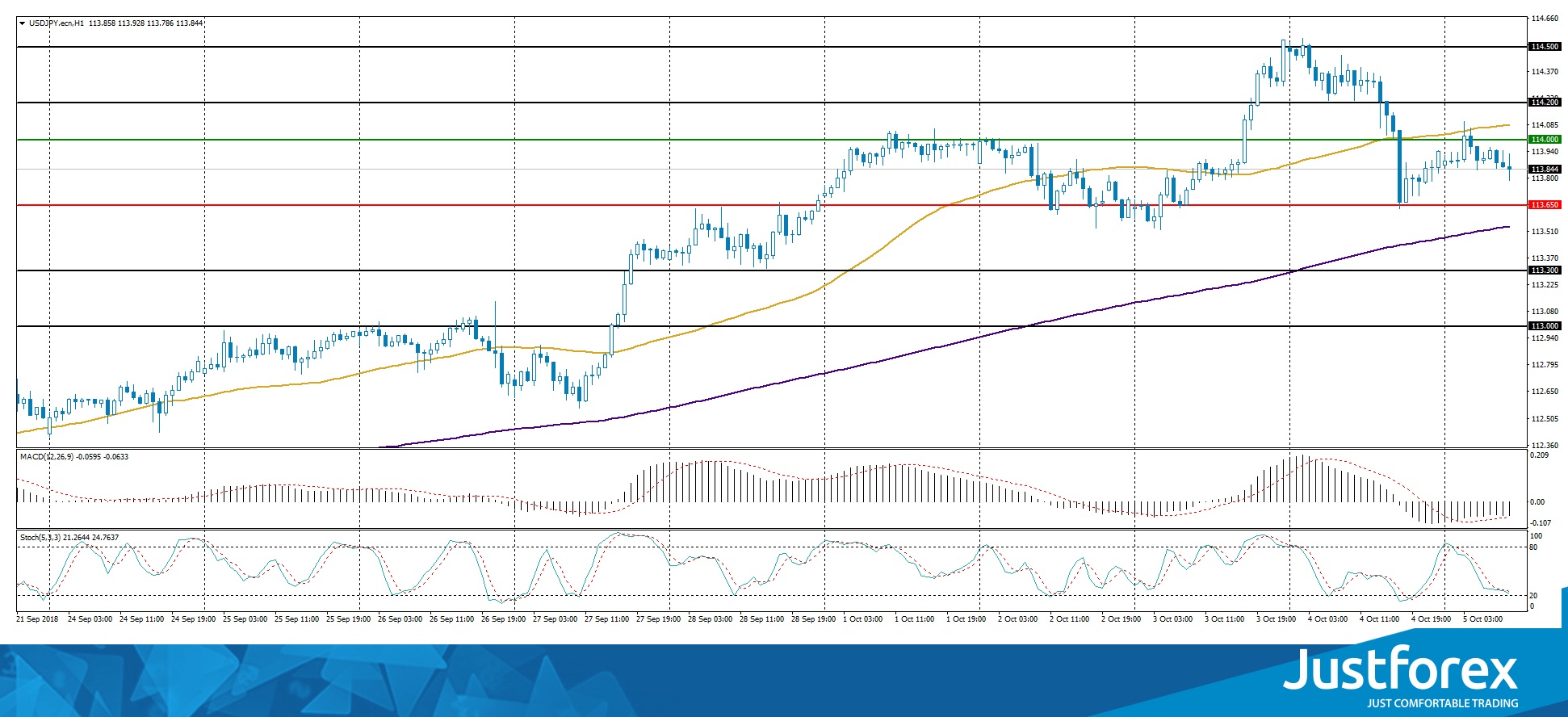
Indicators do not send accurate signals. The price has fixed between 50 MA and 200 MA.
The MACD histogram is in the negative zone and continues to decline, which indicates the bearish sentiment.
Stochastic Oscillator is in the neutral zone, the %K line has crossed the %D line. There are no signals at the moment.
Trading recommendations
Support levels: 113.650, 113.300, 113.000
Resistance levels: 114.000, 114.200, 114.500
If the price fixes below the support level of 113.650, further correction of the USD/JPY currency pair is expected. The movement is tending to 113.300-113.000.
An alternative may be the growth of the USD/JPY quotes to the level of 114.250-114.500.
Forex Technical Analysis: EUR/USD, USD/JPY, GBP/USD
EUR/USD
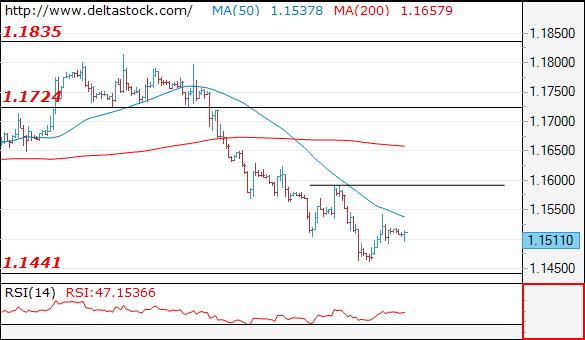
Current level - 1.1511
The intraday bias is positive, for a rise towards 1.1590 and a violation of the latter will challenge 1.1720 area.
| Resistance | Support | ||
| intraday | intraweek | intraday | intraweek |
| 1.1590 | 1.1835 | 1.1440 | 1.1300 |
| 1.1720 | 1.2010 | 1.1440 | 1.1100 |
USD/JPY
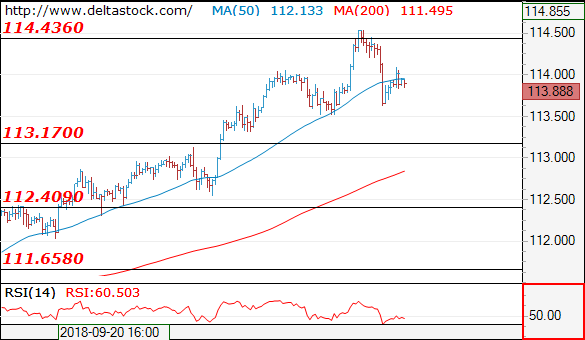
Current level - 113.88
The pullback after the failure at 114.40 confirms a negative outlook, for a slide towards 113.20, en route to 112.40 area. Initial minor resistance lies at 114.20.
| Resistance | Support | ||
| intraday | intraweek | intraday | intraweek |
| 114.20 | 114.40 | 113.50 | 111.65 |
| 114.40 | 114.40 | 112.40 | 110.40 |
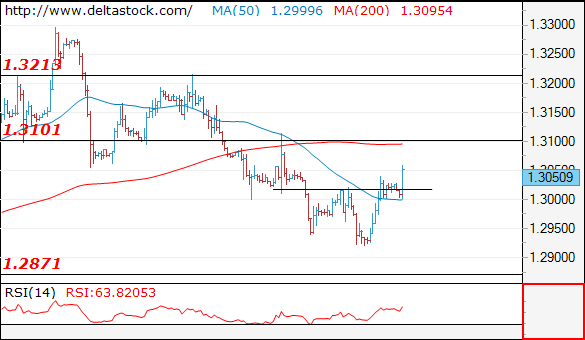
GBP/USD
Current level - 1.3050
The reversal at 1.2920 signals a bullish outlook, for a rise towards 1.3100 crucial area, en route to 1.3210.
| Resistance | Support | ||
| intraday | intraweek | intraday | intraweek |
| 1.3100 | 1.3440 | 1.2920 | 1.2570 |
| 1.3210 | 1.3440 | 1.2800 | 1.2570 |
EURUSD Analysis: Trades Near Monthly S1
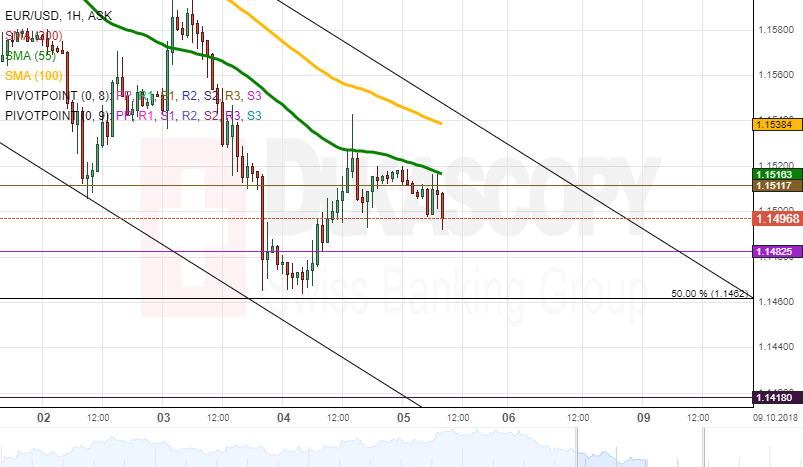
The European Single Currency appreciated 0.33% against the US Dollar since Thursday's session. During Friday morning hours, the rate was located near the monthly S1 at the 1.1507 mark.
On Friday, the European Single Currency will trade at the range of the 1.1500 level and the 1.1450 level. The 55-hour SMA and the monthly S1 should resist the rate from the surge. Most likely, the rate will be located at the 1.1450 mark due to the 50.00% Fibo support, which should keep the rate in the range.
However, fundamentals at 12:30 GMT on Friday, may break the predictions. Watch out for the news!