

Sample Category Title
Weekly Focus: Italian Reprise
Market movers ahead
- The focus in the euro area next week will stay on Italy and the ongoing budget fight. Italian government bonds have come under renewed pressure, as the risk of a new debt crisis in the medium term looms.
- The next focal date for markets will be 15 October, which is the deadline for the Italian budget draft to be presented to Brussels.
- We expect to see US September CPI figures climb higher to 2.3% y/y. In addition there will be a number of interesting speeches from Fed members.
- In China, trade data will shed more light on the effects of the trade war
- In Sweden, we expect inflation figures to come out significantly lower than the Riksbank forecast. In Denmark, September inflation is expected to decline.
Global macro and market themes
- Global growth is slowing, but inflation pressure is rising.
- US bond yields hit a new high.
- Italy reignites debt crisis fears.
- Trump closes trade deal with Canada and Mexico, but is likely to escalate versus China.
Sunset Market Commentary
Markets
Yesterday’s core bond sell-off grinded more or less to a halt this morning. The Bund opened lower but recovered partly before noon. US Treasuries moved sideways throughout the day, awaiting the US payrolls. European equity markets and Italian BTP’s continued yesterday’s downward trend at the opening of European trading. ECB president Draghi initiated the move by pointing out the risks of a heightened budget deficit to Italian president Mattarella. Italy’s bureau of statistics said its leading indicator for economic growth maintained a descending profile, refuting the Italian government that counts on an increase of economic growth to counteract the larger budget deficit. Lega-leader Salvini sneered at EC president Juncker and European Commissioner Moscovici, saying the EU and Italy are in bad shape because of people like them. JP Morgan added that Italy’s ‘efforts’ to lower its budget deficit won’t stop rating agencies from downgrading Italy’s credit score. The Italian bond futures thus lost ground, and stabilized after lunch. Focus returned to the event of the day, US payrolls. US labour market showed its continued strengthening, though the data is in line with expectations. Apart from some modest report-related swings, the US treasuries gained limited ground on the strong report. US yields are adding 2.1 bps (2-yr) to 3.2 bps (30-yr). The German yield curve bear steepened, ranging from -0.2 bps (2-yr) to 0.3 bps (30-yr). 10-yr spread changes vs Germany remained unchanged with the exception of Italy (+5bps).
As is usually the case when important data are due, currencies trade rather subdued. Today was no exception as the dollar barely moved in trading hours preceding the September payrolls. If anything, the greenback slightly predominated during the European risk off trading session, before grinding lower as markets braced for today’s main event. The September job report showed 134 000 new US jobs. While markets anticipated a 185 000 increase, the two-month net revision amounted up to 87 000. Unemployment dropped to a multi decade low of 3.7% as labour participation remained stable at 62.7%. Average hourly earnings increased an expected 2.8% YoY (0.3% MoM), down from 2.9% in August. All in all, the job report highlighted ongoing labour market strength, further supporting the case for a December hike, but held no significant surprises from a markets point of view. The dollar traded accordingly after the numbers, losing ground only very slightly. EUR/USD is changing hands at the 1.152-zone, virtually unchanged from yesterday’s close.
The UK’s economic calendar only contained second tier data, leaving trading up to technical and sentimental considerations. EU diplomats again struck an upbeat tone this morning, saying they see a brexit deal “very close”. Later, EC president Juncker hailed both sides’ efforts to make progress on the issue of the Irish border. Negotiations are likely to continue over the weekend, after which brexit minister Raab will pay Brussels a visit. The next few weeks will prove important for both brexit and the queen’s money. After EU-negotiator Michel Barnier presents and discusses the draft declaration on the future relationship on October 10, a formal brexit summit (including May) takes place just one week later. For now, sterling jumped amid growing brexit optimism, extending the remarkable recovery that started last week. EUR/GBP (0.882) is filling bids at levels not seen since early July.
News Headlines
The Indian central bank unexpectedly kept rates stable at 6.5% today. Following two months of slowing inflation, the central bank wishes to assess the impact of previous hikes before raising rates anew. However, the central bank changed its stance from neutral to “calibrated tightening”, signaling more hikes in the future. The Indian rupee lost ground following the decision, setting a new all-time low against the dollar.
Canadian employment increased more than expected, adding 63 300 new jobs vs. 25 000 anticipated by markets. Part time employment (80 200) rebounded from last month’s steep decline, while full time jobs decreased with a little less than 17 000. The unemployment rate dropped to 5.9%.
Irish Foreign Minister Simon Coveney said it is hard to know if the UK’s new backstop proposal will suffice to avoid a hard border on the island of Ireland. He said new and intensified negotiations with Brussels are needed to come to an agreement.
US: Payroll Growth Slows But Won’t Blow the Fed Off Course
Payroll growth slowed to 134,000 in September, likely depressed in part by Hurricane Florence. Other labor market indicators, including a decline in unemployment and rising earnings, show no signs of cooling.
Payrolls Look to Have Slowed—For Now
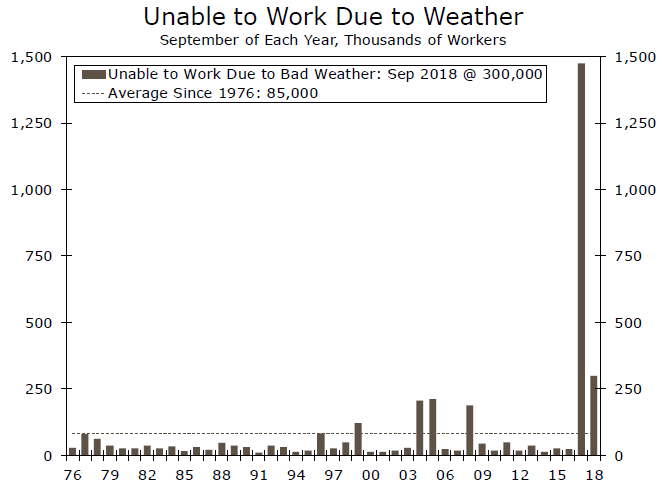
Payroll growth disappointed in September with employers adding 134,000 jobs. That was likely depressed by Hurricane Florence hitting the Carolinas during the survey reference period. Relative to last year's storms, Florence hit a less populated area and also came at the tail end of the survey week, which meant many workers in its path were still able to clock in for part of the week and be counted as employed. Nevertheless, about 300,000 workers said they were unable to work due to bad weather, compared to an average of 85,000 workers in a typical September.
It is worth noting that September is a month where the initial estimate of payroll growth tends to be revised upward. Over the course of the expansion, revisions have brought September payroll growth up by about an average of 55,000. Therefore, between the storm and typical revisions, we do not think the trend in payroll growth has slowed to the extent stated by today's report. Revisions to recent months' data offer some support to this view. Payroll growth for July and August was revised up by 87,000. While that brought the three-month average down to a gain of 190,000, that is a bit better than the three-month pace initially reported in August (185,000).
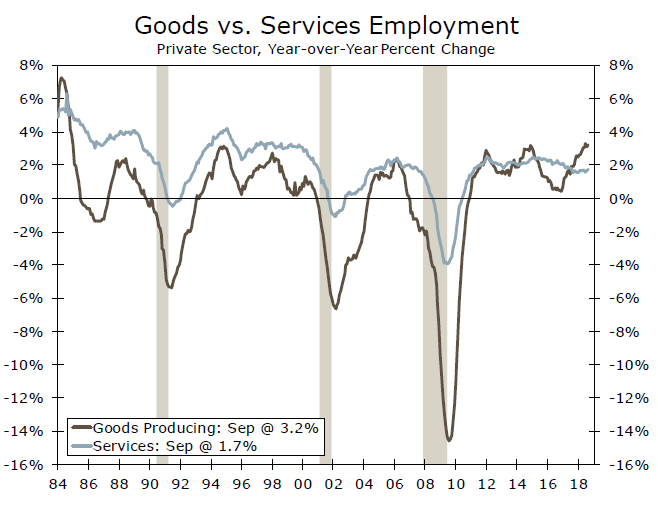
By industry, the goods-sector continues to expand at a torrid pace, with sizeable gains in manufacturing, construction and mining last month. Services were the soft spot, with the retail and leisure & hospitality industries cutting employment in September.
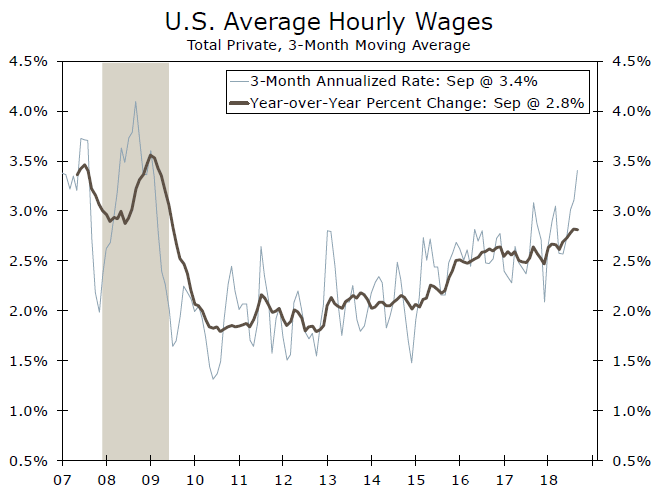
With much of the slowdown in hiring coming from the heavily part-time and lower-paying retail and leisure & hospitality industries, the average workweek was left unchanged and average hourly earnings posted another solid gain (0.3%). That followed a 0.3% gain in earnings in August and pushed the three-month annualized rate to 3.8%. It would not be surprising to see that cool off a bit the next few months given this month's industryrelated boost and favorable calendar dynamics that BLS adjustments do not fully seem to capture (timing of survey week, workweek days in the month).
Payroll Slowdown Not Corroborated by Other Measures
Other employment data do not give any sign of the labor market weakening, let alone to the extent of September's payrolls. Job openings and the share of businesses reporting they have at least one position that is hard to fill sit at record highs, as does the hiring index in the ISM non-manufacturing survey. At the same time, the near 50-year low in initial jobless claims points to firms hanging on to workers, given the difficulty to re-hire later on.
The decline in the unemployment rate to 3.7% and upward march in wage growth will keep the FOMC pressing ahead with rate hikes. We continue to look for the FOMC to raise rates more than the market currently expects over the next 12 months and for the committee to target a fed funds rate of 3-3.25% by the end of Q3-2019.
US: Hiring Activity Slowed in September, But Overall Labor Market Strength Continues
U.S. non-farm payrolls disappointed in September, with 134k new positions created. However, the September letdown is mitigated by a net upward revision of 87k jobs to July and August, and the likely impact of sectors affected by Hurricane Florence. The BLS indicated that Florence affected parts of the East Coast during the reference period for both the household and establishment surveys, but that response rates were within normal ranges. However, there was likely a dampening impact in certain sectors.
The unemployment rate dropped two ticks to 3.7%, a new cycle low. Indeed, you have to go all the way back to 1969 to find a lower unemployment rate. The overall labor force participation rate remained unchanged at 62.7%.
Turning to the industry detail, a slowdown in services sector hiring was behind the September softness. Services hiring cooled to 75k new positions, down from 217k in August. Several services sectors saw a weaker pace of hiring including retail trade (-20k), education & health (+18k) and leisure and hospitality (-17k). The BLS noted that some of the weakness in the leisure and hospitality sector may reflect the impact of Florence.
Meanwhile, hiring in the goods-producing sector accelerated in September, gaining 46K new jobs. Both construction (+23k) and manufacturing (+18k) posted solid growth in September.
Average hourly earnings rose 0.3% on the month, a decent follow-through on the 0.3% jump in August. Unfavorable base effects meant the year-on-year growth in wages dipped to 2.8% (from 2.9%), but the annualized pace over the past three months is a much sturdier 3.4%.
Key Implications
Meh. Every so often you get a below-trend month in hiring, and this is more common in September. We will reserve judgement until the next report before worrying about a slowdown in hiring.
In any case, the U.S. labor market remains strong. Unemployment is the lowest it's been in nearly 50 years, and wage gains are making headway. Going forward, employers will find it increasingly difficult to find workers to fill positions, muting monthly payroll gains, and we would expect to see a natural slowing in monthly job gains.
There is little doubt that the full employment half of the Fed's dual mandate is right on track. And today's employment report is consistent with another hike in December. It has long been the inflation side of the scale that has caused head scratching among FOMC members. Inflation is on target for now, and the question is how much pressure is bubbling beneath the surface. So far there isn't a ton of evidence for a breakout in price pressures. That underpins our expectation that the Fed can continue its gradual pace of a hike a quarter over the next year.
USD/JPY Mid-Day Outlook
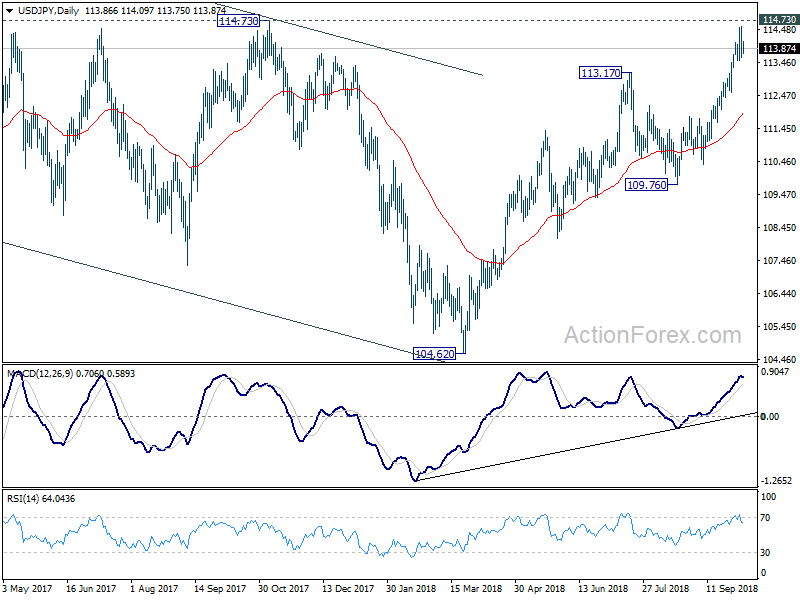
Daily Pivots: (S1) 113.53; (P) 114.04; (R1) 114.45; More...
Intraday bias in USD/JPY remains neutral for consolidation below 114.54 temporary top. As long as 113.51 support holds, further rise is still expected. On the upside, decisive break of 114.73 will confirm larger bullish case. Next target will be 118.65 resistance. Nonetheless, break of 113.51 will indicate short term topping, on bearish divergence condition in 4 hour MACD, and bring lengthier consolidation first.
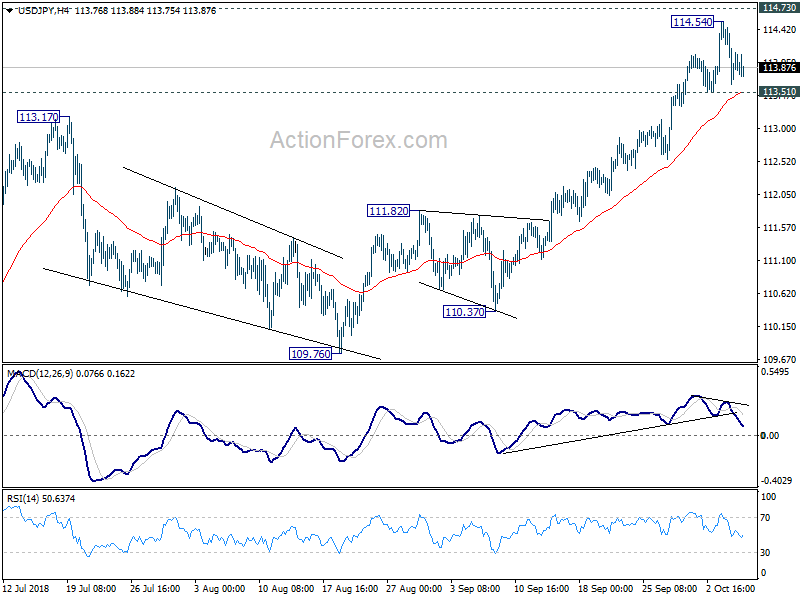
In the bigger picture, corrective fall from 118.65 (2016 high) should have completed with three waves down to 104.62. Decisive break of 114.73 resistance will likely resume whole rally from 98.97 (2016 low) to 100% projection of 98.97 to 118.65 from 104.62 at 124.30, which is reasonably close to 125.85 (2015 high). This will stay as the preferred case as long as 109.76 support holds.
USD/CHF Mid-Day Outlook
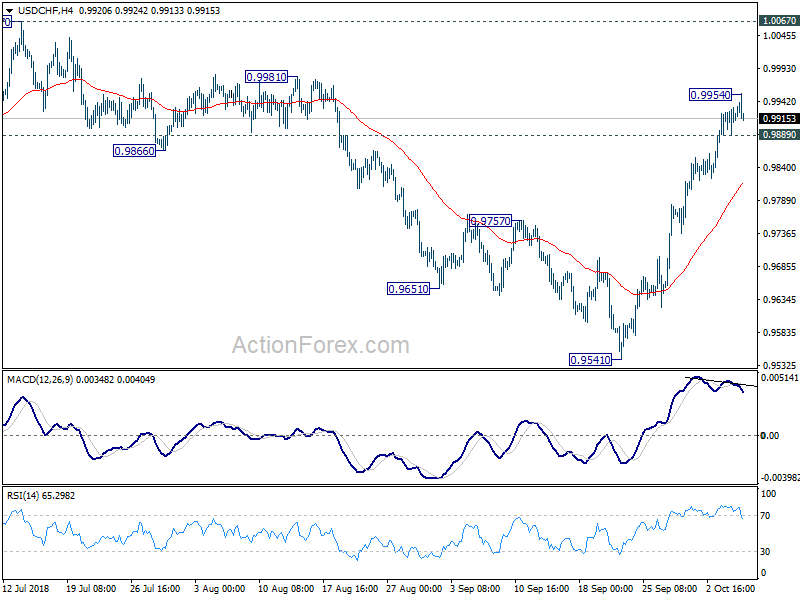
Daily Pivots: (S1) 0.0.9863; (P) 0.9894; (R1) 0.9955; More...
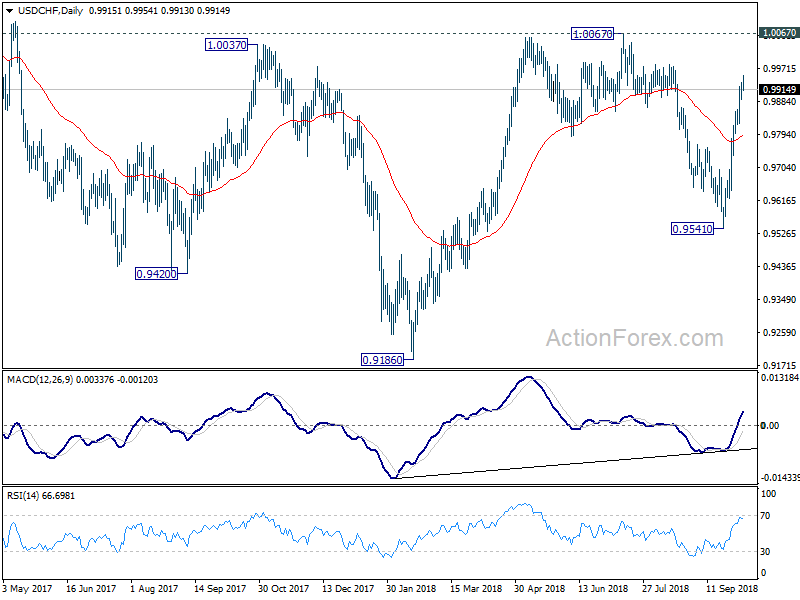
Intraday bias in USD/CHF is turned neutral with a temporary top formed at 0.9954. Consolidation should be brief as long as 0.9889 minor support holds. Above 0.9954 will target 1.0067 resistance next. However, considering bearish divergence condition in 4 hour MACD, break of 0.9889 minor support will indicate short term topping and bring lengthier consolidation first.
In the bigger picture, the pullback from 1.0067 has completed at 0.9541 already. And rise from 0.9186 is likely resuming. Firm break of 1.0067 will pave the way to retest 1.0342 key resistance. We'd be cautious on strong resistance from there to limit upside to bring another medium term fall to extend long term range trading.
GBP/USD Mid-Day Outlook
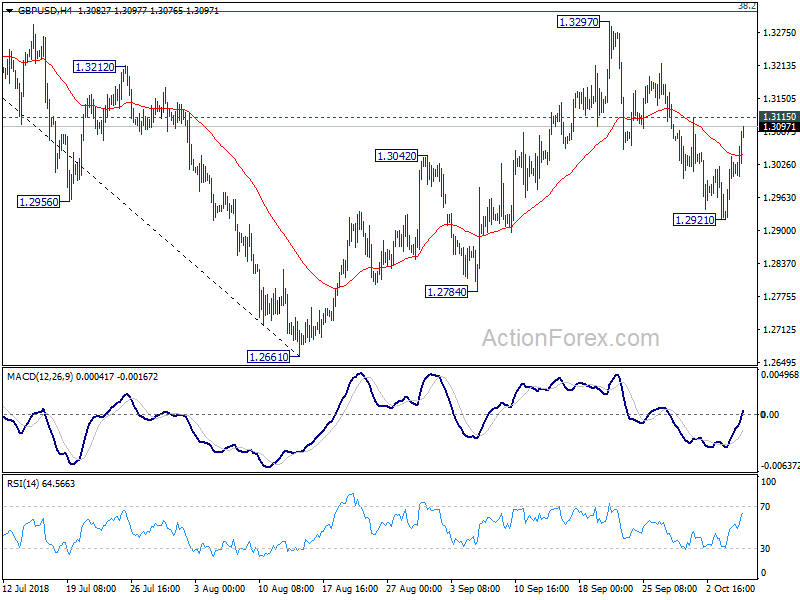
Daily Pivots: (S1) 1.2948; (P) 1.2995; (R1) 1.3067; More...
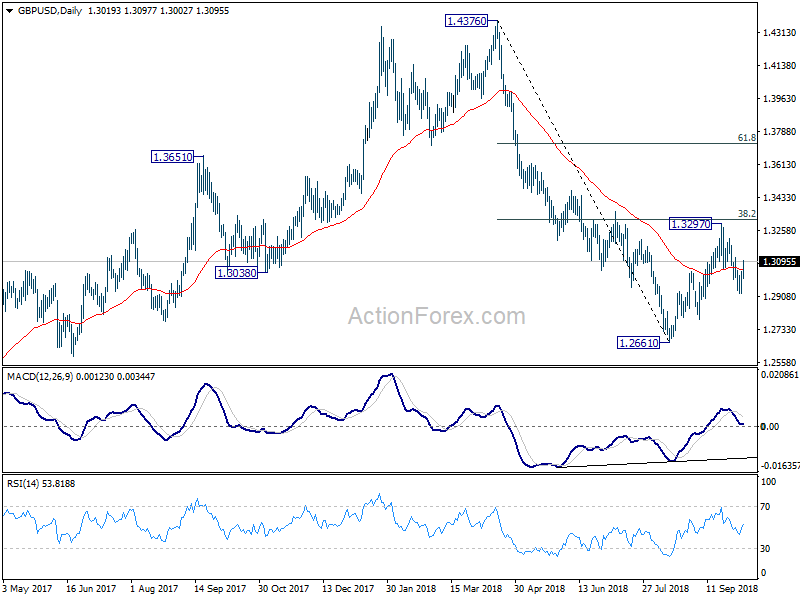
GBP/USD's rebound from 1.2921 extends today but it's limited below 1.3115 minor resistance Intraday bias stays neutral first. On the downside, break of 1.2921 will reaffirm the view that corrective rise from 1.2661 has completed. Intraday bias will be turned to the downside for 1.2784 support next. On the upside, however, break of 1.3115 will dampen our view and turn bias to the upside for 1.3297 to extend the corrective rise from 1.2661.
In the bigger picture, whole medium term rebound from 1.1946 (2016 low) should have completed at 1.4376 already, after rejection from 55 month EMA (now at 1.4062). The structure and momentum of the fall from 1.4376 argues that it's resuming long term down trend. And this will be the preferred case as long as 38.2% retracement of 1.4376 to 1.2661 at 1.3316 holds. However, firm break of 1.3316 would bring stronger rebound to 61.8% retracement at 1.3721. And, the eventual depth of the fall from 1.4376, and the chance of hitting 1.1946 low, will depend on the strength of the interim corrective rebound from 1.2661.
Canadian Labour Markets End Q3 on a Decent Note
The Canadian economy added 63.3k net jobs in August. Even with more Canadians engaged in labour markets, the unemployment rate edged down a tenth of a percentage point to 5.9%
In yet another reversal of the prior month's patterns, part-time employment led the gains, rising 80.2k net positions. In contrast, full-time work fell 16.9k positions. Breaking it down by type, the private sector led hiring (+95.8k), with only modest public sector hiring (+2.3k), while self-employment dropped 35k net positions.
Job growth was concentrated among core age (25 to 54 year old) workers, up 54.3k in this category. Those aged 55+ saw a net 15.4k positions added, while younger workers (15-24 years old) experienced a modest pullback(-6.5k).
Net gains were by and large in the goods-producing industries (+44.9), with construction adding 28k positions, effectively reversing the prior two months' declines. It was a more mixed showing on the service side, adding 18.4k positions on net. Regionally, Ontario (+36.1k) and B.C. (+33.3k) led the charge.
Despite the strong headline, hours worked fell 0.4% in September. Also soft was the wage component as wage growth among permanent employees rose 2.2% year-on-year, the fourth monthly deceleration.
Key Implications
Shrug. Once again the labour force survey is best described as sound and fury, signifying little. Part-time and full-time job gains again reversed roles, with part-time leading the charge in December. So, even though we had a positive headline and an improved unemployment rate, hours worked were down. Ultimately, the trend may be the most telling: the six month average pace of gains now sits at 14.4k, pretty much where one would expect it to be given the economic cycle.
What is perhaps more surprising is the recent softness in wage growth. While concerning, we note that the less timely Canadian payrolls survey continues to show wage gains in the 2.5% to 3.0% range.
All signs are pointing to another Bank of Canada rate hike and today's report does little to change this – indeed, it is important to remember that among the wage measures it follows, the Bank places the least weight on today's data. With a hike this month effectively a lock, focus is now shifting to what comes next. The positive conclusion to USMCA discussions should lift a significant portion of uncertainty that had been weighing on the Bank's forecast. We expect to see an upgraded outlook and a more hawkish tone reflecting these positive developments on October 24th.
Jobs Report Better Than First Impression Suggests
Naturally whenever we see an NFP in the low hundred thousands, questions are asked about what went wrong in the labour that month and whether it’s a sign of things to come but this time that is not the case.
It’s always difficult to assess the impact of something such as Hurricane Florence but it would certainly appear it weighed on employment during the month. That said, 134,000 job is far from a terrible employment number and with August’s being revised up by another 69,000, the labour market looks extremely healthy and provides further evidence of a booming economy.
Add to that unemployment falling to its lowest level in almost 50 years and wages growing by 2.8% and this is far from a bad jobs report. Perhaps though it has been enough to avoid another negative knee jerk reaction from investors and corresponding spike in yields and the dollar and decline on Wall Street. Instead the dollar has softened slightly and futures are now on course for a relatively flat open. All things considered, this is actually another very good report that other countries will be extremely envious of.
An update on GBP/USD short, exit at market
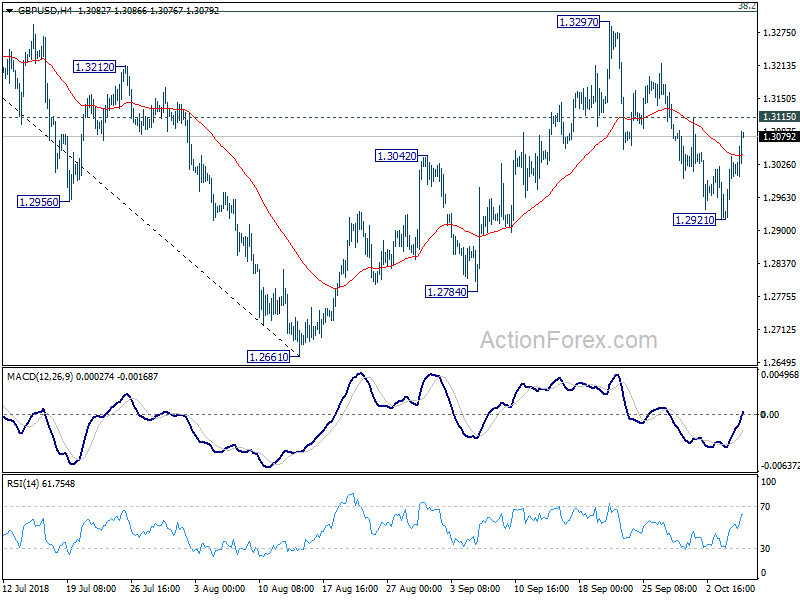
Follow up on our GBP/USD short (entered at 1.3150) as last updated here. In short, we'll exit the position at market now (1.3079), with 71 pips profit .
The stronger than expected rebound from 1.2921 raised the chance that rise from 1.2661 is not completed at 1.3297. That is, we'd probably see another test on 1.3297 before heading back to 1.2661 low.
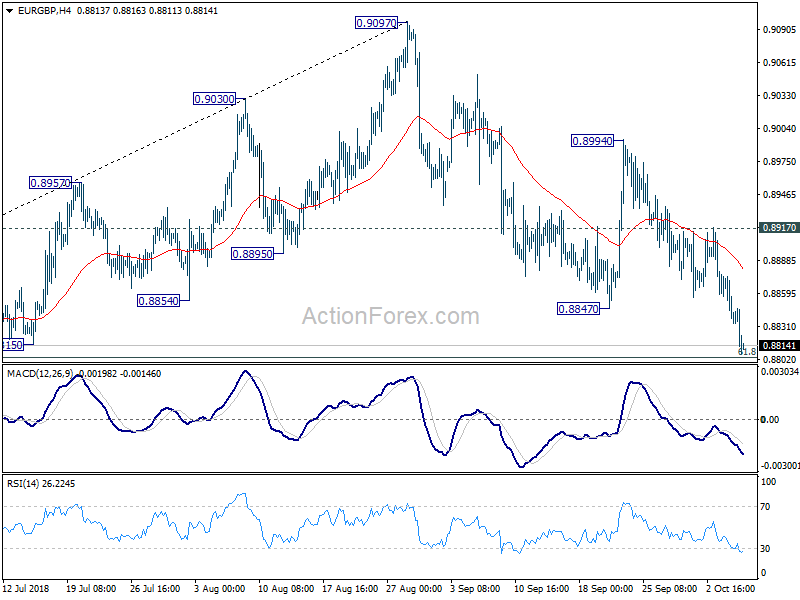
In formulating the strategy, our biggest mistake was the view on EUR/GBP. We believed that the fall from 0.9097 was completed at 0.8847. And the pull back from 0.8894 was a corrective move. That is, Sterling will eventually underperform Euro and help pressure GBP/USD. But the acceleration below 0.8847 today invalidated this view.
Secondly, we gave the position another chance to see if NFP will give dollar a strong boost. But it doesn't. So, we'll exit the GBP/USD short for now with some profit and move on.