Sample Category Title
Markets Are Optimistic But Remain Weary
The markets remain on cautious positive mood. MSCI for Asia-Pacific region adds 0.4%, continuing gently recover for the second day in a row. American markets feel more confident. On Thursday S&P500 added 0.8%.
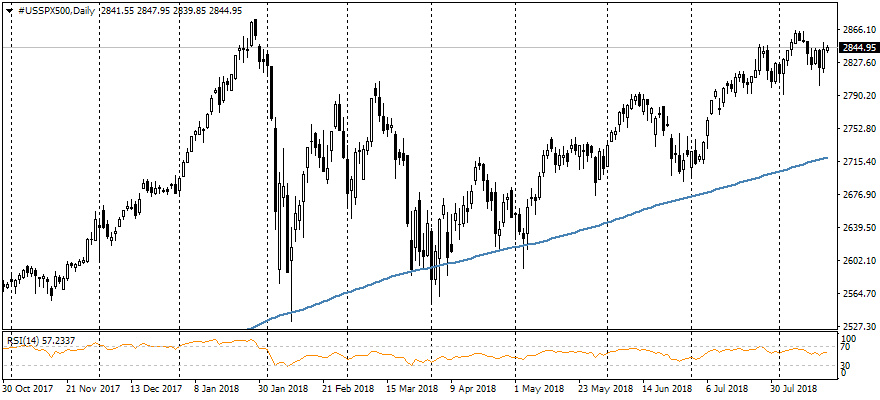
However, moderate growth in demand for risks looks like a development of profit-taking rather than evidence of a sustainable markets turnaround. The negative tendencies can again come to the forefront, resuming escape from risks.
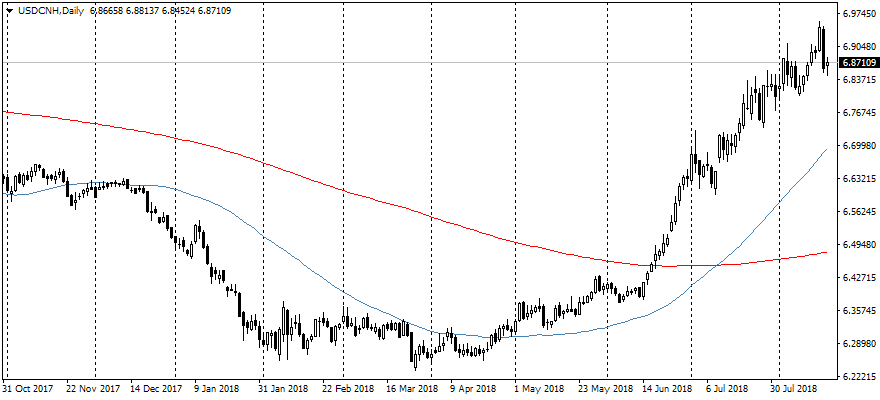
The growth of markets is facilitated by the early start of negotiations between China and the United States on trade issues for the first time since June. It is worth noting that the status of officials involved in the negotiations is not very high, which eliminates the possibility of breakthrough decisions in the near future. Obviously, there will be more necessary rounds of negotiations at the highest level to resolve the trade disputes fully. The dynamics of the Chinese offshore yuan is a good indicator of investor sentiment. After yesterday powerful increase by 1.3% to the dollar, CNH have stabilised near 6.87 on Friday morning.
The Turkish lira has added on Thursday in response to the tightening of the country's Central bank policy and the promises of assistance from Qatar and Germany. Panic has stopped, but still there are not enough reasons for long-term optimism. The U.S. have made it clear that the sanctions imposed on steel and aluminium are a “security issue” and will not be lifted even if the Turks release the American pastor, moreover they threatened with new sanctions. Against this backdrop, the Turkish lira has stopped the recovery rollback and is trading near 5.8.
The Dollar Index Has Moved Away From Annual Highs
The US dollar weakened against the basket of major currencies during yesterday's trading. The US dollar index (#DX) closed in the negative zone (-0.10%). However, demand for the US currency is at a fairly high level. The sentiment of the financial market participants turned up after it became known that this month the US-China negotiations would be held, where the countries would try to settle the trade conflict.
Yesterday, economic data were also published. The volume of retail sales in the UK increased by 0.7% in July instead of the expected 0.2%. The number of building permits issued in the US increased by 1.5% to 1.311M in July, while experts forecasted a value of 1.310M. However, the Philadelphia Fed manufacturing index fell to 11.9 instead of 21.9. We expect statistics from the Eurozone and Canada.
The "black gold" prices are declining. At the moment, futures for the WTI crude oil are testing a mark of $65.40 per barrel.
Market Indicators
Yesterday, the bullish sentiment was observed in the US stock market: #SPY (+0.81%), #DIA (+1.66%), #QQQ (+0.33%).
At the moment, the 10-year US government bonds yield is at the level of 2.86%-2.87%.
The news feed on 2018.08.17:
Consumer price index in the Eurozone at 12:00 (GMT+3:00);
Core consumer price index in Canada at 15:30 (GMT+3:00).
Risk Appetite Recovers Amid Trade Optimism, Canadian Inflation Eyed
Here are the latest developments in global markets:
FOREX: The US dollar index is lower by a modest 0.11% on Friday, extending some of the losses it recorded in the previous session, pressured by a recovery in broader risk sentiment. Likewise, the Japanese yen retreated across the board yesterday as well. Meanwhile, the British pound still hovers near its recent multi-month lows, largely unable to draw support from strong UK data yesterday, as the uncertainty stemming from the Brexit negotiations is casting a long shadow.
STOCKS: Wall Street closed higher on Thursday, amid optimism that the US-China trade standoff will soon deescalate, and following encouraging earnings releases from the likes of Walmart (+9.31%). The Dow Jones led the advance (+1.58%), while the S&P 500 (+0.79%) and Nasdaq Composite (+0.42%) followed in its tracks. That said, futures tracking the Dow, S&P, and Nasdaq 100 are all currently close to neutral territory, suggesting these indices may open flat today. In Asia, most benchmarks were in the green on Friday. In Japan, the Nikkei 225 (0.35%) and the Topix (+0.62%) edged higher, as did the Hang Seng in Hong Kong (+0.07%). In Europe, most major indices were set for a more or less flat open, futures suggest.
COMMODITIES: Oil prices held near their opening levels on Friday, with both WTI and Brent trading in very narrow ranges after they posted some modest gains in the previous session. The rebound was likely driven by a recovery in broader market risk sentiment, raising demand for risk-sensitive commodities like oil. In precious metals, gold edged up by 0.13% on Friday, currently trading just above the $1,175 per ounce handle. The yellow metal managed to close the day only marginally lower yesterday, paring most of the losses it posted early in the session, aided by a pullback in the US dollar.
Major movers: Dollar trips as risk appetite recovers
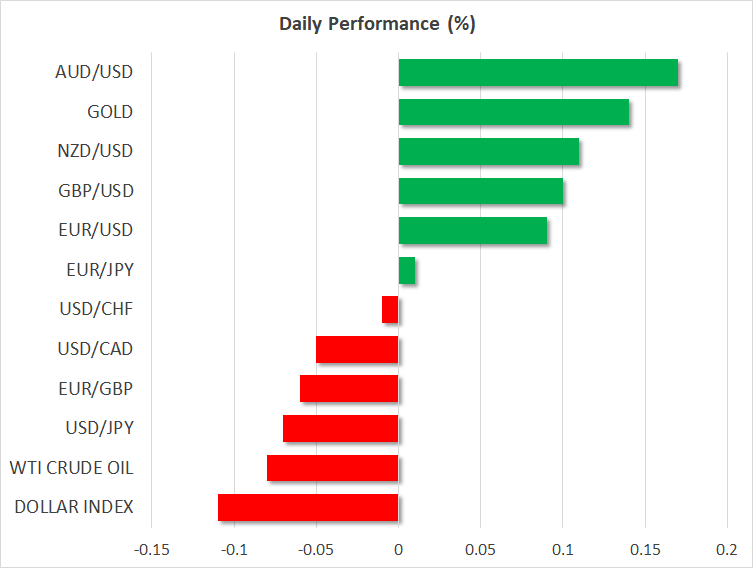
The dollar corrected lower against a basket of six major currencies on Thursday, as a recovery in investors' risk appetite curbed demand for the US currency, which had been attracting safe-haven inflows in recent days amid jitters in emerging markets. Similarly, the Japanese yen felt the heat as well, retreating against all its major peers, while US stock indices closed notably higher. The rebound in risk sentiment followed news that the US and China are gearing up for another round of trade talks in late August, amplifying expectations that the standoff between them may ultimately be resolved via negotiations.
While markets reacted positively to the trade headlines, it's worth noting that President Trump poured some cold water on speculation for an immediate solution yesterday, saying: “they are just not able to give us an agreement that is acceptable”. Indeed, his statement perfectly describes how the latest round of negotiations ended, with China offering material concessions only for the US to brush them aside as insufficient. It's quite difficult to envision China offering much more than it already has and thus, the rift between the two sides appears too large to overcome at the moment – suggesting that markets may be in for a sore disappointment in case these talks fail to bear fruit again.
Elsewhere, the British pound barely advanced, largely unable to capitalize on strong UK retail sales figures. All eyes remain on the Brexit talks, where we may get some fresh comments today. Note, though, that considering the significant losses the pound recorded lately amid speculation for a no-deal EU exit, the Brexit risk premium on the currency is probably quite high already. This implies the risks surrounding sterling from these talks may now be asymmetrical, and tilted to the upside. Continued lack of progress could confirm the current pessimistic narrative and hence keep the currency at current low levels, or even trigger some further moderate losses. In contrast, any hints the negotiations are moving forward may come as a positive surprise, leading to an outsized relief bounce.
In EM, the Turkish lira's rebound was halted yesterday by fresh developments in the US-Turkey diplomatic showdown. US Treasury Secretary Mnuchin warned that Turkey could face even more sanctions if the American pastor is not released “quickly”, stopping the lira's recovery in its tracks. Dollar/lira appears to have stabilized around the 5.80 handle.
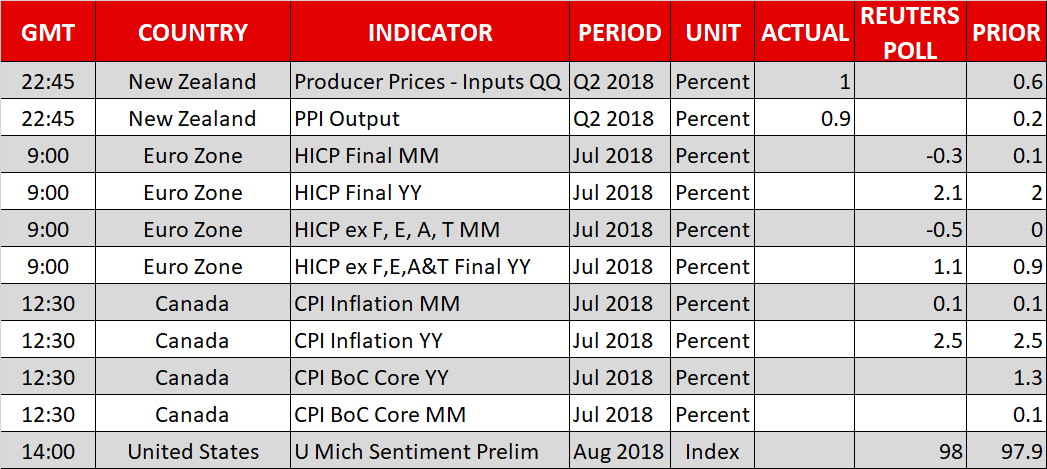
Day ahead: Canadian inflation due; University of Michigan consumer sentiment survey also on the horizon
Friday's calendar features inflation figures out of the eurozone and Canada, as well as the University of Michigan's survey on US consumer sentiment.
At 0900 GMT, the eurozone will be on the receiving end of final inflation figures for July. The Harmonised Index of Consumer Prices (HICP), that uses a common methodology across EU countries, is anticipated to have contracted by 0.3% on a monthly basis in July, something which would put the annual pace of expansion in the measure at 2.1%, leaving it unrevised relative to the preliminary reading and above June's 2.0%. The core HICP rate, that excludes food, energy, alcohol and tobacco, is forecast to grow by 1.1% y/y, higher than June's 0.9%. Given that the numbers constitute the final releases, barring a significant deviation from the preliminary estimates, the euro is not expected to react much to the prints.
Canada's inflation numbers for July will be made public at 1230 GMT, constituting perhaps the release that has the greatest capacity to lead to considerable movements out of today's calendar. CPI is projected to have expanded by 2.5% y/y in July, the same as in June and within the Bank of Canada's target band of 1-3%. Core CPI, as well as the measures of inflation monitored by the Bank of Canada – median, common and trimmed CPI – will also be closely watched by market participants, which have so far almost completely priced in an additional 25bps rate hike by the BoC in 2018, according to Canadian OIS. A data beat may spur speculation for two more rate increases during the year, subsequently boosting the loonie.
Out of the US, the University of Michigan's preliminary survey on August consumer sentiment is due at 1400 GMT. The relevant index measuring consumer morale is projected to show a marginal improvement relative to July's print, while the survey's sub-indices gauging inflation expectations will also be attracting attention.
Meanwhile, sterling is expected to be sensitive to any Brexit related developments.
Also of interest, especially in view of the Turkish drama taking place recently, Standard & Poor's sovereign credit rating report on Turkey is due out later on Friday; the country's bonds are junk-rated and an additional cut may exert pressure on the lira.
RBA Assistant Governor Luci Ellis will be giving a speech at 0730 GMT.
In energy markets, the Baker Hughes count of active US oil rigs is due at 1700 GMT.
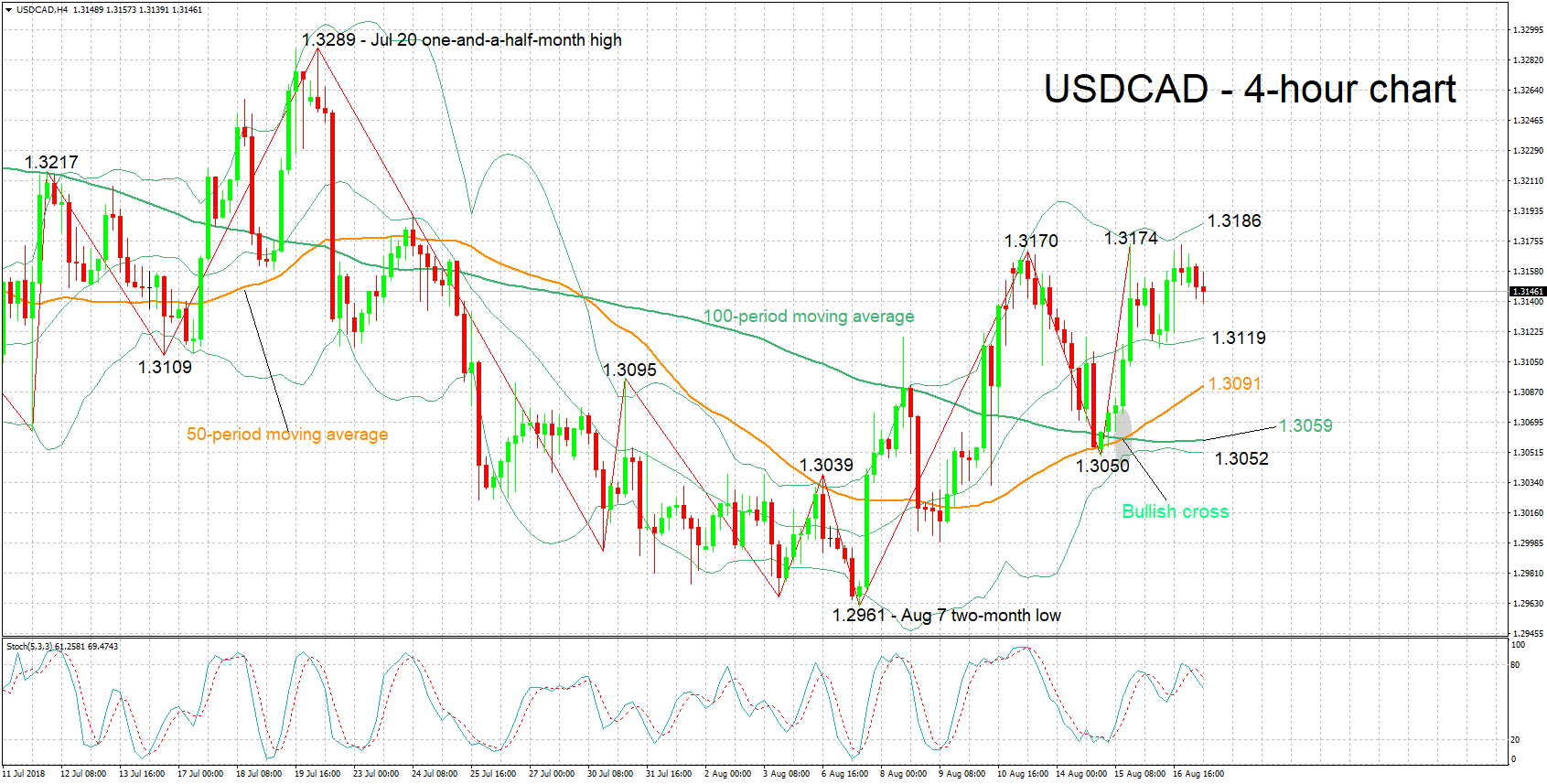
Technical Analysis: USDCAD bearish signal by stochastics in very short-term
USDCAD has eased a bit after touching a three-week high of 1.3174 on August 15. The stochastics are giving a bearish signal in the very-short-term as the %K line crossed below the slow %D one.
An inflation beat out of Canada later on Friday is likely to boost the loonie, pushing USDCAD lower. Support to declines may come around the middle Bollinger line – a 20-period moving average line – at 1.3119; the area around this includes the 1.31 round figure as well. Further below, the current levels of the 50- and 100-period MAs at 1.3091 and 1.3059 respectively, as well as the lower Bollinger band at 1.3052 would be eyed.
Weaker-than-anticipated CPI readings on the other hand, are expected to boost the pair. Resistance to advances could occur around the upper Bollinger band at 1.3186; the region around this encapsulates August 15’s three-week peak, as well as another high from the recent past at 1.3170 and the 1.32 handle. Further above, the one-and-a-half-month high of 1.3289 from late July would increasingly come into scope.
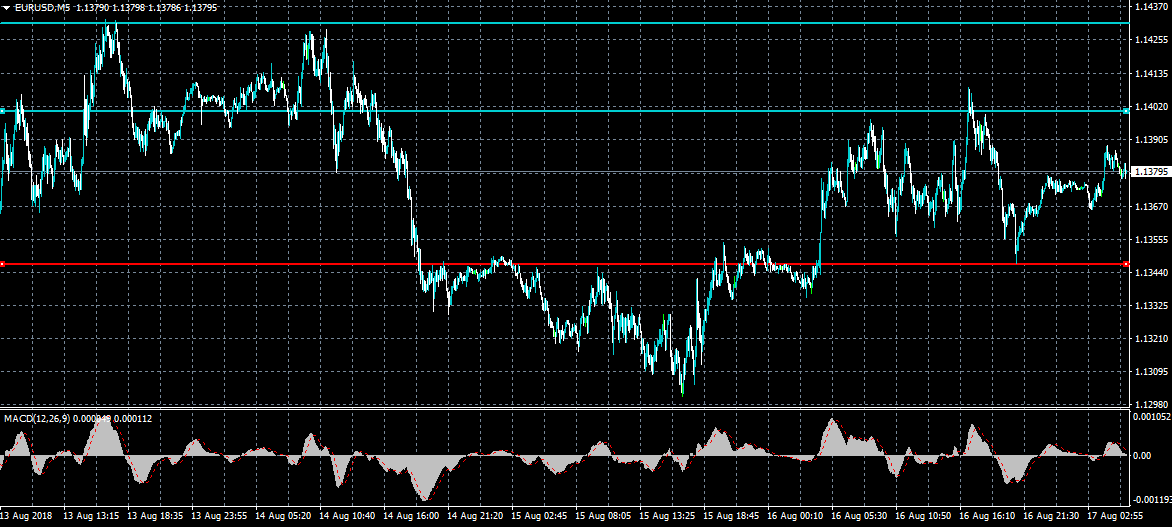
EURUSD Buyers Have The Upper Hand Above 1.1345
The EURUSD pair continues to press against the 1.1400 resistance level on Friday, as the US dollar index fades away from a thirteen-month trading high. Further upside is still expected in the EURUSD will price continues to trade above the 1.1345 support level. Traders will now take their direction from the eurozone consumer price index, with market expectations tilted to the downside.
The EURUSD pair is only intraday bullish while trading above the 1.1345 level, key resistance is found at the 1.1430 and 1.1480 levels.
If the EURUSD pair moves below the 1.1345 level key support is found at the 1.1300 and 1.1230 levels.
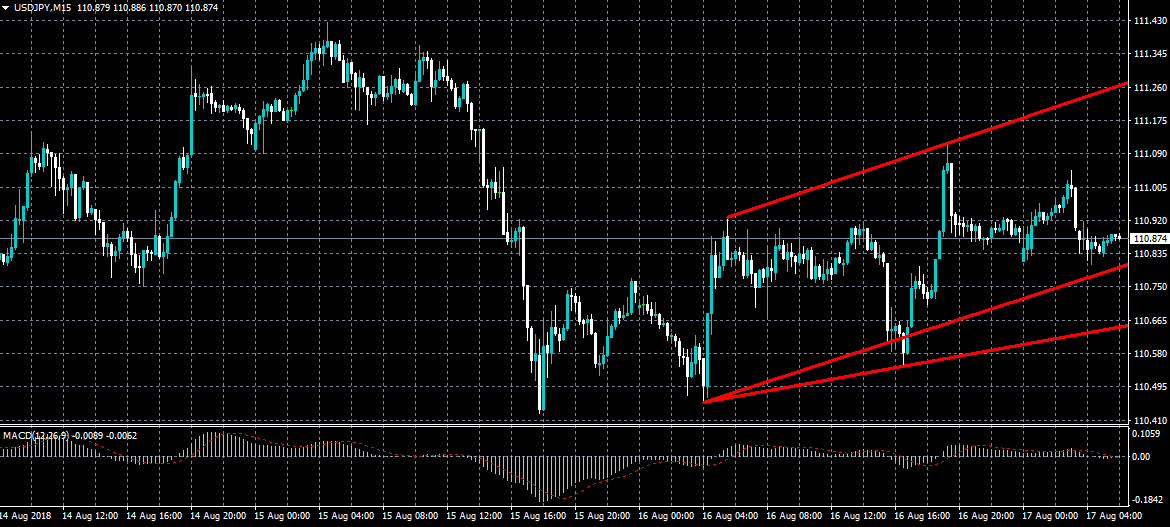
USDJPY Trades Inside Bearish Flag Pattern
The US dollar continues to struggle for direction against the Japanese yen on Friday, as financial markets calm after recent fears about the Turkish economy. The USDJPY pair currently trades within a well-defined bear flag pattern which extends from 110.65 to the 111.25 level. Traders should also note that price is also trading inside much larger bearish head and shoulders pattern.
The USDJPY pair is only bearish while trading below the 110.65 level, key support is now found at the 110.10 and 109.56 levels.
If the USDJPY pair trades above the 111.25 level, buyers are likely to test towards the 111.37 and 111.80 resistance levels.
Inflation Data Hits The Headlines On Friday
The latest readings on consumer inflation for the Eurozone and Canada will headline the financial markets on Friday.
Action begins at 08:00 GMT with a report on the Eurozone currency account balance. Data from the European Commission's statistical agency is expected to show a surplus of €23.2 billion in June compared with €22.4 billion the previous month.
At 09:00 GMT, Eurostat will release the final batch of July consumer inflation data for the 19-member Eurozone. The consumer price index (CPI) is forecast to have declined 0.3% in July. That translates into a year-over-year gain of 2.1%, which is still in line with the European Central Bank's target. So-called core inflation, which strips away volatile goods such as food and energy, is forecast to fall 0.5% month-on-month. In annualized terms, CPI is likely to come in at 1.1%.
Shifting gears to North America, Statistics Canada will release its monthly CPI report at 12:30 GMT. Canadian inflation likely edged up 0.1% in July. That would bring annual CPI to 2.5%. Canada's core inflation rate is forecast to dip 0.1% on month and rise 1.3% annually.
The University of Michigan will release the monthly consumer sentiment index at 14:00 GMT. The preliminary gauge is forecast to read 98.0 in August compared with 97.9 the previous month.
Energy traders will also be keeping tabs on weekly crude inventory data courtesy of Baker Hughes Inc. The report will be released at 17:00 GMT.
The US dollar continues to assert its dominance over the global foreign exchange market, with rising inflation and protectionist policies keeping the greenback elevated. The US dollar index (DXY), which tracks the performance of the greenback against a basket of six peers, set a fresh 13-month high this week as the euro, pound and Aussie plunged to new lows.
EUR/USD
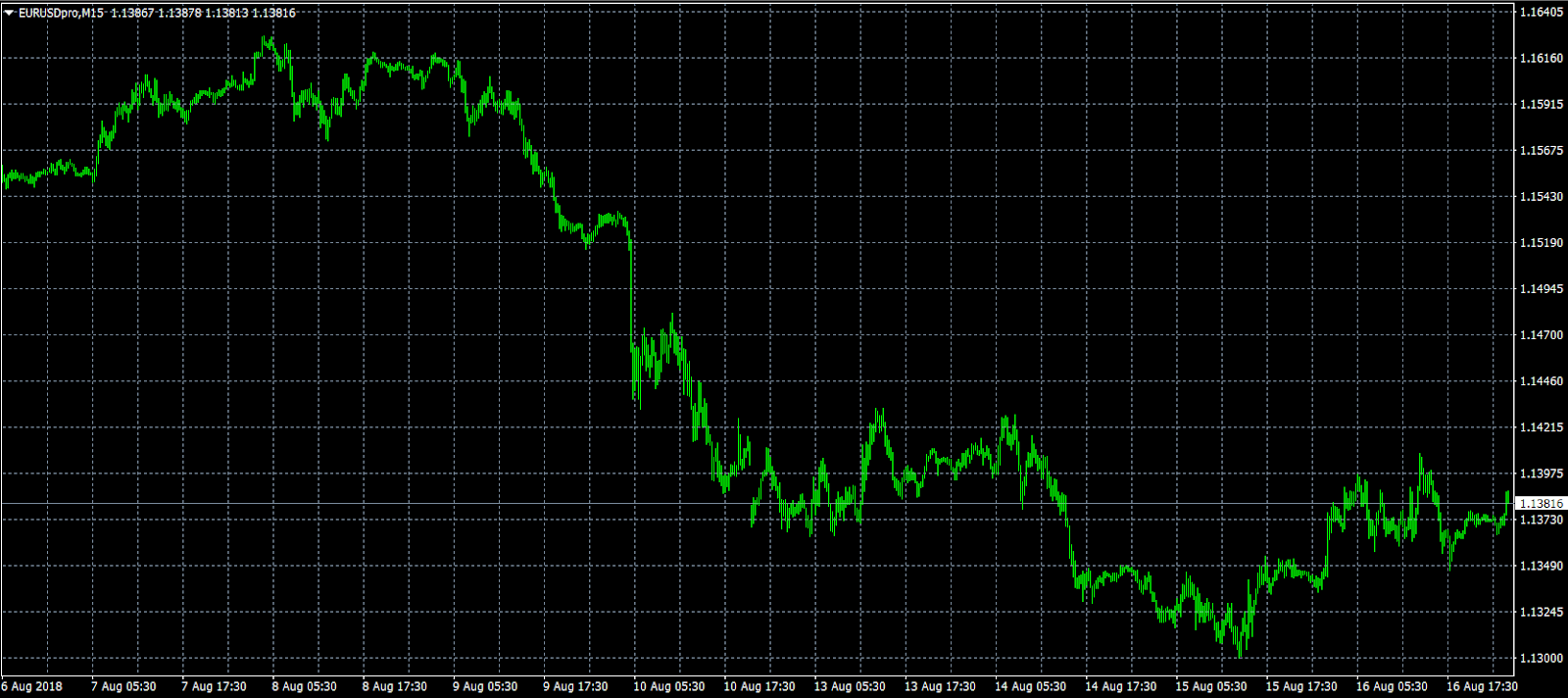
Europe's common currency has recovered somewhat from its recent yearly low, though the general trend remains overwhelmingly bearish. The EUR/USD exchange rate bottomed at 1.1308 this week but has since recovered to around 1.1390. An assertive dollar is expected to keep the euro bulls in check in the short term.
USD/CAD
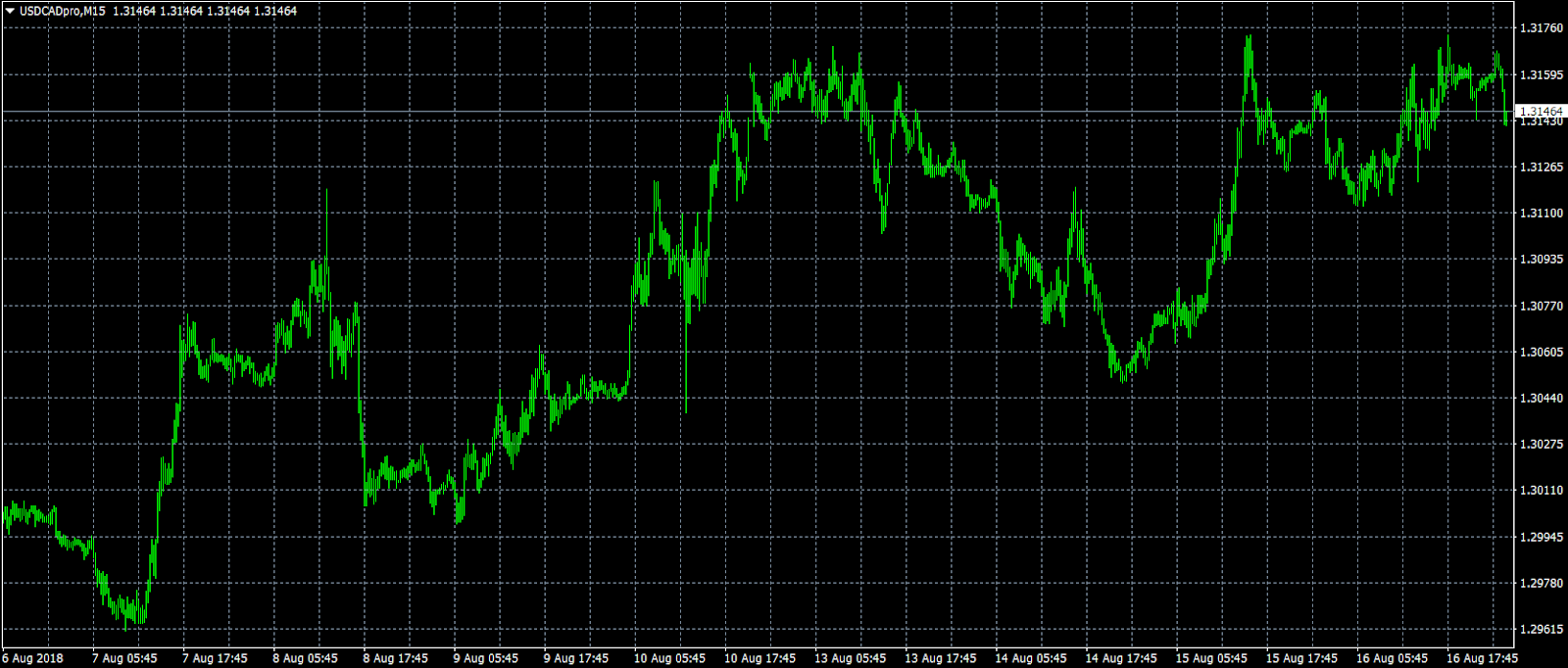
The North American pair took a breather on Thursday following a sharp rebound the previous session. The USD/CAD exchange rate is now trading in the mid-1.3100 region, with the bulls eyeing a re-test of the 1.3200 handle. To get there, they must first overcome the 15 August swing high of around 1.3170.
USD/JPY
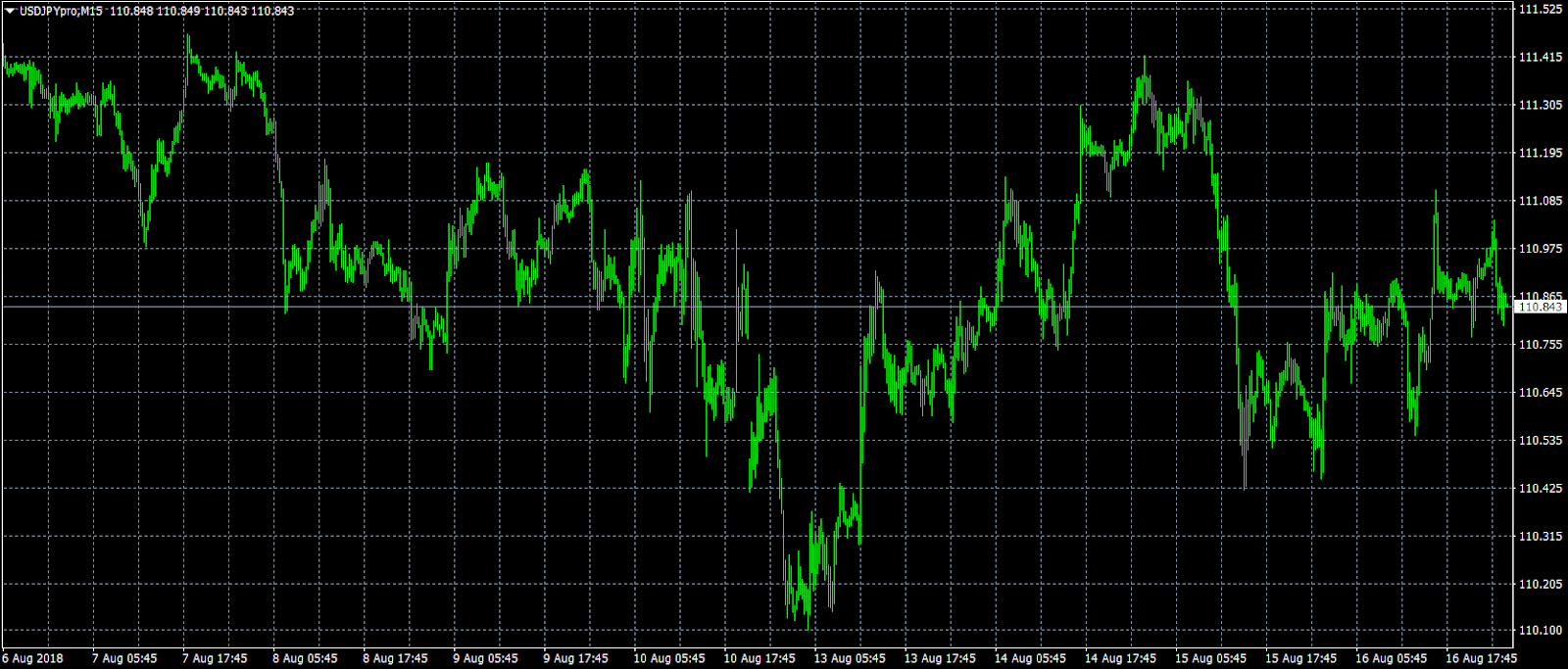
The Japanese yen has been surprisingly resilient in the face of a global dollar onslaught. The USD/JPY is headed for a weekly drop, likely in response to growing risk aversion in the stock market earlier in the week. USD/JPY currently sits at 110.88 and is likely to continue its rangebound theme.
Sentiment Supported By Trade Talk Hopes, Gold Stabilizes
A sense of relief was felt across financial markets following the news that Beijing will resume trade talks with Washington next week.
Although the chances of a breakthrough deal from lower-level talks are seen as unlikely, the meeting could be a positive step towards easing trade tensions between the world’s two largest economies. Asian shares traded mixed on Friday following overnight gains on Wall Street. European equity markets could find support today as optimism over the renewed trade talks boost investor sentiment.
Turkish Lira stabilizes…. but for how long?
The Turkish Lira has staged an incredible rebound against the Dollar this week after freefalling to a record low below 7.23.
The Lira was thrown a lifeline following reports of Qatar pledging $15 billion in direct investments for Turkey. Prices recovered further after the nation’s Finance Minister Berat Albayrak sought to calm investors during a conference call. However, buying sentiment towards the Lira was later dealt a blow, after the United States warned that Turkey will face more sanctions if the US pastor Andrew Brunson is not released.
Taking a look at the technical picture, while the Lira has scope to claw back more losses, gains may be capped by the ongoing uncertainty. The USDTRY has scope to challenge 5.71 if bears can maintain control below the 5.80 level.
Commodity spotlight – Gold
Gold prices nudged higher on Friday morning thanks to a softer US Dollar. However, the yellow metal remains on track to post its largest weekly decline since the middle of 2017.
It is becoming increasingly clear that the yellow metal has struggled to maintain its safe haven allure, with investors rushing to the Dollar instead in these times of uncertainty. With the Greenback heavily supported by US rate hike expectations and safe-haven demand, Gold is likely to witness further losses moving forward.
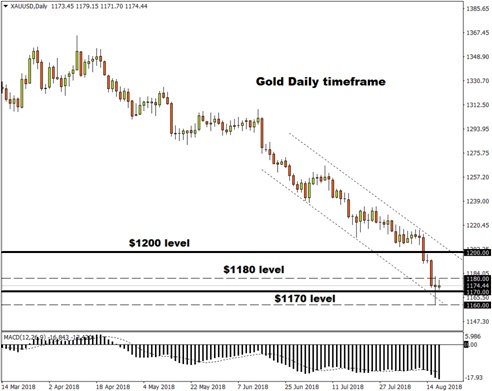
Regarding the technical picture, the yellow metal is heavily bearish on the daily charts. A breakdown below $1171 could invite a decline back towards $1160. A technical rebound back towards the psychological $1200 remains a possibility if bulls are able to push prices back above $1180.
Risk Sentiment Turned Positive During Asian Trading Yesterday
Markets
Risk sentiment turned positive during Asian trading yesterday on news that China and the US will restart trade talks next week. Asian equity gains spilled to Europe (+0.5%) and the US (+0.8% with Dow outperforming). Moves on other markets were much smaller with traded volumes being extremely low. Core bonds started on a weak footing, before regaining losses during European trading. Wall Street’s strong performance eventually sent the Bund and US Note future back south. Changes on the German yield curve ranged between +1.1 bp and +1.6 bps with the belly of the curve underperforming the wings. The US yield curve flattened with yield changes varying between +0.8 bps (2yr) and -0.6 bps (30-yr). 10-yr yield spreads changes vs Germany on intra-EMU bond markets narrowed up to 2 bps with Italy outperforming (-7 bps) and Greece underperforming (+4 bps). The sell-off in EM currencies stopped yesterday, but they failed to stage a comeback. Both USD/JPY and EUR/USD ended the marginally higher, respectively at 110.90 from 110.46 and at 1.1377 from 1.1345. EUR/USD briefly tried to regain the 1.14 handle intraday after the strong US stock market opening. Mixed to disappointing US eco data hardly impacted trading yesterday. Sterling remained in the defensive in the run-up to brexit-talks between the EU and the UK. EUR/GBP closed at 0.8946 compared to a 0.8935 opening.
Summer trading conditions are expected to remain News Headlines in place today. The eco calendar is empty apart from August Michigan consumer confidence and final EMU CPI data. None of them will probably leave a trace on markets. Overnight trading suggest a slow start to the day with most Asian bourses recording small gains (apart from China) and the US Note future & USD/JPY oscillating near yesterday’s closing levels. We have no strong view for today. Investors will gradually start eying Fed Chair Powell’s speech on the economy and monetary policy in Jackson Hole next week (August 24). From a technical point of view, the German 10-yr yield is near the bottom of the 0.3%-0.5% sideways range which we deem strong support. The US 10-yr yield is comfortably near the middle of the 2.8%-3% range. EUR/USD remains in the defensive following the break below 1.1510 which paves the way for a further decline towards 1.1187. Sterling suffers with the brexit-clock ticking in the queen’s money’s disadvantage. A first test of EUR/GBP 0.9031 resistance failed last week. Brexit-talks continue in Brussels today.
News Headlines
German Chancellor Angela Merkel is set to meet Russian President Vladimir Putin tomorrow, near Berlin. They will discuss the ongoing conflicts in Syria, Ukraine and differences on the Nord Stream 2 pipeline. A meeting with one of his major critics is a breakthrough for Putin while Merkel needs to reassert her leadership role in Europe.
Valdis Dombrovskis, the European Commission financial services chief, has warned that the EU’s goal for creating a markets union by 2019 might not be reached. He said that because of governments lagging in approving the necessary laws, the EU’s flagship project to boost private sector investment in business is in jeopardy.
Reserve Bank of Australia Governor Philip Lowe said in a semiannual testimony in parliament that the bank is likely to hold rates steady for “a while yet”. He stated that the bank’s targets of full employment and an inflation rate within the target rate on a sustained basis should be more clearly in sight before the bank will change the current monetary policy stance.
US Secretary of Treasury Steven Mnuchin has threatened Turkey to introduce more sanctions if President Erdogan refuses the release of the American pastor, escalating the diplomatic spat that has spread to global markets. The US already put sanctions on several of the Cabinet members.
GBP/JPY Daily Outlook
Daily Pivots: (S1) 140.34; (P) 140.83; (R1) 141.46; More...
Intraday bias remains neutral for consolidation above 139.88 temporary low. Deeper fall could be seen. But considering loss of downside momentum, downside will be contained by 139.29/47 key support level to bring rebound. On the upside, break of 142.46 will indicate short term bottoming and turn bias back to the upside for stronger rebound.
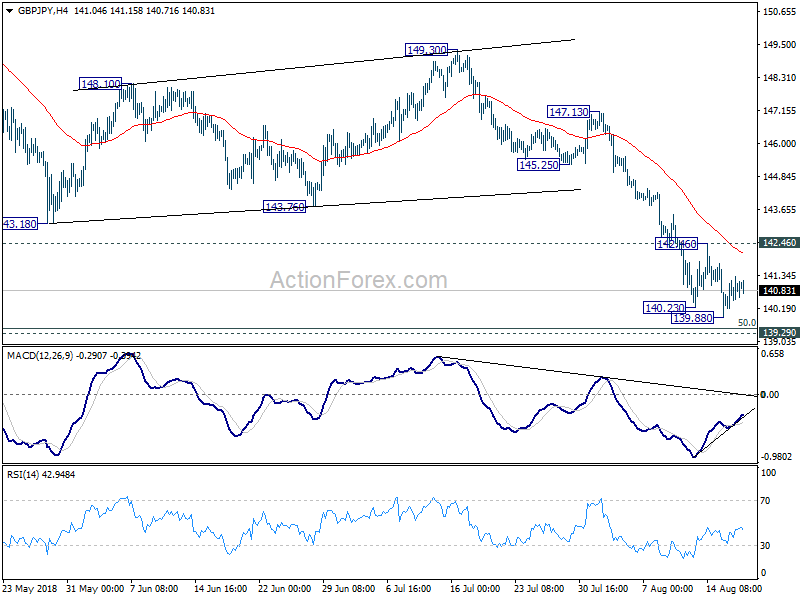
In the bigger picture, at this point decline from 156.59 is still seen as a corrective move. But the current downside accelerate makes this view shaky. Focus will be on 139.29 cluster support (50% retracement of 122.36 to 156.59 at 139.47). Strong rebound from there will re-affirm the bullish case that rise from 122.36 is still to extend through 156.59 high. However, sustained break of 139.29/47 should confirm medium term reversal. GBP/JPY would then target a retest on 122.26 (2016 low).

EUR/JPY Daily Outlook
Daily Pivots: (S1) 125.46; (P) 125.98; (R1) 126.67; More....
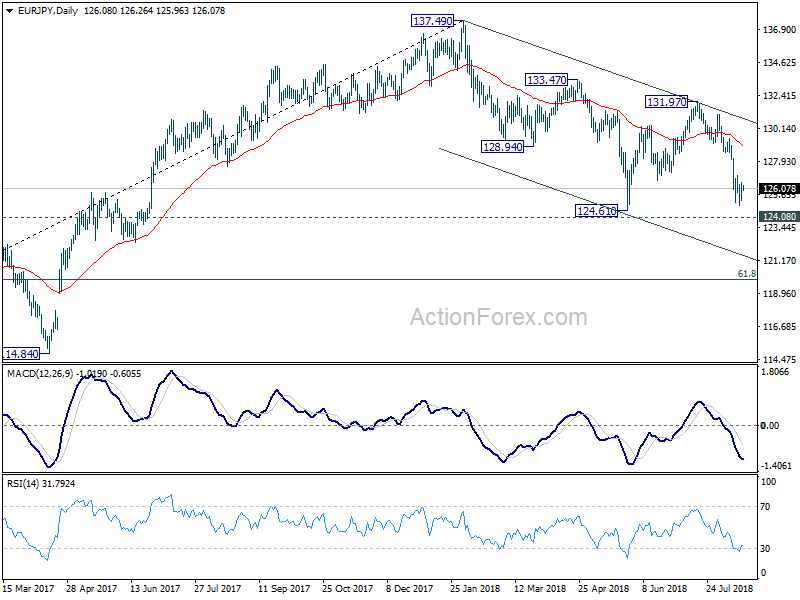
Intraday bias in EUR/JPY remains neutral for the moment. With 126.98 minor resistance intact, deeper fall could still be seen. But considering loss of downside momentum, downside will likely be contained by 124.08/61 key support zone to bring rebound. On the upside, break of 126.98 will indicate short term bottoming and turn bias back to upside for stronger rebound.
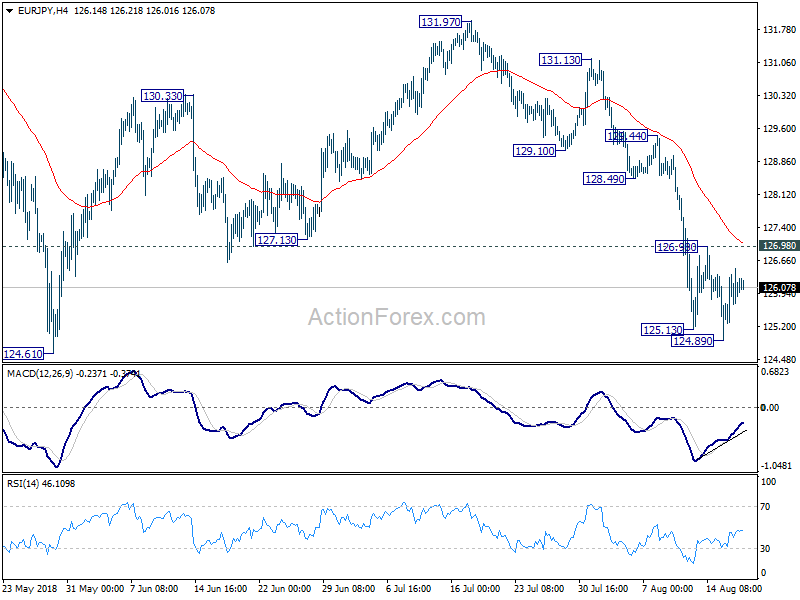
In the bigger picture, focus is back on 124.08 key resistance turned support. Decisive break there will argue that whole rise from 109.03 (2016 low) has completed at 137.49. Deeper decline would be seen to 61.8% retracement of 109.03 to 137.49 at 119.90 next. Sustained break there will pave the way to 109.03 and below. Meanwhile, rebound from 124.08 will keep medium term bullishness intact for another high above 137.49.