Sample Category Title
RBA Lowe warned of trade tension and highly unusual US fiscal stimulus
RBA Governor Philip Lowe appeared before the House of Representatives Standing Committee on Economics today. He reiterated the three points in communications about monetary policy. Firstly, employment and inflation are "moving in the right direction". Secondly, the next move is interest rates is "to be up". Thirdly, progresses is expected to be "gradual" and there is "not a strong case for near term adjustment in interest rates.
Lowe also highlighted a few global risks. Firstly, in some countries, businesses are delaying investment due to rising trade tensions. If it become a "more general story", it's the channel through which trade tensions would "sap the current positive momentum" in the global economy.
Secondly, it's "highly unusual" for the US to have "sizeable fiscal stimulus" at a time of "limited capacity". Growth could "surprise on the upside. And Lowe is "less relaxed" than others on the implications on inflation. He warned that Fed could have to withdraw monetary accommodation "more quickly than currently projected"with possibly disruptive consequences in financial markets.
A third set of global risks are from individual economies with "country-specific structural and/or institutional vulnerabilities", including Argentina, Brazil, Italy and Turkey.
His full opening remarks here.
China State Council to boost private investments, remove obstacles
China's official news agency Xinhua reported that the State Council decided on a host of measures to boost private investment, at a meeting yesterday. And, a number of projects should be identified for attracting private investments. Additionally, the State Council meeting called for lowering thresholds, shoring up the weak links, boosting domestic demand, promoting employment and strengthening the impetus for long-term development.
The measures will include tax and fee cutting for private businesses, VAT reforms, improvements in financing transmission mechanism, and risk compensation mechanism. In particular, obstacles in fields like healthcare and aged-care would be removed, including regulations on land use, funding support and personnel training.
Premier Li Keqiang was quoted saying that "the potential of consumption as a driver for growth need to be further unlocked. At the same time, more efforts need to be made to reduce business costs, support export, and make better use of foreign investment."
Japan manufacturers sentiment hit 7-month high, but non-manufacturing at 1.5 year low
Reuters Tankan manufacturers index rose to 30 in August, up from 25. However, the non-manufacturers index dropped sharply to 25, down from 34.
With the sharp 5 pts rise in index, manufacturer's sentiment, hit the highest level since January. Back then it was an 11-year high of 35. The index is expected to improve further in the new few months. It highlights the robustness of the manufacturing sector despite rising global trade tension and emerging markets risks.
On the other hand, services sentiments tumbled sharply by -9 to the lowest level since December 2016. It's partly due to once-off factors including abnormal whether including flood rains and heat waves. But the deterioration still indicates fragility in the sector and thus casts doubt on domestic demand. Domestic weakness could amply should there be deterioration in global trade tensions.
USTR Lighthizer: A breakthrough in NAFTA talks in the next several days
US Trade Representative Robert Lighthizer said yesterday that he's "hopeful" that there will be a "breakthrough" in NAFTA talks with Mexico in the "next several days". But he didn't offer any details. It's reported that the two sides have largely agreed on the new rules regarding auto trade. And Lighthizer appeared to be willing to ease on the request of sunset clause in exchange for some concessions from Mexico.
On the other hand, Mexican Economy Minister Ildefonso Guajardo urged that "everybody has got to show some flexibility. And he added that "we have everything on the table, there are no preconditions and we'll see at the end how the whole thing falls into place." Also, Guajardo said the sunset clause will be among the "very last times" to be dealt with.
While there appears to be some progresses, it should be noted that Canada is not involved in the bilateral talks between the US and Mexico. And is unsure how Canada would be reengaged.
Eco Data 8/17/18
[php_everywhere instance="1"]
Mid-US session update: DOW surges on Walmart, but no reversal for Yen yet
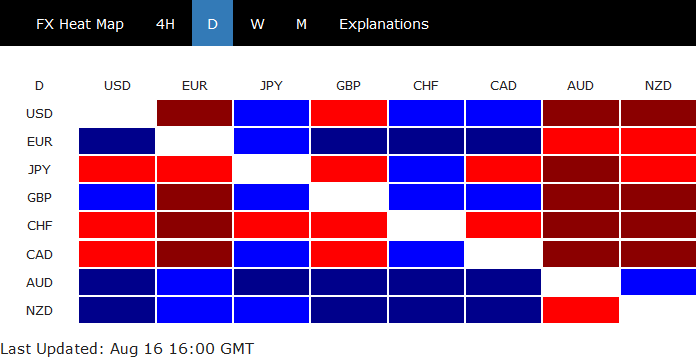
While risk appetite is strong in the first half of US session, Yen is actually not the weakest. Swiss is the biggest loser today, followed by Canadian Dollar. Australian Dollar and New Zealand Dollar remain the strongest ones. Yen and Dollar are just mixed only. We'd like to point out again that, despite recoveries in EUR/USD, GBP/USD, EUR/JPY and GBP/JPY, these four pairs are kept below near term resistance. The levels are 1.1430 in EUR/USD, 1.2826 in GBP/USD, 126.98 in EUR/JPY and 142.46 in GBP/JPY. There is no indicate of reversal yet and they stay bearish.
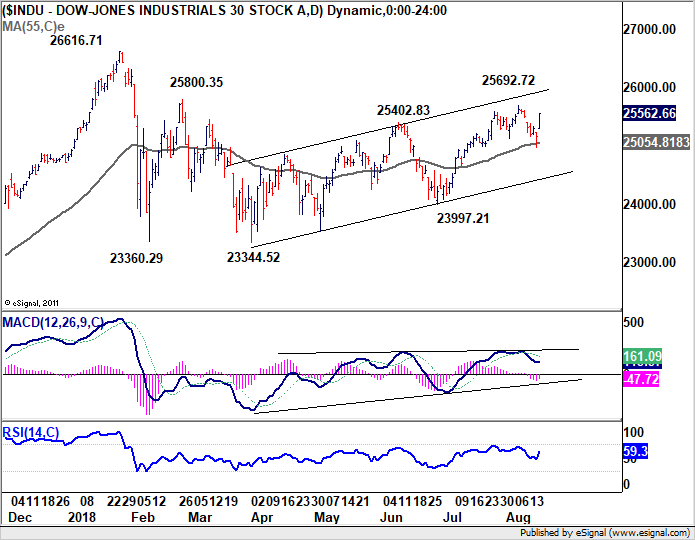
US equities are having a strong rally today. DOW's rally is heavily driven by the stellar earnings report of Walmart, which shares also surged more than 9%. The retail giant reported Q2 same-store sales growth that reached a decade high. At the time of writing, DOW is gaining 1.57%. The strong rally negated yesterday's sharp fall. And, with strong support seen at 55 day EMA, near term bullishness is retained. It's now heading back to 25692.72. Nonetheless, we're still expect strong resistance between 25800.35/26616.71 to limit upside. Meanwhile, S&P 500 is up 1.05%, NASDAQ is up 0.91%.
.
European indices also posted solid gains today. FTSE closed up 0.78% at 7556.38. DAX closed up 0.61% at 12237.17. CAC up 0.83% at 5349.02. However, all are kept below yesterday's high at 7632, 12428.56 and 5417.18 respectively. Today's recoveries are merely seen as a corrective move only.
Elliott Wave Analysis: USD Index Update
USD Index is slowly turning to the downside, away from 96.98 level which is a sign that wave 3 found a top and corrective wave 4 is in play. As such we see current overlapping decline as sub-wave a of 4, which can once completed push price into a new temporary pullback for sub-wave b. Support for the whole correction can be around the Fibonacci ratio of 38.2, and near the 96.13 level.USD Index, 1h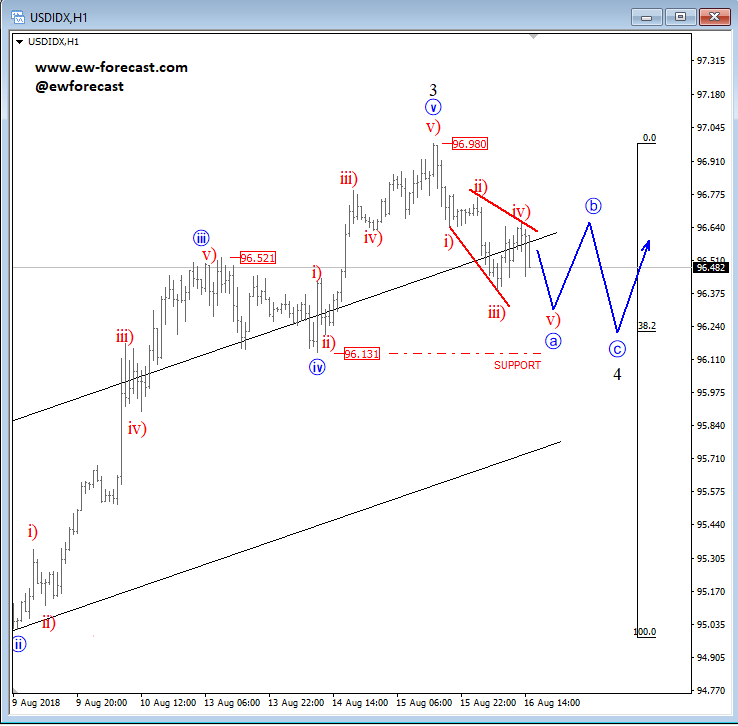
Yen Shrugs Off Lower Japanese Trade Balance
It has been an uneventful week for the yen and that trend has continued in the Thursday session. In the North American session, USD/JPY is trading at 110.77, up 0.02% on the day. On the release front, Japan’s trade surplus with the US dropped 22.1% in July. It was a busy day for U.S indicators. Building Permits improved to 1.31 million, matching the estimate. Housing starts remained at 1.17 million, short of the estimate of 1.27 million. On the manufacturing front, the Philly Manufacturing Index dropped sharply to 11.9, missing the estimate of 21.9 points. Unemployment claims edged down to 212 thousand, shy of the estimate of 215 thousand. On Friday, the U.S releases Preliminary UoM Consumer Sentiment.
The imposition of U.S steel and aluminum tariffs on Japanese exporters has soured economic relations between the two economic superpowers, and Japan has warned that it could retaliate, although Japan has refrained from slapping tariffs on U.S products. The sides met last week in Washington, but there has been no breakthrough in the impasse. Japan is still smarting from the U.S decision to withdraw from the Trans-Pacific Partnership and is intensifying efforts to reduce its economic dependence on the United States, and signed a free trade agreement with the European Union in July. Still, the U.S is Japan’s second-biggest trading partner and accounts for 19% of Japanese exports, so Japan will need to find a way to smooth relations with the unpredictable Donald Trump.
Canadian Inflation Data in Focus as Loonie Hopes for NAFTA Deal
Canada will be on the receiving end of inflation data for July on Friday, at 1230 GMT. Forecasts suggest the headline CPI rate remained unchanged, which would likely keep the Bank of Canada (BoC) on track to deliver at least one more rate increase this year and thereby, potentially benefit the loonie. Beyond economic data, any updates on the future of NAFTA will also be crucial for the currency, particularly following recent reports that a deal may be inching closer.
The Canadian economy has been humming along nicely in recent months, with the labor market continuing to tighten and the latest monthly GDP data beating estimates, suggesting that economic growth likely accelerated in Q2. At the same time, headline inflation picked up speed – boosted by past movements in oil prices. While the core measure has stayed relatively subdued, BoC policymakers remain confident it will gradually creep higher as well, amid an improving economic backdrop.
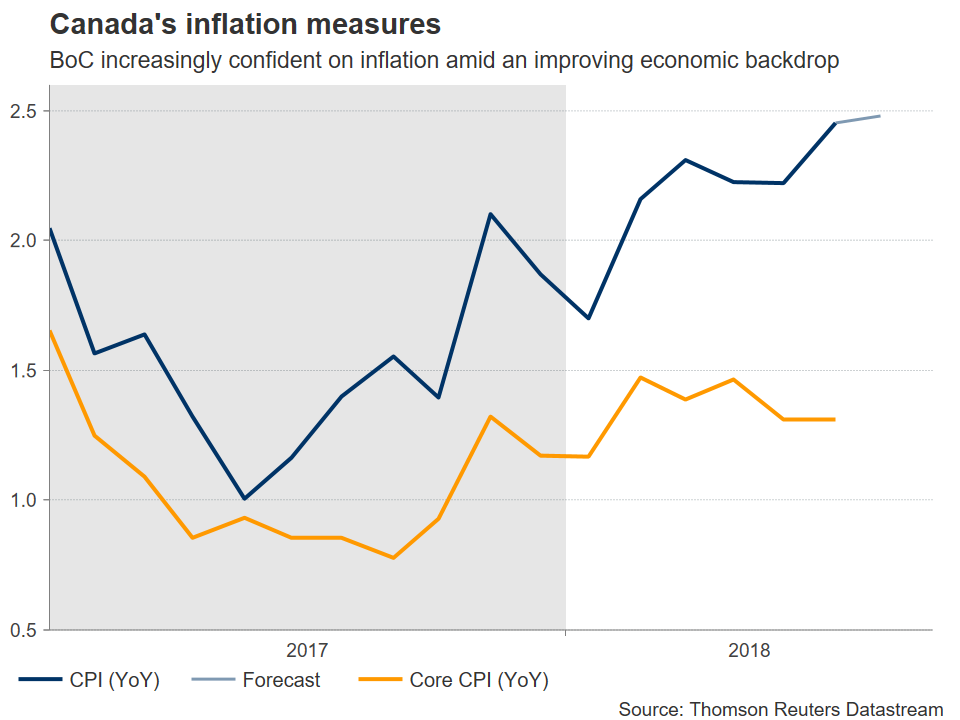
The relatively strong outlook has kept the BoC on track with its normalization efforts, raising rates twice already this year despite the ongoing uncertainty surrounding the NAFTA negotiations. Perhaps as a testament to the strength of the economy, investors appear confident the BoC will hike rates at least once more this year, currently assigning an 86% probability to such an action according to Canada’s OIS. Some pundits even suggest markets are underestimating the possibility that the Bank could raise rates twice by year-end, especially if trade tensions subside a little and domestic economic figures remain firm.
Turning to the upcoming data, Canada’s CPI rate is projected to have held steady at an elevated 2.5% on an annual basis in July. No forecast is available for the core CPI figure, which excludes volatile food and energy items; it stood at 1.3% in June. Looking at gauges of inflationary pressures, the nation’s Markit manufacturing PMI noted that prices charged for final products during the month rose at the highest pace since the survey began in 2010. In isolation, this may suggest that an upside surprise is more likely than a downside one in the CPI prints.
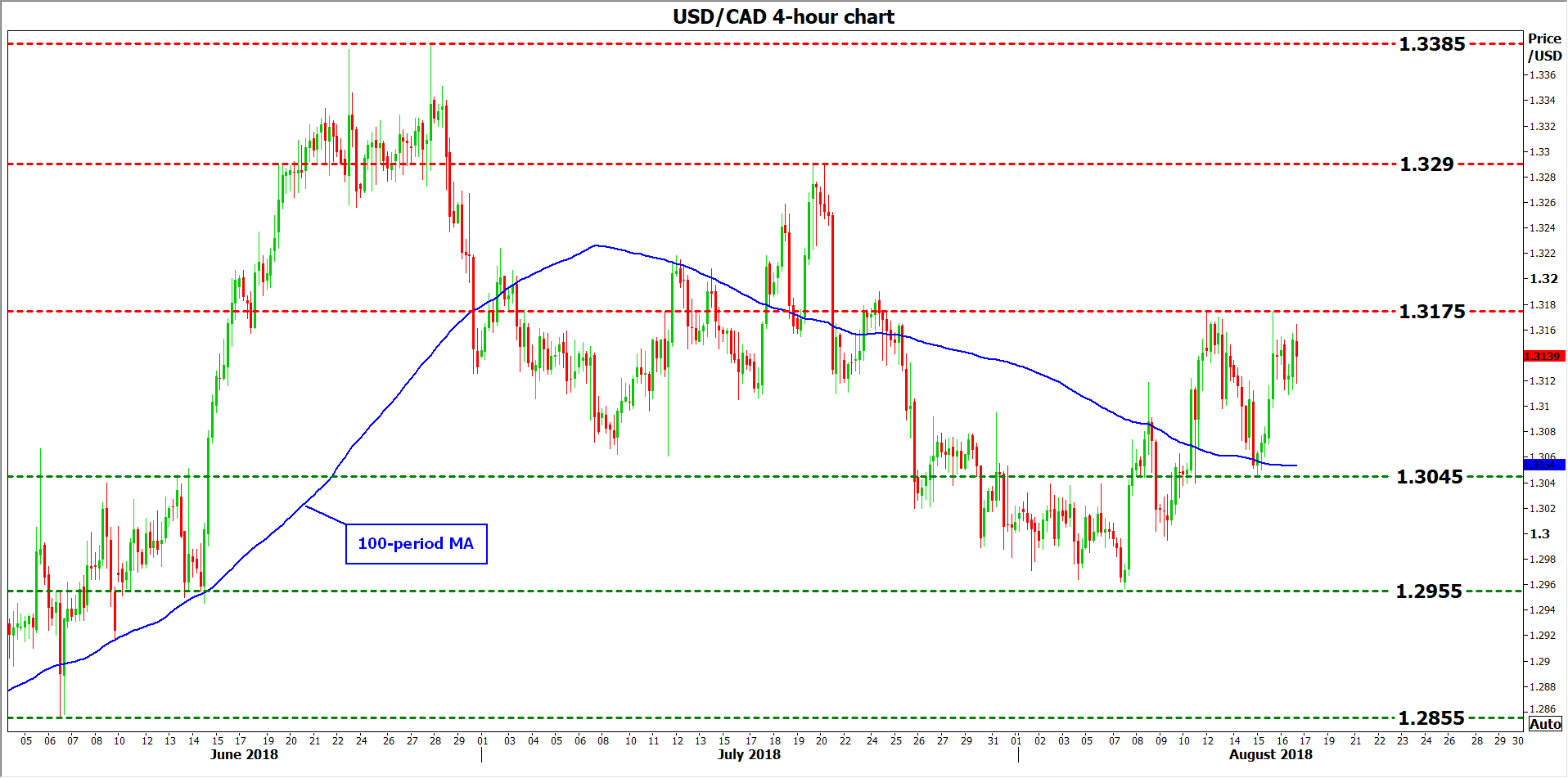
Technically, looking at dollar/loonie, stronger-than-anticipated figures could push the pair lower. Initial support to declines may come around the 1.3045 zone, defined by the August 15 lows. Even lower, the August 7 trough of 1.2955 would come into view, before the 1.2855 territory attracts attention – marked by the June 6 low.
Conversely, in case of disappointing CPI prints that scale back expectations for more BoC tightening this year, immediate resistance to advances could be found near 1.3175, the area that halted the pair’s advance on August 12 and 15. An upside break may shift the focus to the 1.3290 handle, identified by the peaks of July 20, with ever steeper bullish extensions aiming for the 14-month high of 1.3385.
Beyond economic data and monetary policy, the other decisive factor for the loonie will likely be any developments related to NAFTA. Recent media reports suggest that bilateral US-Mexico negotiations are on a good path, and could produce positive results as soon as this month – at which point Canada will be invited back to the table to finalize a deal. While some disagreements still linger, several sources seem to agree there’s clear positive momentum in the talks. Indeed, seeing this through the eyes of President Trump, a deal prior to the US midterm elections in November could be valuable, in the sense that it can be presented to the electorate as a victory – and something concrete with which to justify his administration’s confrontational trade policies. Any hints from the relevant officials that a deal is indeed near its completion could trigger a notable relief rally in the Canadian currency.
EUR50 Slips to 7-Week Lows; Looks for a Rebound
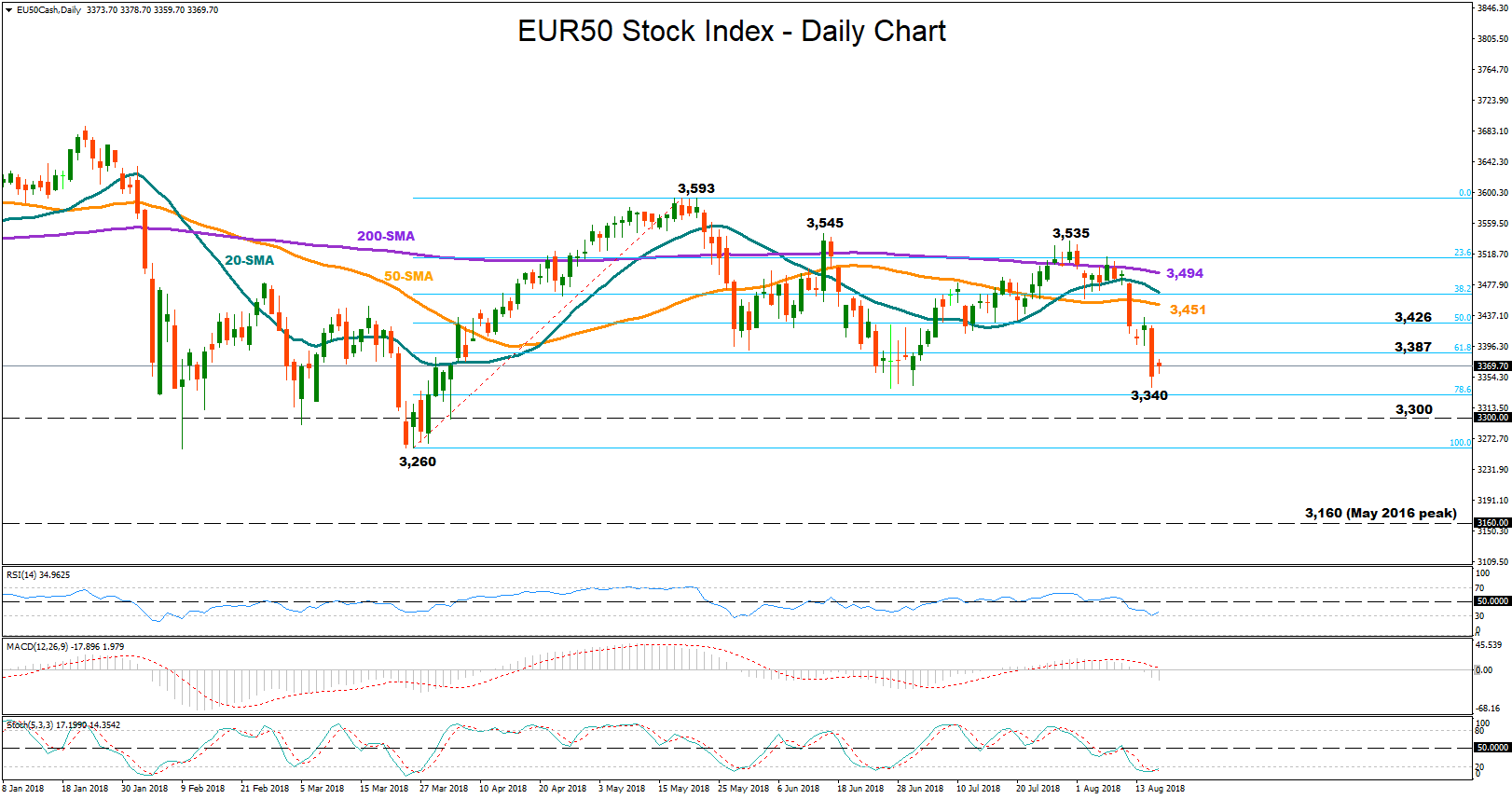
EUR50 stock index lost 1.8% on Wednesday to find support at the 7-week low of 3,340 which stood as a barrier to downside as well as to upside corrections a number of times in the past. This is also where the 78.6% Fibonacci retracement of the upleg from 3,260 to 3,593 is currently located.
In the short-term, bearish pressures are likely to hold as the MACD increases strength to the downside in negative territory and below its red signal line. However, according to the RSI and the Stochastics, the recent fall could be overextended, and a rebound may be around the corner, with the former set to meet its neutral threshold of 50 after bouncing at the 30 oversold mark, and the latter on track to post a bullish cross below 20.
In case of a reversal, the market could rest around the 61.8% Fibonacci of 3,387 before it heads towards the 50% Fibonacci of 3,426. Further up, resistance could run between the 50- and the 200-day (simple) moving averages, this is between 3,451 and 3,494. Yet, it would be more interesting to see whether the bulls can overcome the 3,545 peak, enhancing the case for additional upside moves in upcoming sessions.
Looking at the downside, Wednesday’s low of 3,340 could come into view ahead of the 3,300 support which could be of psychological significance. Even lower, if the price manages to violate the 3,260 bottom, shifting the long-term outlook from neutral to bearish, the next level to watch could be May’s 2016 high of 3,160.