

Sample Category Title
US: Housing Starts Edge Higher in July
U.S. housing starts edged higher in July following a sharp drop in June. Starts rose by just 0.9% m/m to 1.168 million units (annualized), following a further downward revision to the figures for May (-8k units) and June (-15k units). The outturn was much lower than market expectations for a 7.4% showing.
The headline print reflected marginal improvements in both the single and multifamily segments. Single family starts rose 0.9% (to 862k), while multi-family starts came in with a more modest improvement of 0.7% (to 306k), recovering just a fraction of the ground conceded last month.
Building permits posted a 1.5% increase in July, after three consecutive months of declines. There were increases in both the number of single (+1.9%) and multifamily (+0.7%) permits issued.
Regionally, starts were up in the Midwest (11.6%) and South (10.4%), while the Northeast (-4.0%) and West (-19.6%) posted declines. Changes in the Midwest in particular, have been quite volatile of late, veering notably between positive and negative territory. Encouragingly, single-family permits in the South were the highest they have been since July 2007.
Key Implications
Given the size of the decline posted in June, the uptick in July was pretty disappointing. Overall starts are still down 14% from their peak in January of this year. While most of the recent decline has been in the multi-family segment, singles are also down 9% from their peak levels recorded in November 2017.
A lack of housing supply is also pushing up home prices. Unfortunately, headwinds to homebuilding remain in the way of land scarcity, labor shortages, and rising construction costs (exacerbated by tariffs). While demand should continue to be supported by a strong job market and the flow of millennials entering their home buying years, affordability pressures will remain a constraint as long as home prices are rising faster than incomes.
Sunset Market Commentary
Markets:
With the crisis in emerging markets, and especially Turkey, cooling somewhat down, news emerged from the ongoing trade war between the US and China. Chinese authorities announced they will accept an offer made by the United States to send a Chinese delegation to Washington at the end of August to restart informal discussions on possible solutions for their trade dispute. Since the tariff war peaked in June, both countries had not had any official discussions. A sigh of relief penetrated financial markets and pushed investors into a more risk-on mode at the cost of the safe havens. European markets opened in green and were able to hold on to those gains throughout the day. US markets continued that trend, with the Dow Jones even gaining more than 1% at opening. EUR/USD gained some ground on the news and rose 35bp to 1.1385, but stabilized afterwards around 1.1370-1.1380. Later on the day, US data could not initiate a new currency move. Strong retail sales in the UK, 0.7% increase in July against a 0.5% decrease in June, couldn’t support sterling. With no real news on the restart of brexit negotiations today, the pair remained around 0.895.
Global core bonds lost ground overnight (US Note future) or in today’s market opening (Bund) on the headline that China and the US will revamp trade talks at the end of the month.. Risk sentiment slightly improved in globo, with the sell-off in the likes of BRL and ZAR slowing. However, the moves don’t go that far and core bonds even recouped some territory intraday. Traded volumes remain very low. The US Note future received a small additional push in the back following mixed to weaker US eco data. The US yield curve flattens slightly at the time of writing with yield changes ranging between +0.4 bps (2-yr) and -0.4 bps (30-yr). The German curve shifts in similar fashion. The 2-yr yield adds 0.6 bps, while the 30-yr yields loses 0.2 bps. The EMU eco calendar was empty. On intra-EMU bonds markets, 10-yr yield spreads vs Germany narrow up to 4 bps (Italy) with Greece underperforming (+6 bps).
News Headlines:
China is taking measures to ease pressure on its yuan by preventing commercial banks from using interbank accounts to deposit or lend yuan offshore. In addition, the country nearly quadrupled its fixed-asset investment projects in July in an attempt to stabilize its cooling economy.
Credit rating agency Fitch has downgraded its expectations of an orderly transition deal between the UK and the EU. Since the UK voted in 2016 to leave the EU, the rating agency kept a smooth transition as the most likely outcome but has thus changed that view today. “The wide range of possible outcomes means that no individual scenario has a high probability anymore”.
Norges Bank has kept its policy rate unchanged at 0.5%. Norway’s economic conditions hardly changed since June. The central bank expects growth this year at 2.3%. Inflation unexpectedly rose in July (1.4% YoY core inflation) and the bank said price pressures are growing, keeping the planned rate hike for September very likely.
US jobless claims declined for a second week in a row to 212k last week, while 215k was expected. Housing starts rose 0.9% in July, while a 7.4% increase was expected. The Philadelphia Fed Business Outlook disappointed with 11.9 this month (22.0 expected), but its future outlook remains solid at 38.8.
France and and Turkey reported to boost bilateral investment and trade ties
Reuters reported that Turkish President Tayyip Erdogan and French President Emmanuel Macron spoke by phone today. And they talked about developing economic and trade ties and boosting bilateral investment. Macron also told Erdogan that stability in Turkey is important to France. Finance Ministers of the two countries will meet very soon.
Turkish Finance Minister Berat Albayrak held a conference call with thousands of investors and economists. There he tried to assured that the government fully understood and recognized all its domestic challenges. And he insisted that the country's bank were healthy and strong. And, the country would emerge stronger from the currency crisis. Albayrak is Erdogan's son-in-law.
Canadian Manufacturing Sales Up Again in June
Highlights:
- Manufacturing sales jumped another 1.1% in June as shutdowns at petroleum refineries ended.
- Volume sales increased 0.7% but declined about 1.2% excluding the petroleum component.
- Looking through monthly volatility, overall sale volumes were still up 2.8% from a year ago reflecting relatively broadly-based gains. consecutive month.
- The details of the monthly sales data suggest that manufacturing output (i.e. the manufacturing component of monthly GDP) likely increased another 0.2% in June.
Our Take:
As usual, details were more mixed than the 1.1% nominal headline increase — 0.7% excluding price impacts — alone would imply. A 15.9% surge in petroleum & coal refinery sales alone more than accounted for the overall nominal gain in June as temporary maintenance shutdowns that weighed on output in the last two months eased. Sales declined 0.4% excluding petroleum products. Auto sales bounced back after earlier production disruptions but chemical sales declined as pesticide and fertilizer product sales retraced earlier gains. The monthly numbers are often volatile, though. Looking through monthly wiggles, overall sale volumes were still up 2.8% from a year ago suggesting the manufacturing sector in Canada is still holding up relatively well in the face of continued trade uncertainty. The volume of unfilled orders increased another 0.4% month-over-month in June and is up 8.4% year-over-year meaning there is still room for sales to increase further in the near-term.
Concerns about competitiveness and the threat of additional trade disruptions from the U.S. remain given the heavy integration of the manufacturing sector across the Canada-U.S. border. Of course, that reliance cuts both ways, and Canadian manufacturers are likely, at least for now, also benefitting from a much improved U.S. manufacturing sector that posted its strongest year-over-year output growth in more than 6 years in July. Coupled with other better recent economic data — and absent an unexpected shock — the economic backdrop still looks strong enough to warrant further gradual interest rate hikes from the Bank of Canada.
EUR/USD Mid-Day Outlook
Daily Pivots: (S1) 1.1312; (P) 1.1334 (R1) 1.1367; More.....
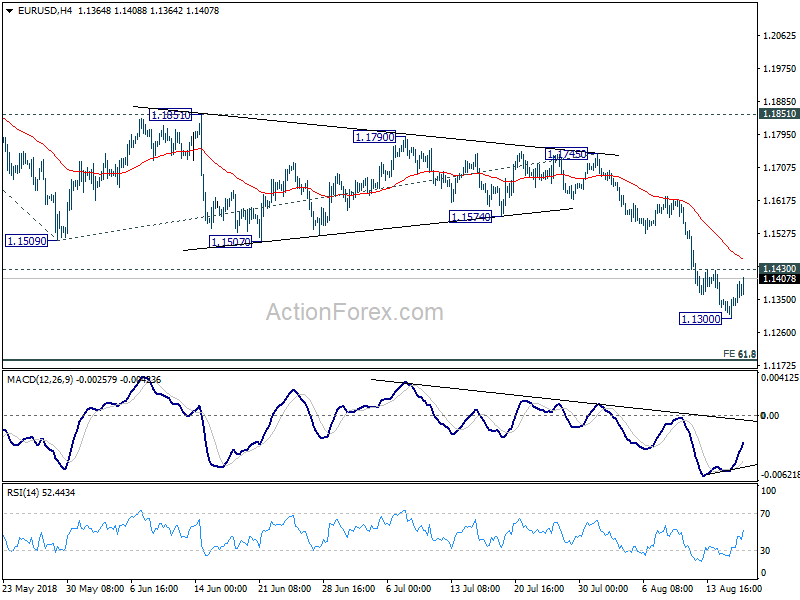
Intraday bias in EUR/USD remains neutral at this point. And, as long as 1.1430 minor resistance holds, further decline is in favor, to 61.8% projection of 1.2413 to 1.1509 from 1.1745 at 1.1186. Note that it's a cluster level with 61.8% retracement of 1.0339 to 1.2555 at 1.1186. Hence, we'll tentatively look for short term bottoming around 1.1186. Meanwhile, considering mild bullish convergence condition in 4 hour MACD, break of 1.1430 will indicate short term bottoming. In that case, lengthier consolidation would be seen first before down trend resumption.
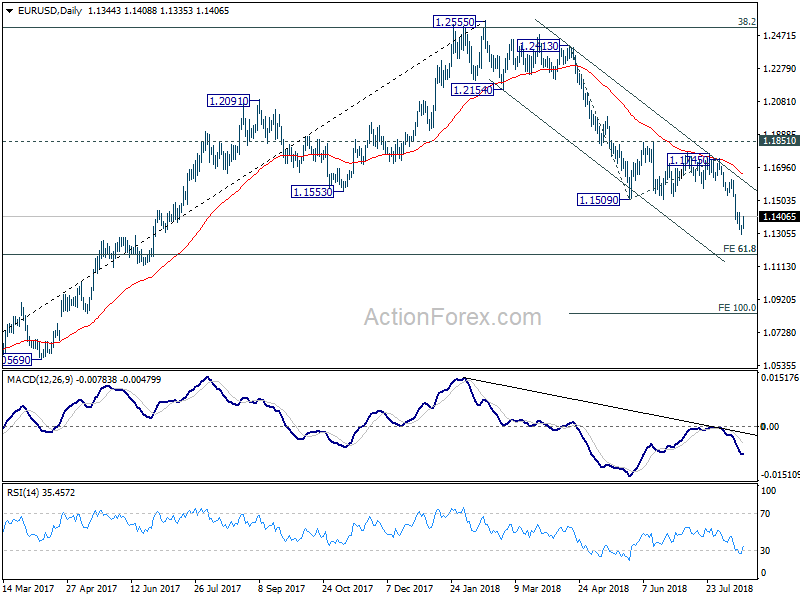
In the bigger picture, the down trend from 1.2555 medium term is in progress for 61.8% retracement of 1.0339 to 1.2555 at 1.1186. Note again that EUR/USD was rejected by 38.2% retracement of 1.6039 (2008 high) to 1.0339 (2017 low) at 1.2516. That carries some long term bearish implications. Sustained break of 1.1186 could pave the way back to retest 1.0339 low. For now, outlook will remain bearish as long as 1.1851 resistance holds, even in case of strong rebound.
USD/CHF Mid-Day Outlook
Daily Pivots: (S1) 0.9914; (P) 0.9949; (R1) 0.9972; More....
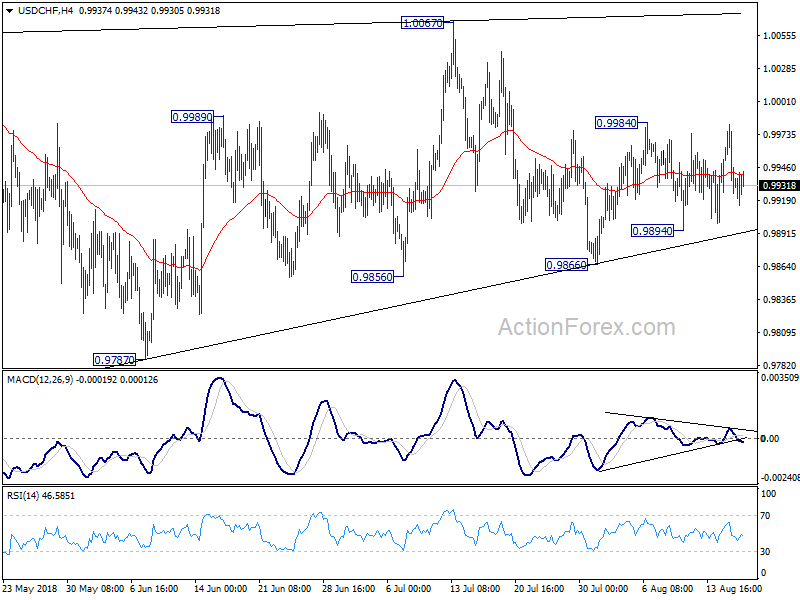
Intraday bias in USD/CHF remains neutral as range trading continues inside 0.9894/9984. On the upside, above 0.9984 will resume the rebound from 0.9866 to retest 1.0067 high. Decisive break there will resume whole rally from 0.9186. On the downside, below 0.9894 might extend the consolidation pattern from 1.0056 with another falling leg. But downside should be contained by 38.2% retracement of 0.9186 to 1.0056 at 0.9724 to bring rebound.
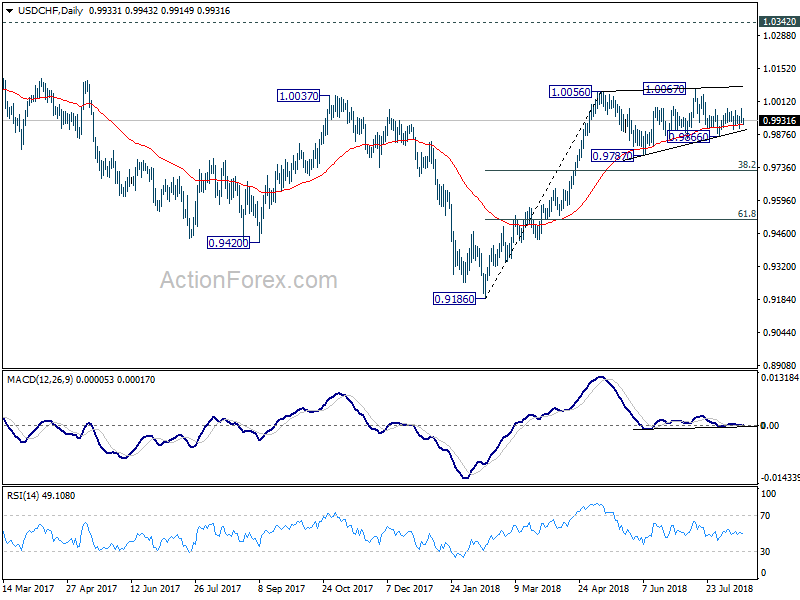
In the bigger picture, current development suggests that the consolidation pattern from 1.0056 is extending with another leg. As long as 38.2% retracement of 0.9186 to 1.0056 at 0.9724 holds, we'd expect rise from 0.9186 to resume at a later stage to retest 1.0342 key resistance (2016 high). However, sustained break of 0.9724 fibonacci level will bring deeper fall, as another declining leg in the long term range pattern.
USD/JPY Mid-Day Outlook
Daily Pivots: (S1) 110.30; (P) 110.87; (R1) 111.30; More...
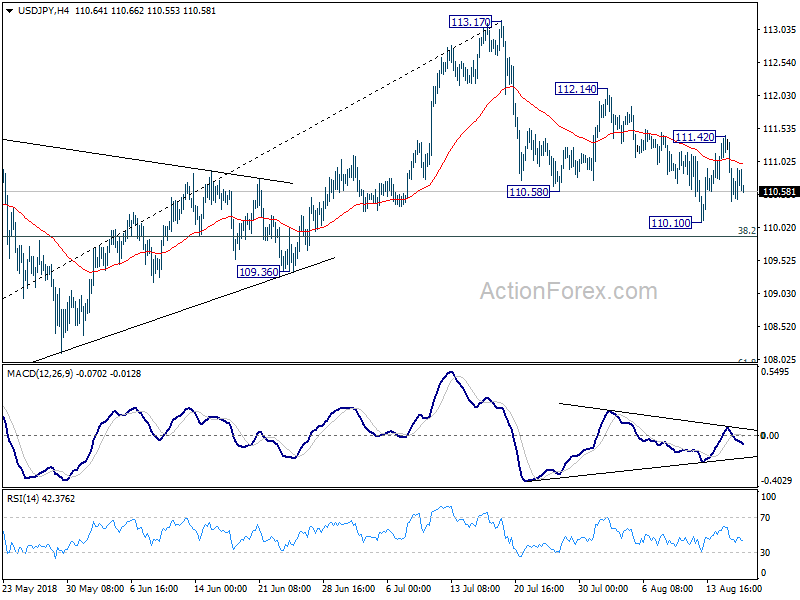
Intraday bias in USD/JPY remains neutral for the moment. Near term outlook is unchanged. The corrective decline from 113.17 might extend lower. But downside should be contained by 38.2% retracement of 104.62 to 113.17 at 109.90 to bring rebound. On the upside, above 111.42 will target 112.14 minor resistance first. Break will argue that larger rally is possibly resuming for above 113.17.
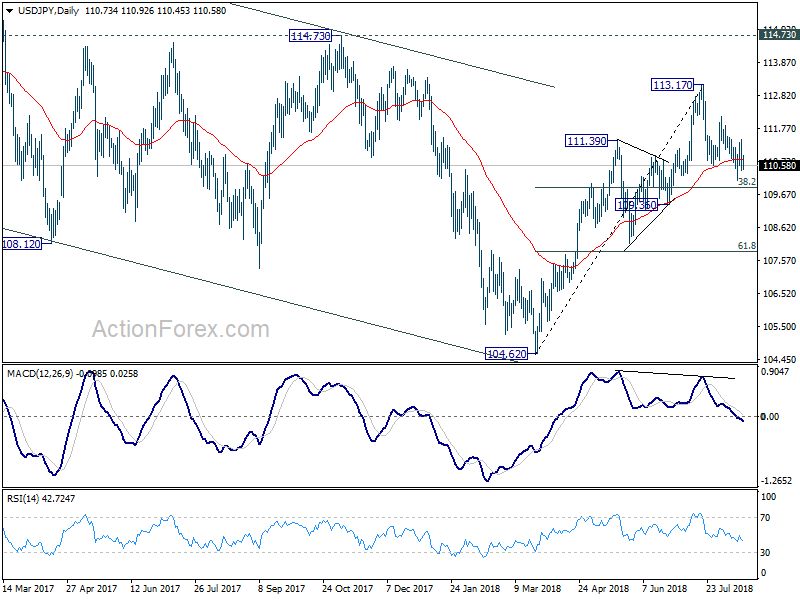
In the bigger picture, corrective fall from 118.65 (2016 high) should have completed with three waves down to 104.62. Decisive break of 114.73 resistance will likely resume whole rally from 98.97 (2016 low) to 100% projection of 98.97 to 118.65 from 104.62 at 124.30, which is reasonably close to 125.85 (2015 high). This will stay as the preferred case as long as 109.36 support holds.
Canada: Petroleum and Coal Products Lead Manufacturing Sales Increase in June
Canadian manufacturing sales posted another strong month in June, jumping 1.1% following last month's upwardly revised 1.5% increase (previously reported as 1.4%). This was a touch higher than market expectations for a 1% uptick. After accounting for price changes, volumes were up a decent 0.7%.
Nondurable goods led the increase, moving up 1.9% (1.6% in volume terms), with petroleum and coal products surging 15.9% (also 15.9% in volume terms) after the impacts of temporary shutdowns in April dissipated and refineries reported surges in capacity utilization.
Durable goods posted a mixed performance, increasing 0.5% on the month, but declining 0.25% in real terms. Within durables, autos posted a rebound, as expected, with motor vehicle sales increasing 2.8%. Performance in the overall transportation equipment sector (-0.2%), however, was pulled down by decreases in aerospace products and parts (-5.3%). Fabricated metals also showed healthy increases of 3% on the month.
Primary metals manufacturing fell 0.3% in June, perhaps indicating early signs of steel and aluminum tariffs affecting sales in this category.
Regionally, Quebec and Alberta led manufacturing sales growth, with the provinces' sales up 3.8% and 3.7% in June, respectively. Manufacturing sales also improved in three other provinces, including Ontario (up 0.5%), British Columbia (up 1.7%), and New Brunswick (up 1.6%). Saskatchewan posted the most disappointing performance, with sales falling 11.1% due to declines in chemical products and pesticide sales. Sales were also down in Nova Scotia (-8.2%), Prince Edward Island (-3.7%), Manitoba (-2.3%), and Newfoundland and Labrador (-8.1%).
Inventories continued their upward trend, increasing 0.5%, but sales pushed the inventory to sales ratio lower to 1.41. Forward looking indicators were mixed, with new orders down 1.8% and unfilled orders increasing 1.7%.
Key Implications
Today's report closes off a solid Q2 on a strong note. Manufacturing growth, while led by rebounding petroleum and coal products, appears healthy in other sectors as well, including fabricated metals and autos. This was further boosted modestly by an upward revision to the previous month's performance.
This release on its own is unlikely to change any views. Nevertheless, it adds further credence to the previously upwardly revised Q2 tracking and solidifies expectation for an October rate hike.
Looking ahead, this lends a solid handoff to the third quarter. It is important to note, however, that transitory factors in this month's performance (especially the surge in petroleum and coal products sales), will not be repeated. Moreover, mixed signs in forward looking indicators may indicate some deceleration in momentum heading into the upcoming quarter.
Gold: Rejects Lower Prices, Eyes More Recovery
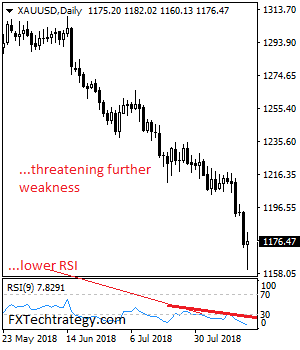
GOLD: The commodity saw a price rejection on Thursday leaving risk of a move higher in the days ahead. On the downside, support comes in at the 1,170.00 level where a break will turn attention to the 1,160.00 level. Further down, a cut through here will open the door for a move lower towards the 1,150.00 level. Below here if seen could trigger further downside pressure targeting the 1,140.00 level. Conversely, resistance resides at the 1,180.00 level where a break will aim at the 1,190.00 level. A turn above there will expose the 1,200.00 level. Further out, resistance stands at the 1,210.00 level. All in all, GOLD looks to recover higher on correction.
Canadian Dollar Trading Sideways as Manufacturing Sales Within Expectations
The Canadian dollar has steadied in the Thursday session, after considerable losses on Wednesday. Currently, USD/CAD is trading at 1.3143, up 0.02% on the day. On the release front, Canadian Manufacturing Sales softened to 1.1%, edging above the estimate of 1.0%. Canadian ADP Nonfarm Employment Change rebounded with a gain of 11.6 thousand. In the U.S, construction numbers were mixed. Building Permits improved to 1.31 million, matching the estimate. Housing starts remained at 1.17 million, short of the estimate of 1.27 million. The Philly Manufacturing Index dropped sharply to 11.9, missing the estimate of 21.9 points. Unemployment edged down to 212 thousand, shy of the estimate of 215 thousand. On Friday, Canada releases CPI and the U.S publishes Preliminary UoM Consumer Sentiment.
The Canadian dollar remains under pressure as the US currency continues to shine. On Wednesday, USD/CAD touched a high of 1.3175, its highest level since July 16. Strong U.S data continues to boost the greenback, and this was the case on Wednesday, as retail sales were unexpectedly strong. Core retail sales posted a gain of 0.5% for a second straight month, easily beating the forecast of 0.1%. If consumer confidence follows suit with a strong reading on Friday, it could be a sign of another strong quarter of economic growth.
Negotiations over NAFTA have progressed slowly, but policymakers in Canada and Mexico are hopeful that the flexibility that the U.S has shown towards the European Union will extend to NAFTA as well. Canadian and Mexican officials are hoping to reach an agreement, despite U.S President Trump’s stated preference for bilateral agreements. NAFTA is a key component of the Canadian economy and with 80% of the country’s exports headed the U.S., the lingering delays in reaching a new NAFTA accord have weighed on the Canadian dollar. If the parties are able to reach a new agreement, traders can expect the Canadian dollar to move higher.