Sample Category Title
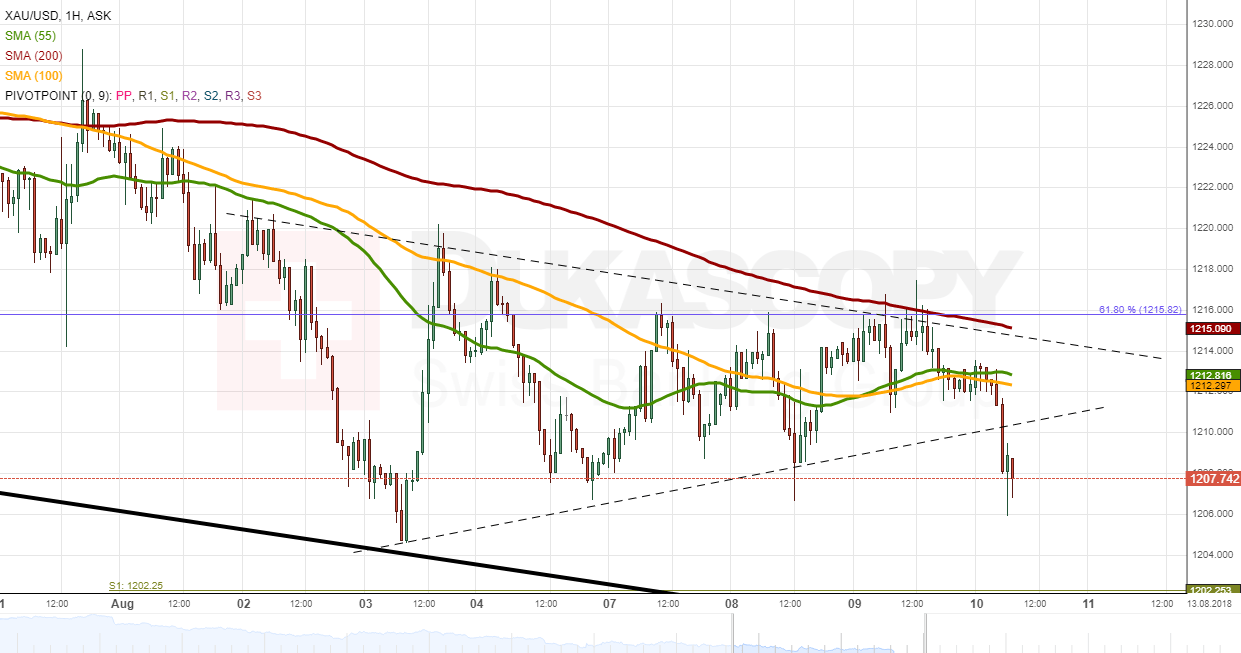
XAUUSD Analysis: Breaks Out Of Triangle
XAU/USD has been moving in a symmetrical triangle during the past few sessions. A bullish breakout from this short-term pattern was halted by the 200-hour and 55-period (4H) SMAs and the 61.80% Fibonacci retracement at 1,216.00.
No significant changes to the pair's direction occurred on Thursday, as the yellow metal was trading in between the 55-, 100– and 200-hour SMAs. This lack of direction changed swiftly early today when Gold lost 0.36% against the US Dollar and returned to re-test a July 2017 low of 1,207.00. This move pushed the rate out of the aforementioned triangle.
It is likely that this bearish move continues in this session, as well. The nearest support is the relatively distant senior channel and the monthly S1 circa 1,200.00.
Erdogan is to Blame For Turkish Lira’s Free Fall
While US sanctions against Turkey have dominated news headlines, recent selloff of Turkish lira is a vote of dissent to the policy of the new government. After his “re-election”, President Tayyip Erdogan has grabbed tighter control of the economic and monetary policies. However, the policies implemented have failed to alleviate the most serious problems facing the economy, namely high inflation and rapid currency depreciation. Rather they have exacerbated the problems. We agree that the latest US sanctions has further eroded market sentiment. However, even if a deal is eventually reached, the policies dictated by President Erdogan would remain the biggest hurdle to investors’ confidence over Turkish economic and financial situations.
Monetary Policy Exacerbates Inflationary Risk
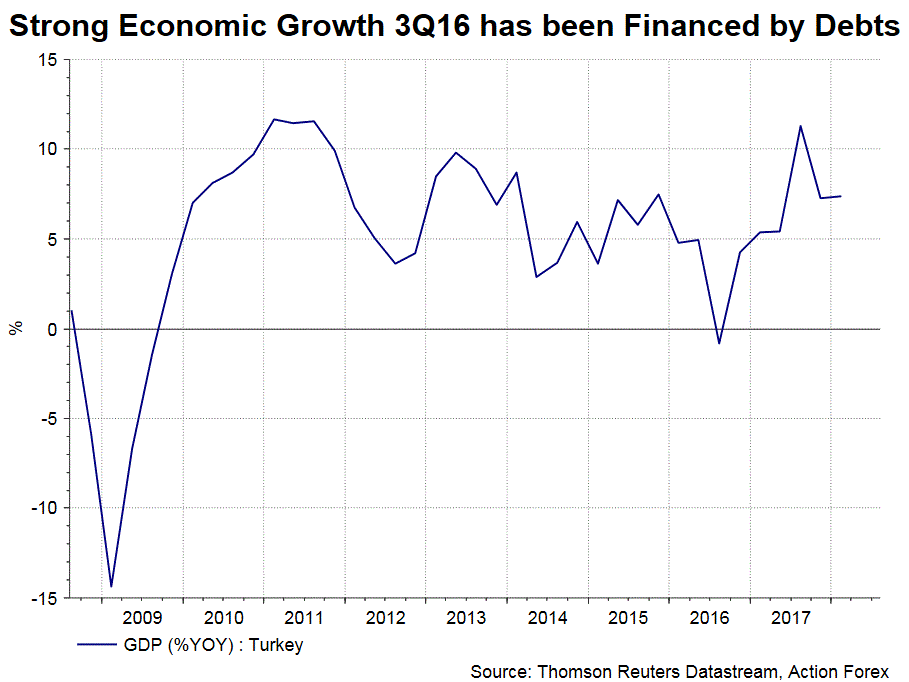
Turkey’s GDP growth has even outpaced that of China since 2H17. The economy expanded +7.4% for the full year of 2017, and is expected to ease to about +4% this year. However, the surge in household consumption and business investment were mainly motivated by fiscal stimuli. Accompanying the robustness in economic activities is the sky-high inflation. Headline CPI surged to +15.8% y/y in July, significantly higher than the +5% target. Core inflation, which excludes volatile items such as food, energy and gold, also rose to +15.1%, from +14.6% in June.
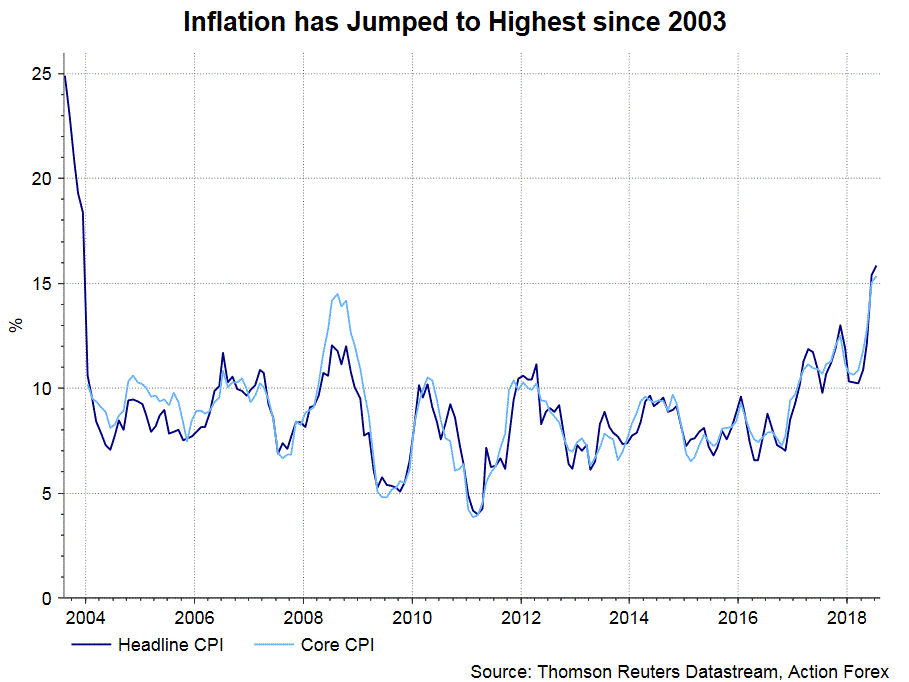
Ironically, the central bank decided to keep interest rates on hold at the July meeting, compared with consensus of a +100 bps increase. Indeed, lira was dumped immediately after the announcement. After being “re-elected” as the President in June, Erdogan has deepened his control over the economic and the monetary policies. Besides appointing his son-of-law as the finance minister, Erdogan declared that, as the President, he assumes the authority to appoint the central bank governor, deputies and monetary policy committee members for a 4-year period. Describing himself as an “enemy of interest rates”, a central bank controlled by Erdogan has refrained from hiking interest rates despite elevated inflation and the fact that the Fed would continue to raise the policy rate this year and in 2019.
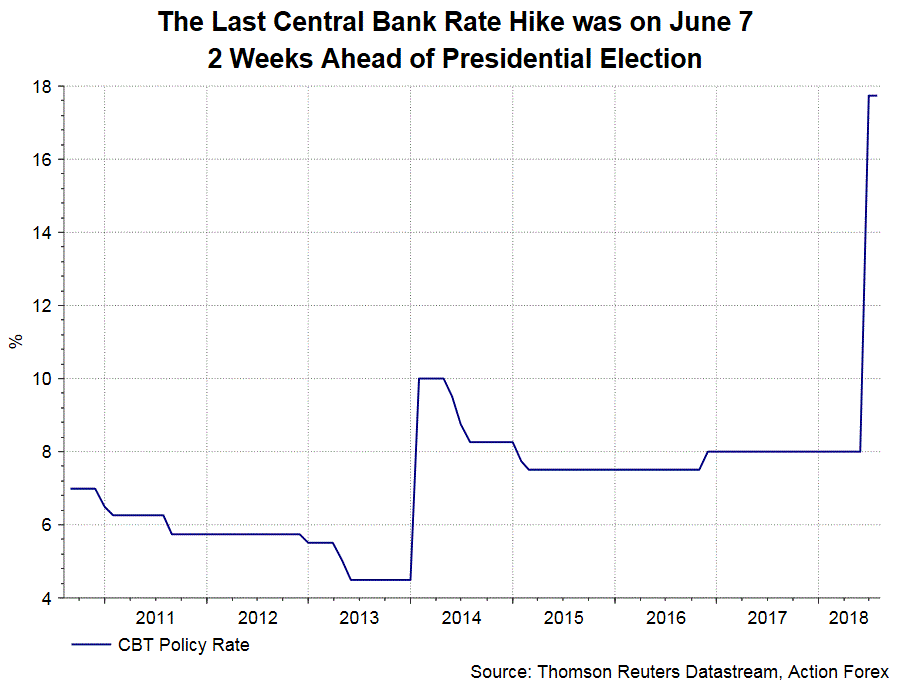
Indeed, the central bank has continued to increase liquidity. Earlier in the week, it announced change in reserve option coefficients (ROCs), lowering the upper limit for the FX maintenance facility to 40% from 45%. According to the central bank, it expects around US$ 2.2B of liquidity to be provided to the financial system to “support price stability and financial stability”. The move is contrary to conventional wisdom of tightening liquidity in order to curb inflation and defend exchange rate.
US Sanction Dampens Sentiment, Raising Challenge of Debt Financing
The robust economic growth has been sponsored by fiscal stimuli, which are in turn financed by debt. Debt-ridden Turkey is facing twin deficits and huge external debts. In 2017, current account deficit reached about US$ 47.1B, about 5.5% of GDP. Moreover, external debt amounted to 53.3% of GDP, of which 70% was attributed to the private sector.
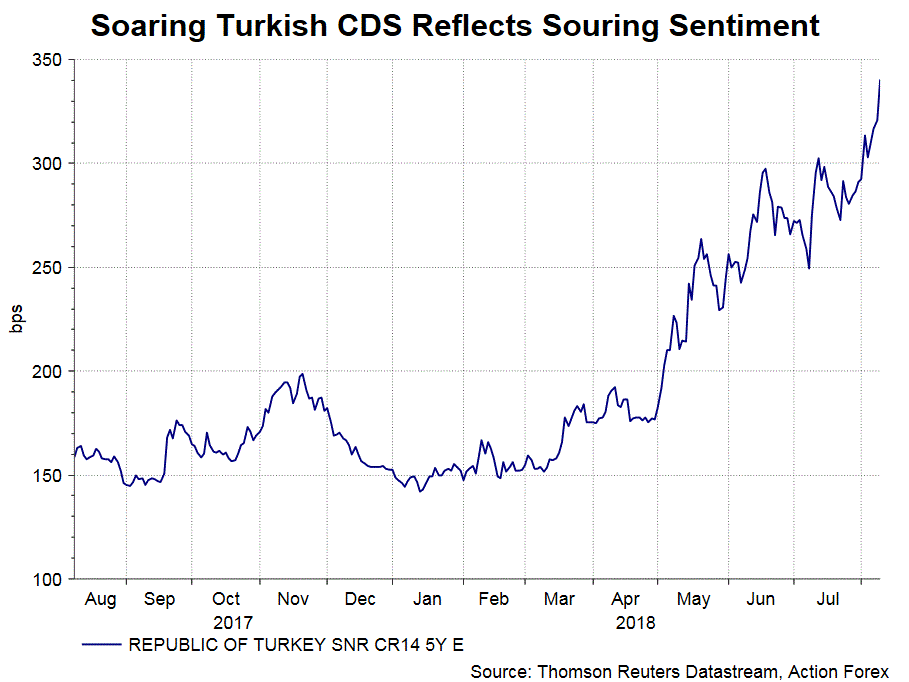
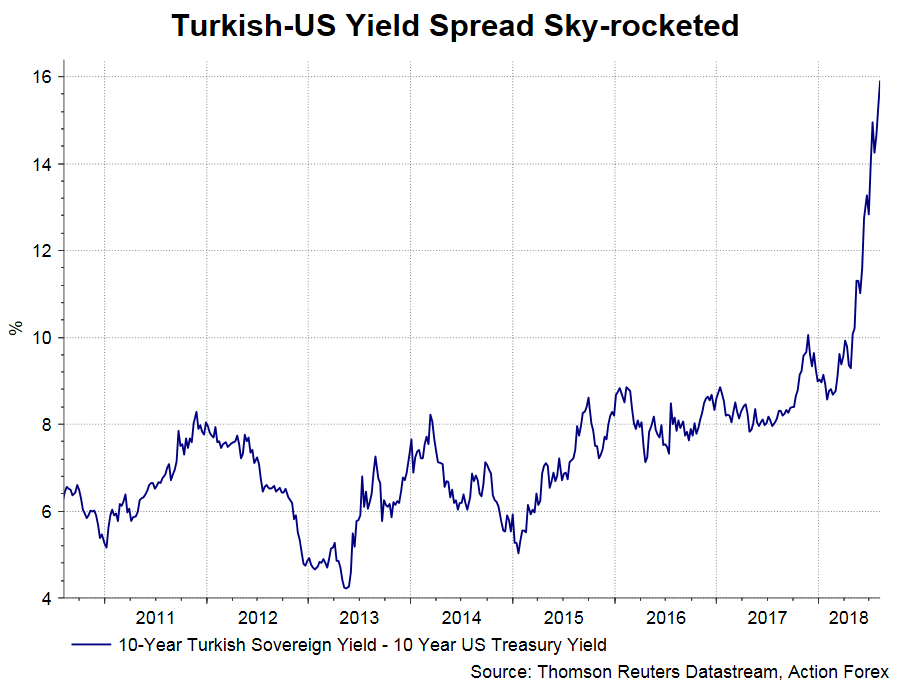
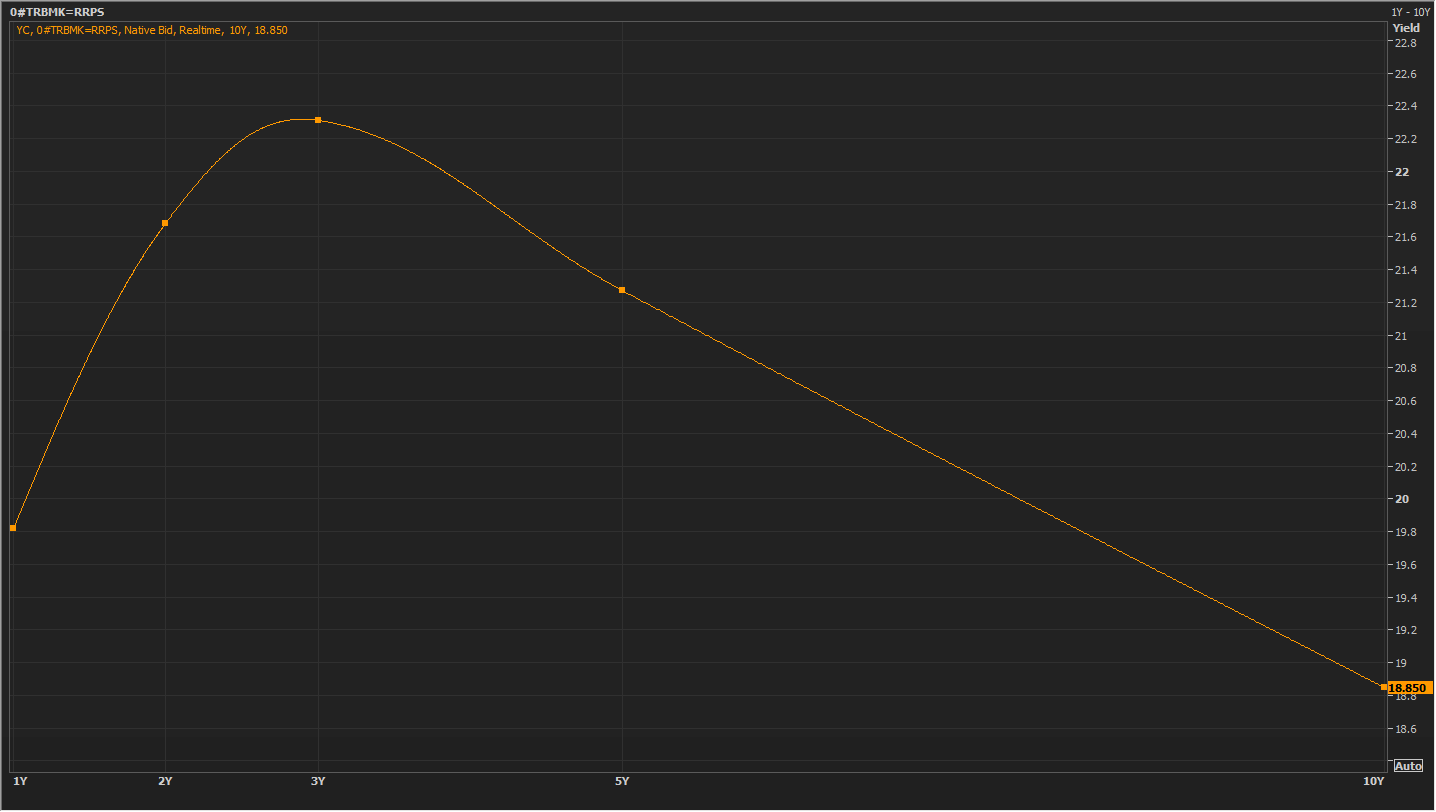
Recent US sanctions have inevitably dent confidence of both consumers and investors, as many are concerned about the ability of the government and the corporate to borrow. Currently trading at 371 bps, Turkey’s 5-year CDS had jumped from Thursday’s close of 349.94. Meanwhile, sovereign debt yields spread between Turkey and US have widened to almost a decade high, reflecting higher borrowing costs for the former. The inverted yield curve structure has raised concerns that recession is coming after rapid growth that are unsupported by underlying fundamentals.
UK GDP grew 0.4% qoq in Q2, but June missed expectations
UK GDP grew 0.4% qoq in Q2, doubled that of Q1's 0.2% qoq and met expectations. Year-over-year, GDP grew 1.3% yoy in Q2, also matched expectation. Nonetheless, June GDP grew only 0.1% mom, below expectation of 0.2% mom, notably slower than May's 0.3% mom.
Total business investment rose 0.5% qoq in Q2, much stronger than expectation of 0.2% qoq and an impressive rebound from Q1's -0.4% qoq.
Industrial production rose 0.4% mom, 1.1% yoy in June versus expectation of 0.2% mom, 1.9% yoy. Manufacturing production rose 0.4% mom, 1.5% yoy versus expectation of 0.3% mom, 1.9% yoy.
Visible trade deficit narrowed to GBP -11.4B versus expectation of -11.9B.
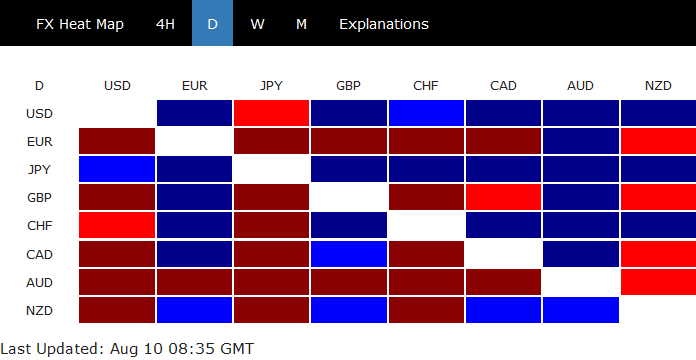
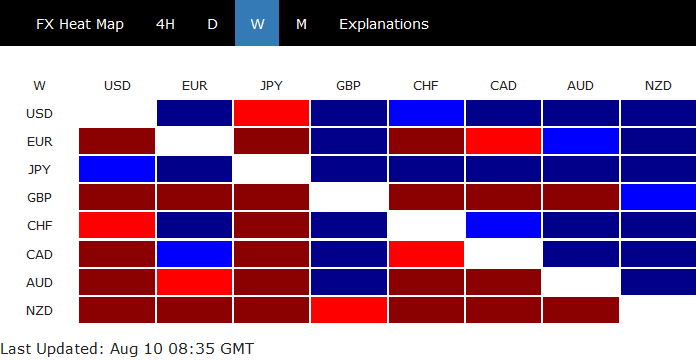
There is little reaction to the set of data. Sterling remains the third weakest one for today, just after Australia Dollar and Euro. For the week, the Pound is also the second weakest after New Zealand Dollar.
The US Dollar Index Has Updated The Weekly High. The Potential For Growth Remains
The US dollar rose against the basket of major currencies during yesterday's trading. The US dollar index (#DX) updated the weekly high and closed in the positive zone (+0.60%). Yesterday, the producer price index was published in the US, which counted to 0.0% in July and was worse than the forecasted value of 0.2%. However, this did not prevent the dollar from strengthening. Trade relations between the United States and its partners are still in the focus of attention. Today, the US dollar rally has continued.
During the Asian trading session, data on Japan GDP have been published. So, GDP growth counted to 0.5% in the second quarter and was better than the forecasted value of 0.3%. Financial market participants expect data on the UK GDP. We also recommend paying attention to economic statistics from the US and Canada.
The "black gold" prices are consolidating. At the moment, futures for the WTI crude oil are testing a mark of $66.60 per barrel.
Market Indicators
Yesterday, the bearish sentiment was observed in the US stock market: #SPY (-0.14%), #DIA (-0.18%), #QQQ (-0.06%).
At the moment, the 10-year US government bonds yield is at the level of 2.89%-2.90%.
The news feed on 2018.08.10:
- Data on the UK GDP at 11:30 (GMT+3:00);
- Manufacturing production in the UK at 11:30 (GMT+3:00);
- Core consumer price index in the US at 15:30 (GMT+3:00);
- Report on the labor market in Canada at 15:30 (GMT+3:00).
Dollar Demand An Unstoppable Force, US Inflation & UK GDP On The Agenda
Here are the latest developments in global markets:
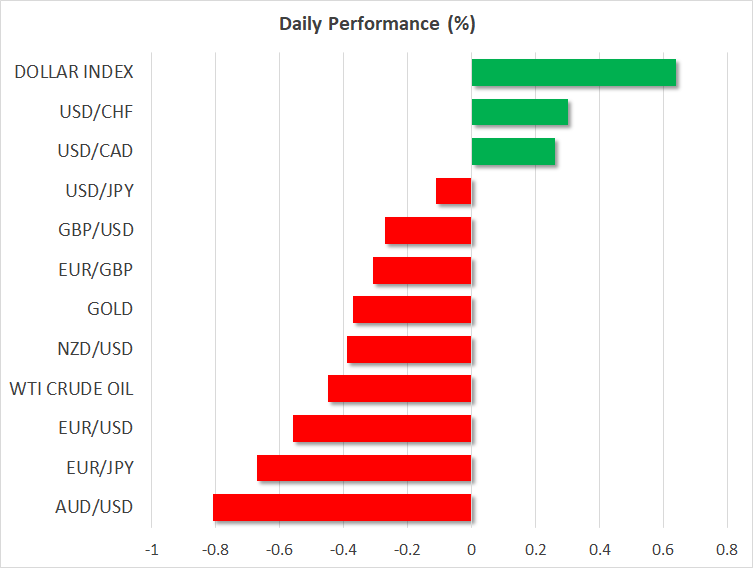
FOREX: The US dollar index is higher by 0.63% on Friday, extending the significant gains it posted in the previous session and touching a new 13-month high. The euro and the pound are the main underperformers, both posting fresh multi-month lows against the greenback. The yen, meanwhile, remains firm amid risk-off tones. In EM, dollar/lira briefly broke above the 6.000 handle, with the pair being up by nearly 7.0% earlier in the session, before pulling back a little.
STOCKS: Wall Street closed lower for the most part on Thursday. The Dow Jones (-0.29%) and S&P 500 (-0.14%) posted modest losses, while the Nasdaq Composite (+0.04%) edged marginally higher. Futures tracking the S&P, Dow, and Nasdaq 100 are all pointing to a lower open today. The negative sentiment spilled over into Asia on Friday, with most indices being in the red. In Japan, the Nikkei 225 and Topix declined by 1.33% and 1.15% respectively, as a stronger yen clouded the outlook for Japanese exporters. In Hong Kong, the Hang Seng dropped by 0.89%. Europe was a similar story, with futures tracking the major indices all flashing red, pointing to a significantly lower open today amid worries European banks may be exposed to Turkish contagion risk.
COMMODITIES: Oil prices traded lower, with WTI and Brent crude being down by 0.44% and 0.67% respectively on Friday, as a strengthening dollar took the wind out of the dollar-denominated liquid's sails. Oil continued to move lower even despite news that China will remove crude oil from the list of US products it will impose tariffs on. In precious metals, gold prices are down by nearly 0.4% today, currently hovering above the $1207/troy ounce level. Since gold is also denominated in dollars, a strengthening greenback renders the yellow metal less attractive for investors using foreign currencies. That said, considering how much the dollar has soared since yesterday, gold has been holding up relatively well, admittedly, with the area around $1200 providing notable support.
Major movers: Dollar soars to yearly highs; yen holds strong as euro & pound slump
The US dollar advanced across the board on Thursday, and is building on those gains in Friday's session as well. The dollar index is up by 0.63%, touching a fresh 13-month high. The greenback's strength appears to be owed to a combination of euro and sterling weakness, as well as some relatively hawkish comments from one of the Fed's arch-doves. Chicago Fed President Charles Evans said that the central bank may need to raise rates into “restrictive” territory. Coming from a policymaker who is typically ultra cautious on policy – having dissented a rate increase in December –, investors likely interpreted his remarks as increasing the likelihood for rates to move higher than what is currently implied by market pricing over the next years.
In the euro area, the single currency retreated against all its major peers, with its underperformance being attributed to reports the ECB is concerned about the exposure of European banks to Turkey. Specifically, policymakers are worried Turkish borrowers may default on foreign-currency loans as the lira continues to collapse, which may spill over into the Eurozone. From the market's perspective, this was likely interpreted as another risk that could delay – or even derail – the ECB's normalization efforts, hence sending the euro lower. Euro/dollar posted a new 13-month low of 1.1430.
Sterling, meanwhile, got a brief reprieve yesterday after media reports suggested the EU may provide some Brexit concessions, allowing the UK to remain in the single market for goods. The currency's rebound was short-lived, though, as it quickly gave back its gains to record new multi-month lows against both the dollar and yen.
The yen held its own in the midst of this, remaining stable against the soaring dollar, but gaining against practically all its other major counterparts. Given the absence of news out of Japan, its gains appear to be a function of safe-haven demand, as trade woes continue to lurk in the background and whispers of contagion risk from Turkey are gaining traction.
On the subject of Turkey, the lira's freefall accelerated on Friday, touching yet another record low. Dollar/lira briefly broke above the psychological 6.000 level. The “straw that broke the camel's back” appears to have been the lack of progress in US-Turkey relations after a meeting in Washington. Economically, inflation is soaring, and a plunging currency will likely exacerbate that further, especially given Turkey's dependency on imports. Market chatter suggests the prospect of capital controls to stem the lira's decline is very much on the table.
Day ahead: UK Q2 flash GDP growth & US CPI figures of most importance; political developments in focus
While fears of a no-deal Brexit continue to pressure the pound, a mixture of UK data is expected to bring fresh volatility to the currency, with investors waiting eagerly to see whether this could be a chance for the pound to recover steep losses.
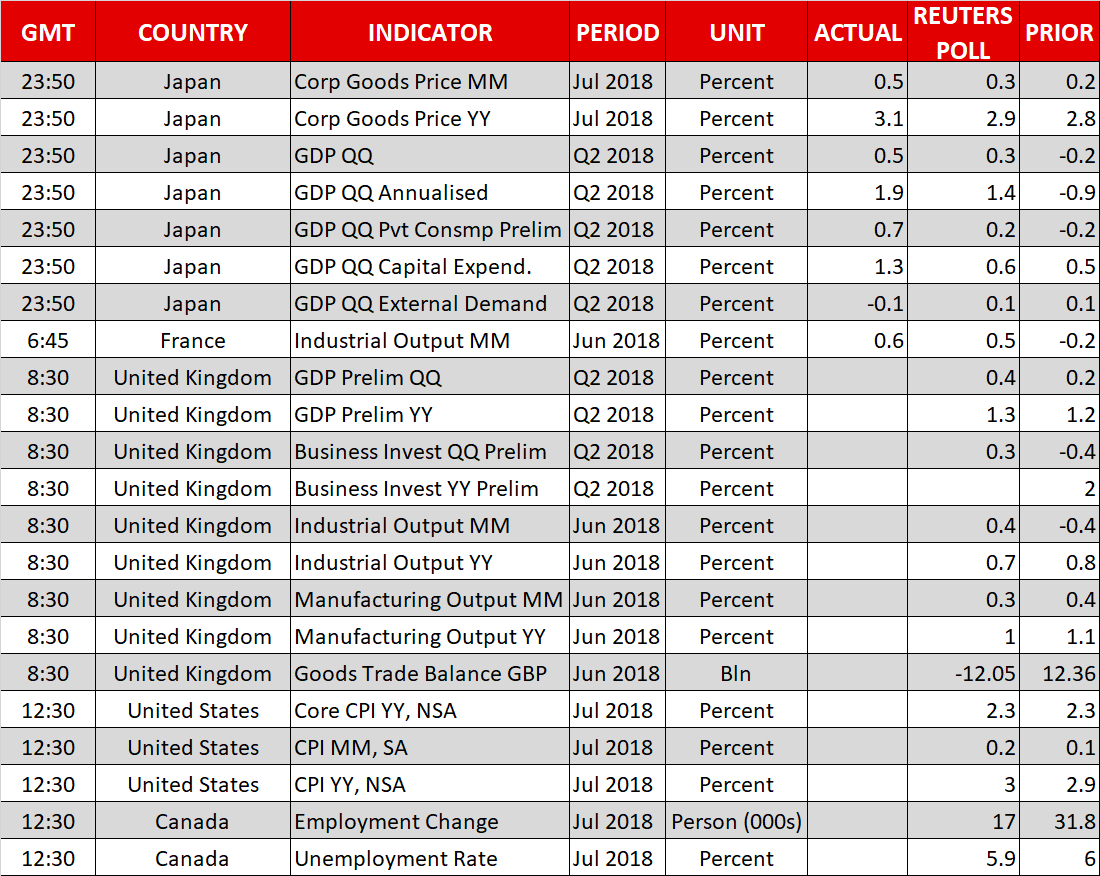
Among the data, preliminary GDP growth figures for the second quarter will attract the most of interest as forecasts suggest that the British economy has picked up speed in the three months to June. According to analysts, GDP has grown by 1.3% year-on-year (y/y), slightly faster than in the first quarter when the expansion was finalized at 1.2%. On a quarterly basis, the measure is also expected to have improved, with analysts estimating a growth of 0.4% compared to 0.2% seen previously.
At the same time, industrial production and trade figures out of the UK will be hitting the markets as well, giving a piece of evidence on whether Brexit uncertainties and US's trade protectionism have weighed on business activities. For the month of June, growth in overall production is anticipated to ease slightly to 0.7% from 0.8% in May, while separately in the manufacturing sector, the output is also said to have narrowed, slowing down from 1.1% to 1.0% y/y. Regarding the exchange of goods with overseas countries, UK's trade deficit is projected to decline by $0.31 billion to $12.05bn.
Should the figures surprise to the upside – especially in the GDP growth front – the pound could reverse south. Still, the loose confidence on how the Brexit story could progress before October's crucial Brexit deal deadline and the Bank of England's limited and gradual approach for future rate hikes could limit any positive data impact on the pound.
Meanwhile in the US, July's consumers prices (1230 GMT) could enhance investors optimism on the US economy even further later in the day as analysts believe that CPI has inched up from 2.9% y/y to 3.0%, rising for the fifth consecutive month to levels seen for the first time since January 2012. Excluding volatile items, however, the core measure is projected to stay unchanged at 2.3% y/y. While CPI figures are not the Fed's favorite inflation measure, the gauge is still closely monitored by policymakers and any improvement in the numbers could signal that the US is in a better inflation trend. Therefore, in the wake of stronger CPI prints, the dollar could rebound in speculation that the Fed's preferred PCE inflation measure could increase positive momentum as well, increasing the odds for two additional rate hikes this year.
In the neighbor Canada, loonie traders will be eyeing July's employment report which is expected to show that the number of employees has increased by 17k, almost half the 31.8k rise seen in June. But the unemployment rate could bring some smiles to BoC policymakers faces as this is anticipated to pull back to 5.9% after reaching 6.0%, the highest rate observed since October.
In oil markets, Baker Hughes is scheduled to report on US active rigs for oil drilling at 1700 GMT.
Developments in US-Russian relations could attract some interest during the day after Russia threatened to retaliate Trump's plans for new sanctions against Moscow aimed to punish the country for the chemical attack on a former Russian spy in Britain. Tensions between Turkey and the US have escalated as well as talks over the detention of a US pastor in Washington between a Turkish delegate and US officials failed to break the ice.
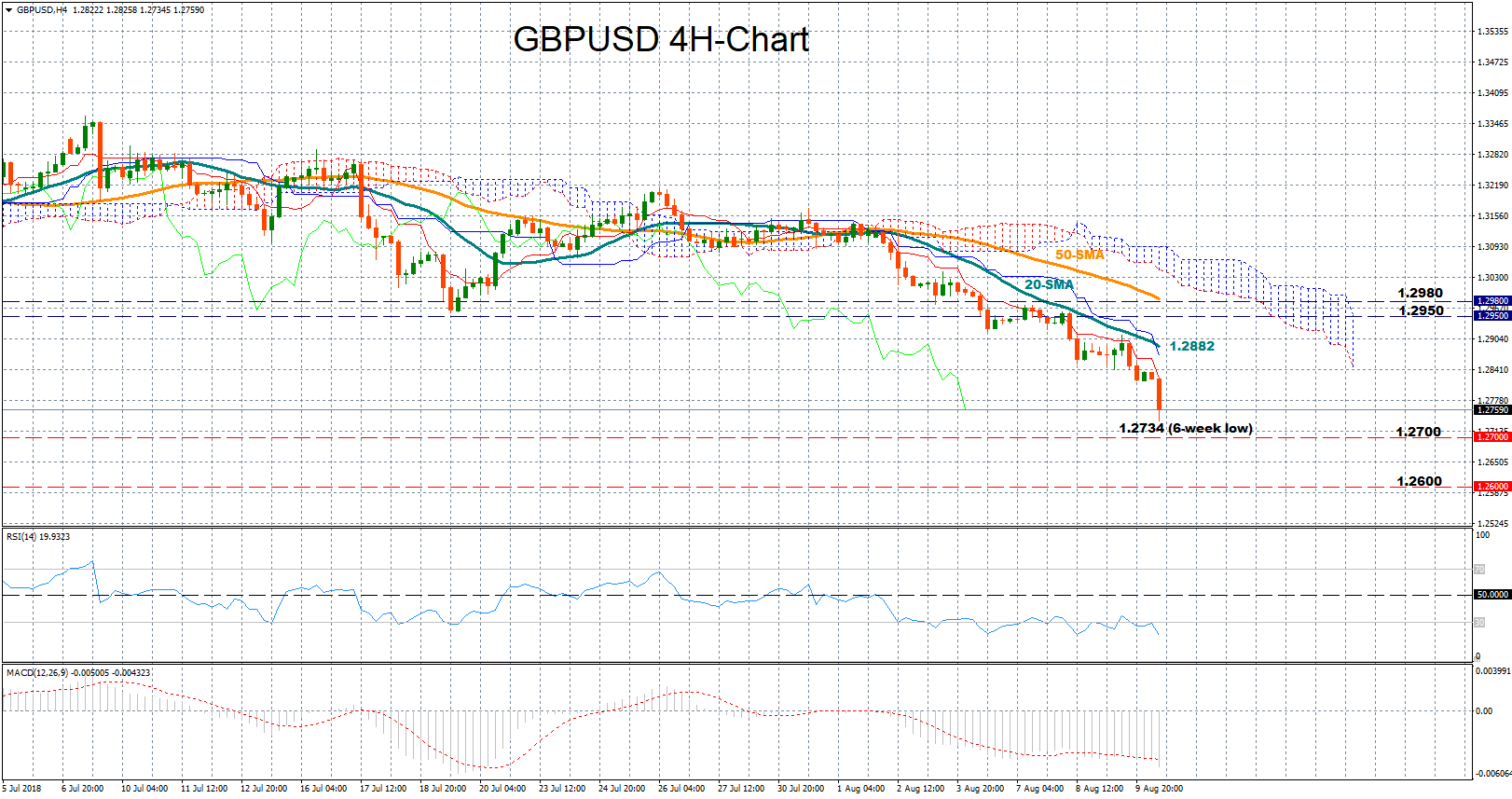
Technical analysis – GBPUSD increasingly bearish and oversold
GBPUSD has lost 1.8% so far this week and is set to finalize the week around six-week lows (1.2734). While the downward pattern could remain in place in the short-term as the price continues to trade below its 20-period moving average and the Ichimoku cloud, the RSI suggests that a rebound is not unlikely as the index has expanded well into the oversold territory (below 30). Still, the MACD, which keeps moving in negative zone, supports that downside pressures could dominate.
Should UK's GDP growth increase faster than expected, the price could bounce up to find resistance at the 20-period MA currently at 1.2882 as it did in the previous week. Even higher, bulls could try to break the 1.2900 round level to test the area between 1.2950- 1.2980 where the price stopped in mid-July and early in August.
On the other hand, further declines fueled by disappointing readings out of the UK, could push pound down to the 1.2700 psychological level before attention turns to 1.2600.
The Dollar Has A Potential Of 5% Rally, Even If Trump Does Not Like It
The dollar rewrote 13-months highs on Friday to a basket of six major currencies, adding 0.25% after gaining 0.5% on Thursday. The further growth of the US currency from the current levels would mean the end of the consolidation period, which has lasted since May, when the index has fluctuated in a relatively narrow range. The way out of this range can start a new stage of the American currency strengthening, as it was in April-May. The repetition of the spring rally is able to send the dollar index to 100, the psychologically important level, where it had a significant resistance in 2015-2017, being only briefly receding above.
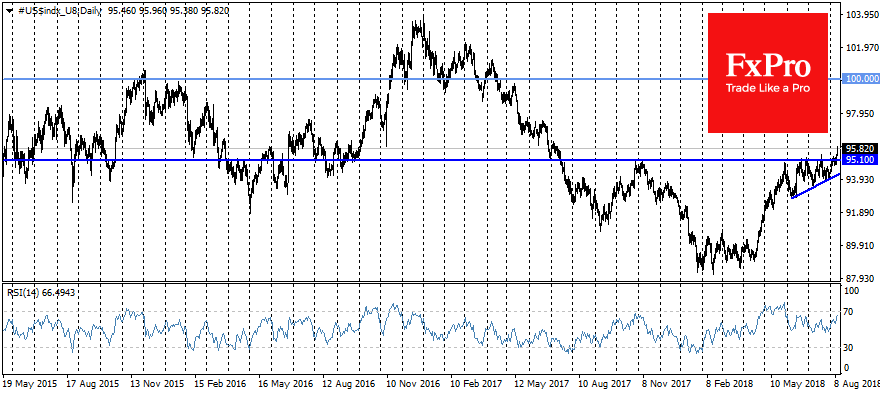
The growth of the dollar this week is mostly due to other currencies’ problems and is not caused by the strong output of American economy. However, the most dramatic decline can be seen for the currencies of the countries with which the United States has some kind of disputes. While the weakening of currencies to the dollar is due to the outflow of investors, there is a higher risk that Trump will once again be dissatisfied with the strengthening of the dollar as it was last month when the symptom rally of the dollar was stopped by Trump’s call for a softer Fed policy.
However, the dollar is strengthened for quite objective reasons, so it is unlikely that Trump’s comments would fundamentally roll the course of the American currency.
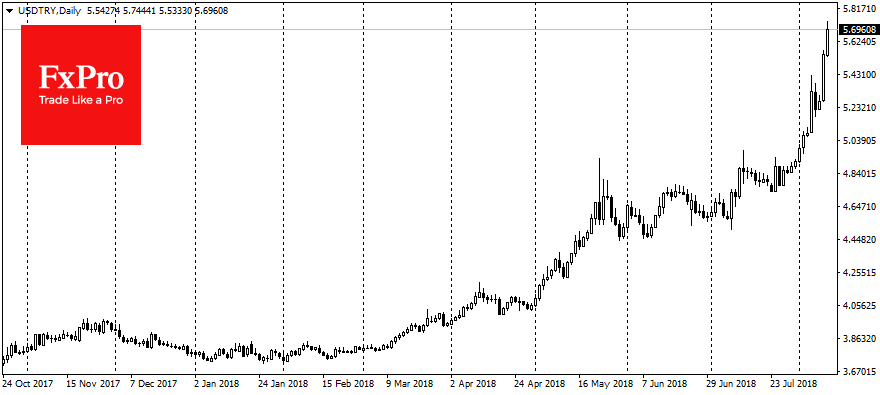
Once again, the Turkish Lira was among the main victims. It collapsed over the last 24 hours by 7.5% to a new historical low of 5.72 per dollar due to the diplomatic conflict between Ankara and Washington. Since the beginning of the year, USDTRY pair has skyrocketed by 51%.
The Russian rubble lost to the dollar 1.7% on Thursday up to 66.65 per dollar, increasing the pace of the decline since the beginning of the month to 6.7% on the outflow of investors from Russian assets under the threat of new U.S. sanctions.
This morning, sterling has fell to 1.2815, the lowest rate since August 2017 on investors’ fears that Britain would leave the EU without an agreement with Brussels, which would exacerbate economic uncertainty for the country.
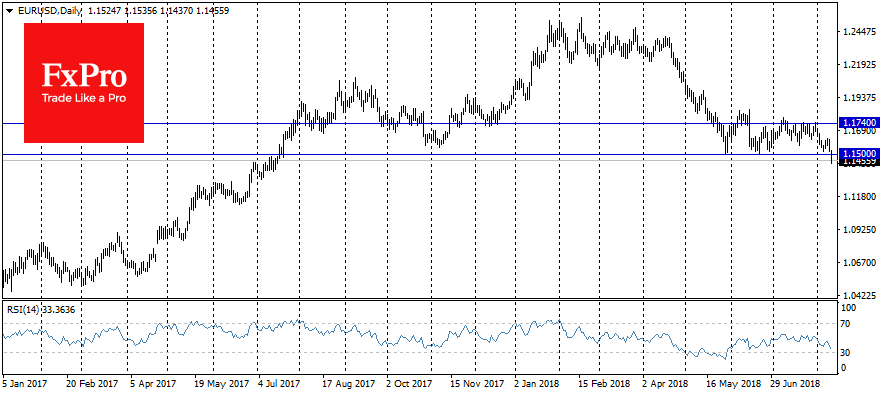
The EURUSD pair has fallen on Friday morning below 1.1500, the lowest rate since July 2017 and below trading range for the last 3 months that increased a sale-off by massive stop-orders flow. A single currency is under pressure due to uncertainty around Britain and worries about the Turkish exposure to some European banks.
In addition, the ECB commented on the euro that the increasing protectionism raises risks for the global growth. This was perceived as a signal that the regulator might be willing to soften its rhetoric in the event of a trade conflicts proliferation.
The New Zealand dollar lost 2% to lows of 2.5 years after RBNZ had predicted that it would not raise the rates until 2020.
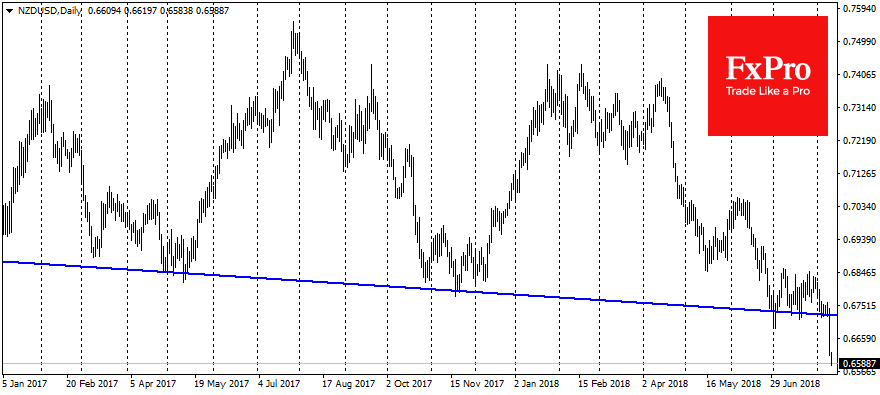
In the context of reduced trading volumes due to the vacation period, the dollar’s output beyond the established trading range can turn into a rather sharp rally in the coming days.
GBP/JPY Daily Outlook
Daily Pivots: (S1) 142.07; (P) 142.79; (R1) 143.17; More...
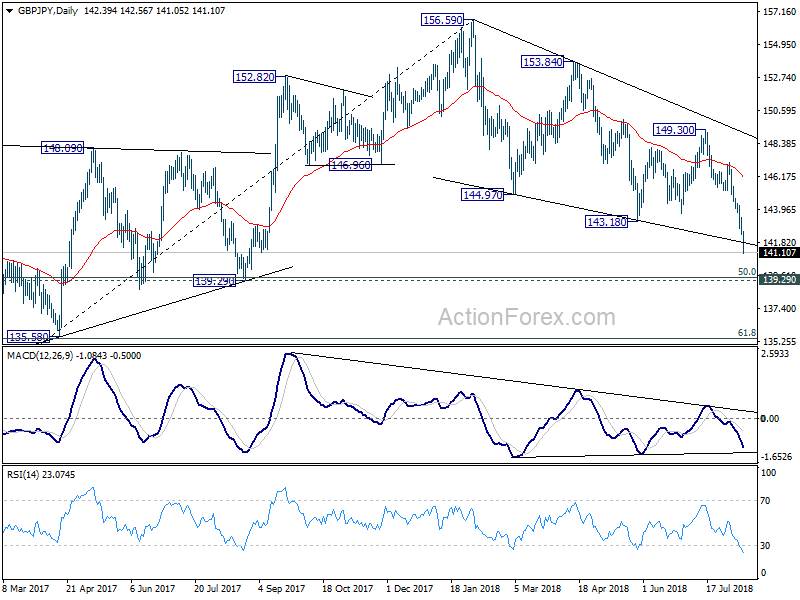
GBP/JPY's fall continues to as low as 141.05 so far and intraday bias remains on the downside. Decline from 156.59 is in progress for 139.29/47 key support level. On the upside, above 142.00 minor resistance will turn bias neutral and bring consolidation. But recovery should be limited well below 145.25 support turned resistance to bring fall resumption.
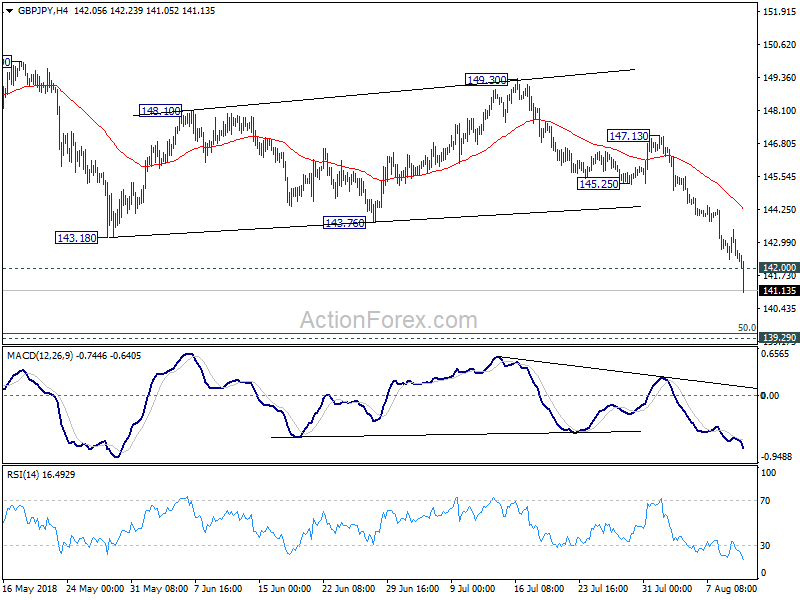
In the bigger picture, decline from 156.59 is seen as a corrective move. In case of deeper fall, strong support should be seen above 139.29 cluster support (50% retracement of 122.36 to 156.59 at 139.47) to contain downside and bring rebound. However, sustained break of 139.29/47 will confirm medium term reversal and turn outlook bearish for 122.36 (2016 low) again.
EUR/JPY Daily Outlook
Daily Pivots: (S1) 127.72; (P) 128.36; (R1) 128.70; More....
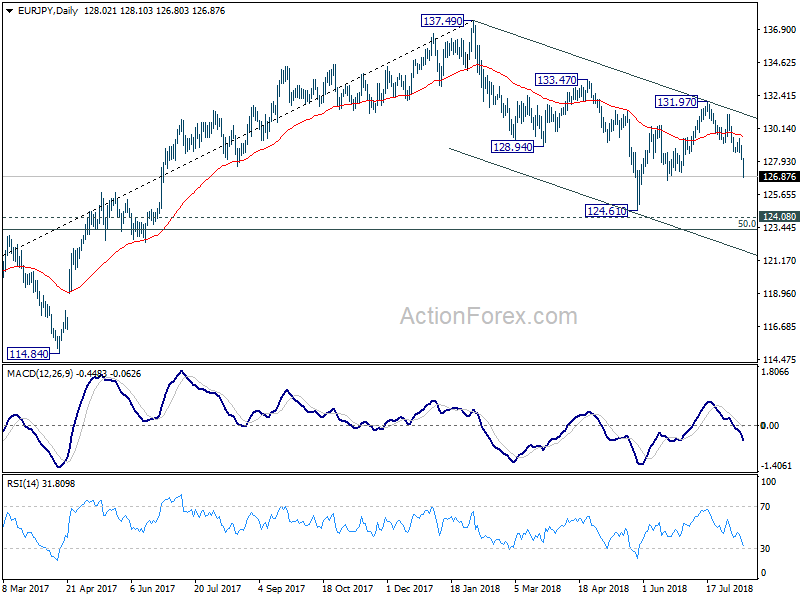
EUR/JPY drops to as low as 126.80 so far as the fall from 131.79 resumed after brief consolidation. The break of 127.13 support confirms our bearish view. That is corrective rebound from 124.61 has completed with three waves up to 131.97 already. Also, the larger fall from 137.49 could be resuming. Intraday bias is now on the downside for retesting 124.61 first. On the upside, above 127.63 minor resistance will turn intraday bias neutral first. But recovery should be limited below 128.49 support turned resistance to bring another fall.
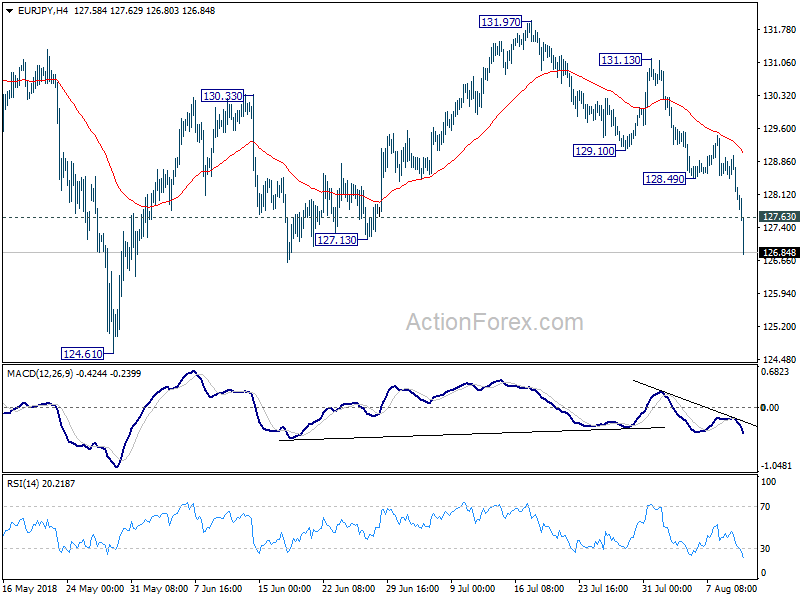
In the bigger picture, for now, EUR/JPY is still holding above 124.08 key support turned resistance. And the larger rise from 109.03 (2016 low) mildly in favor to resume. Break of 133.47 should send the cross through 137.49 high. However, decisive break of 124.08 will confirm medium term reversal and could then pave the way back to 109.03 low and below.
EUR/GBP Daily Outlook
Daily Pivots: (S1) 0.8972; (P) 0.8995; (R1) 0.9034; More...
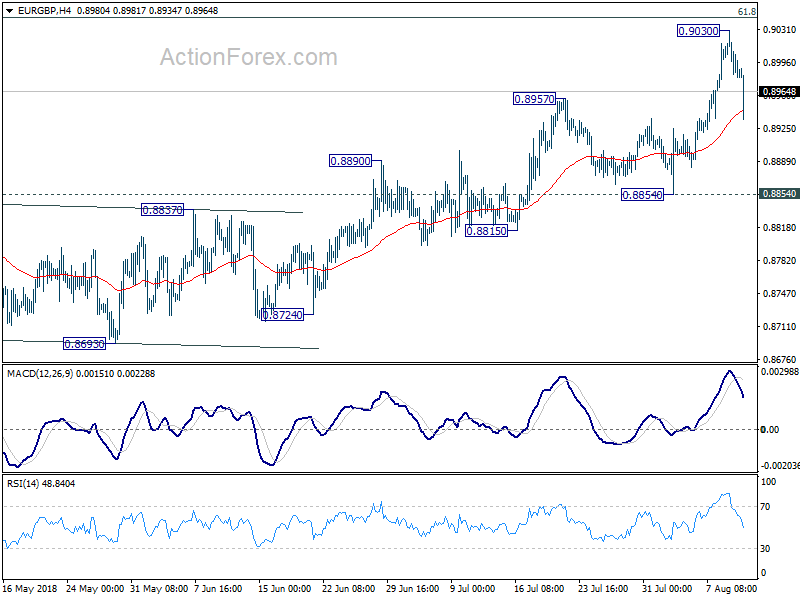
Despite rather deep pull back, price actions from 0.9030 are still seen as a correction only. And, near term outlook will stay bullish as long as 0.8854 support holds. On the upside, sustained break of 61.8% retracement of 0.9305 to 0.8620 at 0.9043 will extend the whole rise from 0.8620 to retest 0.9305 high.
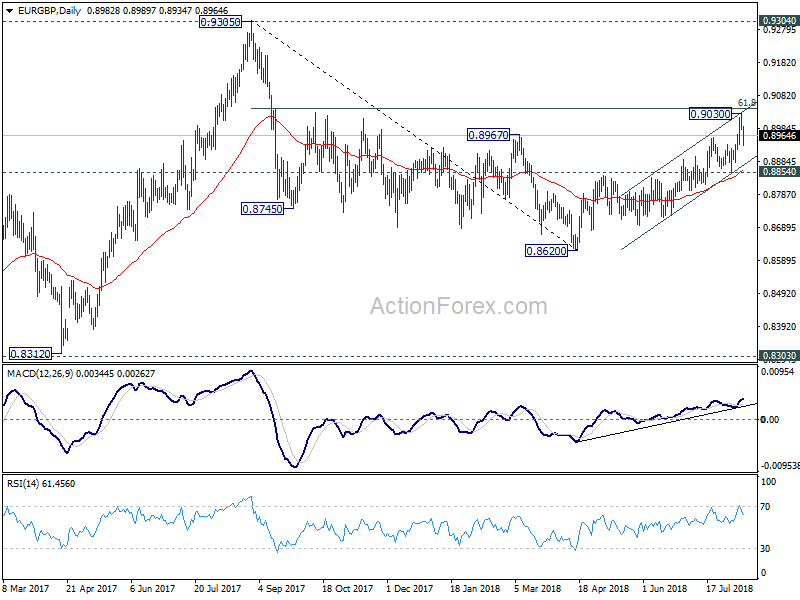
In the bigger picture, EUR/GBP is staying in long term range pattern from 0.9304 (2016 high). The corrective structure of the fall from 0.9305 to 0.8620 is raising the chance that rise from 0.8312 to 0.9305 is an impulsive move. But we're not too confident on it yet. In any case, we'd stay cautious on strong resistance from 0.9304/5 to limit upside in case of further rally. Meanwhile, if there is another medium term decline, strong support will likely be seen from 0.8303 to contain downside.
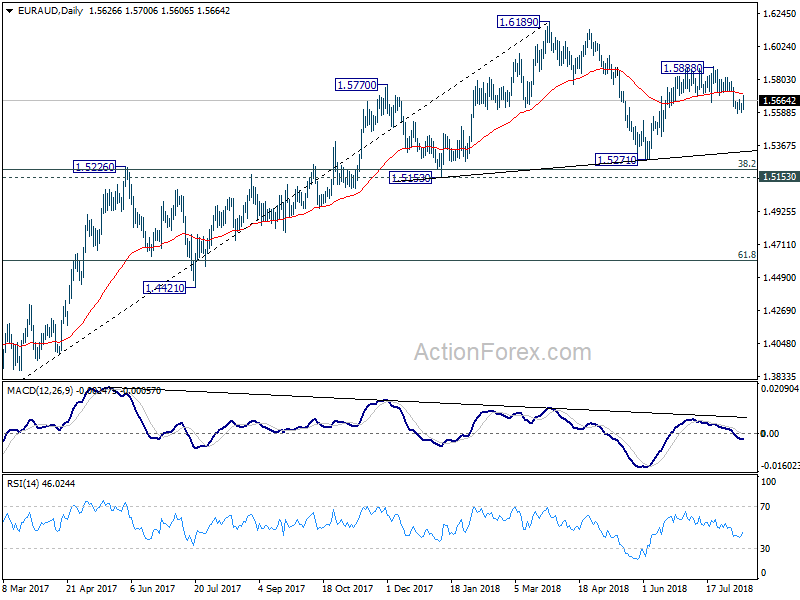
EUR/AUD Daily Outlook
Daily Pivots: (S1) 1.5593; (P) 1.5627; (R1) 1.5668; More....
EUR/AUD recovers further today but struggles to stay above 4 hour 55 EMA (now at 1.5677) 1.5677 so far. Intraday bias remains neutral and another decline is mildly in favor. Below 1.5578 will resume the fall from 1.5888 to 61.8% retracement of 1.5271 to 1.5888 at 1.5507. Sustained break there will pave the way to retest 1.5271 low. Nonetheless, sustained break of 4 hour 55 EMA will bring retest of 1.5888 resistance instead.
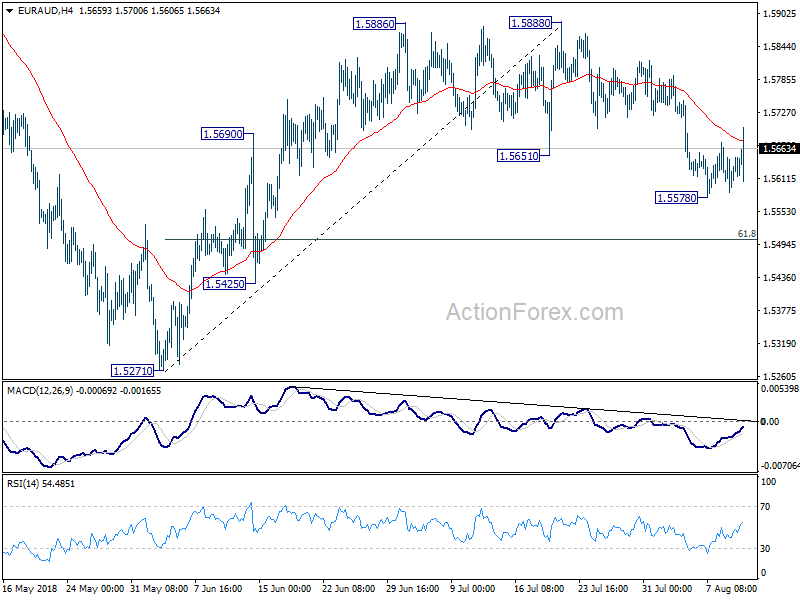
In the bigger picture, the rebound from 1.5271 was somewhat weaker than expected. EUR/AUD also failed to sustain above 55 day EMA and hints on some underlying bearishness. Though, for now, as long as 1.5271 support holds, medium term rise from m 1.3624 (2017 low) is still mildly in favor to extend through 1.6189 high, to 1.6587 key resistance (2015 high). Nevertheless, firm break of 1.5271 will complete a head and shoulder top pattern (ls: 1.5770, h: 1.6189, rs: 1.5888). That would indicate medium term reversal and turn outlook bearish.