Sample Category Title
EUR/USD Daily Outlook
Daily Pivots: (S1) 1.0876; (P) 1.0986; (R1) 1.1057; More...
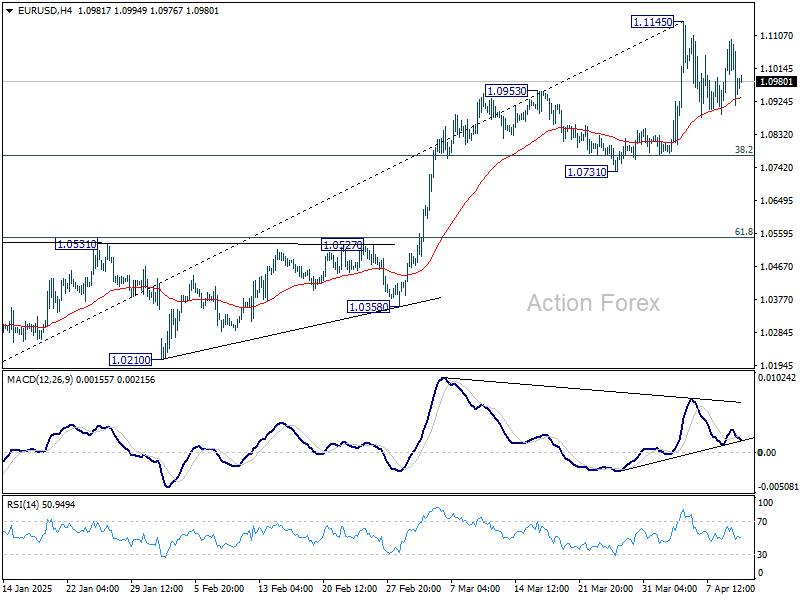
Intraday bias in EUR/USD stays neutral as consolidations continue below 1.1145. In case of deeper retreat, downside should be contained by 38.2% retracement of 1.0176 to 1.1145 at 1.0775. On the upside, above 1.1145 will resume the rally from 1.0176 to 1.1213/74 key resistance zone next.
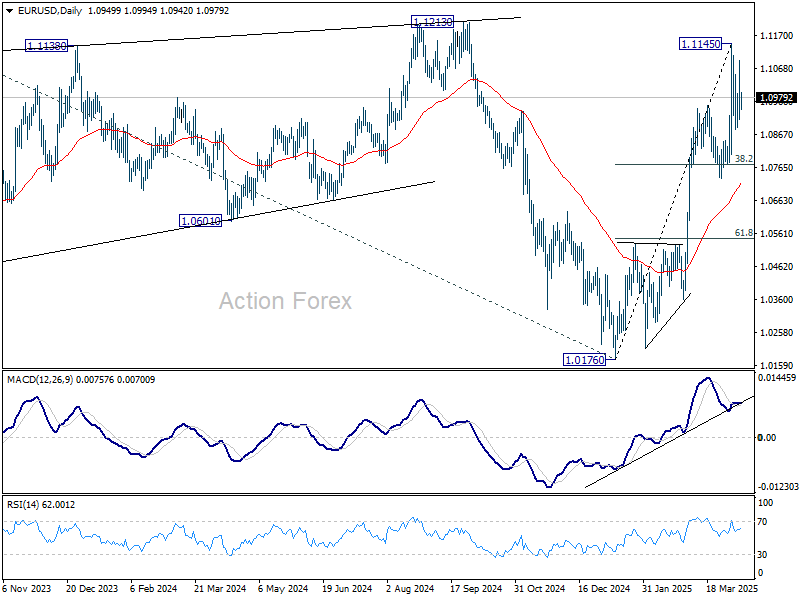
In the bigger picture, fall from 1.1274 (2024 high) has completed as a three wave correction to 1.0176. Rise from 0.9534 ready to resume. Decisive break of 1.1274 will target 100% projection of 0.9534 to 1.1274 from 1.0176 at 1.1916. Also, that will send EUR/USD through the multi-decade channel resistance will carries larger bullish implication. This will now be the favored case as long as 1.0731 support holds.
GBP/USD Daily Outlook
Daily Pivots: (S1) 1.2757; (P) 1.2811; (R1) 1.2878; More...
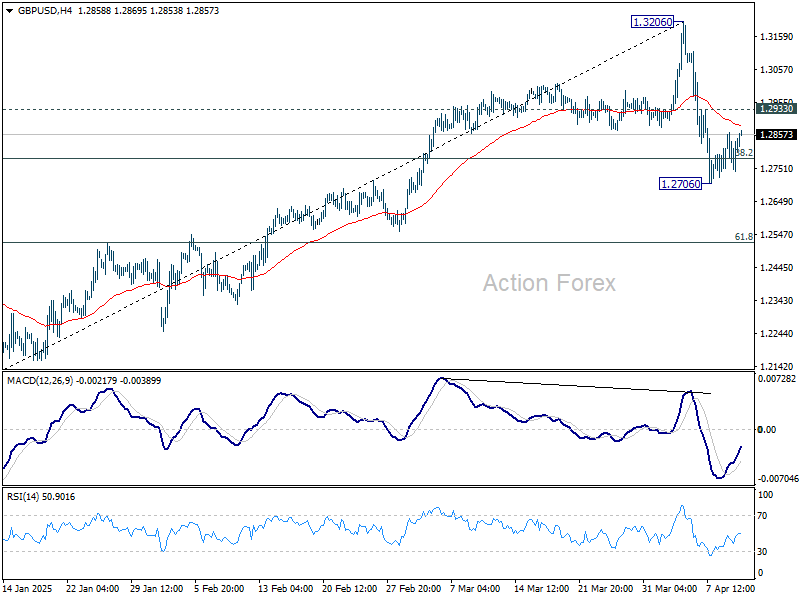
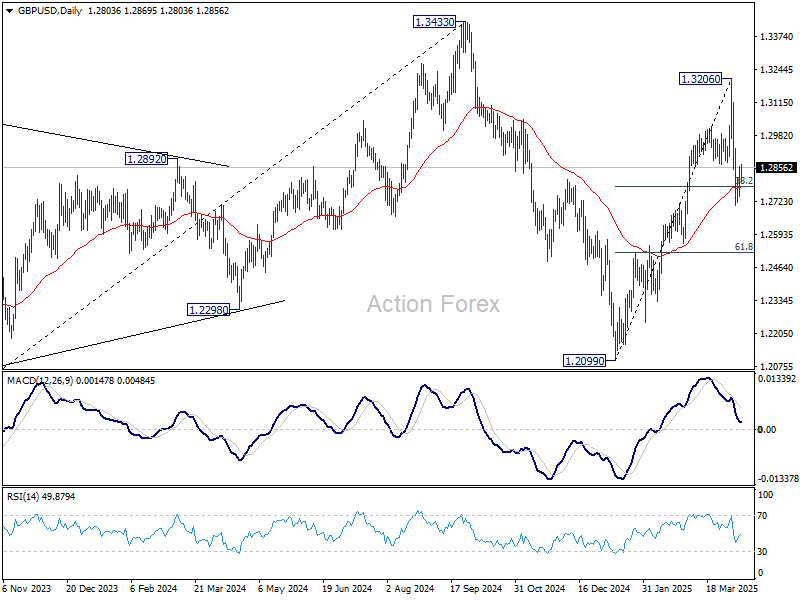
Intraday bias in GBP/USD remains neutral as consolidations continue above 1.2706. Risk will stay on the downside with 1.2933 minor resistance intact. Break of 1.2706 will resume the decline from 1.3206 to 61.8% retracement of 1.2099 to 1.3206 at 1.2522. Nevertheless, firm break of 1.2933 will bring stronger rebound back to retest 1.3206 high.
In the bigger picture, price actions from 1.3433 are seen as a corrective pattern to the up trend from 1.3051 (2022 low). Rise from 1.2099 could be the second leg. Overall, GBP/USD should target 1.4248 key resistance (2021 high) on break of 1.3433 at a later stage.
USD/JPY Daily Outlook
Daily Pivots: (S1) 145.08; (P) 146.68; (R1) 149.36; More...
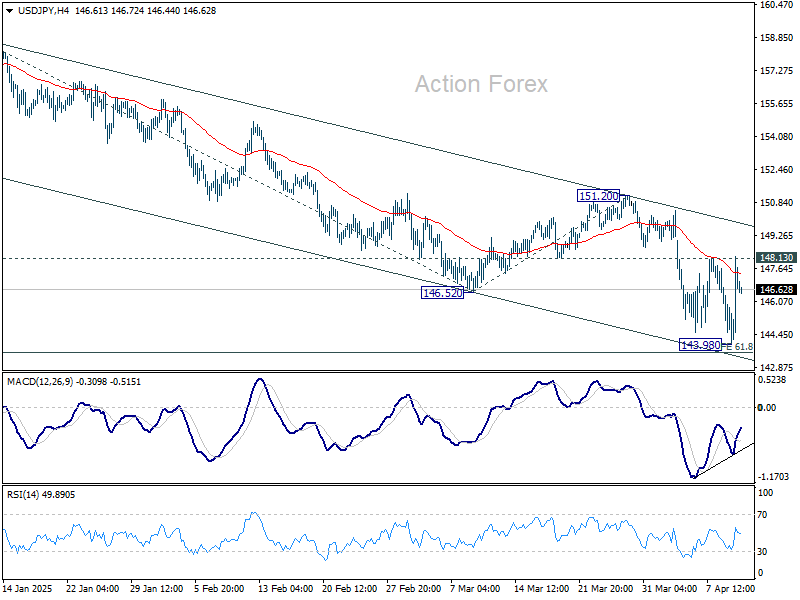
Intraday bias in USD/JPY is turned neutral again with current rebound. On the upside, firm break of 148.13 will confirm short term bottoming, and turn bias back to the upside for 151.20 resistance. Nevertheless, rejection by 148.13, followed by break of 143.98 will resume larger fall from 158.86 through 61.8% projection of 158.86 to 146.52 from 151.20 at 143.57
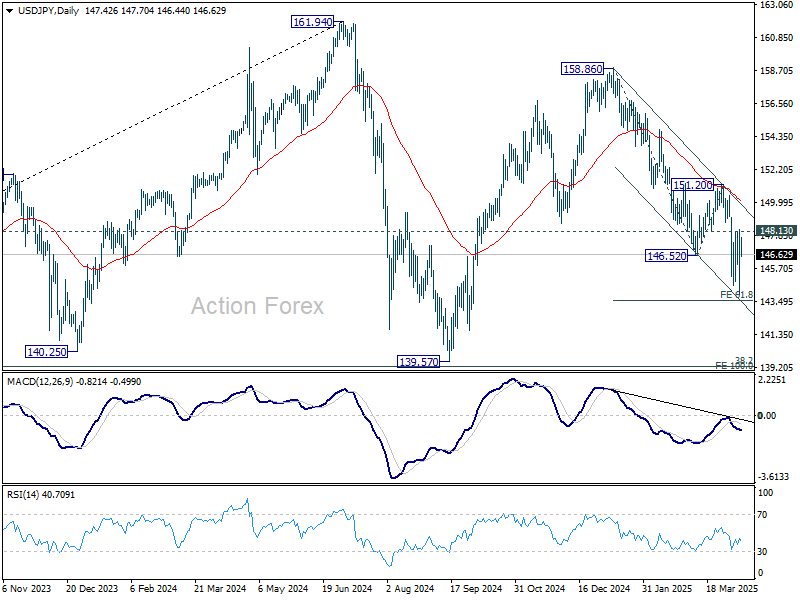
In the bigger picture, price actions from 161.94 are seen as a corrective pattern to rise from 102.58 (2021 low), with fall from 158.86 as the third leg. Strong support should be seen from 38.2% retracement of 102.58 to 161.94 at 139.26 to bring rebound. However, sustained break of 139.26 would open up deeper medium term decline to 61.8% retracement at 125.25.
USD/CHF Daily Outlook
Daily Pivots: (S1) 0.8431; (P) 0.8508; (R1) 0.8656; More…
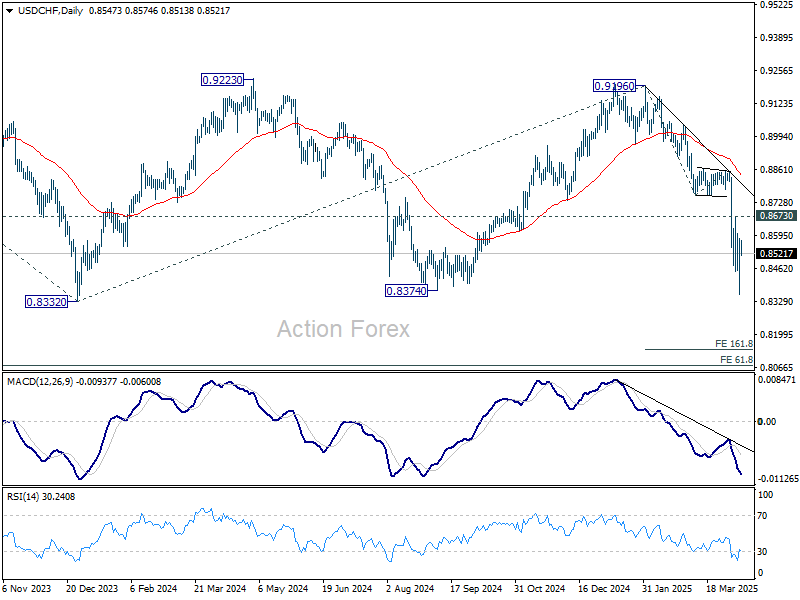
Intraday bias in USD/CHF is turned neutral first with current recovery, and some consolidations would be seen. But near term outlook will stay bearish as long as 0.8673 resistance holds. Below 0.8358 will resume the fall from 0.9196 to 161.8% projection of 0.9196 to 0.8757 from 0.8854 at 0.8144. Nevertheless, firm break of 0.8673 will confirm short term bottoming, and bring stronger rebound back to 0.8757/8854 resistance zone.
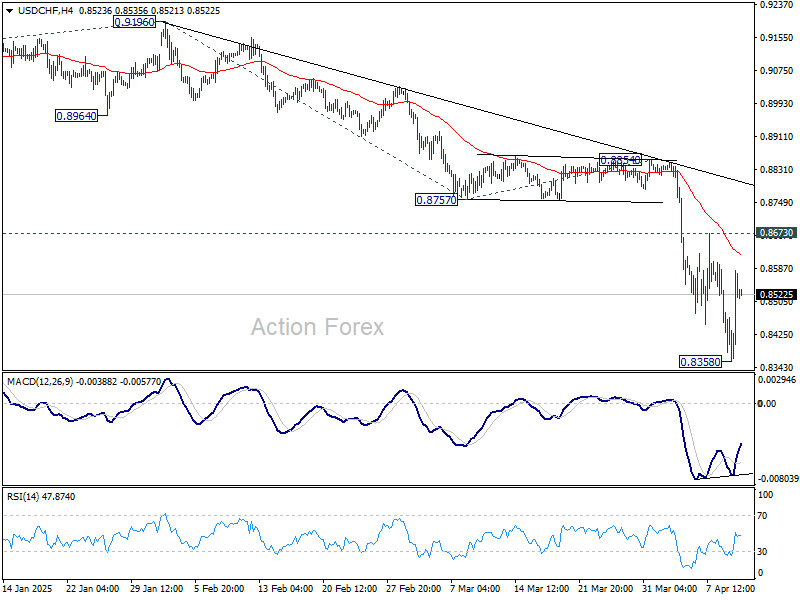
In the bigger picture, rejection by 0.9223 key resistance keep medium term outlook bearish. That is, larger fall from 1.0342 (2017 high) is not completed yet. Firm break of 0.8332 (2023 low) will confirm down trend resumption. Next target is 61.8% projection of 1.0146 (2022 high) to 0.8332 from 0.9196 at 0.8075.
USD/CAD Daily Outlook
Daily Pivots: (S1) 1.4011; (P) 1.4142; (R1) 1.4210; More...
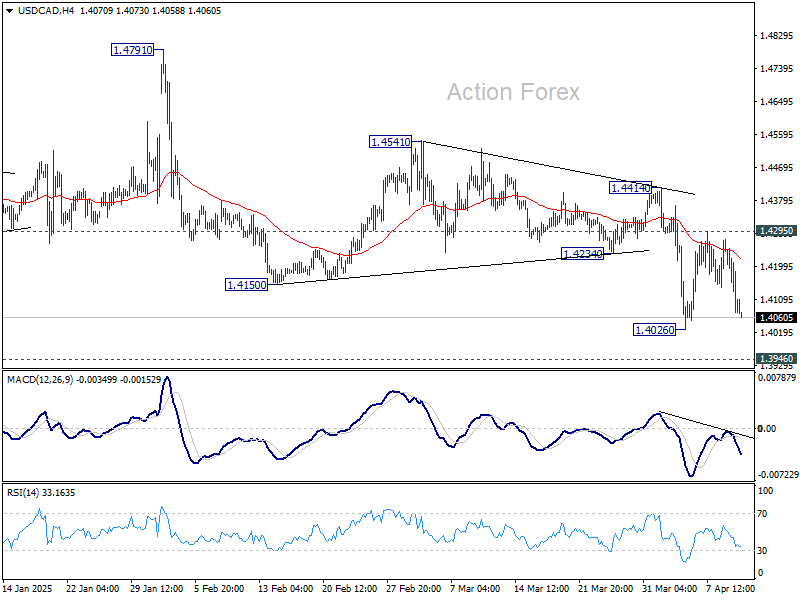
USD/CAD fell notably after rejection by 55 4H EMA (now at 1.4217) but stays above 1.4026 low. Intraday bias remains neutral first. On the upside, above 1.4295 will bring stronger rebound to 1.4414. Firm break there will suggest that the decline from 1.4791 has completed as a three wave correction. However, on the downside, below 1.4026 will resume the fall from 1.4791 to 1.3946/76 key support zone. Sustained break there will carry larger bearish implications.
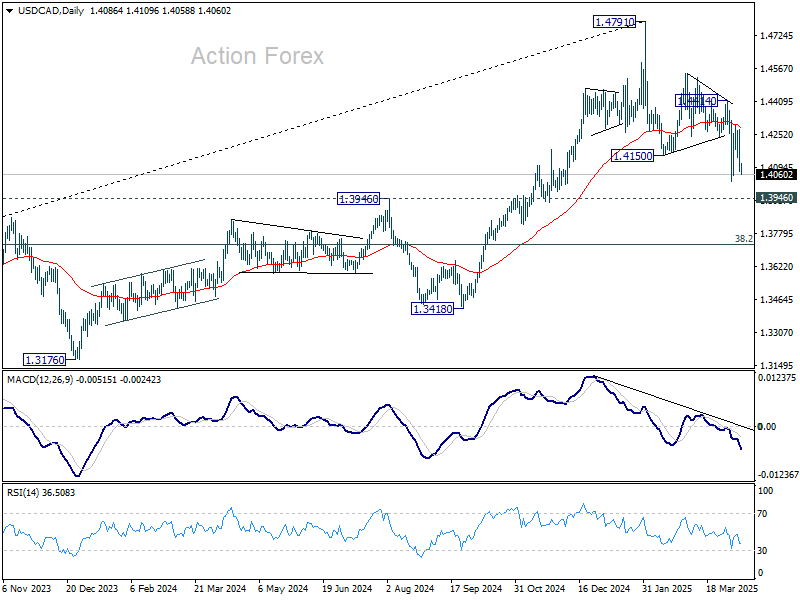
In the bigger picture, focus is now on 1.3976 resistance turned support (2022 high), which is close to 55 W EMA (now at 1.4001). Strong rebound from there will retain medium term bullishness. That is, up trend from 1.2005 is still in progress for breaking through 1.4791 at a later stage. However, sustained break there should confirm medium term topping at 1.4791. Deeper correction would be seen to 38.2% retracement of 1.2005 (2021 low) to 1.4791 at 1.3727.
AUD/USD Daily Report
Daily Pivots: (S1) 0.5987; (P) 0.6081; (R1) 0.6249; More...
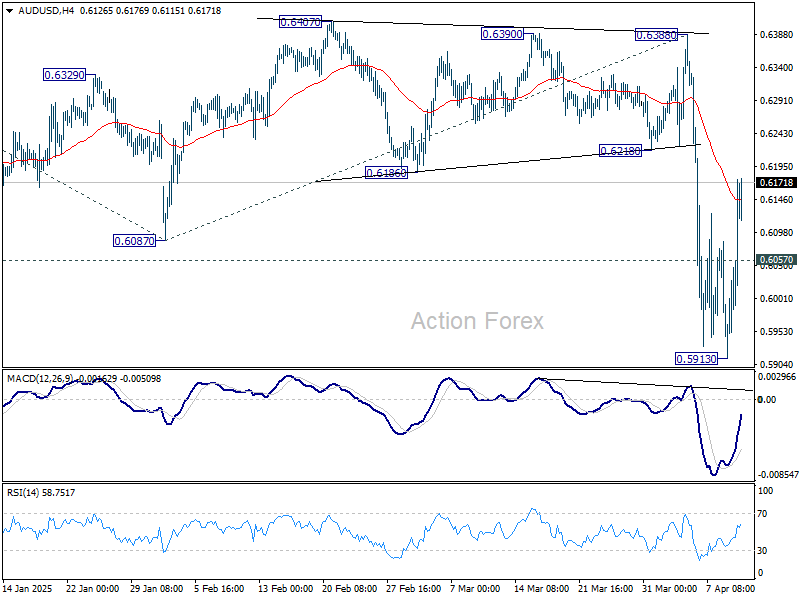
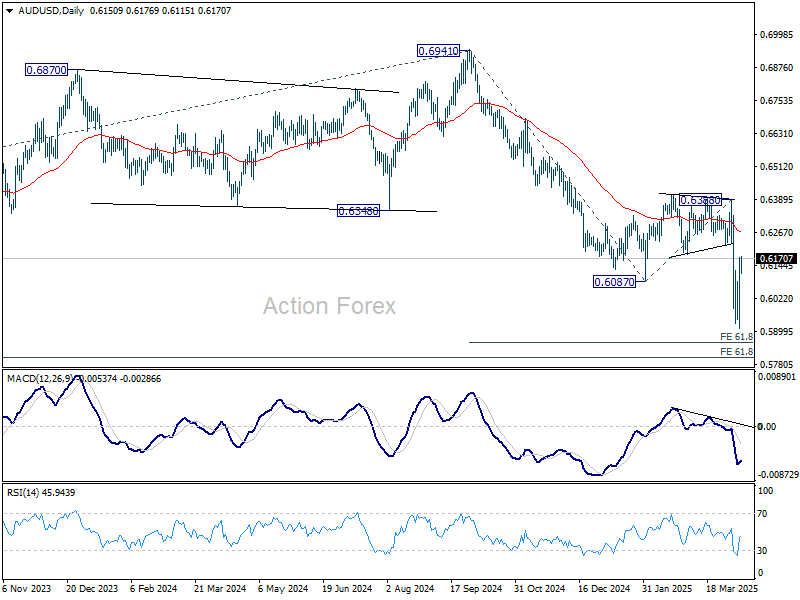
AUD/USD's rebound from 0.5913 extended higher, and it's now pressing 55 4H EMA (now at 0.6146). Sustained trading above there will should confirm short term bottoming, and bring stronger rebound towards 0.6388 resistance. Nevertheless, rejection by the EMA, followed by break of 0.6057 minor support will bring retest of 0.5913 low, and resumption of larger fall from 0.6941 at a later stage.
In the bigger picture, fall from 0.6941 (2024 high) is seen as part of the down trend from 0.8006 (2021 high). Next medium term target is 61.8% projection of 0.8006 to 0.6169 from 0.6941 at 0.5806. In any case, outlook will stay bearish as long as 0.6388 resistance holds.
Markets Soar on Tariff Truce, Reentry Signal or Perfect Exit Opportunity?
US stocks staged a powerful relief rally overnight, snapping back from the recent tariff-induced collapse. All three major indexes posted gains not seen in years, marking a dramatic reversal in sentiment. Yet, despite the scale of the rebound, it remains unclear whether this marks the beginning of genuine investor re-entry—or simply a massive short-covering rally triggered by a temporary policy U-turn.
What markets need now isn’t just a pause, but clarity and consistency. If the 90-day negotiation window devolves into more confusion, or if tariffs on China continue to escalate, the gains seen today could vanish just as quickly as they arrived.
The crux of the matter is whether yesterday’s rally represents just a reflexive bounce driven by short-covering and algorithmic momentum? With the market having been stretched to deeply oversold levels after recent collapse, the slightest spark was bound to trigger a sharp relief jump.
More improtantly, it is uncertain if long-term investors view this bounce as a reason to re-engage with US assets, or merely as an opportunity to exit at better levels. If the latter proves true, this rally could quickly fade into yet another bear market trap.
The catalyst behind the surge came from US President Donald Trump’s abrupt announcement that new 10% tariffs on most US trade partners—technically in effect just hours earlier—would be paused for 90 days to facilitate negotiations.
In contrast, the administration simultaneously escalated its economic conflict with China, announcing an immediate increase in tariffs on Chinese imports to 125%. The White House reinforced the pressure with a warning: “Do not retaliate and you will be rewarded.”
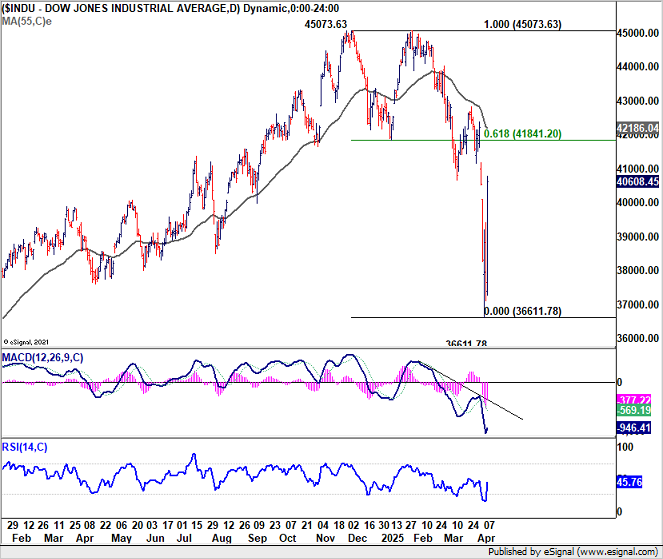
Technically, for DOW, this week’s low at 36,611.78 offers a potential base for near-term consolidation, especially given its proximity to 55 M EMA (now at 35595.76). However, any upside is likely to be capped by 61.8% retracement of 45073.63 to 36611.78 at 41841.20 to set the range for near term consolidations, well, probably for 90 days? Sustained break of 41841.20 is needed before declaring that this tariff crisis is over.
In the currency markets, after all the volatility, Aussie is currently the strongest one for the week so far, followed by Kiwi, and then Loonie. Sterling is the worst performer, followed by Dollar, and then Euro. Swiss Franc and Yen are positioning in the middle.
In Asia, at the time of writing, Nikkei is up 8.01%. Hong Kong HSI is up 1.96%. China Shanghai SSE is up 0.93%. Singapore Strait Times is up 5.73%. Japan 10-year JGB yield is up 0.045 at 1.327. Overnight, DOW rose 7.87%. S&P 500 rose 9.52%. NASDAQ rose 12.16%. 10-year yield rose 0.138 to 4.400.
Fed minutes highlight pre-tariff caution, hint at tough tradeoffs ahead
The minutes from the FOMC's March meeting revealed growing concern among policymakers about the economic outlook, particularly amid rising uncertainty. While these discussions occurred before the dramatic escalation of the US tariff war in April, the insights remain valuable.
“Almost all” participants viewed inflation risks as tilted to the "upside", while "downside" risks to employment and growth were also flagged—setting the stage for a policy dilemma.
Some officials highlighted that the Fed could soon face “difficult tradeoffs,” especially if inflation remains elevated while job and growth prospects deteriorate.
Notably, a few participants also warned that an "abrupt repricing of risk in financial markets" could magnify the impact of any negative economic shocks. Given what has since transpired with global markets in April, these comments seem prescient.
While the minutes may now appear somewhat outdated, they nonetheless provide a crucial baseline for understanding how the Fed might react in an increasingly fragile environment.
Japan's PPI accelerates to 4.2% while import costs ease
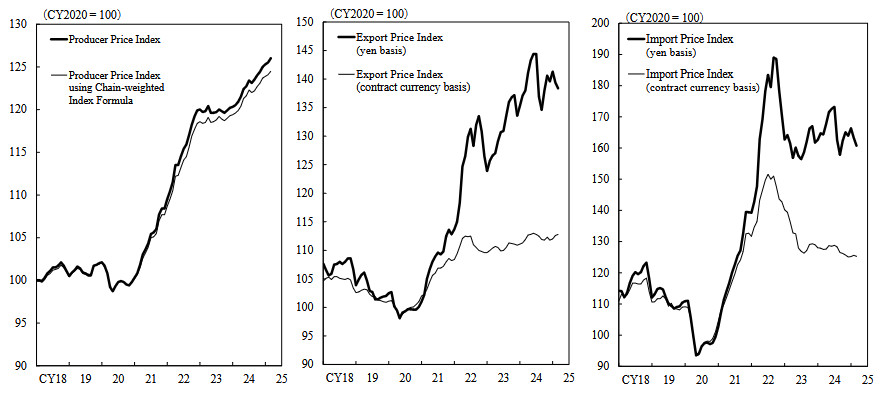
Japan’s PPI rose 4.2% yoy in March, a slight acceleration from February’s 4.1% yoy and topping expectations of 3.9% yoy rise. The increase was broad-based, with notable gains in food prices, which rose 3.1% yoy, and energy costs, with petroleum and coal prices surging by 8.6% yoy.
Despite the uptick in domestic producer prices, import costs in Yen terms fell -2.2% yoy in March, extending the -0.9% decline in February. Export prices, however, rose a modest 0.3% yoy, slowing sharply from February’s 1.7% yoy growth.
China's CPI falls -0.1% yoy in March, PPI highlights persistent deflationary pressures
China’s consumer inflation remained in negative territory for a second straight month in March, with CPI falling -0.1% yoy, missing expectations of 0.1% yoy increase. While the decline was narrower than February’s -0.7% yoy, it still reflects subdued demand pressures across the economy.
Food prices was a drag, down -1.4% yoy, while service prices provided only modest support, rising 0.3% yoy. Core CPI, which excludes volatile food and energy prices, edged up to 0.5% yoy from 0.3% previously, offering a slight glimmer of resilience.
However, with headline inflation still hovering around zero and signs of consumer caution persisting, the broader disinflation trend appears entrenched.
On a monthly basis, CPI dropped -0.4% mom, following February’s -0.2% mom decline, suggesting continued weakness in household spending momentum.
Meanwhile, producer prices extended their decline for a 30th straight month, with PPI dropping -2.5% yoy, deeper than the expected -2.3%.
AUD/USD Daily Report
Daily Pivots: (S1) 0.5987; (P) 0.6081; (R1) 0.6249; More...
AUD/USD's rebound from 0.5913 extended higher, and it's now pressing 55 4H EMA (now at 0.6146). Sustained trading above there will should confirm short term bottoming,and bring stronger rebound towards 0.6388 resistance. Nevertheless, rejection by the EMA, followed by break of 0.6057 minor support will bring retest of 0.5913 low, and resumption of larger fall from 0.6941 at a later stage.
In the bigger picture, fall from 0.6941 (2024 high) is seen as part of the down trend from 0.8006 (2021 high). Next medium term target is 61.8% projection of 0.8006 to 0.6169 from 0.6941 at 0.5806. In any case, outlook will stay bearish as long as 0.6388 resistance holds.
Gold Prices Sparkle Again: Restarts Increase on Recession Fears
Key Highlights
- Gold started a fresh increase after a dip to the $2,950 support zone.
- The bulls could face hurdles near $3,085 and $3,120 on the 4-hour chart.
- Bitcoin is still struggling to start a fresh increase above the $83,500 resistance zone.
- EUR/USD is eyeing more gains above the 1.1150 resistance zone.
- The US CPI could rise 2.6% in March 2025 (YoY).
Gold Price Technical Analysis
Gold prices started a fresh increase from the $2,950 support zone. The recent recession fears and trade war sparked an increase above the $3,000 resistance.
The 4-hour chart of XAU/USD indicates that the price remained stable above the 200 Simple Moving Average (green, 4 hours) and cleared the $3,020 resistance. The bulls pushed the price toward the 50% Fib retracement level of the downward move from the $3,167 swing high to the $2,956 low.
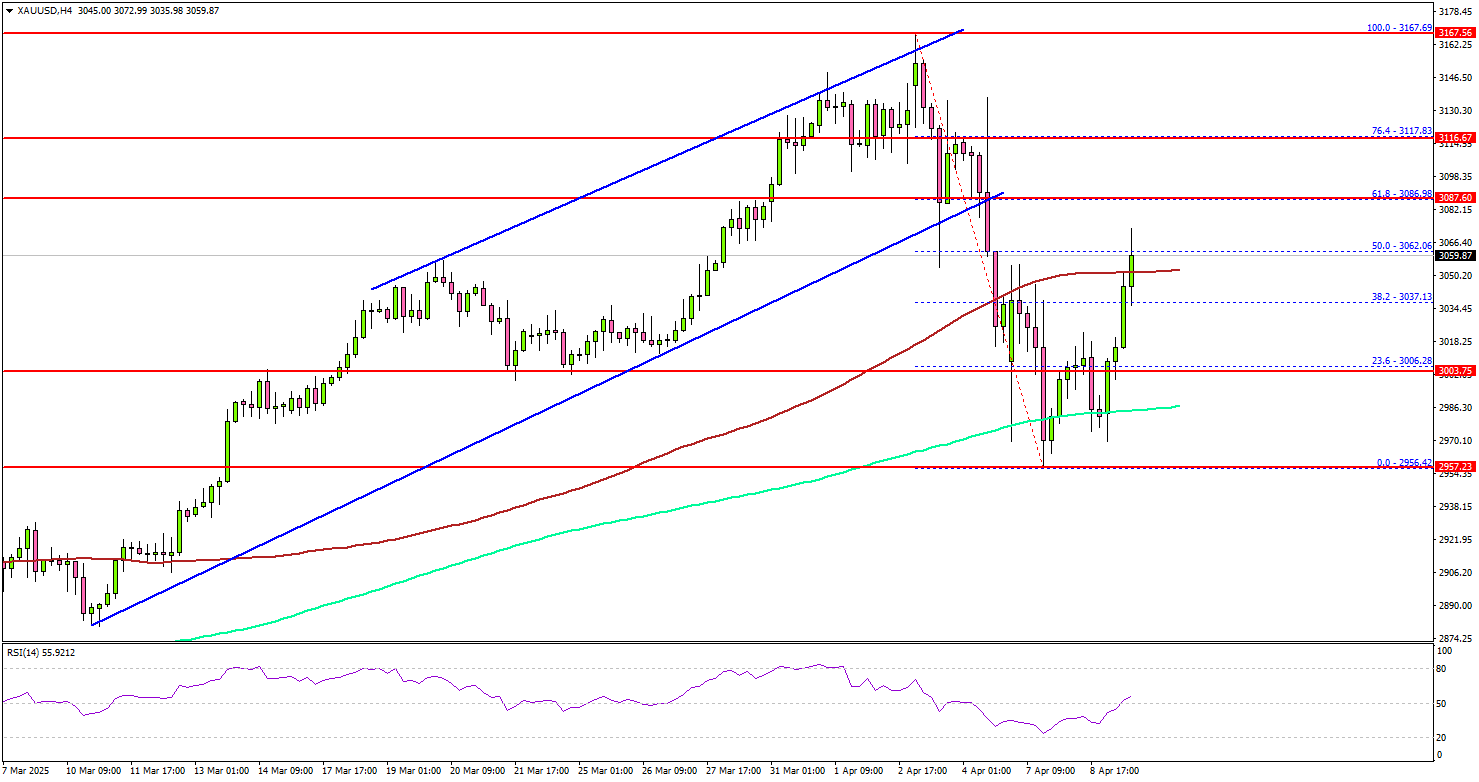
The price gained traction above the 100 Simple Moving Average (red, 4 hours) and might continue to rise. On the upside, immediate resistance is near the $3,085 level or the 61.8% Fib retracement level of the downward move from the $3,167 swing high to the $2,956 low.
The next major resistance sits near the $3,120 level. A clear move above the $3,120 resistance could open the doors for more upsides. The next major resistance could be $3,140, above which the price could rally toward the milestone level of $3,180.
On the downside, initial support is near the $3,045 level. The first key support is near $3,040. The next major support is near the $3,020 level.
The main support is now $3,000. A downside break below the $3,000 support might call for more downsides. The next major support is near the $2,950 level.
Looking at Bitcoin, the price remained in a bearish zone and might struggle to start a recovery wave above the $83,500 resistance.
Economic Releases to Watch Today
- US Consumer Price Index for March 2025 (MoM) – Forecast +0.1%, versus +0.2% previous.
- US Consumer Price Index for March 2025 (YoY) – Forecast +2.6%, versus +2.8% previous.
- US Consumer Price Index Ex Food & Energy for March 2025 (YoY) – Forecast +3.0%, versus +3.1% previous.
China’s CPI falls -0.1% yoy in March, PPI highlights persistent deflationary pressures
China’s consumer inflation remained in negative territory for a second straight month in March, with CPI falling -0.1% yoy, missing expectations of 0.1% yoy increase. While the decline was narrower than February’s -0.7% yoy, it still reflects subdued demand pressures across the economy.
Food prices was a drag, down -1.4% yoy, while service prices provided only modest support, rising 0.3% yoy. Core CPI, which excludes volatile food and energy prices, edged up to 0.5% yoy from 0.3% previously, offering a slight glimmer of resilience.
However, with headline inflation still hovering around zero and signs of consumer caution persisting, the broader disinflation trend appears entrenched.
On a monthly basis, CPI dropped -0.4% mom, following February’s -0.2% mom decline, suggesting continued weakness in household spending momentum.
Meanwhile, producer prices extended their decline for a 30th straight month, with PPI dropping -2.5% yoy, deeper than the expected -2.3%.
Japan’s PPI accelerates to 4.2% while import costs ease
Japan’s PPI rose 4.2% yoy in March, a slight acceleration from February’s 4.1% yoy and topping expectations of 3.9% yoy rise. The increase was broad-based, with notable gains in food prices, which rose 3.1% yoy, and energy costs, with petroleum and coal prices surging by 8.6% yoy.
Despite the uptick in domestic producer prices, import costs in Yen terms fell -2.2% yoy in March, extending the -0.9% decline in February. Export prices, however, rose a modest 0.3% yoy, slowing sharply from February’s 1.7% yoy growth.