

Sample Category Title
EUR/USD Is Likely Forming Double Bottom At 1.1510
Key Highlights
- The Euro declined and retested the last swing low of 1.1505-10 against the US Dollar.
- There is a connecting bearish trend line in place with resistance at 1.1700 on the 4-hours chart of EUR/USD.
- The US Services Purchasing Managers Index (PMI) (Prelim) in June 2018 declined from 56.8 to 56.5.
- Today in the US, the New Home Sales Change for May 2018 will be released, which is forecasted to increase 3.3% (MoM).
EURUSD Technical Analysis
The Euro found support near the 1.1510 level after a major decline against the US Dollar. The EUR/USD pair is likely forming a double bottom pattern at 1.1510 and is poised for more gains.
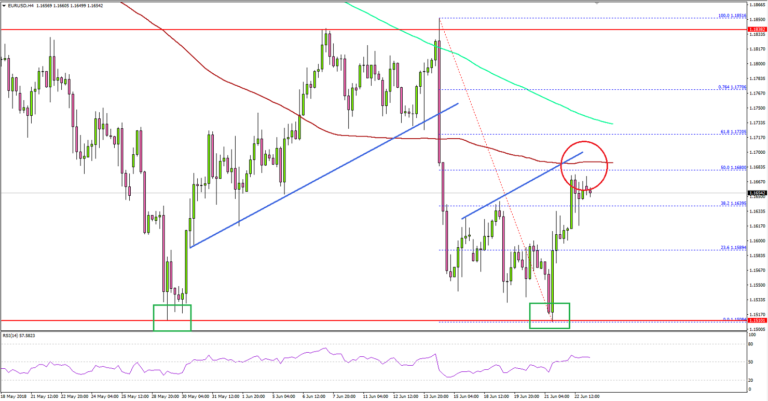
Looking at the 4-hours chart, the pair once again found a strong buying interest above the 1.1500 level. A low was formed at 1.1508 and the pair jumped above the 1.1580 resistance.
There was a break above the 23.6% Fib retracement level of the last decline from the 1.1851 high to 1.1508 low. There was a decent upside move until the Euro found resistance near the 1.1680 level and the 100 simple moving average (red, 4-hours).
Moreover, the 50% Fib retracement level of the last decline from the 1.1851 high to 1.1508 low also acted as a resistance. There is also a connecting bearish trend line in place with resistance at 1.1700 on the same chart of EUR/USD.
Therefore, a break above the 1.1700 resistance may perhaps confirm the double bottom at 1.1510. In the mentioned scenario, the pair could accelerate gains towards the 1.1800 level.
Recently in the US, the Services Purchasing Managers Index (PMI) (Prelim) for June 2018 was released by Markit Economics. The market was looking for a minor decline in the PMI from the last reading of 56.8 to 56.4.
However, the actual decline was a bit less as the preliminary PMI reading came in at 56.5, which was still way above the 50 level. More importantly, the Flash U.S. Manufacturing PMI declined to 7-month low to 54.6, and the Flash U.S. Manufacturing Output Index fell to 9-month low at 54.0.
Overall, it seems like the US Dollar may correct lower in the near term, and major pairs like EUR/USD and GBP/USD could recover further.
Economic Releases to Watch Today
- German IFO Business Climate Index for June 2018 – Forecast 101.7, versus 102.2 previous.
- US New Home Sales for May 2018 (MoM) – Forecast +3.3% versus -1.5% previous.
- Dallas Fed Manufacturing Business Index for June 2018 – Forecast 18.2, versus 26.8 previous.
USDCHF – Retains Downside Pressure Outlook
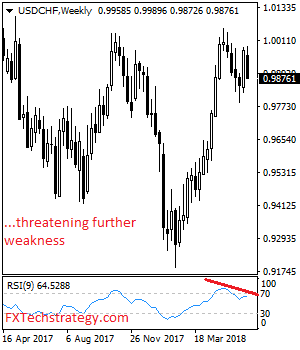
USDCHF - The pair continues to look vulnerable to the downside as it closed lower the past week. On the downside, support lies at the 0.9850 level. A turn below here will open the door for more weakness towards the 0.9800 level and then the 0.9750 level. On the upside, resistance resides at the 0.9900 level where a break will clear the way for more strength to occur towards the 0.9950 level. Further out, resistance comes in at the 1.0000 level. Above here if seen will turn attention to 1.0050. All in all, USDCHF faces further corrective pullback pressure.
EURUSD – Sets Up To Strengthen Further
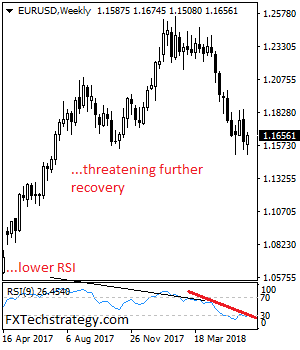
EURUSD - The pair rejected lower prices to close higher the past week. On the upside, resistance comes in at 1.1700 level with a cut through here opening the door for more upside towards the 1.1750 level. Further up, resistance lies at the 1.1800 level where a break will expose the 1.1850 level. Conversely, support lies at the 1.1600 level where a violation will aim at the 1.1550 level. A break of here will aim at the 1.1500 level. Below here will open the door for more weakness towards the 1.1450. All in all, EURUSD faces further upside pressure but with caution of a recovery.
GOLD – Looks To Recover Higher On Correction
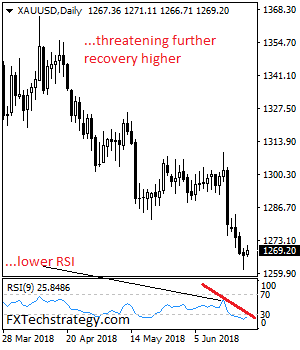
GOLD - The pair continues to face recovery pressure as it looks to move further higher. On the downside, support comes in at the 1,260.00 level where a break will turn attention to the 1,250.00 level. Further down, a cut through here will open the door for a move lower towards the 1,240.00 level. Below here if seen could trigger further downside pressure targeting the 1,230.00 level. Conversely, resistance resides at the 1,280.00 level where a break will aim at the 1,290.00 level. A turn above there will expose the 1,300.00 level. Further out, resistance stands at the 1,310.00 level. All in all, GOLD looks to weaken further.
No Rest For The Weary
Another Trade-induced meltdown
New Curbs on China investment!
Another barrage of potential tariffs along with the US administration looking to impose International Emergency Economic Powers Act of 1977 to prohibit Chinese firms from investing in the US technology sectors has again spooked global equity market in early trade while inducing a yet another risk meltdown.
Indeed the trade war hawks are circling, but the question is fade or trade but by all appearance were undoubtedly nearing that bridge too far and extreme caution should be exercised as the market awaits the rebuttal from China. Be nimble!
No rest for the weary
No rest for weary as the markets will get bombarded by events risk from virtually every angle this week. Trade war, elections, US data, Fedspeak, Eurozone inflation and the Bank of Canada (BoC)Business Outlook Survey all wrapped up in month end portfolio rebalance to add more confusion to the fray. Although a sense of trader fatigue is setting as trade war noise drags on, it will be a week” to be nimble best be quick” as markets are apt to be jumpy.
The Euro has found itself stirred but not shaken by new threats from US President Trump who announced auto tariffs of 20%directed at German automakers. But shares in German and other European car manufactures predictably hit the skids Friday. Indeed, this import tax would be a knockout blow and could wipe out the business of importing German cars to the US. But worst of all, this move risks spiralling into a protracted trade war with the EU.
Turkish elections are seldom a delight to trade given that on any surprise it will turn in to a game of risk transfer at ridiculous high spread premiums. While President Erdogan has declared himself the winner, the opposition CHP are questioning the official result. No precise details on this dispute, but the Turkish Lira is trading 1 % higher in early trade.
On the US front, Housing, GDP, Manufacturing and PCE data make for useful data week, but with the FOMC members taking to the airways on masse it usually provides some moments of confusion as trader’s digest Fedspeak which is generally an exercise in verbal gymnastics.
Big week on the Bank of Canada front with traders very keen to hear Poloz speech and BoC business outlook survey from one of the most hawkish CB’s on the planet. Traders view the Canadian dollar as a reliable barometer for USD sentiment, and we will see some good action around these risk events.
Equity Market
Investors pulled out a record $8.1bn from global equities in the past week with Emerging Markets seeing outflows of $6bn as the trade tension between China and the US threatened to escalate as China vowed in-kind retaliation for any US trade tariffs. These are pretty damning numbers suggesting investors are voting with their feet and will take a lot convincing to get that money out of money market funds, which are the preferred parking spot for retail to wait this trade war mess out. But with US administration is in some form of a trade dispute with everyone, this could undoubtedly drag on for some time to come. And predictably equity futures wobbled at the open before stabilising. However, traders do appear to be better sellers in early markets
Oil Market
Oil prices are opening lower as the market is refocusing on the escalating trade war theme and the obvious concerns around global growth. The Pboc move to reduce RRR suggests mainland is concerned about the recent economic slowdown along with the prospects of a protracted trade war, so traders are taking notice.
But on Friday, WTI rallied above $ 69.00 post-OPEC decision and reversing out much of the bearishness leading up to the much-anticipated Vienna meeting. The bottom line is that given the global demand-supply of the equation and knowing the markets are little more than one supply shock away from surging higher. The perception that the production increase may not offset the production decreases from Venezuela and sanctions impacts from Iran after OPEC surprised the market with a higher output increase than expected.
But the devil is in the details since only four members (Russia Saudi, UAE and Kuwait) have the immediate spare capacity, so the supply increases will not occur instantaneously, and as suggested by Nigeria energy minister Kachikwu, the rise is closer to a 700 K bdp risk. And perhaps even less when factoring in new disruptions in Libya and scheduled North Sea maintenance. And so, the market has swung aggressively from a sell the rumour to buy the news reaction on the OPEC decision.
Also, a report that a 350,000 bpd Canadian oil sands upgrader could be offline for the next month or so has added to the rally as short positions decided to pack it in.
Gold Market
Gold prices exhibited weakness all last week, but there are subtle signs the meltdown may have stopped as the US dollar closed below technical support lines on Friday. And while a technical downtrend remains intact for, Gold markets are looking increasing oversold and very susceptible to safe-haven buying that could ignite at any time but more likely to further weakness in the USD. Local Singapore gold dealers were reporting brisk retail demand for coins and wafers but also saying Jewellers were only buyers on request to fill immediate needs suggesting they want to see gold fall lower before committing to a longer-term purchase.
Asia market
To stabilise plummeting markets China will lower some banks’ reserve requirement ratios (RRR) by 50 basis points on July 5, the country’s central bank said Sunday. This monetary adjustment should not be interpreted as a policy shift designed to weaken the Yuan and further escalate trade tensions, but rather a case of policy fine-tuning intended to calm investors nerves which are fraying due to escalation trade tensions.
To put it bluntly, it was a brutal week for Asia with risk monitors flashing red. China has been the centre of attention with equity market melting down and breaching key support levels like a hot knife through butter and USDCNH is pressing 6.52 in early trade. The market remains vigilante as both trade concerns and a slowdown in China markets. Thus, traders will be more disposed to fade rallies. On the currency front, with no trade war relief in sight selling Yuan on prospects of a more aggressive Pboc policy shift could be a path of least resistance.
In Malaysia, Nor Shamsiah will be the new BNM governor, the market was happy with this welcome announcement as it suggests a policy status quo, while other headlines that PM Mahathir sees fair value for USDMYR at 3.8. Spot adjusted lower on the implication the new government does favour a stronger Ringgit but remain above the critical 4.0 level. Also, higher oil prices post OPEC is lending some support, but the local markets will stay under tremendous stress from capital outflow and the prospect of waning equity markets given trade war risks. As such, my risk-reward index remains in the extremely negative territory for local investments.
Currency market
Directionally, the USD could struggle after the dollar failed to close on solid footing vs EURUSD, GBPUSD and USDCAD on Friday Last weeks robust EUR PMIs are massive and do suggest that EU data pendulum may be swinging back in neutral to positive territory. Traders will continue to put significant weight on the observable data this week, so we should have a busy response from dealers of crucial data prints.
The EURUSD looks happy enough in early trade at 1.1665, but traders will be very much focused on economic data and fed speak.
However, all eyes will be on EMFX which rallied into weeks end and was one of the critical currency markets highlights on Friday. The EM FX reversal was spurred on by rising energy prices, a softer dollar and some squaring of overextending bearish positioning. And the G10 betas like the Australian dollar put in a healthy day for similar reasons. But all eyes today’s market opens as ZTE is back in the middle of the
EUR: With the EURUSD failing to take out 1.1525 convincingly and the subsequent move above 1.1600, the short-term portfolios going long and it’s all about the decent EU PMI prints on Friday. Given the short-term market remains in oversold conditions, any combination of US data wobble or solid Ifo or EU inflation print could trigger a squeeze higher to 1.1740 with a possible extension to 1.1820.
AUD: While I’d still favour being short the AUD, the break above the previous lows at 0.7412 may suggest more shorts will get pared.
JPY: Topside continues to be weighted down by trade war escalations but differential keep dollar supported. Remains a currency pair out of favour.
GBP: The close above 1.3250 Friday suggest the GBP remains supported post-BOE after the surprise dissenter, Haldane, has increased expectations for a rate hike in August.
Cryptocurrencies
Bitcoin fell below the key psychological $6000 mark over the weekend but has since recovered and traded just above that critical level. Investors were back on the regulatory watch after Japan’s Financial Services Agency ordered six of the country’s biggest crypto trading venues to improve measures to prevent money laundering. While the non-stop regulatory oversight continues to weigh on sentiment, there wasn’t enough selling momentum for the move to stick. However, on a subsequent test, all bets are off as if we can clear this support level it should be clear sailing to $5000
Eco Data 6/25/18
[php_everywhere instance="1"]
Bulls Increased Bets While Bears Cowered on USD’s Rally
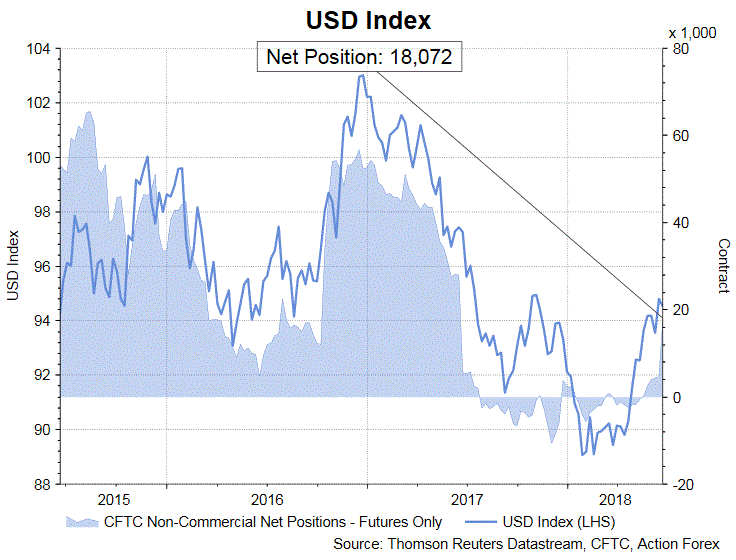
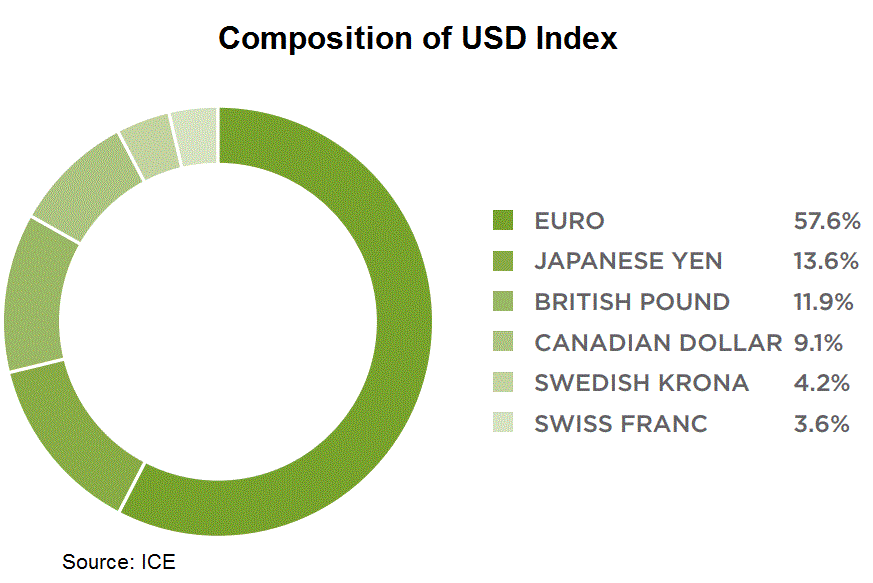
USD bulls won ahead of the June FOMC meeting, as suggested in the CFTC Commitments of Traders report in the week ended June 19. Speculative long positions for USD Index (DXY) futures gained +2 267 contracts while shorts slumped -11 142 contracts, resulting in Net LENGTH of 18 072 contracts, up +13 409 contracts from the prior week. The index rose +1.36% during the week as the greenback strengthened against major currencies with the exception of Japanese yen.
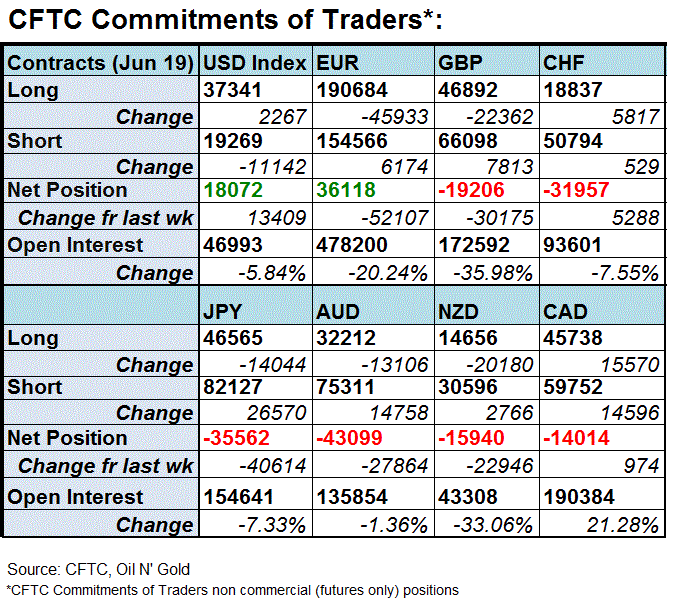
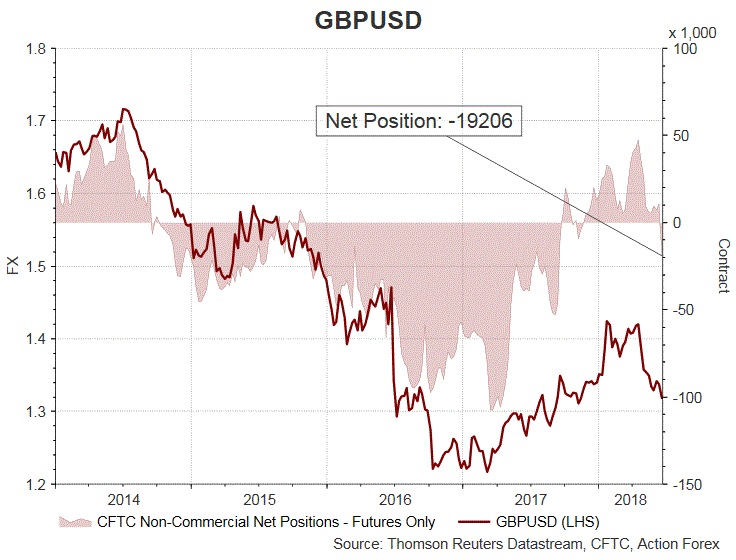
 For European currencies, NET LENGTH for EUR futures slumped -52 107 contracts, to 36 118 for the week. Bulls reduced their bets, by -45 933 contracts, to 190 684, while bears increased bets, by +6 174 contracts, to 154 566, for the week. GBP futures shifted to NET SHORT of 19 206 contracts last week ahead of a more hawkish than expected BOE meeting.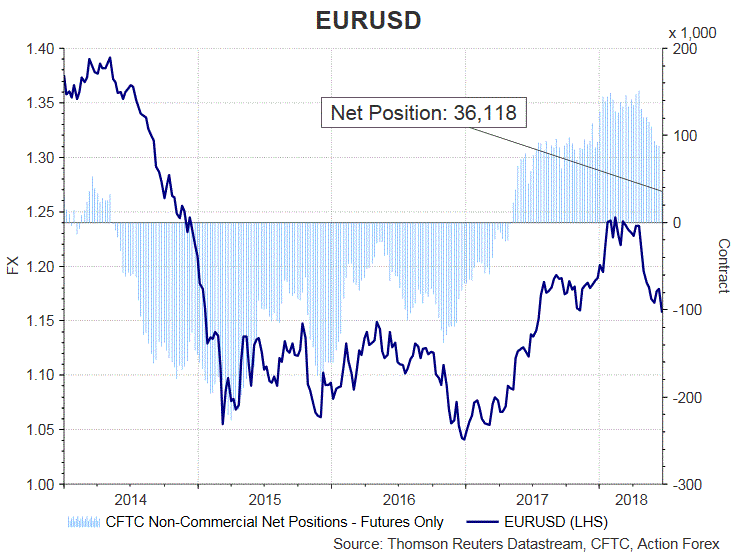
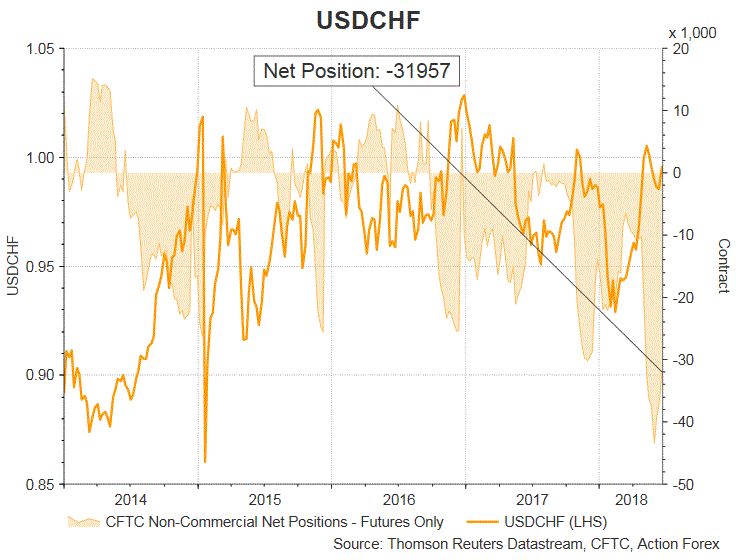
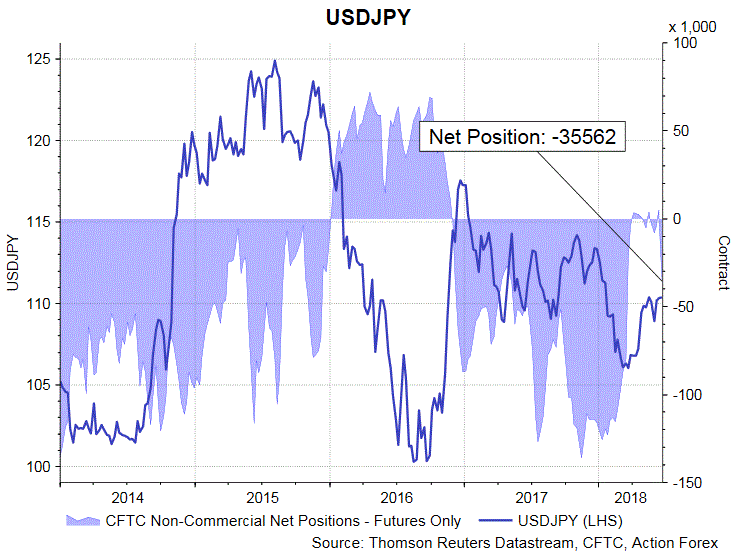
 On safe-haven currencies. Net SHORT for CHF futures was down -5 288 contracts to 31 957. JPY futures drifted to NET SHORT of 35 562 contracts, from NET LENGTH of 5 052 contracts in the prior week.
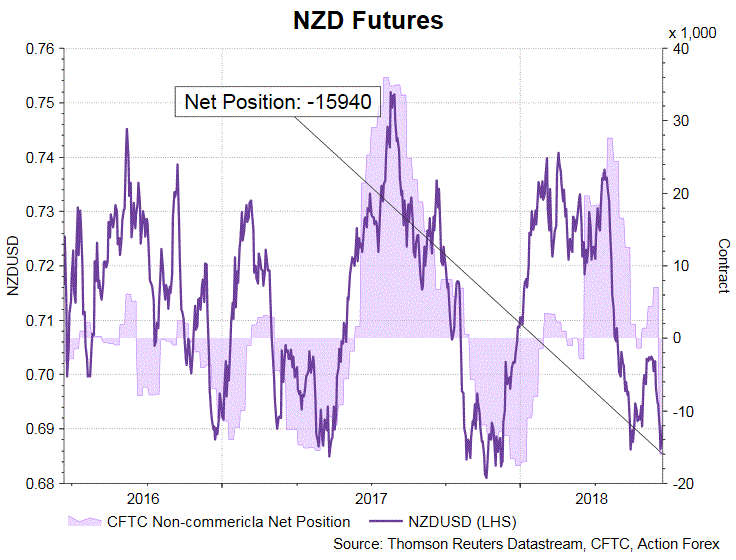
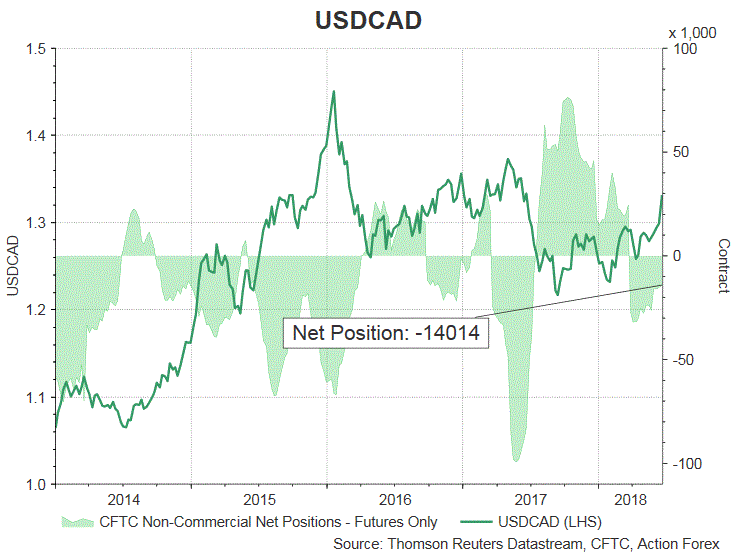
All commodity currencies were in NET SHORT. NZD futures shifted to NET SHORT of 15 940 contracts. Meanwhile, NET SHORT for AUD futures more than doubled to 43 099 contracts while that for CAD futures decreased -974 contracts to 14 014 for the week. All three currencies weakened against US dollar during the week.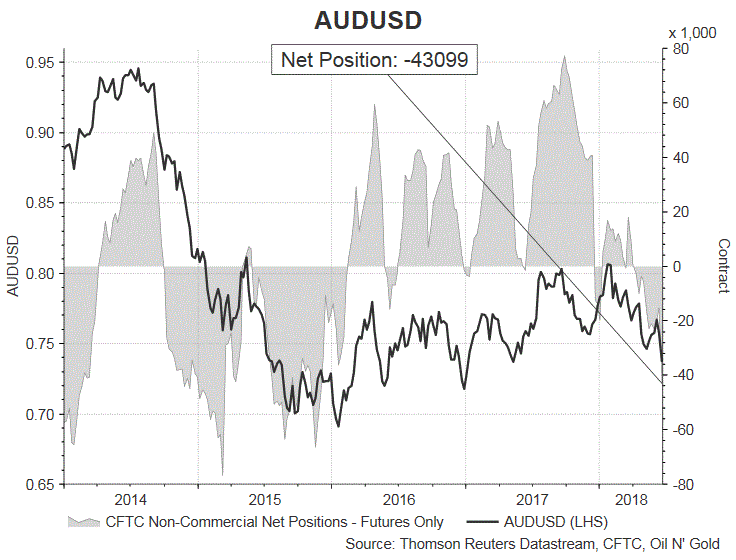
Forex Winning Strategies
Personal Forex coaching is about to be changed! Get this personal coaching guide homestudy video program and let Vic Noble be your personal coach.

Since 2005, through his personal one-on-one coaching at Forexmentor.com, our resident Forex coach Vic Noble has single-handedly turned helped thousands of struggling Forex traders to turn around their trading by addressing common trading mistakes.
In his role at Forexmentor.com, Vic deals with trading challenges on a daily basis with his clients. We receive consistent comments that Vic has an uncanny ability to remove much of the confusion and guesswork that surround the trading decision making process.
Often times, all it takes is one small adjustment or a different way of approaching trading opportunities. These minor but significant changes can make all the difference between winning and losing. For more advanced traders, Vic addresses the common challenge of "information overload " which often paralyze even the most experienced traders.
We had numerous requests to have Vic encapsulates his coaching service in a self-study program which allows traders to review and learn these winning strategies any time any where. After many months of development, Vic and the Forexmentor team are pleased to announce the immediate availability of Vic' Coaching Guide Training Program.
With the course, you can now benefit from 100's hours of personal coaching from Vic and learn these techniques at your own pace.
Here's what you will get with your personal coaching video program:
- Exactly what to look for when you sit down at the computer
- Where and when to enter a trade
- Where to place stops (and when to move them)
- Where and when to exit a trade (with profit or loss)
- Money management made simple
- How to manage a trade properly
- How to use MACD objectively and effectively
- Integrating fibonacci information very effectively and simply with the core concepts of the Forexmentor trading system
- Market Flow—how to determine trend direction without using any technical indicators!! You'll love this one!
FX Systems Lab
What's It All About?
Each of the monthly courses is impeccably detailed and practically focused, with an emphasis not on pie-in-the-sky theory, but rather how to "get down to brass tacks" and actually apply the system for the purpose of making money in the global Forex market. The duration of each course varies, but all are over 90 minutes each (some more). In addition, each trading system is supported by an archive of 12 Daily Recap videos, each of which serves as a mini "case study" profiling the underlying trading system in detail.
The basic format for all of the 12 trading courses will be as follows:
- Chart Layout.
- Finding The Setup.
- Filtering The Setup.
- Trade Entry.
- Trade Management.
- Trade Exit.
- Detailed Case Study.
In addition, the video presentation of each course will be supplemented with a PDF formatted type-written summary of the trading rules for which you can refer to again and again.
Who Is This Service For?
Quite literally, any trader of any level of experience – from newbie to seasoned expert – will find tremendous value in our offering. Our trading systems are designed to reflect the optimal balance of effectiveness, ease of use, risk management and (wherever possible) scalability. Newcomers to Forex looking for someone to teach them the actual 'nuts and bolts' of how to find and execute a trade will come away from the experience with a profoundly elevated sense of confidence. Aspiring, intermediate-level traders who still haven't quite found the system they feel they can make their own will be able to settle down and adopt a consistently applied approach that they can use for the rest of their trading careers. Seasoned pros feeling perhaps a little 'stale' or looking for an edge they hadn't considered before will definitely experience a new sense of urgency as they apply their daily trading plan reflecting our methods. Put simply: there's something here for everyone!
Learn Forex Now
A Comprehensive Guidebook for Aspiring Forex Traders
You've heard just enough commentary "through the grapevine" to wonder whether Forex trading represents a possibly viable opportunity for making a part-time, or possibly even full-time income stream for yourself. And yet you've also done enough searching through pages and pages of sometimes skimpy, sometimes confusing, and sometimes flat-out misleading information available for free on the Internet to know that you need a more comprehensive introductory overview to help you understand what it's all about – before diving headlong into the art and science of applying any particular trading methodology using a live trading account.

If, as either a newcomer to Forex trading or an aspiring trader with just one or two years of experience under your belt, you've ever found yourself wanting for a comprehensive, practical and most of all – completely realistic – overview of what the Forex industry is all about and what it takes to become a competent practitioner within it, then we just might have exactly the learning resource that answers most (if not all) of your most pressing questions: Our new guidebook (available in both hard copy and online versions) called LEARN FOREX NOW!
Objectives of This Book
First of all, let's be clear up-front what this book is NOT: It is not a technical specification of any particular trading system or method; it is not an enumeration of all the steps to take in executing and managing a trade from start to finish; in short, it is not a how-to training manual of any kind that will specifically make you a trader, if that's what you're looking for.
What Learn Forex Now! does instead, is provide you a "one-stop-shopping"information-packed resource that explains what the Forex industry is, how it works, and what it will take for you to succeed in this profession. That latter question is the one that virtually no other book, online course, DVD or weekend seminar tries to honestly address, because the reality of this industry is that there are plenty of people who want to get you excited and sell you something, but there are few who explain the realities of trading, what it takes to become a trader, and what factors you need to assess to determine whether you are cut out for this business or not (and let's face it, no profession is universally well-suited for any and all who might have a curiosity about it).
So our primary objective in writing this book is to give you the "straight goods" about Forex trading, not just from the perspective of an industry overview, or the specification of all the tools, resources and knowledge you need to master to become a profitable trader; but also from the personal and psychological aspects of becoming a trader. By reading and studying the contents of this book carefully, you will substantially cut down on the length of your personal learning curve and get up-to-speed much more quickly than if you simply try to learn from a variety of different introductory sources.
The 21 chapters in this book include the following:
PART I: FOREX ESSENTIAL QUESTIONS
- Chapter 1 – What Is Forex? The Forex industry is big. Really, really, really big. Most people don't realize it, but Foreign Exchange is by a long shot the single largest business on earth. Nothing else comes even close. In Chapter 1, we give you a good basic overview of what the industry looks like (not to mention a more precise quantification than just "really, really, really big").
- Chapter 2 – How Is Forex Traded? Don't even think about 'pulling the trigger' (even if it's just in a demo account) until you know the ins and outs of how Forex is transacted. In this chapter, we cover important concepts relating to the price quote, how Forex profit and loss are determined, the different categories of currency pairs, Position Sizing and Leverage, and much more. Studying Chapter 2 carefully should give you a good basic background in the mechanics of trade execution.
- Chapter 3 – What Do I Need to Trade Forex? In our review of the literature on Forex trading, we've found that almost nobody ever talks about this subject. And yet, wouldn't it be helpful to know what the specific array of tools and resources are that you need to get up and running? From the basic specs on a suitable trading workstation, to what to look for in a charting platform (and a whole lot more), we'll tell you straight up what you need.
- Chapter 4 – Is Forex Trading Right for You? Before you decide to embark upon a career (or even just a hobby) as a Forex trader, you need to determine if it's likely to be a good fit for you. It might be, it might not. There's no occupation in the world that can satisfy 100% of the population, and that's true of Forex trading as well. In this chapter, we'll give you a realistic, completely un-romanticized sense of what kind of person makes a good trader. Is that you?
- Chapter 5 – What Are the Different Styles of Forex Trading? You may already have heard terms like Scalping, Day Trading, Swing Trading or Position Trading, but not have a clear sense of what distinguishes one of these trading styles from another. Here, we'll explain the differences and help you figure out which style might be best suited for you.
- Chapter 6 – What Can I Expect to Achieve from Forex Trading? How much money you can make trading Forex (and in the interest of full disclosure, lose, if you're not careful) is dependent on a set of about a half-dozen key variables reflecting your trading situation and resources. In chapter 6, we'll fully explain what those variables are, and suggest a checklist you can go through for the purpose of deriving expectations that are both realistic and prudent.
- Chapter 7 – What Are The Common Pitfalls of Trading, and How Do I Avoid Them?More people fail at Forex trading than needs to be the case simply because they don't take the time to fully understand the pitfalls that can torpedo a trading account. Knowing what those pitfalls are, and better yet understanding how to avoid them, can give you a leg up on your trading competition and stead you for longer term success. That's what Chapter 7 is all about.
PART II: TOOLS OF THE TRADE – AND HOW THEY'RE USED
- Chapter 8 – Introduction to Chart Analysis. There's no way to avoid it: whether you plan to trade more on fundamentals than technicals or vice versa (or somewhere in between), you simply have to know how to read a chart before you can execute a trade. And regardless what particular trading style or method you end up making your own, knowing a little something about Top-Down Analysis, not to mention how to identify the tradable trend, is the crucial first step to becoming a proficient trader.
- Chapter 9 – Understanding Support & Resistance. Of all the topics in Technical Analysis that you need to know, the first and most important is the concept of Support/Resistance. Because even if you're on the right side of the trend, these price levels can get in your way and scuttle your trade if you're not careful. Conversely, market reactions to Support/Resistance can provide useful clues to getting in on a trade. In Chapter 9, we enumerate all the main varieties of Support/Resistance and explain how to look for them on your chart.
- Chapter 10 – The Wave Concept of Price Action: Progress and Regress. There's only a few truisms we work with in this book – one of them being the proposition that price action unfolds in waves, simple patterns of progress and regress ('two steps forward, one step back') which in turn help us confirm the tradable trend. Chapter 10 shows how you can master this concept in a practical, hands-on way.
- Chapter 11 – Swing Point Patterns: The Turning Points in Price Action. Swing Points are simple price bar patterns which, when appearing in proximity to Support/Resistance levels (and a few other things), can provide reliable indications of a turn. Once you have the basic template committed to memory, you'll be amazed at how much easier it becomes to navigate around market tops and bottoms…of any magnitude.
- Chapter 12 – Swing Point Progressions and Market Flow. Swing Points virtually always start and end the wave structures of price action we cover off in Chapter 10. And as we're able to cobble together these wave patterns using Swing Points for the outline, we're left with something called 'Market Flow' (also known simply as 'trend'), an analytical element that is indispensable to your trading success.
- Chapter 13 – Using Chart Indicators, Part 1: Moving Averages. Everybody who's a trader has at least looked at moving averages at one point in their trading career. In Chapter 13 we'll introduce you to the different types and configurations, and give you a realistic assessment of both the strengths and weaknesses of this popular category of technical indicator.
- Chapter 14 – Using Chart Indicators, Part 2: Oscillators. As the name implies, an oscillator is a special type of chart indicator that plots a line cycling up and down between two polarities, often label 'Overbought' and 'Oversold' (for better or worse). In this chapter, we'll introduce you to some of the most popular types, and debunk some of the potentially dangerous myths about how to use them.
- Chapter 15 – Using Chart Indicators, Part 3: Other Types. You never want to clutter your chart with so many indicators that you lose the proverbial forest for the trees. However, in addition to Moving Averages and Oscillators, there are several other indicators which can come in handy for many different uses – as long as they're used sparingly. The most popular varieties are explained here.
- Chapter 16 – Putting It Together: The Necessary 'Confluence of Events'. Finding technical signals for a trade is like playing the famous board game Clue. You need to whittle down just enough of the improbabilities to arrive at a successful conclusion. This means we work with not just a Swing Point pattern, not just a Support/Resistance level, not just an indicator reading, but all of those happening at once in close proximity on your chart(s) for a trade.
- Chapter 17 – Introduction to Fundamental Analysis. No trading topic engenders more controversy or debate among traders than Fundamental Analysis. Some feel you can't trade without knowledge of economic metrics and the latest policy statement by Central Bank governors. Others feel you can't trade with it, because – simply put – the markets are not 'rational' in a way that fundamental analysis implies. As Chapter 17 concludes, the truth lies somewhere in between.
- Chapter 18 – Risk Management Plain and Simple. It's been stated in the trading literature – and quite rightly so – that the best traders are not primarily technicians, they're risk managers. This is an important distinction because it shifts the focus away from being right all the time, a difficult thing to do in trading. Here, we'll show how to structure your trades in a way that keeps risk to a prudent minimum, which in turn lets you see another trading day even after the occasional string of stop-triggered trades.
- Chapter 19 – Trade Management Plain and Simple. Trade management is not the same thing as risk management, although both concepts are interrelated. The task of trade management is to figure out where you're going to get into the trade, where you're going to place your Initial Protective Stop, when you're going to remove risk from the trade, and where you're going to take your exit.
- Chapter 20 – Developing A Trading Plan. Just remember one thing: Trading is a business, it's not a video game. And like any business, we need to have a plan that guides our day-to-day actions. This section covers off the elements you need to consider, and set up for yourself some simple tools to track progress against that plan.
- Chapter 21 – Ten Practical Tips: Things To Do And Things Not To Do. There are probably hundreds of tips that would be worth considering, but in this section – the last of the book – we cover off what we believe are the Top 10 in terms of importance and relevance. Make these tips the cornerstone of your trading attitude and mindset, and you'll be better off in the long run.