Sample Category Title
FOMC Keeps Rates on Hold Amid Increased Uncertainty
Summary
- The FOMC voted unanimously today to keep its target range for the federal funds rate unchanged at 4.25%-4.50%. The Committee also decided to dial back the pace of quantitative tightening by allowing only $5 billion worth of Treasury securities to roll off the Fed's balance sheet every month.
- In a change from the last post-meeting statement, today's statement noted that "uncertainty around the economic outlook has increased," an apparent reference to the uncertain outlook for U.S. trade policy and the effects it may have on the economy.
- The median GDP growth forecast for this year in the Summary of Economic Projections was downgraded while the core PCE inflation forecast was pushed higher.
- The median dot in the dot plot continues to look for 50 bps of rate cuts this year. However, there are now more FOMC members who think that less than 50 bps of easing would be appropriate than members looking for more than 50 bps of rate cuts.
- We look for 75 bps of easing by the end of the year, which we acknowledge is not a view that is currently shared by most FOMC members.
- If the economic slowdown that we forecast eventually leads the FOMC to place more weight on the "full employment" objective of its dual mandate than on its "price stability" objective, then we believe the Committee will ultimately conclude that lower rates are warranted and commence an easing cycle this summer.
FOMC Keeps Rates Unchanged While Dialing Back Pace of QT
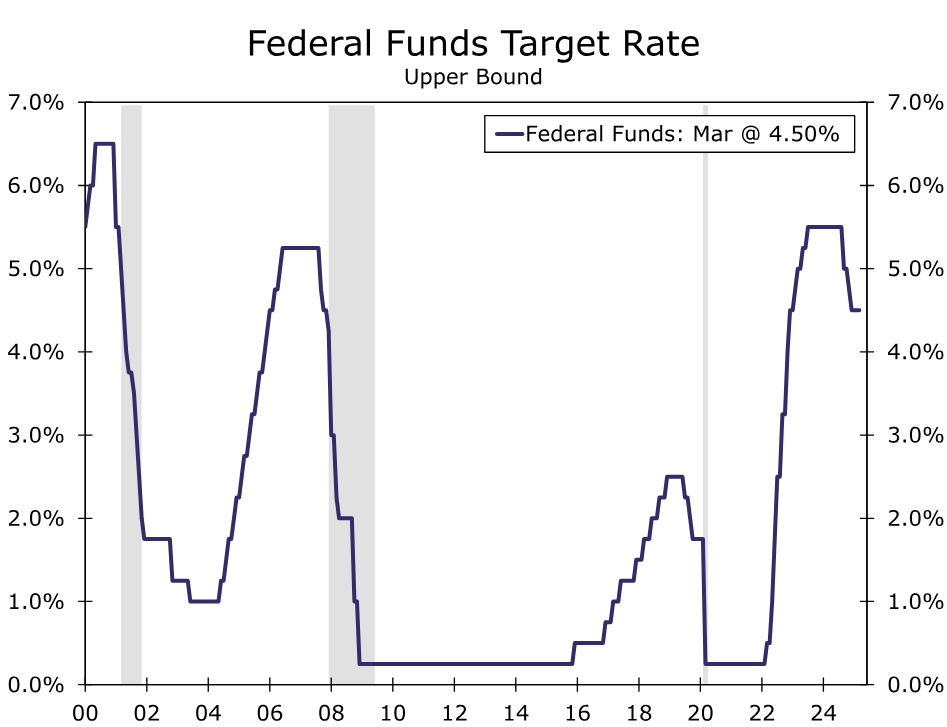
As universally expected, the Federal Open Market Committee (FOMC) held its target range for the federal funds rate unchanged at 4.25%-4.50% at its policy meeting today, a decision that was unanimously supported by all 12 voting members of the Committee. After cutting rates by a cumulative 100 bps at three consecutive policy meetings between September and December, the FOMC has now been on hold for the past two meetings (Figure 1).
The FOMC also decided today to slow the pace of quantitative tightening (QT). Beginning in April, the Federal Reserve will allow only $5 billion of Treasury securities to roll off its balance sheet every month. Previously, the monthly cap was $25 billion per month. (The Fed will continue to allow up to $35 billion worth of mortgage-backed securities to roll off the balance sheet every month). Governor Waller, who wanted to keep the monthly cap for Treasury securities unchanged at $25 billion per month, dissented in the decision related to QT. As we discussed in detail in our most recent "Flashlight" report, technical considerations related to the looming debt ceiling decision may have played a role in the FOMC's decision to slow the pace of QT. That said, Chair Powell implied in his post-meeting press conference that the FOMC likely will not return to a faster pace of QT once the debt ceiling debate is resolved.
Heightened Uncertainty
In deciding to keep rates on hold today, the Committee continued to note in its post-meeting statement that "economic activity has continued to expand at a solid pace." The statement also continues to characterize inflation as "somewhat elevated." Indeed, the year-over-year change in the core PCE deflator, which most Fed officials believe is the best measure of the underlying rate of consumer price inflation, stood at 2.6% in January, above the FOMC's target of 2%. Notably, the Committee stated that "uncertainty around the economic outlook has (emphasis ours) increased," which likely is a reference to the uncertainty surrounding tariff policy. This heightened uncertainty appears to have led the FOMC to change its view of the balance of risks. Previously, the Committee judged "that the risks to achieving its employment and inflation goals are roughly in balance." Today's statement merely noted that "the Committee is attentive to the risks to both sides of its dual mandate." In short, it's difficult to assess where the balance of risks lie if the outlook for economic policy is considerably clouded.
We Look for Policy Easing Later This Year
The central bank also released the quarterly Summary of Economic Projections (SEP) that contains the Committee's macroeconomic forecasts. As we prognosticated in our recent "Flashlight" report, the median GDP growth forecast for 2025 was lowered from 2.1% in the December SEP to 1.7% while the median forecast for core PCE inflation was pushed up from 2.5% to 2.8%. In other words, the current SEP looks for a bit more stagflation in 2025 than the previous SEP, which was released in December. The median forecast in the so-called dot plot continues to look for 50 bps of rate cuts this year, although four FOMC members now think that only 25 bps of rate cuts will be appropriate this year while another four members think it will be appropriate to keep rates on hold all year. (Figure 2). In December, three members looked for 25 bps of rate cuts in 2025 while only one member thought it would be appropriate to refrain from easing this year.
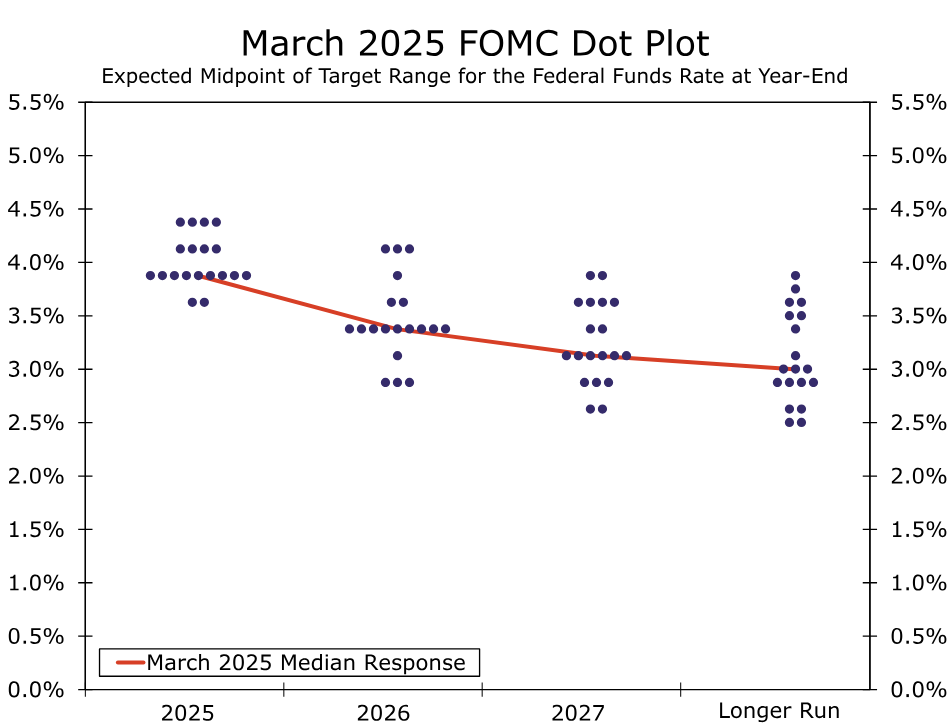
We have a more dovish view of monetary policy in coming months than the collective FOMC. We forecast that the FOMC will reduce its target range for the federal funds rate by 75 bps by the end of the year. (Only 2 of the 19 FOMC members think it appropriate to cut rates by 75 bps by the end of 2025). As we discussed in more detail in our most recent U.S. Economic Outlook, our forecast is predicated on our assumption that the Trump administration will lift tariff rates meaningfully, with most trading partners retaliating, in coming months. Although the levies should cause only one-off increases in prices of tariffed goods, the resulting modest rise in inflation should only be temporary, at least in our view. Meanwhile, the negative hit to GDP growth likely will cause the unemployment rate to rise, which could remain elevated if policy remains restrictive. We do not know what individual FOMC members have assumed about trade policy in coming months. But if the economic slowdown that we forecast eventually leads the FOMC to place more weight on the "full employment" objective of its dual mandate than on its "price stability" objective, then we believe the Committee will ultimately conclude that lower rates are warranted and commence an easing cycle this summer.
That said, we agree with the FOMC's assessment that uncertainty regarding the economic outlook has increased, and we think it likely that the Committee will keep rates on hold again at its next meeting on May 7. The outlook for Fed policy clearly depends on the evolution of economic policy, especially trade policy, in coming months. In our view, the FOMC's near-term policy decisions will be dictated by incoming economic data.
Fed Review: Cautious Stability
- The Fed maintained its policy rates unchanged in the March meeting as expected.
- The Fed's balance sheet run-off (QT) will be tapered to USD5bn per month for Treasuries (prev. redemption cap USD25bn per month) starting from April, also in line with our expectations. MBS redemptions remain unchanged.
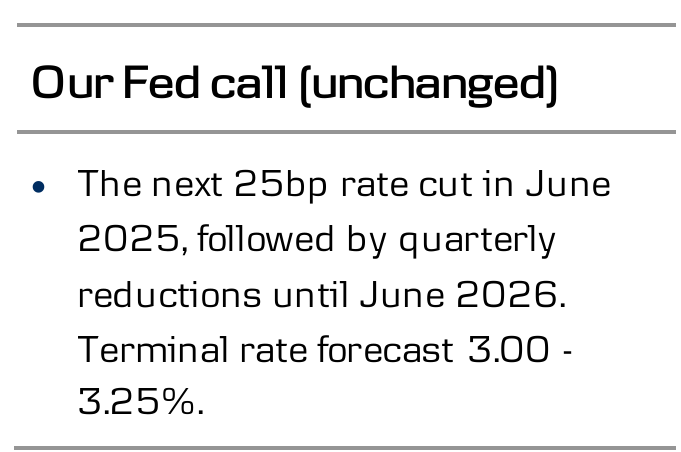
- Overall financial conditions eased modestly with UST yields declining across the curve, EUR/USD ticking higher and equities rising. We make no changes to our Fed call and still look for a total of three cuts in 2025 with the next one in June. Markets price 5bp for May, cumulative 20bp by June and 65bp by December.
The Fed's updated economic projections sparked an initial dovish reaction in the markets, as 2025 GDP forecast was taken down to 1.7% (from 2.1%). Inflation forecasts were revised up for both headline (2.7%, from 2.5%) and core (2.8%, from 2.5%). The widely followed median rate projection remained completely steady through 2025 -2027 and also the distribution of individual forecasts was little changed.
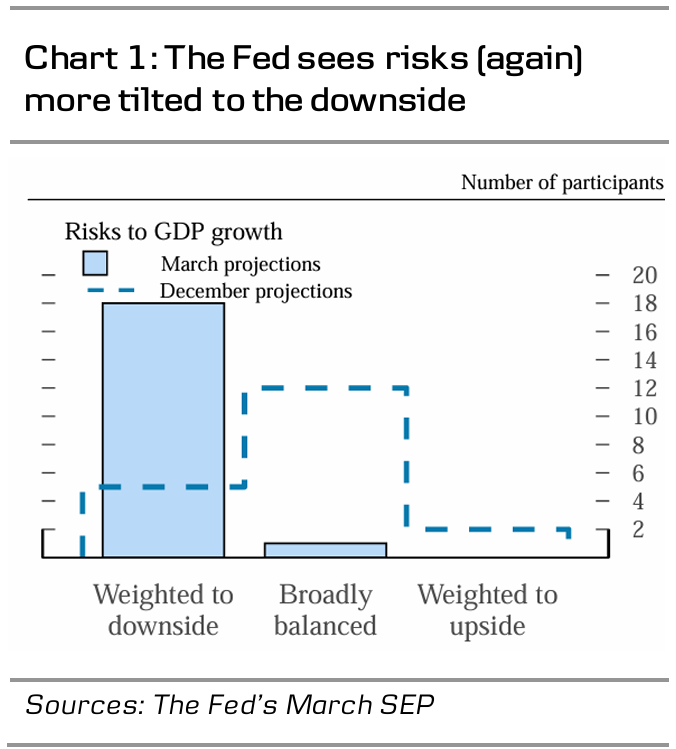
The relatively larger change was seen in the perceived balance of risks. Back in December, the risks around the GDP outlook were seen mostly as balanced, but now 18 out of 19 FOMC participants saw them as weighed to the downside. This was reflected in Powell's remarks as well, as he emphasized that the real economy remained solid both in terms of labour markets and consumer spending, but that the Fed remains mindful of the more cautious signals seen in soft sentiment indicators.
While Powell refrained from specifying how much the expectation of tariffs had influenced the inflation forecasts, he flagged that the 'base case' is still for tariffs to cause no persistent inflation. The Fed pays close attention to inflation expectations, but 'most' longer-term measures remain anchored near the target (with the Michigan survey as a notable 'outlier').
When asked about the possibility of a rate cut in May, Powell did not close the door, but mentioned several times that the Fed is not in a hurry to move. We still look for the next cut in June, followed by quarterly 25bp reductions until the terminal rate of 3.00-3.25% is reached in June of 2026. Our profile is close to market pricing for 2025, but our terminal rate assumption remains below market's expectations.
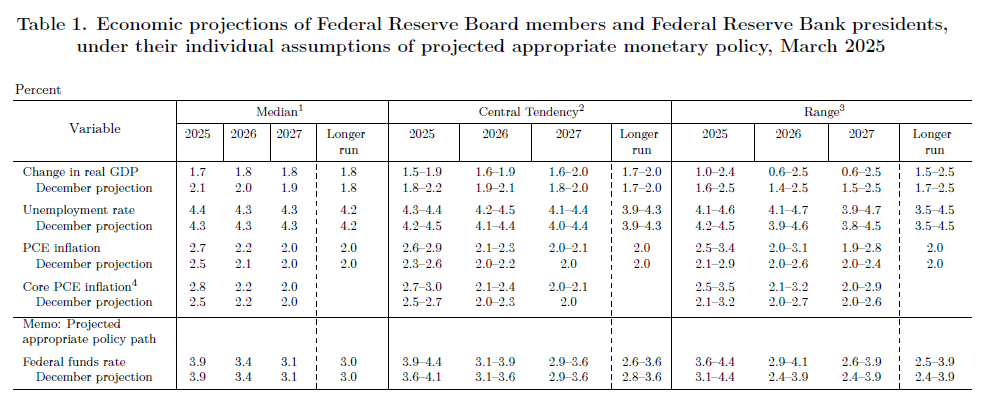
The Fed also announced tapering of the balance sheet run-off (QT) as we wrote in our Fed preview, 14 March, and RtM USD - Time to taper, 18 March. The redemption cap for Treasury holdings will be lowered to USD5bn per month from April (from USD25bn), while the redemption cap for MBS will be maintained unchanged at USD35bn. The cap on MBS has not been binding (redemptions have averaged USD15-20bn per month) and Powell signalled that the Fed has 'strong desire [for] MBS to roll off the balance sheet'. He flagged that the upcoming potential liquidity tightening due to the raise in debt ceiling and rebuild of Treasury cash balance sparked the debate for tapering QT, but also that the move fits well with the general idea of allowing the run-off to progress slower but longer. Reserves remain ample for now (and we agree) but the Fed sends a clear signal for the market not to worry about potential abrupt tightening of liquidity also going forward.
Fed holds rates, slows balance sheet reduction, downgrades growth outlook
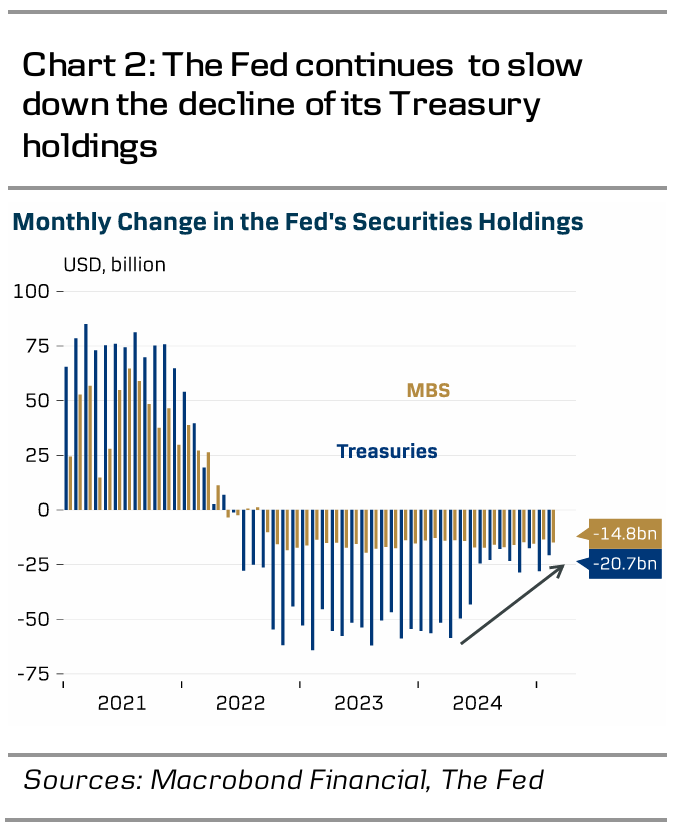
As widely expected, FOMC kept interest rates steady at 4.25-4.50%. At the same time, Fed announced a key shift in its quantitative tightening strategy, stating that beginning in April, it will slow the pace of balance sheet reduction from USD 25B to USD 5B.
In its accompanying statement, Fed acknowledged that recent economic data continues to indicate "solid" expansion, with "low" unemployment and "solid" labor market conditions. Meanwhile, Fed noted that inflation remains "somewhat elevated", reinforcing the need for cautious policymaking.
The updated economic projections showed no change in Fed’s rate-cut outlook, with the median federal funds rate projection still pointing to just two cuts this year, leaving rates at 3.9% by the end of 2025. Looking further ahead, Fed continues to see rates at 3.4% by the end of 2026 and 3.1% by the end of 2027
Fed’s GDP growth forecasts were revised downward, reflecting growing concerns over economic headwinds. The US economy is now expected to grow by just 1.7% in 2025, down from 2.1% in the previous forecast, while 2026 and 2027 growth projections were also slightly trimmed to 1.8%.
Meanwhile, core PCE inflation projections for 2025 were revised higher, from 2.5% to 2.8%, suggesting that price pressures may prove more persistent than previously anticipated. However, core inflation forecasts for 2026 and 2027 remained unchanged at 2.2% and 2.0%, respectively, signaling confidence that inflation will gradually trend back toward the 2% target.
(FED) Federal Reserve Issues FOMC Statement
Recent indicators suggest that economic activity has continued to expand at a solid pace. The unemployment rate has stabilized at a low level in recent months, and labor market conditions remain solid. Inflation remains somewhat elevated.
The Committee seeks to achieve maximum employment and inflation at the rate of 2 percent over the longer run. Uncertainty around the economic outlook has increased. The Committee is attentive to the risks to both sides of its dual mandate.
In support of its goals, the Committee decided to maintain the target range for the federal funds rate at 4-1/4 to 4-1/2 percent. In considering the extent and timing of additional adjustments to the target range for the federal funds rate, the Committee will carefully assess incoming data, the evolving outlook, and the balance of risks. The Committee will continue reducing its holdings of Treasury securities and agency debt and agency mortgage‑backed securities. Beginning in April, the Committee will slow the pace of decline of its securities holdings by reducing the monthly redemption cap on Treasury securities from $25 billion to $5 billion. The Committee will maintain the monthly redemption cap on agency debt and agency mortgage-backed securities at $35 billion. The Committee is strongly committed to supporting maximum employment and returning inflation to its 2 percent objective.
In assessing the appropriate stance of monetary policy, the Committee will continue to monitor the implications of incoming information for the economic outlook. The Committee would be prepared to adjust the stance of monetary policy as appropriate if risks emerge that could impede the attainment of the Committee's goals. The Committee's assessments will take into account a wide range of information, including readings on labor market conditions, inflation pressures and inflation expectations, and financial and international developments.
Voting for the monetary policy action were Jerome H. Powell, Chair; John C. Williams, Vice Chair; Michael S. Barr; Michelle W. Bowman; Susan M. Collins; Lisa D. Cook; Austan D. Goolsbee; Philip N. Jefferson; Adriana D. Kugler; Alberto G. Musalem; and Jeffrey R. Schmid. Voting against this action was Christopher J. Waller, who supported no change for the federal funds target range but preferred to continue the current pace of decline in securities holdings.
NZDUSD Wave Analysis
NZDUSD: ⬇️ Sell
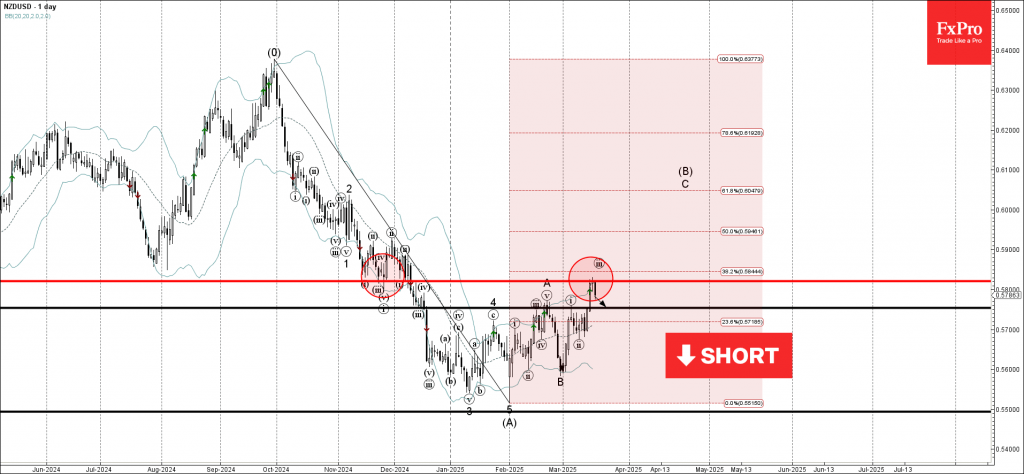
- NZDUSD reversed from the resistance level 0.5820
- Likely to fall to support level 0.5750
NZDUSD currency pair recently reversed down from the strong resistance level 0.5820 (former strong support from the end of November).
The resistance level 0.5820 was strengthened by the upper daily Bollinger Band and by the 38.2% Fibonacci correction of the downward impulse from September.
Given the multi-month downtrend, NZDUSD currency pair can be expected to fall to the next support level 0.5750 (former support from February and the start of March).
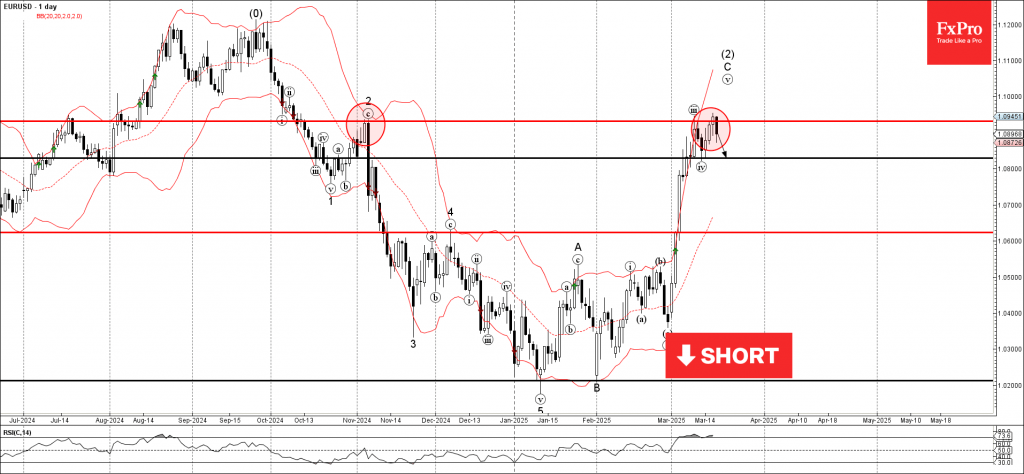
EURUSD Wave Analysis
EURUSD: ⬇️ Sell
- EURUSD reversed from resistance level 1.0930
- Likely to fall to support level 1.0830
EURUSD currency pair recently reversed down from the key resistance level 1.0930 (a former monthly high from November, which also stopped the earlier minor impulse wave iii).
The downward reversal from resistance level 1.0930 is likely to form the daily Japanese candlesticks reversal pattern Evening Star – a strong sell signal for EURUSD.
Given the overbought daily RSI and strongly bullish US dollar sentiment, EURUSD currency pair can be expected to fall to the next support level 1.0830 (low of the previous correction iv).
Sunset Market Commentary
Markets
Markets were caught off-guard this morning by a steep sell-off in Turkish assets which triggered broad risk aversion at the onset of European trading. The meltdown started after news broke that Turkish police arrested Istanbul major and main Erdogan rival Ekran Imamoglu on corruption charges and on alleged terrorism links. Earlier this week, the state Istanbul University already cancelled Imamoglu’s higher education degree which bars him from entering presidential elections (scheduled for 2028). The opposition crackdown comes at a time where autocrats around the world feel empowered by the current makeover in Washington. The Turkish lira lost more than 10% against the euro and the dollar with EUR/TRY and USD/TRY, setting new all-time highs at respectively 43 and 41.30, before recovering some ground after Turkish lenders were rumoured to have sold around $8bn in FX to prop up the ailing currency. Turkish bonds and stocks (-8%) sold off as well. German bond yields gapped around 6 bps lower, before starting an intraday comeback. At the time of writing, daily changed are almost unchanged on a daily basis. The Eurostoxx50 started with a 0.5% deficit, but currently trades near flat as well. EUR/USD corrects from the 1.0940 area towards 1.09 on genuine USD strength. USD/JPY outperforms with a first 150+ quotation since end February after the BoJ kept its policy rate unchanged at 0.5% this morning. Governor Ueda did suggest a rate hike could come as soon as at the next meeting (May 1) with domestic inflation risks (eg shunto wage negotiations) outweighing external growth risks (tariffs). Eco calendars were empty in the US and EMU. ECB vice governor de Guindos and ECB Villeroy both stressed that there isn’t a predetermined path for policy rates, keeping a data dependent approach.
Attention turns to the Fed tonight. Data recently have added to a growing market narrative of stagflation, mostly in soft indicators (e.g. consumer confidence, NY manufacturing index). But hard economic data wasn’t so bad (services ISM, solid payrolls growth, IP, housing). That should prevent the Fed (and therefore the new projections) from getting carried away by the recent bearish (stock) sentiment, especially with uncertainty on the tariff narrative still this big. It’s not until April 2, when Trump’s reciprocal tariffs are to be announced, it’s worth making an analysis. In theory there’s little to push the Fed off the January track (extended pause; dots suggesting two rate cuts in 2025).
News & Views
A quarterly survey of the Origo Group commissioned by the Swedish Riksbank showed that inflation expectations have increased substantially since December. Respondents see CPIF inflation (with fixed interest rates, the preferred inflation measure of the Swedish Riksbank) at 2.3% one year from now, at 2.2% in two years’ time and 2.2% in a five year horizon, to be compared with 1.7%, 1.9% and 2% respectively in the December survey. Respondents also turned more positive on economic growth for the first (2% from 1.6%) and the second year (2.4% from 2.1%). This also resulted in expectations for the Riksbank polity rate at 2.2% over the next two years, compared to 2% in December. Respondents thus de facto expect the Riksbank to have reached the bottom of its easing cycle at the current level of 2.25%. The Riksbank concludes a regular policy meeting tomorrow at 9.30 CET and is largely expected to stay on hold. The krone since end January was a marked outperformer against a strong euro with EUR/SEK easing from the 11.50 area to currently 11.01, even as the move lost some momentum over the previous days.
News agency Reuters reported that the European Union will tighten steel import quotas to reduce the inflows of steel by a further 15% from April 1. Reuters obtained the information from European Commission Executive Vice President Stephane Sejourne. Sejourne indicated that he expects that after the US raises import tariffs by 25%, producers from Canada, India and China would look to sell increasing volumes in the EU. The European Commission will also propose other trade-related measures to support the metals industry. The first measure to reduce quota’s (safeguards) will reduce the imports that come in the EU free of tariffs. Imports outside the quota will be hit by a 25 % levy. The Commission is also preparing new measures to replace the safeguards in Q3 which cannot be extend under WTO beyond June 2026. In a broader perspective, Sejourne also said that the EU did not want to depend on imports for steel, which will be crucial in the EU's rebuilding of its military industrial complex after the Ukraine war. "We want to keep our steel in Europe and be able to recycle in Europe. It's a strategic issue. There is no defense industry without steel, there is no automobile without steel and we want to keep our industries."
EUR/USD Mid-Day Outlook
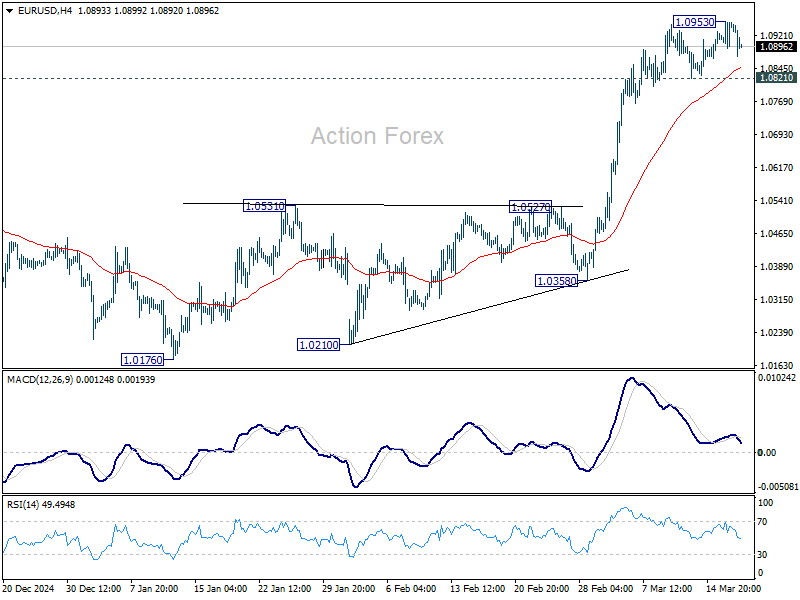
Daily Pivots: (S1) 1.0907; (P) 1.0931; (R1) 1.0969; More...
Intraday bias in EUR/USD is turned neutral first with current retreat. But further rally is expected as long as 1.0821 support holds. On the upside, break of 1.0953 will resume the rise from 1.1076 to retest 1.1274 key resistance. On the downside, though, break of 1.0821 support will indicate short term topping, likely with bearish divergence condition in 4H MACD. That will turn bias back to the downside for deeper pullback.
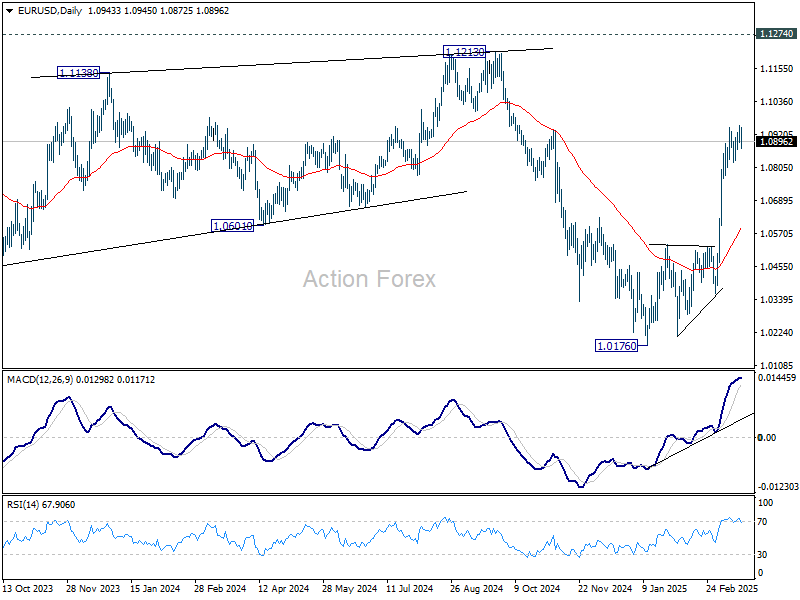
In the bigger picture, prior strong break of 55 W EMA (now at 1.0675) suggests that fall from 1.1274 (2024 high) has completed as a three wave correction to 1.0176. Rise from 0.9534 is still intact, and might be ready to resume. Decisive break of 1.1274 will target 100% projection of 0.9534 to 1.1274 from 1.0176 at 1.1916. Also, that will send EUR/USD through a multi-decade channel resistance will carries larger bullish implication. This will now be the favored case as long as 1.0531 resistance turned support holds.
USD/CHF Mid-Day Outlook
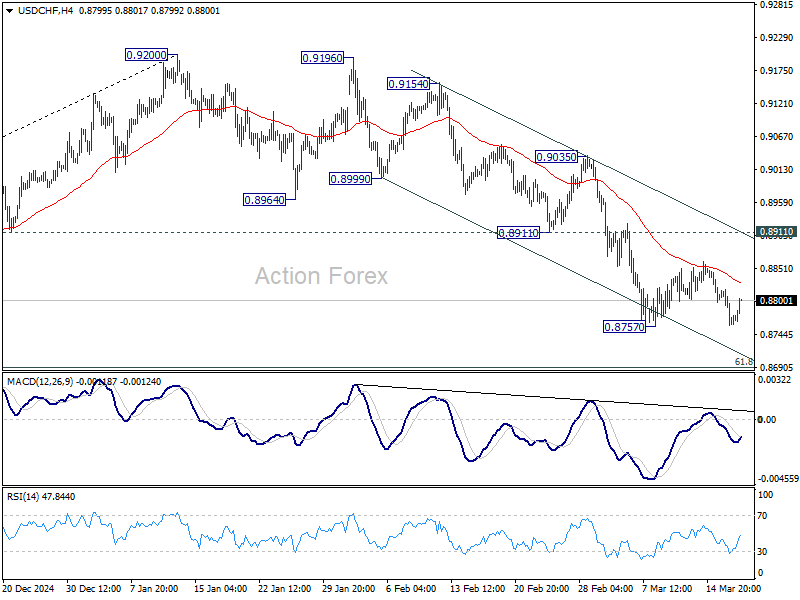
Daily Pivots: (S1) 0.8744; (P) 0.8782; (R1) 0.8805; More…
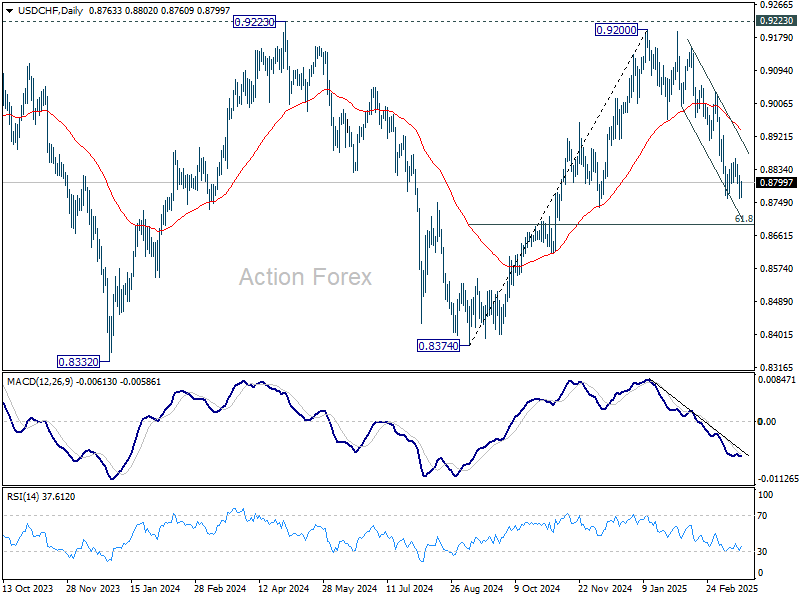
Intraday bias in USD/CHF remains neutral as range trading continues. In case of another recovery, upside should be limited by 0.8911 support turned resistance. On the downside, break of 0.8757 will resume the fall from 0.9200 to 61.8% retracement of 0.8374 to 0.9200 at 0.8690. Sustained break there will pave the way back to 0.8374 support.
In the bigger picture, rejection by 0.9223 key resistance keep medium term outlook bearish. That is, larger fall from 1.0342 (2017 high) is not completed yet. Firm break of 0.8332 (2023 low) will confirm down trend resumption.