

Sample Category Title
USD in corrective mode after uninspiring FOMC statement
Market's reaction to FOMC rate decision overnight was rather muted. The balanced to slightly positive statement secured the chance for June hike, which fed fund futures are already pricing in 100% odd. But it did little on changing the market expectations on the chances of the fourth hike this year in December. That is, it's still uncertain.
Nonetheless, be patient. Expectations could build up again after today's ISM services and tomorrow's non-farm payroll. And, the rate path for the year should be much clearer after new Fed projections to be delivered after next FOMC meeting on June 13.
Here are some reports on FOMC that are worth a read:
- FOMC More Hawkish on Inflation, June Rate Hike a Done Deal
- Fed Keeping Things Gradual with Steady Decision and Balanced Statement
- Amid Rising Inflation, The Fed Remains on Course
- Fed Stands Pat But Appears Ready to Hike More Given its Newfound Comfort with Inflation
And the full statement here: (FED) FOMC Statement May 2, 2018
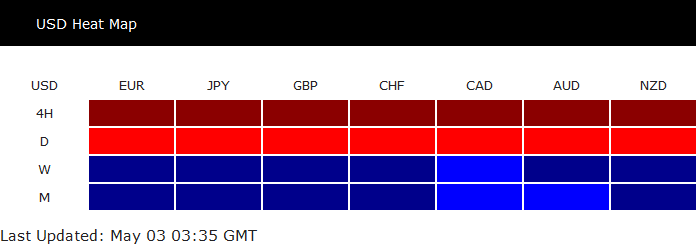
USD is staying in corrective mode after FOMC announcement. There is broad based selloff in the current 4H bar as seen in the USD Heat Map. But USD is held above yesterday's low against all at this point. So the retreat is shallow so far. And the greenback remains the strongest one for the week. It just cannot overwhelm CAD still.
FOMC More Hawkish on Inflation, June Rate Hike a Done Deal
As widely anticipated FOMC left the Fed funds rate target at 1.5-1.75% in May. The accompanying statement also came in largely in line with our expectations – shrugging off moderation in first quarter growth and getting more confident in the inflation outlook. The more hawkish FOMC statement maintained market pricing of 100% chance of a June hike.
On economic developments, policymakers affirmed the ongoing strength in the employment market, noting “job gains have been strong, on average”. They also noted that “business investment continued to grow strongly”. This was compared with the March reference that business investment “moderated from their strong fourth quarter readings”. The members retained the view that the growth of household spending “moderated from its strong fourth-quarter pace”
The major changes came from the reference on inflation. The central bank indicated that “both overall inflation and inflation for items other than food and energy have moved close to +2%”, while in March, they noted that those barometers “have continued to run below +2%”. Meanwhile, the members judged that “Inflation on a 12-month basis is expected to run near the Committee’s symmetric +2% objective over the medium- term”. In March, they expected inflation to “move up in coming months” and “to stabilize around the Committee’s 2% objective over the medium- term”. They viewed the risks are ”roughly balance” in both meetings. Yet, the reference that “the Committee is monitoring inflation developments closely” was removed in May. This evidenced the members growing confidence that inflation would reach the target as expected.
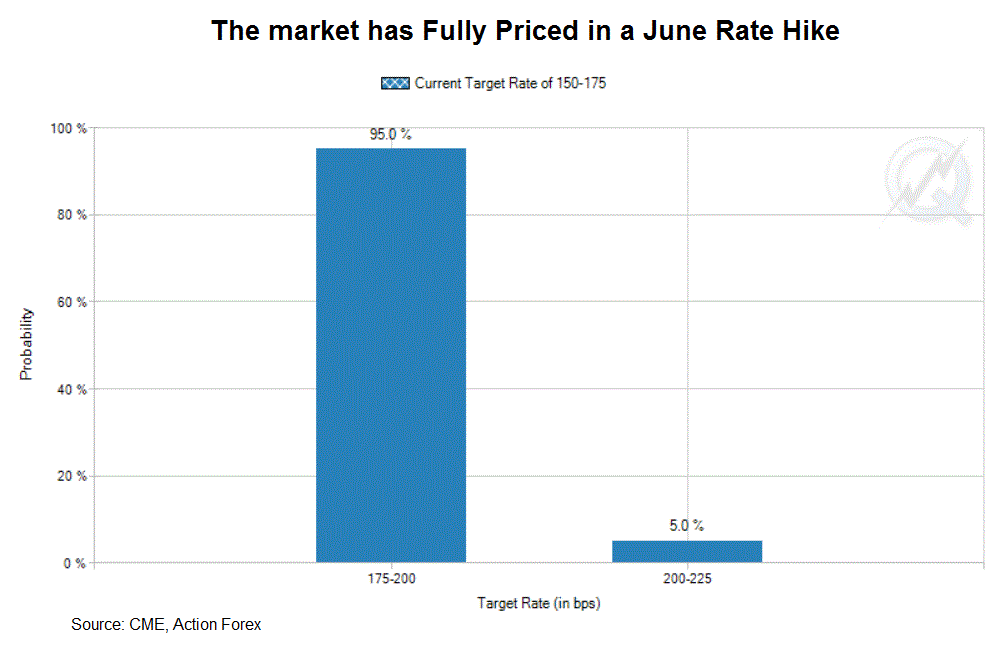
A rate hike in June appears a done deal. According to CME’s 30-day Fed funds futures, the market has already priced in 95% chance of +25 bps, and 5% chance of +50 bps, increase in the policy rate next month. The updated economic projections and the median dot plot would also be released in the June meeting. The market would be closely watching if the members have raised their rate hike expectations to four times from three. The May meeting has failed to reveal any hint on the issue, though.
Amid Rising Inflation, The Fed Remains on Course
The FOMC left interest rates unchanged and acknowledged inflation's progress of reaching the 2 percent target. The policy statement reaffirmed that the Fed intends to continue to "gradually" tighten monetary policy.
Inflation Mandate Progress Recognized
Widely anticipated, the Federal Open Market Committee (FOMC) left the federal funds target rate range [1.50 percent-1.75 percent] unchanged at the conclusion of this two-day meeting. With no rate hike in the cards, focus was squarely on the policy statement and officials' updated assessment of the U.S. economy and whether any signals were being sent as to a change in the anticipated pace of interest rate tightening. Today's statement provided no such evidence.
As expected, officials continued to characterize the labor market as "strengthening" and overall economic activity as rising at a "moderate" rate. Despite the relatively soft Q1 performance from a variety of indicators, the Fed continues to express confidence in the U.S. economy's underlying momentum, which in turn fuels its determination to normalize interest rates. That sentiment is reaffirmed by the FOMC's unanimous decision.
The only material change to the statement came around the language on inflation. In recent months, we have seen a pickup in the pace of consumer inflation as well as wages and salaries. Acknowledging the gap to its target has narrowed considerably, the FOMC upgraded the current assessment, noting that headline and core inflation have "moved closer to 2 percent." Moreover, officials expect inflation to "run near the Committee's symmetric 2 percent objective over the medium term"–a signal of the Fed's willingness to allow inflation to modestly overshoot the 2 percent target for a period of time.
Focus Turns to June and a Likely Boost to the Number of Hikes
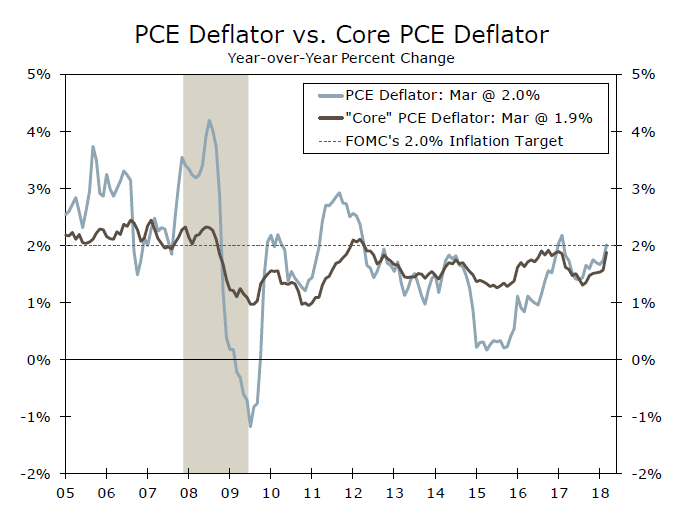
Collectively, the pace of the economic expansion, inflationary pressures continuing to build and officials' strengthened confidence in the outlook has led to the financial markets placing a high probability on the next Fed rate hike occurring at the June 12-13 FOMC meeting. While the March dot plot chart maintained the median number of projected rate hikes for 2018 at three, we suspect the incoming economic data leading up to the June meeting will result in a change to four rate hikes, when officials provide their updated outlook. Seven of the fifteen dots have the Fed raising interest rates four or more times this year (bottom chart). However, with the annual rates of the headline and core PCE deflators already at/near the 2 percent target, and assuming economic growth is as strong as the FOMC's current projections, we would expect the majority of officials' projections to collectively raise the median number of 2018 rate hikes by more than it has currently outlined. In our opinion, inflation is the key metric to monitor and will guide the pending pace of monetary policy tightening for the foreseeable future. We look for the Fed-favorite core PCE deflator to rise and trend at/slightly above the 2 percent target through 2019, supporting our call for four rate hikes this year. We look for the Fed to join that perspective next month.
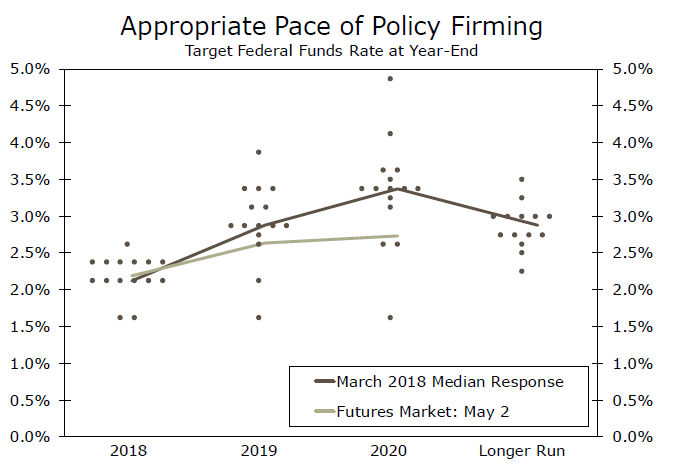
Fed Keeping Things Gradual with Steady Decision and Balanced Statement
Highlights:
- The target range for the fed funds rate was held steady at 1.50-1.75% in a unanimous decision.
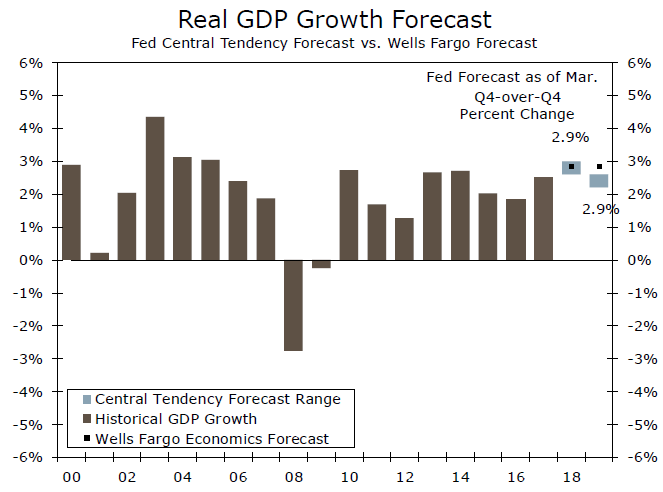
- With the advance Q1 GDP report in hand, the statement confirmed consumer spending growth moderated (no mention of transitory factors that we think were at play) while tweaking the language on business investment, which continued to grow strongly.
- The committee acknowledged inflation has moved close to their 2% objective but still characterized market-based inflation measures as low. That is somewhat surprising with 10-year breakevens now at their highest level since 2014 and close to their longer run median.
- The statement dropped the phrase, inserted in March, that “the economic outlook has strengthened in recent months.”
- Risks to the outlook are still balanced but the committee no longer noted they are “monitoring inflation developments closely.” We think that is a nod to increased confidence that their inflation objective will be met on a sustained basis after spending much of the last few years below 2%.
Our Take:
Given the economic backdrop, it wouldn’t have been difficult for the Fed to justify a rate hike at today’s meeting. GDP growth remained above trend in Q1 even as transitory factors weighed on consumer spending. Inflation is now running at 2% year-over-year and even faster than that on a quarterly basis. Market-based inflation measures continued to increase and are now at multi-year highs. And despite some volatility, job growth has averaged more than 200k per month so far this year. But honoring their guidance that rates will rise only gradually, the Fed opted against back-to-back hikes and left monetary policy unchanged. We think the aforementioned arguments will prompt a rate increase at the next meeting on June 13. The few tweaks in today’s statement didn’t provide an explicit signal in that direction, but the Fed arguably didn’t need to with markets already almost fully priced for a move in June.
Fed Stands Pat But Appears Ready to Hike More Given its Newfound Comfort with Inflation
As was widely expected, the Federal Open Market Committee (FOMC) held the target range for the federal funds rate unchanged between 1-1/2 and 1-3/4 percent.
The views of the FOMC participants appeared little changed from those during the March meeting round, with the statement reiterating the themes of moderate growth, low unemployment, and strong job gains, although the qualifier "on average" was added to the latter, suggesting the Fed is looking through month-to-month volatility in payroll growth.
In light of the recent GDP report, the Fed also reiterated that consumer spending has moderated from its rapid Q4 pace, while fixed business investment was viewed as having grown strongly.
The Fed's take on inflation was notably different. The statement indicated that inflation has now "moved close" to target – previously it "continued to run below" target in the Fed's eyes. Moreover, the outlook was changed from expected to "move up in the coming months and to stabilize around" the objective to now "run[ning] near" the 2 percent target.
Notably, the 2 percent objective was preceded with the word "symmetric".
Interestingly, the Fed's take on the improvement in market-based measures of inflation compensation was largely discounted, with the fact that they "have increased in recent months" struck out of the statement altogether, with the FOMC viewing them as still "low".
Risks were seen as balanced, but the Committee went out on a limb expanding the phrase to cover longer term risks also. Previously the statement was explicitly limited to "near-term" risks. Moreover, the FOMC decided to delete the sentence that it will be "monitoring inflation developments closely" from the statement altogether.
Key Implications
On the surface the May statement appeared to be a lackluster one, with no change in rates and only a few wording changes in the statement. However, many of the wording modifications were quite notable.
The most noteworthy changes were related to the Fed's take on inflation, which was now viewed as close to target, where it was expected to remain over the medium run. Previously, the Fed was just hopeful that such a scenario would play out. From that perspective, well done Powell and Co. Still, much of the credit should likely go to Janet Yellen and Co., who kept rate hikes gradual and set up the rebound in inflation.
Another small but notable change is the addition of the "symmetric" word before the reference to inflation objective. This was certainly not accidental and suggests that the Fed will continue to tighten policy to prevent inflation from overheating, but is not likely to overreact and may tolerate above target inflation to some extent – just the way it tolerated inflation readings below 2%, working diligently to raise it but not panicking by slashing rates.
These changes, together with the fact that the Fed appears to now be far more comfortable with the risks facing the economy, set the Fed up for a June hike – barring any unforeseen shocks. They also suggest that the FOMC will continue to tighten policy over the medium term to ensure inflation does not overheat. We expect two more hikes this year, but a slightly faster pace of tightening is not out of the question.
Gold Price Moved In Bearish Zone Below $1,320?
Key Highlights
- Gold price declined recently and broke a major support at $1,320 against the US Dollar.
- There is a key bearish trend line forming with resistance at $1,315 on the 4-hours chart of XAU/USD.
- The US ADP Employment Change in April 2018 was 204K, more than the forecast of 200K.
- Today, the US Initial Jobless Claims for the week ending April 28, 2018 will be released, which is forecasted to rise from 209K to 225K.
Gold Price Technical Analysis
There were further slides in gold price from the $1,335 resistance against the US Dollar. The price declined and broke a major support area near $1,320, which opened the doors for more losses.
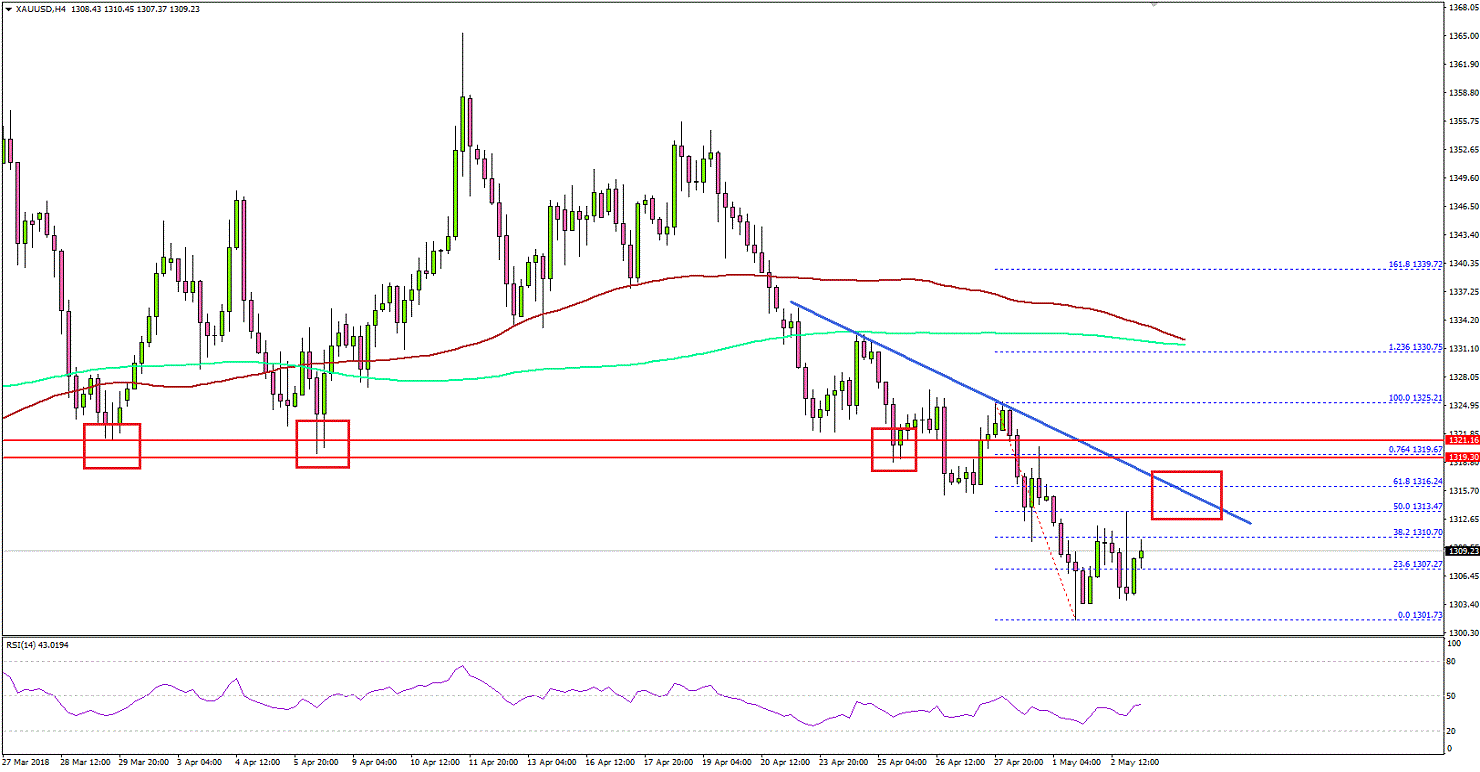
The price traded close to the $1,300 level and a low was formed at $1,301. At the moment, the price is consolidating losses and it recently tested the 38.2% Fib retracement level of the last drop from the $1,325 high to $1,301 low.
However, there are many hurdles on the upside near the $1,315 and $1,320 levels. There is also a key bearish trend line forming with resistance at $1,315 on the 4-hours chart of XAU/USD.
The same trend line is close to the 50% Fib retracement level of the last drop from the $1,325 high to $1,301 low. Moreover, the previous support at $1,320 is likely to act as a resistance.
On the downside, the recent low of $1,301 and $1,300 are decent support levels. A break below $1,300 may perhaps push the price towards the $1,280 level.
Recently, the US ADP Employment Change report for April 2018 was released by the Automatic Data Processing, Inc. The market was looking for a rise of 200K jobs compared with the last 241K.
The actual result was better as the ADP Employment Change was 204K. The outcome was positive and commenting on the same, a chief economist of Moody’s Analytics, Mark Zandi, stated:
Despite rising trade tensions, more volatile financial markets, and poor weather, businesses are adding a robust more than 200,000 jobs per month. At this pace, unemployment will soon be in the threes, which is rarified and risky territory, as the economy threatens to overheat.
Overall, gold price may correct a few points higher, but it won’t be easy for buyers to push it above the $1,320 resistance.
Economic Releases to Watch Today
- Euro Zone CPI for April 2018 (YoY) (Prelim) – Forecast +1.3%, versus +1.3% previous.
- Euro Zone Core CPI for April 2018 (YoY) (Prelim) – Forecast +1.2%, versus +1.0% previous.
- US Services PMI for April 2018 – Forecast 54.4, versus 54.4 previous.
- US ISM Non-Manufacturing Index for April 2018 – Forecast 58.1, versus 58.8 previous.
The US Dollar Is The Market’s Darling
Currency Markets
The USD had a slight wobble on the Feds latest statement redraft which was interpreted dovish on the surface. But below lurked a confident sounding board suggesting inflation targets are on track. With no follow-up presser, additional Fedspeak and the release of the minutes on May 23 will provide more clarity into the boards thought process. But yes, given the robust US economic data, the balance of risk remains for the Fed to keep policy on track and if anything lean more aggressive.
With all the trade noise still simmering on the back burner, the Feds were unlikely to come out heavy-handed anyway as much can change on these delicate trade negotiations between now and June 13 FOMC.
But, with the US economic data flow continuing to dwarf other economies around the world and mainly the EU, the US Dollar remains the markets darling for the time being. As expected, the malefactor in the crowd was the EUR nosediving and pulling most of the G-10 currencies in tow as the common currency now sets sights on YTD low of 1.1915.
Equity markets
US equities hit the late skids afternoon despite a better than expected earnings report from Apple. But with much of the good news in the equity world currently factored, investors are left mulling over the paradoxical landscape of stellar earning but higher interest rates and the threat of trade war. This struggle is unlikely to end anytime soon.
Oil Markets
Prices wobbled when U.S. Energy Information Administration (EIA) reported a larger-than-expected 6.2-million-barrel build in crude stocks on lower exports and higher imports than a week ago. However, Oil bulls found solace in the IMF's threat to expel Venezuela which could all but collapse the Venezuelan oil industry if the IMF cuts funding due to inconsistent economic reporting.
But in general, the market has shifted to consolidation mode as we have amazingly entered a 48-hour lull in geopolitical tensions.
Gold markets
Gold prices initially recovered post FOMC but have come under renewed pressure on a surging USD. The balance of short-term risk remains for a stronger dollar supported by robust US economic data. Given the lull in geopolitical tension, the fear for gold investors is that sell -stop mechanisms get triggered by a move below $1300.00 that could cause gold to cascade much lower. Longs are holding on by a thread at this stage.
Currency View
EUR: Continues to trade heavy as traders are now targeting 1.1915 years to date low. The Euro will continue to get the most attention into NFP.
JPY: Despite the rising political risk in Japan, USDJPY remains supported by easing of political threat in the Korean Peninsula along with higher US bond yields. The market is trading off USD dollar strength not a weaker JPY
MYR: The USD has remained on positive footing post FOMC and has offered no reprieve to the pre-election beleaguered Ringgit versus the USD. While the Ringgit is better positioned, due to higher oil prices, to withstand external shocks better than some regional peers, it too is feeling the pressure from waning global equity markets. Not only is the MYR mired in election risk but it must now compete with the resurging Greenback
Emerging Worries
The Fed was the focus on Wednesday, at least for a short period, but underlying moves for the dollar stem from half-a-world away. AUD edged out USD as the top performer on the day while the euro lagged. Australian trade balance is due up next. Our DAX30 short was stopped by 15 pips (before the index headed lower) for 300 pt loss. The DOW30 short was closed for 450-pt gain.
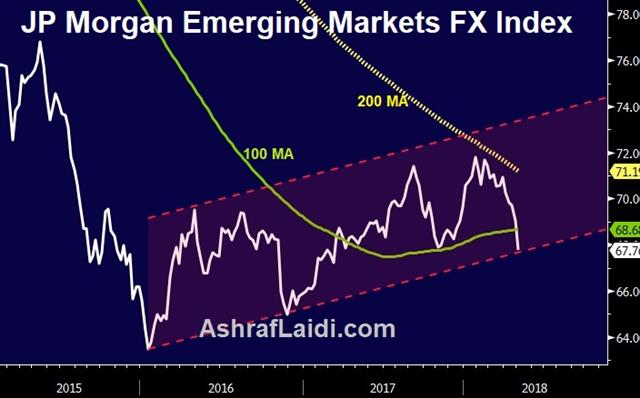
The FOMC decision was a one-hour event in the sense that it moved markets for a grand total of one hour. The initial move was lower in the dollar and then it rebounded completely. The statement added two nods to the symmetric 2% inflation target and omitted a line saying that the economic outlook had strengthened. The symmetric reference is a subtle warning that the Fed will see 2.5% inflation in much the same was as 1.5% inflation in that it won't immediately react. It's a signal that 2% isn't the ceiling of tolerable inflation.
At the same time, that's something many FOMC members have emphasized recently and it's no surprise to the market. It didn't change the markets 96% implied probability of a June hike. From there it will continue to be all about economic data, which is in heavy supply for the remainder of the week.
So why the US dollar rally? Aside from the themes about rate differentials, jitters and growth that we've written about extensively, there are flows. Big flows at the moment are emanating from emerging markets where trouble is brewing.
Argentina's peso fell 3% Wednesday despite a panicky 3 percentage point hike from the central bank and massive FX intervention. The Turkish lira fell 2% and the Russian ruble continues to struggle.
Emerging market money tends not to be overly discriminating and problems in one place can quickly become problems everywhere. Higher US rates have changed the equation for many investors and trickle can become a flood overnight.
In developed markets, the Australian dollar continues to struggle but has so far held Tuesday's lows. It could get some help at 0130 GMT in the March trade balance report. The consensus is for a healty $865 million surplus.
Eco Data 5/3/18
[php_everywhere instance="1"]
Fed kept interest rate unchagned at 1.50-1.75%. Statement cautiously positive, but gives no hints on more than three hikes...
Fed left federal funds rate unchanged at 1.50-1.75% as widely expected. And the decision was made with unanimous vote. Fed maintained tightening bias and noted that "the Committee expects that economic conditions will evolve in a manner that will warrant further gradual increases in the federal funds rate".
Descriptions on the economy are slightly upbeat as "job gains have been strong" and "business fixed investments continued to growth strongly". But "household spending moderated". While core inflation moved "close to 2percent", "market-based measures of inflation compensation remain low".
The tone is cautiously upbeat and give no hints of more than three hikes this year.
Here is the full statement:
Information received since the Federal Open Market Committee met in March indicates that the labor market has continued to strengthen and that economic activity has been rising at a moderate rate. Job gains have been strong, on average, in recent months, and the unemployment rate has stayed low. Recent data suggest that growth of household spending moderated from its strong fourth-quarter pace, while business fixed investment continued to grow strongly. On a 12-month basis, both overall inflation and inflation for items other than food and energy have moved close to 2 percent. Market-based measures of inflation compensation remain low; survey-based measures of longer-term inflation expectations are little changed, on balance.
Consistent with its statutory mandate, the Committee seeks to foster maximum employment and price stability. The Committee expects that, with further gradual adjustments in the stance of monetary policy, economic activity will expand at a moderate pace in the medium term and labor market conditions will remain strong. Inflation on a 12-month basis is expected to run near the Committee's symmetric 2 percent objective over the medium term. Risks to the economic outlook appear roughly balanced.
In view of realized and expected labor market conditions and inflation, the Committee decided to maintain the target range for the federal funds rate at 1-1/2 to 1-3/4 percent. The stance of monetary policy remains accommodative, thereby supporting strong labor market conditions and a sustained return to 2 percent inflation.
In determining the timing and size of future adjustments to the target range for the federal funds rate, the Committee will assess realized and expected economic conditions relative to its objectives of maximum employment and 2 percent inflation. This assessment will take into account a wide range of information, including measures of labor market conditions, indicators of inflation pressures and inflation expectations, and readings on financial and international developments. The Committee will carefully monitor actual and expected inflation developments relative to its symmetric inflation goal. The Committee expects that economic conditions will evolve in a manner that will warrant further gradual increases in the federal funds rate; the federal funds rate is likely to remain, for some time, below levels that are expected to prevail in the longer run. However, the actual path of the federal funds rate will depend on the economic outlook as informed by incoming data.
Voting for the FOMC monetary policy action were Jerome H. Powell, Chairman; William C. Dudley, Vice Chairman; Thomas I. Barkin; Raphael W. Bostic; Lael Brainard; Loretta J. Mester; Randal K. Quarles; and John C. Williams.