Wed, Apr 08, 2026 03:12 GMT
More

    Sample Category Title

    Japan’s CPI slows to 1.5% in January, core measures ease further

    Japan’s headline CPI slowed to 1.5% yoy in January from 2.1%, falling below the BoJ’s 2% target for the first time in 45 months. Core CPI (excluding fresh food) declined to 2.0% from 2.4%, while core-core inflation eased to 2.6% from 2.9%, signaling broader moderation in underlying price pressures.

    The slowdown was largely driven by energy, where costs dropped -5.2% yoy after a -3.1% fall in December. Goods inflation cooled sharply from 2.7% to 1.6%. In contrast, services inflation remained steady at 1.4%, suggesting domestic wage-driven price gains have yet to accelerate meaningfully.

    Food inflation remains elevated but is gradually cooling. Prices excluding fresh items rose 6.2% yoy, down from 6.7%. Rice inflation slowed for an eighth consecutive month to 27.9%.

    Japan PMI composite jumps to 53.8, export demand surges

    Japan’s private sector gathered further momentum in February, with PMI Manufacturing rising from 51.5 to 52.8 and PMI Services edging up to 53.8. PMI Composite climbed from 53.1 to 53.8, marking the strongest expansion since May 2023 and signaling a more broad-based recovery.

    According to S&P Global’s Annabel Fiddes, the upturn was supported by firmer demand both domestically and overseas. Total new orders expanded at the quickest pace since May 2023, while manufacturers recorded the strongest increase in export work in eight years.

    Stronger sales pushed capacity utilization higher, with backlogs rising at a record pace. Firms responded by increasing hiring, while improved demand allowed businesses to regain some pricing power despite persistent cost pressures. Business confidence also strengthened, supported by new product launches, technology demand and optimism following Prime Minister Sanae Takaichi’s landslide election victory.

    Full Japan PMI flash release here.

    Australia PMI composite dives to 52.0 in February, cost pressures reaccelerate

    Australia’s February flash PMIs signaled a slowdown in private sector momentum. PMI Manufacturing slipped from 52.3 to 51.5, while PMI Services dropped sharply from 56.3 to 52.2. As a result, PMI Composite fell from 55.7 to 52.0, indicating growth continued but at a much more modest pace.

    According to S&P Global’s Eleanor Dennison, the private sector was unable to sustain the strong start to the year. Both manufacturing and services recorded softer expansions in output and new orders, with the services sector experiencing the more pronounced pullback.

    However, inflationary pressures remain evident. Firms reported elevated wage burdens and higher supplier costs, pushing both input and output price inflation to five-month highs. Despite softer new business growth, job creation accelerated to an 11-month high, underscoring labor market tightness.

    Full Australia PMI flash release here.

    NZ trade deficit at NZD -519m as China flows diverge

    New Zealand’s goods exports rose 2.6% yoy in January to NZD 6.2B, up NZD 157m from a year earlier. Goods imports increased 1.9% yoy to NZD 6.7B, up NZD 126m. The result was a monthly trade deficit of NZD -519m.

    By destination, export performance was mixed. Shipments to China, New Zealand’s largest trading partner, fell NZD -118m (-7.0%) yoy. In contrast, exports to Australia jumped NZD 134M (+20%), while flows to the EU (+16%) and Japan (+11%) also posted solid gains. Exports to the US were broadly flat.

    On the import side, China led the increase, with imports surging NZD 346m (+24%) yoy. South Korea also recorded a strong rise (+36%), while imports from the EU edged higher. Meanwhile, purchases from the US (-17%) and Australia (-8.1%) declined.

    The data suggest stable overall trade volumes but highlight shifting bilateral flows, particularly with China, which may have implications for growth in coming months.

    Full NZ trade balance release here.

    Cliff Notes: Lingering Concerns Over Capacity

    Key insights from the week that was.

    In Australia, the data release of the week was the January Labour Force Survey which reported a +17.8k lift in employment, in line with the market’s expectation. While labour demand is still best characterised as ‘soft’, having slowed to a well below-average pace through 2025, it appears to be finding its footing. At the same time, labour force growth has been tracking a weaker trend, the participation rate falling 0.6ppts over the past year, keeping the unemployment rate steady at 4.1% in recent months.

    This data is likely to raise some concern over a possible ‘re-tightening’ in labour market conditions, and the risk of more persistent inflation – a key concern for the RBA’s Monetary Policy Board. On the latter, Chief Economist Luci Ellis dissected the minutes from the February Board meeting earlier this week, including the apparent downplaying of the impact of exogenous exchange rate appreciation on the inflation outlook.

    Coming back to the labour market, it is important to recognise that a lower unemployment rate has a very different flavour if it is being driven by weaker participation versus stronger hiring. The forces driving the current downswing in participation – namely an easing in cost-of-living pressures – may not persist for much longer given inflation’s persistence. Combined with an underlying structural uptrend in labour supply, we could easily see a turnaround in labour force participation lift the unemployment rate again.

    This is all to say that the upside risks to inflation stemming from the labour market may prove transitory. This week’s benign result for Q4 wages growth, up 0.8% (3.4%yr), supports this assertion. Today’s note from Chief Economist Luci Ellis furthers the discussion around the relationship between the labour market and inflation.

    Offshore, in a holiday shortened week, the focus was on the balance of risks in the US. Out last Friday, the market celebrated January’s 0.2% headline gain for consumer prices against the 0.3% consensus expectation. However, the headline beat was primarily the result of a 1.5% decline in energy prices and a moderate 0.2% increase in food prices, along with a flat outcome for core goods prices. Services ex-energy in contrast rose 0.4% in January after a 0.3% increase in December – outcomes well in excess of the FOMC’s target and consistent with broad-based capacity pressures across housing, transport and medical care.

    While the January FOMC meeting occurred before this data release, the minutes recognised that inflation risks are now broadly balanced against labour market uncertainty, which has receded of late given evidence of stabilisation after a period of "gradual cooling".

    Arguably, most of the Committee still believe policy can be eased further in time, but it is interesting to note that “Several participants indicated that they would have supported a two-sided description of the Committee's future interest rate decisions, reflecting the possibility that upward adjustments to the target range for the federal funds rate could be appropriate if inflation remains at above-target levels”. So, if we see further persistence in services inflation, or businesses pass through more of the cost of tariffs, the FOMC may become more vocal in their concerns over inflation. This would trigger a resetting of market expectations from the current pricing of two or more cuts in 2026 to one or no cuts, with consequences for financial markets.

    We currently view one fed funds rate cut as most probable in 2026, although this view is held with low conviction given the above risks to inflation. For the US dollar however, we continue to believe any rate reset is likely to be more than offset by a greater appreciation of growth opportunities elsewhere in the world, seeing the US dollar trend lower.

    Across the Atlantic, Q4 GDP disappointed in the UK (0.1%, 1.0%yr) but showed resilience in the Euro Area (0.3%, 1.3%yr). Thankfully for the UK, the latest inflation data gave the BoE support to continue cutting through the first half of this year as annual headline inflation slowed to 3.0%yr, to be in line with core inflation at 3.1%yr. Importantly, services inflation looks to be abating as hoped, now 4.4%yr after being stuck around 5.0%yr through the first half of 2025.

    Turning finally to Asia, we are yet to get a sense of how China’s economy has begun 2026 given Lunar New Year Holidays but expect authorities will have to quickly shift to a pro-active stance for policy, else risk a structural deceleration in growth taking root. Across the rest of the region are a broad array of conditions and prospects, with countries such as Taiwan and Vietnam growing rapidly while those whose industry is concentrated more in services such as Thailand underperform. Politics are also very important at present and likely to remain so. As an example, the opportunity seen by many in Japan’s economy and stock market depends on the Government taking action to support investment and consumption and, in doing so, spur private sector confidence. Highlighting the need for action, this week Japanese Q4 GDP surprised to the downside, rising just 0.1% after a 0.7% decline in Q3. Underlying the result, household consumption grew just 0.1%.

    NAIRU: Dead, Undead or Just Resting?

    Full employment objectives for central banks are common and long-standing. They are harder to assess than inflation objectives, and evolve as our understanding of the economy improves.

    • Full employment objectives for central banks are common and long-standing. The RBA has been mandated to pursue both price stability and full employment since its founding as a separate institution. Even a central bank with an inflation-only mandate would need to care about labour market developments, because these provide information about future inflation.
    • It is harder to know whether the economy is at full employment than whether inflation is at target. Gaps from full employment are inferred from price and wage outcomes. The exact mapping from those outcomes to a judgement about tightness of the labour market depends in part on how you think the ‘unemployment gap’ or ‘output gap’ affects prices and wages, and how you think inflation expectations are formed.
    • The RBA has in recent times instituted a dashboard or checklist approach to assessing where the labour market is relative to full employment. This approach has limitations but is being progressively evolved. It also still focuses on a subset of approaches to analysing the labour market. The so-called ‘NAIRU’ and the gap-oriented approach to assessing full employment is far from dead to central banks.

    Many central banks, including the RBA, have ‘full employment’ as part of their mandate, in addition to inflation control. In most cases, again including Australia, this has been true for decades. Indeed, it is well understood that even a central bank with an inflation-only mandate would still want to have a view on full employment, because a labour market being away from that point will influence inflation in future, potentially pushing it away from target. This was the point Mervyn King made back in 1997, that even an ‘inflation nutter’ central bank would still care about employment and unemployment.

    But how do central banks know if they have achieved a full employment goal? An inflation target can be specified as a desired rate or range of rates for inflation, and perhaps a horizon over which to achieve it. ‘Full employment’ has, however, always been a bit more nebulous. Typically, policymakers and academic economists alike have framed ‘full employment’ as being the lowest rate of unemployment that is still consistent with inflation remaining at its target. That way, the two mandates are defined not to conflict. ‘Full’ does not mean ‘everybody who wants one has a job’, and it is not necessarily as low a rate of unemployment as other parts of society might prefer.

    The evolution of economic understanding of the relationship between inflation and unemployment began in the middle of the previous century, when A W Phillips noted an inverse relationship between growth in money wages and the unemployment rate in the UK. In other words, an unemployment rate below its ‘natural rate’ – an ‘unemployment gap’ – was associated with faster wages growth. The ‘Phillips curve’ concept later expanded to be between price inflation and unemployment rather than money wages growth and unemployment. More recently, the RBA has also related these ‘gaps’ to growth in unit labour costs (which includes all employee compensation, not just wages, expressed relative to output produced) rather than wages or prices directly. This approach stems from the ‘markup model’ framework where marginal costs and labour market slack are related, rather than prices and slack. As we have previously noted, other central banks do not put anywhere near the emphasis on this model that the RBA does.

    Later work focused on the role of expected inflation, holding that unemployment would only decline below its ‘natural rate’ if people were ‘surprised’ by inflation. If unemployment was below the ‘Non-Accelerating Inflation Rate of Unemployment’ (now you know why economists call it the NAIRU), inflation (or wages growth) would not just be higher, but would be ever-increasing, because people would come to expect the current rate of inflation to continue, and then you needed to surprise them some more. So if inflation or wages growth was increasing, that was taken as evidence that the unemployment rate was below the NAIRU and the labour market was tighter than ‘full employment’. A steady rate of unemployment or wages growth was seen as a signal that the labour market was roughly in balance.

    The RBA’s recent work on establishing where full employment might be has instead taken the view that inflation expectations in Australia are reasonably anchored. So instead of looking for increasing inflation or wages growth as a sign that the labour market is tighter than full employment, any deviation of inflation from target, or wages growth from what the central bank judges to be consistent with inflation remaining at target, is seen as a sign that the labour market is away from full employment. The NAIRU isn’t really dead in the RBA’s framework: they just dropped the “A”.

    Observant readers will note that the judgement about whether wages growth is consistent with inflation at target requires a judgement about the mapping from wages growth to labour costs to inflation target. This involves a judgement about trends in productivity growth that is subject to both debate and data revisions.

    The RBA has also fleshed their assessment process out with a ‘checklist’ or ‘dashboard’ of indicators of full employment and a separate one for the output gap. This has not been without criticism from labour market experts, though to be fair the dashboards have been improved over time and are now less sensitive to historical averages. It has also integrated at least some of the insights from labour economics that frame the labour market as an exercise in matching workers and jobs, with all the frictions that might arise from that. Still, the exercise has a little of the flavour of the RBA’s use of ‘checklists’ in the early 1980s, before the inflation targeting era. That experiment did not end well.

    In the end, though, the RBA’s framework is all about taking signal from inflation and wages data and reading back to the labour market. Consider two possible views of economic trends. One is that trend growth in capacity – that is, potential output – is just above 2%, and the sustainable rate of unemployment is around 4.6%, the RBA’s latest estimate. Another, closer to our own view, would be that potential output growth is more likely to be in the 2¼–2½% range and the sustainable unemployment rate is more like 4¼%. The labour market data on its own will not help you distinguish between these two sets of assumptions. The signal from inflation and wages growth will be the deciders.

    The upshot is that the RBA has put a lot of effort into measuring where full employment is. Neither it, nor the profession more broadly, have done as much on building theory about why it is where it is, or where it might go from here, including whether it could be deliberately moved to make even lower unemployment feasible. And despite the dropping of the “A”, the intellectual framework has not evolved much over the past decade. It is still all about inferring gaps from Kalman filtering the relationship between output, labour market data and price and wage outcomes.

    There are alternatives, which both policymakers and the research community would be familiar with but have generally not pursued, sticking instead to the ‘gap-oriented’ approach to assessing the balance between demand and supply. One alternative – though by no means the only one – was even expounded in a Bank of England publication more than a decade ago (full disclosure: the author, Professor Roger Farmer, was one of my PhD thesis examiners). There is also more to be gleaned from search-oriented analysis of the labour market.

    The analysis of where full employment is therefore far from settled. Further changes in central bank frameworks can be expected as more research is done. Hopefully this future research avoids incrementalism and considers the implications of how labour markets actually work in the 21st century. Meanwhile, the NAIRU might have changed form, and dropped a letter here or there, but it is not dead to central banks.

    USD/CHF Carves a Bottom after Reaching 14-Year Lows

    2025 was the year of the Swiss Franc, and there were quite a few reasons.

    De-dollarization, flows moving towards Europe, the Yen losing some of its Safe-Haven characteristics amid fiscal trouble in Japan, and general diversification towards quality as the World faces troubled times ahead.

    Reaching 14-year lows less than a month ago, USD/CHF had become a bear dream for those who thrive on Dollar outflows. 2025 began with a 17% decline in the Major pair and was at the center of the essential themes driving FX flows.

    But as Dollar bearish positioning also reaches decade lows, some questions regarding the extended moves are arising.

    If the US Dollar finds reasons to catch a serious bid, troubled times could be coming ahead for heavy Greenback-Short sellers. A question evoked in our recent Dollar Index analysis.

    Dollar Bear Positioning is at Extremes – Source: Bank of America Survey

    With safe havens like Gold and Silver seeing sudden outflows at the end of last month, coinciding with Kevin Warsh's appointment as head of the Federal Reserve, the appeal of these no and low-yielding assets is being called into question. And the Swiss Franc is no stranger to such.

    Switzerland is a victim of quite heavy deflationary pressures, with its currency strengthening (hurting Swiss exports) and the rougher US trade policies, which exacerbate a fundamentally low-inflation regime.

    Swiss Inflation – Courtesy of Trading Economics

    After reaching a new deal, trade is seemingly bouncing back, but pressure remains on the Swiss National Bank.

    The latest inflation report showed a modest 0.1% increase, but if inflation doesn't show a material increase in the coming few reports, the Central Bank might be forced to turn to negative rates. And such come at high costs.

    In the meantime, USD/CHF has carved out a pretty strong bottom in recent days and could offer interesting mean-reversion setups for those looking for FX volatility ahead.

    Let's dive right into a multi-timeframe analysis of USD/CHF to spot where the action stands and where it could be heading.

    USD/CHF Multi-Timeframe Technical Analysis

    Daily Chart

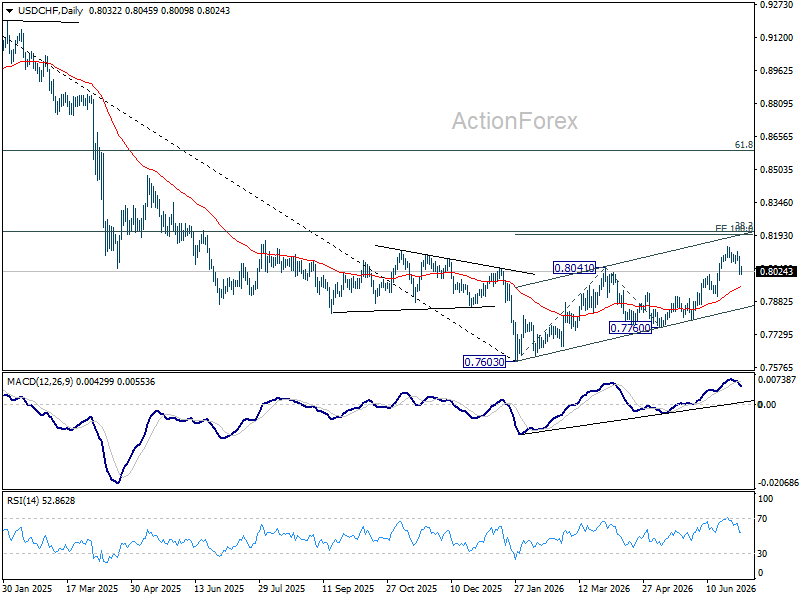
    USD/CHF Daily Chart – Source: TradingView. February 19, 2026

    USD/CHF is carving out a breakout from its mid-February Triangle consolidation, and will soon face a key test for its buying momentum.

    The Daily RSI and Uptrend are working together to provide a fresh push in the pair, with traders leaning on the Monday Lows (0.7675) to drive the action higher.

    • If the action falls back below the weekly lows, the breakout will be void but for now it gives high probabilities of holding.

    4H Chart and Technical Levels

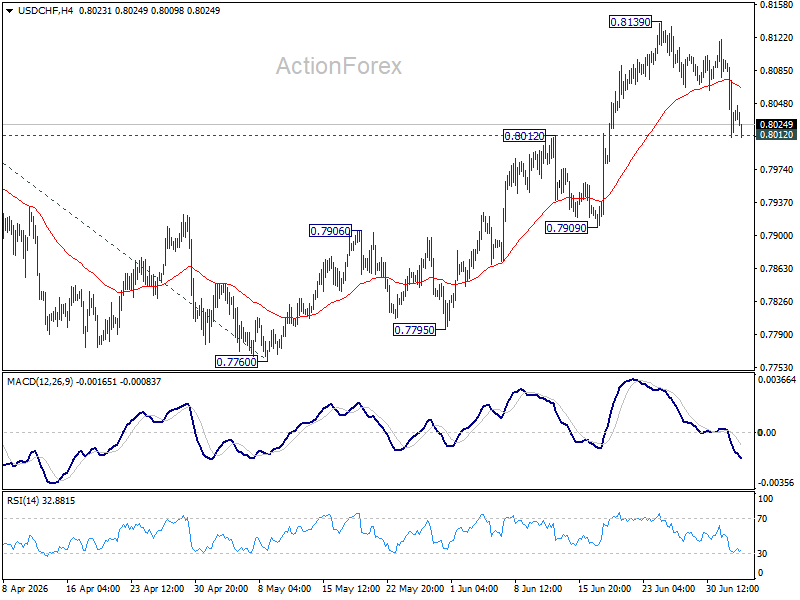
    USD/CHF 4H Chart – Source: TradingView. February 19, 2026

    USD/CHF is breaking out on quite strong price action, but will face a short-term barrier from overbought conditions. Check trading setups on the 1H timeframe just below.

    Trading Levels for USD/CHF

    Resistance Levels

    • 0.7780 to 0.78 Momentum Pivot
    • 0.7850 2025 lows Pivotal Resistance (Bullish Above)
    • 0.7950 Minor Resistance
    • 0.8075 to 0.81 Late 2025 Range highs

    Support Levels

    • 0.7725 50H Moving Average
    • 0.77 to 0.7725 August 2011 Lows Support
    • 0.76292 2026 and 14-year lows
    • 0.76 Support zone July 2011
    • 0.70696 All-Time lows (August 2011)

    1H Chart

    USD/CHF 1H Chart – Source: TradingView. February 19, 2026

    The pair now looks slightly overextended on the 1H timeframe, but remains in an upward formation, as seen on the intraday bull channel.

    • Traders looking to capture a potential bull move could wait for a retracement to the 50-Hour Moving average at 0.77250.
    • If the action doesn't pullback lower, traders can look for breakout setups
      • Breaching the February highs 0.78175 would point to a swift test of the Pivotal resistance around 0.7850.
    • Any daily close below the 200-Hour MA could prompt a retest of the 2026 low and further bearish action, but technicals aren't pointing to such outcomes for now.

    Safe Trades!

    Oil Rallies as War Premium Returns: WTI Retests End-January $66 Highs

    • Oil breaks higher during overnight trading as pressure mounts ahead of the weekend.
    • WTI attempts a retest of its January highs with tensions not easing.
    • Exploring an in-depth Technical Analysis of the commodity.

    Betting on geopolitical events is an odd task in Markets.

    Without discussing the moral aspect (traders have to make money, or at least try to, no matter what), trading live events come with significant potential risk.

    Participants build up anxiety, heavy positioning, and costly conviction ahead of uncertain outcomes – this is the War Risk Premium, and it is not a cheap one.

    Sometimes it pays, as was observed during last Summer with the 12-Day War, which took WTI to $78.43 highs in a matter of a week.

    However, many times, similarly to what happened already on a few occasions in the current rise, Oil may just shoot higher before giving up in exhaustion as nothing official happens.

    Will prices tumble again? Who knows.

    Tensions really are rising, and the military armada amassed in the Middle East is already higher than the one seen in 2003 before the Iraq War, so there is a basis for fear. The Trump Admin also sounded a bit more aggressive in their speeches yesterday. Let's see how it plays out.

    Being positioned is a good way to gain exposure to potential volatility; however, it remains very tricky. A good entry point is essential, and the most important thing is to make sure you respect your rules and risk to trade for longer.

    Odds for a US strike in Iran by end March – Source: Polymarket. February 19, 2026

    Polymarket-based odds for a strike before February 28 remain below 30%. Given the amount of insider trading on this platform, the attack may still have time before it happens.

    Odds for an end-March strike rose accordingly on Tuesday, right after Oil tumbled to $62, and are currently holding around 60%.

    WTI is trading as if something were to happen this weekend. So overall, that is a lot of speculation, and the timing is tricky to predict.

    In the meantime, let's dive into a multi-timeframe analysis of WTI (US) Oil to determine levels of interest and put the odds in the trader's favor to capitalize on the issue.

    US Oil Multi-Timeframe Analysis

    WTI Daily Chart

    WTI Oil Daily Chart – February 19, 2026. Source: TradingView

    WTI just retested its January 29 highs, slightly breaking above, but as long as no candle closes above, at least on the 1H timeframe, it is difficult to assume that a breakout is unrolling.

    Overall, the Daily picture helps to assess where the action currently stands.

    Oil remains strongly above its 200-Day Moving Average, which acts as key barometer for the risk-premium and should stay above there (+/- $0.50) for the time being.

    • A progressive build up could test the $67.50 to $68 resistance, the next main stop but that would happen only if anxiety continues to remain high while nothing happens.
    • If an offensive occurs, expect $70 to break swiftly and head between $75 to $80.
    • With no news this weekend, the action could easily retest the 200-Day MA ($62.83) which is the most optimal point of entry to capture the risk-premium.
      • Any daily close below $61 means that traders are unrolling their positions.

    WTI 4H Chart and Technical Levels

    WTI Oil 4H Chart – February 19, 2026. Source: TradingView

    The immediate action looks very tricky!

    RSI is at overbought levels, but the profit-taking which just occurred quickly got faded higher – the 4H Candle is forming a bullish Hammer (closing in 2h). Hence, positioning looks to be amassing once again.

    We will see further details on the 1H timeframe but it seems that if nothing happens, a small retracement looks plausible and could offer decent pullback entries.

    • The Bullish Channel formation points to $69 in the event of progressive rallies.

    WTI Technical Levels

    Levels to place on your WTI charts:

    Resistance Levels

    • $66.67 session Highs
    • Past Week Resistance $65.50 to $66.50
    • September 2025 Major resistance $67.50 to $68
    • Psychological Resistance $70
    • $78.43 12-Day War highs

    Support Levels

    • 1H 50 and 200-Period MA $64.00
    • $65 psychological level micro-support
    • Range Key Pivot/Support $62.30 to $63.40 (Iran Premium lows and 200-Day MA)
    • 4H 200-period MA $61.65
    • May Range lows support $59 to $60.5 Major support
    • Iran Support area $58.50 to $59

    1H Chart

    WTI Oil 1H Chart – February 16, 2026. Source: TradingView

    Oil is now hanging tight at its end-January Spike levels, but the tricky part is the overbought RSI levels which could easily point to a correction.

    Aggressive pullback entries could take place at 2 levels:

    • The $65 psychological level would be very aggressive – Bulls are not letting this go and points to higher odds of an immediate intervention (over the weekend)
    • $64 is the less-aggressive but still very strong corrective level that would allow the most anxious traders to be part of the action
    • If nothing happens, look for a retest of the key pivot zone $62.00 to $63.40

    Safe Trades and a successful week!

    USDCHF Wave Analysis

    USDCHF: ⬆️ Buy

    • USDCHF reversed from support area
    • Likely to rise to resistance level 0.7800

    USDCHF currency pair recently reversed from the support area between the key support level 0.7600 (which stopped earlier impulse wave (1) in December) and the lower daily Bollinger Band.

    The upward reversal from this support area started the active short-term corrective wave 2.

    USDCHF currency pair can be expected to rise to the next resistance level 0.7800 (former multi-month support from September and the top of the earlier correction (2)).

    Brent Crude oil Wave Analysis

    Brent Crude oil: ⬆️ Buy

    • Brent Crude oil broke the resistance area
    • Likely to rise to resistance level 72.75

    Brent Crude oil recently broke the resistance area between the round resistance level 70.00 (which has been reversing the price from September) and the 61.8% Fibonacci correction of the downward impulse from June.

    The breakout of this resistance area accelerated the active minor impulse wave 3 – which belongs to the intermediate impulse wave (C) from December.

    Brent Crude oil can be expected to rise to the next resistance level 72.75 (former monthly high from July).