

Sample Category Title
EUR/GBP Daily Outlook
Intraday bias in EUR/GBP stays on the downside at this point. Fall from 0.8863 should target 61.8% retracement of 0.8221 to 0.8863 at 0.8466 at next. On the upside, above 0.8601 minor resistance will turn bias neutral first. But risk will stay on the downside as long as 0.8686 resistance holds, in case of recovery.
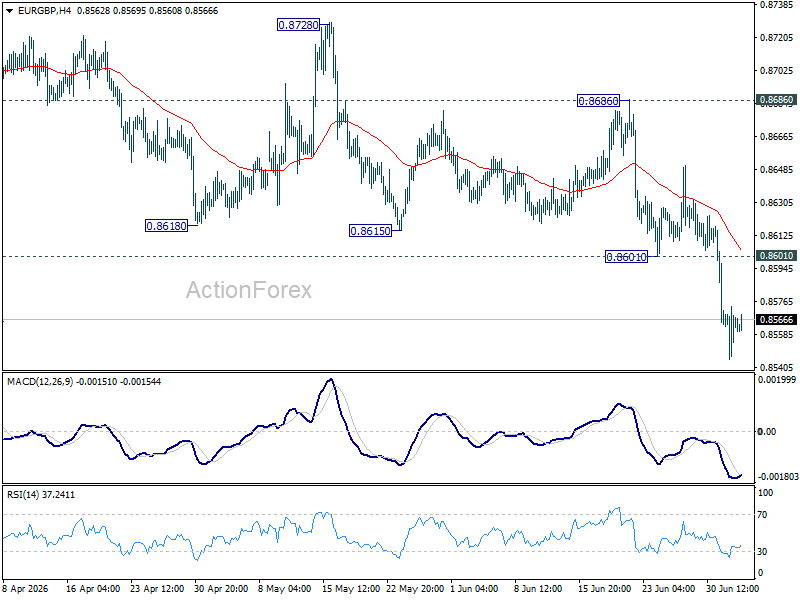
In the bigger picture, current development suggests that rise from 0.8221 (2024 low) has completed at 0.8863, just ahead of 38.2% retracement of 0.8221 (2024 low) to 0.8863 (2025 high) at 0.8618. Deeper fall would be seen back to 0.8201 (2022 low). For now, outlook will be neutral at beast as long as 0.8863 hold.
EUR/AUD Daily Outlook
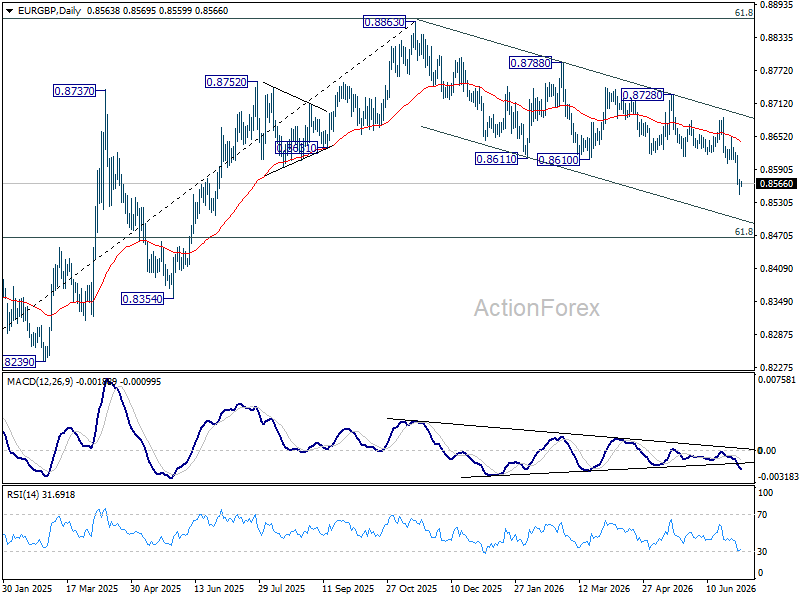
Intraday bias in EUR/AUD remains neutral as consolidations continue below 1.6617. Further rally remains in favor as long as 1.6306 support holds. Break of 1.6617 will resume the rally from 1.6108 towards 1.6842 resistance.
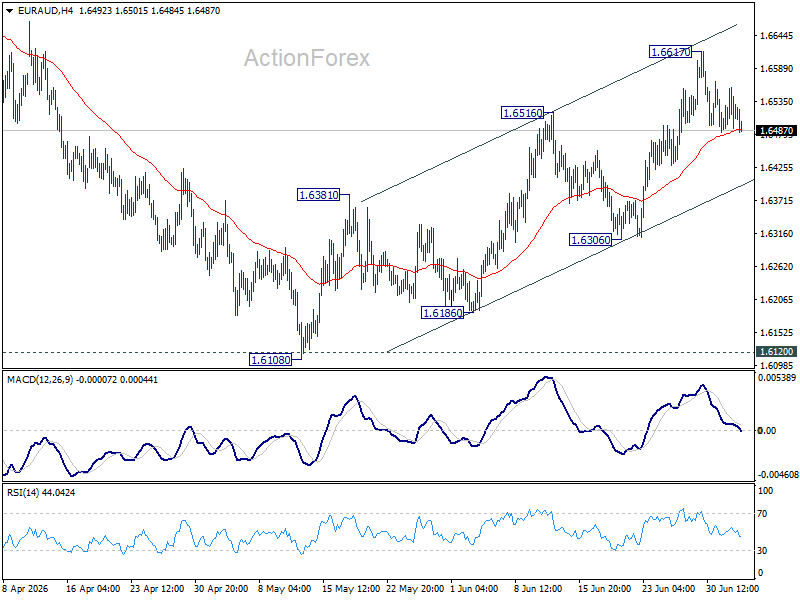
In the bigger picture, outlook will stay bearish as long as 1.6842 resistance holds. Fall from 1.8554 (2025 high) is expected to continue to 61.8% retracement of 1.4281 to 1.8554 at 1.5913. Decisive break there will pave the way back to 1.4281 (2022 low). However, firm break of 1.6842 should confirm medium term bottoming, and bring stronger rally.
EUR/CHF Daily Outlook
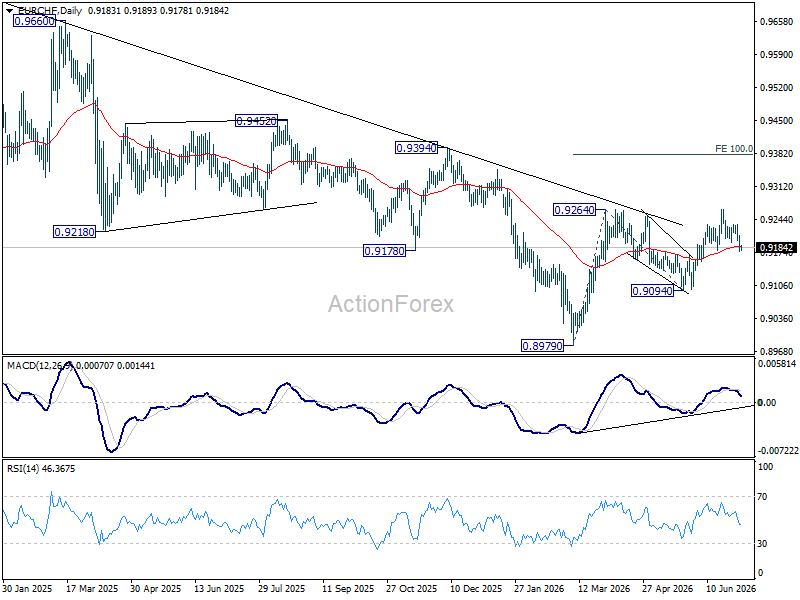
Intraday bias in EUR/CHF remains neutral as it's still defending 0.9179 support. On the upside, above 0.9234 will bring stronger rebound to 0.9265. Firm break there will resume the rally from 0.8979 to 100% projection of 0.8979 to 0.9264 from 0.9094 at 0.9379. However, decisive break of 0.9179 will dampen this bullish view and bring deeper fall back to 0.9094 support instead.
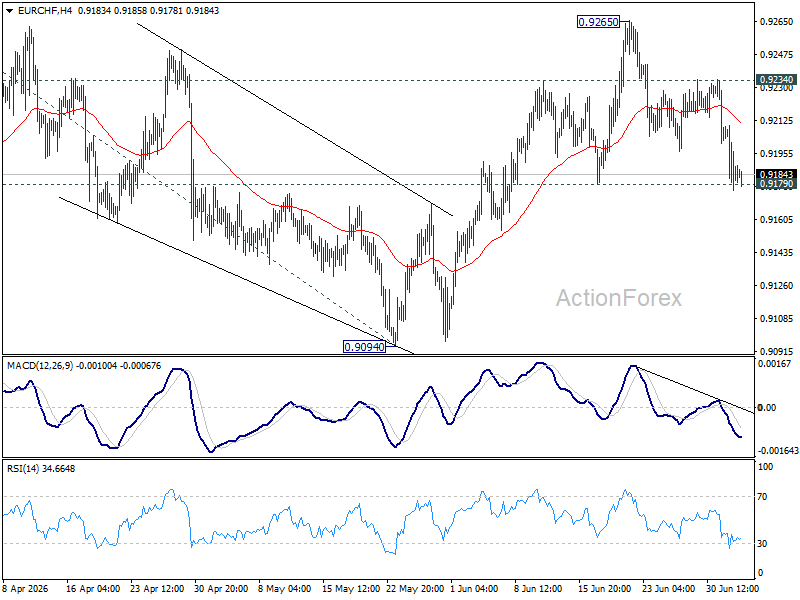
In the bigger picture, the break of medium term falling trend line resistance indicates that 0.8979 is already a medium term bottom. Considering bullish convergence condition in W MACD, rise from there should at least be reversing the fall from 0.9928, with prospect of developing into a medium term up trend. Firm break of 0.9394 resistance will add more credence to this case. For now risk will remain on the upside as long as 0.9094 support holds, in case of retreat.
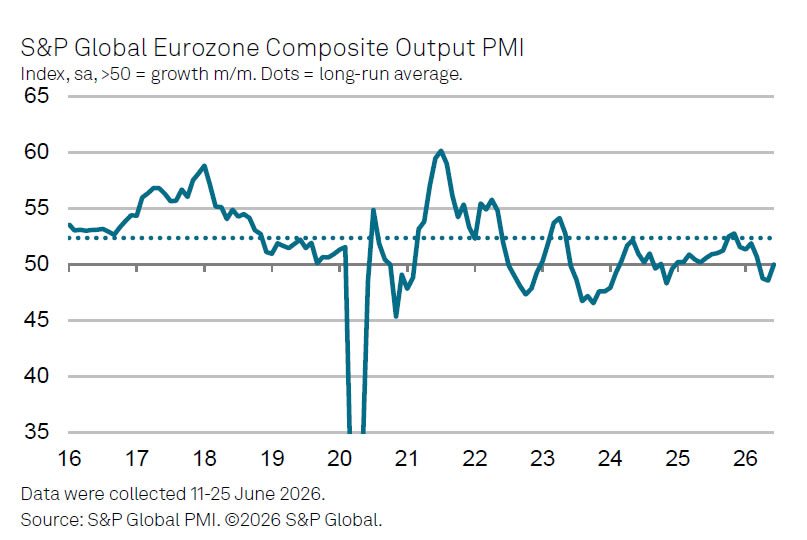
Eurozone PMI Services Stabilize While Cooling Inflation Supports ECB Pause
Eurozone business activity stabilized in June as the downturn in the services sector eased and manufacturing continued to expand. The final S&P Global Eurozone Composite PMI Output Index rose to 50.0 from 48.5 in May, a three-month high that marked the end of two consecutive months of declining output. Meanwhile, the Services PMI Business Activity Index improved to 49.4 from 47.7, also a three-month high, although it remained just below the 50 threshold separating expansion from contraction.
According to S&P Global Chief Business Economist Chris Williamson, the improvement reflects a sharp easing in inflationary pressures following the collapse in energy prices after the US-Iran ceasefire. Input cost inflation in the services sector fell at its fastest pace since the survey began in 1998, excluding only the extraordinary declines seen during the COVID-19 lockdowns. The moderation in costs helped revive activity in sectors hit hardest by the Middle East conflict, particularly leisure and tourism, while business confidence strengthened to its highest level since the war began as firms anticipated further improvement in demand.
The survey reinforces the view that the worst of the energy-driven slowdown may be over, but it also strengthens the case for policy patience at the European Central Bank. Williamson noted that the near-unprecedented easing in cost pressures is likely to soften some of the more hawkish views within the Governing Council, reducing the need for additional rate hikes in the near term. With inflation cooling more rapidly and growth beginning to stabilize, policymakers now have greater scope to pause and assess how quickly price pressures continue to fade during the second half of the year.
| Indicator | Previous | Latest |
|---|---|---|
| Composite PMI Output | 48.5 | 50.0 |
| Services PMI Business Activity | 47.7 | 49.4 |
Sunrise Market Commentary
Markets
Yesterday's US payrolls were supposed to deliver key input for the Fed decision making process as Fed Chair Warsh at the start of its mandate promised that the US central bank will deliver on its price stability mandate. Strong US payrolls over previous months suggested that the 'second pillar' of the Fed's mandate, maximum employment, didn't need any Fed attention/support for now. However, the June payrolls missed expectations. One data set of course doesn't change the broader picture, but it also didn't raise the momentum for the Fed to take action. The US in June added a net 57k of jobs vs 113k expected. The numbers of the previous two months also were downwardly revised by 74k. The negative surprise was mainly due to an unexpected negative contribution of leisure and hospitality (-61k). Professional business services (+36k) and private education and health (+69k) contributed positively. The unemployment rate (derived from a different consumer survey) eased from 4.3% to 4.2%, but this was mainly due to decline in labour market participation (labour force declined 720k and employment 'only' declined 507k according to this survey). Average hourly wages at 0.3% M/M and 3.5% Y/Y were as expected. The 'remarkable swings' in some of the underlying data at least suggest that there might be a case for Fed Warsh's initiative to let one of his task forces take a look at the 'use and reliance on existing data sources' when assessing monetary policy. Whatever, the overall message was that the US labour market probably still is in some kind of equilibrium but that there is no need for the Fed to rush to action due to a further tightening of the labour market. The US yield curve steepened even as changes at the end of the day were very limited. The 2-y yield declined 3.7 bps. The 30-y rose slightly (+1.5 bps). Markets now only discounted less than 20% chance of a Fed rate hike at the end of July meeting. Such a 25 bps step is now only fully priced in by the end of the year. Aside from the payrolls, EMU (but also UK and Japanese bond markets) during the day were also captured in a broad steepening move. German yields yesterday rose between 2.3 bps (2-y) and 4.5 bps (30-y). On FX markets, the weaker payrolls pushed the dollar into the defensive. DXY dropped from 101.4 to 100.86. EUR/USD regained the 1.14 big figure (close 1.1432). Even the yen, which was fighting an uphill battle of late, rebounded from Wednesday's multi-year lows against the dollar. USD/JPY dropped from 162.6 to close near 161.1. Equities got a temporary intraday boost after the report, but especially the Nasdaq struggled to hold these gains. The Dow (+1.14%) closed at an all-time high. The Nasdaq lost 0.8% in an apparent rotation move.
Today US markets are closed (long weekend for Independence Day). In Europe and the UK only some second-tier data are on the agenda. One can expect order-driven, technical trading. Yen traders will be on alert for potential yen interventions by Japanese authorities in an environment of lower market liquidity. We also keep an eye on the dollar as headlines suggest that the issue of Fed independence apparently isn't completely muted yet.
News & Views
The Trump administration and its allies are actively exploring ways to remove members of the Fed board and to replace them with the president's own picks, Bloomberg reported citing people familiar with the matter. That followed the Supreme Court's ruling this week that overruled the attempted sacking of governor Cook over alleged mortgage fraud. The Court said president Trump had failed to provide Cook procedures to properly dispute the allegations against her. The administration now sees the decision as providing a procedural roadmap for how to actually remove Cook from the job. Meanwhile, White House frustration is growing again over former chair Powell to stay on as Board member, going against protocol. While the inquiry into the out-of-budget renovation of the Fed headquarters was dropped in April, the investigation remains prone to be reopened. The administration is also zeroing in on regional Fed members. The search for a new Atlanta Fed president after Bostic stepped down in February was said to be halted until the new Fed chair Warsh, a Trump pick, was sworn in so that he would have a say in the process as well.
For some key European leaders, it seems all but inevitable that ships transiting through the Strait of Hormuz will have to pay fees to Iran and Oman, another Bloomberg exclusive reported. While not reflecting the government's official stance, several Gulf states hold the same view. Both Oman and Iran have said there's no way of going back to the pre-war free-for-all situation. Oman is reportedly looking at the Malacca Strait in Asia as a leading example. This key maritime route is managed by Indonesia, Malaysia and Singapore with these countries charging vessels for any navigation and security services needed.
The Weekly Bottom Line: Celebrating America’s Exceptionalism
Our summary of recent economic events and what to expect in the weeks ahead.
Canadian Highlights
- The July 1st CUSMA extension deadline came and went, but this outcome was well telegraphed and the status quo, in terms of U.S. tariffs on Canada, remains.
- Canada's economy popped in April and likely grew again in May. This puts Q2 growth on track to print above 2% annualized, easing recession concerns.
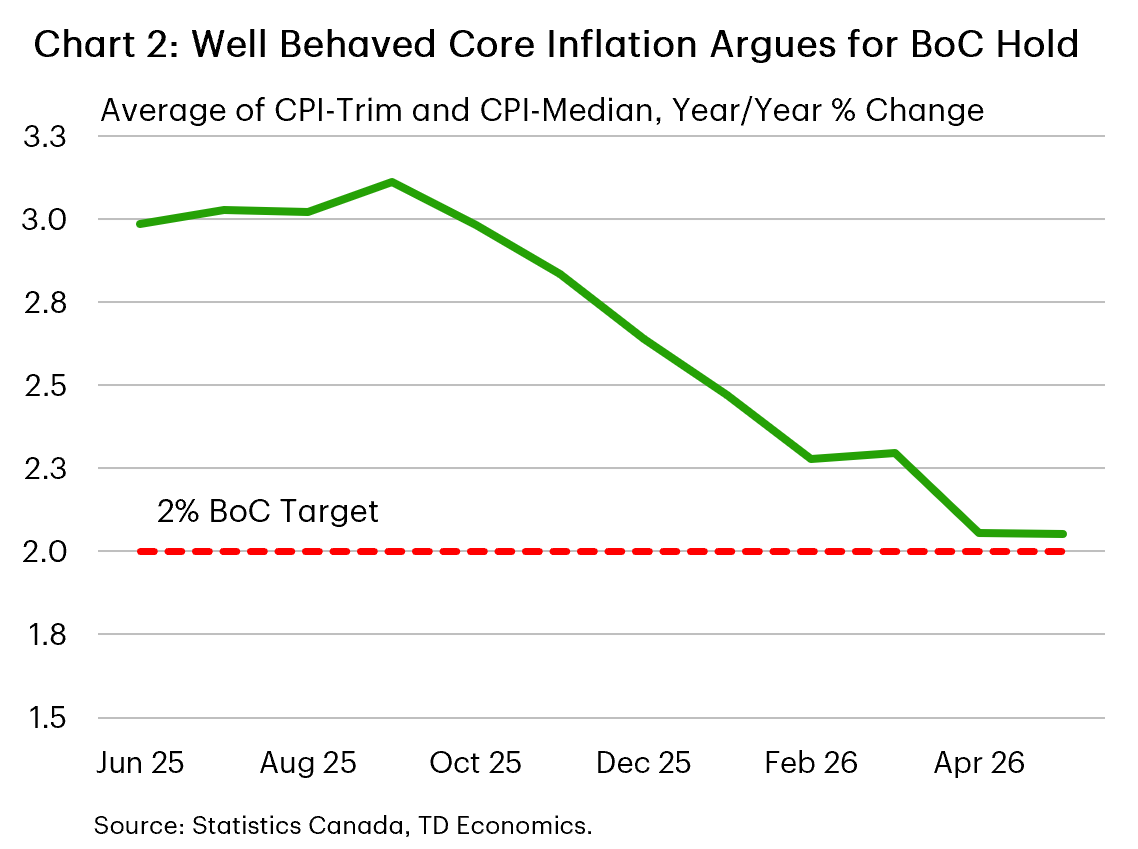
- Lower oil prices should help near-term inflation, while underlying slack and contained core inflation pressures strengthen the case for a Bank of Canada hold stance.
U.S. Highlights
- U.S. equities had a stellar first half performance this year, with the S&P 500 and NASDAQ rising 9.5% and 13%, respectively.
- Nonfarm employment moderated in June, but underlying hiring trends remain reasonably solid. The unemployment rate dipped to a twelve-month low of 4.2%.
- The ISM Manufacturing Index remained in expansionary territory for the sixth month in June, while vehicle sales hit a nine-month high of 16.5 million.
Canada – GDP Fireworks Ahead of Canada Day
In this holiday shortened week, there were still some notable moves in financial markets. Oil slid lower and, more broadly, has plunged since early June on hopes of a U.S.-Iran peace deal and improved traffic through the Strait of Hormuz. Canadian bond yields climbed during the week but eased back a bit today, driven by dynamics in the U.S. For its part, the Canadian dollar was unchanged at about 70 cents U.S. but has been tumbling since early May, pressured by hawkish U.S. central bank messaging.
The recent slide in oil prices is certainly a welcome development from an inflation perspective and will be reflected in June's CPI print. However, there could still be some upside to oil prices after this initial downswing. Global inventory buffers were steadily drawn down during the conflict and the summer driving season is set to ramp up.
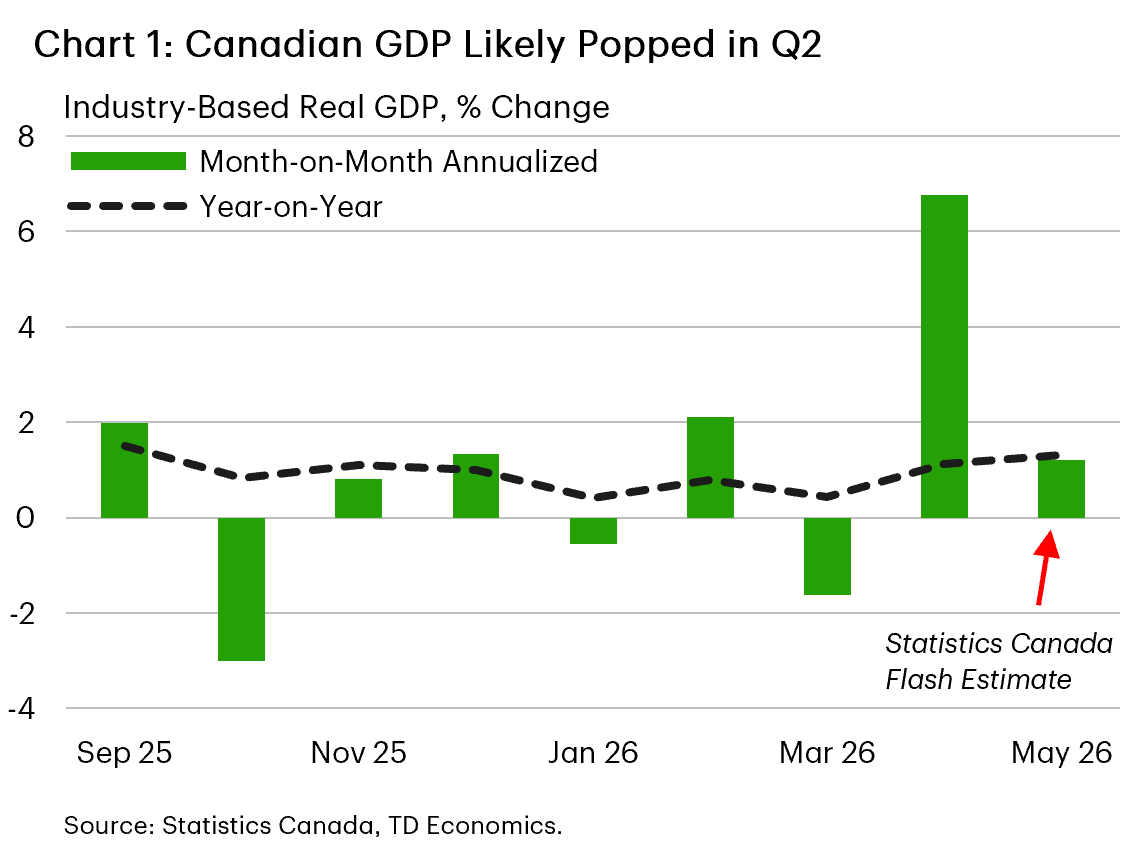
Nonetheless, our forecast assumes that oil prices are past their peak. The Bank of Canada will breathe a sigh of relief if that turns out to be true, although policymakers were treated to some fireworks ahead of the Canada Day holiday, courtesy of a well-timed surge in monthly GDP. Indeed, Canadian GDP shook off some winter blues, popping by 0.5% month-on-month in April. This should help quell recession chatter, with April's gain marking the largest such increase since July 2025.
On the less-positive side, the July 1st deadline to extend the CUSMA agreement for another 16 years came and went this week. However, this outcome was telegraphed well ahead of time by Canada, U.S. and Mexico. For now, the status quo remains, with most of Canada's exports to the U.S. tariff-free, but with punishing levies on sectors such as steel, aluminum and autos still in place. The process now moves to annual reviews (which will keep the cloud of uncertainty hanging), although parties can strike a deal at any time. We have tentative evidence that the worst of the trade conflict may be in the rearview. For instance, manufacturing GDP has risen in two of the last three months through April, and may have increased again in May given a pickup in hiring.
Incorporating StatCan's GDP guidance for May, Canada's economy is now on track to grow at a pace above 2% annualized in the second quarter. This is stronger than what the Bank of Canada expected in its April projection. Even still, it doesn't materially change our view on rates. Remember that the bounce back in GDP comes on the heels of several quarters of soft activity, meaning that the economy is still likely in excess supply. Core inflation remains well behaved, with economic slack likely to apply downward pressure. Next week brings a slew of important data, including the Bank of Canada's Business Outlook Survey (BOS) and the June read on the job market. The prior BOS offered evidence that businesses are adjusting to the trade war, while Canadian hiring surged in May (raising the risk of some giveback in next week's report). We'll be monitoring these closely, but it would take some surprises to shake us from the view the Bank will remain on hold this year.
Rishi Sondhi, Economist
U.S. – Celebrating America's Exceptionalism
This weekend will mark America's 250th anniversary, but for financial markets, this holiday shortened week also brought a brief halftime for calendar 2026. It's been an eventful first six months of the year, marked by a flurry of trade deals, further shifts in tariff policies, a new chapter for the Federal Reserve and plenty of geopolitical tensions. Through it all, financial markets have remained remarkably calm. The S&P 500 rose 9.5% through the first half of the year while the NASDAQ was up nearly 13% – or more than double last year's mid-year performance. It remains to be seen whether the run is something to cheer or fear, but one thing is for certain, the AI buildup and the expected productivity enhancements that it could eventually deliver have been pivotal catalysts underpinning the bull rally.
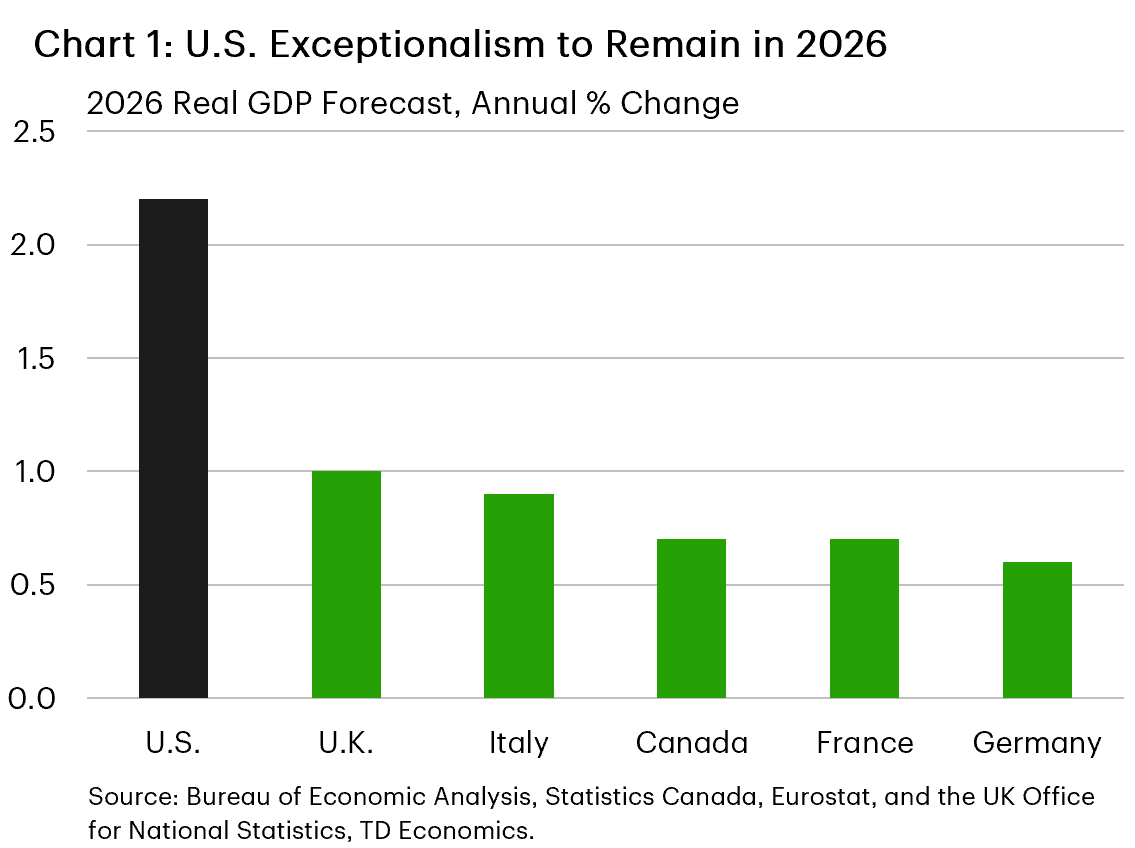
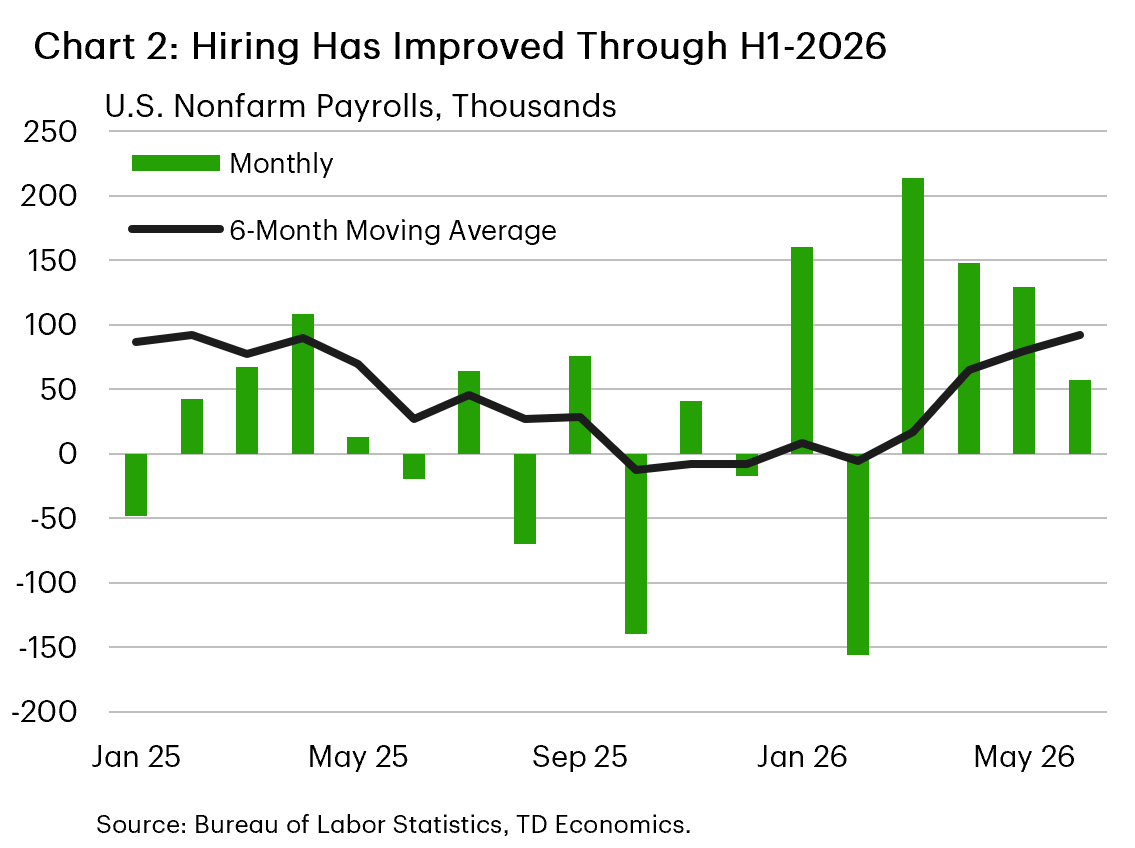
Beyond the AI push, a return to the American exceptionalism trade has also offered a tailwind for equities. U.S. growth is tracking north of 2% for 2026, or a multiple of any of the other G7 nations. And perhaps more encouragingly, the balance of risks for the U.S. outlook feels tilted to the upside. The U.S.-Iran peace deal has quickly returned energy prices to pre-conflict levels, dragging gas prices lower. This is good news for the consumer. At the same time, the labor market has clearly turned a corner after grinding through a soft patch last year. Nonfarm payrolls rose by 57k in June, a moderation from prior months, but a decent print nonetheless. Smoothing through the volatility, hiring has averaged 111k and 92k over the last three and six months, respectively. This is well above the breakeven rate, which helped to push the unemployment rate to a twelve-month low of 4.2%. But it wasn't all good news, a sharp drop in the labor force was entirely driven by a decline of over 800k prime working age individuals (i.e., 25 to 54 years old). It's too early to know what drove the decline or whether it's simply related to volatility. But the magnitude is noteworthy and something worth monitoring in the months ahead.
Other data out this week also reinforced America's economic resilience. June vehicle sales rose to a nine-month high of 16.5M, while the ISM Manufacturing Index remained in expansionary territory for the sixth consecutive month. Importantly, both production and new orders continue to expand at decent clips. And while input prices remain elevated, the sub-index fell to a four-month low, suggesting the worst of the cost pressures stemming from the energy shock are now in the rearview mirror.
This is good news for Fed officials, who are hunting for any signs of slowing price pressures amid continued concerns of elevated inflation. In his first public appearance since the June press conference, Chair Warsh underscored the Fed's commitment to return price stability, but stopped short of giving any forward guidance. While this leaves the impression that every meeting is "live" we would argue that the data released since the last FOMC meeting alongside the sharp pullback in energy prices reduces the odds of the Fed hiking rates this summer.
Economics Week Ahead
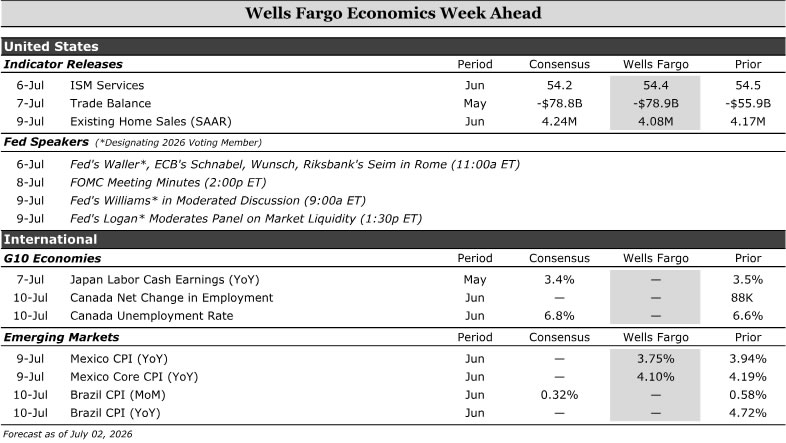
Next week's release of the June FOMC meeting minutes should provide further insight into what could shift a divided Committee toward additional tightening, although we continue to expect the Fed to remain on hold as recent inflation strength appears largely driven by fading supply-side factors rather than overheating demand. Abroad, Japan's labor cash earnings data will be closely watched for signs that wage growth remains consistent with the Bank of Japan's policy normalization path. In Canada, we expect labor market conditions to remain broadly stable despite some moderation in hiring after May's strong employment gain, supporting a patient approach from the Bank of Canada. In emerging markets, Mexico's June CPI report should show further progress on disinflation, but persistent services inflation is likely to keep Banxico on hold.
United States:
- FOMC Meeting Minutes (Wednesday)
G10 Economies:
- Japan Labor Cash Earnings (Tuesday), Canada Labor Force Survey (Friday)
Emerging Markets:
- Mexico CPI (Thursday)
U.S. Week Ahead
FOMC Meeting Minutes — Wednesday
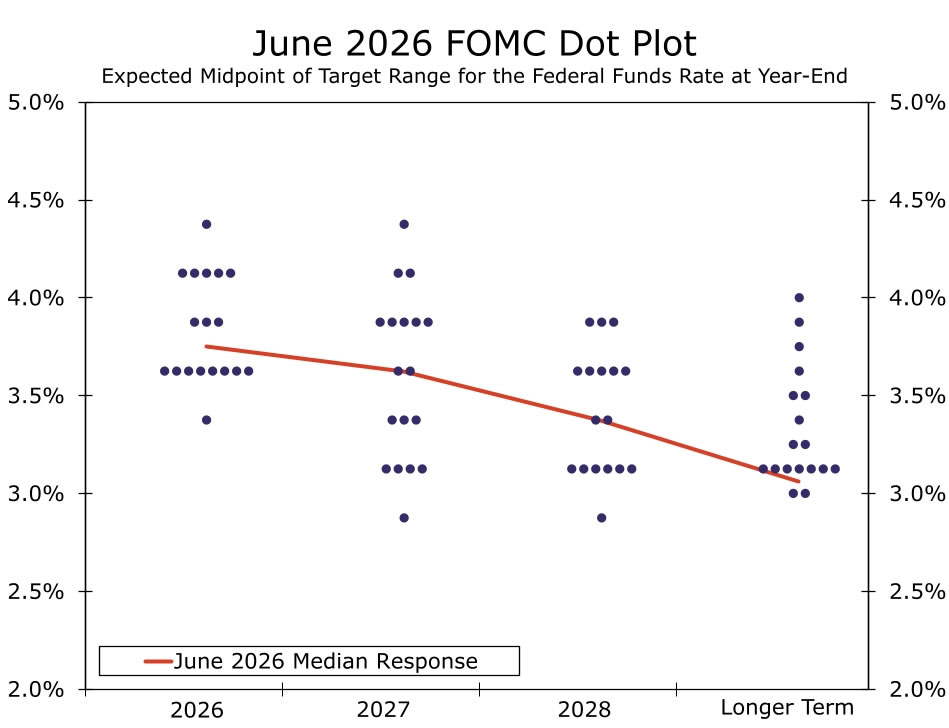
We will look to next week's FOMC minutes for any signs of what could shift a divided Committee from a hold toward rate hikes. The dot plot from the last meeting made clear that policymakers are split on whether rate hikes are warranted, but with forward guidance getting tamped down under Chair Warsh, the Fed's reaction function remains uncertain in terms of what exactly would build broader support for more restrictive policy.
We will be looking to whether a majority of participants view the recent pickup in inflation as persistent enough to warrant additional tightening or as primarily a temporary supply-shock. We will also be interested to see the extent to which Committee members view the labor market/the demand side of the economy as an inflationary problem.
While the minutes may lean hawkish, we continue to view recent inflation strength as being driven largely by supply side factors, including tariffs and energy, that should fade over time. Since the June meeting, oil prices have fallen further, which should help ease concerns that energy-related inflation will broaden further. And the June employment report showed no signs that the labor market is overheating or contributing to broader inflationary pressures. We thus continue to expect the FOMC to keep the funds rate on hold for the foreseeable future.
G10 Week Ahead
Japan Labor Cash Earnings — Tuesday
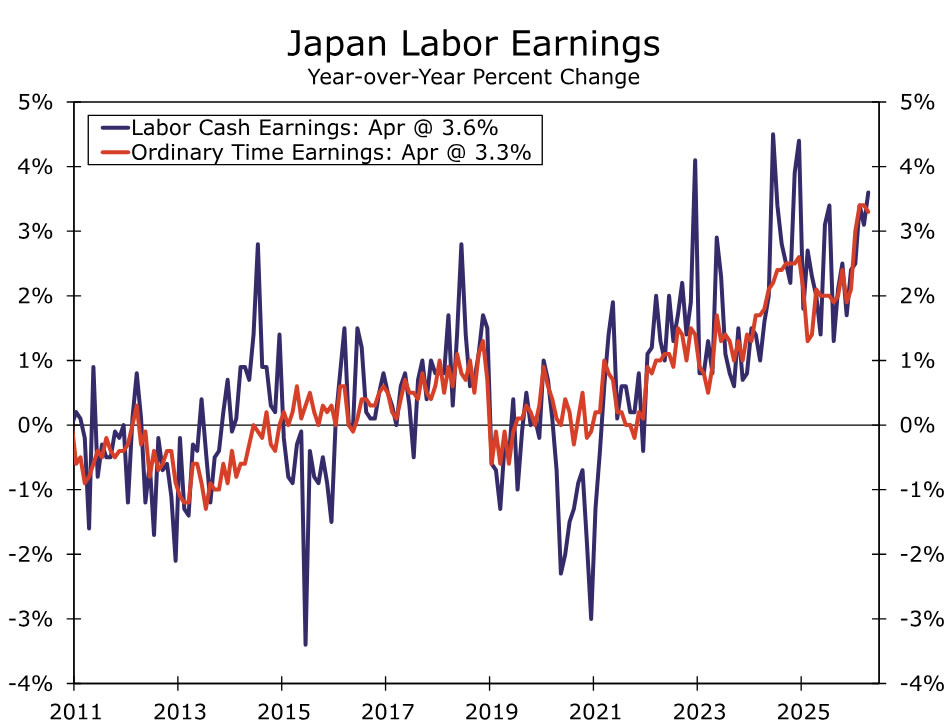
With Japan's labor cash earnings for May due next week, the release will offer a fresh read on whether the wage-price cycle remains intact. The Bank of Japan (BoJ) continues to signal conviction in its path toward policy normalization, as April labor cash earnings and ordinary time earnings (the BoJ's preferred gauge of underlying wage momentum) rose 3.6% and 3.3% year over year, respectively. This year's Shunto negotiations delivered another round of strong pay gains, with labor unions securing average wage increases of more than 5% for a third consecutive year, effective from April. Given the limited coverage of union workers and the lagged pass-through from negotiated settlements to realized earnings, wage growth should remain supported in the months ahead. Lower oil prices could also help ease margin pressure for smaller firms, supporting a broader pass-through of negotiated wage increases.
While inflation has been soft, the fading of government subsidies and impact of a weaker yen on import prices should contribute to a gradual pickup in inflation. Combined with resilient GDP growth and a solid Q2 Tankan report, a strong wage print would support the case for further tightening. As such, we continue to expect the BoJ to deliver a 25 bps rate hike in Q3 (most likely September), bringing the policy rate to a terminal level of 1.25% by year-end.
Canada Labor Force Survey — Friday
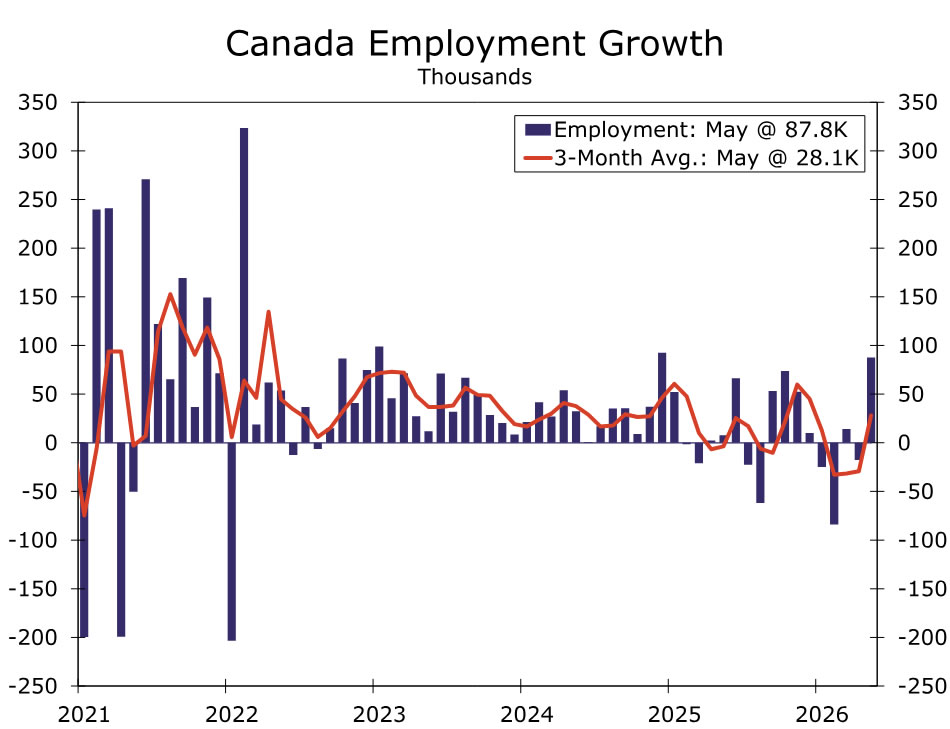
Canada's labor market remains soft, though weakness earlier in the year was met with a sharp rebound in May. Even so, employment is up less than 1% from a year ago, underscoring the sluggish pace of hiring beneath the month-to-month volatility. While demand has softened, recent gains having been concentrated in full-time positions, rather than part-time work, is a sign of stability.
Labor supply constraints are also easing only gradually. An aging workforce and slower immigration flows should continue to limit labor force growth, helping keep a lid on any significant increase in unemployment. As a result, we expect the jobless rate to remain broadly within the 6.5–7.1% range that has prevailed over the past 12–18 months.
Following the strongest monthly employment gain since late 2024, some payback in June would not be surprising. Still, our broader assessment is that labor market conditions are stabilizing rather than deteriorating. Wage growth remains positive but is no longer accelerating materially, consistent with labor demand that has softened enough to reduce inflation pressures but not enough to raise meaningful recession concerns. Taken together, the labor market argues for continued patience from the Bank of Canada, keeping policy on hold for the foreseeable future.
EM Week Ahead
Mexico CPI — Thursday
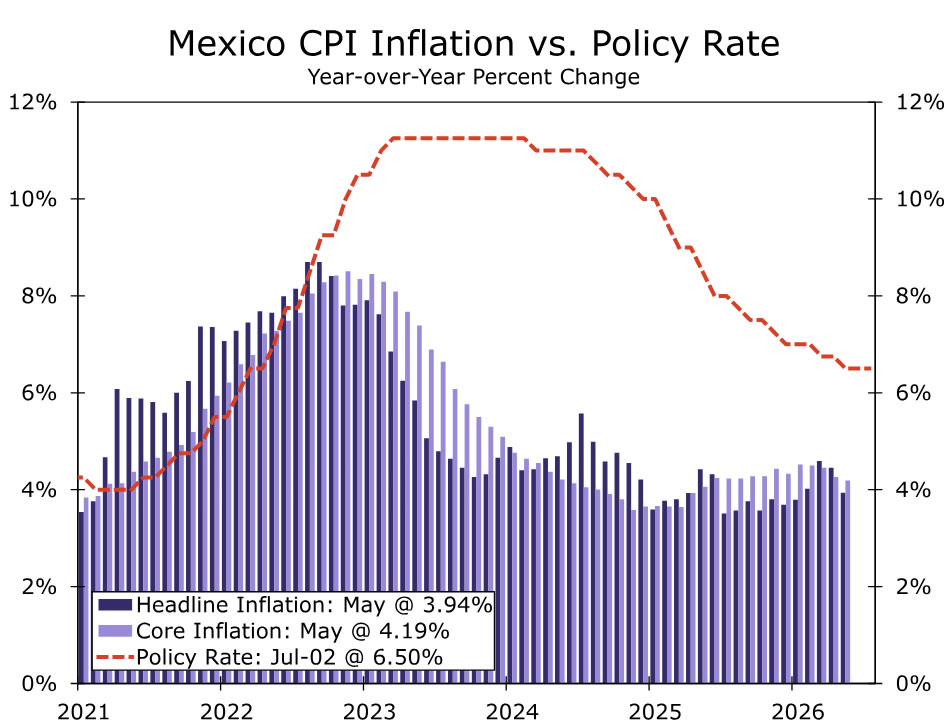
Mexico's June CPI release next week should provide more clarity on whether disinflation is broadening enough to reopen the door to rate cuts. Based on the mid-month data, we expect headline and core inflation to slow to 3.75% year over year and 4.10%, respectively, from 3.94% and 4.19% in May. Still, core services inflation remains sticky, which should keep Banxico cautious.
At its June meeting, Banxico's Governing Board unanimously held the Overnight Rate at 6.50% and suggested that the current policy setting remains appropriate for an extended period. Policymakers also revised their Q2-2026 headline inflation forecast slightly lower, while the core forecast moved slightly higher.
Our base case remains for Banxico to stay on hold through year-end and into 2027. That said, risks are tilted toward a cut rather than a hike. Banxico expects growth to rebound in Q2 after contracting in Q1, then expand at a steady pace. If activity instead continues to struggle and disinflation broadens further, a rate cut could come by year-end.
FTSE Elliott Wave: Forecasting the Rally After a 3-Wave Pullback
Hello traders. In this technical article we’re going to take a quick look at the Elliott Wave charts of FTSE Index published in members area of the website.
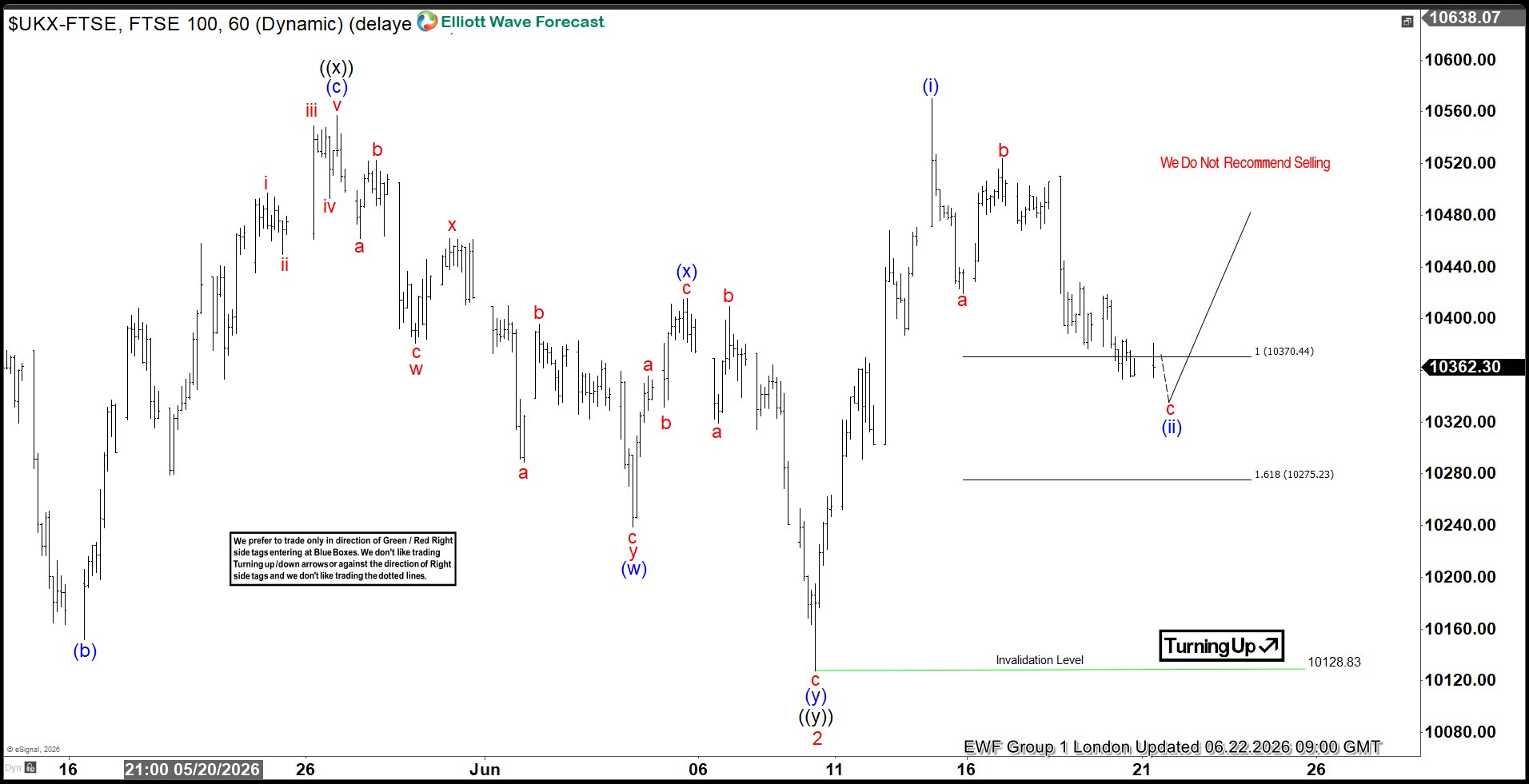
As our members know, FTSE made a pullback that unfolded as an Elliott Wave Zig Zag pattern. Price completed a clear 3-wave move down from the peak and found support at the Equal Legs zone (buying area).
In the following analysis, we explain the Elliott Wave pattern and the market outlook.
FTSE Elliott Wave 1 Hour Chart 06.22.2026
FTSE is currently forming an intraday three-wave pullback from recent highs. We identified a buying zone by measuring the Equal Legs area using the Fibonacci extension tool, with a projected relative to b. The ideal support area comes in at 10370.44-10275.23. The correction is not complete yet, and the index could see more downside in the near term within the marked buying zone. As long as price holds within this region, we expect buyers to step in and the rally to resume toward new highs.
90% of traders fail because they don’t understand market patterns. Are you in the top 10%? Test yourself with this advanced Elliott Wave Test
FTSE Elliott Wave 1 Hour Chart 07.03.2026
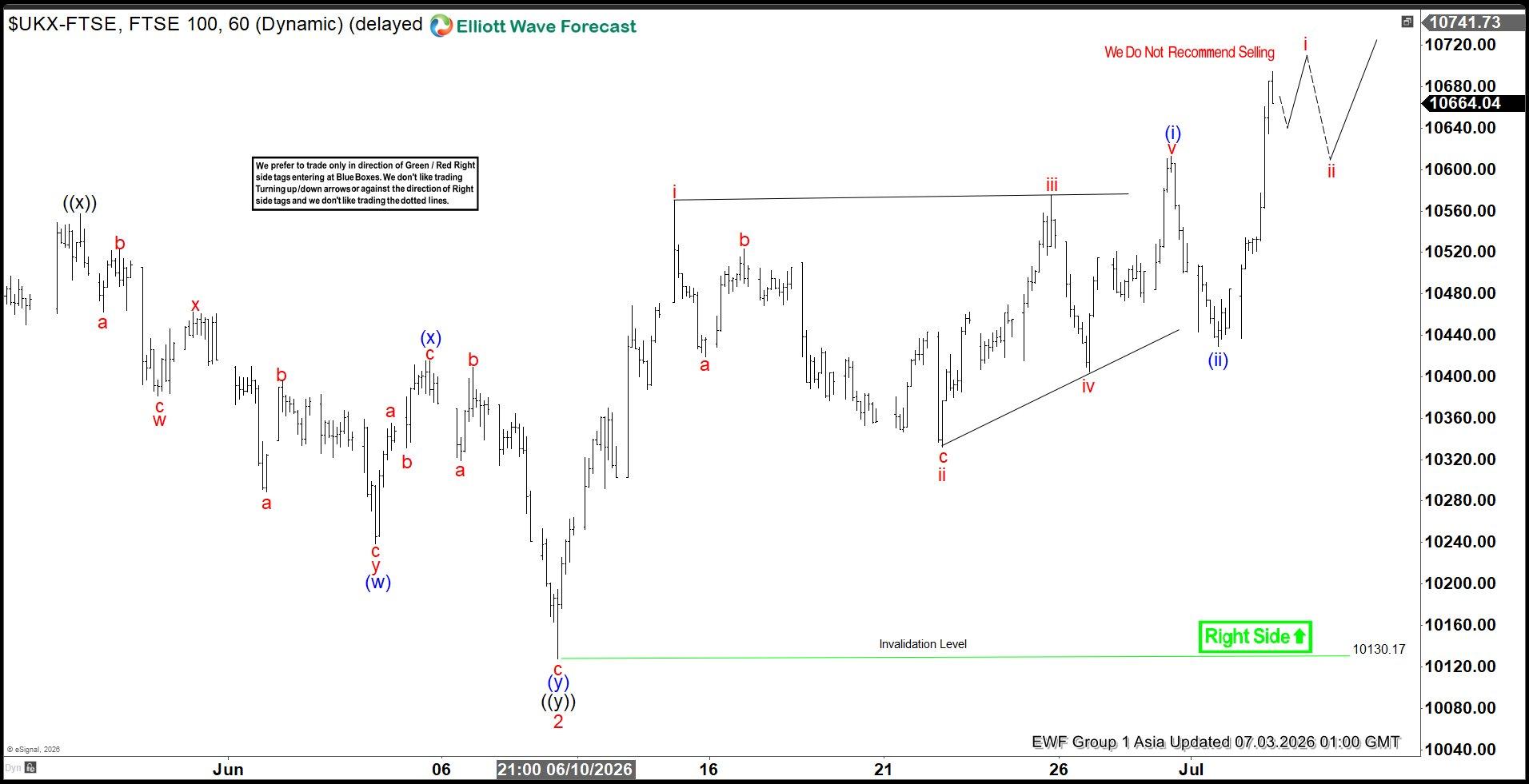
The Index has found buyers at the Equal Legs zone , just as expected. The correction ended at the 10333.17 low, and since then, FTSE is giving us a rally. As a result, any long positions from the equal legs zone are now risk-free.
Important note: Our analysis is not based on Elliott Wave in isolation. We perform detailed higher-time-frame cycle analysis, which shows an incomplete market structure. This is one of the key drivers of price action, along with correlation analysis and broader market context.
We also teach our members in live analysis sessions how to identify incomplete bullish and bearish sequences. Even a 14-day trial, is enough to noticeably improve your trading analysis and forecasting approach.
Japan Services PMI Rebounds While Rising Costs Keep Inflation Pressures Alive
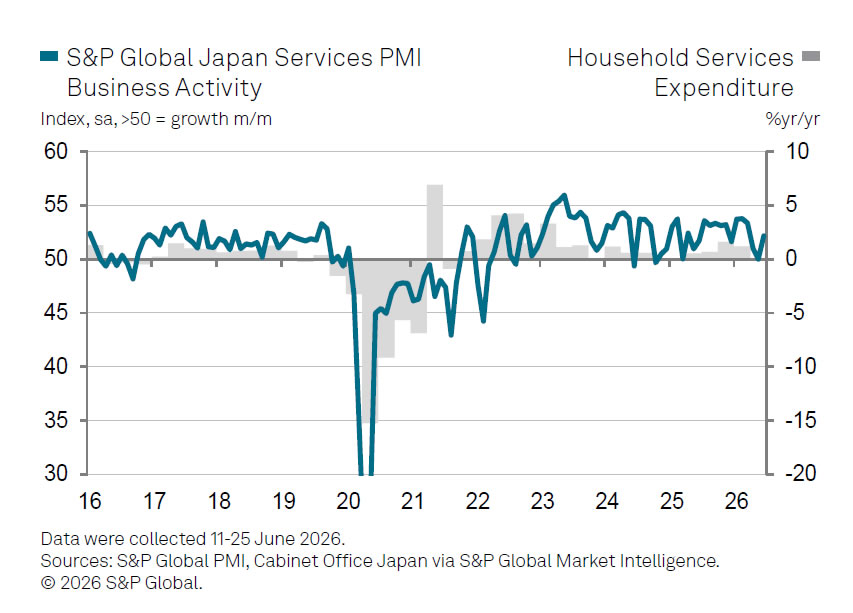
Japan's service sector returned to expansion in June, helping lift overall private-sector activity to its strongest pace in three months. The final S&P Global Japan Services PMI Business Activity Index rose to 52.2 from the neutral 50.0 reading in May, marking renewed growth after a brief pause. The Composite Output Index, which combines manufacturing and services, climbed from 51.1 to 52.8, reflecting stronger manufacturing output alongside a recovery in services activity.
Survey details suggested domestic demand remained the main driver of growth. According to S&P Global, new business across manufacturing and services expanded at the second-fastest pace in three years, supported largely by firmer domestic orders. External demand, however, was less supportive. New export business grew at its slowest pace in six months as service providers reported a noticeable decline in overseas demand, partly reflecting lower tourist arrivals. Business activity nevertheless continued to expand for the 14th time in the past 15 months, with firms citing higher volumes of new work and upcoming events.
Despite the improvement in activity, inflation pressures remained elevated. S&P Global said input costs rose at the fastest pace in four years as supply chains continued to feel the effects of the Middle East conflict, prompting another marked increase in selling prices. Firms were only slightly more optimistic about the outlook, with uncertainty surrounding geopolitical developments and rising costs tempering confidence. The survey suggests Japan's economy continues to expand at a moderate pace, though persistent cost pressures are likely to keep the Bank of Japan attentive to the inflation outlook in the months ahead.
| Indicator | Previous | Latest |
|---|---|---|
| Services PMI Business Activity | 50.0 | 52.2 |
| Composite PMI Output | 51.1 | 52.8 |
Cliff Notes: On the Minds of Policy Makers
Key insights from the week that was.
This week’s RBA minutes provided more colour around the Monetary Policy Board’s (MPB) June deliberations. Overall, the MPB views the economy as “operating with excess demand and widespread inflationary pressures”. On the domestic front, there were “somewhat differing views” among MPB members regarding the extent of current capacity pressures, but they are nonetheless seen as elevated and a risk to the normalisation of inflation towards target. On the Middle East conflict, the MPB welcomed progress towards a resolution but still viewed the balance of risks as firmly skewed to the upside for inflation and the downside for growth. As such, “increasing the cash rate target” will be considered if required.
Last week’s speech from Deputy Governor Hauser shed more light on the RBA’s thinking on the relationship between inflation and unemployment. The main takeaway is that inflation tends to be more sensitive when the economy is already tight; but equally, that the policy trade-off in such a situation allows more scope to focus on bringing inflation down without a large cost to employment. These judgements underscore the RBA’s successive rate hikes earlier in the year and their subsequent decision to pause and assess in June.
The RBA is also closely monitoring trends in the housing market and the implications for wealth and consumption. Cotality’s latest home value index fell 0.4% in June, Sydney and Melbourne’s correction deepening as price growth slowed from a higher base across the smaller capitals. Together with signs of slowing credit growth, evidence that the RBA’s rate hikes and sentiment are weighing on the market is mounting. Westpac is forecasting further house price declines through the remainder of the year, though strong population growth and tight supply will limit their scale.
Before moving offshore, a final note on trade. The goods trade balance surprised materially to the downside in May, flipping from a surplus of $1.4bn to a deficit of $3.0bn, the largest in over a decade. Volatility in gold flows was one of the chief culprits, accentuated by a surprisingly large fall in iron ore exports and a solid lift in car imports (i.e. EVs). Imports of equipment related to the data centre build-out have moderated but are still well above historical norms. Expect continued volatility over the coming year(s).
Over in the US, nonfarm payrolls disappointed in June, with only 57k jobs created and April/May revised down by a combined 74k. The three-month average is now 111k versus 164k in May, though June’s result still suggests labour demand is at least keeping pace with supply. Household survey employment is materially weaker, however, declining 507k in June and averaging a loss of 195k jobs per month over the past three. Further, continuing the trend of the past 18 months, the participation rate fell to 61.5% in June; had participation held steady since January 2025, the unemployment rate would now be above 5%, not the reported 4.2%. Taken together, these outcomes imply the labour market is most likely marking time. That said, the downside risks the household survey allude to are worth close attention.
Also consistent with the FOMC becoming less concerned with inflation in coming months was the latest ISM manufacturing report. Most notably, the prices component fell 9.1pts to 73, signalling a turn in upstream price pressures. Together with the decline in oil benchmarks in recent weeks and the available detail of both the CPI and PPI, which have offered little evidence of material secondary inflation effects from the Middle East conflict, this moderation should alleviate concerns amongst the FOMC that a sustained re-acceleration in consumer inflation is a probable risk.
The preliminary release for June Euro Area inflation was also supportive of an increasingly benign inflation outlook, prices falling 0.1% versus a 0.1% expected gain. The improvement was broad based too, annual headline inflation moderating to 2.8%yr from 3.2%yr and core inflation to 2.4%yr from 2.6%yr. Importantly, this was achieved while the labour market remains historically tight.
FOMC Chair Kevin Warsh picked up on this improvement in inflation prospects at the ECB’s Sintra Forum on Central Banking, highlighting that inflation expectations and risks "have come down" in recent weeks. Admittedly he is focused on the US but, per the Euro Area data above, the narrative is broadly true for developed economies across the northern hemisphere. The keynote panel at the conference also discussed several other important topics including the need for greater flexibility and timeliness when conducting monetary policy, how AI advances are being factored into decision making and the importance of safeguarding financial stability.
Finally to Asia where the Q2 Tankan was received positively, participants focusing on the increase in large manufacturer sentiment from 17 to 22. Other outcomes were less positive, however. Smaller manufacturers are more cautious, as are service firms. R&D expectations were also revised down, and profitability and labour market indicators came under pressure. Overall, the survey suggests the BoJ needs to keep evolving risks in mind as they continue to normalise policy.