

Sample Category Title
Dollar Punches Above 109 Yen, Japanese Inflation Reports Meet Expectations
USD/JPY continues to move upwards this week. In Tuesday’s North American session, USD/JPY is trading at 109.14, up 0.40% on the day. On the release front, Japanese inflation data met expectations. The Services Producer Price Index dropped from 0.6% to 0.5%, matching the estimate. The Bank of Japan’s favored inflation indicator, BoJ Core CPI, came in at 0.7%, down from 0.8% a month earlier. This also matched the estimate. In the US, CB Consumer Confidence jumped to 128.7, beating the estimate of 126.0 points. US New Home Sales also looked sharp, jumping to 694 thousand and crushing the estimate of 625 thousand. This marked a 4-month high. However, manufacturing data was not as strong, as Richmond Manufacturing Index dropped 3 points, well off the estimate of a 16-point gain. This was the first contraction since October 2016.
The US dollar continues to flex its muscles and USD/JPY has climbed 1.1% this week. The yen is currently at its lowest level since February 5. The catalyst for the greenback rally was higher yields for 10-year US treasury bills, which rose to 2.996% on Monday. Higher yields for US-T bills have made them more attractive than European or Japanese counterparts and pushed the US currency higher. With oil pushing above $70 a barrel, there are concerns that inflation will rise, which has pushed bond prices lower and yields upwards. The dollar has also benefitted from a reduction in geopolitical risk, with an easing of tensions between North and South Korea, and a lull in the conflict in Syria.
Japan’s economy continues to grow and key indicators are generally performing well. At the same time, inflation has lagged behind growth and remains well below the Bank of Japan’s target of around 2 percent. The markets have been speculating that stronger economic conditions might cause the BoJ to re-examine its ultra-accommodative monetary policy. However, on Monday, BoJ Governor Haruhiko Kuroda poured cold water over such sentiment, stating that in order to reach its inflation target, “the Bank of Japan must continue very strong accommodative monetary policy for some time”. The BoJ will issue an inflation forecast on Friday, with the bank expected to reiterate that the inflation target will be reached in fiscal year 2019. Kuroda’s dovish statement can be seen as an attempt to curb volatility in the yen following the release of the inflation forecast.
USDCAD – Bulls Show Strong Hesitation Under Daily Cloud Top, Risk of Deeper Pullback
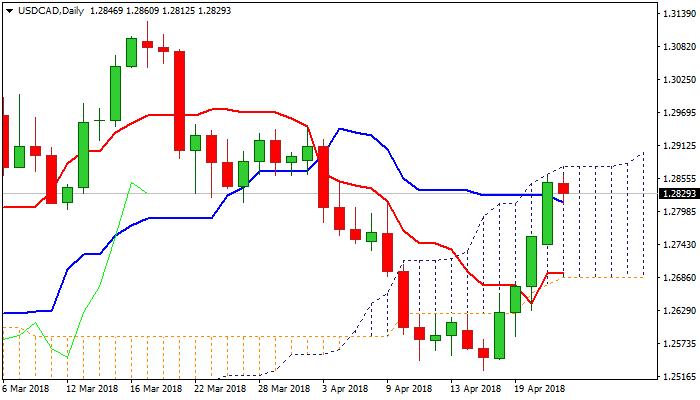
The pair holds within 50-pips consolidation on Tuesday after strong four-day rally was capped by daily cloud top (1.2862) on Monday and today’s action failed to extend further as cloud is widening and top lies at 1.2875.
Recovery rally retraced over 50% of 1.3124/1.2527 descend but shows initial signs of stall under key barrier, as strongly overbought slow stochastic is reversing and daily RSI turning south. Also, profit-taking action after 2.5% advance in four days, could accelerate pullback which was so far held by daily Kijun-Sen (1.2815).
Close below the latter would signal deeper correction of 1.2527/1.2860 rally and expose initial supports at 1.2782/68 (Fibo 23.6%/55SMA), while further easing would open way towards pivotal supports at 1.2733/30 (Fibo 38.2%/20SMA).
Meanwhile, extended consolidation could be expected while daily Kijun-sen holds, as US dollar remains supported in the near-term and today’s upbeat US Consumer confidence and New home sales data could further boost dollar’s bulls.
Bullish scenario requires firm break through cloud top (1.2875) and Fibo 61.8% of 1.3124/1.2527 descend, to open way towards psychological 1.30 barrier
Res: 1.2875; 1.2943; 1.3000; 1.3076
Sup: 1.2815; 1.2782; 1.2768; 1.2730
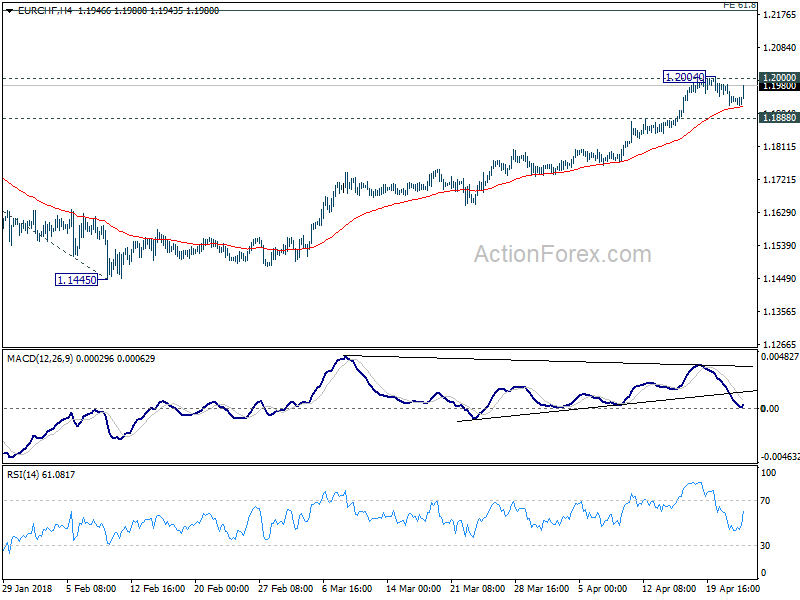
EUR/CHF heading back to 1.2, after drawing support from 4H 55 EMA
EUR/CHF rebounds strongly in early US session. That's primarily driven by selloff in "safe-haven" currencies as the movements in CHF and JPY are in sync. At the same time, EUR is extending consolidation against USD.
Technically, EUR/CHF's pull back from 1.2004 was held comfortably above 4 hour 55 EMA. That suggests near term bullish momentum remains intact. And the cross could break 1.2 handle, on its second attempt on one take. (Well yes, it's actually the second take). With that, we'll be looking at 61.8% projection of 1.0629 to 1.1832 from 1.1445 at 1.2188 as next target.
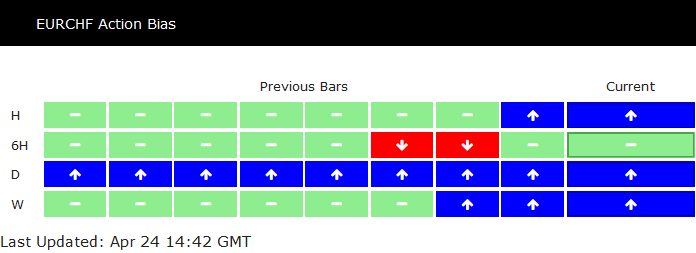
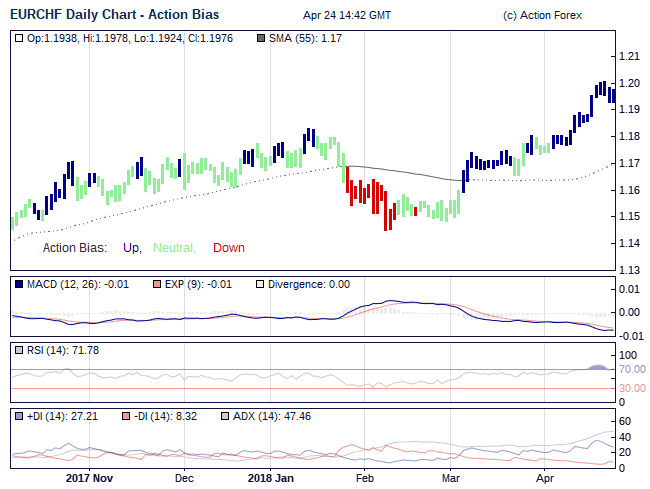
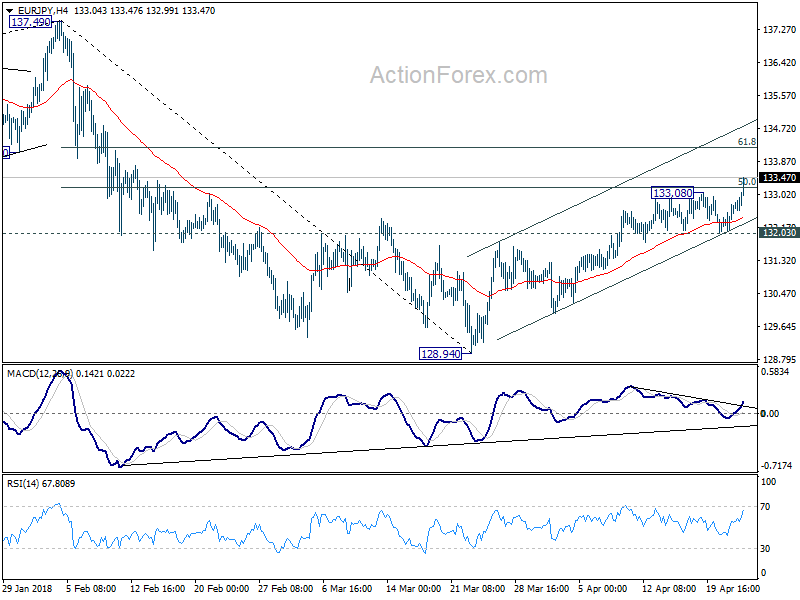
Action bias table also support this view. As seen in D action bias chart, EUR/CHF is maintain solid upside action bias. The neural and two red bars indicated consolidation. And H action bias turned blue again, suggesting pick up in upside bias.
FX Favorable for US Dollar
EUR/USD is trading near its lows since Mar 1 today. After positive fundamentals in the US and very weak data in the Eurozone, the market became clear in being favorable to the dollar. This week, important macroeconomic events are scheduled for Thursday and Friday, hence the market will be consolidating within the next few days.
In the meantime, there were two events in the US that supported the USD. The preliminary Industry Business Climate Index by Markit rose to 56.5, against the expectations at 55.2 and the previous mark at 55.6. The Service Markit Index also rose, but not so high, moving from 54.00 to 54.40. However, in the breakdown by components, one can easily see new order volume grow, which makes the entire indicator increase.
Another news that supported the greenback were the existing home sales that increased to 5.6M, against the expectations at 5.55M. With the supply being rather tight and the loan interest rising, the demand in real estate is still high, as people try to buy homes now, before the price has gone up way too high. In the meantime, the EUR was weak with the mixed data on private sector business activity.
Today is a rather quiet day in terms of fundamental releases, although March new building permits are scheduled later today in the US; with this indicator showing high demand, too, the US dollar may become even stronger.
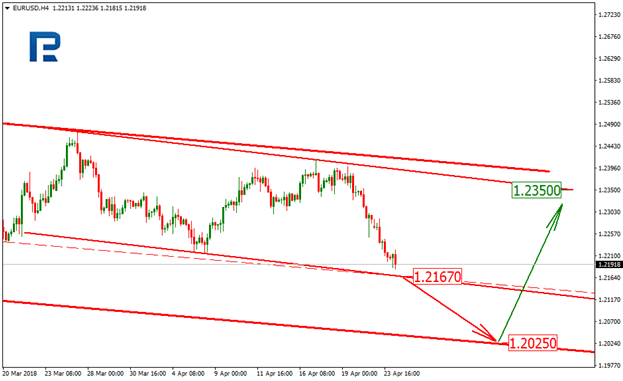
Technically, EURUSD is still correcting inside a descending channel. The current trend consists of two channels, a broad mid term channel, and a tight short term one. As of now, the price is aiming to the short term channel support at 1.2167. While testing this support, the pair may start trading sideways. However, once the support gets broken out, the price may fall to the mid term channel support at 1.2025. Then, a new ascending move may form, aiming to the resistance at 1.2350.
EUR/JPY Mid-Day Outlook
Daily Pivots: (S1) 132.27; (P) 132.52; (R1) 132.95; More....
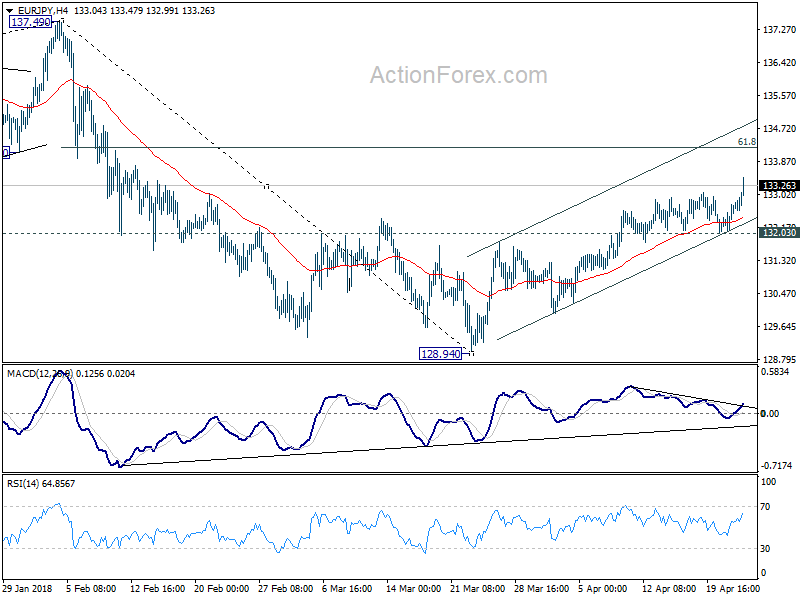
EUR/JPY's strong rally suggests that rebound from 128.94 has resumed. Intraday bias is back on the upside for further rise. At this point, such rebound is still seen as a correction, hence, we'd expect strong resistance bring 61.8% retracement of 137.49 to 128.94 at 134.22 to limit upside. Break of 132.03 will turn bias to the downside for retesting 128.94 low. However, sustained break of 134.22 will turn focus back to 137.49 high instead.
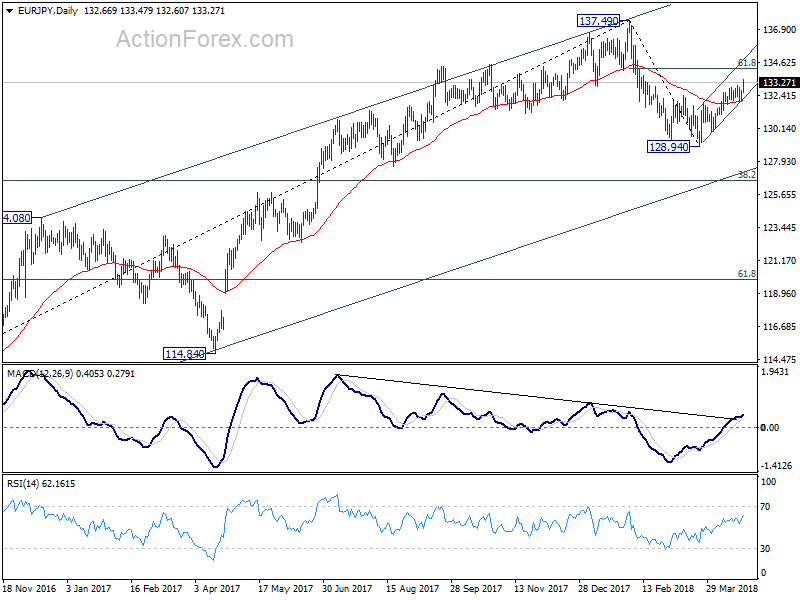
In the bigger picture, price action from 137.49 medium term top are developing into a corrective pattern. Strong support from 55 week EMA (now at 129.91) suggests that the first leg has completed at 128.94 already. Nonetheless, break of 137.49 is needed to confirm resumption of the rise from 109.03 (2016 low). Otherwise, we'd expect more corrective range trading, with risk of another fall to 38.2% retracement of 109.03 to 137.49 at 126.61 before completion.
EURGBP Struggles for More Upside Movement; Still in Bearish-Tilting Channel
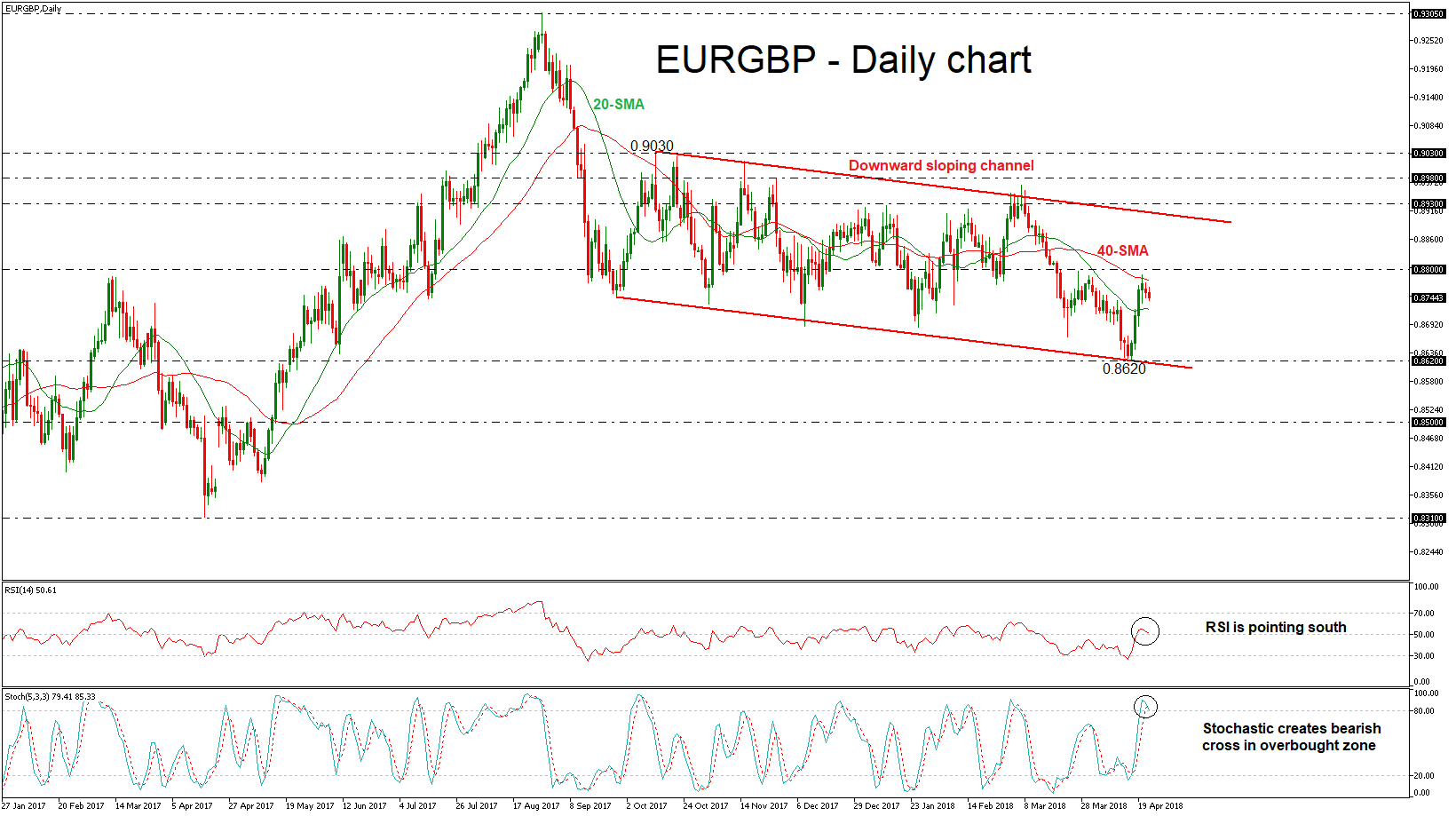
EURGBP accelerated sharply higher in the previous week but it has struggled to extend its gains over the last hours. The pair remains in a slightly downward-tilting channel, which has been in place since September 2017. The longer-term neutral to bearish outlook was recently confirmed again when the pair touched an 11-month low of 0.8620 on April 16.
In the near-term, the price failed to break the 40-day simple moving average (SMA) and is moving lower, as well as the technical indicators. The RSI indicator is pointing down and it has managed to cross into negative territory below the 50 level. Also, the stochastic oscillator has created a bearish crossover with the %K and %D line in the overbought zone, suggesting that the weakness in the market is not over yet.
In the near term, a downside push is possible with prices looking to post a second straight session of losses today. In case of a slip below the 20-day SMA, the price could touch the 0.8620 support barrier, which is holding near the lower boundary of the downward sloping channel. Further downside pressure could penetrate the channel to the downside and drive EURGBP towards the 0.8500 handle.
On the flip side, an immediate level is likely to come from the 0.8800 psychological level, which has proved a strong resistance area in the past. A break above that could lead prices near the upper channel line around the 0.8900 critical level.
USDJPY: Bullish, Sees Price Extension
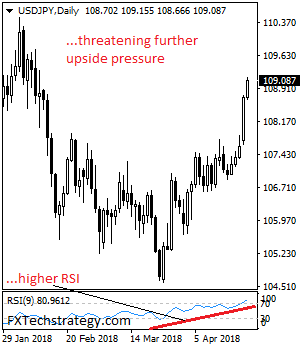
USDJPY: The pair saw a strong gain on Tuesday as it extended its gain on Tuesday. On the downside, support lies at the 108.50 level where a break if seen will aim at the 108.00 level. A cut through here will turn focus to the 107.50 level and possibly lower towards the 107.00 level. On the upside, resistance resides at the 109.50 level. Further out, we envisage a possible move towards the 110.00 level. Further out, resistance resides at the 110.50 level with a turn above here aiming at the 111.00 level. On the whole, USDJPY faces further upside pressure.
Sunset Market Commentary
Markets:
Global core bonds remain within yesterday’s trading ranges for now, but the US Note future is at risk of losing more ground as the contract slides lower entering US trading. A slightly bigger than expected setback of the German Ifo business sentiment featured on the European calendar, but didn’t cause a directional move. Stock and commodity markets provided no impetus either. Investor focus returned to the psychological 3% barrier in the US 10-yr yield as US investors entered dealings. Key resistance stands at 3.05%/3.07%. US equity futures profit from strong Caterpillar earnings/outlook with industrials leading the way higher. US Treasuries underperform German Bunds. The start of the upcoming US supply operation was negative as well. The US yield curve shows a simultaneous 1.5 bps shift higher at the time of writing. Changes on the German yield curve are limited to +0.5 bps. 10-yr yield spread changes versus Germany are unchanged with Greece outperforming (-4 bps).
The dollar maintained its recent gains. USD/JPY outperforms other major USD cross rates with the pair briefly trading north of the 109 big figure early in US dealings. The rally in other USD cross rates like EUR/USD, cable or USD/AUD slowed. In line with recent data evidence, several national European confidence indicators, including German IFO business confidence, came out on the softer side of expectations. EUR/USD dipped briefly below the 1.22 handle. However, the move had no strong legs. Recent trends in the major FX cross rates were USD driven, not euro driven. For now, there was no important enough US news to support further sustained USD gains. EUR/USD hovers currently in the low 1.2210/20 area. USD/JPY hovers around the 109 pivot.
Sterling developed an intraday trading pattern that was quite similar to yesterday. Last week, sterling came under pressure as BoE governor Carney indicated that the next BoE rate hike could come later than next month. The subsequent correction of sterling petered out on Friday and yesterday. This consolidation pattern continued today. EUR/GBP hovered around the 0.8750 pivot. UK eco data were mixed. The UK March budget data were better than expected and so was the deficit for the 2017/18 fiscal year. The CBI orders were close to expectations but the CBI business Optimism showed a substantial setback in April (from 13 to -4). EUR/GBP trades currently in the 0.8745 area. Cable hovers near 1.3960. So, sterling is trading off the recent lows despite ongoing noise on Brexit and despite reduced market expectations on a BoE rate hike.
News Headlines:
While still at lofty levels, business confidence in Germany, France and Italy deteriorated in April as a stronger currency and capacity constraints limited output in the euro zone’s biggest economies. The indicators point at a continuing momentum in the euro zone, but suggest economic growth probably reached its peak.
As expected, Hungary’s central bank left its main interest rate unchanged at a record low of 0.9%. Loose monetary conditions need to be maintained for an extended period to meet the inflation target, the Monetary Council said in an accompanying statement. It expects inflation to reach the 3% target by mid-2019 as upward pressure from wages on inflation has yet to materialize.
The uncertainty being generated by US trade tariffs is already hurting investment in the global economy and could do serious damage to world growth, ECB policymaker Francois Villeroy de Galhau said.
JPY dives as US yield breaches 3%, EUR/JPY resumes rebound from 128.94
JPY is sold off broadly in early US session as 10 year yield breaches 3% level, extending recent rally. But USD continues to consolidation against most other major currencies, including EUR and GBP, AUD and CAD.
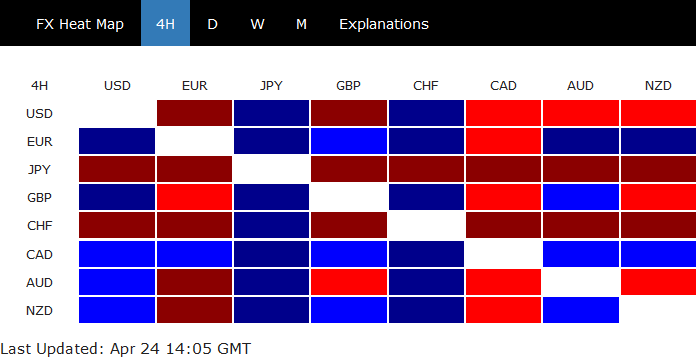
EUR/JPY defies gravity again as it surges through 133.08 to resume the rebound from 128.94. That's mainly thanks to the selloff in JPY though. For now, further rise would be seen but as the rebound from 128.94 is seen as a corrective move, we'll looking for topping again around 61.8% retracement of 137.49 to 128.94 at 134.22.
US consumer confidence rose to 128.7, suggesting solid economic expansion ahead
Conference board consumer confidence rose to 128.7 in April, up from 127.0. That's also notably higher than expectation of a fall to 126.0.
Comments by Lynn Franco, Director of Economic Indicators at The Conference Board:
- "Consumer confidence increased moderately in April after a decline in March.
- "Consumers' assessment of current conditions improved somewhat, with consumers rating both business and labor market conditions quite favorably.
- Consumers' short-term expectations also improved, with the percent of consumers expecting their incomes to decline over the coming months reaching its lowest level since December 2000 (6.0 percent).
- Overall, confidence levels remain strong and suggest that the economy will continue expanding at a solid pace in the months ahead."
Other data from US:
- New home sales rose to 694k annualized rate in March, up from 667k, beat expectation of 625k.
- S&P Case-Shiller 20 cities house price rose 6.8% yoy in February, above expectation of 6.3% yoy.
- House price index rose 0.6% mom in February, met expectation.