Sample Category Title
EUR/USD Analysis: Shows Further Upside Potential
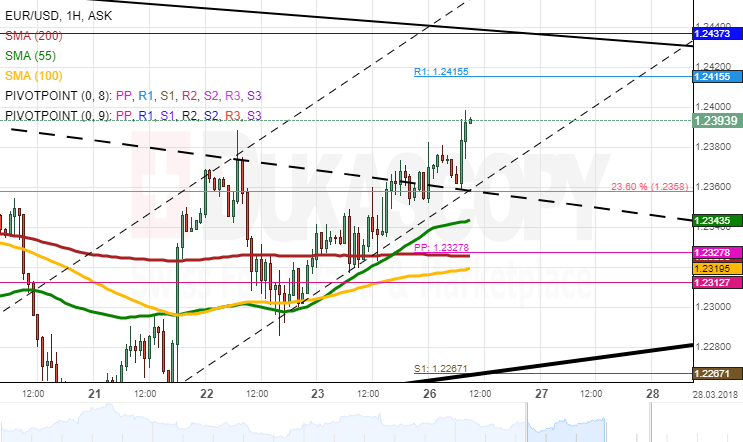
The strong support of the 200-hour SMA allowed the the Euro bulls to grow stronger during the second part of Friday.
Even though this up-move was not very significant, the pair did manage to breach its nearest resistance formed by the 23.60% Fibonacci retracement and a downward-sloping trend-line at 1.2360.
The Asian session showed no changes to the overall price level, as further advance is restricted by the weekly R1 at 1.2380.
Given that the prevailing trend-line was breached to the upside, it is likely that the Euro continues to appreciate against the US Dollar during the following session. This scenario is likewise supported by technical indicators. Gains could be capped near the monthly R1 and a channel line near the 1.2435 mark.
GBP/USD Analysis: Supported By 55-Hour SMA
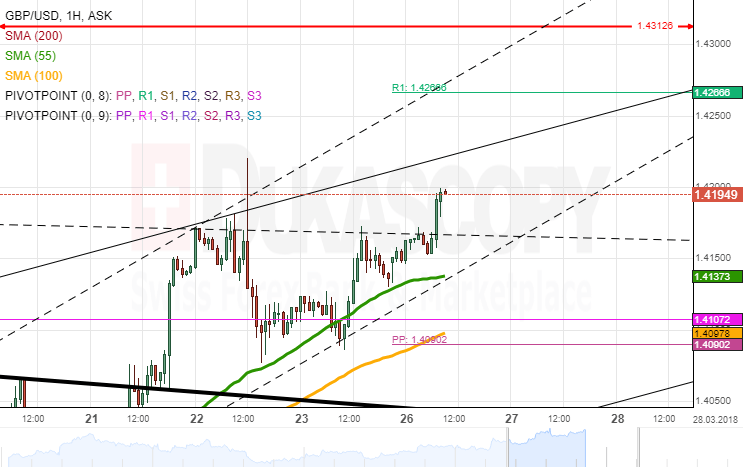
The minor period of consolidation which started on Thursday was not followed by a breakout of the 55-hour SMA near 1.41. Instead, the Pound gained upside momentum mid-Friday and pushed the rate above the 1.4150 mark.
It is likely that the same scenario occurs today. No significant fundamentals that could add some bearish pressure are scheduled for today. Thus, the Sterling should continue trading along the 55-hour moving average. The nearest resistance is set by a channel line or the monthly R2 near 1.4225 and 1.4300, respectively.
In case the 55-hour SMA is breached, losses should not exceed the 1.41 area where the 100-hour moving average is located.
USD/JPY Analysis: Points To Recovery
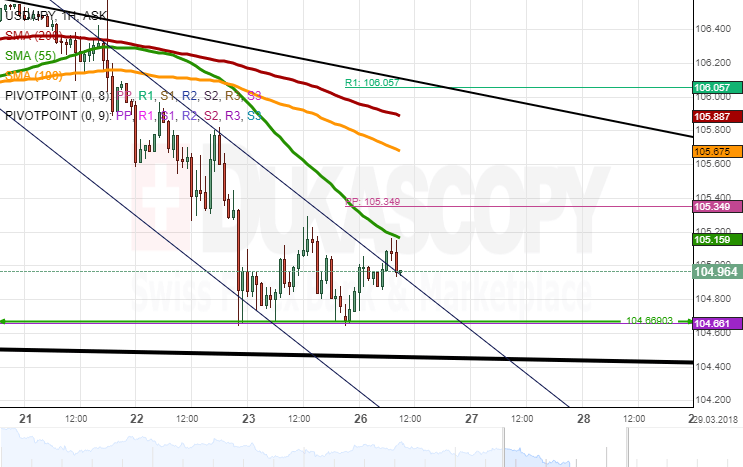
Following two consecutive sessions of decline, the US Dollar entered a period of consolidation on Friday.
Given that technical indicators are already showing signs of recovery, it is likely that the pair eventually manages to accelerate from the newly-formed 2017/2018 low of 104.67 and approach a trend-line located near 105.80. This yearly low is likewise reinforced by the monthly S1. In order to fulfil the aforementioned scenario, the pair still needs to overcome the 55-hour SMA.
Despite technical signals pointing to soon appreciation, the weakness of the US Dollar which could be driven by such global political developments as US tariffs on Chinese imports are likely to push the rate even lower past the bottom boundary of a long-term channel and towards the weekly S1 at 104.50 and 104.05, respectively.
Gold Analysis: Remains In Junior Channel
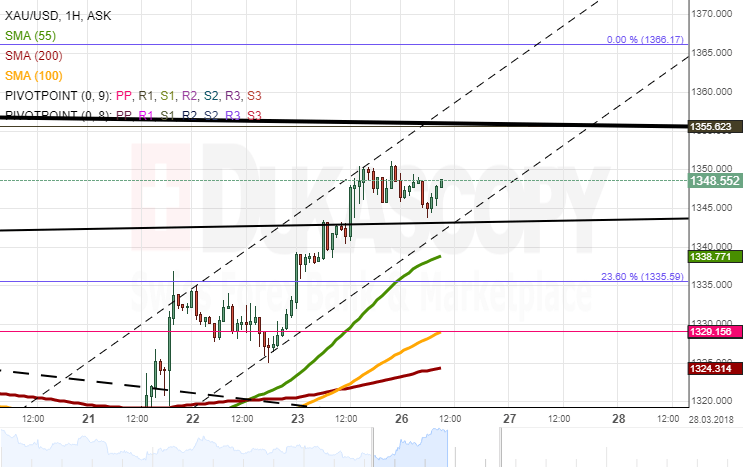
The yellow metal continues to trade in a five-day ascending channel against the US Dollar.
As apparent on the chart, the pair hindered near a medium-term channel at 1,345.00 during the first part of Friday. However, the prevalence of strong upside momentum mid-session allowed for a breakout of this pattern and further advance up to the 1,350.00 mark.
Gold has still fallen short from the senior channel located at 1,355.00. Thus, bulls might still manage to push towards this line.
Meanwhile, the rate has been trading sideways since mid-Friday. This shows that bulls could nevertheless be exhausted and therefore fail to reach the aforementioned area. A possible downside target for today is the 23.60% Fibonacci retracement and the 55-hour SMA near 1,335.00.
Intensive talks of Irish Border in Brexit negotiation starts
The UK and EU start intensive talks on the most troublesome topic in Brexit negotiation today, the Irish Border. Both sides agreed, back in December, on the principle of avoiding a hard border between Ireland and Northern Ireland. However, there are key differences on the way to fulfil this principle. And there seems to be no agreeable solution yet. The negotiation team will try to address areas like customs, food safety, animal health and regulations of goods and come up with something for next EU summit in June.
Last month, EU proposed a backstop option if there will be no solution on Irish border. And that is, Northern Ireland will remain in the customs union. But that was bluntly objected by UK Prime Minister Theresa May.
Brexit Secretary David Davis reiterated that position on Sunday. Davis said that while UK agreed to a "backstop", it will not be the one as proposed by the EU. He remained optimistic and said it's "overwhelmingly likely" to solve the problem in the context of a trade and customs agreement. And he added, "there are ways of dealing with this. You can't just say 'we haven't done it anywhere else' - we haven't attempted to do it anywhere else."
Dollar Recovers After Fresh 16-Month Low Versus Yen, Trade Woes Remain In Focus
Here are the latest developments in global markets:
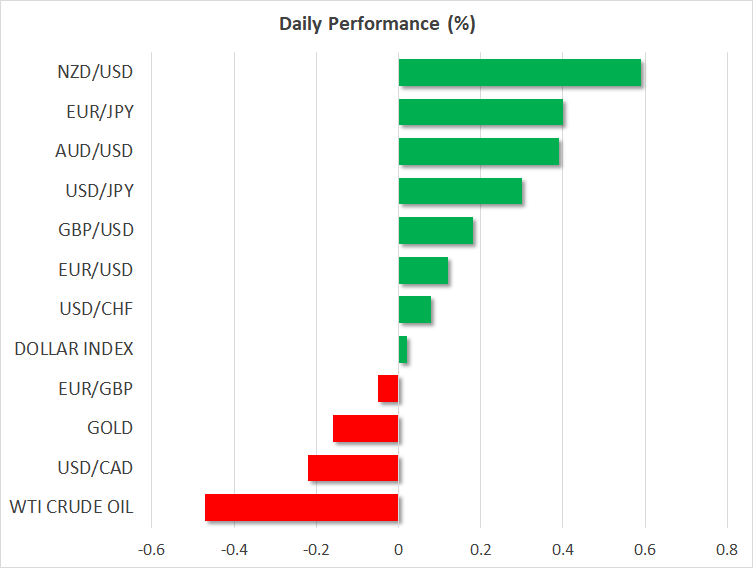
FOREX: The dollar was little changed versus a basket of currencies on Monday after previously recording a one-month low and coming under pressure versus the yen, with dollar/yen hitting a fresh 16-month low. The pair later recovered though to trade higher on the day.
STOCKS: US markets remained in a downward spiral on Friday, as concerns over a potential trade war continued to suppress risk appetite. The Nasdaq Composite was the biggest underperformer once more, plunging by 2.4%, while the S&P 500 and Dow Jones fell by 2.1% and 1.8% respectively. However, futures tracking the Dow, S&P and Nasdaq 100 are all currently well-into positive territory, signaling a higher open for these indices today. The shift in sentiment is likely owed to comments by Secretary Treasury Steven Mnuchin over the weekend that he is “cautiously hopeful” the US can reach an agreement with China soon and avoid implementing tariffs altogether. In Asia, Japan’s Nikkei 225 and Topix rose by 0.7% and 0.4% correspondingly, while in Hong Kong, the Hang Seng was higher as well but by less than 0.1%. In Europe, futures tracking most of the major indices were flashing green.
COMMODITIES: Oil prices were on the back foot on Monday, with WTI and Brent crude declining by a bit more than 0.4% and 0.3% respectively, both benchmarks giving back some of their notable gains from last week. The precious liquid was likely dragged lower by the broader risk aversion in markets. Oil seems to be caught at a crossroads at the moment, with diminished risk appetite weighing on the commodity, but speculation that fresh sanctions could be imposed on Iran soon supporting prices. In precious metals, gold fell 0.2% on Monday, last seen near the $1345 per ounce level, after having touched the $1350 resistance zone earlier during the Asian session. The yellow metal was one of the biggest outperformers last week, as the mounting worries over global trade finally started to support the safe-haven perceived asset.
Major movers: Dollar rebounds from one-month low to trade little changed; antipodeans gain as trade war fears recede somewhat
The dollar index was roughly flat at 89.46 at 0630 GMT after previously falling to as low as 89.35, a level last seen on February 20. The greenback faced pressure versus the yen, hitting a fresh 16-month low of 104.55 before managing to recover to trade higher by 0.3%, a few pips above the 105 handle.
Continuing concerns over a possible global trade war and rising political uncertainty in Japan on the back of a scandal acting to the detriment of Japanese PM Shinzo Abe’s popularity were seen as reasons for the yen’s rise earlier in the day, but also last week when dollar/yen lost more than 1%.
Abe’s policies are supportive of a weaker yen and him losing popularity is seen by some as a reason to place long yen positions in forex markets. In relation to the scandal troubling his administration, the former Japanese tax agency chief will be testifying before parliament on Tuesday.
US President Donald Trump’s move last week, pertaining to the imposition of tariffs on Chinese imports to the US, refueled the trade war narrative and led to volatility in currency and equity markets, with the latter posting notable losses as risk sentiment soured. Indicatively, the S&P 500 lost a whopping 6% in the week that preceded. However, South Korea winning an exemption from US steel tariffs, spurred some hopes that an outright trade war would be averted and helped risk appetite somewhat and with it commodity-linked currencies, including the aussie and the kiwi. Specifically, aussie/dollar and kiwi/dollar traded higher by 0.4% and 0.6%, at around 0.7730 and 0.7280 respectively – the latter having earlier recorded an 11-day high of 0.7284.
Elsewhere, euro/dollar was 0.1% up at 1.2364, with the eurozone’s four largest economies releasing March CPI figures as the week unfolds, while pound/dollar edged higher by 0.2%, trading at 1.4162; this compares to last week’s near two-month high of 1.4216.
Overall, the greenback was broadly weaker against other major currencies, besides the yen which was also losing considerable ground versus the euro and sterling.

Day ahead: Speeches by key policymakers and trade developments in the spotlight
There are no major data releases on the economic calendar today, but there are several speeches by key policymakers that could attract market attention. Any updates in the “trade war” narrative will also be closely followed.
In the UK, the Bank of England’s highly-influential chief economist and MPC member Andy Haldane will speak in Edinburgh, though the exact timing remains tentative. Following last week’s BoE meeting, where two other MPC members dissented and voted for a rate hike, markets will probably scrutinize Haldane’s comments for any signals regarding the likelihood of a hike at the May gathering. Investors have currently priced in a 60% probability for such an action, according to the UK overnight index swaps. Considering that Haldane is often viewed as a “centrist” policymaker, if he indicates his support for a May hike then markets could push that probability higher, and the British pound alongside it.
In the US, New York Fed President William Dudley (a permanent voting member within the FOMC) will speak on regulatory reform before the US Chamber of Commerce at 1630 GMT. Cleveland Fed President Loretta Mester (voter) and Fed Board Governor Randal Quarles (voter) will also deliver remarks at 2030 GMT and 2310 GMT respectively. Meanwhile in Europe, ECB Governing Council members Jens Weidmann and Ewald Nowotny will step up to the rostrum at 1030 GMT.
In equity markets, focus will probably remain on the possibility of a US-China trade war materializing. Secretary Mnuchin’s comments over the weekend that he is “cautiously hopeful” a deal can be reached with China seem to have turned sentiment around somewhat, at least according to futures tracking the major US indices. Any comments from the Trump administration – and of course by China – will bear close watching. Risk sentiment is highly fragile at the moment, and even a single headline could have major repercussions for price action.
Interestingly, both the S&P 500 and the Dow Jones closed slightly above their corresponding 200-day moving averages (MA) on Friday, and it will be crucial to see whether those levels hold today. A rebound from the 200-day MAs could signify some stabilization in these benchmarks, whereas a downside violation would probably open the way for the February lows in these indices.
In terms of second-tier economic data, the US Dallas Fed manufacturing index for March will be released at 1430 GMT, but this is usually not a major market mover.
Technical Analysis: Gold hits fresh one-month high, bearish signal by stochastics in very short-term though
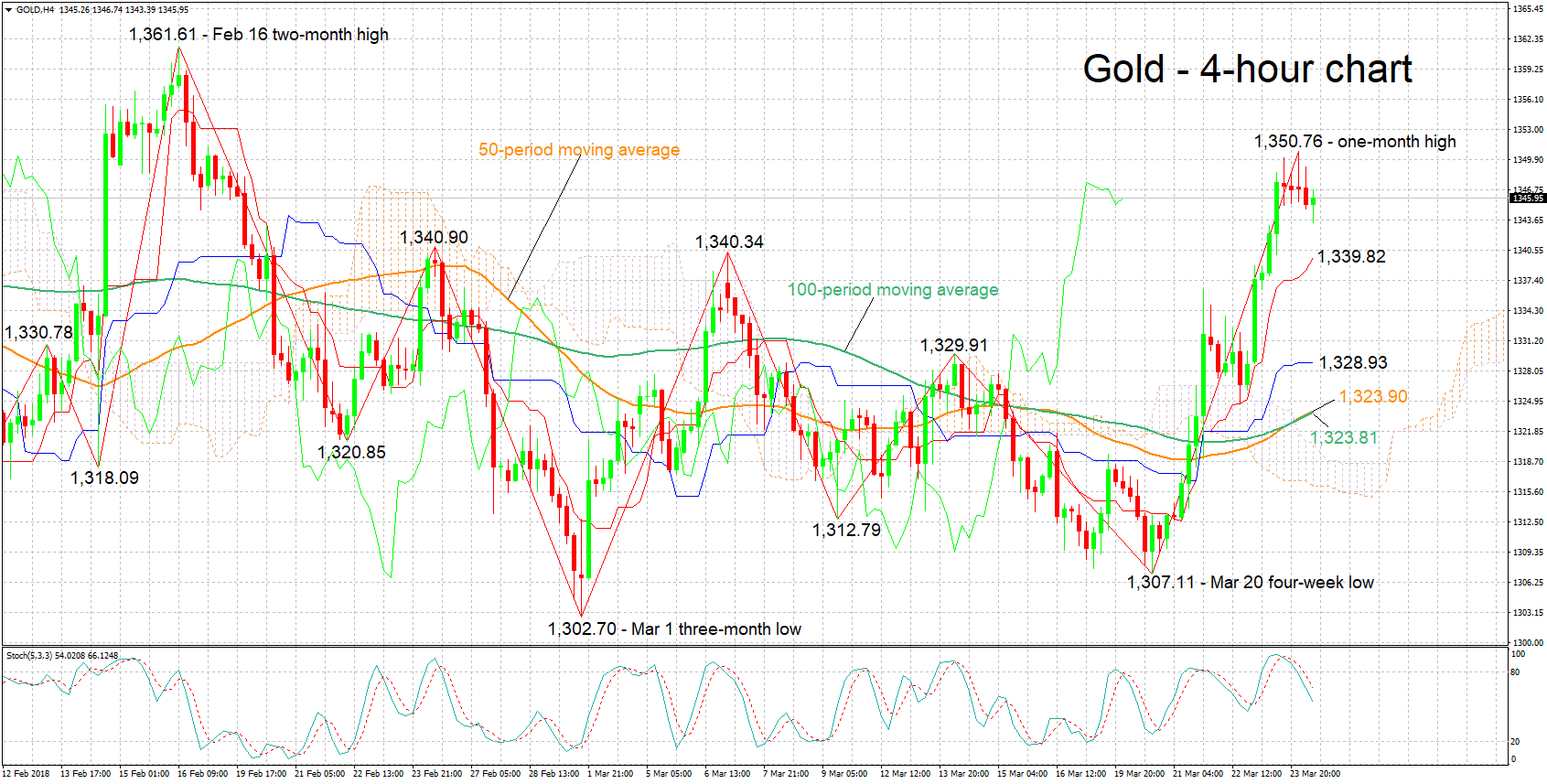
Gold posted notable gains in the week that preceded and reached a more than one-month high of 1,350.76 earlier on Monday. The Tenkan- and Kijun-sen lines are positively aligned in support of a bullish picture in the short-term for the precious metal, though the Kijun-sen has flatlined, suggesting that bullish momentum is losing steam. In addition, the stochastics are giving a bearish signal in the very short-term: the %K line has crossed below the slow %D one and both lines are heading lower.
Escalating tensions on the front of global trade have the capacity to lead to further gains for the safe-haven perceived asset, with resistance to advances potentially coming around the 1,350 handle which was somewhat congested in the past and which includes the more than one-month high from earlier in the day. An upside break off this area would increasingly turn the attention to the range around the two-month peak of 1,361.61 recorded around mid-February.
Abating fears over trade on the other hand are likely to reduce the precious metal’s attractiveness, potentially pushing it lower. The area around the 1,340 handle which encapsulates a couple of peaks from the recent past as well as the current level of the Tenkan-sen at 1,339.82 might act as support to price declines.
The direction of the greenback also can spur movements in the dollar-denominated commodity; a stronger greenback renders the metal less attractive to non-dollar holders and vice versa.
IMF Lagarde proposes “rainy-day fund” to Eurozone as “temporary cushion”
In a speech titled, "A Compass to Prosperity: The Next Steps of Euro Area Economic Integration", IMF managing director Christine Lagarde outlined her recommendations. She focused on three of the reform areas for Eurozone officials to consider in the review in the coming months. The ares include a modernized capital markets union, an improved banking union, and a move toward greater fiscal integration, starting with the creation of a central fiscal capacity.
In particular, she mentioned IMF's proposal of a "rainy-day fund" for building up assets in good times. During a downturn, countries could receive funding to help offset budget shortfalls. And, in extreme cases, " the fund would be allowed to borrow, however any borrowing would be repaid by members' future contributions." Though, she emphasized that " it will be a temporary cushion and not a permanent pillow."
The full speech is available here.
Technical Outlook: AUDUSD – Bears Take A Breather On US-China Talks, But Strong Bearish Bias Remains While 10SMA Stays...
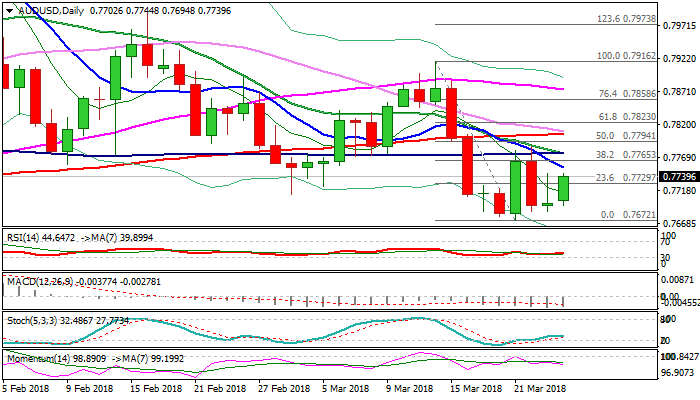
The Aussie dollar trades in recovery mode on Monday and is firmly above 0.77 handle, supported by news about US-China talks, which aim to improve current situation and prevent trade war. Positive results of talks could result in further recovery. However, techs remain firmly bearish and keep the downside at risk, which could intensify if recovery stalls under initial barrier at 0.7752 (falling 10SMA). Daily MA's are in firm bearish setup and formed multiple bear-crosses, marking a cluster of barriers between 0.7775 and 0.7810, reinforced by thick daily cloud base at 0.7817 and weighing heavily on near-term action. Additional pressure is coming from negative momentum studies (14-d momentum is heading south, deeply in negative territory). Unless stronger fundamentals boost the pair and sideline immediate bearish risk on lift above 10SMA, the pair may hold in extended but limited consolidation, before broader bears continue towards target at 0.7641 (weekly cloud base).
Res: 0.7752, 0.7775, 0.7809, 0.7817
Sup: 0.7695, 0.7686, 0.7672, 0.7641
Forex Technical Analysis: EUR/USD, USD/JPY, GBP/USD
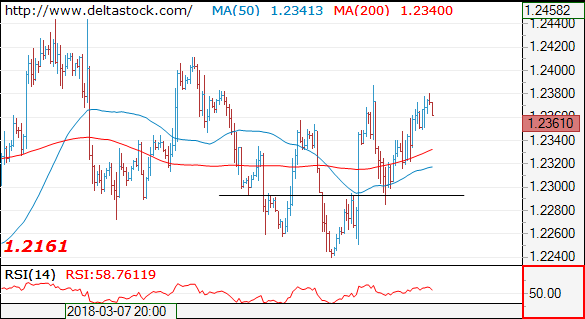
EUR/USD
Current level - 1.2361
The bias is positive, for a rise towards 1.2460 area. Initial support lies at 1.2290 area.
| Resistance | Support | ||
| intraday | intraweek | intraday | intraweek |
| 1.2390 | 1.2460 | 1.2290 | 1.2160 |
| 1.2460 | 1.2560 | 1.2240 | 1.2090 |
USD/JPY
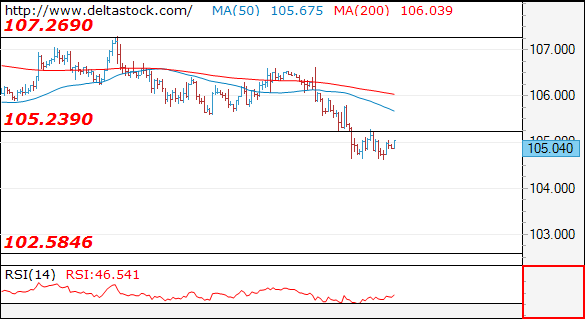
Current level - 105.04
My outlook here is bearish below 105.20, for a slide towards 104.30, en route to 103.40 area. Crucial on the senior frames is 106.60.
| Resistance | Support | ||
| intraday | intraweek | intraday | intraweek |
| 105.20 | 108.30 | 104.30 | 104.30 |
| 106.60 | 110.40 | 103.40 | 102.50 |
GBP/USD
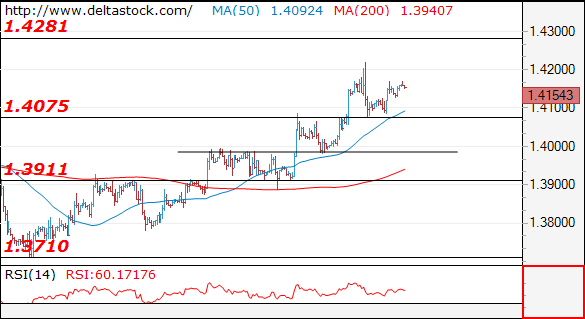
Current level - 1.4154
The failure at 1.4075 signals, that the uptrend is intact, heading towards 1.4280 Resistance. Only a break through 1.4075 support will signal a reversal and a slide towards 1.3910.
| Resistance | Support | ||
| intraday | intraweek | intraday | intraweek |
| 1.4220 | 1.4280 | 1.4075 | 1.3710 |
| 1.4280 | 1.4340 | 1.3910 | 1.3620 |
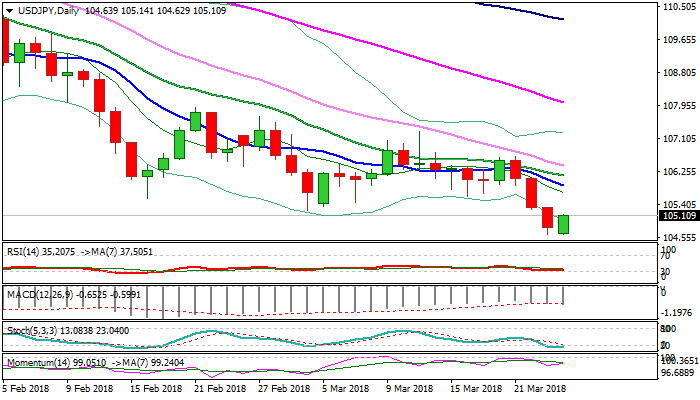
Technical Outlook: USDJPY May Hold In Extended Consolidation Before Bears Resume, Falling 10SMA Expected To Cap Upticks
The pair bounced back to 105 zone in late Asian / early European trading after starting the week with 20-pips gap-lower and retesting Friday’s low at 104.63 (the lowest since November 2016).
Positive sentiment for Japanese currency persists on growing fears about global trade war which sparked risk-off trading and increased demand for safe-haven assets, as well as political crisis in Japan, which could deepen as Japanese PM Abe is due to testify in parliament on Tuesday.
The pair generated bearish signal on Friday’s close below psychological 105 support, which could result in further fall on triggering a number stops parked below.
Bears could extend significantly if situation with US tariffs deteriorates and could retest 101.20 (09 Nov 2016 low) as no significant supports lay en-route.
Bearish daily / weekly techs support scenario, but bears may enter consolidation phase before continuing lower.
Probes above 105 face solid barrier at 105.24 (former low of 02 Mar), with extended upticks to be seen as positioning for fresh downside, while capped by falling 10SMA (105.90).
Immediate downside risk would be sidelined on break above 10SMA, however, lift and close above 30SMA (106.40) is needed to turn near-term bias to the upside.
Res: 105.24, 105.45, 105.60, 105.90
Sup: 104.63, 104.04, 103.68, 103.20