

Sample Category Title
XAUUSD Intraday Analysis
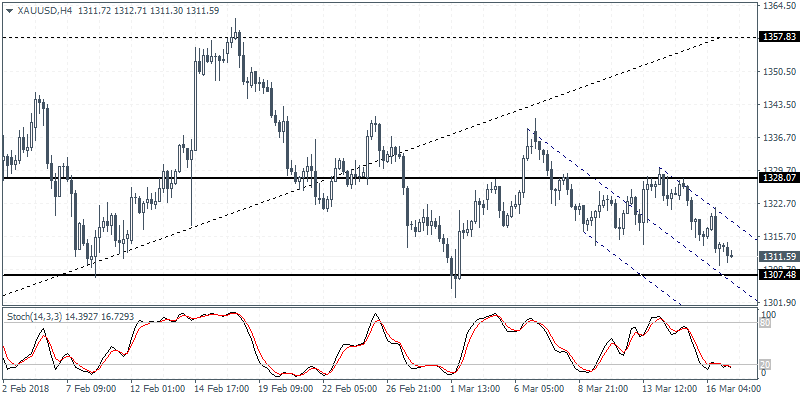
XAUUSD (1311.59): Gold prices were also seen closing the week lower but overall, the trend remains supported above 1307. Only a breakdown below this level could signal further declines toward 1282 - 1274 region. In the near term, the 4-hour chart shows a possible retest toward 1318 - 1317 level where short term resistance could be established. A reversal at this level could confirm the downside bias in gold targeting 1307 and eventually to the 1282 level of support.
GBPUSD Intraday Analysis
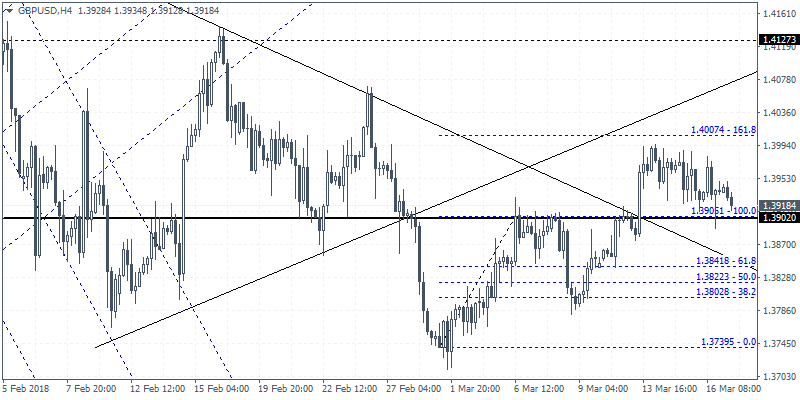
GBPUSD (1.3918): The British pound closed on Friday with the doji but price action was supported above the 1.3902 level of support. Although price action has failed to post any big gains above this level we expect the consolidation to continue in the short term. Any near-term dips could send the British pound to retest the 1.3902 level while to the upside the price area of 1.4000 could potentially be tested following the breakout after the bullish ascending triangle pattern
EURUSD Intraday Analysis
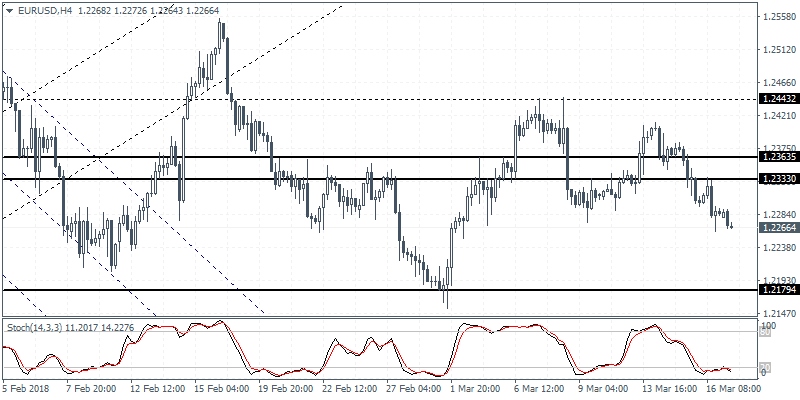
EURUSD (1.2266): The EURUSD was seen posting modest declines on Friday led by weaker than expected consumer prices. With the recent ECB speech from Draghi at the ECB Watchers conference, the central bank is expected to maintain a slow and steady pace when it comes to tapering. The ranging price action in EURUSD continues to play out with last week seeing the euro currency falling below the support zone of 1.2635 - 1.2333 area. We expect to see this level being re-tested once again for resistance while to the downside, the common currency could be seen extending the declines to 1.2179 level of support.
Slow Start Ahead Of A Busy Week
The markets get off to a slow start ahead of what could be an eventful week with the FOMC meeting due on Wednesday. The U.S. dollar was seen edging higher on Friday but only posted modest gains as investors brace for the Fed meeting this week.
On the economic front, data from the U.S. was somewhat mixed. Housing starts were seen rising at a slower pace of just 1.24 million compared to 1.33 million the month before. Building permits were somewhat better, rising 1.30 million. Industrial production figures released on Friday surged 1.1% beating estimates of 0.3% and reversing the revised 0.3% declines from the month before.
Data from the Eurozone showed that headline consumer prices rose only 1.1% missing estimates of 1.2% increase.
Looking ahead, Italy's industrial production and trade balance figures are coming up today amid a quiet trading day. The G-20 meetings are due. Other major factors coming up include the Brexit talks due on 22 March where Britain is hoping to clinch a transitory deal.
Sterling performing well, GBP/CHF with solid upside bias
Sterling doing rather well today with GBP/CHF, GBP/NZD and GBP/AUD topping the daily top mover table. These three pairs are also the top 10 movers in the 4 hour and monthly period.
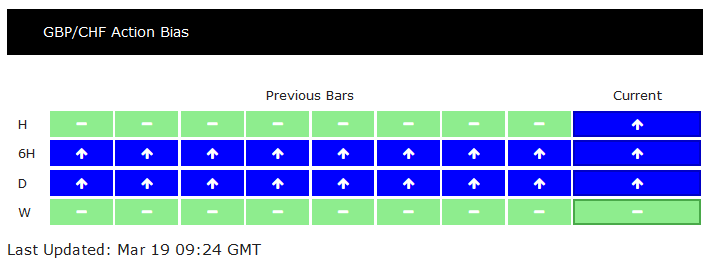
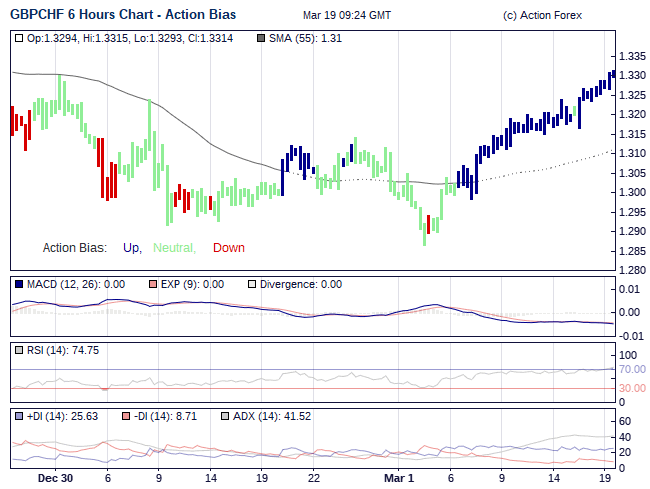
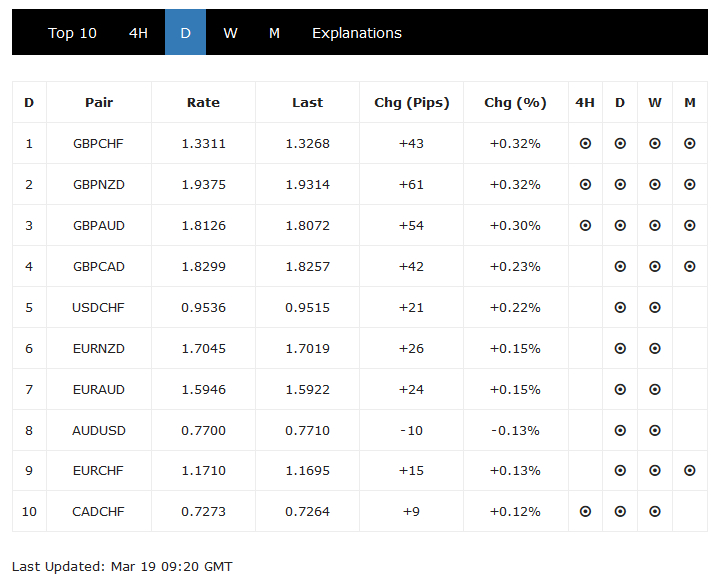 Upside momentum in GBP/CHF is quite clear as seen in 6H action bias chart.
Gold Remains Bearish As Recent Bounce Runs Out Of Steam
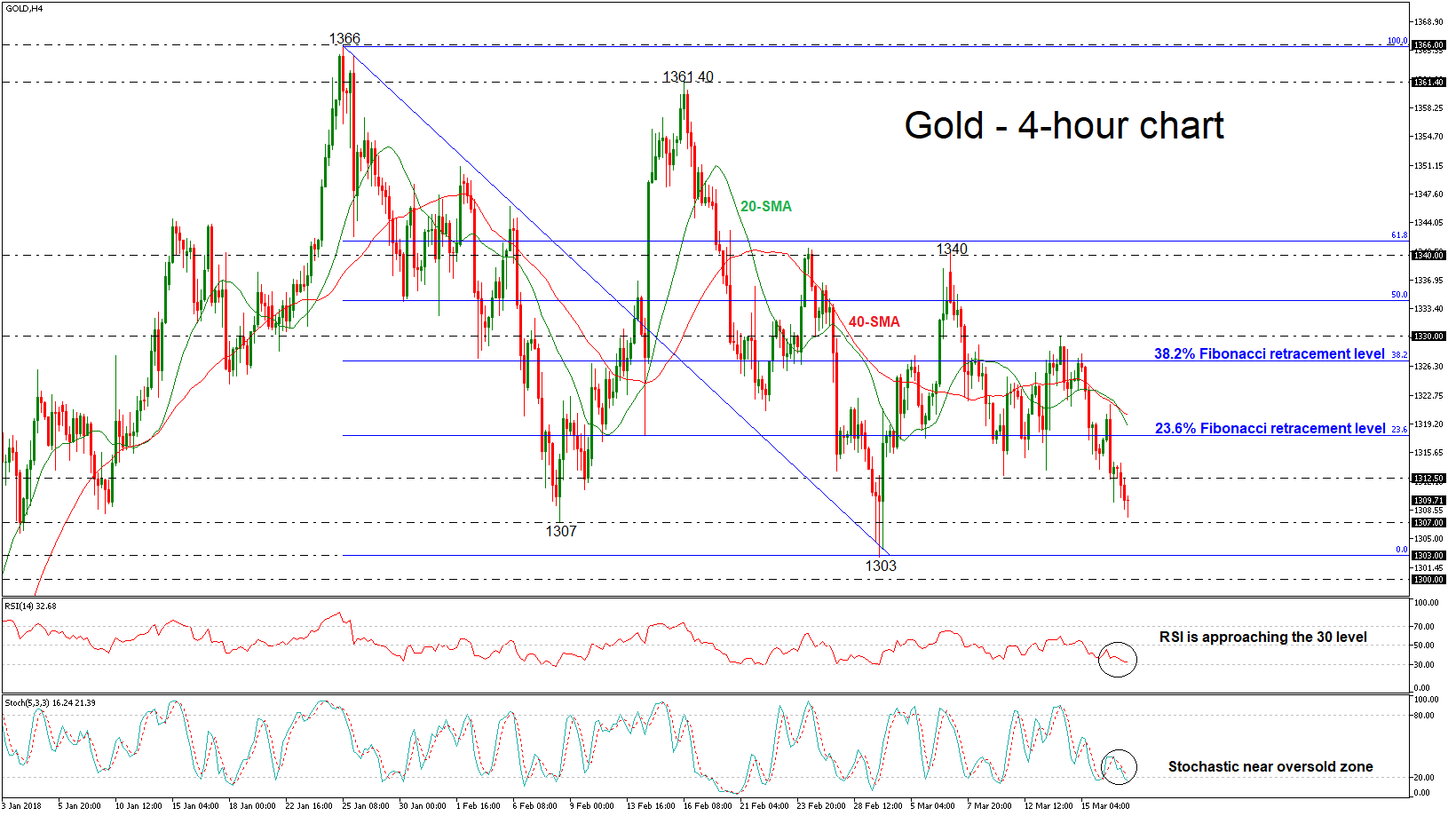
Gold has been underperforming in the past three days, breaking back below the key level of 1312.50. When looking at the bigger picture the precious metal lacks a clear trend, while in the short-term, technical indicators support a bearish structure.
In the 4-hour chart, momentum indicators are pointing to a negative bias with the RSI indicator approaching the 30 level and the oversold zone. Moreover, stochastics are heading downwards to reach oversold levels, with the bearish cross between the %K the %D line suggesting a decline. The 20-simple moving average (SMA) has also posted a bearish crossover with the 40-SMA, following the negative bias of the price.
Further losses could see the March 1 low of 1303 acting as a major support level. A drop below the aforementioned level could reinforce the bearish movement in the short-term, opening the way towards the next key handle of 1300.
In the event of an upside reversal, a climb above the 1312.50 resistance level could open the door to the 23.6% Fibonacci retracement level of 1318 of the downleg from 1366 to 1303. A break above this level could lead the way towards the 38.2% Fibonacci mark of 1327.
Japanese Politics Boost The Yen, G20 Gathering Kicks Off Busy Week
Here are the latest developments in global markets:
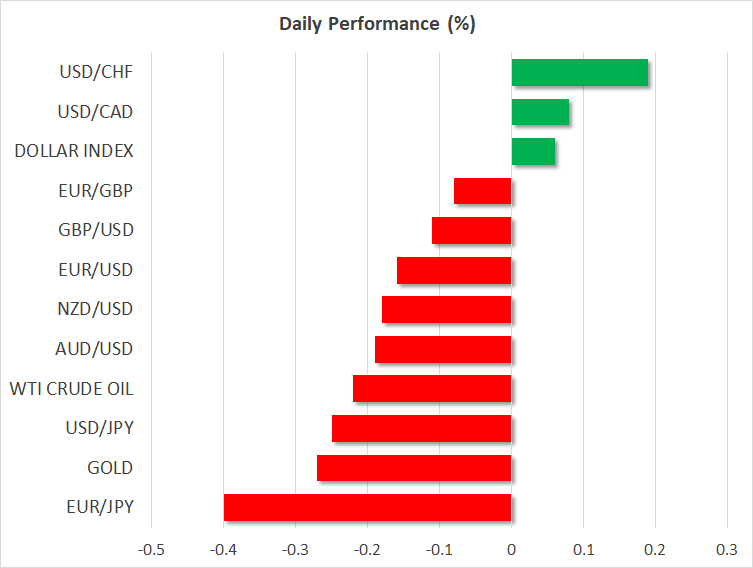
FOREX: The US currency traded less than 0.1% higher versus a basket of currencies on Monday, though it was losing ground versus the yen as those promoting weaker-yen policies were seen as losing public support in Japan.
STOCKS: US markets closed mostly higher on Friday, with the Dow Jones and the S&P 500 advancing by 0.3% and 0.2% respectively, while the Nasdaq Composite was practically flat on the day. Futures tracking the Dow, S&P, and Nasdaq 100 are all currently flashing red though, pointing to a negative open today. In Japan, the Nikkei 225 and the Topix fell by 0.9% and 1.0% correspondingly, as the surge in the yen and the elevated political uncertainty in Japan continued to undermine sentiment in equity markets. In Hong Kong, the Hang Seng traded higher by 0.1%, while in Europe, futures tracking all the major indices are well into negative territory, suggesting these benchmarks are likely to open lower.
COMMODITIES: Oil prices started the week on a soft note, with WTI crude and Brent both declining by 0.2% and giving back some of the significant gains they posted on Friday. While there was no clear fundamental catalyst behind Friday’s move, media reports attributed the surge to political tensions in the Middle East that threaten to disrupt oil production. In precious metals, gold prices fell by around 0.3% on Monday, extending losses from Friday owed to a recovering US dollar. Since gold is denominated in dollars, a strengthening greenback makes the metal appear less attractive for investors using foreign currencies.
Major movers: Yen strengthens as Abe is seen to weaken; commodity currencies hit fresh lows versus the greenback
The dollar index was slightly higher at 90.31, not far below Friday’s near three-week high of 90.38 achieved on the back of upbeat data, including surging industrial production in February. The Federal Reserve meeting, that concludes on Wednesday and during which the delivery of a 25 bps interest rate hike is widely expected, is anticipated to give direction to the US currency, at least in the short-term. Any developments on trade are also likely to lead to positioning on the dollar. Treasury yields in both the short- and long-end of the curve were on the rise on Monday, rendering the greenback more attractive.
Given that the delivery of a rate hike is seen as a done deal on Wednesday, the focus is on whether FOMC policymakers will revise their projections for the total number of interest rate rises to four in 2018, from the previous three. New Fed chief Jerome Powell’s press conference upon completion of the meeting will also be attracting interest.
Weekend polls showing declining support for Japanese Prime Minister Shinzo Abe’s government, which has been supporting weaker-yen policies, led to a strengthening Japanese currency. Dollar/yen was 0.25% lower at 105.74, getting closer to the 16-month low of 105.23 that was recorded in early March. Euro/yen traded 0.40% down at 129.73. This compares to last Thursday’s seven-month low of 129.33.
Euro/dollar and pound/dollar were retreating, albeit not by much, trading lower by around 0.2% and 0.1% respectively at 0732 GMT. The former, which came under pressure on the back of a slew of dovish-perceived comments by ECB policymakers over the last couple of weeks, recorded a two-week low of 1.2256 earlier on Monday. Sterling is expected to be driven by Brexit developments this week but also data releases – including on inflation – and the Bank of England meeting on Thursday.
Commodity-linked currencies were losing ground versus the greenback. Dollar/loonie was 0.1% higher, recording a fresh nine-month high of 1.3122. The Canadian dollar has been suffering recently on worries the US will walk away from NAFTA, some dovish-interpreted comments by the Governor of the Bank of Canada, as well as on the back of soft housing data last week. Aussie/dollar and kiwi/dollar were both down by 0.2%, with the former hitting a three-month low of 0.7684 and the latter a near three-week low of 0.7194, as increasing concerns over a potential trade war took their toll on these trade-sensitive currencies.
Day ahead: G20 meeting the first event in a packed week
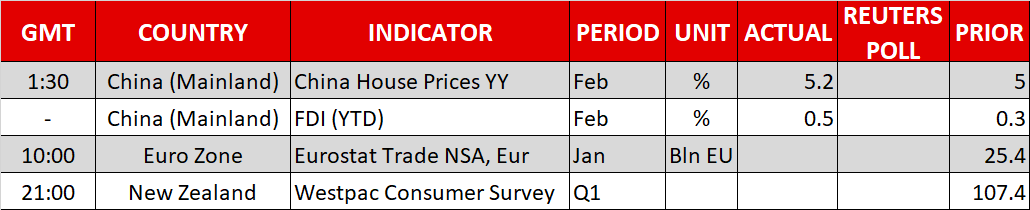
The economic calendar is almost empty in terms of data releases today, but the G20 meeting in Argentina should provide ample of headlines to keep traders busy.
The finance ministers of the Group of 20 nations will commence a two-day meeting today in Buenos Aires. While such meetings are typically not major events for the foreign exchange market, this time may well be different, as the finance leaders are expected to discuss the outlook for free trade in light of the protectionist policies of the Trump administration. Any comments from the various ministers will be closely tracked, especially those from the US delegation, headed by Treasury Secretary Mnuchin. If the broader message from the G20 is one that reaffirms their commitment to resist protectionism, some trade concerns could dissipate. In such case, the aussie, the kiwi, and stock markets could recover, while safe havens like the yen may tumble. On the contrary, if the US delegation for example appears committed to introducing new tariffs on China soon, trade woes could remain in the spotlight. In this scenario, the market reactions that ensue may be a lower aussie and stocks, while safe assets such as the JPY could extend their recent gains.
The only data release that could attract some attention is eurozone’s trade balance for January, due out at 1000 GMT, though this is usually not a major market mover for the euro.
In terms of policymakers’ appearances, there are three on the agenda. In the US, Atlanta Fed President Raphael Bostic will deliver remarks at 1340 GMT, while in the eurozone, ECB Executive Board member Yves Mersch will step up to the rostrum at 1800 GMT. Considering that we are currently in the Fed’s “blackout” period though, ahead of the rate decision on Wednesday, Bostic is not anticipated to touch on monetary policy. Norges Bank Governor Oystein Olsen will also be giving a speech at 1600 GMT.
The rest of the week looks much more interesting, with three major central bank meetings, an EU summit, as well as a raft of key economic data due to be released, mostly from the UK. The Fed will announce its policy decision on Wednesday, and since a 25bps rate hike is already fully priced in, focus may be on whether or not policymakers will upgrade their rate path projections to signal four rate hikes in 2018, from three currently. A few hours after the Fed, the Reserve Bank of New Zealand (RBNZ) is expected to keep its policy unchanged. Then on Thursday, focus will turn to the Bank of England (BoE), where investors will be looking for signals regarding the likelihood of a rate hike in May. Besides the BoE on Thursday, sterling traders will also concentrate on the outcome of the EU summit, where EU leaders are anticipated to approve a transitional Brexit deal for the UK.
Technical Analysis: Gold posts near 3-week low; bearish in the short-term
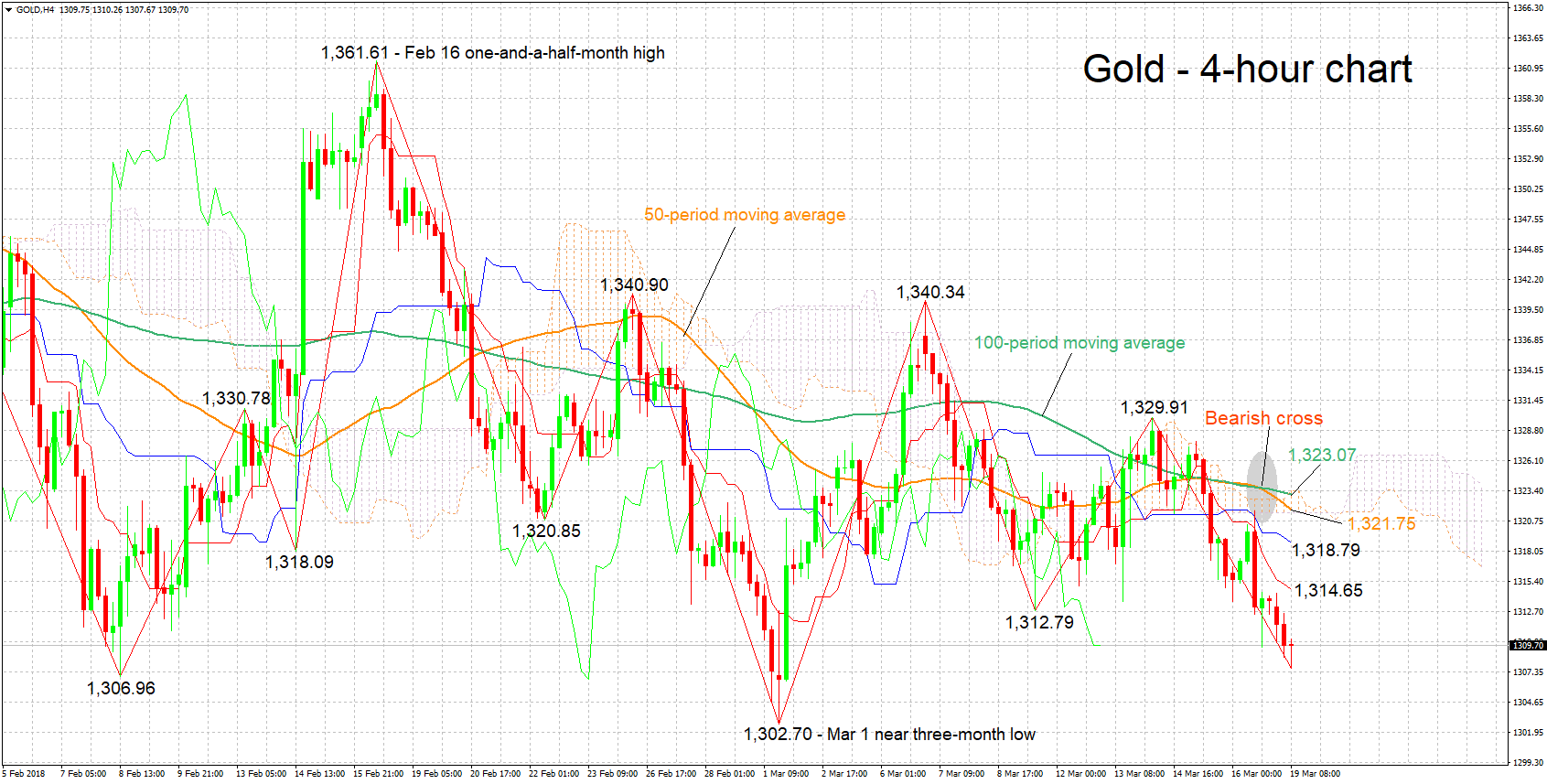
Gold has declined after hitting a near two-week high of 1,329.91 last week, eventually posting an 18-day low of 1,307.67 earlier on Monday. The negatively aligned Tenkan- and Kijun-sen lines are projecting a bearish short-term picture for the precious metal.
If the US currency weakens, then the dollar-denominated metal could post some gains. Resistance to price advances might come around the current level of the Tenkan-sen at 1,314.65; a previous bottom at 1,312.79 is also part of the area around this level.
A stronger greenback on the other hand is likely to lead to losses for gold, with the range around the near three-month low of 1,302.70 from March 1 potentially providing support to price declines.
Rising or receding risks over global trade also have the capacity to offer direction to the safe-haven perceived asset.
Technical Outlook: GBPUSD Looks For Signal To Break Out Of Tight Range Between Daily MA’s And Cloud Top
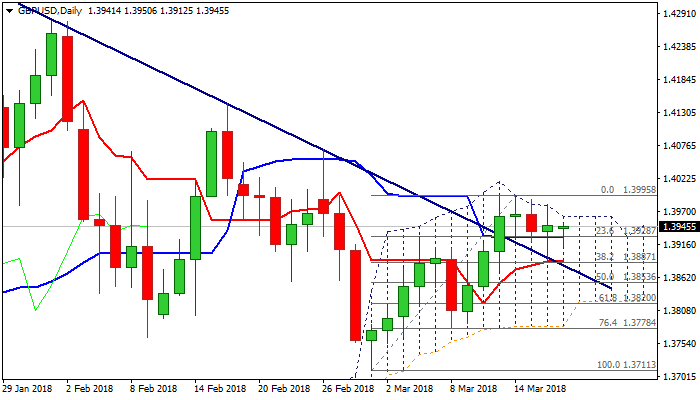
Cable holds within tight range on Monday, capped by descending cloud top (1.3961) but near-term action is supported by converged daily MA's (10/20/30) at 1.3900 zone and forming bull-crosses.
Rising 55SMA (1.3888) continues to underpin after containing Friday's dips and is reinforced by broken bear-trendline off1.4345 peak.
Bullish setup of daily MA's and fresh bullish momentum building, support the action for final break through pivotal 1.40 resistance zone, after several rejections last week, to signal continuation of recovery leg from 1.3711 (01 Mar low).
Close above daily cloud, following four consecutive rejections, will be strong bullish signal for extension towards 1.4070 (26 Feb high) and 1.4102 (Fibo 61.8% of 1.4345/1.3711 descend).
Bearish scenario requires close below 55SMA to signal top and spark fresh weakness.
Key releases for sterling this week (inflation on Tuesday and labor data on Wednesday) along with FOMC rate decision , are expected to generate fresh direction signals.
Res: 1.3961, 1.4000, 1.4028, 1.4070
Sup: 1.3900, 1.3888, 1.3853, 1.3820
ECB Knot confident on inflation, Villeroy de Galhau on path to normalization
Some comments from ECB officials.
Klaas Knot, ECB Governing Council member and President of the Dutch central bank, said "Inflation has been fairly stable so that provides me with a high degree confidence that actually inflation will pick up and will at some point approach the definition of price stability."
Francois Villeroy de Galhau, ECB Governing Council member and Bank of France Governor, said "we are making progress on the inflation front... although a bit slower than we had expected." And, "our policy is on a path to normalization."
ECB Governing Council member and Bundesbank President Jens Weidmann said in a German newspaper interview that "I personally think that the good economic developments and the inflation forecast would allow a rapid end to the bond purchases.
EU called urgent meeting on Brexit
It's reported, with unnamed sources quoted, that EU officials called an urgent meeting regrading Brexit. It's believed that there could be certain decisions made regarding the transition deal ahead of the EU summit later this week. Meanwhile, UK Brexit Secretary David Davis will also meet with EU chief negotiator Michel Barnier.