

Sample Category Title
Elliott Wave Analysis: USDCHF More Upside While Above 0.942
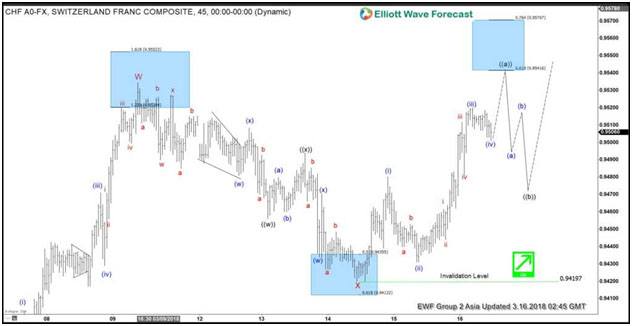
USDCHF Elliott Wave view suggests that the rally from 3.5.2018 low (0.9336) is unfolding as a double three Elliott Wave structure where Minor wave W ended at 0.9535. Below from here, Minor wave X ended at 0.942 and the internal subdivision unfolded as a smaller degree double three Elliott Wave structure. Down from 0.9535, Minute wave ((w)) ended at 0.9456, Minute wave ((x)) ended at 0.9494, and Minute wave ((y)) of X ended at 0.942. Minor wave Y is currently in progress as a zigzag Elliott Wave structure where Minute wave ((a)) should end with 1 more leg higher towards 0.954 – 0.957.
A zigzag is a 5-3-5 Elliott Wave structure. The first leg of this zigzag, Minute wave ((a)), subdivides into a 5 waves impulse Elliott Wave structure. From Minor wave X low (0.942), rally to 0.948 ended Minutte wave (i), Minutte wave (ii) ended at 0.9431, Minutte wave (iii) ended at 0.952, and Minutte wave (iv) appears complete at 0.95. Near term, expect 1 more leg higher in Minutte wave (v) towards 0.954 – 0.957 area to end Minute wave ((a)) zigzag of the higher degree. Pair should then pullback in Minute wave ((b)) in 3, 7, or 11 swing to correct cycle from 3/14 low. As far as pivot at 3/14 (0.942) is holding during the dips, pair should resume the rally to new high above Minor wave W at 0.9535.
USDCHF 1 Hour Elliott Wave Chart
EUR/USD Daily Outlook
Daily Pivots: (S1) 1.2274; (P) 1.2329 (R1) 1.2358; More....
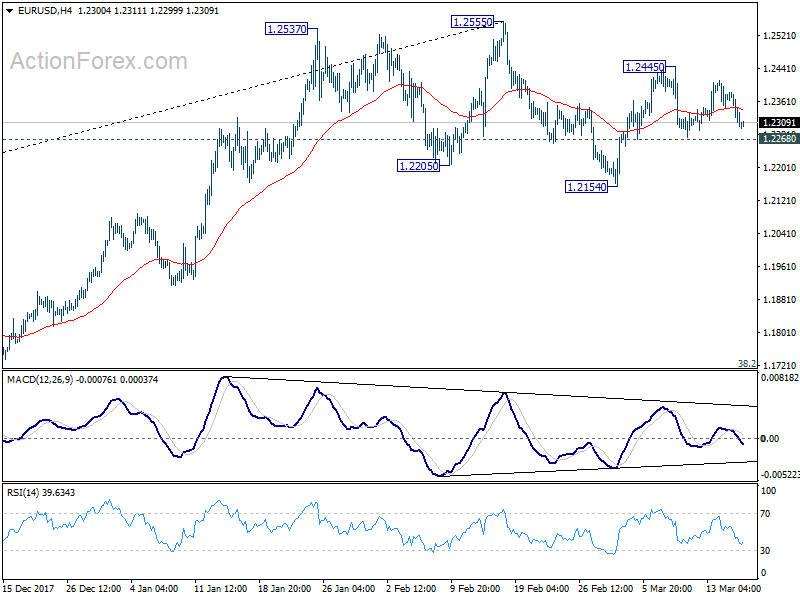
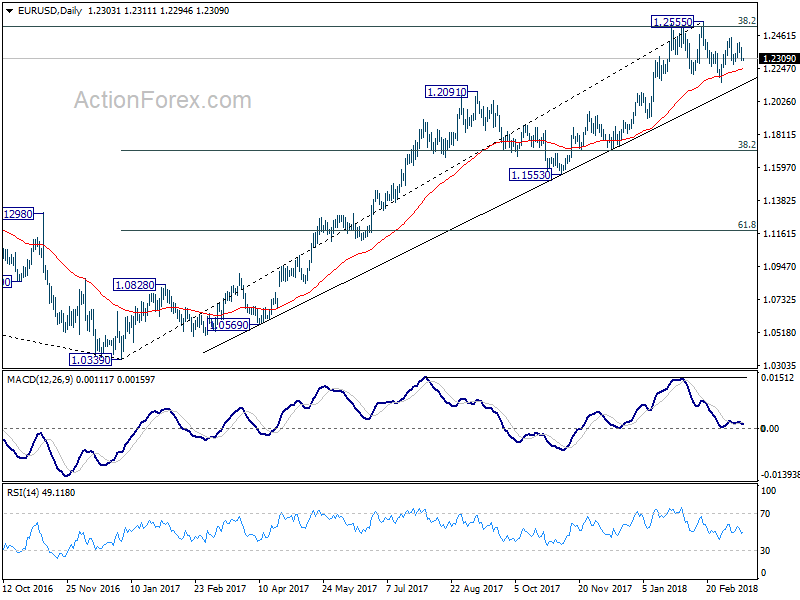
Intraday bias in EUR/USD remains neutral as range trading continues. On the upside, break of 1.2445 will target a test on 1.2555 high. Decisive break there will resume medium term rally and carry larger bullish implication. But again, break of 1.2268 will argue that fall from 1.2555 is resuming. And intraday bias will be turned back to the downside for 1.2154 support and below.
In the bigger picture, key fibonacci level at 38.2% retracement of 1.6039 (2008 high) to 1.0339 (2017 low) at 1.2516 remains intact despite attempts to break. Hence, rise from 1.0339 medium term bottom is still seen as a corrective move for the moment. Rejection from 1.2516 will maintain long term bearish outlook and keep the case for retesting 1.0039 alive. Firm break of 1.1553 support will add more medium term bearishness. However, sustained break of 1.2516 will carry larger bullish implication and target 61.8% retracement of 1.6039 to 1.0339 at 1.3862.
GBP/USD Daily Outlook
Daily Pivots: (S1) 1.3907; (P) 1.3948; (R1) 1.3975; More....
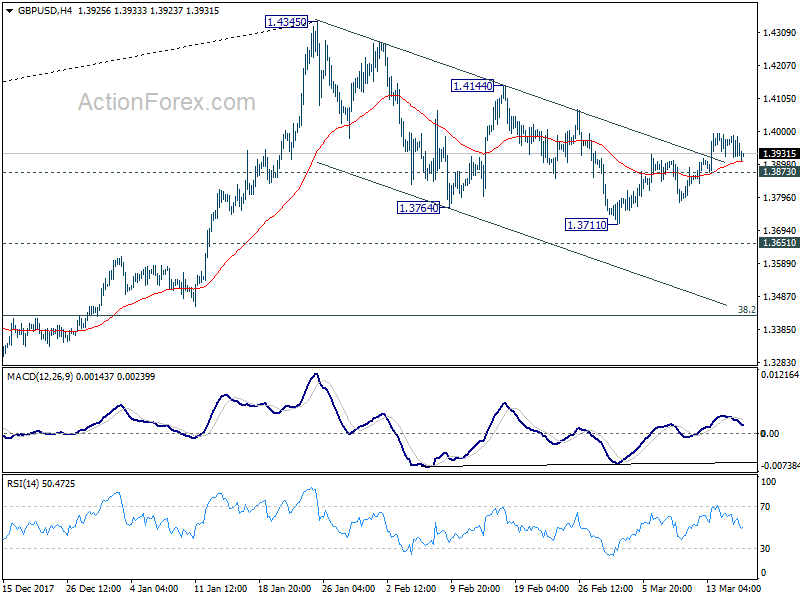
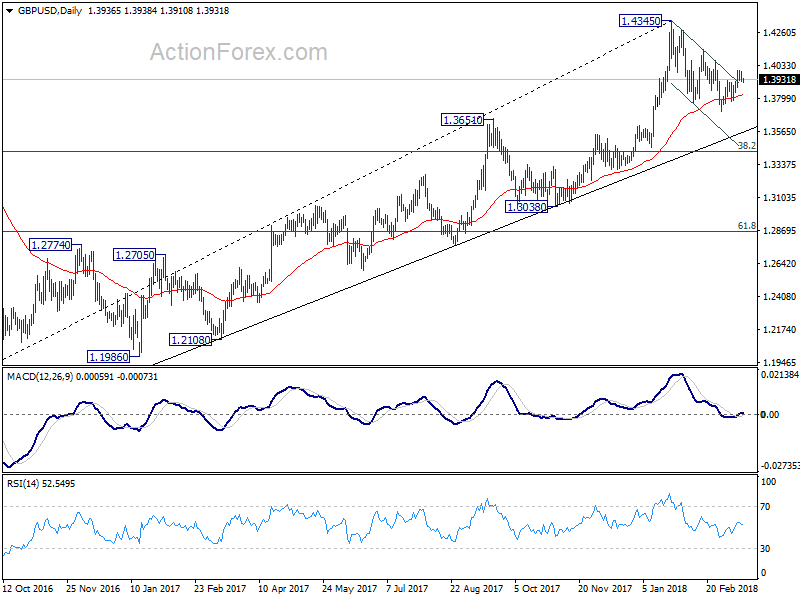
At this point, with 1.3873 minor support intact, further rise is still in favor in GBP/USD for 1.4144 resistance. Break there will confirm completion of correction from 1.4345 and target retest of this high. On the downside, below 1.3873 minor support will turn bias to the downside to extend the corrective fall from 1.4345 instead.
In the bigger picture, as long as 1.3038 support holds, medium term outlook in GBP/USD will remains bullish. Rise from 1.1946 is at least correcting the long term down from 2007 high at 2.1161. Further rally would be seen back to 38.2% retracement of 2.1161 (2007 high) to 1.1946 (2016 low) at 1.5466. However, GBP/USD fails to sustain above 55 month EMA (now at 1.4259) so far. Break of 1.3038 support, will suggest that rise from 1.1946 has completed and will turn outlook bearish for retesting this low.
USD/CHF Daily Outlook
Daily Pivots: (S1) 0.9458; (P) 0.9488; (R1) 0.9544; More...
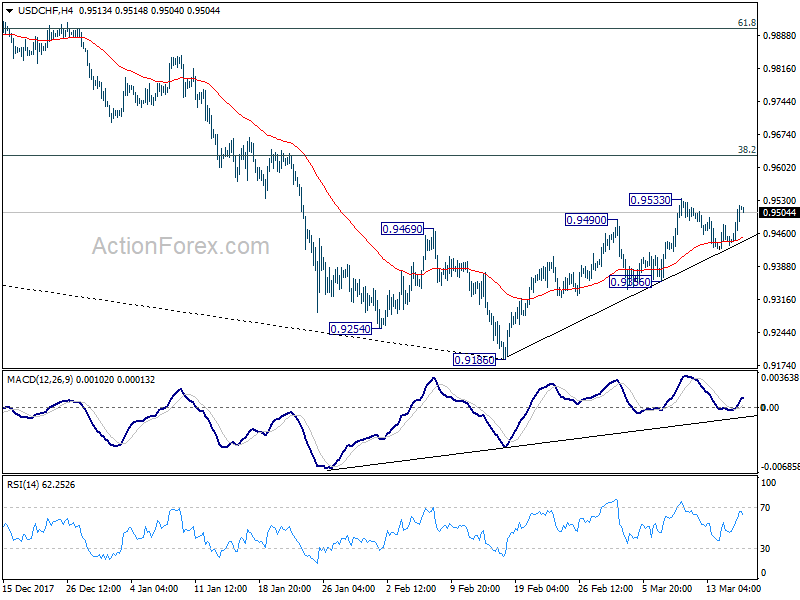
USD/CHF is staying in range below 0.9533 temporary top and intraday bias remains neutral first. Further rise is in favor as long as 0.9356 support holds. Break of 0.9533 will resume the rebound from 0.9186 and target 0.9626 fibonacci level. However, on the downside, break of 0.9356 will indicate that the rebound has completed. In such case, intraday bias will be turned back to the downside for retesting 0.9186 low.
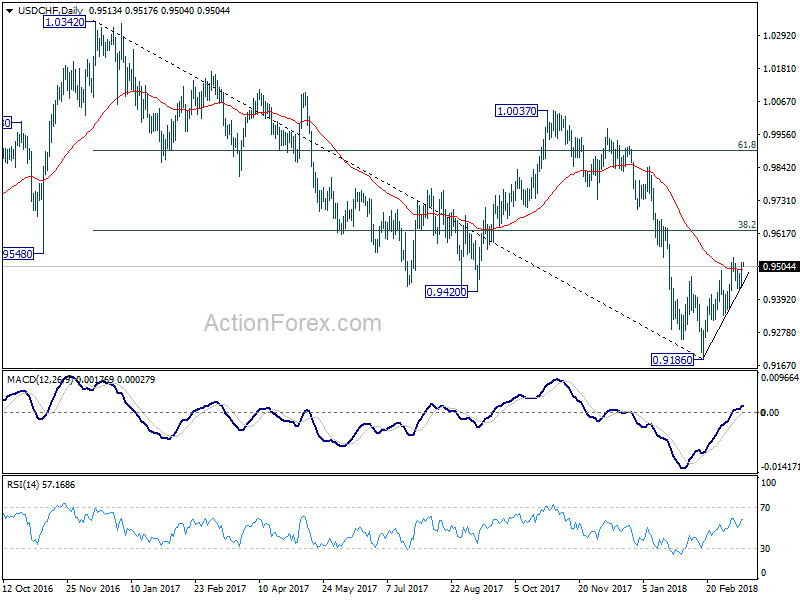
In the bigger picture, fall from 1.0342 is seen as a medium term down trend. Current development is raising the chance that it is completed. But there is no confirmation yet. Focus will now be back on 38.2% retracement of 1.0342 (2016 high) to 0.9186 (2018 low) at 0.9626. Sustained break there will add much credence to the case of trend reversal and target 61.8% retracement at 0.9900 and above). However, rejection from 0.9626 will maintain medium term bearishness for another low below 0.9186.
USD/JPY Daily Outlook
Daily Pivots: (S1) 105.94; (P) 106.17; (R1) 106.57; More...
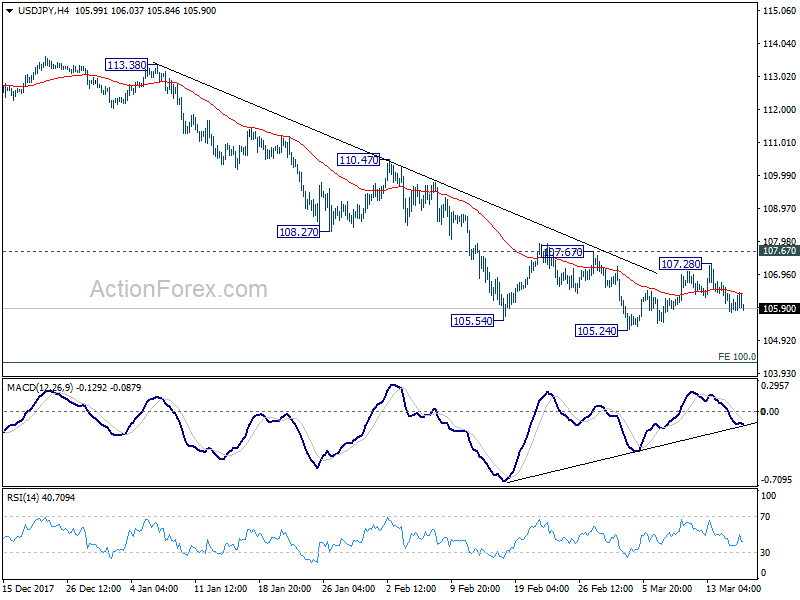
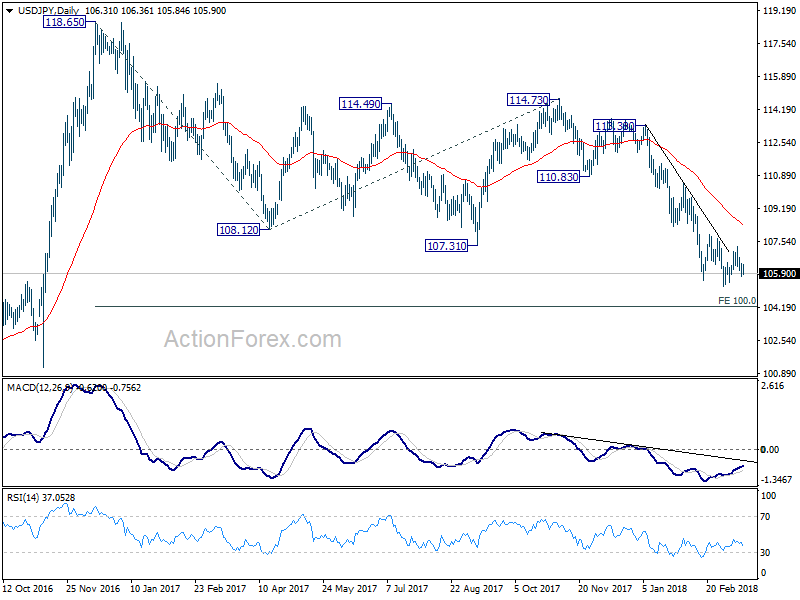
At this point, USD/JPY is still bounded in range of 105.24/107.67 and intraday bias remains neutral. After all, near term outlook remains bearish with 107.67 resistance intact. And deeper decline is in favor. On the downside, break of 105.24 will resume larger decline from 118.65 and target 100% projection of 118.65 to 108.12 from 114.73 at 104.20 next. On the upside, firm break of 107.67 resistance will indicate near term reversal, on bullish convergence condition in 4 hour MACD. In such case, outlook will be turned bullish for 110.47 resistance next.
In the bigger picture, current development argues that the corrective pattern from 118.65 is extending. The solid break of 61.8% retracement of 98.97 to 118.65 at 106.48 now suggests that the pattern from 125.85 high is possibly extending. Deeper fall could be seen through 98.97 key support (2016 low). This bearish case will now be favored as long as 110.47 resistance holds.
USD/CAD Daily Outlook
Daily Pivots: (S1) 1.2975; (P) 1.3021; (R1) 1.3099; More....
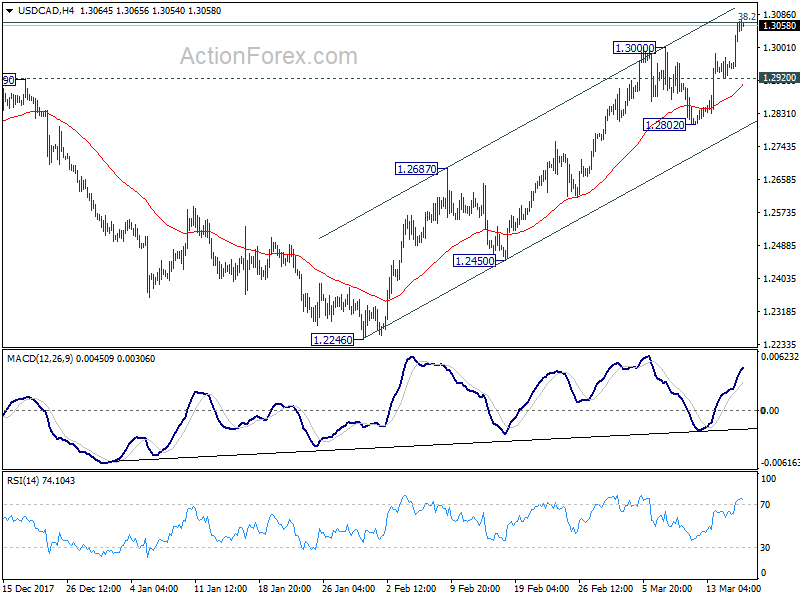
USD/CAD surges to as high as 1.3071 so far and met 1.3065 medium term fibonacci level. Intraday bias remains on the upside. Sustained trading above 1.306 will pave the way to next fibonacci level at 1.3685. On the downside, below 1.2920 minor support will turn bias neutral first. But near term outlook will stay bullish as long as 1.2802 support holds.
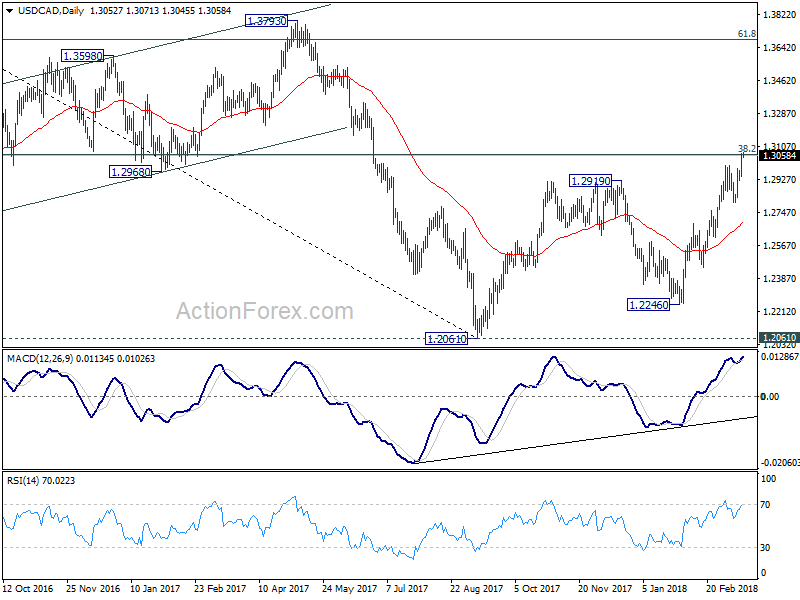
In the bigger picture, we're favoring the medium term bullish case. That is larger down trend from 1.4689 has completed at 1.2061, drawing support from 50% retracement of 0.9406 (2011 low) to 1.4689 (2015 high) at 1.2048. Further rally should be seen back to 38.2% retracement of 1.4689 to 1.2061 at 1.3065 first. Break will target 61.8% retracement at 1.3685. This will be the preferred case now as long as 1.2687 support holds.
AUD/USD Daily Outlook
Daily Pivots: (S1) 0.7766; (P) 0.7825; (R1) 0.7856; More...
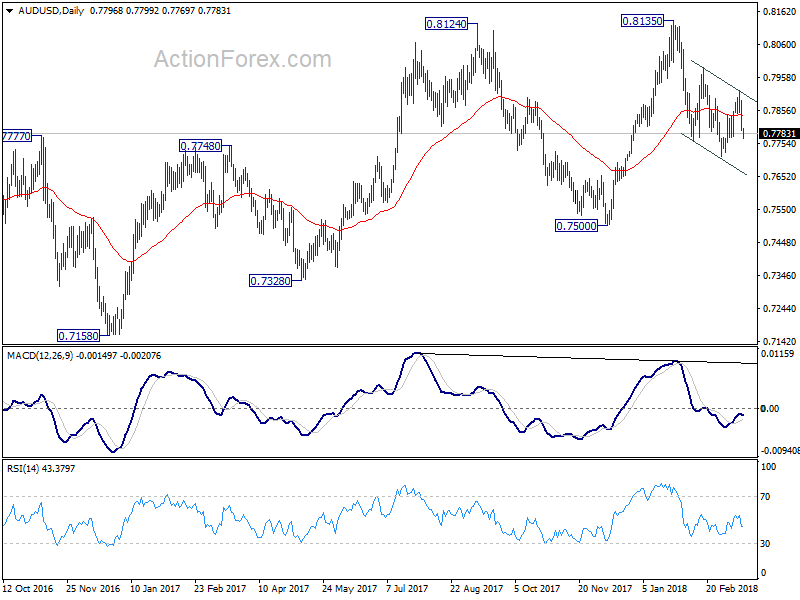
AUD/USD failed to sustain above 0.7892 resistance and topped at 0.7915. Subsequent sharp fall now turns focus back to 0.7772 minor support. Break there will likely resume the decline from 0.8135 through 0.7712. In that case, AUD/USD should target 0.7500 key support next. On the upside, break of 0.7915 resistance will revive the case of near term reversal. And, intraday bias will be turned back to the upside for 0.8135 top.
In the bigger picture, medium term rebound from 0.6826 is seen as a corrective move. It might still extend higher but we'd expect strong resistance from 38.2% retracement of 1.1079 to 0.6826 at 0.8451 to limit upside to bring long term down trend resumption. On the downside, break of 0.7500 support will now be an important signal that such corrective rebound is completed. 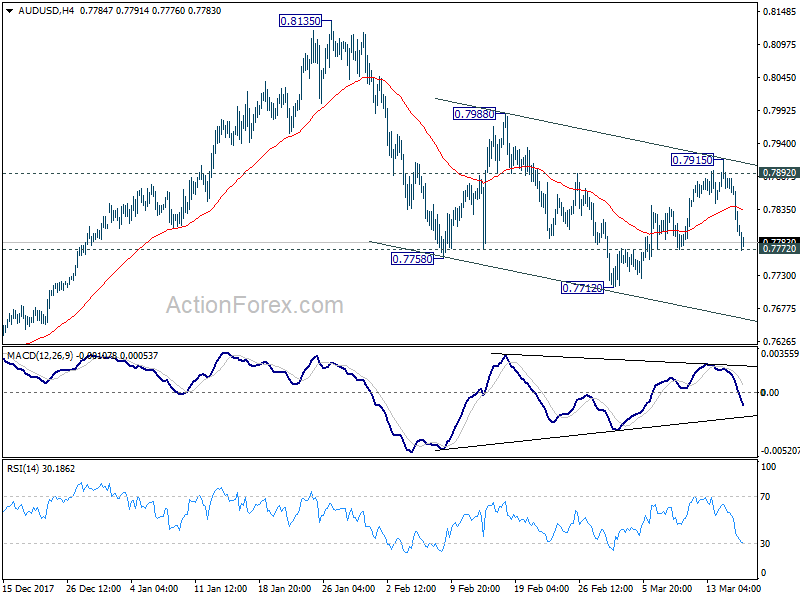
AUD, NZD, CAD Weaken on Fear of Rising Protectionism
Commodity currencies, including Canadian, Australian and New Zealand Dollar are suffering steep selling towards the end of the week. New White House economic adviser Larry Kudlow's strong Dollar comment was seen by some as a factor, as he urged TV interview viewers to "buy King Dollar and sell gold". But looking from the large picture in the markets, Dollar is just trading marginally better than the above three. Yen remains the strongest one for the week, and for today. The resilient Sterling follows closely as the second strongest one.
Increasing gestures of protectionism of US President Donald Trump and concerns of trade war is seen as the main factor driving the commodity currencies down. Canadian Dollar has its own problems in NAFTA renegotiation and the risk of the return of steel tariffs. Trump's administration is work on the USD 60b a year unilateral tariffs on China. Australia and New Zealand, with China as largest trade partners, would definitely be affected on contagion. While Australian government might view the US ally, to investors, "America first" Trump wouldn't care much about casualties elsewhere.
IMF Lagarde: Fix economic imbalances with fiscal means, not trade obstacles
IMF Managing Director Christine Lagarde urged politicians to "resolve trade disagreements without resort to exceptional measures". She warned that "trade wars not only hurt global growth, but they are also unwinnable". And, "self-inflicted harm of import tariffs can be substantial even when trade partners do not retaliate with tariffs of their own." She added that " protectionism is pernicious, because it puts the biggest strain on the poorest consumers who buy relatively more low-priced imports." And "harming trade is bad for the economy and bad for people."
She emphasized "the way to address global economic imbalances is not to raise new obstacles to trade." That is, by "using fiscal means to address global imbalances is critical", including "lowering deficits in the US to bring public debt towards a sustainable path, and stronger infrastructure investment and education spending in Germany," At the same time, " those who are adversely affected by globalization and technological progress should receive more support to ensure that they can invest in their skills and transition to higher-quality jobs."
The IMF's Global Prospects and Policy Challenges report also noted that "the global expansion is gaining strength from the pick-up in international trade, and it should not be put at risk by the adoption of inward-looking policies." "The modernization of the rules-based multilateral trade system should continue, anchored in the World Trade Organization, with well-enforced rules that promote competition and a level playing field. Co-operation is also needed to tackle excess global imbalances." The report also warned "the re-emergence of unilateral trade restrictions may escalate tensions and fuel global protectionism, disrupting worldwide supply chains and affecting long-term productivity."
USD 60b tariffs on Chinese goods is devastating to American families
U.S. Chamber of Commerce President and CEO Thomas Donohue criticized that unilateral tariffs on Chinese goods by Trump's government would be destructive to the economy. He warned that the USD 30b a year tariffs on Chinese good would "wipe out over a third of the savings American families received from the doubling of the standard deduction in tax reform." Further, with Trump's request of USD 60b a year tariff, "the impact would be even more devastating."In addition, Donohue said "tariffs could lead to a destructive trade war with serious consequences for U.S. economic growth and job creation,"
UK-EU planning intensive talk on Irish border
UK Brexit Secretary David Davis is targeting to complete the legal text of the transition deal at the two-day summit from March 22. Most of the differences would likely be bridged on the following days. But the criteria of avoiding a hard Irish border remains a key showstopper. EU proposed a fall back option in its own draft published earlier this month. That is, should there be no compromisable solution, Norther Ireland would stay in the customs union along side Republic of Ireland. But UK Prime Minister Theresa May has instantly and bluntly rejected that idea. Intensive talk is now planned between March 26 and April 18 on the issue. There is some optimism on completing the transition agreement among UK officials. But businesses in UK would definite request a deal with full clarity. Any conditions in the deal attached to the outcome of Irish border issue would dissatisfy UK businesses and markets.
RBA Debelle: Markets underpriced risks of global tightening
RBA Deputy Governor Guy Debelle warned that markets are under pricing the risks of global monetary stimulus remove. He pointed to "equity prices embody a view of the future that robust growth can continue without generating a material increase in inflation." And, "there is little priced in for the risk that this may not turn out to be true." Meanwhile, to him, the market volatility back in February, with sudden selloff in stocks, was just "a small example of what could happen following a larger and more sustained shift upwards in the rate structure." He admitted before wrong in predicting higher volatility before, but added "I think there is a higher probability of being proven correct this time."
NZ PMI suggests Q1 manufacturing GDP similar to Q4's
New Zealand Business NZ manufacturing PMI dropped to 53.4 in February, down from 54.4. Among the sub-indices, production rose 0.4 to 53.9, employment rose 3.3 to 54.8, new orders rose 5.1 to 54.8, deliveries rose 2.9 to 52.7. But finished stocks dropped -1 to 51.1. Bank of New Zealand economist Doug Steel noted in the release that "Q1 manufacturing GDP wouldn't be much different from Q4's based on the "generally slower PMI". Business NZ manufacturing executive director Catherine Beard said pace of expansion had levelled off in recent months and "noted the sluggish start to the year with a dip in new orders being a common message."
February 25 imagery suggests North Korea testing nuclear reactors at Yongbyon
Defence & security intelligence analysts Jane's reported that North Korea likely had preliminary testing it's nuclear reactors at the Yongbyon research facility. That came weeks ahead of the planned meeting between North Korean Leader Kim Jong-un and South Korean President Moon Jae-in next month. There will also be a planned meeting between Kim and US President Donald Trump in May. But it should be noted that the analysis was based on an imagery from February 25. And, the experimental light water reactor (ELWR) was built and optimized for electricity production. Nonetheless, it still has 'dual-use' potential and can be modified to produce fissile material for nuclear weapons.
Looking ahead
Eurozone CPI final will be the main feature in European session. Canada will release manufacturing sales and international securities transactions. US will release housing starts, building permits, industrial production and U of Michigan consumer sentiments.
AUD/USD Daily Outlook
Daily Pivots: (S1) 0.7766; (P) 0.7825; (R1) 0.7856; More...
AUD/USD failed to sustain above 0.7892 resistance and topped at 0.7915. Subsequent sharp fall now turns focus back to 0.7772 minor support. Break there will likely resume the decline from 0.8135 through 0.7712. In that case, AUD/USD should target 0.7500 key support next. On the upside, break of 0.7915 resistance will revive the case of near term reversal. And, intraday bias will be turned back to the upside for 0.8135 top.
In the bigger picture, medium term rebound from 0.6826 is seen as a corrective move. It might still extend higher but we'd expect strong resistance from 38.2% retracement of 1.1079 to 0.6826 at 0.8451 to limit upside to bring long term down trend resumption. On the downside, break of 0.7500 support will now be an important signal that such corrective rebound is completed.
Economic Indicators Update
| GMT | Ccy | Events | Actual | Forecast | Previous | Revised |
|---|---|---|---|---|---|---|
| 21:30 | NZD | Business NZ Manufacturing PMI Feb | 53.4 | 55.6 | 54.4 | |
| 04:30 | JPY | Industrial Production M/M Jan F | -6.60% | -6.60% | ||
| 10:00 | EUR | Eurozone CPI M/M Feb | 0.20% | -0.90% | ||
| 10:00 | EUR | Eurozone CPI Y/Y Feb F | 1.20% | 1.30% | ||
| 10:00 | EUR | Eurozone CPI Core Y/Y Feb F | 1.00% | 1.00% | ||
| 12:30 | CAD | Manufacturing Sales M/M Jan | -0.90% | -0.30% | ||
| 12:30 | CAD | International Securities Transactions (CAD) Jan | -1.97B | |||
| 12:30 | USD | Housing Starts Feb | 1.30M | 1.33M | ||
| 12:30 | USD | Building Permits Feb | 1.33M | 1.38M | ||
| 13:15 | USD | Industrial Production M/M Feb | 0.30% | -0.10% | ||
| 13:15 | USD | Capacity Utilization Feb | 77.70% | 77.50% | ||
| 14:00 | USD | U. of Mich. Sentiment (Mar P) | 99.3 | 99.7 |
Market Morning Briefing: Euro – Is Again Testing Support Near 1.23
STOCKS
Dow (24873.66, +0.47%) is trading in the narrow range of 25500-24500 and could move on either side early next week. While below 25500, there is scope of testing 24000 on the downside. A break above 25500 if seen could initiate a rise towards 26500 in the medium term. Need to see how long the index manages to stay below 25500.
Dax (12345.56, +0.88%) moved up slightly but continues to trade below immediate resistance near 12500. While that holds, near term looks bearish towards 12100.
Nikkei (21750.59, -0.24%) could trade in the 22600-21400 region in the next few sessions. While above 21400, near to medium term looks bullish.
Shanghai (3292.21, +0.03%) is stuck in the 3350-3250 region and is likely to continue so today also. A gradual decline towards 3250-3200 is possible in the medium term.
Nifty (10360.15, -0.49%) trades above support near 10200 on the 3-day charts. Some ranged movement in the 10500-10200 region is possible next week too. Sensex (33685.54, -0.44%) is below 34000 and could see some dip towards 33500-33250 in the near term.
COMMODITIES
Brent (65.06) is again likely to test resistance at 66. Watch price action there. If 66 holds, another dip towards 64.50 is possible else if the price manages to break above 66 next week, we could see a rise towards 67.50 in the near term.
Nymex WTI (61.23) is also heading towards resistance at 62. Price is likely to remain stuck in the 62-60 region in the coming sessions.
Gold (1316.20) has broken below immediate resistance near 1320 and this could be an indication of an upcoming decline towards 1300. Need to be careful at current levels.
Copper (3.1180) has fallen sharply and could come down to test 3.0750 before bouncing up towards 3.15 again next week.
FOREX
Dollar index (90.105),against our expectation has bounced again from support levels near 89.5-89.75 on daily candles. The support had been broken yesterday, leading us to predict that a further downmove towards crucial support near 89.2 on weekly line chart would happen. However the support has held and now, there is immediate resistance visible near 90.25 on daily candles which might produce a dip.
Euro (1.2306) - is again testing support near 1.23 on weekly candles which has held on the past few occasions. It could further dip towards 1.225, seen as support on daily candles, post which a bounce back to higher levels can be expected.
Dollar Yen (105.98) continues its down move towards crucial support near 105 on daily candles. A break of the same would confirm medium term bearishness for Dollar Yen.
Euro Yen (130.42) is dropping towards support near 130-129.75 on 3 day candles as expected. If the Dollar Yen goes below 105, we might see Euro Yen break 130 for lower levels.
Pound (1.3926) as per our expectation had dipped from resistance near 1.4 on the daily candles and is now moving towards support near 1.39 on 3 day candles.
Dollar Rupee (64.935) to continue range trade between 64.75-65.15 today also. Next week could see some movement as volatility may rise.
INTEREST RATES
US 10 Yr Yield (2.82), 30 Yr (3.05), 5 Yr (2.62), 2 Yr (2.28) : The US 2 Year Yield has risen to a 9 year high near 2.28% as data on unemployment claims and import prices indicated higher employment and rising prices respectively. The longer term yields continue to consolidate near levels seen in the last 2-3 sessions.
After CPI and Retail Sales data disappointed those expecting rate hikes, data on unemployment claims and import prices have again raised sentiment for 4 rate hikes this year. As mentioned yesterday, the data releases on housing starts, industrial production and capacity utilization (due later today) could prove to be extremely important in building further sentiment.
A week of volatility in yields is expected next week.
(Long term resistance levels for the 4 yields have been as follows: 2.85-2.90, 3.20, 2.7 and 2.2 respectively - these could be breached in end-March if the rate hike takes place. Let's wait and watch.)
IMF Lagarde: Fix economic imbalances with fiscal means, not trade obstacles
IMF Managing Director Christine Lagarde on trade war:-
- She urged politicans to "resolve trade disagreements without resort to exceptional measures".
- "Trade wars not only hurt global growth, but they are also unwinnable".
- "We know that the self-inflicted harm of import tariffs can be substantial even when trade partners do not retaliate with tariffs of their own,"
- "We also know that protectionism is pernicious, because it puts the biggest strain on the poorest consumers who buy relatively more low-priced imports. In other words, harming trade is bad for the economy and bad for people."
- "The way to address global economic imbalances is not to raise new obstacles to trade. Using fiscal means to address global imbalances is critical. This includes, for example, lowering deficits in the US to bring public debt towards a sustainable path, and stronger infrastructure investment and education spending in Germany,"
- "And importantly, those who are adversely affected by globalization and technological progress should receive more support to ensure that they can invest in their skills and transition to higher-quality jobs."
The IMF's Global Prospects and Policy Challenges report:-
- "The global expansion is gaining strength from the pick-up in international trade, and it should not be put at risk by the adoption of inward-looking policies,"
- "The modernization of the rules-based multilateral trade system should continue, anchored in the World Trade Organization, with well-enforced rules that promote competition and a level playing field. Co-operation is also needed to tackle excess global imbalances."
- "The re-emergence of unilateral trade restrictions may escalate tensions and fuel global protectionism, disrupting worldwide supply chains and affecting long-term productivity."