

Sample Category Title
Week Ahead – US Inflation and Retail Sales in Focus; New Zealand GDP also Eyed
It will be a relatively quiet week in terms of economic data over the next seven days, with the exception of the United States where inflation and retail sales figures will attract plenty of attention. The schedule for central bankers will also be lighter but not totally void as the Swiss National Bank holds a regular policy meeting.
Japan reports producer prices and machinery orders
The Bank of Japan kept monetary policy unchanged this week and reaffirmed its commitment to maintain its extensive stimulus program at least until the 2% inflation target has been met. Producer price data out of Japan on Tuesday are expected to show there is little imminent threat of an upsurge in inflationary pressures. Corporate goods prices are forecast to rise by just 0.2% month-on-month in February, with the annual rate declining marginally to 2.6%. Core machinery orders – a key measure of future capital spending – will follow on Wednesday. Orders slumped by 11.9% m/m in December. Another poor month in January could spark some concerns about the Japanese manufacturing outlook over the coming months. However, this is unlikely to have a significant impact on the yen and not much reaction is expected either from the minutes of the BoJ’s January meeting minutes due on Wednesday.
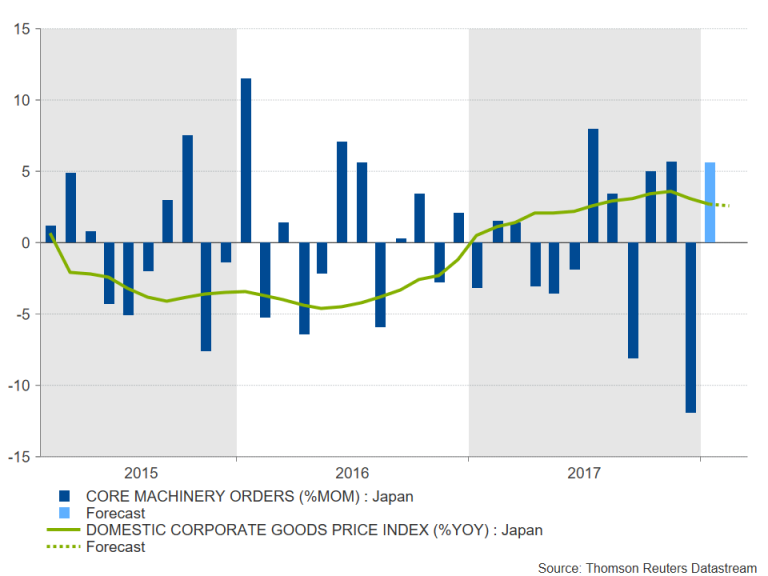 Lunar New Year likely boosted retail sales in China
Retail sales in China are expected to have picked up to 9.8% year-on-year in February from 9.4% the prior month, with spending possibly getting a lift from the Lunar New Year celebrations. The boost is not expected to apply to industrial output however, which is forecast to slow from 6.2% to 6.1% y/y. Fixed asset investment is also expected to moderate in February. Stronger-than-anticipated growth in industrial activity should not be discounted though given the surge in exports during the month.
New Zealand GDP eyed
The New Zealand dollar has been consolidating since late January as weak inflation data and market turbulence have put a lid on the kiwi’s 6-week old rally. Fourth quarter GDP figures on Thursday could inject some fresh upside momentum to the kiwi/dollar pair if there’s a positive surprise. New Zealand’s economy is expected to have expanded by 0.5% quarter-on-quarter in the final three months of 2017, slightly below the prior quarter’s 0.6% rate. However, with both employment and trade numbers beating expectations in Q4, a stronger reading is possible. A disappointing figure on the other hand would add to the growing number of analysts expecting the Reserve Bank of New Zealand to stave off from hiking rates until the second quarter of 2019.
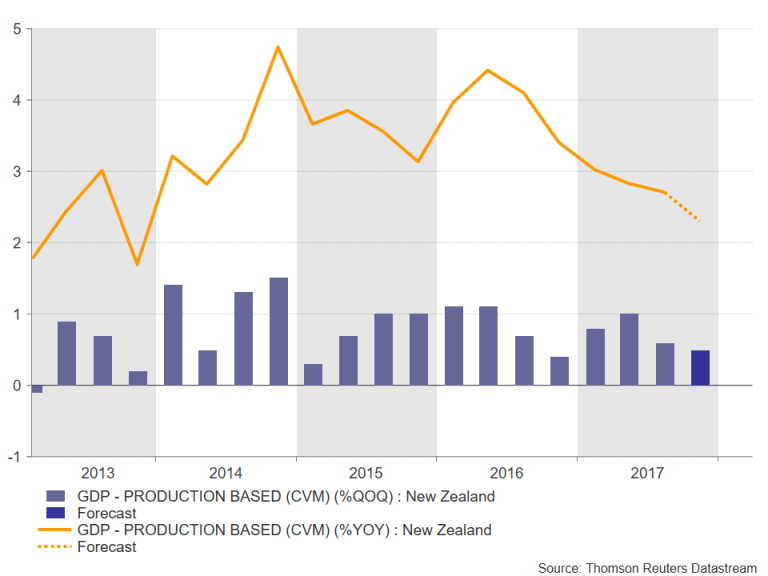 SNB meeting to headline light calendar week in Europe
After a dovish Mario Draghi drove the euro to below $1.23 at this week’s European Central Bank meeting, there’s little in the form of data to give the single currency a helping hand up. Industrial production for January (Wednesday) and final CPI figures for February (Friday) will be the only major releases out of the Eurozone next week. Euro area labour costs for the fourth quarter may also attract some attention on Friday.
Investors’ focus will instead turn to the Swiss National Bank and the Norges Bank as the Swiss and Norwegian central banks meet to set interest rates. The SNB is expected to keep its target for the 3-month Libor rate at between -1.25% and -0.25% on Thursday. A stronger-than-expected CPI reading for February out of Switzerland this week is unlikely to prompt the SNB to signal a rate hike. SNB Chairman Thomas Jordan still considers the Swiss franc to be “highly valued” despite the euro’s 10% appreciation versus the Swissie over the past year.
In Norway, policymakers have been having less success with inflation as core inflation in the country has moderated substantially since 2016 to below 2%. However, CPI data released this week showed an unexpectedly stronger-than-expected pick up in February, boosting the Norwegian krone. Rates are forecast to be kept on hold at 0.5% on Thursday, but the Norges Bank could bring forward the timing of a rate hike in its latest projections.
US inflation and retail sales back in limelight
The US dollar managed to regain some footing this week as Korean geopolitical risks and trade war fears abated. Economic indicators out of the US next week have the potential to extend the greenback’s recovery as price and consumer spending gauges come to the forefront. The CPI report is first up on the calendar on Tuesday. The headline inflation rate is forecast to edge up to 2.2% y/y in February, while the core rate is also expected to advance by 0.1 percentage points to 1.9%. On Wednesday producer prices and retail sales figures will keep traders busy. After a 0.3% m/m drop in January, retail sales are anticipated to bounce back by the same amount in February.
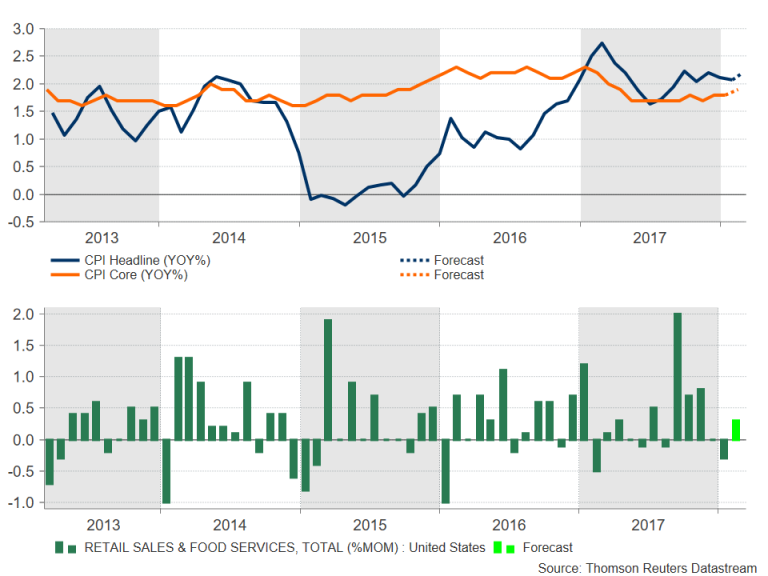 Manufacturing activity surveys for New York and Philadelphia will be watched on Thursday. The New York Fed’s Empire State manufacturing index is forecast to rise in March, but the Philly Fed manufacturing index is expected to fall slightly in the same period. Housing indicators are due on Friday as figures on building permits and housing starts for February are published. Also out on Friday are industrial production data and the University of Michigan’s consumer sentiment gauge. Industrial output is set for a 0.3% m/m rebound in February, following a 0.1% dip in January, while the preliminary reading of the UoM consumer sentiment index is expected to move slightly lower from 99.7 to 99.4 in March.
5 Fronts of Trump’s Trade War
Donald Trump signed a proclamation to place tariffs on steel and aluminum on Thursday in the first concrete step in his quest to reduce the bulging US trade deficit. The resulting steps as well as fallout will be a driving force for markets in the weeks/months ahead.
Major decisions on retaliation, exemptions and strategy are coming. Here are five areas to watch.
1. The Timeline
Trump’s declaration exempted Canada and Mexico but put all other countries on the clock. They have 15 days to convince the US administration not to tax their steel imports. Trump singled out Australia as it could be spared, indicating defense procurement may be a factor in decision. Exemptions from Trump’s tariffs will have FX implications, but if such reprieves multiply, then it bodes well for risk trades at the expense of the yen.
2. Who Replaces Cohn
The first casualty of the trade war was White House economic advisor Gary Cohn, who resigned Tuesday of the tariffs. Expect Trump to name his replacement in the week ahead. Who he chooses could help signal his agenda into the November mid-term elections and beyond. Cohn made a push for Shahira Knight, widely considered as a moderating voice. Another possibility is former Reagan economist Larry Kudlow whom Wall Street would support. Nonetheless, trade hawk Peter Navarro is also angling for the job, and choosing him would signal that these tariffs are here to stay. Worthy of note, Navarro is especially critical of the trade relationship with Canada.
3. Retaliation
The EU has taken an aggressive stance towards US aluminum and steel tariffs, which raises the possibility it will retaliate rather than aim for an exemption. China will certainly not be granted an exemption – it wait until the 15-day period runs out to see if Trump acts. Alternatively, Beijing may pre-announce retaliatory measures in the hopes of getting the White House to back down. Countries can also file a complaint against the US at the World Trade Organization, to which the US will appeal on the argument that is protecting national security. The entire process could take 1-2 years, during which, complaints, lawsuits and trade barriers will dominate world trade.
Uncertainty is high and many trade partners will be affected but action is assured. And if action comes, the next big question will be how the US reacts.
4. NAFTA
Mexico and Canada got a reprieve Thursday but the timeline is indefinite. The idea of a 30-day exemption for Mexico and Canada was floated, suggesting the US is growing impatient with the progress of NAFTA talks. The Mexican Presidential election in July also means talks need a quick finish or they will go on hiatus. Trump said Thursday he was optimistic about a deal but there has been no progress on the thorny parts of a deal. Ultimately, aside from saying things like “NAFTA is the worst trade deal ever”, Trump is reluctant to address any specific problems with the Agreement, leaving him a window to carve out a deal that’s largely the same while declaring victory.
5. The Trade Deficit
A headline that was ignored this week was a surge in the US trade deficit to a nine-year high. It’s rising because of a strengthening US demand and a tax plan that’s added further stimulus to an economy already near full capacity. In all-likelihood it will continue to rise. As it does, it will infuriate and embarrass the President and he’s likely to unveil further haphazard ways to fight it. That means this story isn’t going to go away as long as Trump is in the White House.
Usually the story goes like this: As long as the world economy is growing in synch, the US trade deficit will move towards 3% of GDP, the budget deficit towards 4% of GDP and the US dollar would have little choice but to pull lower. At least that’s what the chart shows.
Australia & New Zealand Weekly: Prospects for the Australian Economy; Markets; and Global Risks
Week beginning 12 March 2018
- Prospects for the Australian economy; markets; and global risks.
- RBA: Deputy Governor Debelle, Assistant Governors Bullock and Kent speak.
- Australia: Westpac-MI consumer sentiment, AusChamber-Westpac survey, housing finance, NAB business survey.
- NZ: Q4 GDP, current account, house sales.
- China: new finance, retail sales, foreign direct investment, industrial production.
- Euro Area: ECB Draghi speaks.
- US: CPI, retail sales.
- Key economic & financial forecasts.
Information contained in this report current as at 9 March 2018.
Prospects for the Australian Economy; Markets; and Global Risks
I am visiting customers and officials in Hong Kong; Beijing and Singapore next week.
I set out below the Executive Summary of the 70 page document I will be presenting during the visit.
Prospects for the Australian Economy; Markets; and Global Risks
As we contemplate 2018 there are a number of key themes that we believe will dominate economic and market developments. Our advice to customers throughout 2017 has been to expect Australia's growth rate to likely be anchored below trend in both 2018 (2.7%) and slowing to 2.5% in 2019. That has contrasted with official forecasts (Reserve Bank and Treasury) which anticipate growth picking up to 3.25% in both 2018 and 2019.
We have recognised a solid ongoing boost to growth from non– residential construction; government investment (especially at the state level) and exports. However we are much more cautious than official forecasts on the consumer; residential construction and equipment investment.
Slowing household incomes
Signals from the December quarter national accounts are more encouraging for the official view. Household spending has been revised up from an expected 2.1% to 2.9% following the release of the December quarter national accounts. This picture of households has changed from "lacklustre" to "slightly below trend". However this was associated with a weak savings rate of 2.7% despite a boost in nominal labour income growth to 4.8% for the year largely due to an extraordinary lift in hours worked of 3.5%. With hours worked increasing so rapidly, labour income growth should have been boosted further but was constrained by wages growth and a drift to lower paid jobs – non-farm compensation per employee remained flat in the December quarter to be up an insipid 1.8% for the year.
Labour productivity fell over the year with GDP per hours worked falling by 1% over the year and unit labour costs growth lifting to 2%. This adverse development in labour productivity is likely to temper the recent strong demand for labour we experienced in 2017.
It is therefore our expectation that there will be a slowdown in the current break neck pace of growth in hours worked over the course of 2018 and into 2019. Weak wages growth and the drift to lower income jobs looks set to continue putting some downward pressure on growth in labour incomes. With the savings rate now probably at its lows, another year of below trend consumer spending growth can be expected.
Business investment
New business investment lifted by 5.8% over the past year, a sharp turnaround from a 6.2% decline over 2016. Over the year, infrastructure work fell 1.2%; non-residential building advanced 12.3% and equipment investment spending increased by 8.4%.
Mining equipment investment lifted by 31% over the year, reflecting the final fit out of three major projects. It is more encouraging that non-mining equipment investment lifted by 6.2% over the year following a slowdown in 2016 partly associated with the uncertainty around the 2016 election. With another Federal Election due by May 2019 and even greater uncertainty associated with that election (conservative government was expected to win the 2016 election whereas the Labour opposition is comfortably ahead in the current opinion polls), we may start to see equipment investment run into some headwinds from the second half of 2018.
Housing downturn
Dwelling investment contracted in 2017 by 5.8%. Based on the downturn in the trend in high rise approvals and a flat outlook for detached housing, we expect this downturn has further to run with the contraction accelerating into 2019. Oversupply and a marked slowdown in sales to foreigners are weighing on the outlook for residential building. House price inflation is disappearing. On a six month annualised basis, prices are now falling in Sydney and Perth and slowing in Melbourne and Brisbane.
The regulator's macro prudential policies are restricting interest only loans and tighter guidelines for all new loans are slowing house prices and credit growth. In previous cycles the authorities have relied on raising interest rates to slow the highly cyclical housing market. This time, the same effect has been achieved by the regulator as banks have independently raised loan rates; foreign demand has slowed; and regulations have significantly squeezed the availability of credit.
Furthermore, the attractiveness of investment properties has diminished. Land taxes and lacklustre rental growth have tightened rental yields. Prospects of adverse tax changes in the event of a change of government are also impacting investor confidence. Most banks are predicting rate increases while the alternative government is planning to reform some aspects of investor taxes.
We expect a long extended period of flat house prices on a national basis with weakness particularly centred on the Sydney and Melbourne markets. This will represent a considerable change in the "atmospherics" around housing wealth and may weigh further on prospects for consumer spending.
Inflation below target
Inflation is also likely to remain benign holding a little below the bottom of the Reserve Bank's 2–3% target band. In this regard we are in broad agreement with the Reserve Bank which is forecasting that underlying inflation will hold at 1.75% in 2018 before lifting modestly to 2% in 2019. Note that underlying inflation has held below the 2–3% target band in 2015; 2016 and 2017.
With underlying inflation likely to therefore register five consecutive years at or below the bottom of the target range it is reasonable to argue that Australia is experiencing a structural fall in inflation. Arguably, without the risk of overheating the housing market, interest rates would have been even lower in Australia in recognition of this structural fall and the disappointing progress in restoring inflation to the target range.
Interest rate outlook
We have been of the view through 2017 that the official cash rate will remain on hold in both 2018 and 2019. With rates on hold in Australia and the US Federal Reserve continuing to raise rates, Australia's cash rate is set to fall below the Federal Funds rate by March. By end 2018, it is set to be 63 basis points below the Federal Funds Rate, and by end 2019, 112 basis points below the Federal Funds Rate.
Sustained period of negative Aus–US rate spreads
The US economy is operating with much less 'slack' in its labour market (unemployment rate of 4.1% compared to an estimated full employment rate of 4.5%) than Australia (unemployment rate of 5.5% compared to a full employment rate of 5.0%) but, to date, wage pressure has only recently emerged (three month annualised pace has lifted to around 4%).
Of most concern to markets has been the planned lift in government spending ($300 billion over 18 months) and the Tax Cuts ($1.5 trillion over 10 years) in the US. These policies are likely to boost the Budget deficit by around 2% of GDP providing a solid boost to demand when the economy is already operating at full capacity in the labour market.
We expect three 25 basis point hikes in March, June and September from the FED. That would see the USD/AUD yield differential in the overnight market contract to minus 63 basis points – a situation we have not seen since early 2000. A further two hikes are expected in the first half of 2019.
AUD/USD Bond Spread
Back in August 2017, Westpac had been forecasting that AUD cash rates would fall below the US Federal Funds Rate by around 40 basis points by end 2018. That, in turn, would drive the 10 year bond spread to zero, from around 60 basis points. At that time markets were priced for the US rate to be around 35 basis points below Australia. We now expect RBA rates to be even lower than Federal Funds at minus 63 basis points by end 2018 and minus 112 basis points by mid-2019. The likely result is that AUD 10 year bonds will trade around 30 basis points below US bond rates by mid-2019.
Commodity Prices; China; and the Australian Dollar.
Amid general euphoria around the global economic outlook we suggest caution. The Chinese economy is generally expected to slow as consumption and net exports are unable to compensate for the ongoing slowdown in investment. However, the big uncertainties and risks continue to centre around the Chinese financial system.
Much has been made of the synchronised lift in global growth in 2017. From Australia's perspective the key development has been the faster than anticipated growth in China. China's growth rate printed 6.9% in 2017 but we anticipate a decent slowdown in 2018 to 6.3%.
China realises that it must move away from its growth model based on exports and investment. In particular the role of the financial sector must change from channelling high savings at low cost to strategic sectors, to facilitating China's economic transformation to a more sustainable model based on services and consumption. But the "old" model has resulted in financial assets growing from 260% of GDP in 2011 to 470% in 2016 (IMF, 2017). The excessive growth (around 30% per annum over the last 10 years) has been in the largely unregulated non–bank sector.
In November, President Xi nominated poverty; pollution and financial leverage as his key "challenges". We expect that the slowdown in growth in the non-bank sector will weigh on commodity prices as speculators are squeezed for funding and local governments, in particular, are restricted in their access to funding for new infrastructure projects.
We are already seeing some evidence of this squeeze on the non– bank sector. Banks are no longer allowed to guarantee wealth management products; entrusted loans (corporates borrowing to lend to other corporates with banks operating as agents) have been banned; rapid growth in short term interbank funding has been slowed; and general funding for wealth management products is being restricted.
These forces are likely to weigh on iron ore and coking coal prices. Some lift in supply from Australian producers is also expected to lower prices. These atmospherics for commodity prices along with the widening interest rate differential are eventually expected to weigh on the AUD. We recognise that capital flows are also critical to the AUD's prospects. In forecasting, we have endeavoured to accommodate any direct impact of capital flows that is not explained by rates and commodity prices.
We target AUD at USD 0.74 by end 2018 and 0.70 by end 2019.
The week that was
The market has had a lot to ponder, from growth and funding in Australia to trade frictions and rate expectations elsewhere.
In the National Accounts, Australia received one of its preeminent quarterly releases this week. GDP growth in the December quarter was disappointing at just 0.4% and 2.4% over the year, annual growth down from 2.9%yr in Q3 and below its trend pace of 2.75%yr. Of note however, while the headline outcome was sub-par, the detail was constructive. The main negatives in the release were temporary in nature: a 0.5ppt subtraction from net exports and a 1.0% decline in business investment associated with the winddown of the mining investment boom. Residential construction is an enduring negative (-1.3, 5.8%yr), but one that is offset by the ongoing strength in public demand (1.1%, 4.9%yr).
Most notable for the outlook was an above expectation gain for household consumption (+1.0%yr), and a revision to the prior quarter, from 0.1% to 0.5%. Opportunity for further solid gains in consumption was also seen in the lift in nominal labour income growth to 4.8%yr, the strongest annual gain since mid-2012. These outcomes will provide some comfort to the RBA, being representative of the successive outcomes necessary to see growth lift from below to above trend in 2018. We instead continue to believe that headline growth will hold below trend in 2018 and 2019 as the consumer holds back; business investment takes time to accelerate; and residential construction remains a negative.
Ahead of the GDP release, the balance of payments provided an update of how we fund ourselves as a nation. Historically Australia has funded persistent current account deficits by our banks borrowing funds offshore and on-lending the funds domestically. Post-GFC however, reduced domestic appetite for bank credit and stronger growth in deposits has limited the need for banks to borrow offshore. Rather, the current account has been funded by the purchase of Australian assets by foreign investors.
This flow of capital grew rapidly during the mining investment boom. But foreign investors' appetite for Australian assets has persisted since, broadening across the entire economy. This capital offered additional support to the Australian dollar. In the second half of 2017 however, it is evident that direct investment's support for the dollar decelerated materially. Should this nascent trend persist, it will be another reason for the AUD to depreciate to USD0.70 by September 2019 as we expect, in addition to declining commodity prices and the Australian/US interest rate differential. Offshore, trade and rate expectations have been in focus this week.
Since US tariffs on steel (25%) and aluminium (10%) were announced by President Trump at the beginning of March, financial markets have been unsteady. This was all the more the case after a separate targeted action against China for "alleged theft of intellectual property" was mooted and a potential retaliation by Europe against the US (targeting prestige US brands such as Harley Davison) was reported. For the US economy, trade sanctions could derail the benefits of tax reform, particularly with respect to investment. While for the globe, the threat comes at an inopportune time, as a number of indicators of economic momentum begin to plateau (at elevated levels).
Parallels have been drawn to 2002 when then President Bush imposed a tariff in excess of 30% on steel that was met by retaliatory action from other countries. That decision was followed by a sharp fall in the US dollar and US equities. However in 2002, equities had already been moving lower for more than a year after the tech bubble burst and amid 2001's very weak economic growth. With the US economy currently on a strong footing, today's circumstances are very different. We remain of the view that global economic strength and diplomacy will win out, and this will allow the FOMC to continue raising interest rates in 2018, most likely three times. Supporting this view, Atlanta Fed's Bostic stated this week that he has upgraded his fed funds rate view for 2018 from two to three hikes despite headwinds from 'trade frictions'.
ECB President Draghi provided financial markets with a number of salient points to ponder this week. In response to the continued strength of the Euro Area economy, the reference to potentially increasing the scale of the purchase program was removed from the statement – a first (small) step towards policy being tightened. However, he and the Governing Council also very clearly highlighted that conditions are not yet conducive to policy being tightened. For that to occur, "a sustained adjustment in the path of inflation consistent with its inflation aim" is necessary.
What Draghi said about fiscal policy in Europe and beyond was equally as important. There was a two-part call: to step-up structural reforms; and make use of current momentum to build a fiscal buffer for future use. Draghi was also unusually forthright on President Trump's tariffs. Opining that "If you put tariffs against what are your allies, one wonders who the enemies are" in Q&A highlights the ECB's and Europe's opposition to Trump's policy.
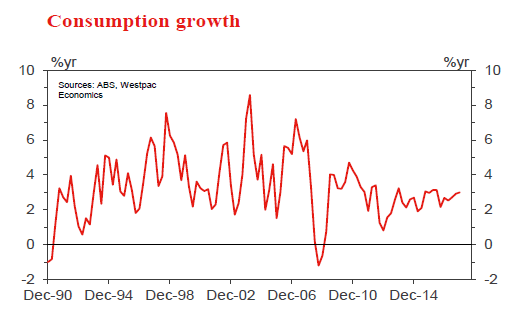
Chart of the week: Consumer spending
Consumers were the main upside surprise in the December national accounts with a better than expected quarterly result and significant upward revisions. The combined effect has lifted annual growth at 2.9%yr vs our forecast estimate of 2.1%.
The big upward revision to the previously very weak Q3 estimate is particularly notable. The ABS advises that revised tourism spending estimates were the major contributor to the change. Consumption includes spending by Australians abroad and excludes domestic spending by non-residents. Q3 estimates for spending abroad were impacted by changes to passenger surveys with the 'outbound' card collection discontinued and only arrivals collected. That added 0.26ppts to Q3 spending.
Note that there is no net effect on GDP due to a matching upward revision to tourism imports. It also explains why national accounts spending estimates are now much stronger for Q3 than retail sales which are unadjusted for net tourist spending.
New Zealand: week ahead & data wrap
Late fade
Next week sees the release of the December quarter national accounts, the last major piece of economic information from 2017. We expect it to highlight that the New Zealand economy, while still growing, has lost some momentum over the last year.
We estimate that GDP grew by 0.6% in the December quarter. That result would bring growth over the 2017 calendar year down to 2.9%, compared to 4% growth in 2016. Population growth was similar in both years – around 2% – so this represents a substantial softening in per-capita growth.
We recognise that next week's release is not the final word on the economy's performance. A year ago, the GDP figures appeared to be saying the same thing: that growth had been strong in previous years, but more recently had slowed to barely above zero in per-capita terms. However, at the end of last year Stats NZ published revisions to the recent history of GDP, incorporating better-quality information from annual surveys. The new figures told a different story: growth had in fact remained strong, reaching its peak in 2016.
The figures for 2017 have yet to be subjected to the annual revisions process. But the reported slowdown in GDP growth matches with what else we saw going on in the economy last year – which wasn't always the case in 2016.
Firstly, the housing market was much more subdued in 2017, following a couple of years of double-digit house price gains. That flowed through into people's willingness to spend, with the rate of growth in card spending slowing over the course of the year. Secondly, construction activity flattened out last year as the building industry faced constraints on capacity and access to finance. Finally, business confidence fell over the course of 2017 – a move that began even before the new Government was formed.
Coming into this year, a slower starting point for the economy will present challenges for policy makers. Lower than expected GDP could translate into a lower tax take (though so far tax revenue has continued to surprise to the upside of the Treasury's forecasts). It also raises questions about the economy's ability to absorb the impact of the Government's policy changes, such as those around labour laws and housing market speculation. For the RBNZ, lower than expected growth would mean that the rise of home-grown inflation pressures would be delayed even further.
GDP (15 March)
Previously we were forecasting a 0.8% rise in the production measure of GDP. However, we have revised this down to 0.6%, as the last of the sectoral indicators that were published this week were softer than we expected on balance.
Building work put in place rose by 1.4% in the December quarter, a little less than our forecast. Activity continues to slow in Canterbury as the earthquake rebuild work winds down, but it is trending higher in the rest of the country. Residential building work was flat for the quarter, while non-residential building rose. We've also assumed that other construction (not covered by the building work survey) will retrace to some extent after a 9% jump in the previous quarter.
The manufacturing survey initially appeared to be positive, with a 1% rise in sales volumes. The main factor was a 17% surge in petroleum manufacturing – but this is not the measure used to calculate GDP. The manufacturing survey is based on deflated sales; this can be unreliable when oil prices move sharply, as they did in the December quarter. For measuring GDP in this industry, Stats NZ surveys production volumes directly from the major players. It's unlikely that actual volumes rose to such a degree, given that refining capacity is limited.
The remaining details in the manufacturing survey were soft on balance. Manufacturing of machinery fell back after a strong rise in the September quarter, and there were either declines or small gains in wood products, metals and minerals. Food processing was mixed, with fruit and meat up, but dairy and beverages down.
Goods turnover was relatively brisk in the December quarter, with some of the strongest gains seen in the retail, wholesale and transport sectors. However, growth in personal and business services was more subdued. The poor dairying season continued, although milk collections didn't fall short by as much as they did in the September quarter.
The expenditure measure of GDP is considered to be less reliable as a measure of quarterly growth, but the details are sometimes of interest. For the December quarter, we expect to see solid growth in household spending and business investment, but with much of the growth being serviced by imports. In particular, there was a surge in imports of plant and machinery in the December quarter (which continued into early 2018). These imports have increased the trade deficit for now, but they will add to the economy's productive capacity over time.
Current account (14 March)
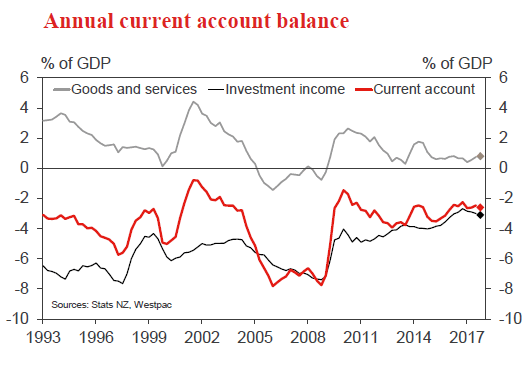
The surge in imports of capital equipment will contribute to an expected widening of the current account deficit over the year to December. We expect a deficit of 2.6% of GDP, from a revised 2.5% in September.
For the December quarter, the surge in imports overshadowed a modest rise in export volumes, leading to an increase in the goods trade deficit. Trade in services remained strongly in surplus, with growth in tourist numbers both into and out of the country. The current account deficit remains well within what we would consider a sustainable range. That is, a deficit of less than 3-4% will stabilise or even reduce New Zealand's net overseas debt position, relative to GDP.
Indeed, it's remarkable that the deficit has remained at historically low levels throughout the economy's upturn. Low global interest rates have played a major part in keeping the country's net interest costs down. Stronger returns from export sectors such as tourism have also played a role.
But perhaps the most significant factor is that we haven't seen a repeat of the surge in domestic demand – largely fuelled by offshore borrowing – that characterised the economic boom of the 2000s. Increased regulation and greater caution since the Global Financial Crisis have constrained the growth in overseas borrowing, contributing to a slower but arguably more sustainable economic upswing this time around.
Data Previews
Aus Jan housing finance (no.)
Mar 13, Last: –2.3%, WBC f/c: –1.0%
Mkt f/c: -0.2%, Range: -1.5% to 1.0%
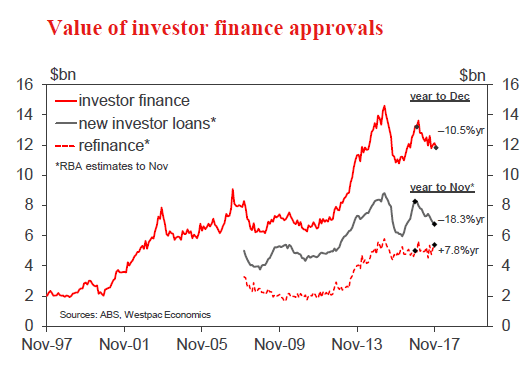
- Australian housing finance approvals posted a soft finish to 2017, the number of approvals for owner occupiers dipping 2.3%. Approvals ex refi were down 3.4%mth but still up 2.1%yr. The value of housing finance approvals to investors also posted a decline, down 2.6% to be 10.5% lower for the year with a notably sharper fall in NSW.
- Industry figures suggest Jan was another soft month for owner occupier approvals – we expect a 1.0% decline. As always, housing data should be treated with extra caution around the summer holiday low period as seasonal adjustment can amplify monthly volatility.
 Aus Q1 AusChamber-Westpac survey of Industrial Trends
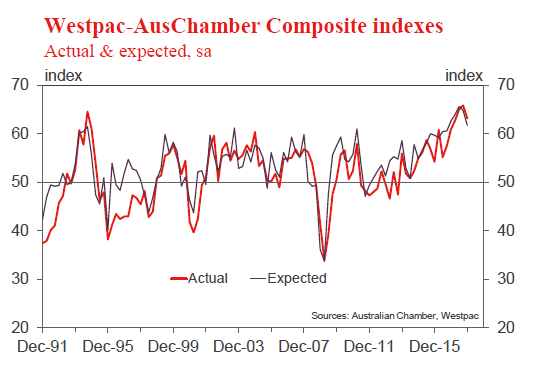
Mar 13, Last: 63.4
- The Australian Chamber-Westpac survey of the manufacturing sector provides a timely update on conditions in the sector and insights into economy-wide trends. The Actual Composite tracks a range of demand related measures including investment and employment. The Q1 survey was conducted during February and the start of March.
- In Q4, the Actual Composite moderated to 63.4 from 66.1 in Q3, after a rebound from a dip in June 2015 to 55.1. Strength is centred on a lift in new orders and output as well as increased overtime and an uplift in employment.
- Manufacturing is benefitting from a rise in public infrastructure, non-mining business investment, and stronger world growth combined with a relatively low AUD. However, moderate consumption constrained by low wage growth and intensity from offshore competition are headwinds.
 Aus Mar Westpac-MI Consumer Sentiment
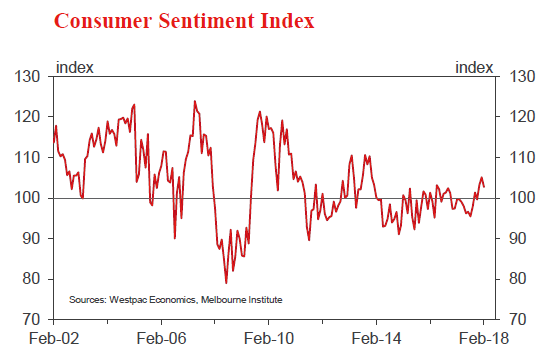
Mar 14 Last: 102.7
- The Westpac-Melbourne Institute Consumer Sentiment Index fell by 2.3% to 102.7 in Feb from 105.1 in Jan. The Feb survey was conducted amid a wave of volatility across global financial markets. Under the circumstances, the slight fall in sentiment is a decent result, particularly given that it leaves the index in net optimistic territory above the 100 mark for a fourth consecutive month – a run that follows a twelve month stretch in which pessimists were in the ascendency for all but one month.
- The March survey is in the field over the week ended March 10. Financial markets have settled down somewhat, the ASX200 up over 2% since the Feb survey. The global backdrop remains unsettled though with increasing trade tensions. Further signs of house price declines locally are also likely to weigh on sentiment.
 NZ Feb house sales and prices
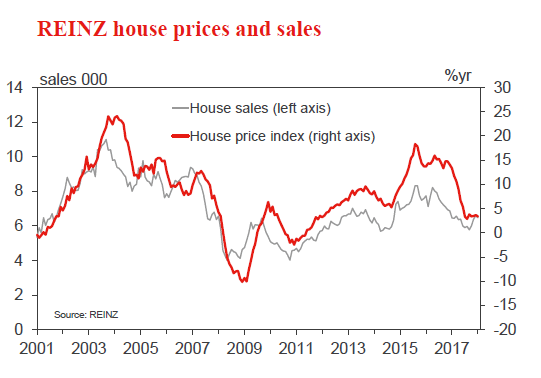
- Due the week starting 12 March, Sales last: -2.0%, Prices last; +3.4%yr
- January's REINZ housing market data was a little softer than the preceding three months. However, housing market data can be choppy on a month-to-month basis, particularly around the holiday season. In addition, monthly sales figures tend to get revised higher over time. We we still think that the housing market best characterised as enjoying a bit of a resurgence at present, following a drop in mortgage rates in late-2017 and the passing of the election.
- With fixed mortgage rates falling further in recent weeks, and the Reserve Bank slightly easing its LVR mortgage lending restrictions, we expect the current market buoyancy to continue for a few more months.
- However, later this year we expect fixed mortgage rates to start increasing, and the Government's policy program of cooling the housing market will bear on the market. We expect that these conditions will see the housing market slow through the back half of 2018.
 NZ Q3 current account, % of GDP
Mar 14, Last: -2.5%, Westpac f/c: -2.6%
- We estimate that the annual current account deficit widened slightly to 2.6% of GDP.
- In seasonally adjusted terms, the goods trade deficit is expected to have widened by about half a billion dollars in the December quarter. A modest rise in export volumes was overshadowed by a surge in import volumes, led by imports of capital equipment and vehicles (including two more Boeings for Air New Zealand's fleet).
- The services surplus was broadly unchanged in the December quarter. There was strong growth in tourist numbers both into and out of the country.
- We expect a slight narrowing of the investment income deficit for the December quarter, with a pullback in profits of overseas-owned firms after a few unusually strong quarters.
 NZ Q4 GDP Production-based GDP
Mar 15, Last: 0.8%, Westpac f/c: 0.6%, Mkt f/c: 0.6%
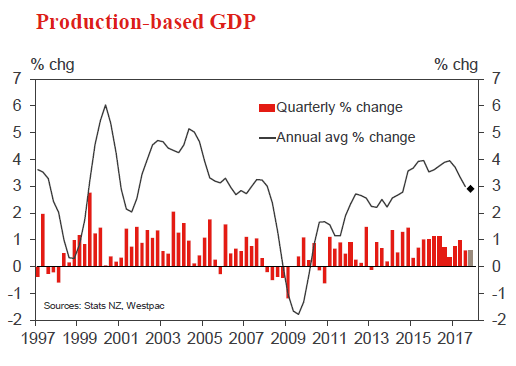
- We expect a 0.6% rise in the production measure of GDP. That compares to an average growth rate of 0.8% over the previous three quarters of 2017. With population growth still running strong at about 0.5% a quarter, this would mark the second quarter when growth has been barely above zero in per capita terms.
- There are no obvious one-off factors driving the quarterly result, just modest growth across a range of sectors. Retail and wholesale turnover were relatively brisk, but the services sectors were generally subdued, milk production fell, and the construction sector faced constraints on growth.
- For the year as a whole, we expect the growth rate to slow to 2.9%, compared to a peak of 4% growth in 2016.
 US Feb CPI
Mar 13, last 0.5%, WBC f/c 0.3%
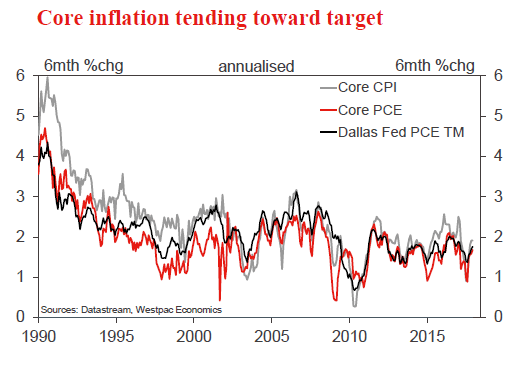
- The January headline monthly outcome of 0.5% was the strongest since early 2013 and materially above target if annualised. That said, a similar gain a year ago dropped out of the annual growth calculation, leaving it unchanged at 2.1%yr.
- A large contributor to inflation in the month, and indeed over the past six, was energy prices. In January, the energy index rose 3.0% as gasoline prices gained 5.7%.
- That said, a noticeable acceleration in core inflation (ex food and energy) has also been evident. Having recorded a 1.1% annualised gain in the six months to July 2017, core inflation has since accelerated to a 2.6% pace.
- Come February, energy won't be a key contributor, but core pressures will remain, resulting in a price gain circa 0.3%.
 US Feb retail sales
Mar 14, last -0.3%, WBC f/c 0.4%
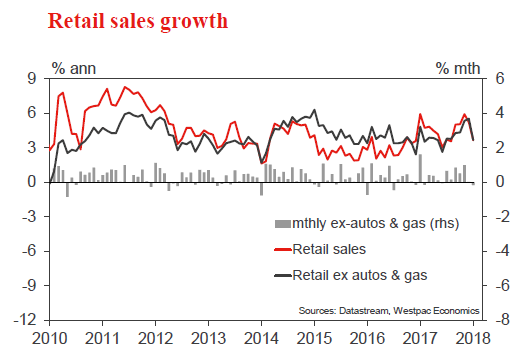
- Retail sales were a major disappointment in January, recording the weakest outcome in 11 months as households cut back on auto purchases and building materials. A downward revision was also made to the December outcome, exaggerating the weakness.
- It is worth noting that, excluding these more volatile items, core retail sales were also soft, a flat outcome in January following a revised 0.2% decline in December. Coming at a time of strong confidence and employment growth, the outcomes jar with the market's strong narrative.
- Come February, we anticipate spending will pick up. However, at less than 5% annualised, it is an outcome best regarded as solid not strong. For consumption to accelerate further, wage inflation will have to strengthen across the economy and confidence hold up.
Weekly Focus: From Symbolic to All-Out Trade War?
Market Movers ahead
- We do not expect recent developments on trade to evolve into an all-out trade war, but to remain largely verbal. However, the central theme will be if the US takes further steps against China and the potential for escalation.
- US core CPI will come down after a number of stronger-than-expected releases.
- In China, we expect data for industrial production, retail sales and fixed asset investments to confirm the picture of a moderate slowdown.
- Euro area wage growth is expected to remain around the current level.
- In Sweden, inflation will rebound somewhat but remain below the Riksbank's forecast. We expect house prices in Stockholm to have increased in February, as purchases moved forward prior to new amortisation rules taking effect in March.
- In Norway, the main event is, of course, the rate-setting meeting at Norges Bank, where we expect the rate path to be revised up a little.
Global macro and market themes
- The ECB shrugs off political risks and moves on unabated.
- Eurosceptic win in Italy leaves political risk premium in EUR and Italian bonds under pressure.
- The ECB manages to deliver 'hawkish' shift in guidance in a soft tone.
- Trump's trade rhetoric is yet another USD negative to add to 'the list'.
Sunset Market Commentary
Markets
Core bonds traded with a tentatively negative bias this morning. The scheduled talks between the US and North Korea caused a positive risk momentum on Asian markets. The impact of the Trump import taxes was considered as modest as US allies including the EU and Japan advocated that their exports were no security issue for the US. Bond markets settled in some kind of wait-and-see modus, counting down to the US payrolls. US job growth was strong (313 k + an upward revision of the January figure). However, the data series that really matters from markets, the AHE wage growth series, printed at a disappointing 0.1% M/M and 2.6% Y/Y (from 2.9% Y/Y, 2.8% was expected). Core bonds spike briefly up and down looking for direction. Bond yields finally trended slightly higher. However, the moves remain very modest. The combination of good job growth and modest inflationary pressure propelled US equities. The US yield curve bear steepens with yields between 2.5 (2-y) and 4.4 (bp) higher at the time of writing. Increases in German Bund yields are more modest ranging between unchanged for the 2-year yield and +2.2 bp for the 10-y yield. Spreads of intra-EMU bonds versus German Bunds were little changed today.
No big story to tell on USD trading today. EUR/USD preserved yesterday’s post-ECB decline, but there was little follow-through price action. Interest rate differentials widened a bit further in favour of the dollar, but didn’t help the US currency. This pattern didn’t change after the US payrolls. Job growth was very strong but wages again disappointed. This caused only a subdued market reaction both on interest rate markets and in the USD price action. EUR/USD filled bids in the 1.2275 area around the time of the publication of the payrolls, but the decline was blocked. The pair hovers again in the 1.23 area. USD/JPY tries to further extend intraday gains. The pair is additionally supported by a positive stock market reaction and soft BoJ talk. The pair tries to regain the 107 barrier, but it is a tough battle.
Sterling trading was again driven by technical considerations. UK data were mostly weaker than expected. The UK January trade deficit widened again on a monthly basis. Manufacturing production grew a meager 0.1% M/M and 2.7% Y/Y, below consensus. Construction output was also weaker than expected. Even so, sterling gained gradually further ground against the euro. Underlying euro softness after yesterday’s ECB press conference was maybe still at work. The rejected topside test of the EUR/GBP 0.8930/50 resistance was probably also in play. EUR/GBP is currently trading in the 0.8970 area. Cable is changing hands just in the 1.3850 area.
News Headlines
US job growth was very strong in February. The US economy added a stellar 313 000 jobs in February. The market only expected job growth of about 205 000. Data off the previous months were also upwardly revised. Still, the unemployment rate was unchanged at 4.1%. However, the most important part of the report for markets, wage growth, disappointed again. Average hourly earing rose only 0.1% M/M and 2.6% Y/Y. A rise of 0.2% M/M and 2.8% Y/Y was expected. So for now, there is no confirmation yet that a buoyant labour market is already resulting in a sustained acceleration of wages and prices as was suggested last month.
UK January activity disappointed again, suggesting a slow start for the UK economy in 2018. Manufacturing production rose a meagre 0.1% M/M and 2.7 % Y/Y (0.2% M/M was expected). Overall industrial production rebound 1.3%M/M and 1.6% Y/Y, reversing December decline due to the closure of the Forties pipeline. Still, overall production was below consensus. UK construction activity also tumbled 3.4% M/M to be 3.9% lower compared to the same month last year. The UK goods trade deficit widened again to 12.325 bln from 11.771 bln in December.
DOW breaks 25000, Dolllar weak after wage disappointment
DOW opens with triple digital gains and is trading above 25000 handle. This represents prior resistance at 24995.24, and 50% retracement of 25800.35 to 24217.47 at 25008.91. Rebounds from 2418.47 has resumed and should now target 61.8% retracement at 25195.68 and above.
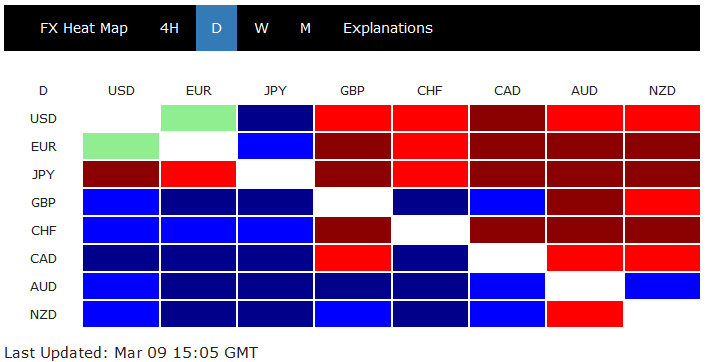
But, for the moment, rise from 24217.47 doesn't have impulsive look. So, it will likely start to feel heavy above 25195.69. 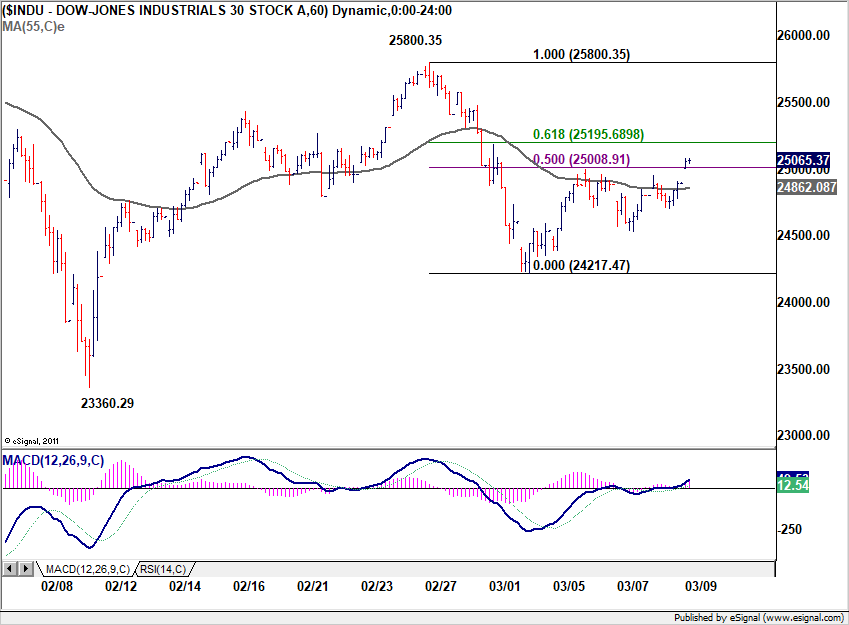 In FX, after wage growth disappointment, Dollar is in red for today except versus Yen and Euro. Aussie and Kiwi are the strongest ones, followed by Sterling and then CAD.
Jobs, Wages, Labor Force Growth: Fed on Path to Raise Rates
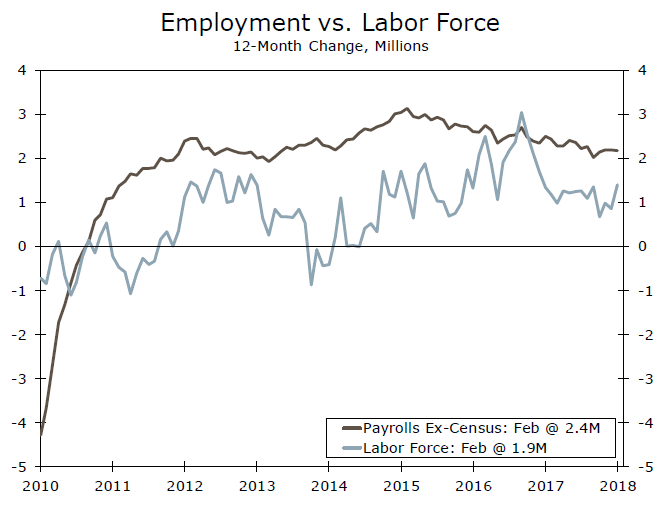
Another month of job and wage gains support the case for better growth (2.5-3.0 percent) for 2018 and continued consumer spending. The long view remains for job gains to outpace labor force growth.
February Jobs at 313,000: Solid Sign for Income and Growth
Nonfarm payrolls rose 313,000 in February with the three-month average at a solid 242,000 jobs. Job gains are consistent with 2.5-3.0 percent economic growth in the first half of 2018, with steady consumer spending, better business investment and a likely FOMC March rate hike, soon followed by another one in June.
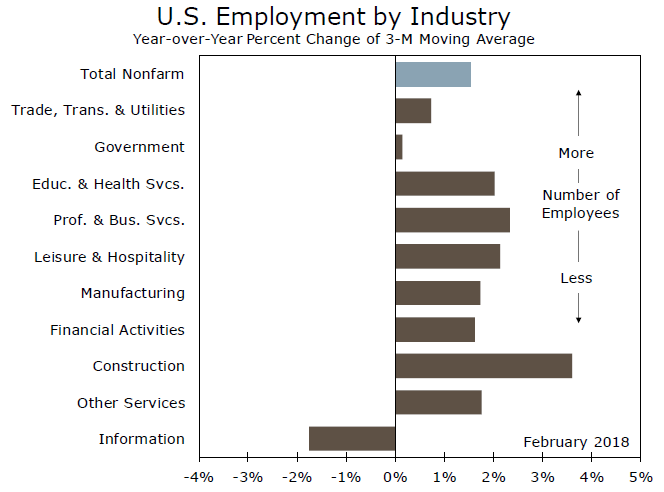
Jobs gains appeared in many sectors including business services, trade & transportation as well as education & health (top graph). Only information services jobs have declined in each of the past three months due to drops in jobs in telecommunications and motion pictures. Over the past three months, aggregate hours worked are up 3.1 percent – very solid and consistent with continued growth in personal income and consumption.
Inflation Leads Wages—Not Wages Lead Inflation
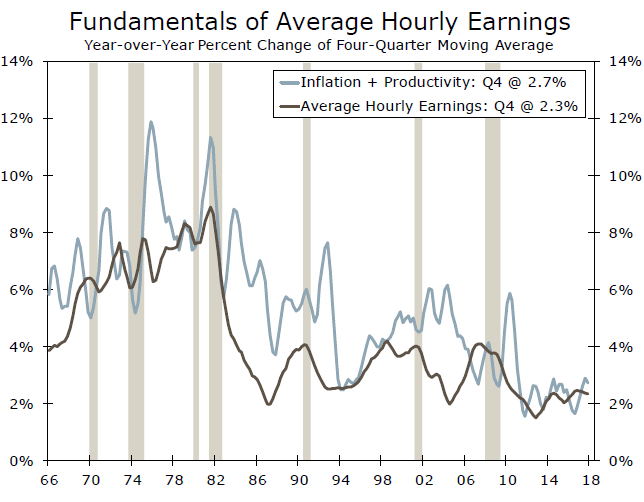
Contrary to the casual rhetoric, Granger causality tests reveal that inflation leads wages—not vice versa. This statistical result follows the theoretical model that workers and employers respond to higher inflation. Workers respond to inflation by trying to negotiate higher nominal wages to maintain a real wage standard. Employers find that higher inflation gives them the flexibility to raise wages and maintain profit margins.
Nominal average hourly earnings rose 0.15 percent in February and are up 2.6 percent over the year—slower than the January pace. While job growth remains strong, the gradual rise in earnings over the past six months signals higher incomes but also pressure on profits as firms have modest top-line pricing power. Longer term, subdued inflation readings and weak productivity numbers suggest limited gains in nominal wage growth.
The Long Game
Despite a strong labor force participation number in today's report, the overall trend for labor force growth has slowed more recently, compared to 2014-2016 rates. In February, the labor force jumped 0.5 percent, month over month, but is up just 1.2 percent over the past year. The trend slowdown reflects the ongoing demographic shifts that run quietly in the background of the month to month changes in the labor market. Growth in the working age population (ages 16+) has slowed to 0.6 percent per year, less than half the pace registered in the 2000s. Excluding workers over the age of 65, population growth has stalled over the past year.
Rising labor force participation among prime-age workers has offered some support, but the participation rate for workers 25-54 remains more than a point and a half below its pre-recession level and almost two and a half points below the high set in 1999. Unless participation rates continue to rise as solidly as this month, we expect payroll growth to slow and the unemployment rate to decline over the course of the year as businesses have increasing difficulty finding workers.
US: The Hits Just Keep On Coming!
U.S. payrolls surged ahead in February, up 313k against expectations for a 200k increase. Gains were largely in the private-sector hiring (+287k), and upward revisions to the prior two months added another 54k jobs.
The unemployment rate remained unchanged at 4.1% as increased numbers of new workers entered the labor force. The labor force participation rate rose to 63.0% in February, re-attaining it's post-recession peak. Overall participation in the labor force has been fairly steady since early 2016, but that hides an encouraging upward trend for core-age workers (25-54 yrs.), which is being offset by the large cohort of baby boomers entering retirement.
All eyes were on wage growth, which rose a moderate 0.2% m/m in February. That left average hourly earnings up 2.6%, a slight deceleration from 2.8% in January. Still, wages have advanced at a 3% annualized pace over the past three months.
Payroll gains were broad based, with hiring in both good and services sector accelerating. In the lead were construction (+61k), retail trade (+50k), professional and business services (+50k), manufacturing (+31k), financial activities (+28k) mining(+9k) and health care (+19k).
Key Implications
The job market has certainly got off to a roaring start in 2018. Hiring has picked up in recent months, driven by an acceleration in goods sector hiring, and the mining and manufacturing sectors in particular. Still, the unemployment rate has remained steady at 4.1%, as growth in the labor force has also gained speed.
While some might be a bit disappointed in the step back in wage growth, the trend over the past few months has been positive. And, with hiring growth like this, wage pressures are bound to accelerate further over the coming months, which should continue to draw people off the sidelines and into the workforce. On top of tax cuts, recently announced government spending increases will add further fuel to this fiery labor market.
There is little debate that the Fed will hike in March. Our latest forecast calls for three hikes in total over 2018, but if this momentum continues, there is certainly an upside risk to this view.
Modest Canadian Employment Gains in February
February saw the Canadian economy add 15.4k jobs on net, only slightly offsetting January's 88k loss. The participation was effectively unchanged, resulting in a drop in the unemployment rate to 5.8%.
In another reversal from January, it was part-time jobs that drove the gains, up 54.7k (January: -137k). Full-time employment declined 39.3k net positions, ending a five month streak of net job additions.
The bulk of the gains were seen in the public sector (+50.3k), while the private sector added 8.4k net jobs. Holding back the overall pace of gains was a decline in self-employment, down 43.3k in February after four months of net increases.
By industry, net job additions came from the service-producing sectors (+25.9k), with notable increases in health care (+24.5), other services (+16.6k), and transportation (-12.6k). Trade stood out on the negative side, shedding 22k net positions. Goods-producing industries subtracted 10.4k from the total, led by a 16.5k net decline in manufacturing employment.
On a regional basis, Ontario led the way, adding 15.7k net positions – not enough to offset January's 50.9k net loss. Performances were mixed across the remaining provinces. Of note, Alberta's unemployment rate fell to 6.7%, a 1.5 percentage point decline relative to its year-ago level, as the provincial participation rate fell slightly in February.
Wages decelerated a tick in February, to 3.1% year-on-year (from 3.3% in January). Despite part-time work driving the net job gains, aggregate hours worked were up 3.2% year-on-year, supported by a month-on-month gain of 0.6%.
Key Implications
Canada's monthly jobs market roulette wheel landed on 15.4k this month, a positive development but not enough to reverse January's losses. Beneath the headline were relatively encouraging details. Part-time employment may have led the gains as full-time pulled back, but gains in employees led the way as self-employment declined. What's more, hours worked gained nicely in February, and wage growth remained above 3%. With a tight labour market, headline job gains are likely to trend around or slightly below February's pace going forward – what will matter more are these underlying details.
With the monthly variation a casino game, yearly changes matter: Overall employment was up 282.5k on net relative to last February, entirely due to full-time job gains. To be sure, the pace of yearly gains is moderating (having peaked at 427k in December), but this is to be expect given that economic and labour market slack has largely been absorbed.
At a 3.1% pace in February, wage growth marked a fourth straight month above its longer-term average of 2.6%. This would normally be suggestive of a tight labour market. However, as expressed earlier this week, the Bank of Canada still sees wage growth as being below what they would expect in an economy without any labour market slack (at least up to this point: this was the second month of >3% wage gains, while the national accounts data reported a 4.9% y/y gain in 2017Q4). It thus seems that the Bank of Canada has set the wage gains of 2007/2008 as their guideline (wage growth at the time exceeded 4%, or more than 7% in national accounts measures). This suggests that today's solid wage numbers, while welcome, are unlikely to change the Bank's cautious stance.
Fed Evans prefers to wait “a little bit longer” before rate hike
Chicago Fed Charles Evans:
- Still concerned with low inflation
- "My own preference would be to wait a little bit longer, let the March anomalous inflation rate from a year ago fall out."
- "Let's make sure these sort of Amazon, disruptive kind of pricing models aren't continuing to find their way into keeping inflation lower than that."
- When inflation starts to show sign of heading to 2% target, he would be "much more confident" to continue "a gradual upward adjustment of the funds rate."