Sample Category Title
EUR/JPY Elliott Wave Analysis
EUR/JPY - 133.92
Although the single currency did fall earlier this month to as low as 131.17 (our short position entered at 133.50 met target at 131.50 with 200 points profit), as euro found renewed buying interest there and has staged a strong rebound, suggesting the correction from 134.50 has ended at 131.17 and retest of this level would be seen, however, break there is needed to confirm medium term upmove has resumed and extend gain to 135.00, and then 135.50-60. Having said that, loss of upward momentum should prevent sharp move beyond 136.00-10 and reckon 136.95-00 would hold, price should falter well below 138.45-50 (1.618 times extension of 109.49-124.10 measuring from 114.85), bring correction later.
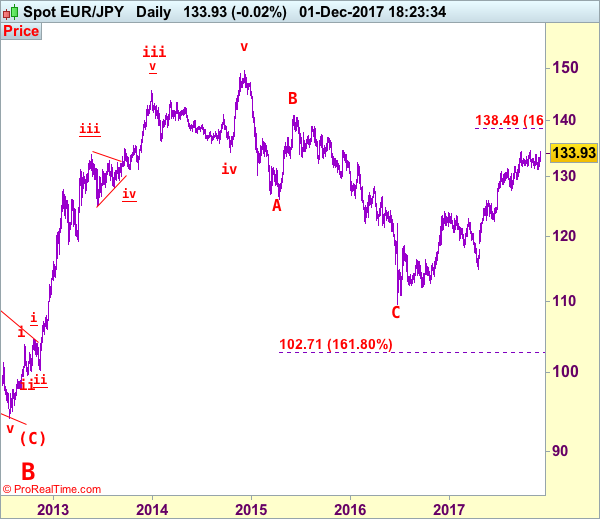
The daily chart is labeled as attached, early selloff from 169.97 (July 2008) to 112.08 is wave (A) of B instead of end of entire wave B and then the rebound from there to 139.26 is wave (B), hence, wave (C) has possibly ended at 94.12 with a diagonal triangle as labeled in the daily chart, hence upside bias is seen for further gain. Recent rally above indicated retracement level at 116.69 (50% Fibonacci retracement of the intermediate fall from 139.26-94.12) adds credence to this view and signal major reversal has commenced but first leg of this wave C has possibly ended at 149.79, hence wave 2 has commenced with wave A ended at 126.09, followed by wave B at 141.06, wave C commenced and could have ended at 109.49, indicated upside targets at 126.00 and 130.00 had been met and further gain to 135.00 would follow.
On the downside, whilst initial pullback to 133.50-60 cannot be ruled out, reckon 132.90-00 would limit downside and bring another rise later to aforesaid upside targets. Only below support at 131.72 would abort and signal the rebound from 131.17 has ended instead, bring another test of this level. Once this support is penetrated, this would suggest a temporary top is formed, bring retracement of recent rise to previous support at 130.62, then towards 130.00 later.
Recommendation: Short entered at 133.50 met target at 131.50 with 200 points profit and would turn long at 133.00 for 135.00 with stop below 132.00.
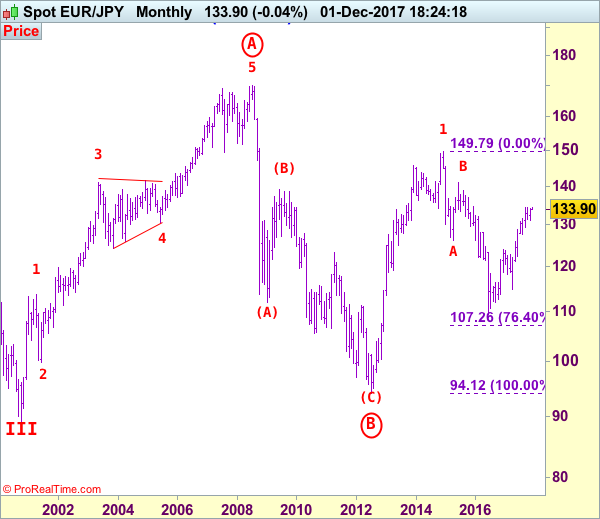
To re-cap the corrective upmove from the record low of 88.93 (18 Oct 2000), the wave A from there is subdivided as: 1:88.93-113.72, 2:99.88 (1 Jun 2001), 3:140.91 (30 May 2003), 4:124.17 (10 Nov 2003) and 5 ended at record high of 169.97 (21 Jul 2008). The brief but sharp selloff to 112.08 is viewed as a-b-c x a-b-c wave (A) of B. The subsequent rebound to 139.26 is (B) of B and (C) of (B) has possibly ended at 94.12 and in any case price should stay well above previous chart support at 88.93, bring rally in larger degree wave C towards 150.00.
Trade Idea: GBP/USD – Target met and buy at 1.3410
GBP/USD – 1.3490
Original strategy :
Bought at 1.3260, met target at 1.3450
Position: - Long at 1.3260
Target: - 1.3450
Stop: -
New strategy :
Buy at 1.3410, Target: 1.3600, Stop: 1.3350
Position: -
Target: -
Stop:-
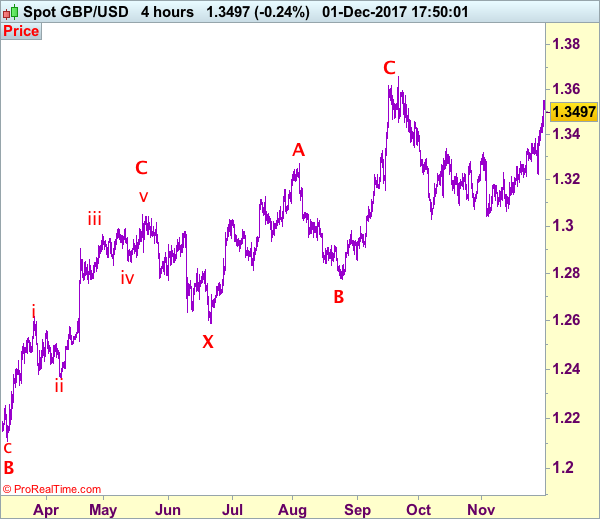
Cable rallied in line with our bullish expectation, our long position entered at 1.3260 met upside target at 1.3450 (with 190 points profit), this anticipated rise adds credence to our view that entire correction from 1.3658 has ended at 1.3027 earlier and upside bias remains for the rise from 1.3027 to extend gain to 1.3550, then 1.3595-00, however, reckon said recent high at 1.3658 (Sept high) would hold from here due to near term overbought condition, bring retreat later. Our preferred count is that (pls see the attached chart) the wave IV is unfolding as a complex double three (ABC-X-ABC) correction with 2nd wave B ended at 1.2774, hence 2nd wave C could have ended at 1.3658.
As we have taken profit on our long position entered at 1.3260, would be prudent to buy sterling again on pullback as 1.3400-10 should limit downside and bring another rise later. Below previous resistance at 1.3383 would defer and risk correction to 1.3335-40, break there would confirm top is formed instead, bring further fall to 1.3290-00 first.
Our preferred count on the daily chart is that cable's rebound from 1.3500 (wave (A) trough) is unfolding as a wave (B) with A ended at 1.7043, followed by triangle wave B and wave C as well as wave (B) has ended at 1.7192, the subsequent selloff is the larger degree wave (C) which is still unfolding with minor wave (III) of larger degree wave 3 ended at 1.1986, hence wave (IV) correction is in progress which could either be a triangle wave (IV) of a complex formation but upside should be limited to 1.3500 and price should falter well below 1.4000, bring another decline in wave (V) of 3 for weakness to 1.1500, then 1.1200.
OPEC’s Decision To Extend Production Cuts And The Volatility Of Bitcoin
Investors who were banking on OPEC to enforce some 'extraordinary measures” to rebalance markets were left empty-handed on Thursday, after the cartel simply agreed on extending oil output cuts until the end of 2018.
Although short-term oil bulls were offered a slight boost following OPEC's decision to extend production cuts by nine months, the overall muted market reaction verifies how this was already mostly priced in. There is even a suspicion that reports of both Nigeria and Libya agreeing to cap their production in 2018, were the main reasons why oil prices held steady following the meeting. While OPEC and Co. continue to cut production in an effort to boost prices, U.S. shale output has increased - with production rising 3% in September to 9.48 million barrels a day. It is becoming clear that oil prices will continue to remain exposed to downside risks, thanks to rising production of U.S. Shale scuppering OPEC's efforts to rebalance markets.
Taking a look at the technical picture, WTI Crude still fulfills the prerequisites of a bullish trend on the daily charts as there have been consistently higher highs and higher lows. A breakout above $58.00 may encourage a further incline higher towards $59.00. Alternatively, sustained weakness under $56.75 could trigger a decline back towards $56.00.
Dollar jittery as U.S. tax vote stalls
The Dollar weakened against a basket of major currencies on Thursday, after U.S. Senate Republicans delayed voting on their tax bill as a setback forced them to make tweaks a few hours before a planned final vote.
With the Greenback becoming extremely sensitive to any progress on U.S. tax reforms, there could be some action today depending on the outcome of the U.S. Senate's vote on tax reform legislation. From a technical standpoint, the Dollar Index remains depressed on the daily charts. Bears remain in control below the 93.50 lower high with the next level of interest at 92.55.
Commodity spotlight – Gold
Gold was under pressure during Thursday's trading session, with prices dipping towards $1270 as the risk-on sentiment and positive U.S. economic data reduced appetite for safe-haven assets.
Although the yellow metal has edged slightly higher today on the back of a weakening Dollar, bears remain in power below the $1280 resistance level. From a technical standpoint, sustained weakness below $1280 could trigger a further decline back towards $1267. Alternatively, a break above $1280, is likely to open a path back towards $1289.
Are Bitcoin bulls tired?
It has certainly been another explosively volatile trading week for Bitcoin which sprinted to a record high above $11400 on Wednesday.
I found it mind-boggling how the cryptocurrency entered a bear market by sharply depreciating towards $9000 after hitting record highs then back to a bull market in less than 24 hours – but with Bitcoin, we are seeing that anything is possible. With everyone's favorite cryptocurrency having no intrinsic value and being inherently unstable, there are growing concerns over this just being another massive speculative bubble. While Bitcoin has on repeated occasions bounced back stronger amid criticism and negativity, the current price action suggests that bulls may be tired.
Taking a peek at the technical picture, the $10000 psychological level seems quite significant. A yearly close above this level could signal further upside; alternatively sustained weakness under $10000 may spark jitters resulting in a decline back towards $9000.
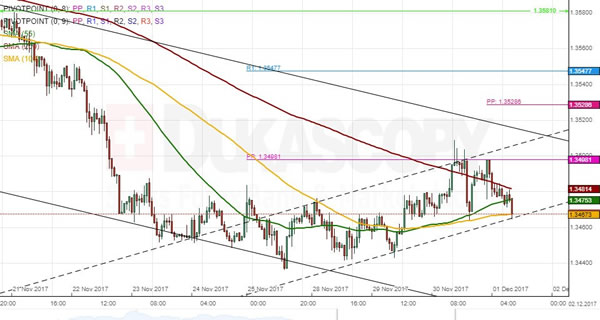
USD/SGD 1H Chart: Bearish Patterns Dominate
USD/SGD is being dominated by several channels, the most important of which in the short term are three. The US Dollar bounced off the upper boundaries of the two most senior channels on October 27 and subsequently began trading lower. Its bottom boundary was tested a month later near the 1.3440 mark. The pair has since recovered some of its lost positions and thus tested the weekly PP two times. It is expected that the most junior channel could be respected during the following two trading sessions until the psychological 1.35 mark is reached. However, technical indicators suggest that the rate might trade lower within next week. A possible downside target could be the 1.34 area where the bottom boundary of a five-month channel is located.
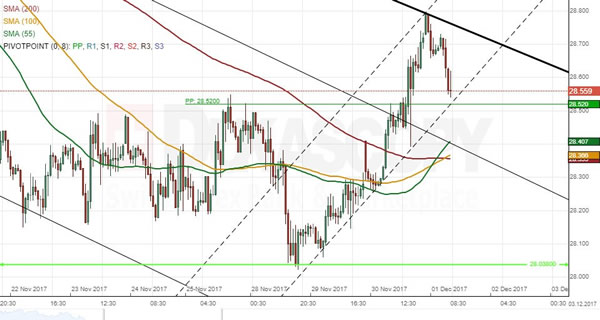
TRY/JPY 1H Chart: Lira Moves Away From Historic Low
The Turkish Lira has been trading in a channel down against the Japanese Yen for the last three months. During this time, a new descending channel was formed. After failing to edge down to the bottom boundary of the senior pattern last week, the Lira reached its ultimate low of 28.04 and reversed to the upside. Meanwhile, the pair breaching the shorter-term pattern yesterday might point to appreciation in both short and medium term; however, the upper line of the senior channel is yet to be breached circa 28.65. It is likely that the pair edges lower in this session and tries to make a retracement from the breached channel. However, the combined support of the 55-, 100– and 200-hour SMAs at 28.35 should limit further loses. This area is expected to mark a point of reversal from which the Lira might start its momentum north.
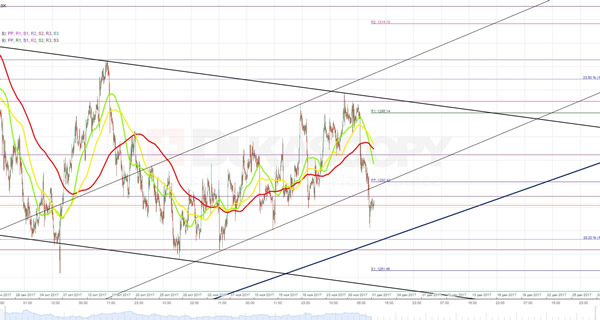
XAUUSD Analysis: Breaks From Junior Channel Up
Formation of a minor pennant pattern, indeed, pushed the further downwards. However, the fact that the buck continued to appreciate against the gold in based not only on release of satisfying macroeconomic data yesterday. Most probably the maximum that the pair has reached on November 27 was interpreted as a rebound from the upper trend-line of a larger descending channel, while the subsequent massive plunge simultaneously signified a breakout from the junior rising wedge formation. If this view dominates the market, then the bearish pressure is expected to continue until the pair reaches the lower support line of a dominant long-term ascending channel near 1,271.00. As for today, unless some event causes high volatility the pair is likely to fluctuate between the 1,276.50 and 1,271.50 levels.
EURUSD Analysis: Prepares To Hit 1.1940
In line with expectations, in first half of previous trading session the pair slipped to the bottom and, after reaching at the 200-hour SMA that was located slightly above the lower trend-line of a junior ascending channel, resumed the surge. By this morning, the currency rate has crossed practically all notable resistance levels. The only area left untested is located at 1.1936. Nevertheless, it is unlikely to stop the pair from reaching the upper boundary of a senior descending channel near 1.1940 by the end of the day. But even in case bears take the lead, for instance, after release of better than expected information on the US ISM Manufacturing PMI, combined support level formed mainly by the 100-hour SMA but also by the 61.8% Fibonacci retracement level is expected to neutralize the plunge.
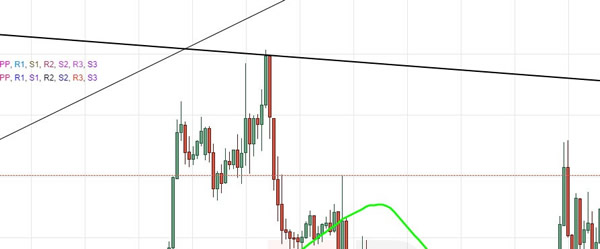
GBPUSD Analysis: Slowly Heads To Weekly R3
In accordance with expectations, in first half of previous trading session the cable made a minor pull back to 1.3440 and then resumed the surge. An existence of two barriers located at the 1.3500 and 1.3530 levels was confirmed, while the pair continued to climb to the top yesterday. As majority of pending orders both in 50 and 100 pip range are set to buy, the currency rate is expected to continue moving upwards today as well. The bullish scenario is also backed up by fundamental reasons, such optimism related to progress made on Brexit. However, there is a need to take into account that alleged resistance barriers located at the 1.3560, 1.3580 and 1.3590 might either halt or event slightly turnaround the pair, especially if it matches with release of the US ISM Manufacturing PMI.
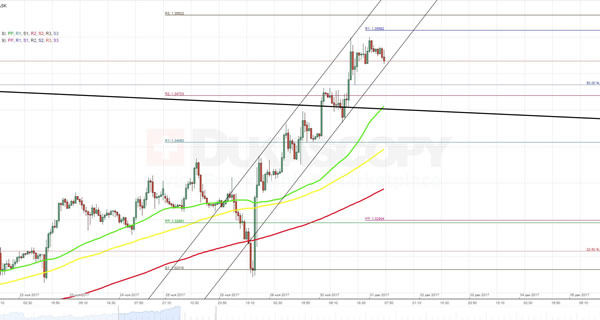
USDJPY Analysis: Tests Strong Resistance At 112.70
Unfortunately, neither existence of a rising wedge formation, nor the weekly R1 or the 50% Fibonacci retracement level stopped the rate from breaking to the top. However, this does not automatically mean dissolution of the pattern, as it still stay in force by making readjustment of the boundaries. Regardless of existence of the figure, in order to continue moving upwards, the pair will need to cross strong resistance zone located between the 112.62 and 12.70 marks. In addition to that, this barrier is strengthened by the 55-day SMA that lies at 112.75 as well as the 50% Fibonacci retracement level located at 113.00. In support of this assumption, 55% of pending orders in 100 pip range and 59% in 50 pip ranges are set to sell.
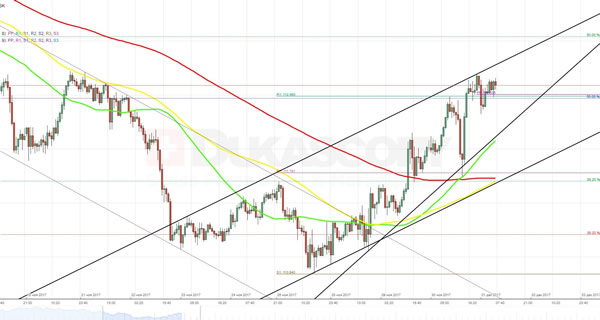
USD/JPY: US Core PCE Price Index
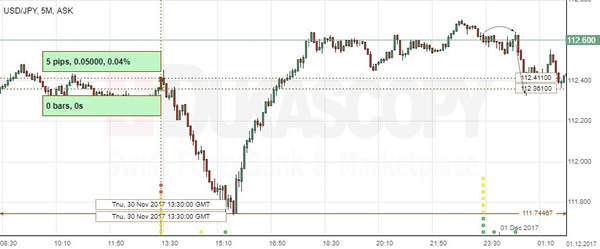
The Greenback made the last attempt to rise against the Yen before falling sharply on non-negative US economic data. The USD/JPY added 5 base points, ahead of the sharp fall to the 111.74 area. However, bulls put the pair back to the pre-data level of 112.60.
US consumer inflation growth weakened in October, as the hurricane-related increase in purchases of motor vehicles started to fade. The Fed’s closely watched inflation measure, the Core PCE Price Index excluding energy and food increased 1.4% year-over-year in October, though the figure undershot the bank’s 2% target for more than 5 years. Recent economic data strengthened projections for the Fed to raise borrowing costs once again in December.