Sample Category Title
Market Update – Asian Session: Asian Equities Open Generally Higher
Hang Seng Technology index trades lower by over 1%; Tencent -2.5%
China/Hong Kong
Markets opened mixed: Shanghai -0.1%, Hang Seng +0.3%
Hang Seng Information Technology Index -1.5%, Materials Index -0.9%; Utilities +0.3%
China Nov Caixin Manufacturing PMI declines despite m/m rises seen in the official manufacturing and non-manufacturing PMI data
(CN) CHINA NOV CAIXIN MANUFACTURING PMI 50.8 V 50.9E
(HK) Macau Nov Casino Rev MOP23.0B +22.6% y/y v +19%e
(CN) PBOC OMO: Skips OMO, says liquidity is at 'relatively high level' v CNY280B injected in 7,14,63-day reverse repos prior: For week net drain of CNY40B v net CNY150B injected w/w
(CN) PBoC sets yuan reference rate at 6.6067 v 6.6034 prior (prior close: 6.6090)
(CN) China: Some chipmakers eligible for import tax break
Japan
Nikkei225 opened +0.8%, later pared gains; closed: +0.4%
TOPIX Iron & Steel Index +1.2% (Nippon Steel +2%)
Nippon Paint [4612.JP] +8% (ended takeover talks with Axalta Coating Systems)
Sharp [6753.JP] +8% (to return to the first section of the TSE on Dec 7th)
Toshiba [6502.JP] +1.5% (renewed speculation related to settlement with Western Digital)
Little initial reaction seen to batch of Japanese data
JAPAN OCT NATIONAL CPI Y/Y: 0.2% V 0.2%E; EX FRESH FOOD (CORE) Y/Y: 0.8% V 0.8%E
JAPAN Q3 CAPITAL SPENDING EX SOFTWARE: 4.3% V 3.1%E; CAPITAL SPENDING Y/Y: 4.2% V 3.2%E
JAPAN OCT JOBLESS RATE: 2.8% V 2.8%E; JOB-TO-APPLICANT RATIO: 1.55 V 1.52E
BoJ Executive Dir Amamiya: Need to 'persistently' continue 'powerful' easing
Japan Fin Min Aso: Confirms no decision made on tobacco tax
Australia /New Zealand
ASX200 opened +0.4%, closed +0.4% ; Resources Index +0.6%
Billabong [BBG.AU]: +23% (received takeover offer from Boardriders)
(AU) Australia sells A$1B v A$1B indicated in 2.25% Nov 21, 2022 bonds, avg yield 2.1577%, bid to cover 3.94x
(NZ) New Zealand Fin Min Robertson: expects growth to strengthen through 2019 and 2020; most economists agree growth will soften next year; Will cut net debt to 20% of GDP within 5 years; Will need to re-prioritize some government spending
(NZ) NEW ZEALAND Q3 TERMS OF TRADE INDEX Q/Q: 0.7% V 1.3%E
(NZ) RBNZ Spencer to give speech on ‘low inflation’ on Dec 5th
Looking Ahead: Busy next week in terms of Australia data releases including Q3 GDP, Reserve Bank of Australia rate decision, Oct Retail Sales and Trade Balance data.
South Korea
Kospi opened +0.5%, later pared opening gains
Samsung Electronics +0.8%
Q3 GDP revised higher: South Korea Q3 Final GDP Q/Q: 1.5% v 1.4%e; Y/Y: 3.8% v 3.6%e
SOUTH KOREA NOV TRADE BALANCE: $7.84B V $8.5BE: Exports Y/Y: 9.6% v 10.3%e
South Korea Nov CPI M/M: -0.7% v 0.0%e; Y/Y: 1.3% v 1.8%e; Core Y/Y: 1.2% v 1.7%e (below Bank of Korea’s 2% target)
North America
US markets hit record highs amid continued focus on tax reform: Dow Jones +1.4%, S&P500 +0.8%, Nasdaq +0.7%, Russell 2000 +0.1%
S&P 500 Industrials +1.6%, Energy +1.5%
Tax Reform: (US) US Senate Majority Leader McConnell: Next floor votes will be at 11 AM on Friday
US Senate will not vote on the Republican tax bill on Thursday and debate to continue on Friday, says a separate financial press report
(US) Sen Cornyn (R-TX): a tax 'revenue trigger' probably will not work in the Senate – press
(US) Sen McCain (R-AZ): will support Senate GOP tax bill
US) Sen Collins (R-ME): not yet committed to voting for final GOP tax bill, still have a lot of concerns; personally favor corporate tax being lowered to 21% or 22% rather than 20% - press interview; - Senators are also still negotiation on a 'revenue trigger'
(US) Joint Committee on Taxation (JCT): Senate tax bill pays for less than half of its cost
Fed Speak: (US) Fed's Mester (hawk, non-voter): tax plan unlikely to have major impact on growth; inflation expectations remain reasonably well anchored
(US) Fed's Kaplan (moderate, voter): Biggest issue at the Fed is we're at or near full employment - comments in Dallas
(US) Atlanta Fed cuts Q4 GDP estimate to 2.7% from 3.4% on 11/22
Politics: US President Trump said to have ‘urged’ top Republicans to end probe related to Russia – NY Times
(US) Republicans reportedly planning a 2-week stop gap govt funding extension bill that would keep the govt open through Dec 22nd – press
M&A: Broadcom said to delay higher bid for Qualcomm until 2018 – US financial press
Europe
(UK) EU official: EU and UK reach agreement over Brexit divorce bill – press
(DE) SPD official Weil: coalition talks with Germany Chancellor Merkel's CDU/CSU could extend until at least Feb - German press
Levels as of 01:00ET
Hang Seng -0.2%; Shanghai Composite -0.2%; Kospi +0.1%
Equity Futures: S&P500 -0.3%; Nasdaq100 -0.2%, Dax flat; FTSE100 flat
EUR 1.1888-1.1915 ; JPY 112.32-112.69 ; AUD 0.7551-0.7571 ;NZD 0.6817-0.6842
Dec Gold +0.1% at $1,274/oz; Jan Crude Oil +0.3% at $57.56/brl; Dec Copper flat at $3.071/lb
China’s November PMIs Helped by ‘Double-11’
The Caixin manufacturing PMI for China slipped to 50.8 in November, from 51 in October. The reading also missed expectations of 51. Looking into the details, production and new orders increased at modest rates, while purchasing costs rose sharply. However, confidence towards the business outlook dropped to joint-lowest on record. As the agency noted, the manufacturing sector remained stable for most of November, despite 'some signs of weakness'. It forecast that the economy would remain stable for 4Q17. While growth should improve this year, when compared with 2016, it should decelerate in 2018. By contrast, the official manufacturing PMI rose +0.2 point to 51.8 in November this also beat expectations of a drop to 51.5. Non- manufacturing PMI increased +0.5 point to 54.8 last month. Divergence between official and private PMIs is nothing new. Part of the reason for the divergence is that the official data focus on large enterprises, while Caixin's focus on SMEs. This interpretation appears contradicting this month. Indeed, the official report suggests that SME PMI improved, while that for large companies slipped -0.2 point to 52.9 in November.
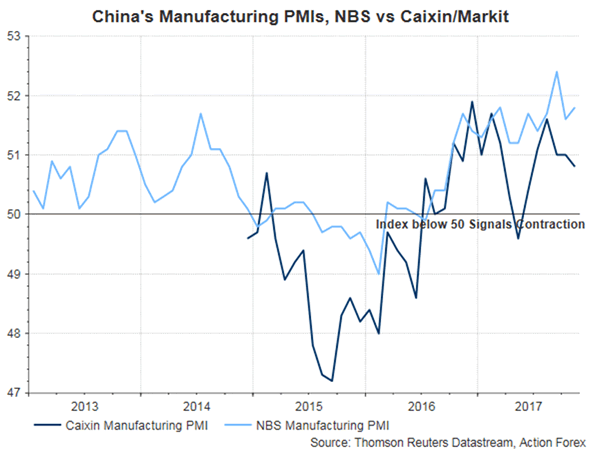
Official PMIs and November Macro Data Forecasts
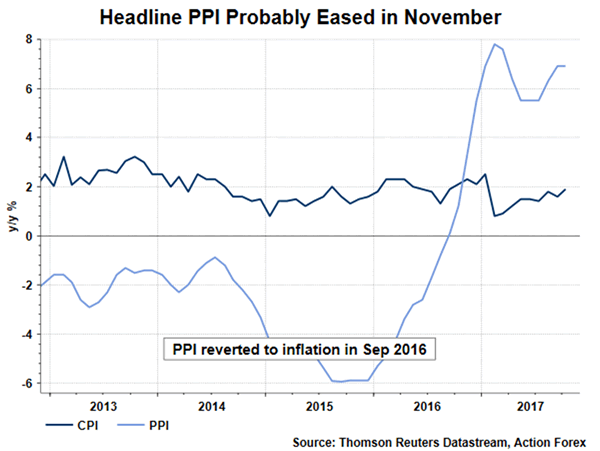
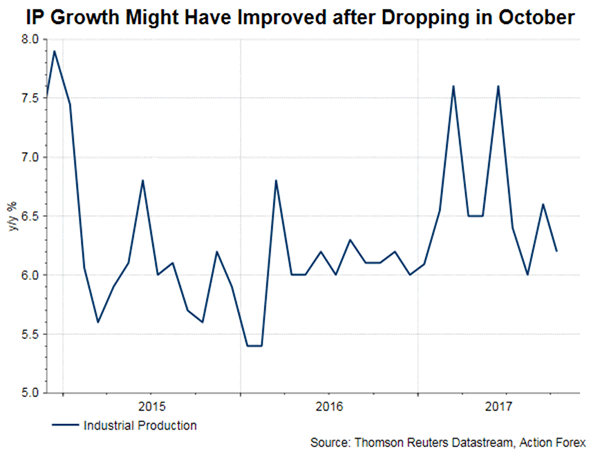
Take a look as the manufacturing PMI first. Its increase was mainly driven by production and new orders sub-indices which rose to 54.3 and 53.6, from 53.4 and 52.9 in October, respectively. Raw material sub-index slipped -0.2 point to 48.4 while the employment index was down, also by -0.2 point, to 48.8. Inflation pressure eased last month, as shown in the declines in input and output price sub-indices, due to high base effect. This might imply that headline PPI would also ease in November. Besides improvement in the new orders sub-index, the new export orders sub-index also rose +0.7 point to 50.8. This might suggest a pick-up in IP growth during the month
Non- manufacturing PMI, comprising of services and construction sector, increased +0.5 point to 54.8 last month. Both services and construction PMIs rose during the month. It is believe that a one-off factor, namely the 'double-11' festival, has helped boost the services sector (in particular retail, IT and logistic activities) performance. This might also help explain the outperformance of SMEs as many of the retail, IT and logistic activities belong to this category
Australia’s Manufacturing Sector Activity Accelerated In November
For the 24 hours to 23:00 GMT, the AUD declined 0.18% against the USD and closed at 0.7558.
LME Copper prices rose 0.1% or $4.5/MT to $6761.0/MT. Aluminium prices declined 1.4% or $29.0/MT to $2033.0/MT.
In the Asian session, at GMT0400, the pair is trading at 0.7563, with the AUD trading 0.07% higher against the USD from yesterday's close.
Overnight data revealed that Australia's AiG performance of manufacturing index sharply advanced to a level of 57.3 in November, indicating that manufacturing sector is expanding at an accelerated pace. The index had recorded a reading of 51.1 in the prior month.
Elsewhere, in China, Australia's largest trading partner, the Caixin/Markit manufacturing PMI index dropped more-than-anticipated to a level of 50.8 in November, dipping to its lowest in five months. The PMI had registered a reading of 51.0 in the prior month, while markets were anticipating the PMI to ease to a level of 50.9.
The pair is expected to find support at 0.7545, and a fall through could take it to the next support level of 0.7527. The pair is expected to find its first resistance at 0.7588, and a rise through could take it to the next resistance level of 0.7613.
Next week, investors would keep a close watch on the Reserve Bank of Australia's (RBA) interest rate decision.
The currency pair is showing convergence with its 20 Hr moving average and trading below its 50 Hr moving average.

Euro-Zone’s October Unemployment Rate Dipped To Its Lowest In Nearly 9 Years, Annual Inflation Came In Weaker-Than-Expected In November
For the 24 hours to 23:00 GMT, the EUR rose 0.38% against the USD and closed at 1.1897, after robust jobs data in the Euro-zone boosted investor sentiment.
The Euro-zone's unemployment rate surprisingly declined to 8.8% in October, hitting its lowest level since January 2009, thus suggesting that the region's jobs market has gathered further strength. Market participants had expected the region's unemployment rate to remain steady at 8.9%.
However, the region's flash consumer price index (CPI) advanced less-than-anticipated by 1.5% on an annual basis in November, thus justifying the European Central Bank's (ECB) cautious approach on monetary policy, as the nascent economic recovery across the common currency region has been struggling to prop-up inflation. The CPI had registered a rise of 1.4% in the previous month, while markets had anticipated for an increase of 1.6%.
Another set of data indicated that Germany's seasonally adjusted unemployment rate remained steady at a record low of 5.6% in November, at par with market expectations. On the other hand, the nation's retail sales unexpectedly retreated 1.2% on a monthly basis in October, confounding market consensus for an advance of 0.3%, thus highlighting that weak wage growth has curtailed the nation's household spending. In the previous month, retail sales had climbed 0.5%.
The greenback erased some of its losses against its major counterparts, amid renewed optimism over the US tax reforms after John McCaine, a rebel senator, declared his support for the Republican tax bill.
On the economic front, the number of Americans filing for fresh jobless claims unexpectedly dropped to a level of 238.0K in the week ended 25 November, following a revised reading of 240.0K in the prior week. Markets were anticipating initial jobless claims to record a steady reading. Moreover, the nation's personal spending rose 0.3% on a monthly basis in October, meeting market consensus and compared to a revised increase of 0.9% in the previous month. Further, the nation's personal income rose 0.4% MoM in October, beating market expectations for a gain of 0.3%. In the prior month, personal income had registered a rise of 0.4%.
On the contrary, the nation's Chicago Fed PMI dropped to a three-month low level of 63.9 in November, more than market expectations for a fall to a level of 63.0. In the previous month, the index had registered a level of 66.2.
In the Asian session, at GMT0400, the pair is trading at 1.1911, with the EUR trading 0.12% higher against the USD from yesterday's close.
The pair is expected to find support at 1.1836, and a fall through could take it to the next support level of 1.1761. The pair is expected to find its first resistance at 1.1959, and a rise through could take it to the next resistance level of 1.2007.
Ahead in the day, traders would look forward to the release of final Markit manufacturing PMI for November across the Euro-zone, scheduled in a few hours. Moreover, the US ISM manufacturing and the final Markit manufacturing PMIs for November as well as construction spending data for October, set to release later in the day, will garner significant amount of investor attraction.
The currency pair is trading above its 20 Hr and 50 Hr moving averages.

Pound Trading On A Stronger Footing, Ahead Of UK’s Manufacturing PMI
For the 24 hours to 23:00 GMT, the GBP rose 0.81% against the USD and closed at 1.3522, following news that the European Union leaders are set to offer a two-year Brexit transition deal as early as January after negotiators over the Northern Ireland border were nearing fruition.
In economic news, UK's seasonally adjusted Nationwide house prices climbed 0.1% on a monthly basis in November, in line with market expectations and compared to a rise of 0.2% in the prior month.
In the Asian session, at GMT0400, the pair is trading at 1.3531, with the GBP trading 0.07% higher against the USD from yesterday's close.
The pair is expected to find support at 1.3459, and a fall through could take it to the next support level of 1.3386. The pair is expected to find its first resistance at 1.3577, and a rise through could take it to the next resistance level of 1.3622.
Going ahead, investors would focus on Britain's Markit manufacturing PMI for November, slated to release in a few hours.
The currency pair is trading above its 20 Hr and 50 Hr moving averages.

Japan’s Annual Inflation Slowed As Expected In October
For the 24 hours to 23:00 GMT, the USD rose 0.6% against the JPY and closed at 112.65.
In the Asian session, at GMT0400, the pair is trading at 112.54, with the USD trading 0.1% lower against the JPY from yesterday's close.
Overnight data indicated that Japan's national consumer price index (CPI) rose 0.2% on a yearly basis in October, in line with market expectations. In the prior month, the CPI had registered a rise of 0.7%. Additionally, the nation's unemployment rate remained steady at 2.8% in October, at par with market expectations.
Other data indicated that the nation's final Nikkei manufacturing PMI rose less than initially estimated to a level of 53.6 in November, compared to a level of 52.8 in the prior month, while the preliminary figures had indicated an advance to a level of 53.8.
The pair is expected to find support at 111.95, and a fall through could take it to the next support level of 111.37. The pair is expected to find its first resistance at 112.91, and a rise through could take it to the next resistance level of 113.29.
Going forward, Japan's final 3Q GDP figures, consumer confidence index and the Nikkei services PMI, all due to release next week, will be on investors' radar.
The currency pair is trading above its 20 Hr and 50 Hr moving averages.

Swiss Economy Expanded As Expected In 3Q 2017
For the 24 hours to 23:00 GMT, the USD marginally declined against the CHF and closed at 0.9841.
Macroeconomic data revealed that Switzerland's seasonally adjusted gross domestic product (GDP) rose 0.6% on a quarterly basis in the three months to September, meeting market consensus. The GDP had posted a revised rise of 0.4% in the previous quarter. Moreover, the nation's KOF leading indicator unexpectedly climbed to a level of 110.3 in November, defying market expectations for a drop to a level of 109.7 and compared to a revised level of 109.8 in the previous month.
On the other hand, the nation's real retail sales fell 3.0% YoY in October. In the prior month, real retail sales had recorded a revised rise of 0.5%.
In the Asian session, at GMT0400, the pair is trading at 0.9839, with the USD trading slightly lower against the CHF from yesterday's close.
The pair is expected to find support at 0.9809, and a fall through could take it to the next support level of 0.9780. The pair is expected to find its first resistance at 0.9875, and a rise through could take it to the next resistance level of 0.9912.
Moving ahead, market participants will closely monitor Switzerland's consumer price inflation and unemployment rate data, both due to release next week.
The currency pair is trading below its 20 Hr and 50 Hr moving averages.

Loonie Trading On A Weaker Footing, Ahead Of Canada’s GDP Data
For the 24 hours to 23:00 GMT, the USD rose 0.25% against the CAD and closed at 1.2896.
In the Asian session, at GMT0400, the pair is trading at 1.2876, with the USD trading 0.16% lower against the CAD from yesterday's close.
The pair is expected to find support at 1.2848, and a fall through could take it to the next support level of 1.2821. The pair is expected to find its first resistance at 1.2906, and a rise through could take it to the next resistance level of 1.2937.
Ahead in the day, all eyes would be on Canada's crucial GDP data for September and unemployment rate for November.
The currency pair is trading between its 20 Hr and 50 Hr moving averages.

US Dollar Kick Starts Recovery Vs Japanese Yen
Key Highlights
- The US Dollar found support near 110.80-110.00 against the Japanese Yen, and started an upside move.
- There was a break above a crucial bearish trend line with resistance at 111.80 on the 4-hours chart of USD/JPY.
- The US Initial Jobless Claims for the week ending Nov 25, 2017 declined to 238K.
- Japan’s National CPI in Oct 2017 increased to 0.2%, compared with the last +0.7%.
USDJPY Technical Analysis
The US Dollar was in a major downtrend until it found support near 110.80-110.00 against the Japanese Yen. The USD/JPY pair is now moving higher and is placed well above 112.00.
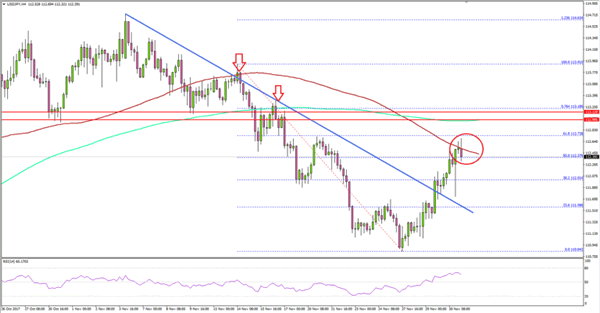
Looking at the 4-hours chart, there was a break above a crucial bearish trend line with resistance at 111.80. The pair also moved above the 38.2% Fib retracement level of the last decline from the 113.91 high to 110.84 low.
On the upside, the pair is now facing a couple of key resistances near 112.50, the 100 simple moving average (4-hour, red), 113.00 and the 200 simple moving average (green, 4-hour).
Once the pair settles above 112.50 and 113.00, there could be a retest of the all-important 114.50 resistance area. On the downside, supports are seen at 112.00 and 111.80.
US Initial Jobless Claims and Core Personal Consumption Expenditure
Recently in the US, the Initial Jobless Claims figure for the week ending Nov 25, 2017 was released by the US Department of Labor. The market was looking for a rise from the last reading of 239K to 240K.
However, the actual was better than the forecast as there was a decline in claims to 238K. On the other hand, the last reading was revised up from 239K to 240K.
The US Core Personal Consumption Expenditure for Oct 2017 was released by the US Bureau of Economic Analysis. The forecast was slated for an increase of 1.4% in the index compared with the same month a year ago.
The actual was similar to the forecast as the index increased by 1.4%. Moreover, the US Personal Income in Oct 2017 increased by 0.4%, better than the forecast of 0.3%.
Overall, the result was positive and helped USD/JPY in gaining traction above 112.00.
Economic Releases to Watch Today
Germany’s Manufacturing PMI for Nov 2017 – Forecast 62.5, versus 62.5 previous.
France Manufacturing PMI Nov 2017 – Forecast 57.5, versus 57.5 previous.
Spanish Manufacturing PMI for Nov 2017 – Forecast 56.5, versus 55.8 previous.
Euro Zone Manufacturing PMI for Nov 2017 – Forecast 60.0, versus 60.0 previous.
UK Manufacturing PMI for Nov 2017 – Forecast 55.5, versus 55.3 previous.
US Manufacturing PMI for Nov 2017 – Forecast 54.2, versus 53.8 previous.
US ISM Manufacturing Index for Nov 2017 – Forecast 58.4, versus 58.7 previous.
Canada’s Net Employment Change Nov 2017 – Forecast 10K, versus 35.3K previous.
Canada’s Unemployment Rate Nov 2017 – Forecast 6.2%, versus 6.3% previous.
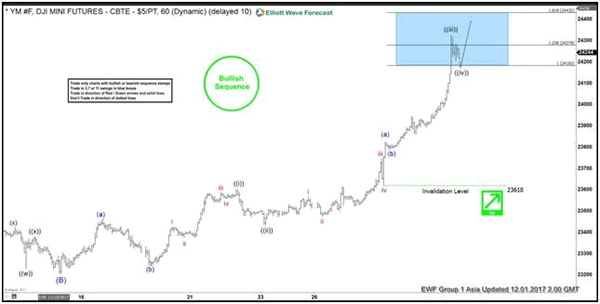
Elliott Wave View: Dow Future
Dow Future Short term Elliott Wave view suggests that Intermediate wave (B) ended at 23204. The rally from there is proposed to be unfolding as a leading diagonal Elliott wave structure. Minute wave ((i)) ended at 23599, Minute wave ((ii)) ended at 23432, and Minute wave ((iii)) ended at 24328. Minute wave ((iv)) is in progress to correct cycle from 11/23 low and while pullbacks stay above 23618, expect another push higher to finish Minute wave ((v)). The 5 waves leading diagonal rally from 11/15 low should end Minor wave 1 of a larger degree when Minute wave ((v)) is complete later. Afterwards, Index should pullback in Minor wave 2 in 3, 7, or 11 swing before the rally resumes. We don’t like selling any proposed pullback.
YM_F Dow Future 1 Hour Elliott Wave Chart