Sample Category Title
Euro Punches Past 1.17 On Strong German GDP
The euro has posted gains in the Tuesday session and is trading at a 3-week high. Currently, EUR/USD is trading at 1.1716, up 0.42% on the day. In economic news, German Preliminary GDP accelerated to 0.8% in the third quarter, above the estimate of 0.6%. German Final CPI remained unchanged at a flat 0.0%. Eurozone Flash GDP remained unchanged at 0.6%, matching the forecast. ZEW Economic Sentiment reports were mixed. The German release of 18.7 missed the forecast of 19.8, while the Eurozone reading jumped to 30.9, above the estimate of 29.3 points. Central bankers will attend an ECB event in Frankfurt, and the markets will be listening closely to Mario Draghi and Janet Yellen.
German GDP jumped to 0.8% in the third quarter, recording its strongest quarter since 2014. Germany’s economy is growing at annualized rate of 2.8% in 2017. The catalyst for the strong reading was an increase in business investment, as sales of machinery and equipment increased. German fundamentals remain strong, as business and consumer confidence is high and unemployment remains at record-low levels. However, the positive economic conditions have failed to trigger much inflation, which has been a problem throughout the eurozone. German Final CPI dripped to 0.0% in October, the first time inflation has not moved higher since May. Germany has been the locomotive for the euorozone, and boosted traditional laggards such as France and Spain. Geopolitical concerns such as Catalonia and Brexit have the potential to crash the party, but in the meantime, eurozone indicators have generally been pointing upwards.
With central banks signalling major policy shifts, communicating clearly with markets has become even more critical. The ECB is hosting a meeting on the challenges of central bank communication, and Janet Yellen and Mario Draghi will both be participating in the discussions. The ECB is set to taper its asset-purchase program in January, while the Fed has started trimming its massive balance sheet. Both Yellen and Draghi are all-too-familiar with unwanted market movement when investors have misinterpreted the Fed or the ECB, and will not want to repeat past mistakes.
Market Update – European Session: European GDP Data Shows A Broad-Based Recovery Underway
Notes/Observations
German economic engine humming along; other European GDP data beats expectations as well (Italy, Poland); could increase the pressure from Germany for monetary policy to be normalized more quickly than seen currently
UK CPI registered a slight miss but remained elevated; won't change the trajectory of interest rates; GBP remains soft on political concerns
Overnight
Asia:
China Oct Industrial Production Y/Y: 6.2% v 6.7%e
China Oct Retail Sales Y/Y: 10.0% v 10.5%e
China National Stats Bureau (NBS): Jobless rate below 5%; CPI is at ideal level
China State Researcher Zhu sees 2018 GDP growth of 6.5% and CPI at 3%
Australia Oct NAB Business Conditions: 21 v 14 prior (record high);
Bank of Japan (BOJ) Gov Kuroda: Need continue to pursue powerful monetary easing to make sure that positive inflation developments are not cut short
Europe:
PM May has granted parliament full vote on Brexit deal. Brexit Secretary Davis made the concession to Labour and pro-European Tories, allowing parliament to vote on the exit agreement and implementation bill.
Davis insisted Britain would still leave the EU in March 2019 regardless of whether parliament rejected the exit deal
Brexit Min Davis: Parliament will get a vote on the final Brexit deal before the country leaves EU; if parliament rejects the Brexit deal, a no-deal Brexit ensue
Americas:
Bipartisan group of senators reportedly have come to tentative agreement on loosening post-crisis banking regulations. Would exempt banks with under $100B in assets from tougher oversight and they would not have to perform annual stress tests. Would exempt banks with $100-250B in assets from the stricter Fed regulation after 18 month, but would give the Fed leeway to re-designate these banks at their discretion
Treasury Sec Mnuchin: Looks forward to successful House tax vote this week; Imposes 183.4-194.9% duties on China plywood imports. US job mkt has more room to grow; Trump won't bend on 20% corporate tax rate. very supportive of President Trump's decision to pick Powell for Fed Chair
Mexico Foreign Min Videgaray: aware that a "no deal" scenario is possible on NAFTA; hope to have a good outcome but Mexico is preparing for many scenarios
Economic Data:
(SE) Sweden Oct Maklarstatistik Housing Prices Y/Y: 7.0% v 9.0% prior
(NO) Norway Q4 Consumer Confidence: 17.3 v 15.7 prior
(IN) India Oct Wholesale Prices (WPI) Y/Y: 3.6% v 3.0%e
(DE) Germany Q3 Preliminary GDP Q/Q: 0.8% v 0.6%e; Y/Y: 2.8% v 2.3%e; GDP NSA Y/Y: 2.3% v 2.0%e
(DE) Germany Oct Final CPI M/M: 0.0% v 0.0%e; Y/Y: 1.6% v 1.6%e
(DE) Germany Oct Final CPI EU Harmonized M/M: -0.1% v -0.1%e; Y/Y: 1.5% v 1.5%e
(FI) Finland Oct CPI M/M: 0.0% v 0.2% prior; Y/Y: 0.5% v 0.8% prior
(FI) Finland Sept GDP Indicator Y/Y: 3.8% v 3.7% prior
NO) Norway Q3 Overall GDP Q/Q: 0.7% v 1.1% prior; Mainland GDP Q/Q: Y/Y: 0.6% v 0.5%e
(RO) Romania Q3 Advance GDP Q/Q: 2.6% v 1.1%e; Y/Y: 8.8% v 6.2%e
(ES) Spain Oct Final CPI M/M: 0.9% v 0.9%e; Y/Y: 1.6% v 1.6%e
(ES) Spain Oct Final CPI EU Harmonized M/M: 0.6% v 0.6%e; Y/Y: 1.7% v 1.7%e
(ES) Spain Oct CPI Core M/M: 0.6% v 0.1%e; Y/Y: 0.9% v 1.2%e
(CZ) Czech Q3 Advance GDP Q/Q:0.5% v 0.3%e; Y/Y: 5.0% v 4.7%e
(HU) Hungary Q3 Preliminary GDP Q/Q: 0.8% v 0.7%e; Y/Y: 3.6% v 3.7%e
(CH) Swiss Oct Producer & Import Prices M/M: 0.5% v 0.5% prior; Y/Y: 1.2% v 0.8% prior
(SE) Sweden Oct CPI M/M: -0.1% v +0.1%e; Y/Y: 1.7% v 1.8%e
(SE) Sweden CPI CPIF M/M: -0.1% v +0.1%e; Y/Y: 1.8% v 2.0%e, CPI Level: 323.38 v 323.86e
(NL) Netherlands Q3 Preliminary GDP Q/Q: 0.4% v 0.4%e; Y/Y: 3.0% v 3.4%e
(IT) Italy Q3 Preliminary GDP Q/Q: 0.5% v 0.5%e; Y/Y: 1.8% v 1.7%e
(PD) Poland Q3 Preliminary GDP Q/Q: 1.1% v 0.8%e; Y/Y: 4.7% v 4.5%e
(UK) Oct CPI M/M: 0.1% v 0.2%e; Y/Y: 3.0% v 3.1 %e; CPI Core Y/Y: 2.7% v 2.8%e; CPIH Y/Y: 2.8% v 2.9%e
(UK) Oct RPI M/M: 0.1% v 0.2%e; Y/Y: 4.0% v 4.1%e, RPI-X (ex-mortgage interest payment) Y/Y: 4.2% v 4.2%e
(UK) Oct PPI Input M/M: 1.0% v 0.8%e; Y/Y: 4.6% v 4.8%e
(UK) Oct PPI Output M/M: 0.2% v 0.3%e; Y/Y: 2.8% v 2.9%e
(UK) Oct PPI Output Core M/M: 0.1% v 0.3%e; Y/Y: 2.1% v 2.9%e
(UK) Sept ONS House Price Index Y/Y: 5.4% v 4.8% prior
(PT) Portugal Q3 Preliminary GDP Q/Q: 0.5% v 0.7%e; Y/Y: 2.5% v 2.8%e
(DE) Germany Nov ZEW Current Situation Survey: 88.8 v 88.0e; Expectations Survey: 18.7 v 19.5e
(EU) Euro Zone Q3 Preliminary GDP (2nd reading) Q/Q: 0.6% v 0.6%e; Y/Y: 2.5% v 2.5%e
(EU) Euro Zone Sept Industrial Production M/M: -0.6% v -0.6%e; Y/Y: 3.3% v 3.2%e
(EU) Euro Zone Nov ZEW Expectations Survey: 30.9 v 26.7 prior
Fixed Income Issuance:
(ID) Indonesia sold total IDR19.4T in 3-month,12-month Bills; 5-year; 10-year and 15-year Project-based Sukuk (PBS)
(NL) Netherlands Debt Agency (DSTA) sold €2.5B vs. €2.0-3.0B indicated range in 0.75% 2027 DSL bonds; Avg Yield: 0.511% v 0.475% prior
(ES) Spain Debt Agency (Tesoro) sold total €5.97B vs. €5.5-6.5B indicated range in 6-month and 12-month Bills
(ZA) South Africa sold total ZAR3.3B vs. ZAR3.3B indicated in 2031, 2037, 2044 and 2048 bonds
SPEAKERS/FIXED INCOME/FX/COMMODITIES/ERRATUM
Equities
Indices [Stoxx600 -0.2% at 385.5, FTSE +0.1% at 7425, DAX +0.1% at 13085, CAC-40 +0.1% at 5347, IBEX-35 +0.2% at 10066, FTSE MIB +0.2% at 22487, SMI flat at 9158, S&P 500 Futures -0.1%]
Market Focal Points/Key Themes: European Indices trade little changed in a relatively flat session so far coming off the earlier highs as the Euro strengthens on better German GDP and ZEW numbers. In the UK large caps Vodafone and Tesco trade sharply higher, helping prop up the index, as Vodafone raised its outlook and the CMA provisionally cleared Tesco's takeover of Bookers Group. In Germany Infineon trades almost 5% higher after upbeat 2018 guidance, while Henkel trades slower after results. Miners are among the leading decliners on the Stoxx 600 as copper prices fall. Looking ahead notable earners include retailers Home Depot and TJX.
Equities
Consumer discretionary [- Bookers [BOK.UK] +5.0%, Tesco [TSCO.UK] +4.9% (CMA provisionally clears Tesco acquisition of Bookers), ITV [ITV.UK] -6% (Earnings), DCC [DCC.UK] +1.0% (Earnings), B&M [BME.UK] -2.0% (Earnings)]
Industrials: [Henkel [HEN.DE] -3.5% (Earnings), Alstom [ALO.FR] +3.5% (Earnings)]
Technology: [Infineon [IFX.DE] +4.3% (Earnings), Computacenter [CCC.UK] +7.5% (trading update)]
Telecom: [Vodafone [VOD.UK] +4.3% (Earnings)]
Energy: [RWE [RWE.DE] -1.2% (Earnings)]
Real Estate:[Bovis [BVS.UK] +1.3% (Earnings)]
Speakers
Fed Chair Yellen, ECB's Draghi, BOE Gov Carney and BOJ Gov Kuroda all participated on an ECB panel in Frankfurt
ECB's Draghi: noted that forward guidance had become a full policy instrument
ECB's Nouy (SSM chief): The clock was ticking for banks to move quickly if they wanted to leave the UK after Brexit - comments from Frankfurt
ECB's Lautenschlaeger (Germany): Imperative to sort out non-performing loans. ECB has led the way with its work on NPLs; to begin providing feedback later in Nov
EU Presidency office said to be eyeing capping deposit withdrawals if banks are found to be failing
Spain PM Rajoy: Catalan takeover was working well and saw 2018 GDP around 3% if regional issue were resolved. Aim was to stop the separatist from winning at the Dec 21st regional elections but if separatists did win they must respect the law. A separatist win would not force any general election as Rajoy vowed to serve a full 4-year term
German Finance Ministry stated that domestic economy continued its strong upturn driven by growth in global demand for industrial goods
German ZEW Economists noted that high levels of growth in Europe supported further growth within Germany and raised expectations for the coming six months
IMF raised South Korea 2017 GDP growth forecast from 3.0% to 3.2%
Fed's Evans (dove, voter) spoke at the ECB conference in Frankfurt and called for a new approach to rate-setting that would allow the central bank to respond to shocks when interest-rate cuts alone were not enough. Price level targeting might be a good way to go but needed more study. For any new policies to succeed the Fed must deliver on current 2% inflation target
Currencies
USD was mixed in the session.
EUR/USD was back above the 1.17 handle as European GDP data beat expectations (Germany, Italy, Poland). Dealers noted that the better growth outlook could increase the pressure from Germany for monetary policy to be normalized more quickly than seen currently
GBP was softer after Oct CPI data came in below expectations. The 3.0% annual reading matched the highest level from 2012. Dealers noted that the inflation data won't change the trajectory of interest rates. Dealers noted that weakness in today's session still simmering from political uncertainty and Brexit concerns within the UK.
SEK currency was softer following some disappoint CPI data for Oct. EUR/SEK rose from 9.80 to above 9.85 as dealers now saw the 1st potential repo-rate increase from Swedish Central Bank (Riksbank) in October 2018 with risk tilted toward an even later hike
Fixed Income
Bund futures trade at 162.11 up 6 ticks, with technical levels in focus. Support lies at 162.00, followed by 161.50. Resistance stands initially at 163.51, followed by 164.25.
Gilt futures trade at 124.50 unchanged after inflation remained static at 3% in October, defying expectations of a rise among economists and at the Bank of England. Continued upside eyeing 125.75 then 126.47. Downside targets include 124.24 then 123.74.
Tuesday's liquidity report showed Monday's excess liquidity rose from €1.8595T to €1.864T and use of the marginal lending facility dropped to €96M from €118M - Corporate issuance saw a wrath of corporate IG supply come to market via 11 deals totaling over $11B
Looking Ahead
(PT) Bank of Portugal Reports Oct ECB financing to Portuguese Banks: €B v €22.8B prior
05.30 (UK) Weekly John Lewis LFL sales data
05:30 (EU) ECB allotment in 7-day Main Financing Tender (MRO) tender
05:30 (HU) Hungary Debt Agency (AKK) to sell in 3-month Bills
05:30 (DE) Germany to sell €5.0B in new 0% Dec 2019 Schatz
06:00 (PT) Portugal Q3 Labor Costs Y/Y: No est v 2.9% prior
06:00 (BR) Brazil Sept Retail Sales M/M: +0.2%e v -0.5% prior; Y/Y: 5.4%e v 3.6% prior
06:00 (BR) Brazil Sept Broad Retail Sales M/M: 0.8%e v 0.1% prior; Y/Y: 8.9%e v 7.6% prior
06:00 (US) Oct NFIB Small Business Optimism: 104.0e v 103 prior
06:00 (TR) Turkey to sell 2019 and 2027 bonds
06:30 (EU) ESM to sell €1.0B in 0% 2022 bonds (syndicated on Oct 23rd 2017
06:45 (US) Daily Libor Fixing
07:00 (IS) Iceland Oct Unemployment Rate: No est v 1.8% prior
07:45 (US) Weekly Goldman Economist Chain Store Sales
07:45 (FR) ECB's Villeroy (France) in Paris
08:00 (PL) Poland Oct CPI Core M/M: 0.4%e v 0.1% prior; Y/Y: 0.9%e v 1.0% prior
08:00 (RU) Russia announces weekly OFZ bond auction (held on Wed)
08:00 (RO) Romania Central Bank (NBR) Nov Minutes
08:05 (UK) Baltic Dry Bulk Index
08:15 (US) Fed's Bullard (non-voter, Dove)
08:30 (US) Oct PPI Final Demand M/M: 0.1%e v 0.4% prior; Y/Y: 2.3%e v 2.6% prior
08:30 (US) PPI Ex Food and Energy M/M: 0.2%e v 0.4% prior; Y/Y: 2.2%e v 2.2% prior
08:30 (US)Oct PPI Ex Food, Energy, Trade M/M: 0.2%e v 0.2% prior; Y/Y: No est v 2.1% prior
08:30 (FR) ECB's Coeure (France) in Brussels
08:55 (US) Weekly Redbook Sales
09:00 (EU) Weekly ECB Forex Reserves: € v € prior
09:00 (BR) Brazil to sell I/L 2022, 2026, 2035 and 2055 Bonds
10:00 (CO) Colombia Sept Trade Balance: -$0.4Be v -0.9B prior
10:30 (FR) ECB's Coeure (France)
11:00 (IS) Iceland Oct International Reserves (ISK): No est v 688B prior
11:30 (US) Treasury to sell 4-Week Bills - 12:30 (UK) BOE's Cunliffe in Oxford
13:00 (AR) Argentina Oct National CPI M/M: No est v 1.9% prior
13:05 (US) Fed's Bostic (non-voter) on monetary policy outlook
16:00 (CL) Chile Central Bank (BCCH) Interest Rate Decision: Expected to leave Overnight Rate Target unchanged at 2.50%
16:30 (US) Weekly API Oil Inventories
GBP Remains Vulnerable Ahead Of Inflation Data
Chinese Data Shrugged Off as Equity Markets Edge Slightly Lower
European equity markets are expected to open a little lower on Tuesday, following similar moves in Asia overnight and a flat opening session in the US.
There doesn't seem to be much really driving the markets right now and what little there is doesn't appear to be having a great impact. The Chinese data overnight disappointed across the board and investors pretty much shrugged it off, although it's worth noting they were only marginal misses and were in keeping with the broader trend.
Sterling Under Pressure as Pressure on May Mounts
The pound is coming under a little pressure again this morning, having already suffered decent losses at the start of the week as political concerns resurface as a critical time for Brexit negotiations. Theresa May's position is looking increasingly under threat as a growing number of her own party scheme behind the scenes to replace her.
Not only does this create political uncertainty at a time when the country is in desperate need of the opposite, it could also further delay or disrupt Brexit negotiations which are already progressing at a snail's pace. MPs will begin debating a hundreds of proposed amendments to the EU Withdrawal Bill today, which will include enshrining a leaving date and time into law, leaving little flexibility for parliament if negotiations run until the last minute or run out of time altogether.
Sterling is likely to remain volatile today, with inflation data due out for October this morning and Bank of England Governor Mark Carney speaking shortly after. The central bank has previously claimed inflation would peak in October just above 3%, which will require Carney to write a letter to Chancellor Philip Hammond explaining the reason for the overshoot, even if the reason is quite obvious.
Central Bank Event Sees Fed, ECB, BoJ and BoE Heads Join Panel Discussion
The BoE raised interest rates earlier this month in an attempt to rein it in a little, a move many have questioned given its effectiveness at a time of significant economic uncertainty for the country. Carney will appear alongside the heads of the ECB, Federal Reserve and Bank of Japan this morning in a panel discussion at a central bank event in Frankfurt, which will be closely followed by traders.
That said, with the ECB having only recently announced a nine month extension and cut to its asset purchases, the BoE having raised rates and Yellen's successor having been announced, I do wonder how much insight we'll actually get today.
German GDP and Inflation Data Gets Us Off to an Underwhelming Start
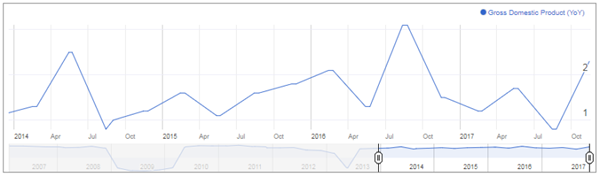
German GDP provided no surprises this morning, with the economy growing a respectable 2.3% in the third quarter compared to a year ago, in line with expectations. Inflation also rose 1.6%, unchanged from the previous month and also in line with expectations.
China Could Tighten In Mid-2018
Strong German data boost the single currency
While Germany's Q3 GDP increase of 0.8% over Q2 beat expectations by 0.2% bumped the euro up towards 1.17 USD per EUR, this has come at a cost. European Central Bank Vice President Vitor Constancio congratulated himself on Monday, stating that the ECB monetary policy was highly successful. Yeah, right: after injecting more than €2 trillion in the economy! And even so, the Eurozone is still flirting with deflation.
The German economy is strong. Performance has been positive since Q2 2014, with growth mostly driven by exports. The euro's weakness since the start of the year has definitely helped. Only strong inflation will help the ECB for now.
China could tighten in mid-2018
China's economy has showed a slight deceleration, but nothing dramatic. Still, to keep capital from flowing elsewhere, the People's Bank of China might tighten interest rates in mid-2018.
Chinese October retail sales increased 10.0% annually, below expectations of 10.5%. Fixed investment rose 7.3%, and industrial production increased 6.2% - both behind expectations. So growth is slowing, not surprisingly, given the central bank's war on shadow lending and pollution. China's 10-year government bond yield has risen to the highest level in three years, despite injections of CNY 150 billion via reserve repos.
This has allowed CNY to gain, with USD/CNY falling to 6.64. Stronger than expected trade growth continues to support the economy which we don't see slowing significantly in 2018.
see the PBoC flowing the fed lead with tighter rates in mid-2018.
RBNZ Holds OCR Steady. Dual Mmandate Expected To Be Introduced
The Reserve Bank of New Zealand's monetary policy meeting released last week showed at the central bank kept the overnight cash rate unchanged at 1.75% as widely expected. Although there were expectations for the central bank to maintain a dovish outlook, it was widely regarded as neutral.
The central bank's decision to leave monetary policy unchanged comes ahead of potential changes to the RBNZ's mandate. The newly formed labor government proposed the idea to also include full employment. This would bring about the dual mandate for the RBNZ similar to that of the central banks among the G7 economies.
While keeping the forward guidance steady, the RBNZ's monetary policy statement kept its wording from the previous statement. "Monetary policy will remain accommodative for a considerable period. Numerous uncertainties remain, and policy may need to adjust accordingly," the central bank's statement showed.
On the positive side, the central bank said that inflationary pressured remained low. However, it projected that the economy's gross domestic product would settle around 2% annual growth rate.
The central bank was optimistic for the year ahead. It argued that the impact of weaker housing prices and construction activity was offset by low interest rates. The optimistic view also gained support by the new government initiatives to stoke growth.
For 2018, the RBNZ expects GDP to average around 3.6% on an annual basis although various economists predict that growth could average just 2.5% next year. This is slightly higher than the forecasts of 2% GDP growth this year.
RBNZ's terms of reference
Last week also saw the finance ministry under the new government issuing the terms of reference. The ministry explained how the review of the central bank would proceed.
According to the initial reports, a two-phase review has been planned. The first part was similar to the manifesto released by the Labor party. The RBNZ is mostly likely to be given an additional mandate of employment.
It also proposes that a new committee would be introduced to make monetary policy decisions which put it on par with other central banks such as the ECB's governing council, the MPC from the Bank of England the Fed's FOMC.
Uncertainties still remain about further changes to the central banks although the ministry ruled out further changes to its terms of reference.
The phase two of the terms of reference was void of many details. However, the state Treasury and the RBNZ are expected to prepare a list of functions that could also include macro-prudential policy matters.
Contrary to the campaign trail talk about the preference for the central bank to intervene in the currency markets, there was no mention of this. It helped to improve the sentiment in the New Zealand dollar as a result.
The Kiwi dollar was hit since the September elections in New Zealand saw the conservative alliance of the Labor party and the Populist Party, NZ First forming a government. Investors sold off the New Zealand dollar following the strong rhetoric from the parties which included curbing migration and preference for a weaker exchange rate.
The RBNZ is currently headed by Grant Spencer who is the acting governor. Spencer stepped up following the end of the former RBNZ Governor Wheeler’s five year term in September. Spencer is expected to remain the acting governor for a period of six-months.
Following the conclusion of the RBNZ's meeting, the OIS markets were little changed. The central bank is not expected to hike rates next year although the markets expect to see the RBNZ move on rate hikes by 2019. The lack of any references towards stronger currency intervention also helped to soothe investor concerns.
The kiwi dollar managed to bounce on the back of the data, although the overall sentiment in NZDUSD remains biased to the downside.
The US Dollar Doesn’t Like Talks About The Rate
Despite being pretty clear and logical, talks about the benchmark key rate increase in the USA in December are "haunting" some monetary politicians and investors. These doubts, which were mentioned in Patrick Harker's comments below, put pressure upon the "sensitive" USD.
Not long time ago, the FOMC member Patrick Harker said that one should be very careful when estimating the USA inflation and the Federal Reserve had to be ready for any stresses and shocks in the economy. Nevertheless, Harker said he would support the key rate increase next month, although he thought that the necessity in the rate hike had been decreasing recently.
He's not the first American monetary politician to say that inflation risks may be a reason to postpone the key rate hike. In September 2017, the CPI in the USA expanded up to 2.2% y/y and by 0.5% m/m. The last time the indicator improved in the similar way was in January. Between January and September, the inflation growth varied from 0.09% m/m (May and June) to 0.30% m/m. There was even the deflation in July, when the CPI lost 0.07% m/m.
One should admit that the indicator is rather unstable. However, the Fed's target is at 2% and from this point of view, the index is doing well. "Mood swings" relating to the key rate increase will affect the US Dollar until the regulator's meeting scheduled for December is over.
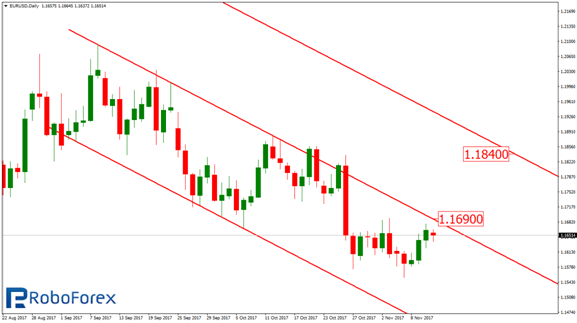
The USD perspectives are better seen at the EUR/USD pair chart. From the technical point of view, the downtrend continues. The pair is trading to test the upside border of the current channel and, as a result, may break it and move beyond 1.1690. The uptrend may continue if the price reaches 1.1840, which is the upside border of the projected channel.
EUR/TRY 1H Chart: Pair Trades Near Long-Term Channel
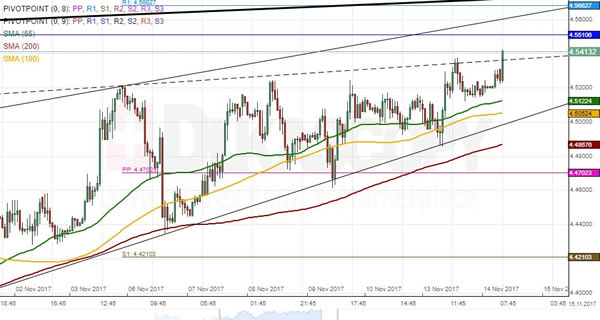
The common European currency continues its long-term appreciation against the Turkish Lira. As a result, the pair is constantly pushing its ultimate high northwards. During the past three months, the Euro is stranded in an ascending wedge. However, it seems that a breakout is likely to occur soon, as the upper boundary of this pattern has been unreachable for the last week and a half. In addition, the rate has approached the upper boundary of a senior channel circa 4.57 which has bounded the rate since mid-2014. Along the way, the Euro faces a strong resistance of the weekly and monthly R1 at 4.55. Given the pair’s long-term appreciation, it would not be surprising if this bullish movement continues to prevail. However, it is more likely that a pair retraces from the senior channel just to cool off its high levels.
CHF/SGD 1H Chart: Channels Prevail
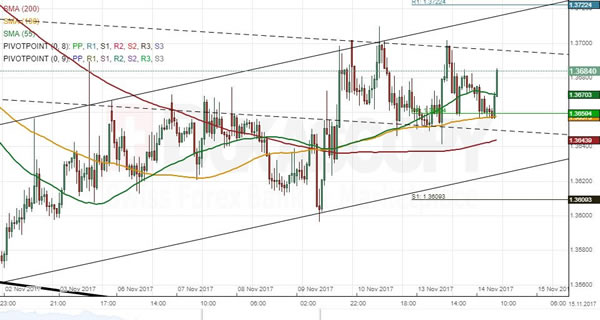
CHF/SGD has been guided by two opposite channels. The senior formation has restricted the pair in a descending movement since late May. After bouncing off its bottom boundary two weeks ago, the pair formed a junior channel up along the way. These two patterns suggest that the pair should appreciate during the following two weeks, at least. This assumption is reinforced by the fact that the rate might try to move away from the 1.3560 mark—its lowest level since early 2015. In the short-term, however, the rate is likely to trade relatively sideways, given the movement of a minor three-day channel (drawn with dashed lines). The rate might hold this consolidation phase during this week and then resume its upward movement. A near-term upside target is the weekly R2 and the monthly PP circa 1.3780.
EUR/USD Analysis: Trades At 1.1675
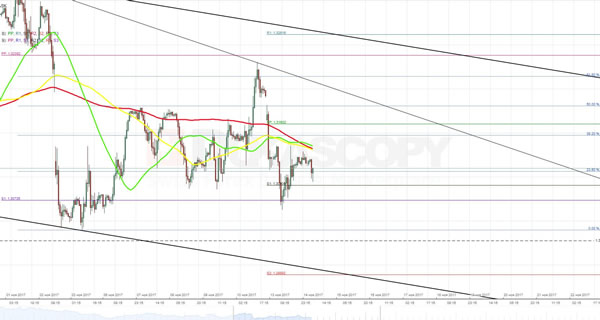
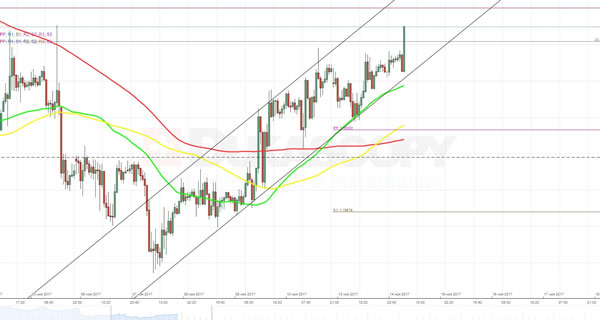
In line with expectations, the common European currency continues to advance against the Dollar in one-week long ascending channel.
However, there is a need to notice that yesterday fluctuations of the rate started to narrow down, which indicates on transformation of the current pattern into the rising wedge formation. Most likely a breakout will happen as soon as the currency rate will hit the 23.6% Fibonacci retracement level located at 1.1679. On the other hand, the rising 55-hour SMA might constrain the exchange rate from rapid falling. However, the above scenario might be altered due to the ECB President Draghi and the Fed Chair Yellen discussion at the Central Bank Communications Conference.
GBP/USD Analysis: Anticipates British Inflation Release
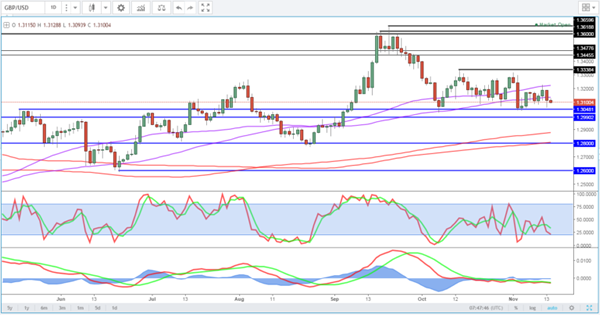
Recovery of the Pound after rapid fall on Monday was neutralized by a combination of the 55-, 100- and 200-hour SMAs. From the southern direction the same function was exercised by support zone near the 1.3112 mark. In other words, the cable moved horizontally, anticipating the release of the British inflation data. At the moment, the rating is moving to the bottom, but if the released data beats expectations, market reaction might be large enough to bypass the above moving averages and elevate the rate to the weekly PP at 1.3160. In the opposite scenario, the sell-off of Sterling might be so active, that the currency rate will pass through the monthly S1 at 1.3072 and stop only near the 0% retracement level at 1.3039 and then resume the plunge towards the bottom edge of large descending channel