Sample Category Title
(BOE) Bank Rate reduced to 4.5%
Monetary Policy Summary, February 2025
The Monetary Policy Committee (MPC) sets monetary policy to meet the 2% inflation target, and in a way that helps to sustain growth and employment. The MPC adopts a medium-term and forward-looking approach to determine the monetary stance required to achieve the inflation target sustainably.
At its meeting ending on 5 February 2025, the MPC voted by a majority of 7–2 to reduce Bank Rate by 0.25 percentage points, to 4.5%. Two members preferred to reduce Bank Rate by 0.5 percentage points, to 4.25%.
There has been substantial progress on disinflation over the past two years, as previous external shocks have receded, and as the restrictive stance of monetary policy has curbed second-round effects and stabilised longer-term inflation expectations. That progress has allowed the MPC to withdraw gradually some degree of policy restraint, while maintaining Bank Rate in restrictive territory so as to continue to squeeze out persistent inflationary pressures.
CPI inflation was 2.5% in 2024 Q4. Domestic inflationary pressures are moderating, but they remain somewhat elevated, and some indicators have eased more slowly than expected. Higher global energy costs and regulated price changes are expected to push up headline CPI inflation to 3.7% in 2025 Q3, even as underlying domestic inflationary pressures are expected to wane further. While CPI inflation is expected to fall back to around the 2% target thereafter, the Committee will pay close attention to any consequent signs of more lasting inflationary pressures.
GDP growth has been weaker than expected at the time of the November Monetary Policy Report, and indicators of business and consumer confidence have declined. GDP growth is expected to pick up from the middle of this year. The labour market has continued to ease and is judged to be broadly in balance. Productivity growth has been weaker than previously estimated, and the Committee judges that growth in the supply capacity of the economy has weakened. As a result, the recent slowdown in demand is judged to have led to only a small margin of slack opening up.
In support of returning inflation sustainably to the 2% target, the Committee judges that there has been sufficient progress on disinflation in domestic prices and wages to reduce Bank Rate to 4.5% at this meeting.
Based on the Committee’s evolving view of the medium-term outlook for inflation, a gradual and careful approach to the further withdrawal of monetary policy restraint is appropriate.
In addition to the risks around inflation persistence, there are also uncertainties around the trajectories of both demand and supply in the economy that could have implications for monetary policy. Should there be greater or longer-lasting weakness in demand relative to supply, this could push down on inflationary pressures, warranting a less restrictive path of Bank Rate. If there were to be more constrained supply relative to demand, this could sustain domestic price and wage pressures, consistent with a relatively tighter monetary policy path.
The Committee will continue to monitor closely the risks of inflation persistence and what the evolving evidence may reveal about the balance between aggregate supply and demand in the economy. Monetary policy will need to continue to remain restrictive for sufficiently long until the risks to inflation returning sustainably to the 2% target in the medium term have dissipated further. The Committee will decide the appropriate degree of monetary policy restrictiveness at each meeting.
Minutes of the Monetary Policy Committee meeting ending on 5 February 2025
1: Before turning to its immediate policy decision, the Committee discussed: the international economy; monetary and financial conditions; demand and output; and supply, costs and prices. The latest data on these topics were set out in the accompanying February 2025 Monetary Policy Report.
2: The Committee discussed recent global economic developments, and in particular the extent to which these had been reflected in yield curves across advanced economies. During the current monetary policy cycle, the level of US and UK three-year forward rates, had been closer to each other than to the equivalent euro-area rates. The gap between the US and UK curves relative to the euro-area curve had widened materially over the previous six months or so, as US and UK rates had increased. Market intelligence suggested that the upward movement in US yields over this period had in part reflected expectations of a more inflationary policy mix, with the possible implementation of tariffs, looser fiscal policy and tighter controls on migration by the new US administration.
3: In the days leading up to the MPC’s policy decision, the US administration had made various announcements on trade tariffs, to which some other governments had responded. The Committee noted that this was a rapidly evolving situation, which it would be monitoring closely, and that the ultimate impact would depend on the final composition of policies, as discussed in Box C of the February Report. Nevertheless, there had already been an increase in economic uncertainty globally and a pickup in financial market volatility.
4: Market intelligence suggested that developments in the United States had influenced recent movements in UK government bond yields, alongside domestic factors. Since the MPC’s previous meeting, the market-implied path for Bank Rate in the United Kingdom had first risen and then fallen back, ending the period somewhat lower in aggregate. Almost all respondents to the Bank’s latest Market Participants Survey (MaPS) were expecting a 25 basis point reduction in Bank Rate at this MPC meeting, in line with market pricing. The median MaPS respondent expected 100 basis points of Bank Rate cuts this year, albeit with the overall distribution skewed towards fewer cuts, consistent with the market-implied path declining by around 85 basis points over the year. In addition to international factors, there had been UK-specific considerations, including data news that had been taken by market participants to suggest risks of a weaker outlook for activity, which had also been partly reflected in a small depreciation in the sterling effective exchange rate.
5: Bank staff expected that GDP had fallen by 0.1% in 2024 Q4 and projected that it would rise by 0.1% in 2025 Q1. The Committee discussed the extent to which recent developments reflected underlying demand and supply drivers, acknowledging significant uncertainties around the current and prospective balance between them. The recent slowdown in demand was assumed to have led to only a small margin of slack opening up, as growth in the supply capacity of the economy appeared to have been weakening for some time. Within potential supply, potential productivity appeared to have been very weak while labour supply growth had been strong. Business survey indicators of output growth had deteriorated over recent months, as had broader metrics of business and consumer confidence, which would be consistent with a slowdown in demand, and the household savings rate had continued to be high. The ratio of broad money to nominal GDP had returned to close to its pre-Covid trend, suggesting an erosion of the money overhang that had emerged during the pandemic.
6: Twelve-month CPI inflation had fallen slightly, to 2.5% in December. The latest evidence from key indicators suggested progress on underlying disinflation in domestic prices and wages had generally continued. There had nevertheless been substantial upside news to the near-term outlook for headline CPI inflation, which was now expected to rise quite sharply in the near term, to 3.7% in 2025 Q3, owing in part to energy prices, before easing again. Measures of households’ short-term inflation expectations had increased somewhat over the previous few months, while businesses’ short-term inflation expectations had picked up slightly but had remained well below recent peaks.
The immediate policy decision
7: The Monetary Policy Committee (MPC) sets monetary policy to meet the 2% inflation target, and in a way that helps to sustain growth and employment. The MPC adopts a medium-term and forward-looking approach to determine the monetary stance required to achieve the inflation target sustainably.
8: The Committee’s latest projection for CPI inflation was set out in the accompanying February Monetary Policy Report. In support of returning inflation sustainably to the 2% target, the Committee was maintaining its focus on the persistence of inflationary pressures in the medium term. Progress on disinflation in domestic prices and wages had generally continued.
9: Since the MPC’s previous meeting, CPI inflation had fallen slightly, while services inflation had moderated. Annual private sector regular AWE growth had increased, although the news from other pay indicators had been mixed. Pay growth was expected to slow to around 3¾% by year-end, broadly consistent with estimates from the Agents’ annual pay survey, as well as the Decision Maker Panel. GDP growth had been weaker than expected at the time of the November Report, and indicators of business and consumer confidence had declined. GDP growth was expected to pick up from the middle of this year. The labour market had continued to ease and was judged to be broadly in balance. Productivity growth had been weaker than previously estimated, and the Committee judged that growth in the supply capacity of the economy had weakened.
10: Reflecting recent developments in global energy costs and regulated prices, CPI inflation was expected to rise quite sharply in the near term, to 3.7%. The MPC judged that this would not lead to additional second-round effects on underlying domestic inflationary pressures. Compared with economic conditions during the succession of large external cost shocks in 2021-22, the labour market was now looser and therefore some of the dynamics observed previously were unlikely to reoccur. Nevertheless, given the recent extended period over which inflation had remained above the 2% target, the threshold for second-round effects might now be somewhat lower.
11: In the medium term, and conditioned on the market path for interest rates, inflation was expected to return to around the 2% target. The MPC’s February forecast remained consistent with the second case for the evolution of persistent inflationary pressures that the Committee had identified previously. That is, the emerging margin of slack in the economy was projected to act against some continuing second-round effects in domestic prices and wages, allowing CPI inflation to fall back to target sustainably.
12: Taking recent developments together, the Committee was now placing greater weight on the second and third cases that it had been considering. Nevertheless, there were considerable risks around the path of spare capacity in the economy and inflationary pressures over the medium term, to which monetary policy might need to respond.
13: In terms of upside risks, the continued elevated rate of wage growth, and the upside news in the near-term outlook for headline CPI, could present a risk to inflation persistence, particularly if it were to affect firms’ and households’ inflation expectations.
14: In terms of downside risks, domestic inflationary pressures could be weaker than projected in the forecast. In addition, recent developments in activity could reflect greater weakness in demand relative to supply, and UK and global uncertainties could weigh further on demand and the labour market. This could lower wage pressures and dampen companies’ pricing power going forward.
15: The MPC judged that monetary policy still remained clearly in restrictive territory, following recent reductions in Bank Rate. However, there was a range of views among members on the remaining degree of restrictiveness.
16: While cyclical developments in the economy played a significant role in determining the monetary stance at policy-relevant horizons, the long-term real equilibrium interest rate, R*, could also play a role in that assessment as a long-term anchor for the policy rate, albeit not as a direct guide for setting policy. As set out in Box A in the February Report, there was evidence that R* had risen modestly since the MPC's previous assessment in 2018, but there was significant uncertainty around the range of estimates at any point and the extent of any increase.
17: The Committee turned to the immediate policy decision.
18: Seven members preferred to reduce Bank Rate to 4.5% at this meeting, on the basis that there had continued to be sufficient progress on disinflation in domestic prices and wages. There was a range of views underlying these members’ outlooks for the economy, with various risks around both the domestic and global environment.
19: On one view, looking through the expected near-term pickup in CPI inflation, the disinflation process had remained on track, and weakening activity and a looser labour market could weigh further on inflation. There was increased uncertainty around both the UK and global economic outlooks, with potentially countervailing forces acting on the prospects for domestic inflation. This warranted an approach to policymaking which was both gradual in continuing to lean against the persistence in inflation and careful in recognising increased uncertainty and that there were two-sided risks to inflation.
20: On another view, the upside news in indicators of pay growth and inflation over recent quarters, in parallel with continued weakness in activity, was symptomatic of constrained supply relative to demand. In large part, this reflected tepid productivity growth, which was unlikely to recover significantly over the forecast period. On this basis, weakness in observed activity and employment going forward could continue to reflect constrained supply rather than an accumulation of economic slack. This view continued to warrant a cautious and gradual removal of monetary policy restriction.
21: Two members preferred a 0.5 percentage point reduction in Bank Rate, to 4.25%, although they had different views on inflation dynamics, the structural factors underpinning them, and future monetary policy. Disaggregated data pointed to inflation continuing to decline through both wage and price-setting channels. The prospect of weak activity and lower labour demand was likely to reduce wage pressures as well as moderate firms’ pricing power. For one member, a more activist approach at this meeting would give a clearer signal of financial conditions appropriate for the United Kingdom, even as monetary policy would need to remain restrictive for some time to anchor inflation expectations, and Bank Rate would likely stay high given structural persistence and macroeconomic volatility. For the other member, the subdued outlook for demand remained consistent with CPI inflation staying sustainably at the target in the medium term despite the expected near-term uptick in regulated prices, and Bank Rate needed to account for policy transmission and supply capacity over the medium term.
22: Based on the Committee’s evolving view of the medium-term outlook for inflation, a gradual and careful approach to the further withdrawal of monetary policy restraint was appropriate.
23: In addition to the risks around inflation persistence, there were also uncertainties around the trajectories of both demand and supply in the economy that could have implications for monetary policy. Should there be greater or longer-lasting weakness in demand relative to supply, this could push down on inflationary pressures, warranting a less restrictive path of Bank Rate. If there were to be more constrained supply relative to demand, this could sustain domestic price and wage pressures, consistent with a relatively tighter monetary policy path.
24: The Committee would continue to monitor closely the risks of inflation persistence and what the evolving evidence might reveal about the balance between aggregate supply and demand in the economy. Monetary policy would need to continue to remain restrictive for sufficiently long until the risks to inflation returning sustainably to the 2% target in the medium term had dissipated further. The Committee would decide the appropriate degree of monetary policy restrictiveness at each meeting.
25: The Chair invited the Committee to vote on the proposition that:
- Bank Rate should be reduced by 0.25 percentage points, to 4.5%.
26: Seven members (Andrew Bailey, Sarah Breeden, Megan Greene, Clare Lombardelli, Huw Pill, Dave Ramsden and Alan Taylor) voted in favour of the proposition. Two members (Swati Dhingra and Catherine L Mann) voted against the proposition, preferring to reduce Bank Rate by 0.5 percentage points, to 4.25%.
Operational considerations
27: On 5 February, the stock of UK government bonds held for monetary policy purposes was £646 billion.
28: The following members of the Committee were present:
- Andrew Bailey, Chair
- Sarah Breeden
- Swati Dhingra
- Megan Greene
- Clare Lombardelli
- Catherine L Mann
- Huw Pill
- Dave Ramsden
- Alan Taylor
Sam Beckett was present as the Treasury representative.
David Roberts was also present on 27 January and 3 February, as an observer for the purpose of exercising oversight functions in his role as a member of the Bank’s Court of Directors.
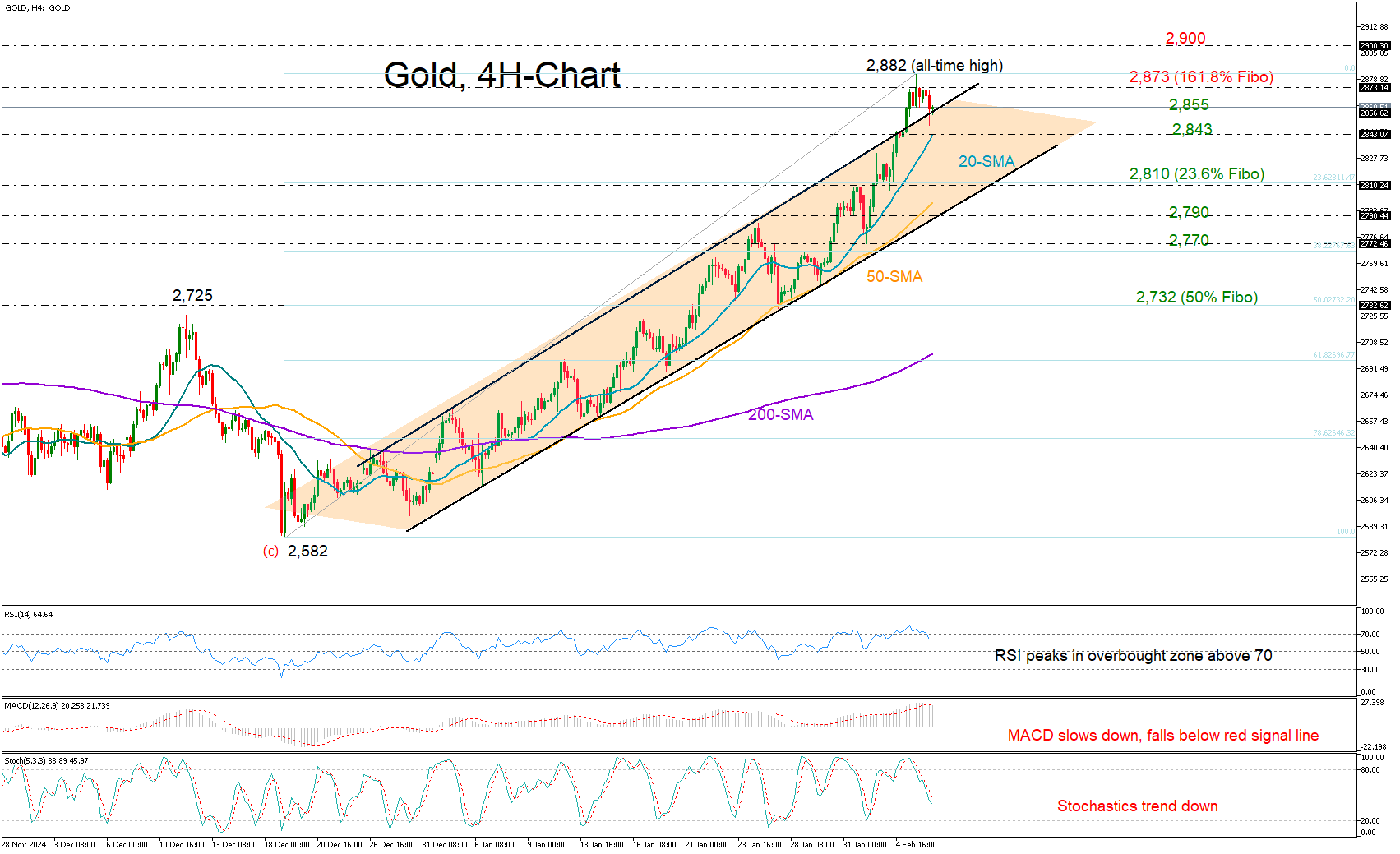
Are Gold Bulls Exhausted?
- Gold bulls take a rest after record rally to $2,882.
- A potential decline could be contained above $2,843.
Gold bulls are taking a breather after a powerful rally to a new all-time high of $2,882. Although sellers tried to push the price lower earlier today, the upper band of the broken bullish channel added a footing under the price near $2,855.
With the RSI peaking in the overbought zone and the stochastic oscillator sailing southwards, a cooldown is likely but it could be temporary if the 20-period simple moving average (SMA) at $2,843 comes to the rescue once again. A break lower, however, could motivate some profit taking toward $2,810, with further declines to $2,790 or even $2,735 if bearish momentum accelerates.
On the upside, if gold reclaims $2,870, the next key test is the $2,900 psychological level, followed by $2,945.
Overall, the bottom line is that gold’s record rally has hit a hurdle at $2,870, but the bulls remain in control unless $2,840 gives way.
Australian Dollar Dips, Services PMI Beats Estimate
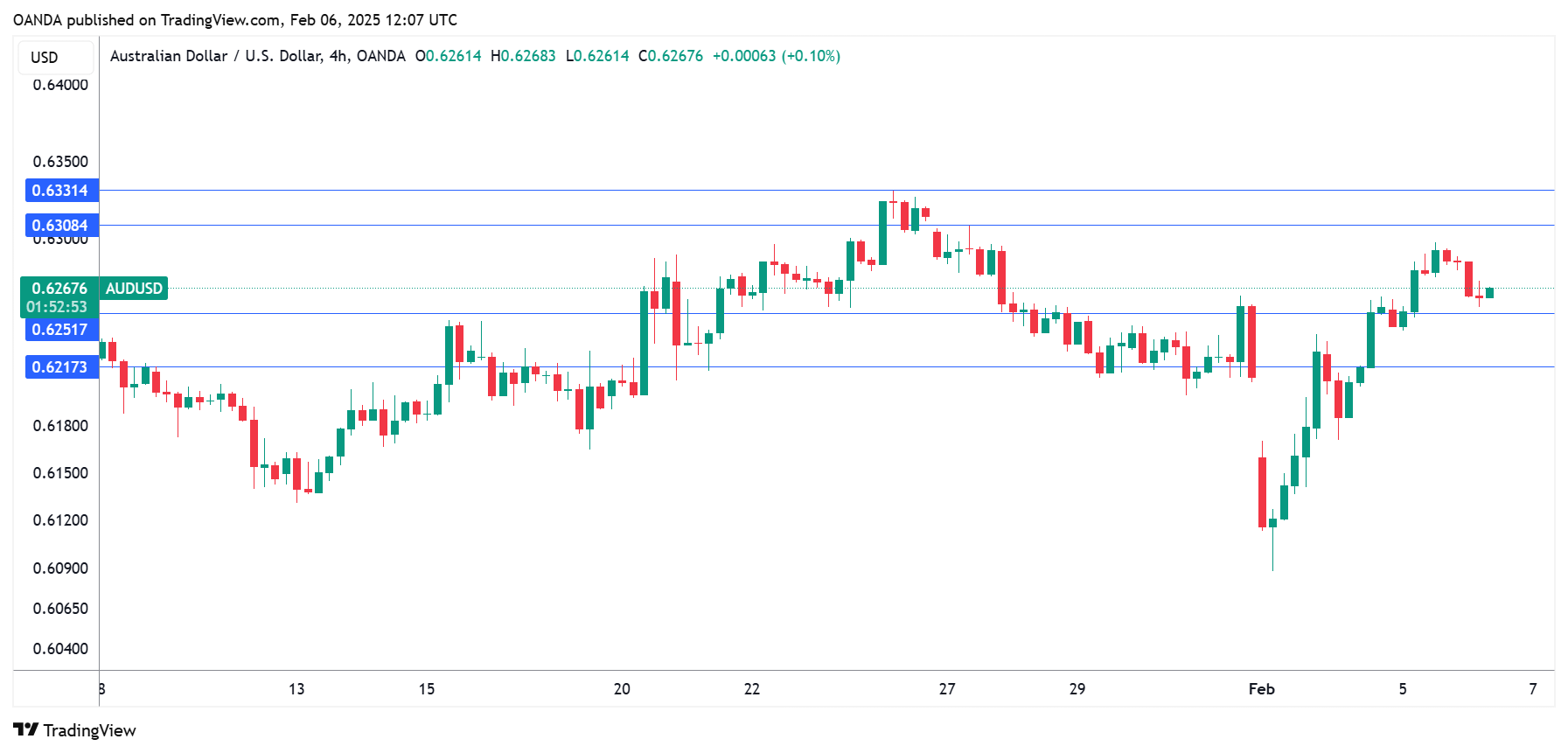
The Australian dollar has snapped a three-day rally on Thursday. In the European session, AUD/USD is trading at 0.6266, down 0.27% on the day. After sliding to a 5-year low on Monday, the Aussie has recovered and gain 0.9% this week.
Australia’s PMI stronger than expected
It’s been a good week for Australian PMIs. On Monday, Manufacturing PMI climbed back into positive territory in January and rose to a revised 50.2, up from a preliminary estimate of 49.8 and above the December reading of 47.8. This marked the first expansion in a year, as the manufacturing sector has been hit hard by the weak global economy and the slowdown in China, Austaralia’s number one trading partner.
This was followed by an acceleration in Services PMI on Wednesday, with a reading of 51.2 in January, up from the preliminary reading of 50.4 and above the December read of 50.8. The services sector has shown sustained growth for twelve straight months. This was the strongest expansion since August with an increase in customer demand and new orders.
Earlier in the week, Australia’s retail sales declined for the first time in nine months. Although the drop was a modest 0.1%, much better than the market estimate of -0.7%, it is raising concerns about the strength of the economy and has fueled expectations that the Reserve Bank of Australia will cut rates at the Feb. 18 meeting. The money markets are currently pricing a quarter-point cut at 80%.
The central bank has been an outlier amongst major central banks as it has not joined the easing cycle and a rate cut would be hugely significant. The RBA has held the cash rate at 4.35% since Nov. 2023 and with underlying inflation falling and a weak economy, conditions seem ripe for a rate cut.
AUD/USD Technical
- AUD/USD is testing support at 0.6274. Below, there is support at 0.6251
- There is resistance at 0.6308 and 0.6331
GBP/USD Technical: BoE’s Hawkish Cut Priced In, But GBP Bulls Now Approaching Key Resistance
- GBP/USD has rallied by 2.1% from Monday, 3 February swing low.
- The 2-year yield premium shrinkage between UK sovereign fixed income over the US Treasury Note may trigger a bearish reversal on the GBP/USD.
- Watch the key medium-term resistance of 1.2610 on the GBP/USD.
Since its swing low of 1.2249 printed on Monday, 3 February, the GBP/USD has rallied for three consecutive sessions with a gain of 2.1% and hit an intraday high of 1.2550 on Wednesday, 5 February.
UK-US trade deal optimism and BoE’s gradual approach in cutting rates support a recent firmer GBP
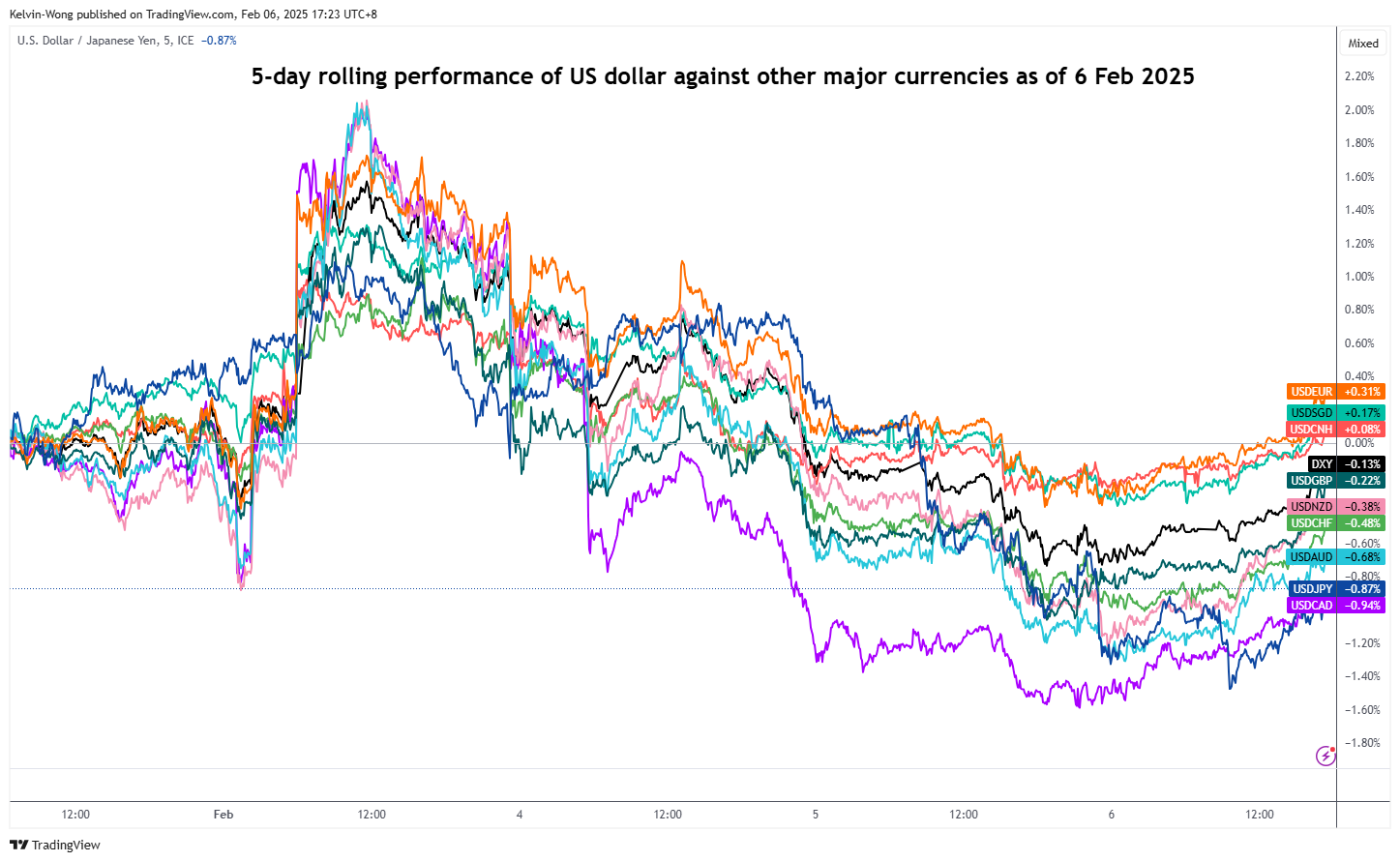
Fig 1: 5-day rolling performance of US dollar against major currencies as of 6 Feb 2025 (Source: TradingView, click to enlarge chart)
The recent push-up in the GBP/USD has been attributed to two key factors. Firstly, on the ongoing trade tensions between the US and its major trading partners, US President Trump has remarked that a potential trade deal could be worked out between the US and the UK which has lowered the odds of US trade tariffs being imposed on UK goods.
Secondly, it is now widely expected that the Bank of England (BoE) will likely enact its third interest cut of 25 basis points since August last year on Thursday, 6 February to bring the policy bank rate down further to 4.5%.
Interestingly, the market participants seem to be pricing in some form of “hawkish cut” in today’s BoE monetary policy decision as its new economic forecasts for the UK economy may see a downgrade on growth prospects for 2025 while inflation pressures face the risk of an upside revival due to UK Chancellor Reeves’s recent expansionary budget.
Therefore, these potential lowered growth and higher inflation forecasts are likely to reinforce stagflation fears in the UK economy, in turn raising the likelihood of BoE adopting a “gradual approach” stance towards loosening monetary policy in the near term.
GBP/USD at risk of bearish reversal below 1.2610
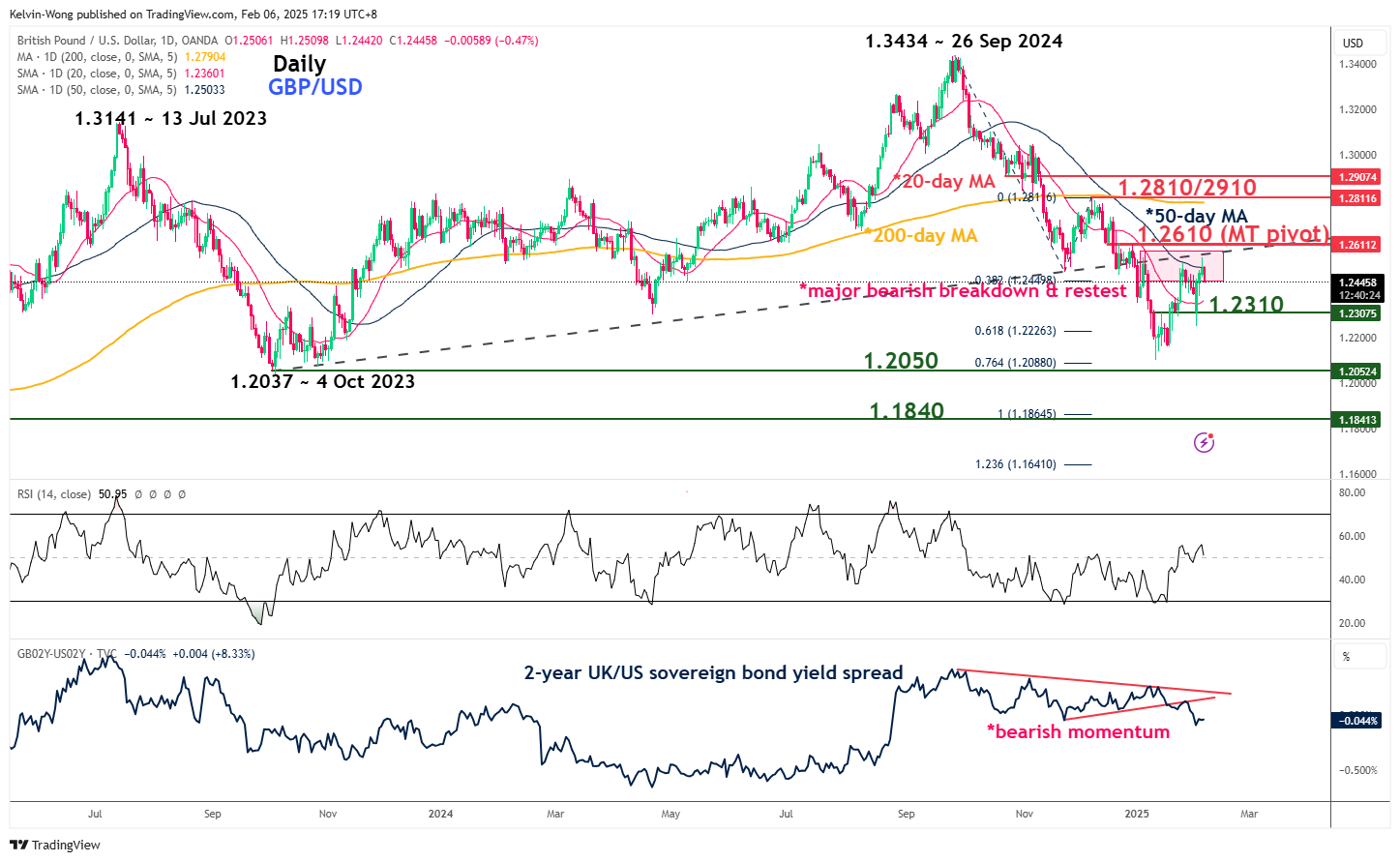
Fig 2: GBP/USD medium-term trend as of 6 Feb 2025 (Source: TradingView, click to enlarge chart)
On the contrary from a technical analysis standpoint, the recent multi-week rebound seen in the GBP/USD from its 13 January swing low of 1.2100 is likely to be a corrective upmove sequence within its medium-term downtrend phase that remains intact.
Intermarket technical analysis using the yield spread between the 2-year UK sovereign bond over the 2-year US Treasury Note has flashed a bearish momentum condition which suggests that there are higher opportunity costs of holding onto medium-term UK fixed income instruments versus US fixed income due to a potential reduction in UK yield premium (see Fig 2).
These observations suggest the British pound may continue to see further downside pressure against the US dollar in the medium term.
Watch the 1.2610 key medium-term pivotal resistance, and a breakdown below 1.2310 support suggests a potential continuation of its impulsive down move sequence to expose the next medium-term supports of 1.2050 and 1.1840 over a medium-term horizon (multi-week).
However, a clearance above 1.2610 invalidates the bearish scenario for a squeeze up towards the long-term pivotal resistance zone of 1.2810/2910 (also the 200-day moving average & 61.8% Fibonacci retracement of the medium downtrend phase from 26 September 2024 high to 13 January 2025 low).
GBP/USD at a Crossroads as BoE Rate Decision Looms
- GBP/USD stabilizes near 50-SMA as traders await BoE rate cut.
- Technical signals cannot guarantee bullish continuation.
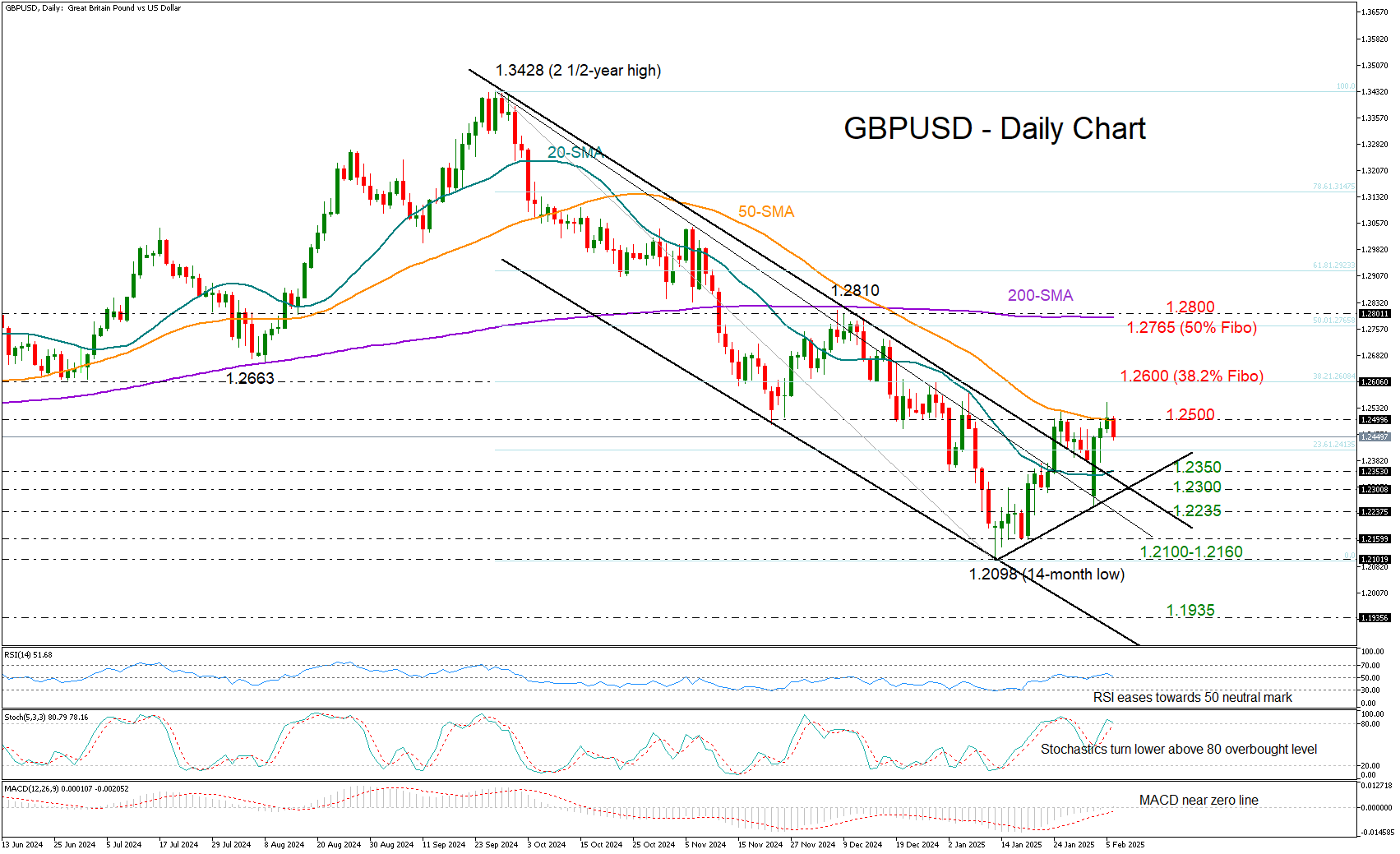
GBP/USD is facing a pivotal moment near the 1.2500 round level and its 50-day simple moving average (SMA) just a few hours before the Bank of England’s policy announcement at 12:00 GMT. A decisive break above this psychological barrier could fuel optimism that the recent rebound from the 14-month low of 1.2098 is something more than a fleeting recovery.
From a technical standpoint, caution is warranted as the rise in the RSI seems fragile and the Stochastic oscillator is already near its 80 overbought level, hinting at easing buying interest. If the bears take over, the price could slide towards the 20-day SMA at 1.2350 and then retest the support trendline from January at 1.2300. A continuation lower and beneath 1.2235 could target the crucial area of 1.2100-1.2160.
If the bulls successfully claim the 1.2500 border, the next barrier could lie around the 1.2600 mark, which overlaps with the 38.2% Fibonacci retracement of the latest downtrend. A step higher could trigger a fast rally towards the 50% Fibonacci of 1.2765 and the 200-day simple moving average (SMA).
In brief, GBP/USD is searching for a fresh bullish catalyst to extend its recovery and shift the trend decisively upward. A clear close above 1.2500 could bring new buyers into the market, while a drop beneath 1.2300 may increase selling activity.
Bitcoin Strengthens as Crypto Falls
Market Picture
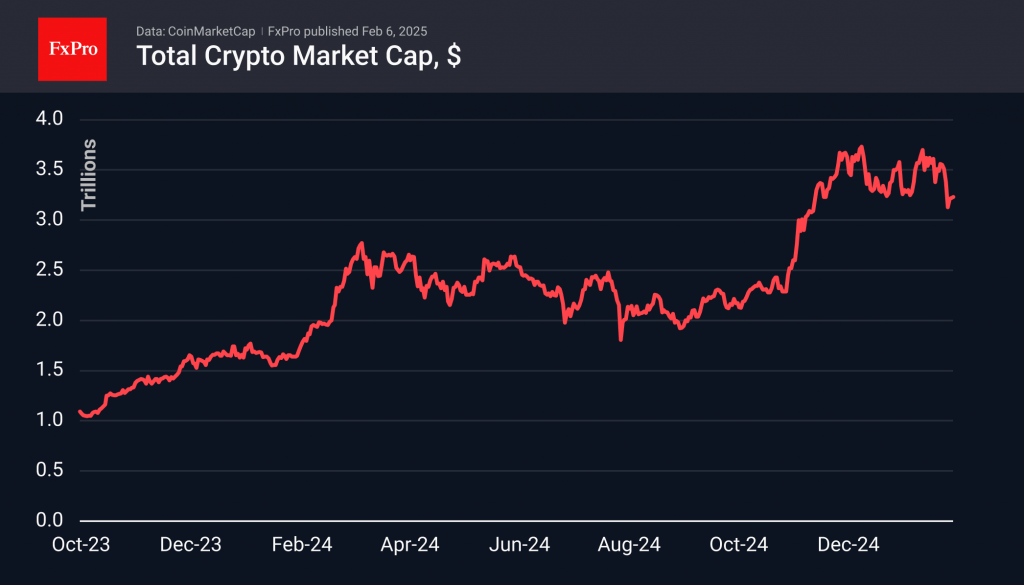
The cryptocurrency market is in no hurry to recover. Trading near $3.3 trillion in capitalisation, the crypto market is consolidating at a lower level. Before that, there was consolidation near $3.5 trillion, and a fortnight ago, it was just below $3.8 trillion.
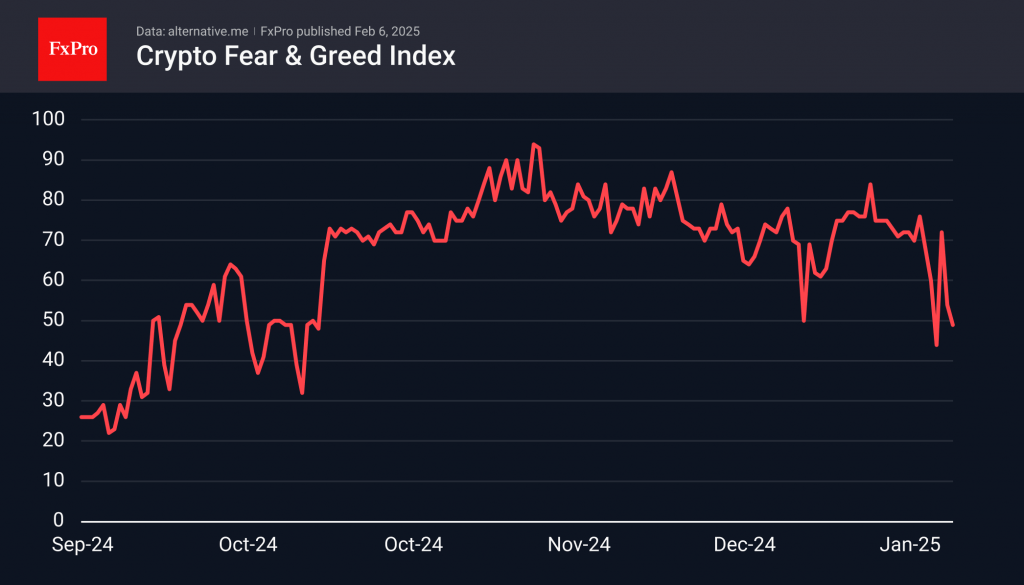
It looks like we saw another ‘sell on fact’ as growth stopped after Trump’s inauguration, which crypto enthusiasts were optimistic about. The sentiment index rolled back into neutral territory by the end of the first week of February.
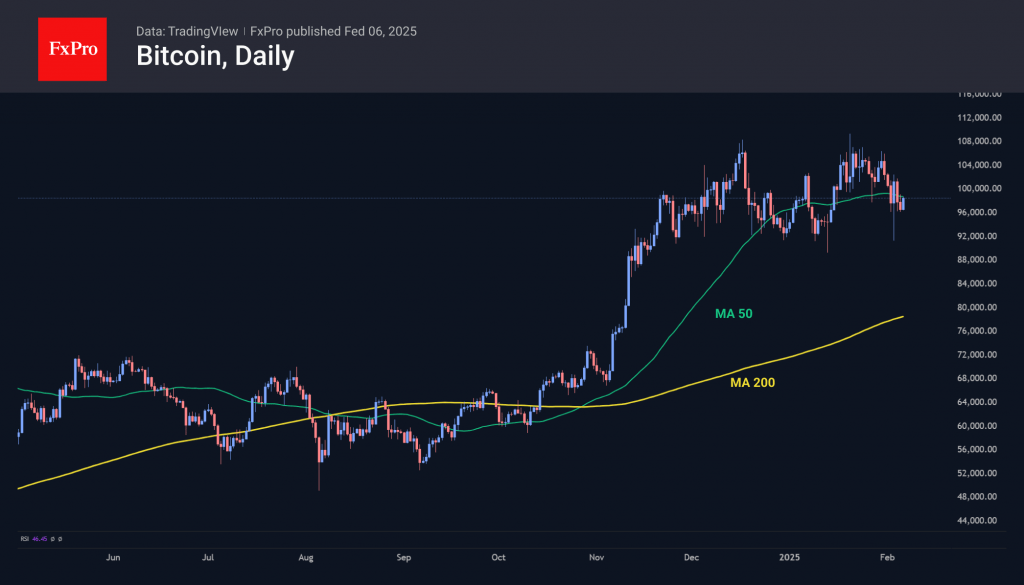
Bitcoin is trading at 98,500, having lost over 6% in the last seven days. The bulls failed to organise a quick rebound after Monday’s collapse. Corporates and private speculators seem to be buying BTC during downturns. It is not enough to refresh historical records, but it is causing Bitcoin’s dominance to grow above 60%—the highest since March 2021.
News Background
Crypto investors are frustrated by the lack of progress on creating a US Bitcoin reserve. The day before, David Sachs, head of the Digital Asset Markets Task Force, called the evaluation of creating a Bitcoin reserve a priority but did not provide details.
Former BitMEX exchange head Arthur Hayes said the US, China and other nations will soon be forced to print money, driving Bitcoin to new records.
El Salvador has bought 20 more BTC over the past week, taking advantage of the price drop. On 4 February, the country bought 11 BTC at once, bringing the national bitcoin stockpile to 6,067 BTC.
Technology company Semler Scientific also continues to add to its Bitcoin reserve. It has purchased 871 BTC in the past three weeks and has a total of 3,192 BTC.
Ethereum issuance has grown to 120,521,725 ETH. Comparable levels were last seen in September 2022, before The Merge update. The rise in supply casts a shadow on the narrative of Ethereum as a deflationary asset.
A bill has been introduced in the U.S. Senate to regulate stablecoins, which could boost demand for U.S. Treasuries and spur financial innovation.
USD/CAD Exchange Rate Stabilises
As we reported on 3 February, the decision by the US president to impose 25% tariffs on goods imported from Canada sent the USD/CAD rate soaring to a 22-year high.
However, after a round of negotiations between Donald Trump and Justin Trudeau, the tariff implementation was postponed by a month, which was reflected in the USD/CAD exchange rate chart.
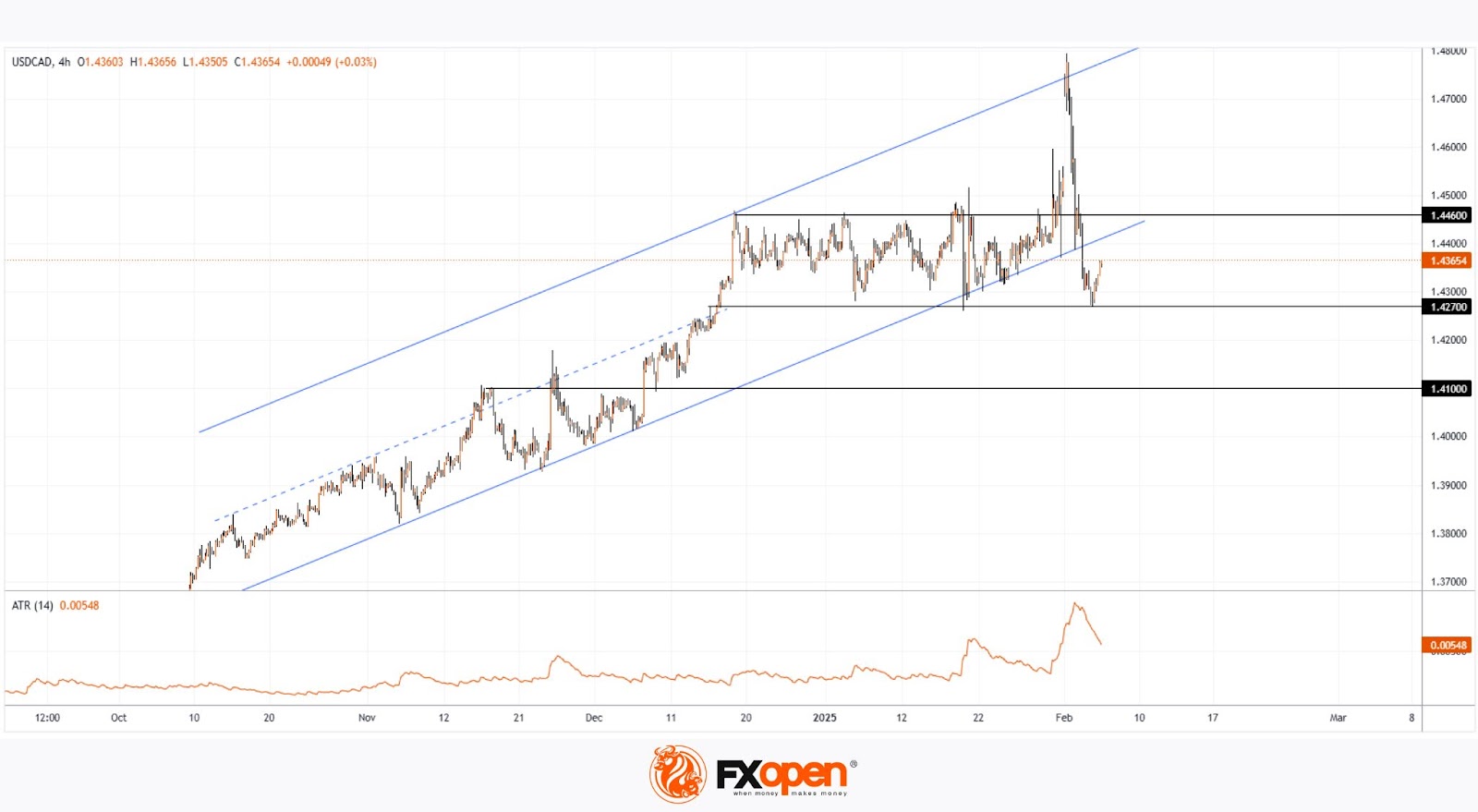
Current USD/CAD Chart Analysis:
→ The price has retreated from the upper boundary of the ascending channel identified three days ago and has now dropped below its lower boundary.
→ The price has returned to and remains within the broad 1.4270 – 1.4460 range.
→ The ATR indicator has reversed from its peak and is trending downward.
Given these factors, it is reasonable to say that USD/CAD is stabilising after recent volatility. But what lies ahead?
The exchange rate may fluctuate within the 1.4270 – 1.4460 range, reacting sensitively to any news on Trump’s tariff policies and his startling suggestion of making Canada the 51st US state.
Trade over 50 forex markets 24 hours a day with FXOpen. Take advantage of low commissions, deep liquidity, and spreads from 0.0 pips. Open your FXOpen account now or learn more about trading forex with FXOpen.
This article represents the opinion of the Companies operating under the FXOpen brand only. It is not to be construed as an offer, solicitation, or recommendation with respect to products and services provided by the Companies operating under the FXOpen brand, nor is it to be considered financial advice.
Eurozone retail sales falls -0.2% mom in Dec, EU down -0.3% mom
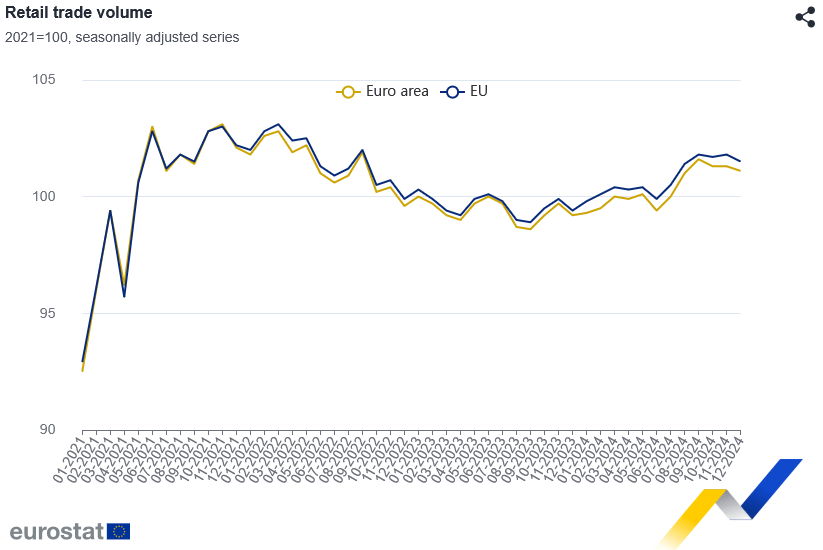
Eurozone retail sales slipped by -0.2% mom in December, missing market expectations of -0.1% decline and pointing to continued weakness in consumer demand. The drop was largely driven by -0.7% contraction in food, drinks, and tobacco sales, while non-food products saw a modest 0.3% increase. Automotive fuel sales in specialized stores also ticked up 0.2%, providing some offset to the broader decline.
At the EU-wide level, retail sales fell even further, down 0.3% mom. The country-level breakdown highlights stark contrasts in retail activity. Slovenia (-2.2%), Germany (-1.6%), and Poland (-1.5%) saw the sharpest contractions, while Slovakia (+8.2%), Finland (+2.1%), and Spain (+1.4%) registered solid gains.
GBP/USD Analysis: Bank of England Decision Looms – What to Expect?
- The Bank of England (BoE) is expected to announce a 25 bps rate cut on February 6, 2025.
- Weak UK Data and ongoing trade war and geopolitical risks pose threat to BoE policy.
- Key levels to watch are 1.2500 (resistance) and 1.2466 (support).
- Governor Bailey comments and press conference are key to future policy hints.
The Bank of England (BoE) is set to announce its latest monetary policy decision on February 6, 2025, in what is shaping up to be one of the most closely watched meetings in recent months. The central bank faces a delicate balancing act as it navigates a mix of economic challenges and opportunities.
The seesaw price action experienced by the British Pound over recent weeks was initially down to uncertainty surrounding Britain’s inflation, interest rate and fiscal challenges. That is not to downplay the US and its role in the recent uncertainty in global markets.
What is Expected from the Bank of England (BoE)?
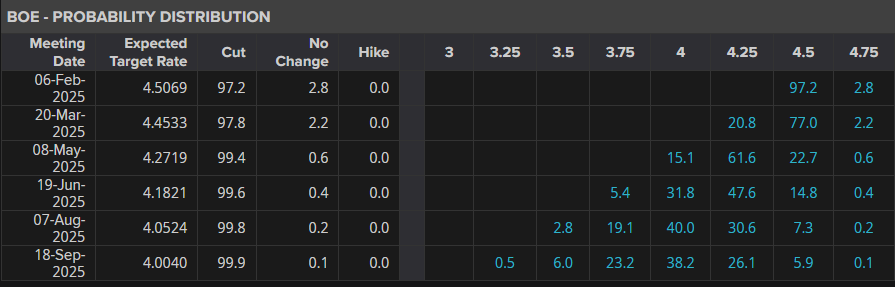
According to LSEG Workspace data, market participants are pricing in a 97% probability of a 25 bps cut tomorrow. Such a move would hardly come as a big surprise for anyone following developments in the UK over the past few months.
The bigger question will be whether the outlook moving forward will strike a dovish tone which could see the British Pound surrender some of its recent gains. I am not sure if such a statement will materialize though, largely on the back of a shaky jobs market and the prospect of lower services inflation.
Source: LSEG
If the BoE delivers a 25 bps cut and discusses any further cuts as being gradual and the number of cuts to be expected in 2025, the market reaction could be relatively muted. A definitive change in stance with any hint regarding speeding up of rate cuts could send the British Pound sliding.
At this stage, market participants are pricing in around 83 bps of cuts through December 2025, however a dovish message by Governor Bailey and this could increase to markets expecting a rate cut every quarter. This would mean 100 bps of cuts in 2025.
UK Data and the Picture it Paints
Inflation in services, a key focus for the BoE, dropped a lot in December. This could be temporary since it might rise back to 5% in January, but overall, it is clearly going down. By the second quarter, it’s expected to fall below 4%, and it’ll look even better once less important categories are excluded.
The jobs market is also showing signs of weakness. Private-sector employment slowly dropped in 2024, and job openings have decreased a lot. While wage growth has been stubborn, surveys suggest it will slow down as the year progresses.
These factors certainly paint a picture that may require further rate cuts. Now of course there is the shadow of a potential trade war which could kick off another round of inflation and play a role in BoE decision making going forward.
On the geopolitical side we still do not have a resolution in Russia-Ukraine while President Trump’s call for Gazans to be moved has added a fresh new dimension to the Middle East as well. A further deterioration in these conflicts could lead to sticky inflation rearing its ugly head once more.
Technical Analysis – GBP/USD
From a technical point of view, Cable has staged an impressive recovery this week.
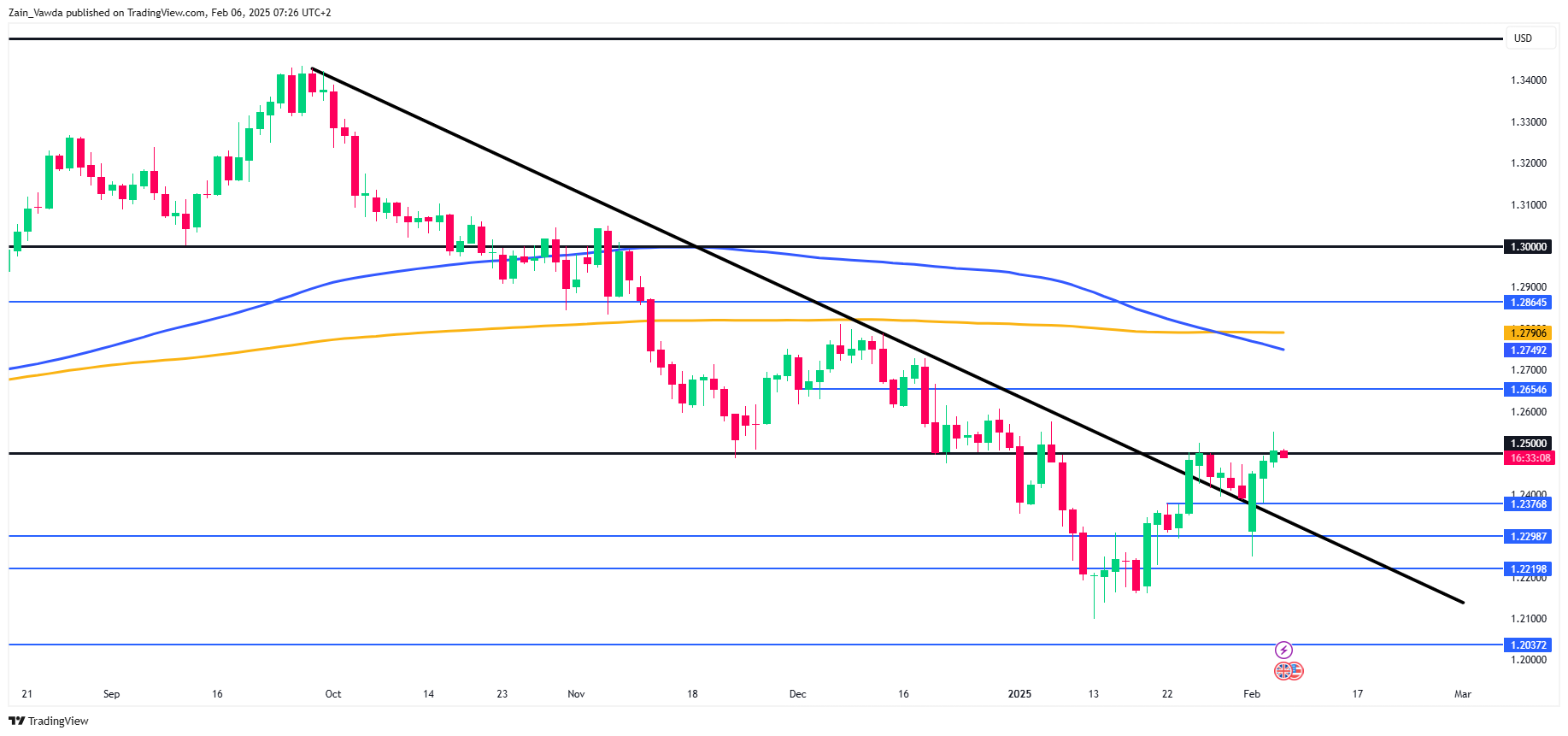
Following a gap lower over the weekend on tariffs being implemented, the British Pound has gained around 300 pips against the greenback, peaking yesterday at 1.25500 before pulling back to trade below the 1.2500 psychological level.
Looking at the daily chart below and as you can see the medium-term descending trendline remains intact thanks to Monday’s swift recovery.
A daily candle close above the 1.2500 handle may embolden bulls but if any move is to take place, it will likely come after the BoE meeting.
Source: TradingView (click to enlarge)
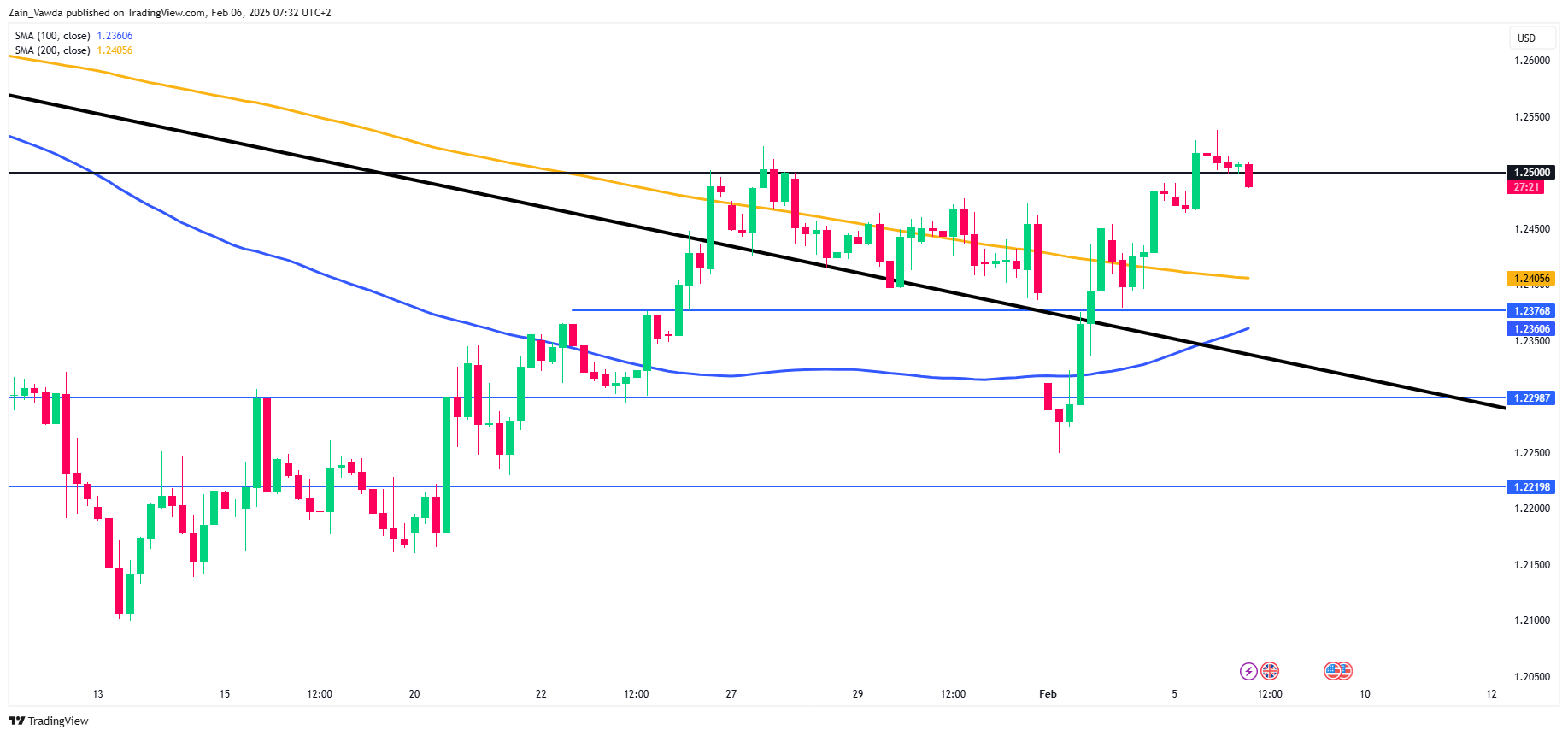
Dropping down to a H4 and the bullish trend remains intact without a four-hour candle close below the 1.2466 handle.
A close below this handle will result in a change of the four-hour structure and open the door for bears to push price toward support at 1.2400, where the 200-day MA rests.
The possibility of a deeper correction toward 1.2350 may provide a better risk to reward opportunity for potential bulls should it materialize. I expect that barring any surprises today, for any moves relating to GBP/USD to remain short-lived.
Source: TradingView (click to enlarge)
Support
- 1.2466
- 1.2405
- 1.2360
Resistance
- 1.2550
- 1.2750
- 1.2864
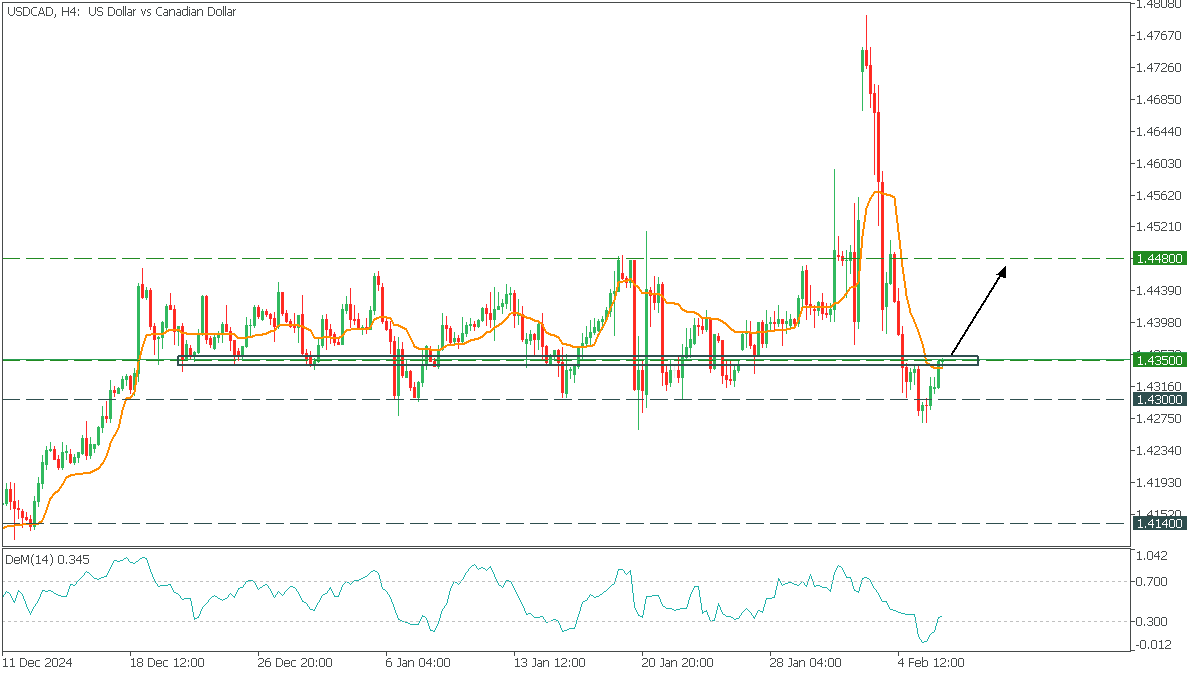
USDCAD: Rebound
USDCAD, H4
On the H4, USDCAD, after a sharp fall, reached a critical support area and rebounded. DeMarker came out of the oversold zone, which makes a slight rise possible on a break above the AMA.
- We may consider buying USDCAD on a break above 1.4350 with a target of 1.4480;