Sample Category Title
ECB’s Cipollone open to March cut, flags risks of full US-China trade war
ECB Executive Board member Piero Cipollone indicating that while "there is still room for adjusting rates downwards", the March decision remains uncertain. He stated that ECB must be "extremely careful" in its assessment, and he will enter the meeting "with an open mind".
Discussing the concept of the neutral rate in a Reuters interview, Cipollone downplayed its practical significance in policy setting. He pointed out that when estimates for the neutral rate vary widely—such as between 1.75% and 2.25%—it becomes "not terribly useful for setting monetary policy." If ECB operates near either end of the range, it could risk either undershooting or overshooting its inflation target.
Cipollone also raised concerns about the evolving global trade situation. The immediate impact of US tariffs depends on European retaliation and specific product categories affected, He warned that a "full trade war" between the US and China poses a more significant threat.
With China accounting for 35% of global manufacturing capacity, broad trade restrictions could flood European markets with Chinese goods. This would create a dual challenge— "deflationary" pressures from lower-priced imports and a "contractionary" effect as European producers struggle to compete.
US Treasury Kept Current Auction Sizes at Unchanged Levels
Markets
US Treasury Secretary Bessent seems to manifest himself as the voice of reason for US President Trump’s chaotic, sometimes illogic, burst of thoughts. In an interview with Fox Business he elaborated on/clarified themes like the ones spelled out by Trump in his WEF-address when he urged OPEC+ to lower oil prices and suggested to be doing a better job than Fed Chair Powell at the helm of the Fed. Centre piece in Bessent’s reasoning remains the 3-3-3 programme which he put forward in the run-up to last year’s elections: getting the fiscal deficit down to 3% of GDP from above 6% in recent year, lifting oil production by 3mn b/d and achieving economic growth of 3%. Getting gasoline and heating oil prices down is key as the energy component is one of the surest indicators for long-term inflation expectations. Consumers will not only be saving money, but their optimism for the future will help them rebuild from the years of high inflation, he argues. Bessent and Trump’s focus is on the 10-year Treasury (yield) according to the Treasury Secretary, rather than the Fed’s benchmark rate. “He (Trump) is not calling for the Fed to lower rates”. Bessent doesn’t say it out loud, but that’s what eventually will happen if they manage such growth rates in a non-inflationary environment resulting in a “good interest-rate cycle”. The final pillar in helping long term bond yields lower is DOGE. “We cut the spending, we cut the size of the government and we get more efficiency in government.” Bessent even takes it one step further by suggesting that the bond market is already recognizing the above-mentioned ploy. While long term US Treasuries effectively outperformed since Trump’s inauguration (bull flattening with front end losing around 15 bps and very long end up to 25 bps), we must add that this is solely due to a drop in real rates while inflation expectations remained sticky just below 2.5%. Our reading (from the bond market) at the moment is one where investors start contemplating a scenario in which Trump’s explosive policy mix risks backfiring to the US economy at a moment when the Fed committed itself to a more/too hawkish monetary policy to fend off inflationary threats (which might end up hurting the economy even more). Some early growth worries are causing the correction in LT bond yields rather than anticipation on a less restrictive monetary policy or a shift lower in inflation expectations. It’s still too early days to draw any firms conclusions with Trump known to be very sensitive to economic growth/the stock market and the administration still having some aces up their sleeves like making 2017 tax cuts permanent.
News & Views
US Treasury kept the current auction sizes at unchanged levels for the February to April quarter in the updated quarterly refunding statement released yesterday. It believes they “leave it [the US Treasury] well positioned to address potential changes to the fiscal outlook and to the pace and duration of future SOMA redemptions” adding that based on the current projected borrowing needs it anticipates maintaining these auction sizes for at least the next several quarters as well. Treasury will kick off the funding quarter with a combined $125bn sale next week, consisting of a $58bn 3-yr, $42bn 10-yr and a $25bn 30-yr Note sale. It plans to maintain the February 30-yr TIPS new issue auction size ($9bn) but increase the 10-yr auction size in March as well as the 5-yr one in April to $18bn and $25bn respectively. In terms of buybacks, Treasury anticipates that over the course of the upcoming quarter it will purchase up to $30bn securities across buckets for liquidity support and up to $59.5bn in the 1-month to 2-year bucket for cash management purposes.
Italy’s budget watchdog UPB lowered growth estimates for the country from 1% to 0.8% this year. It also marginally clipped the 2024 estimate from 0.8% to 0.7%. This compares to the 1% for 2024 and 1.2% in 2025 that the Italian Treasury had penciled in. UPB said the downward revision mainly followed on higher gas prices and trade tensions with the risk of US tariffs for Europe looming. Italy is also particularly vulnerable to energy shocks since it imports around 95% of annual gas consumption. Treasury will be reviewing its growth estimates in April. Preliminary growth figures released end-January showed the Italian economy stagnating in Q4 for the second quarter straight.
JPY: Is This The Time It Sticks?
Sentiment across Europe and the US improves on waning trade tensions with the US. Most major indices ended the session in the green, but gains in the US were questionable due to the underwhelming set of earnings from big companies including Google, AMD and Ford, and a better than expected ADP report that showed that the US economy added 183’000 new private jobs in January, comfortably more than around 148’000 pencilled in by analysts, meanwhile the S&P’s services and composite PMI numbers hinted at a faster-than-expected growth in the US activity in January. Happily, for the Federal Reserve (Fed) doves, the ISM numbers looked softer-than-expected and along with the US Treasury’s announcement that it does not anticipate increasing auction sizes for nominal coupon and floating-rate notes ‘for at least the next several quarters’ gave relief to bond traders and sent the US 10-year yield 12bp lower, the 2-year yield eased as well. As such, the S&P500 gained 0.39% with around 350 companies eking out gains, Nasdaq 100 extended gains despite disappointment in Google. Nvidia jumped 5% given that Big Tech companies like Meta and Google - that made up to 50% of its revenue in Q3 - insisted that they will spend more on AI this year. Collectively, Alphabet, Meta, and Microsoft are projected to spend around $228 billion on capital expenditures in 2025 – that’s around 75% more than they spent last year, and a part of that cash will flow directly into the pockets of Nvidia. Elsewhere, Qualcomm topped expectations yesterday after the bell but the stock fell nearly 5% AH due to a slight miss in intellectual property licensing revenue and lower-than-expected licensing revenue guidance. And Amazon is due to report its holiday season earnings today after the bell, with all eyes on its cloud revenue – expected to post a nearly 20% year-over-year increase, which would be the largest growth in two years.
Speaking of AI and tech, Chinese AI and robot companies are doing well due to the DeepSeek push. The CSI’s Artificial Intelligence index rallied 2.40% yesterday and is up by more than 13% since January 13, while the CSI Robot index jumped more than 5% yesterday to the highest since last July. Chinese AI has potential to attract more gains on the convergence narrative with the highly-valued US peers. After all, if the European stocks are good to buy due to convergence, why not the Chinese AI?
That brings me to Europe – where the picture didn’t change much yesterday after a set of weaker-than-expected PMI numbers mostly confirmed the gloomy economic outlook in the old continent and reinforced the idea that the European Central Bank (ECB) should to more to support the underlying economies. Good news is that France has a budget and a PM. It doesn’t change the reality of instable politics of France but it does contribute to narrowing the spread between the German and French yields, and that’s positive for sentiment. As such, the Stoxx 600 gained while the EURUSD rebounded yesterday. But the rebound in euro versus the US dollar was more due to a broad-based weakness in the US dollar following a sharp fall in the US yields than the French political news. The EURUSD tested the 50-DMA offers but couldn’t clear it, Cable tested its own 50-DMA but attracted top sellers above this level. If the US dollar eases more this week on the back of waning trade tensions and ideally soft jobs data (that would support the Fed doves), both euro and sterling could find room to extend recovery without necessarily damaging their medium-term bearish trend. On Friday, the US jobs data should give a clearer short-term direction. A softer-than-expected report could lead to a further dollar weakness in the immediate future. As such, short-term tactical traders could take advantage of a potential temporary relief in euro and sterling against the dollar, while medium-term traders will seek topselling opportunities to strengthen their bearish positions. Note that the EURUSD will remain in the medium-term bearish trend below 1.06, and Cable should remain downbeat below 1.2650. After all, the Bank of England BoE) is expected to lower its rates by 25bp today, as Rachel Reeves growth plans are clouded by the country’s restricted finances and the economy calls for BoE support.
In Japan, the yen got a nice energy boost after the Bank of Japan’s (BoJ) Tamura said that Japan's neutral rate is at least 1% and added that rates must reach that level by the second half of this fiscal, ‘when the outcome of annual wage negotiations will likely confirm broad-based pay increases including for small firms’. His comments strengthened the hawkish BoJ expectations and pulled the USDJPY to below 152 level shortly. Provided the way the things look at the BoJ, the way – this time – is certainly open for a sustainable slide below the 150 level. Note that the USDJPY will step into the medium-term bearish consolidation zone if it slides below 151.20 – the major 38.2% Fibonacci retracement on September to January rebound.
Elsewhere, recovery in AUD and CAD remain particularly vulnerable to Trump trade news. And despite waning tensions, UPS decided yesterday to halt deliveries from mainland China and Hong Kong due to tariff delays... China pointed its finger at Apple and its app store as the continuation of the escalation of the trade war, gold extended gains while crude oil tanked more than 2% to below its 100-DMA after the EIA data showed that the US crude inventories popped almost 9mio barrels last week. The outlook for oil remains negative, price rallies should see resistance within the 73/75pb range, including two Fibonacci retracements and the 200-DMA.
BoE Meeting Takes Centre Stage Today
In focus today
Today, we expect the Bank of England to cut the Bank Rate by 25bp to 4.50% in line with consensus and market pricing. We anticipate the vote split to be 8-1 with the majority voting for a cut and hawk Catherine Mann voting for an unchanged decision. We expect the BoE to stick to its previous guidance noting that "a gradual approach to removing monetary policy restraint remains appropriate". On balance, we tilt towards a dovish twist during the press conference with downside risks to growth tentatively materialising. See more in our preview Research UK - Budget skies are clearing for GBP; BoE to cut, 3 February.
From the US, preliminary US Q4 productivity data is released. Solid productivity gains have helped moderate growth in firms' unit labour costs despite relatively large increases in nominal wages. SF Fed's Daly is scheduled to give a speech in the evening.
In the euro area, retail sales data for December is released. This print has been rising during the past six months showing signs of recovering private consumption.
The focus in Sweden today will be on the January flash inflation print. We expect CPIF at 1.54% (Riksbank: 1.79%, cons: 1.6%) and CPIF excluding energy at 1.94% (Riksbank: 2.41%, cons: 2.1%). We see a clear downside risk to the Riksbank's forecast, and this print will be important for future policy considerations from the Riksbank. The flash estimate today will not provide any information about the components or the weights.
Economic and market news
What happened yesterday
In the euro area, the final composite PMI for January confirmed the initial reading of 50.2, with services PMI almost unchanged at 51.3. There were some revisions beneath the aggregate data, as German PMIs were revised upwards due to improvement in the manufacturing sector. In contrast, Spain and France showed lower figures in the final release. As Spain has been the main growth driver of the euro area, the weakening PMIs are noteworthy. Yet, Spain remains comfortably in growth territory, with a composite PMI of 54.0, a level it has maintained for the past six months, whereas French PMIs are lower signalling weaker activity.
In France, French Prime Minister survived the no-confidence vote and pushed through a delayed 2025 budget aimed at reducing France's deficits. Bayrou succeeded by negotiating budget compromise with the Socialist party.
In the US, the ISM non-manufacturing figure was lower than expected at 52.8 (prior: 54.1, cons: 54.3). The weak ISM pushed EUR/USD higher and confirmed earlier signals of weakness from PMI. Indices for business activity, new orders, and prices all declined. Leading data for January showed an unusual pattern, with manufacturing growth improving while the services sector lost stream. Meanwhile, ADP employment exceeded expectations with 183K jobs created in January (prior: 176K, cons: 150K), highlighting a surge in private sector employment and strengthening the case for a stable labour market.
In Norway, housing data showed great strength with seasonally adjusted housing prices increasing by 1.4% m/m in January, significantly surpassing Norges Bank's estimate of 0.5% from the December MPR. This may lead the market to question the necessity or possibility of rate cuts in Norway. However, at the press conference following the January monetary policy meeting, Governor Bache conveyed that there are no concerns in the housing economy that would impact rate cut decisions soon.
Equities: Global equities rose yesterday due to a variety of factors. Firstly, earnings on both sides of the Atlantic from some of the mega-cap companies impacted sector performance, resulting in a noticeably different outcome in Europe and the US. Secondly, defensive sectors outperformed on both sides of the Atlantic. While this aligns badly with the strong markets and with indices ending at daily highs, some of this can also be attributed to earnings and partly to the fact that yields took a nosedive. Adding complexity, despite what we might call mixed macroeconomic conditions and a significant drop in yields with a flatter curve, banks performed well yesterday.
This can also be ascribed to earnings from banks, especially on our side of the Atlantic. Finally, positive sentiment combined with lower yields aligns well with support for small caps, which outperformed large caps by 0.4% yesterday. In the US yesterday, the Dow rose by 0.7%, the S&P 500 by 0.4%, the Nasdaq by 0.2%, and the Russell 2000 by 1.1%. Markets in Asia are mostly positive this morning. Futures in Europe and the US are higher across the board this morning.
FI: European yield curves bear flattened yesterday as the short end went higher in yields following cautious comments from Lane on the speed of rate cuts while at the same time the 30y was supported by soft ISM services as well as the QRA being in line with their previous communications and expectations, thus the US Treasury saying that they expect to keep auction sizes steady for a least next several quarters. As for the front end, Lane said that it might take longer than expected to get inflation to the target amid he also said that the miss ground, where one is not to overweighing the upside risks nor the downside risks.
FX: EUR/USD has fully erased the tariff-induced losses earlier this week with the cross at 1.04. USD/JPY continues to slide, now just above 152. GBP/USD scale back some of yesterday's gains ahead of the BOE meeting where a cut is expected. The SEK has had a good run this week. EUR/SEK pauses at 11.35 and NOK/SEK at 0.97 ahead of the Swedish set of inflation data at 08:00 CET, where we and the market expect core and headline prints below the Riksbank's forecast. The zloty has re-found its groove with EUR/PLN back at the 4.20 support area.
GBP/JPY Daily Outlook
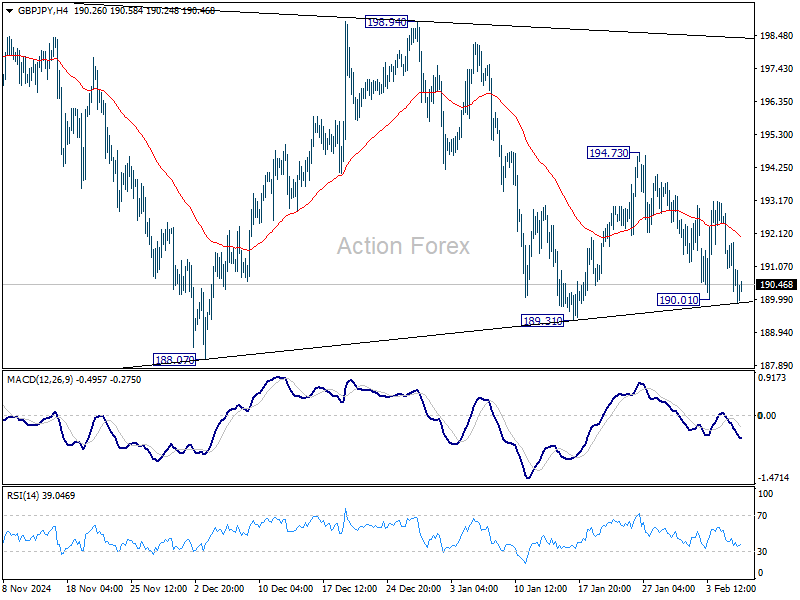
Daily Pivots: (S1) 189.81; (P) 191.31; (R1) 192.31; More...
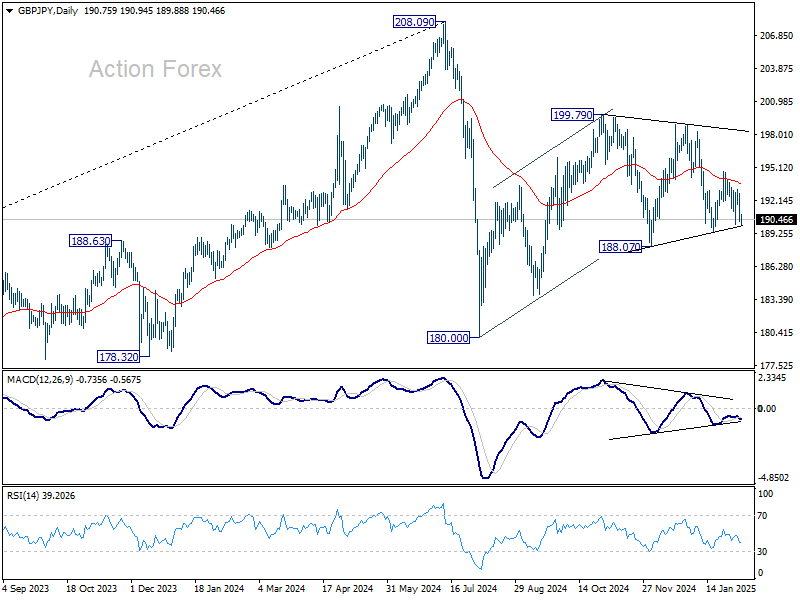
Intraday bias in GBP/JPY remains neutral for the moment. On the downside, firm break of 189.31 will suggest that corrective pattern from 180.00 has completed. But before that, the pattern could still extend. Break of 194.73 will bring stronger rebound instead.
In the bigger picture, price actions from 208.09 are seen as a correction to whole rally from 123.94 (2020 low). The range of consolidation should be set between 38.2% retracement of 123.94 to 208.09 at 175.94 and 208.09. However, decisive break of 175.94 will argue that deeper correction is underway.
EUR/JPY Daily Outlook
Daily Pivots: (S1) 158.06; (P) 159.18; (R1) 159.87; More...
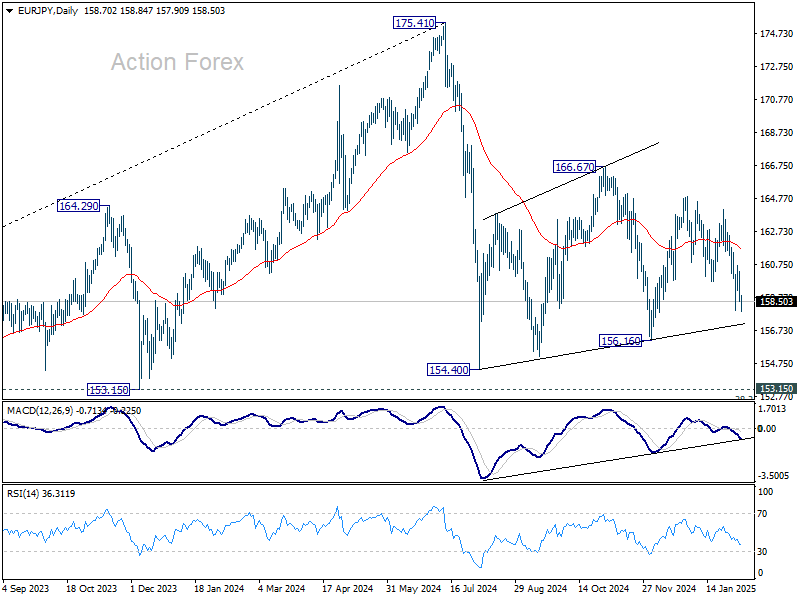
Intraday bias in EUR/JPY remains neutral for the moment. Overall outlook is unchanged that consolidation pattern from 154.40 could still extend. On the downside, below 157.96 will target 156.16 support. However, break of 161.48 will turn bias back to the upside for 164.07 resistance.
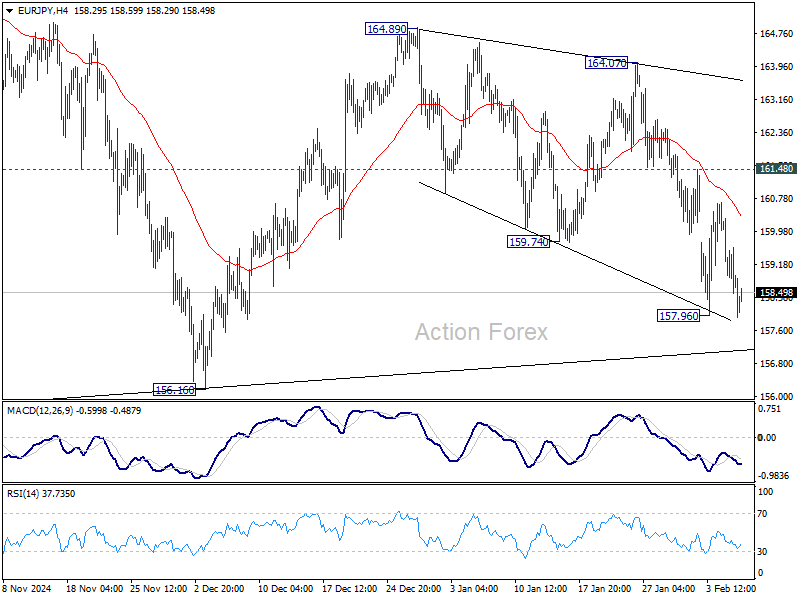
In the bigger picture, price actions from 175.41 are seen as correction to rally from 114.42 (2020 low). The range of consolidation should have been set between 38.2% retracement of 114.42 to 175.41 at 152.11 and 175.41 high. However, decisive break of 152.11 would argue that deeper correction is underway...
EUR/GBP Daily Outlook
Daily Pivots: (S1) 0.8303; (P) 0.8320; (R1) 0.8335; More...
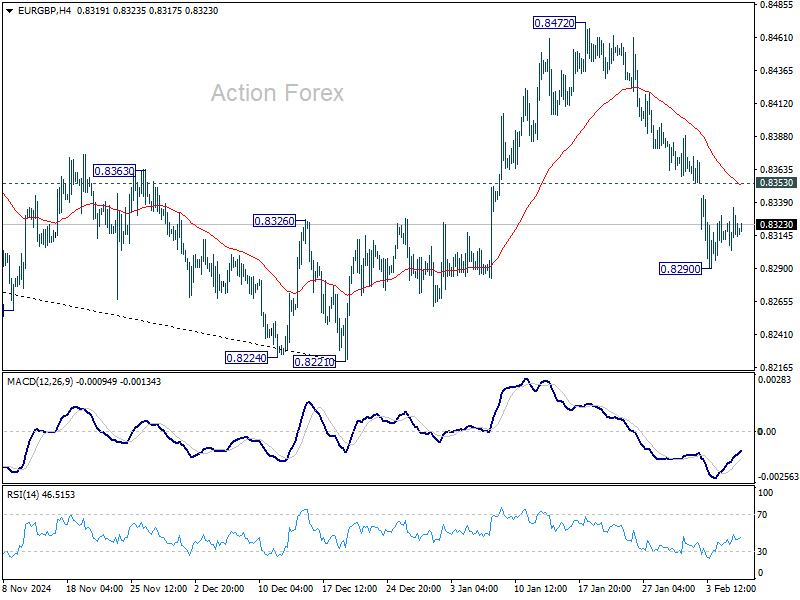
Intraday bias in EUR/GBP is turned neutral for consolidations above 0.8290 temporary low. Further decline s expected as long as 0.8353 resistance holds. Corrective rebound from 0.8221 should have completed already. Fall from 0.8472 would target a retest of 0.8221 low. However, firm break of 0.8353 will turn bias back to the upside for stronger rebound.
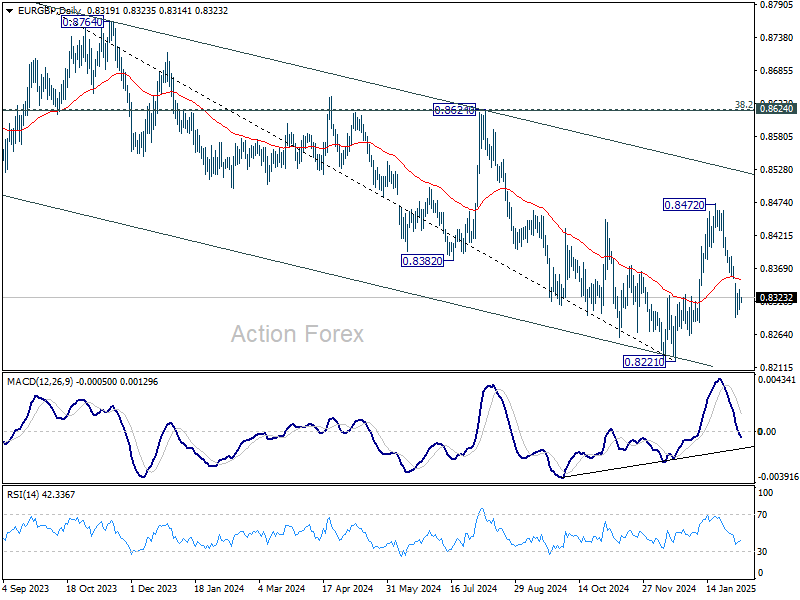
In the bigger picture, a medium term bottom should be in place at 0.8221, just ahead of 0.8201 key support (2022 low). Sustained trading above 55 W EMA (now at 0.8442) will pave the way to 0.8624 cluster zone (38.2% retracement of 0.9267 to 0.8221 at 0.8621), even just as a correction to the down trend from 0.9267 (2022 high). But still, medium term outlook will be neutral at best as long as 0.8621/4 holds.
EUR/AUD Daily Outlook
Daily Pivots: (S1) 1.6521; (P) 1.6574; (R1) 1.6605; More...
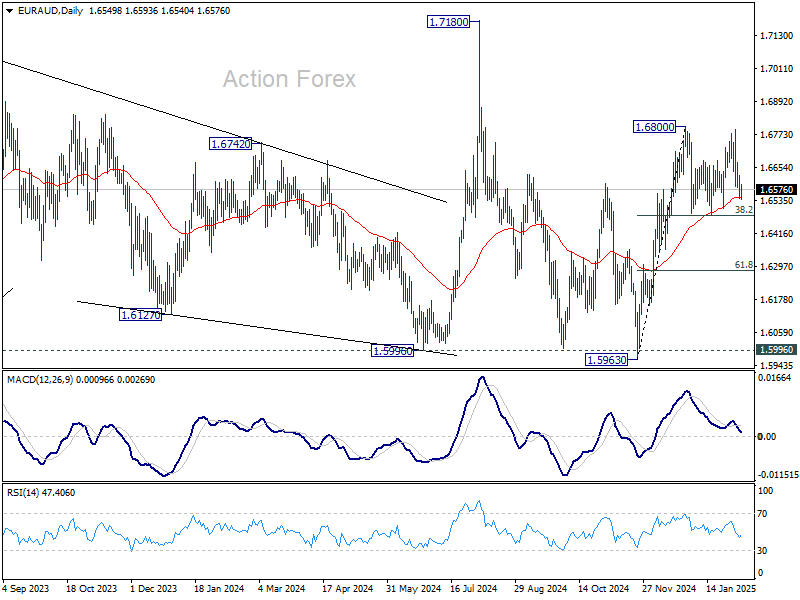
EUR/AUD's consolidation from 1.6800 is still in progress and intraday bias stays neutral. Strong support is expected from 38.2% retracement of 1.5963 to 1.6800 at 1.6480 to contain downside. On the upside, firm break of 1.6800 will resume the rally from 1.5963. However, sustained break of 1.6480 will bring deeper correction 61.8% retracement at 1.6283 instead.
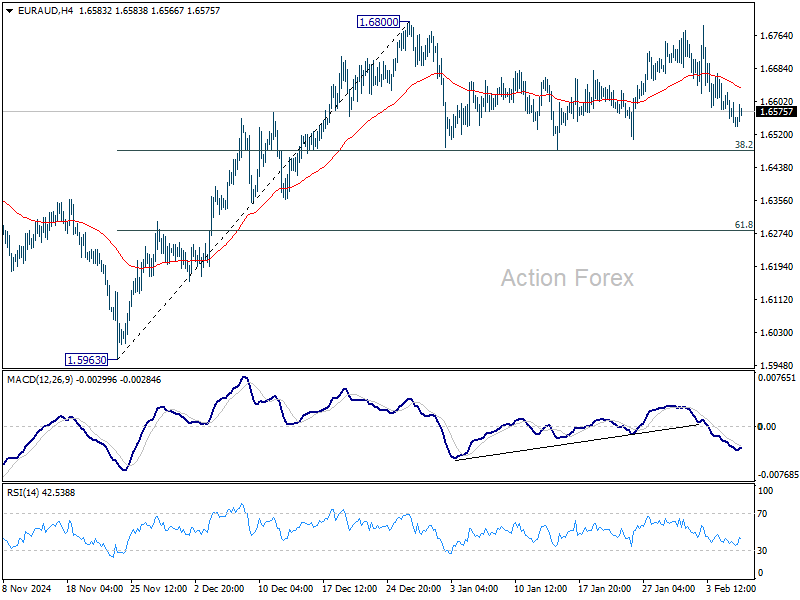
In the bigger picture, EUR/AUD is holding on to 1.5996 key support (2024 low) despite brief breach. Larger up trend from 1.4281 (2022 low) is still in favor to resume through 1.7180 at a later stage. Nevertheless, sustained break of 1.5996 will indicate that such up trend has completed and deeper decline would be seen.
EUR/CHF Daily Outlook
Daily Pivots: (S1) 0.9368; (P) 0.9387; (R1) 0.9400; More....
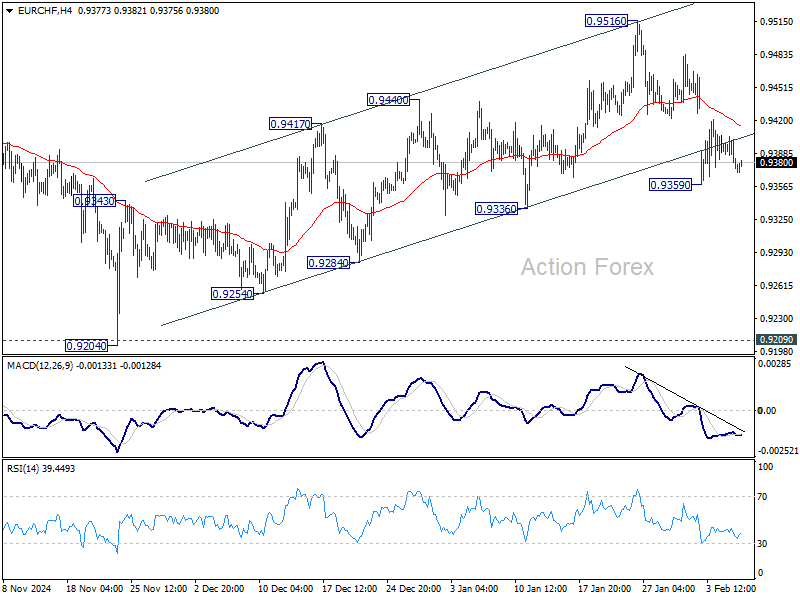
EUR/CHF is staying in range trading above 0.9359 and intraday bias remains neutral. Risk will stay on the downside as long as 0.9516 resistance holds. Corrective rebound from 0.9204 might have completed at 0.9516 already. Firm break of 0.9336 support will solidify this bearish case and target a retest on 0.9204 low.
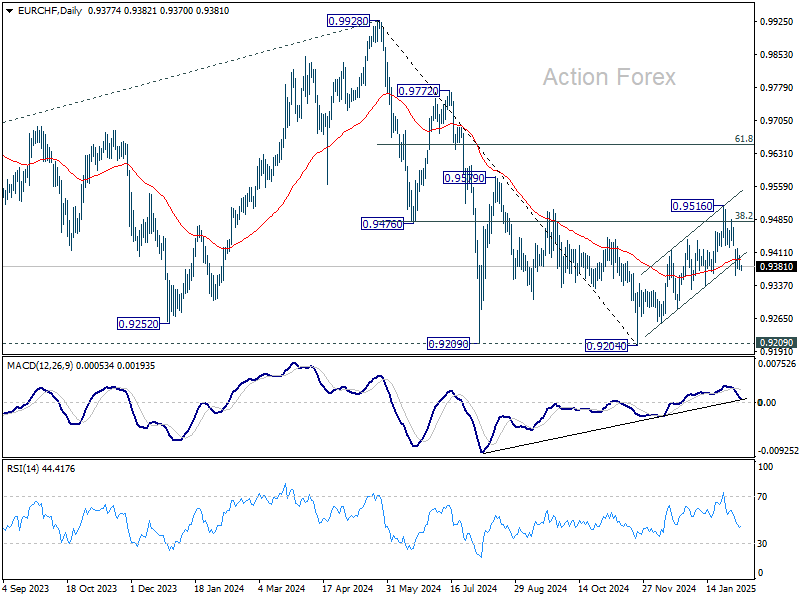
In the bigger picture, current development argues that rebound from 0.9204 has completed as a corrective move after failing to sustain above 38.2% retracement of 0.9928 to 0.9204 at 0.9481. Firm break of 0.9204/9 support zone will confirm larger down trend resumption.
USD/CAD Daily Outlook
Daily Pivots: (S1) 1.4275; (P) 1.4310; (R1) 1.4350; More...
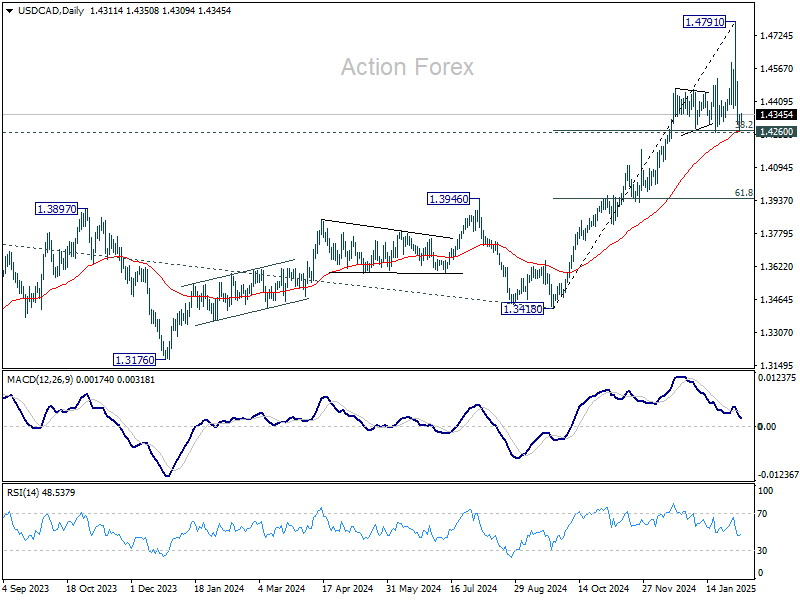
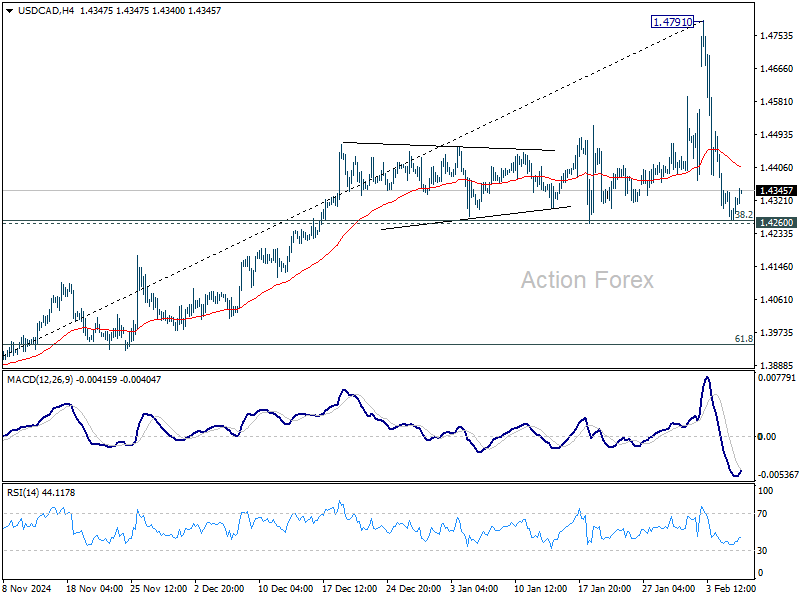
Intraday bias in USD/CAD remains neutral for the moment. Downside of the consolidation from 1.4791 should be contained by 1.4260 cluster support (38.2% retracement of 1.3418 to 1.4791 at 1.4267), which is also close to 55 D EMA (now at 1.4264). Larger up trend is expected to resume through 1.4791 at a later stage. However, firm break of 1.4260 will indicate that deeper correction is underway.
In the bigger picture, the break of 1.4667/89 key resistance zone (2020/2015 highs) confirms long term uptrend resumption. Next target is 100% projection of 1.2401 to 1.3976 from 1.3418 at 1.4993. Medium term outlook will remain bullish as long as 1.3976 resistance turned holds (2022 high), even in case of deep pullback.