Sample Category Title
Technical Outlook: EURUSD Breaks Below Key Supports As Politics Continues To Produce Negative Impact
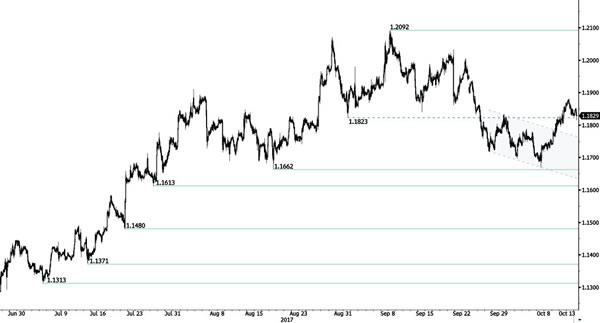
The Euro holds in red for the second day and broke below important supports at 1.1848/26 ( daily H&S pattern neckline / Fibo 61.8% of 1.1662/1.2092 upleg), signaling further downside.
Fresh weakness was triggered by politics with completion of reversal pattern, seen as strong bearish signal.
Bears are gaining momentum for test of immediate support at 1.1798 (rising 55SMA) and could stretch towards key short-term support at 1.1722/20 (top of thick daily cloud / Fibo 38.2% of 1.1118/1.2092 ascend) where bears are expected to face strong headwinds.
Near-term action favors selling upticks for extension towards daily cloud top, however, overall bullish picture sees current pullback as correction of broader uptrend which should ideally reverse at 1.1720.
From the fundamental side, negative impact from the politics is expected to fade and focus to turn towards the ECB as recent talks of rate hike and reduction of the QE program, expected to remain the key driver of the Euro.
Alternatively, loss of 1.1722/20 pivots would signal deeper correction and expose supports at 1.1662 (17 Aug trough) and 1.1605 (50% of 1.1118/1.2092).
Res: 1.1861, 1.1893, 1.1913, 1.1936
Sup: 1.1798, 1.1720, 1.1662, 1.1605

Geopolitical Risks In The Driving Seat Again
Demand for safe havens returned on Monday, as a new war of words between North Korea and the U.S. triggered a flight to safety amongst investors. The latest comments came from North Korea's foreign minister, Ri Yong-Ho, who accused the U.S. of ‘declaring war' and said that they have ‘every right to take countermeasures', including the right to shoot down U.S. strategic bombers, even when they are not inside the airspace border of their country. His comments sent gold above $1,310, while U.S. 10-year treasury yields declined four basis points. In currency markets, the classic safe havens, JPY and CHF, made sharp gains against their major counterparts, while equities in Asia followed Wall Street lower early Tuesday.
So far, every aggressive selloff in equities and move to safe havens on geopolitical risks, has proven to be short-lived. The best-case scenario is for the U.S. to add more pressure on China and Russia, to increase sanctions against Pyongyang and pressure Kim Jong-un to sit around a negotiation table. However, as an investor, you should keep all options on the table.
An exciting development was seen in options market, where the trading volume in CBOE's Volatility Index "VIX" surged yesterday to a new high. The price action was not significant, as the index peaked at 11.21, only to drop back 9% four hours later. This activity may be an early sign of anxiety among investors, who started to consider hedging their positions against a market correction. However, I suggest that you do not jump to conclusions from a single day of increased activity, as it may have been a speculative move. If trading volumes remain high in the next couple of days, then markets are seriously expecting a considerable correction in equity markets.
Tensions between the U.S. and North Korea were not the only reason for the drop in U.S. treasury yields. The Federal Reserve's well-known dove Charles Evans, sounded less hawkish in his remarks in to the Economic Club of Grand Rapids. He said the Fed should wait until there are clear signs that American paychecks and prices are rising, before raising rates again. So far, there are no signs that inflation or wages will pick up in the next couple of months. The comments made by Evans may be overshadowed by speeches from Neel Kashkari and Janet Yellen later today, which will most likely have a stronger impact on the shape of the yield curve.
Oil prices were also making headlines, as Brent hit its highest levels in over two years yesterday, closing above $59. Tighter supplies and growing demand contributed heavily to the recent 33% surge from July lows. However, the 3.8% move on Monday was driven by threats from Turkey to cut crude flows from the Kurdistan region, as they seek their independence from Iraq. The Kurdistan region of Iraq currently produces around 650,000 barrels per day, of which 85% goes through the Turkish pipelines. If the Turks decided to cut crude flows, it would create a shock which markets are currently pricing in. However, I think this is going to be only a temporary threat, given that independence will not happen overnight and OPEC members will quickly cover the shortage. In my opinion, the spread between Brent and WTI has gone too far and should shrink back towards $4-5.
NZD/USD: NZ Trade Balance
The NZD/USD exchange rate dropped markedly on the New Zealand's trade balance data late Monday. The Kiwi lost against the US Dollar 17 base points or 0.23% to touch the 0.7249 mark and to rebound gradually, though the trading session continued in the weaker area of 0.7240-0.7250, where the post-election uncertainties kept supporting the bearish sentiment in the pair.
Statistics New Zealand reported that the country's trade balance marked a NZ$1235M deficit for the month of August, compared with expectations for a fewer deficit of NZ$825M. The Market also remained watching any sings from the Reserve Bank of New Zealand, as its hawkish tone could strengthen the Kiwi.

USD/CAD Daily Outlook
Daily Pivots: (S1) 1.2326; (P) 1.2355; (R1) 1.2399; More....
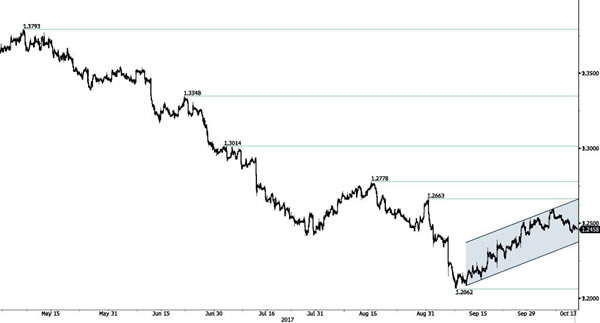
Intraday bias in USD/CAD remains neutral as consolidation from 1.2061 is still in progress. At this point, we'd remain cautious on strong support from 1.2048 to bring sustainable rebound. But still, break of 1.2439 support turned resistance is needed to be the first sign of trend reversal. Otherwise, outlook will remain bearish. Firm break of 1.2048 will pave the way to next fibonacci level at 1.1424. Break of 1.2412 will bring stronger rise back to 55 day EMA (now at 1.2531) and above.
In the bigger picture, focus remains on 50% retracement of 0.9406 to 1.4869 at 1.2048. As long as this level holds, we'd still favor that case that fall from 1.4689 is a correction. Rebound from 1.2048 could extend the larger up trend from 0.9406. However, firm break of 1.2048 will indicate that fall from 1.4689 is at least a medium term down trend and should target 61.8% retracement at 1.1424 and below.


EUR/USD: German Ifo Business Climate
EUR/USD attempted to rebound from the 1.1860 mark after a lingering downmove, which was additionally fuelled by the weak Ifo economic report. Following the publication, the Euro lost against the Greenback 10 base points or 0.09%, while the bearish sentiment was sustained putting the pair to the monthly low.
The Ifo Institute for Economic Research reported on Monday that its Business Climate Index dropped to 115.2 in September, reflecting unclarities surrounding the German Federal Election, which left Angela Merkel in front of tricky coalition negotiations. Statement showed that firms were less satisfied with both current situation and near-term outlook, as the country's economy entered the period of new legislation.

AUD/USD Daily Outlook
Daily Pivots: (S1) 0.7917; (P) 0.7945; (R1) 0.7964; More...
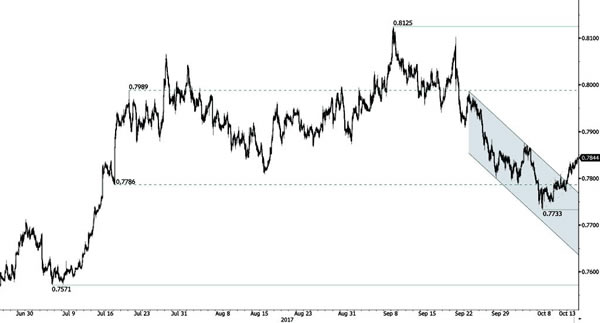
Intraday bias in AUD/USD remains neutral for the moment as consolidation from 0.8124 continues. With 0.7807 support intact, outlook stays bullish for another rally. Above 0.8124 will target 100% projection of 0.6826 to 0.7833 from 0.7328 at 0.8335 next. However, considering bearish divergence condition in daily MACD, firm break of 0.7807 will indicate near term reversal and turn bias back to the downside for 0.7328 key support.
In the bigger picture, rise from 0.6826 medium term bottom is still in progress. At this point, there is no confirmation of trend reversal yet and we'll continue to treat such rebound as a corrective pattern. But in any case, break of 55 month EMA (now at 0.8090) will target 38.2% retracement of 1.1079 to 0.6826 at 0.8451. Break of 0.7807 support is needed to to be the first sign of completion of the rebound. Otherwise, further rise is now in favor.


XAUUSD Analysis: Breaks Descending Channel
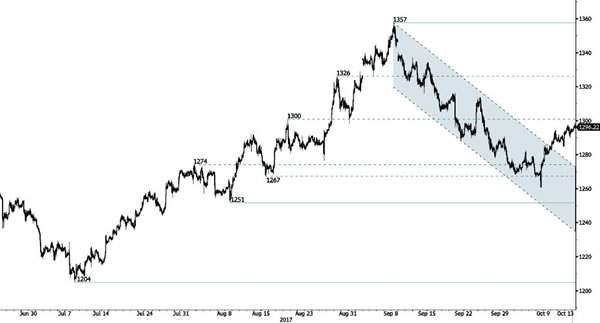
In result of the previous trading session, the yellow metal managed to recover not less than 1.26% against the buck. Such rapid advance pushed the pair not only through the psychological 1,300.00 level but also through the upper boundary of a descending channel as well as the 200-hour SMA. Most likely this sudden interest in gold was attributed to very hostile rhetoric between the US and North Korea. On the other hand, such movement could also have a technical rationale, as by the moment, the pair has reached the 1,313.61 mark that represents a point from which it entered into a downfall six days ago. This fact as well as the additional resistance set up by the weekly R1 at 1,315.94 suggests that the rate is likely cool down and eventually resume the fall.

EUR/USD Daily Outlook
Daily Pivots: (S1) 1.1808; (P) 1.1872 (R1) 1.1913; More...
EUR/USD's decline from 1.2091 continues today. Break of 1.1822 support indicates near term reversal. That is, fall from 1.2091 is now correcting whole rally from 1.0569. Intraday bias is turned to the downside for 1.1661 support first. Break will target 38.2% retracement of 1.0569 to 1.2091 at 1.1510, where we're expecting support to bring rebound. On the upside, break of 1.2029 resistance is needed to confirm completion of the pull back. Otherwise, deeper fall will remain in favor as the correction develops.
In the bigger picture, rise from medium term bottom at 1.0339 is still in progress for 38.2% retracement of 1.6039 (2008 high) to 1.0339 (2017 low) at 1.2516. However, it should be noted that there is no confirmation of trend reversal yet. That is, such rebound from 1.0399 could be a correction. And the long term fall from 1.6039 (2008 high) could resume. Hence, we'd be cautious on strong resistance from 1.2516 to limit upside. But after all, break of 1.1661 is needed to indicate medium term topping. Otherwise, outlook will remain bullish in case of pull back.


USDJPY Analysis: Falls Amid Kim-Trump Hostile Rhetoric
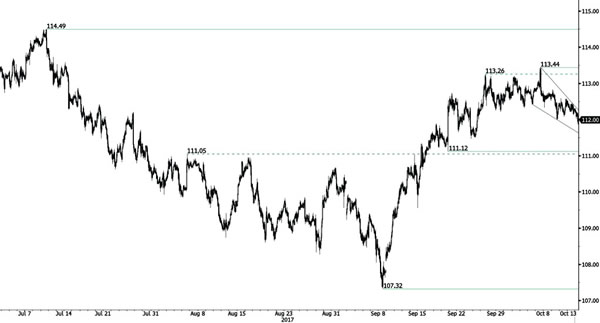
An increasing hawkish rhetoric between the United States and North Korea led to appreciation of the Yen by 63 basis points just in three hours. As a result, the pair broke through the 100-hour SMA as well as the weekly PP and ended up near the 200-hour SMA. Accordingly, today the currency rate might try using this downside momentum to slip to the area between the 111.38 and 111.26 levels. On the other hand, a number of factors indicate on presence of a new junior descending channel. If this assumption is true, then the rate should not fall below the 111.40 mark. In contrast, the buck might use the above 200-hour SMA as a springboard to try to return at least to the weekly PP at 111.90.

GBPUSD Analysis: Sneaks Below Monthly R2 At 1.3485
Although initially the currency pair managed to climb above the weekly PP at 1.3536 that was backed up by the 55- and 100-hour SMAs, but later it failed to strengthen this position and continue the surge. In result of the two hour downfall, the Pound lost 67 basis points against the Greenback, thus breaking the previously active rectangle pattern whose lower trend-line was represented by the monthly R2 at 1.3485. During this trading session the Sterling might try to restore some of the lost positions, but this attempt is likely to be neutralized by the 200-hour SMA, which is located near the 1.3494 level. In additional to that, the northern direction also contains the previously mentioned 55- and 100-hour SMAs, which are lying along the upper edge of a supposed new descending channel.