

Sample Category Title
Dollar Faces Headwinds After FOMC Minutes, Euro Rises As Rajoy Sets Deadline For Puigdemont
The dollar was mostly in the red against its major counterparts during the Asian session after the FOMC meeting minutes released on Wednesday indicated that Fed policymakers had doubts on the inflation path. In contrast, the euro was on track to post gains for the fifth straight day as Catalonia’s questioned status of independence is likely to clear out next week.
On late Wednesday, the minutes of the Fed’s September meeting sounded dovish to investors’ ears as the statement showed that policymakers are concerned that factors weighing on inflation might be more persistent and “patience in removing policy accommodation while assessing trends in inflation was warranted”. Even though this might signal a slowdown in interest rate hikes, the minutes also revealed that most policymakers continue to support another rate rise this year.
Later in the day, market watchers will keep a close eye on PPI figures released out of the US for more evidence on inflation (CPI numbers out of the US will be released tomorrow). Initial jobless claims will be also in focus.
The dollar index made a fresh two-week low of 92.79 before it edged up to 92.81, being 0.17% down on the day. Dollar/yen declined by 0.19% to 112.25, finding additional pressure from Japanese election polls published by the Nikkei business daily on Wednesday which showed that Prime Minister Shinzo Abe’s conservative Liberal Democratic Party could keep its two-thirds majority in the elections scheduled for October 22. In terms of data out of Japan, the service sector experienced a contraction of 0.2% m/m in October, whereas analysts expected a growth of 0.1%. Moreover, Japanese PPI rose by 3.0% y/y and 0.2% m/m as expected.
In Spain, the Prime Minister Mariano Rajoy, asked the Catalan leader, Carles Puigdemont, on Wednesday to clarify whether he considers Catalonia as independent, giving a time deadline of eight days for the region to drop its independence bid. Moreover, he said that if the Catalan government shows opposition, then he would have to suspend the region’s autonomy. This comes after Puigdemont signed Catalonia’s sovereignty on Tuesday but froze its implementation to give time for both sides to start discussions on the matter.
Euro/dollar approached a three-week high of 1.1879 but slipped to 1.1860 afterwards following worse than expected CPI readings out of France. The pair was 0.15% down on the day.
Pound/dollar made a fresh one-week high of 1.3264 but fell to 1.3240 before the session-end, gaining 0.14%. Figures on RICS House Price Balance provided some support to cable as 6% of surveyors reported house price increases in their areas in September, while analysts expected the figure to drop from the previous 6% to 4%.
In other currencies, the aussie surged 0.60% reaching a one week high of $0.7834 on the back of a weaker dollar as well as on better than expected new home loans and inflation projections. In August, new home loans increased by 1.0% m/m, above the 0.5% anticipated but below the downwardly revised 2.8% experienced in July. Annual inflation forecasts for the next twelve months published by the Melbourne Institute rose from 3.8% to 4.3%.
The kiwi climbed by 0.50% to a one week high of $0.7187 despite coalition talks in New Zealand being still in the dark as Winston Peters, the leader of the kingmaker First Party said on Wednesday that he needs more time before he gives his final answer on whether he will side with the National Party or the Labour-Green bloc.
Regarding commodities, WTI crude and Brent were weaker ahead of the EIA report later today, with the former being down by 0.49% at $51.05 per barrel and the latter falling by 0.28% to $56.78. Gold was 40% up at $1,296.80 per ounce.
Sterling Moves To 1.3266
The British pound has moved to its highest trading level since October 5th against the U.S dollar, hitting 1.3266, as the U.S dollar index weakened, following the release of a more dovish than expected FOMC Meeting Minutes.
Trading sentiment surrounding the GBPUSD pair is currently bullish, with price-action now trading well above the key 1.3220 technical level, which had previously been a key turning point for the pair.
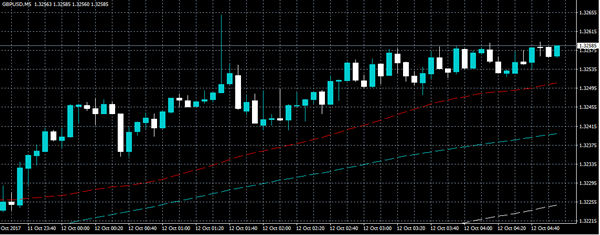
Later today the British pound may come under selling pressure, as the Bank of England releases its most recent findings of the Credit Conditions and Bank Liabilities Survey.
Despite the GBPUSD pairs recent recovery from the 1.3029 level, today's daily price-close above the 1.3220 level remains critical for further bullish advancement.
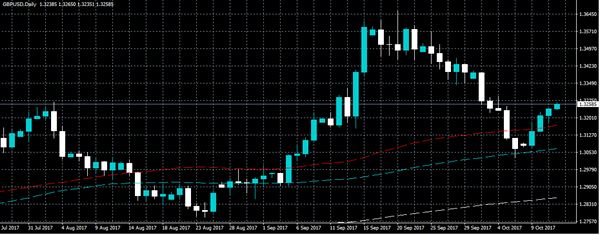
Key intraday technical support for the GBPUSD pair is found at the H4 time-frame 100 period moving average, at 1.3246 and the key 1.3220 level. Further support is found at 1.3207 and the former daily low, at 1.3175.
To the upside, key intraday resistance is found at 1.3266 and the key 1.3290 level. Further resistance above the 1.3290 level is found at the pairs 100-week moving average, at 1.3323 and the key 1.3360 level.
Euro Moves To Monthly Pivot
Following the release of FOMC Meeting Minutes, the EURUSD pair has advanced towards the 1.1878 level, after Federal Reserve policy raised deep concerns over the current low inflationary environment in the United States.
The trading sentiment surrounding the EURUSD pair today is bullish, as the euro continues to test its key monthly pivot point, at 1.1875, while the U.S dollar index sinks below its key 200-week moving average.
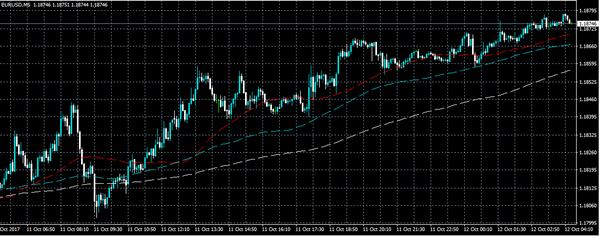
The euro has reached a confluence of critical resistance, facing its monthly pivot point and 61.8 Fibonacci retracement level of the recent 1.1669 swing low to the 1.2004 swing price-high, at 1.1875.
Later today the EURUSD will react to U.S inflation data, with the release of the Producer Price Index for the month of September.
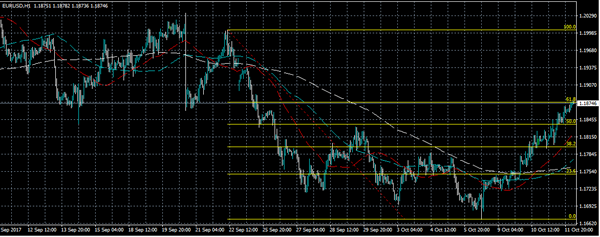
Key near-term intraday technical support for the EURUSD is found at the pairs 50-day moving average, at 1.1862, and the euro's daily pivot point, at 1.1848. Once below 1.1848, further support is found at 1.1832 and 1.1800.
Key technical resistance above the 1.1875 level is found at 1.1890, and the key 1.1910 level. Once above 1.1910, further resistance is found at the September 25th price-high, at 1.1936 and the 1.1985 level.
Markets Look To Monetary Policy As Central Bankers Chime In
The financial community will have a dual focus on Thursday, as a steady stream of economic data is accompanied by fresh commentary from multiple central bankers from Europe and the United States.
The Thursday session kicks off at 6:45 GMT with a report on French consumer inflation. Headline CPI is expected to come in at 1.1% in the 12 months through September.
Later in the day, the European Commission's statistical agency will release Eurozone industrial production figures for the month of August. The monthly print is expected to show a gain of 0.5%. That will translate into year-over-year growth of 2.5%, forecasters say.
Portugal's consumer price index (CPI) will make headlines at 10:00 GMT before attention shifts to North America.
The US Labor Department will report on factory-gate prices at 08:30 GMT. The producer price index (PPI) is expected to rise 2.5% annually in September, up from 2.4% the previous month. Core PPI likely rose 2% year-over-year, according to forecasts.
Bank of England (BOE) Monetary Policy Committee member Andrew Haldane will kick off the central bank commentary at 13:00 GMT. Haldane has emerged as one of the BOE's more hawkish members.
Later in the day, European Central Bank (ECB) President Mario Draghi and Executive Board Member Peter Praet will also deliver speeches.
Federal Reserve bankers Jerome Powell and Lael Brainard are also due to speak.
EUR/USD
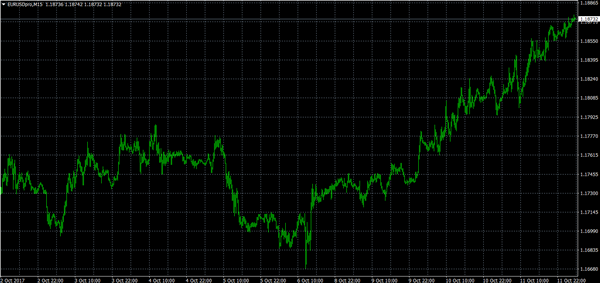
The euro sprang forward on Wednesday, rising to two-week highs against the greenback. The EUR/USD continued higher overnight, where it came within 12 pips of 1.1900. Markets are in a bullish phase, as prices extend further beyond the 200-day simple moving average (SMA). At the moment, the EUR/USD faces an initial resistance at the 2 August high of 1.1911. On the opposite side of the ledger, support is located at the 6 October low of 1.1686.
USD/CAD
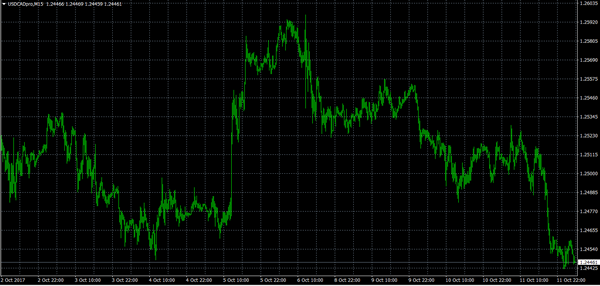
The USD/CAD followed the greenback lower on Wednesday, as prices fell back below 1.2500. The Canadian dollar is also being supported by booming oil prices, of which Canada is a prime exporter. The USD/CAD edged even lower overnight, where it was trading in the 1.2440 range. A sharp pullback toward the 1.2400 handle could expose the pair to an even bigger correction following a month-long winning streak.
US OIL
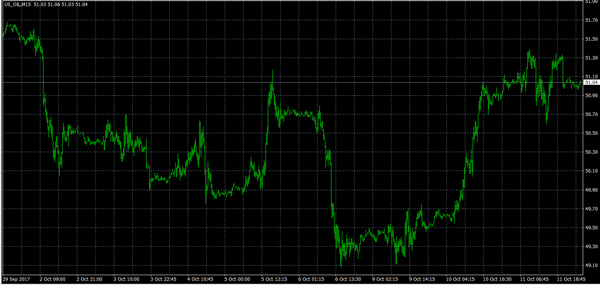
Oil prices are riding high this week on signs of improving demand. US crude prices rose sharply above $51.00 a barrel on Wednesday. Prices pulled back through the overnight trade to settle in the low $51.00 range. The latest rally in oil prices formed a double-top. A failure to extend the gains north of $51.40 may trigger another short-term pullback in the market. That being said, the bulls are finally gaining traction.
Aussie Dollar Breaks Key Resistance Vs US Dollar
Key Highlights
- The Aussie Dollar after forming a bottom, traded higher and broke a major resistance at 0.7800 against the US Dollar.
- There was a break above a crucial bearish trend line at 0.7800 on the 4-hours chart of AUD/USD.
- Australia's Home Loans in August 2017 increased 1%, more than the forecast of +0.5%.
- Today in the US, the Initial Jobless Claims (Oct 7, 2017) will be published, which is forecasted to decline from 260K to 251K.
AUDUSD Technical Analysis
The Aussie Dollar after steady decline found support at 0.7720-00 against the US Dollar. The AUD/USD pair recovered well this week and recently broke a major resistance at 0.7800.
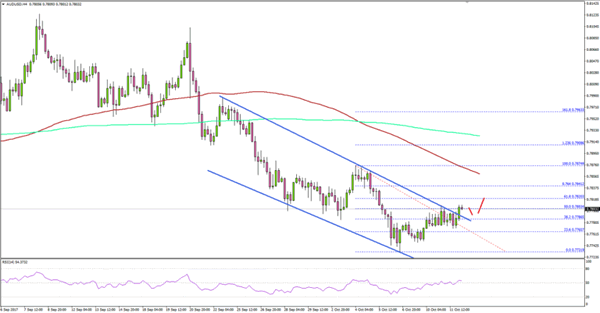
There was a nice recovery above the 23.6% Fib retracement level of the last decline from the 0.7875 high to 0.7719 low.
Looking at the 4-hours chart, there was a break above a major bearish trend line at 0.7800. The trend line resistance was also near the 50% Fib retracement level of the last decline from the 0.7875 high to 0.7719 low.
At the moment, the pair is struggling to gain momentum above 0.7800. Therefore, there is a chance of a minor dip before the pair resumes its uptrend towards the 0.7850 level.
Australia's Home Loans
Today in Australia, the Home Loans figure for August 2017 was released by the Australian Bureau of Statistics. The forecast was slated for a rise of 0.5% in loans compared with the previous month.
The actual result was above the forecast, as there was a rise of 1% in the home loans. On the other hand, the last reading was revised down from 2.9% to 2.8%.
The report added that:
The trend estimate for the total value of dwelling finance commitments excluding alterations and additions rose 0.6%. Owner occupied housing commitments rose 0.9% and investment housing commitments rose 0.2%.
The result had a positive impact on AUD/USD and the pair was able to move above the 0.7800 resistance.
Other Economic Releases to Watch Today
Euro Zone Industrial Production for August 2017 (MoM) – Forecast +0.5%, versus +0.1% previous.
US Producer Price Index Sep 2017 (MoM) – Forecast +0.4%, versus +0.2% previous.
US Producer Price Index Sep 2017 (YoY) – Forecast +2.5%, versus +2.4% previous.
US Initial Jobless Claims – Forecast 251K, versus 260K previous.
ECB President's Draghi's Speech.
XAUUSD Intraday Analysis
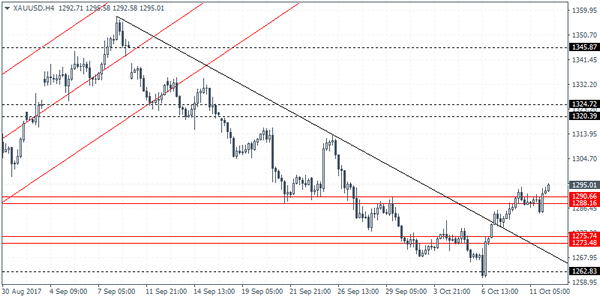
XAUUSD (1295.01): Gold prices struggled near the resistance level of 1290 - 1288 region but was seen attempting to clear this level. Any upside move in prices is likely to see a reversal back to the cleared resistance level where support could be formed. The upside bias will keep gold prices potentially targeting the 1320 - 1324 region of resistance as the next target with the said support level to the downside. In the event of a break down below the 1290 - 1288 region, gold prices could remain mixed with a potential to post further declines down to 1275 - 1273 region.
USDJPY Intraday Analysis
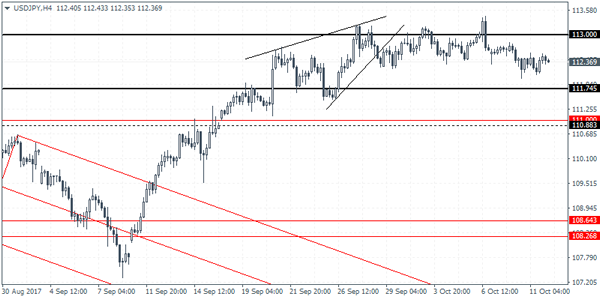
USDJPY (112.36): The USDJPY continues to remain trading within the range of 113.00 and 111.74. This consolidation is seen as USDJPY attempts to break past the longer term falling trend line. With the strongconsolidation posted here, the bias is building to the downside. Support at 111.74 will be the initial target followed by a decline to 111.00. However, in the medium term, USDJPY is seen maintaining the sideways price action as a result. Only a breakout from the range will establish the direction and potentially signal further gains or declines in prices.
EURUSD Intraday Analysis
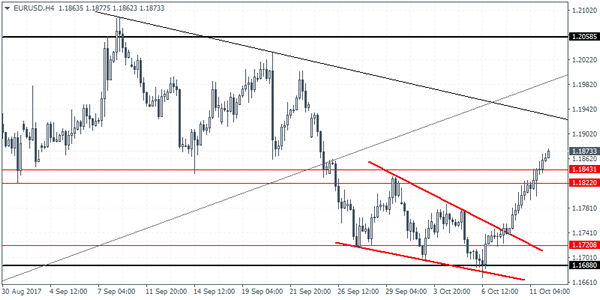
EURUSD (1.1873): The euro maintained bullish gains for a fourth consecutive day as price breached the resistance level of 1.1822 - 1.1843. Clearing this resistance will now see further gains in the currency pair as it targets the potential unfilled gap at 1.1948. However, establishing support near the newly breached resistance level will add more validity to the upside. Despite the anticipated move towards 1.1948 EURUSD longer term bias remains to the downside. Thus, a potential reversal near the above target could signal a possible move towards 1.1822 - 1.1843 region followed be a further decline to the previous support at 1.1720.
Markets Muted To FOMC As Inflation Puzzles Officials
The FOMC meeting minutes released late yesterday showed a mixed outlook as policy makers were divided on interest rate hikes. While some officials preferred for rates to be hiked, others preferred to wait for more evidence.
Besides the FOMC minutes, Fed speak over the day included Evans who questioned whether more accommodative policy was required to boost inflation while on the other hand, George said that the Fed should continue with its gradual rate hikes.
On the economic front, data was relatively quiet. Looking ahead, the US producer prices index data will be released today. Estimates point to a 0.4% increase on the headline PPI while core PPI is expected to rise 0.2% on the month. ECB President Mario Draghi will be speaking today followed by FOMC members Powell and Brainard.
It Is All About Inflation
When the Federal Reserve met on 19-20 September, it announced the start of winding down the $4.5billion balance sheet and maintained plans for a thirdrate hike in 2017. The statement reflected confidence in economic activity, particularly the pickup in household spending and growth in business investments. DespiteHurricanes Harvey and Irma, the central bank was still confident that the U.S. economy would keep its momentum, and Janet Yellen sounded more hawkish than markets anticipated. This was all good news for the U.S. dollar, which rallied for three weeks after the meeting, appreciating 2.3% against a basket of currencies.
The primary concern was low inflation. Fed chair Janet Yellen, described it as something of a "mystery." When an institution that employs over 300 Ph.D. economists,not knowing whether low inflation is persistent or transitory, the risk of tightening monetary policy further might be a huge policy mistake if inflation does not return to normal levels. The Phillips curve model, which theorisesthat there should be a strong inverse relationship between unemployment and price inflation, is apparently not working;it is probably time for the Fed to abandon this theory, and find new models.
Yesterday's Fed minutes reflected such worries. Several members insisted that the decision of raising rates for the third time in 2017 should depend on economic data, which underscores their belief that inflation would move towards the Fed's 2% inflation target. The dollar bulls did not like the statement, despite expectations of a December rate hike remaining above 80%, according to CME's FedWatchTool. The Dollar Index continued to fall for the fifth day in a rowon Thursday, with overall declines of 1.5% from 6 October highs.
Given that inflation has become the most important economic metric impacting the dollar's direction, today's PPI and more importantly, tomorrow's CPI should be watched very closely. Any upside surprise would curb the dollar's fall; however, a disappointing figure would be an excuse to keep dragging the USD lower.
The Euro performed very well, climbing to the highest level in more than two weeks at 1.1878. After Carles Puigdemont suspended the process of Catalonia's independence, Spain's Prime Minister, Mariano Rajoy, has given him five days to say whether or not he has declared independence. Depending on the response, the government in Madrid could impose direct rule on Catalonia. I think the overall crisis in Spain is still underpriced, and if no agreement is reached in the next couple of days, the stability of the Eurozone as a whole would be at risk. Although economic fundamentals continue to support a stronger Euro, politics will play a significant role as to where the Euro heads next. ECB's Mario Draghi will participate in the annual meetings of the World Bank Group and the IMF in Washington today. Any new hintsof ECB's next move will move the single currency.
Despite no advances made in the Brexit negotiations, Sterling continued to trade higher against the dollar for the fourth consecutive day. Although Brexit will keep weighing on Sterling in the longer run, monetary policies seem to be the major driver for now. Expectations of BoE raising rates in the final quarter of 2017 remained high, thus narrowing monetary policy divergence within the Federal Reserve. I think in the next couple of days, Sterling will be driven by economic data rather than Brexit negotiations.