Sample Category Title
EURUSD Analysis: Moves Around 1.1898
Most of the previous trading day the currency pair spent in a horizontal movement, being squeezed between the weekly PP at 1.1918 and the monthly PP at 1.1881. At the same time, it is fluctuating in a symmetrical triangle pattern, which is about to be broken.
The southern side remains protected by the bottom trend-line of a dominant ascending channel. In contrast, the northern direction is secured only by the weekly R1, which is located more than 100 basis points from the current position of the rate. For this reason, an upcoming rebound still remains seems to be a more preferable scenario.

GBPUSD Analysis: Waits For UK Data
The first half of the previous trading day the currency pair, indeed, spent in a limbo between two combined support and resistance barriers. However, a sharp appreciation of the buck by 37 basis points dragged the pair down right in the middle of a short-term symmetrical triangle.
It seems that this pattern formed in anticipation of a release of information on the UK Services PMI. Even though the plunge towards the 200-hour SMAs seems a more reasonable scenario from a technical perspective, everything will depend on content of the report that will be published by the Markit at 8:30 GMT.

USDJPY Analysis: Slips In A Channel Down
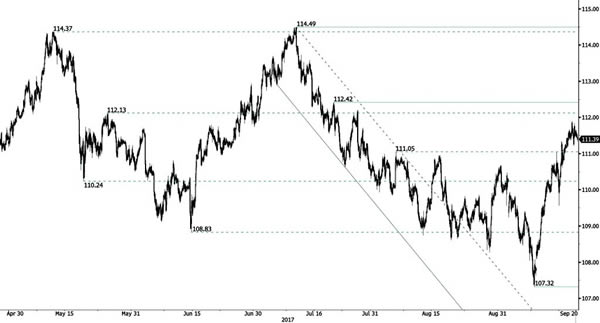
Yesterday the Greenback made a few attempts to break to the top through a combination of the weekly and monthly PP, but failed. For this reason, the Yen continued to appreciate in a descending channel.
Today, the pair is expected to continue to move towards the weekly S1 at 108.80, as the northern side contains too many barriers to allow the buck to recover. The only difference is that this time it seems that the channel has transformed into a falling wedge. However, this minor detail does not change the general projected direction for the pair.

XAUUSD Analysis: Fails To Break Above 1,339.40
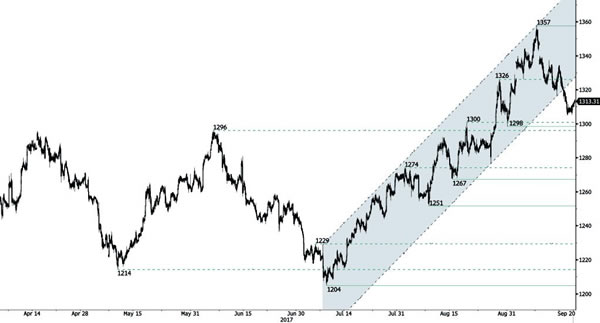
In line with expectations, a resistance set up by the weekly PP at 1,339.42 together with the upper edge of a medium-term ascending channel neutralized the further surge of the bullion.
An aggregate of technical indicators suggests that the rise will continue due to pressure from the upcoming 55- and 100-hour SMAs. While this might be true, the northern path remains obstructed not only by the above weekly PP but also by the monthly R1 at 1,348.36 and the weekly R2 at 1,352.71.
In this sense, the further flat movement at least in the first half of Tuesday seems a more likely scenario.

AUD/USD: RBA Cash Rate
The early Monday's report showed that the Australian current account deficit widened more than expected, causing a 0.23% gain in AUD/USD. However, the Aussie failed to sustain gains against the before the RBA announced its interest rate decision. The AUD/USD currency pair fell to the 0.7855 mark and then retreated back to the 0.7668 area.
The RBA interest rates were unchanged for 13 consecutive months, as the Central Bank remained a "hostage" of household debt levels, which prevented any changes in monetary policy. The rate of 1.50% is expected to be kept on hold, while the global economic growth continues to accelerate. In addition, economic data suggested that the country's economy was still in a good shape.

GBP/USD: UK Construction PMI
The GBP/USD exchange rate fell in a wake of disappointing Britain's construction PMI report to continue trading in a wide-range dynamics. The US Dollar strengthened against the British Pound by 10 base points to find a temporary resistance at the 1.2950 level.
Markit reported that the UK construction PMI slumped unexpectedly to the weakest level in a year of 51.1 with the strongest hit from falling investment in the commercial sector, which reflected overall Brexit pressure on the country's economic growth. The reading was close to the 50 mark indicating stagnation within the sector, which is likely to be reached if Brexit talks keep moving forward slowly, forcing the UK firms to free up offices and sap demand for commercial projects.

Elliott Wave Analysis: USDJPY And AUDUSD Intra-Day Prices
USDJPY went more complex, but still corrective from the 110.67 high. Its an overlapping decline with an open gap at 110.20, so we definitely expect a bounce this week, while price is above 108.25.
USDJPY, 1H

Regarding commodity pairs, AUDUSD can again become very interesting for a new breakout as we see a triangle in final stages in current red wave 4). An a-b-c decline can get down to 0.7900 where downside may be limited this week.
AUDUSD, 1H

WTI Oil Futures Consolidate After Bounce Above 47
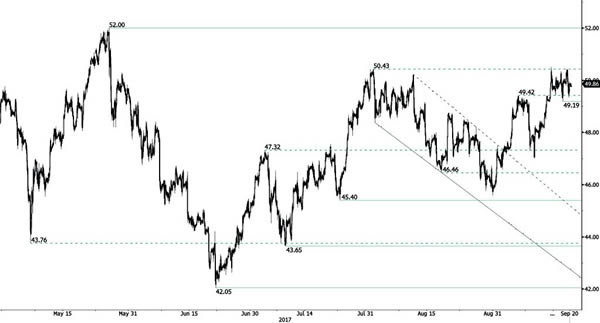
WTI oil futures are in a consolidation phase in the short-term and are pivoting around the key 47.00 level following a bounce at the end of August which ran out of steam.
The market is finding strong support at 47.00 which is where the 50-period moving average is converging. The 20-period MA is currently rising and if it crosses above the 50-period MA this would bring on a more bullish bias in the market. Since momentum oscillators are in bullish territory (RSI above 50 and MACD above zero), there is room for an upside move in prices.
Oil prices may struggle to rise above yesterday’s 47.63 high and is expected to continue moving sideways in the short term. A break above this resistance would shift the focus to the upside to target the next highs at 48.48 and 48.87 before reaching the key 50.00 level.
Alternatively, if prices fall and break below 47.00 then the neutral bias would shift to bearish to target support at 45.56 (August 31 low). Looking at the bigger picture, WTI oil has been on a downward trajectory and making lower highs since the decline from 50.19. So it remains to be seen whether the high at 47.63 is going to be another lower peak if the market moves below 45.56 to 45.38.
Overall, the short-term neutral bias is intact in the mid-47 area with a slight risk to the upside based on the bullish short-term technicals.

GBPUSD In Neutral Phase In Short And Medium-Term
GBPUSD is in a neutral phase and has been in a very narrow range since August 28. The pair is trading below the key 1.3000 level and above 1.2850.
GBPUSD hit a high of 1.2994 last Friday but upward pressure eased rapidly. The pair is more likely to trade sideways in the near term, based on the flat momentum oscillators. RSI has been hugging the 50 line for the past week while MACD is horizontal.
The market’s neutral outlook is expected to hold as long as prices remain capped by the 50-day moving average which is acting as resistance at 1.2973. Above this, the key 1.3000 level is strong resistance. A successful break of this level would target 1.3104 and then the August 3 peak at 1.3267.
The odds for a move lower are high if the 50-day MA keeps acting as a barrier to the upside. Immediate support is at 1.2851 (August 31 low). From here, 1.2773 is another support level (August 24) ahead of the 200-day MA at 1.2668. A deeper decline would bring about a strong bearish bias with scope to retrace all of the upleg from 1.2588 to 1.3267.
The near-term outlook for the pair is viewed as neutral but so is the medium-term picture, following the pull-back from the one-year peak of 1.3267.

Dollar Consolidates, Aussie Retreats As RBA Holds Rates At Record Lows
The dollar entered a consolidation phase in Asia as investors remained nervous about North Korea's possible future nuclear actions, while US markets provided little direction as they were closed for the Labour Day Holiday. Meanwhile, in Australia the RBA decided to keep its monetary policy unchanged, holding cash rates at record lows, but concerns over an appreciating exchange rate pushed the aussie down.
Investors preferred to put their money in safe-haven assets during the Asian trading hours and avoid riskier assets as they were worried that another nuclear test from North Korea could turn heightened tensions between the US and North Korea into a dangerous military conflict. The South Korean central news agency reported yesterday that North Korea is potentially preparing to fire another ballistic missile while today South Korea's Asia Business Daily stated that Pyongyang was moving a rocket described as an intercontinental ballistic missile towards its west coast. This followed North Korea's Sunday test of a relatively powerful nuclear weapon – considered as a hydrogen bomb – which provoked the US to threaten to terminate trade ties with nations collaborating with the North Korea as well as to impose stricter sanctions on the already isolated country. Moreover, US Defence Secretary James Mattis warned of a “massive military response” if Pyongyang threatened the US or its allies.
Besides that, traders will keep a close eye on the Fed's policy meeting on September 19-20 and on debt ceiling discussions for potential support. The Congress must decide on the maximum amount the government can borrow before the September 29 deadline taking account the cost of the disastrous tropical storm Harvey. Later today, speeches by Fed officials Brainard and Kashkari might give clues on Fed's actions.
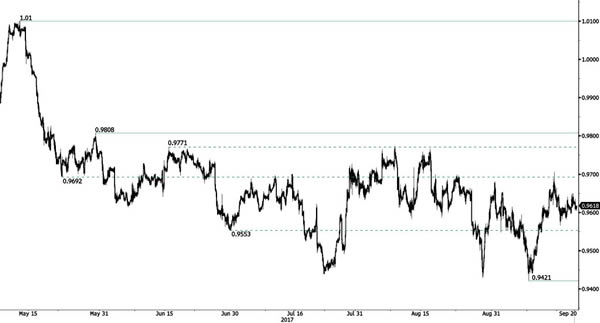
The dollar consolidated near 92.50 against a basket of major currencies, while it reached one-week lows against the yen and the swiss franc. Dollar/yen touched a low of 109.14 before it rose to 109.41, while dollar/swissie bottomed at 0.9543 before it climbs to 0.9567. Regarding the safe-haven gold, it moved sideways during the Asian session around $1,335.61.
The euro was flat versus the greenback, hovering around $1.1904.
In the meantime, the Reserve Bank of Australia (RBA) concluded its policy meeting on early Tuesday. RBA policymakers decided to hold interest rates at the 1.5% record low as it was widely expected, while the monetary statement released afterwards indicated concerns over an appreciating currency. Particularly, the statement expressed that the dollar's weakness kept the local currency strong which consequently restricted prices from rising. In addition, the central bank's outlook for the economy remained positive with economic output and inflation increasing gradually as developments in the labor market are expected to lift subdued wages. Finally, the statement highlighted that housing markets which weigh on the economy have shown signs of cooling.
The aussie sank immediately after the monetary policy statement by 0.40% to $0.7947 but managed to climb to 0.7966 afterwards. However, prior the release of the statement, the aussie hit a session high of $0.7984 after the Australian trade surplus and the Chinese Service Caixin PMI came in better than expected. Net exports grew surprisingly by 0.3% in the second quarter while analysts anticipated the figure to narrow by 0.05%. In the first quarter, net exports dropped by 0.7%. China, Australia's biggest export partner also posted stronger service activities in August, with the Caixin service PMI increasing by 1.2 points to 52.7.
The kiwi, which is positively correlated with the aussie, was in an uptrend during the session, edging up by 0.18% to $0.7172.
The pound ticked up to $1.2936 after a steep fall yesterday which drove the currency to an intra-day low of $1.2911 following the comments of the UK's finance minister Phillip Hammond who warned policymakers to avoid delaying EU withdrawal legislation as this would harm the country's relations with the European Union.
Dollar/loonie declined by 0.19% to 1.2394 ahead of the Bank of Canada's monetary policy tomorrow, where expectations are for the rates to remain unchanged. However, a rate hike is not out of the plans based on upbeat economic conditions in the country.
Regarding oil prices, WTI crude was up by 0.53% at $47.55 per barrel, as Texas energy refineries were in recovery. Brent was down by 0.11% at $52.28 per barrel.