Sample Category Title
EUR/USD – Euro Hugging 1.20 Ahead Of Fed Rate Statement
It continues to be a quiet week for the euro, as EUR/USD stays close to the 1.20 level. Currently, EUR/USD is trading at 1.2004, up 0.08% on the day. On the release front, there are no major eurozone indicators on the schedule. German PPI remained unchanged at 0.2%, edging above the forecast of 0.1%. In the US, the Federal Reserve winds up its policy meeting and will release a rate statement. We'll also get a look at Existing Home Sales, which is expected to improve to 5.46 million. On Thursday, ECB President Mario Draghi will deliver remarks at the European Systemic Risk Board conference in Frankfurt. The US will release unemployment claims and the Philly Fed Manufacturing Index.
The eurozone is enjoying solid growth, with much of the credit going to Germany, the largest and strongest economy in the bloc. The German economy continues to perform well, with low unemployment, strong consumer demand, and a robust export sector. Institutional investors and analysts like what they see, as German ZEW Economic Sentiment Sentiment rebounded in September and climbed to 17.3 points, following a disappointing reading in August of 10.0 points. The ZEW report was very positive, noting that German growth in the second quarter remained strong, and both the public and private sectors were marked by increased investment. The report added that the stronger euro had not had a negative impact on the German economy, and the upcoming German election had not caused any uncertainty in the markets.
Janet Yellen & Co. will be on center stage on Wednesday, as the markets prepare to pore over the Federal Reserve's September rate statement. There is virtually no chance that the benchmark rate of 1.25% will change, so analysts have two things in mind – the Fed balance sheet and inflation. Earlier in the year, the Fed outlined plans to begin reducing its bloated balance sheet of $4.2 trillion, and the markets are expecting more details, such as a start date for the tapering. The Fed is expected to reduce the balance sheet by not replacing some maturing bonds, starting at $10 billion/month, and gradually moving higher. This move can be viewed as a mini-rate hike, and could provide a boost for the US dollar against major rivals, such as the euro. However, if the Fed does not address its balance sheet, the markets could get nervous and the US dollar could lose ground. As for inflation, persistently low levels remains well below the Fed target of 2% and this has hampered plans for a third rate hike in 2017. Janet Yellen has not discussed a December move, but in recent weeks, some FOMC members have come out against another rate hike before inflation moves higher, even if this means waiting until 2018. If the rate statement addresses the timing of another rate hike, we could see substantial movement from the US dollar.
FOMC: What Would Spark Panic?
Why the market is so calm?
Investors would pay close attention to Dot Plot
Investors are going to hold their horses ahead of the Fed meeting. The Fed are expected to announce the process of reducing their balance sheet and this is very much priced in to the market. So far, the Fed has telegraphed this message very well, hence, it is about time for them to get the food of their hard labour.
The reason that the market is widely calm, and that we are still seeing the US markets hitting record highs is because the amount by which the Fed is going to tighten the monetary policy is not going to have any meaningful immediate impact. If the Fed sticks to its plan for the next three years, the total amount by which they would have reduced their balance sheet would only be 1/3 of what they have pumped so far.
This strategy gives the Fed a lot of room to put the car back into the reverse gear if things start to roll over.
The element that investors are going to pay a lot of attention to is the update on the dot plot. We expect the Fed to show a softer approach to the future interest rate hike. According to their last projection, the Fed expected seven rate hikes by the end of 2019. However, in the new forecast, the market is widely expecting them to drop one interest rate hike.
Anything which deviates from the Fed's plan would spark a concern for the markets. We do think that another rate hike by the end of this year still has a 40 percent chance, however the upcoming economic data is going to keep traders on their toes due to the massive footprints of hurricanes. If the economic numbers starts to bounce back up, and reducing the size of the balance sheet jells well with the market, the odds would be really high for the December rate hike.
Technical Outlook: USDJPY – Reversal Pattern Is Forming On Daily Chart But The Fed Is Seen As Main Driver...
The pair trades in red on Wednesday following repeated failure to close above important barriers at 111.61/75 (daily cloud top/Fibo 61.8% of 114.49/107.31 descend), which were dented on short-lived spike to 111.87 on Tuesday. Long-legged Doji that was left yesterday and today's fresh easing are forming reversal pattern which requires today's close in red for completion. Strongly overbought slow stochastic on daily chart warns of correction with close below broken 100SMA (111.11) to generate fresh bearish signal and further dent larger bulls from 107.31 (08 Sep low). With technical studies pointing to stronger corrective action, focus turns towards Fed's announcement later today. Hawkish tone from FOMC would bring bulls back to rails for fresh acceleration higher and probe above next target at 112.20 (200SMA). Dovish Fed would put the greenback under fresh pressure and confirm reversal scenario.
Res: 111.75; 111.87; 112.23; 112.80
Sup: 111.11; 110.98; 110.61; 110.17

Elliott Wave Analysis: EURUSD And GBPUSD
We haven't seen much of the moves recently as markets awaits FOMC rate decision and press conference later today at 18.00 GMT. Technically speaking the US dollar remain bearish ahead of the event and it may see more weakness if we consider the price action on EURUSD and Cable.
On EURUSD we are tracking a triangle, currently still in wave d but near resistance here at 1.2000, so be aware of another sharp leg down; ideally wave e which may retrace even for 100 pips before bulls may finally cause a break to the upside, but only if market remains above 1.1835.
EURUSD, 1H

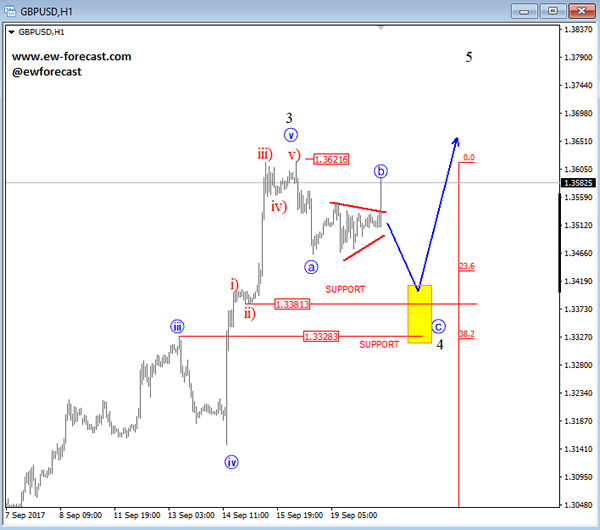
Cable is also in a corrective phase, ideally in a fourth wave now which may see 1.3330-1.3380 zone from where I would expect a new turn up for a fifth wave rally.
GBPUSD, 1H
Will The Fed Keep The ‘Dot Plot’ Unchanged?
Today, all eyes will be on the highly-anticipated FOMC policy decision. This is one of the 'bigger' meetings, meaning that besides the rate decision we will also get fresh economic forecasts, an updated 'dot plot', as well as a press conference by Chair Yellen. According to the Fed funds futures, the financial community is almost certain that policymakers will keep interest rates unchanged, something we agree with given that inflation remained broadly subdued in the aftermath of the latest meeting. Even though the CPI rates rebounded a little in August, we doubt such a minor recovery will be enough to ease the concerns of policymakers around inflation.
We think the market will place most of its emphasis on any potential changes to the 'dot plot', and subsequently, on any signals regarding the beginning of balance sheet normalization. We expect the 'dots' to continue to signal another hike this year. We did get some dovish comments from voting FOMC members recently, but we suspect that most of those officials already have their 'dots' set to signal no more hikes this year. As for the pace of future hikes, we believe they may keep it untouched as well and wait to see whether the latest rebound in inflation will continue. In case the 'dots' are left broadly unchanged as we expect, the dollar could gain. With regards to the balance sheet, market chatter suggests the Fed is very likely to signal that this process may begin in October. The risk here would be the Committee postponing this announcement.
EUR/USD slid somewhat yesterday following the report citing ECB sources (see below), but was quick to recover and trade even higher. During the Asian morning Wednesday, the pair emerged above the key barrier of 1.2000 (S1), something that may have opened the way for another test near the 1.2100 (R1) resistance hurdle. Nevertheless, even if the pair trades higher ahead of the FOMC decision tonight, we see the likelihood for a retreat in the aftermath as we expect the Committee to keep signaling one more hike this year. As such, if the pair is trading near 1.2100 (R1) ahead of the decision, it could fall back down to 1.2000 (S1) thereafter. Having said that, as long as the rate continues to trade above the medium-term uptrend line taken from the low of the 17th of April, we would treat such a retreat as a corrective phase of the broader upside path.
Euro spikes lower on ECB-related reports
The common currency briefly pulled back yesterday, after Reuters reported that concerns over EUR strength are leading to uncertainty and divide within the ECB Governing Council. Sources familiar with the ECB suggested that policymakers disagree on whether or not to set a firm end-date for bond-buying in October, and that some want to keep the optionality of extending or expanding asset purchases if needed. Focus now turns to tomorrow’s ESRB (European Systematic Risk Board) conference, where speakers include President Draghi. Even though these events are usually more academic in nature, any further hints from Draghi that the Bank may be headed for a 'dovish tapering' could work against EUR.
BoJ: A more upbeat tone?
During the Asian morning Thursday, the BoJ will announce its own policy decision and expectations are for this Bank to take no action as well. We see the case for the BoJ to appear more optimistic than previously, considering that ever since the latest meeting, the nation’s CPI rates rose further, the unemployment rate declined, and economic growth accelerated. Besides upgrading its language, we believe that the Bank may even revise up its economic forecasts. JPY could gain on the news, but given the overall risk-on sentiment lately (evident by record highs in the S&P500), any positive reaction may remain short-lived.
USD/JPY traded slightly higher on Tuesday, but hit resistance near 111.80 (R1) and during the Asian morning it retreated. Nevertheless, given that the rate is still trading above the 111.00 (S1) key support level, we consider the short-term outlook to be positive. A Fed 'dot plot' pointing to one more rate hike by year-end could encourage the bulls to shoot and test once again the 111.80 (R1) resistance. A break above that level could initially aim for the 112.20 (R2) line, marked by the peak of the 26th of July. The pair could retreat somewhat overnight following the BoJ decision, but as we already noted, we expect such a slide to be only brief and short-lived.
As for today’s economic indicators:
The only noteworthy indicator today is the UK retail sales for August. Expectations are for both the headline and the core rates to have ticked down, something that could weigh on the pound somewhat, at least on the news.
EUR/USD
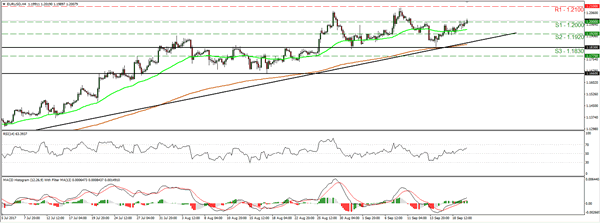
Support: 1.2000 (S1), 1.1920 (S2), 1.1830 (S3)
Resistance: 1.2100 (R1), 1.2170 (R2), 1.2250 (R3)
USD/JPY
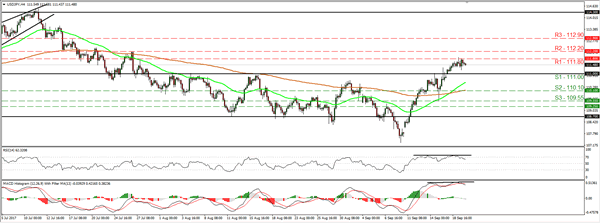
Support: 111.00 (S1), 110.10 (S2), 109.55 (S3)
Resistance: 111.80 (R1), 112.20 (R2), 112.90 (R3)
XAUUSD Analysis: Makes Premature Rebound
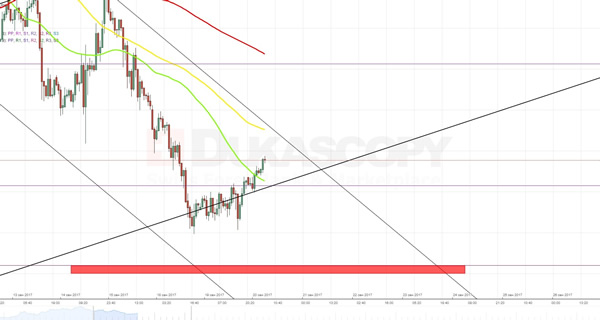
Contrary to expectations, the pair did not try to test a strong support level near the 1,300.00 mark. In contrast, it made a premature turn-around and bypassed the weekly S1 at 1,310.77 as well as the 55-hour SMA. Such outcome suggests that at least first half of this trading day the gold might spend in further advance against the buck. However, it is unlikely that the pair will manage to break through the upper trend-line of a guiding descending channel that is additionally backed up by the 100-hour SMA. This assumption is also supported by the general picture on a daily chart. However, there is a need to notice that the eventual outcome will greatly depend on decision and comments made by the Federal Reserve later this day.
USDJPY Analysis: Tries To Break Below 111.26
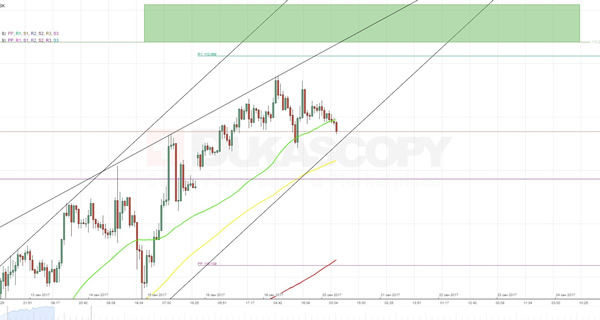
Even though in the early Tuesday morning the pair moved quite confidently towards the weekly R1, which is located at the 112.07 level, in second half of the day it made a rebound and did not go above the 111.90 mark anymore. Surprisingly, but a release of better than expected American housing data did not led to appreciation of the Greenback against the Yen. Such outcome suggests considering a possibility of transformation of a dominant ascending channel into a rising wedge. However, even if the new pattern will take the lead this fact should not change the general yesterday's scenario. On the other hand, the relevance of this pattern will greatly depend on the Fed's decision that will be made later this day.
GBPUSD Analysis: Forms Minor Symmetrical Triangle
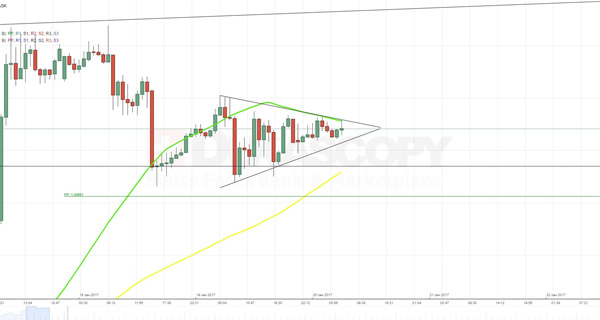
Unfortunately for the Pound, previous trading session signified the end of an upside momentum that guided movement of the pair over the last four days. On hourly chart it is easy to note how the 55-hour SMA managed to neutralize multiple attempts to break to the top. However, from the opposite direction the fall of the rate was similarly constrained by the monthly R2 at 1.3485. In result of this consolidation the currency pair is now fluctuating in a minor symmetrical triangle whose breakout point in terms of time coincides with announcement of the Federal Funds Rate. On the other hand, there is a need to take into account that the above pattern is likely to broken a little bit earlier due to reaction on release of data on the UK Retail Sales.
EURUSD Analysis: Waits For Fed’s Decision
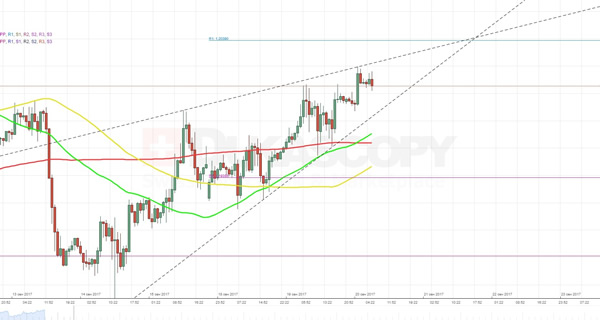
In line with expectations, a pressure from the 55- and 200-hour SMAs, better than expected German release as well as general informational background helped to pair to make a breakout from an ascending triangle pattern yesterday. From technical point of view, the currency rate is continuing to feel pressure from the bottom from the before-mentioned moving averages. Hence, an area between 1.2030 and the weekly R1, which is located at the 1.2039 level, represents the next likely target to be reached by the pair. By the way, the moment of approaching to this resistance level practically coincides with the announcement of the Federal Funds Rate. In addition, that area also represents a breakout point from the recently formed rising wedge pattern.
USD/JPY: US Building Permits
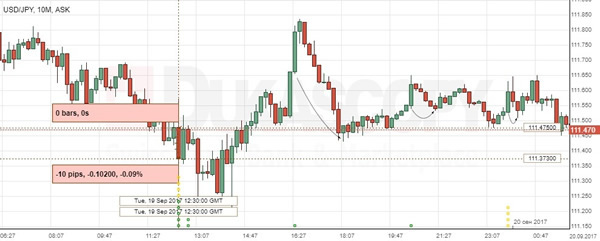
The US economic reports caused a temporary depreciation of USD/JPY during the Tuesday session. The Greenback lost against the Japanese Yen 10 base points or 0.09% to be seen trading near the 111.37 mark, though the decrease was not sustained as figures failed to impress the market.
The Commerce Department revealed that the US building permits rose to the strongest level in seven months over the course of August with the total number of 1.30M permits issued. The property market was moving ahead before an expected transitory hit from Hurricanes Irma and Harvey. Though, the number of permits in damaged areas was not significantly weaker, housing could stay a drag on the US economy in the third quarter.