

Sample Category Title
EUR/CHF Targeting New Highs
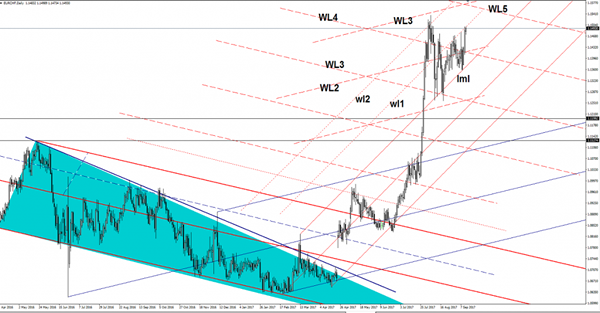
The currency pair edges higher and looks poised to approach and reach fresh new highs in the upcoming period. Right now is pressuring a dynamic resistance, could find temporary resistance at this level and could retreat a little to recapture more directional energy. Is trapped within an ascending channel, so the perspective remains bullish on the short term.
Is trading in the green and should approach the 1.1536 previous high, could be attracted also by a major dynamic resistance.
The Euro-zone and the Switzerland data could bring more action on this pair. The German Final CPI could increase by 0.1% in August, while the German WPI is expected to increase by 0.1% after the 0.1% drop i the former reading period. The Inflation Production may increase by 0.1%, while the Employment Change by 0.3%.
Price rallied aggressively after the retest of the upper median line (uml) of the minor ascending pitchfork and now is pressuring the first warning line (wl1). Is trapped within the upper median line (uml) and the warning line (wl1). Remains to see if we’ll have a breakout or a retreat towards the upper median line (uml).
You should know that the major upside target will be at the fifth warning line (WL5) of the major descending pitchfork. Resistance could be found also at the third warning line (WL3) of the major ascending pitchfork. I’ve said in the previous weeks that the perspective will remain bullish as long as the rate is trading above the upper median line (uml).
Dollar Shines Against Yen As US Yields Rise, Pound Near 1-Year High On Inflation Jump
Risk Aversion Has Ebbed Significantly Fueling a Comeback by The Dollar. The greenback closed another day in the green against most of its peers after a solid start for the week as North Korean tensions were absent from the headlines. Although dollar-negative factors are suddenly decreasing, some analysts attributed these gains to short-covering. The dollar index against a basket of six major currencies was flat at 91.882 after closing Tuesday a shade lower. It has managed to remain above the 2-1/2-year low of 91.011 plumbed on Friday.
Dollar Capped Vs Euro as German Yield Spike Neutralizes Support. German bund yields jumped nearly 7 basis points as safe-haven government debt came under pressure from a respite in North Korea tensions, helping prevent the dollar from gaining on the euro.
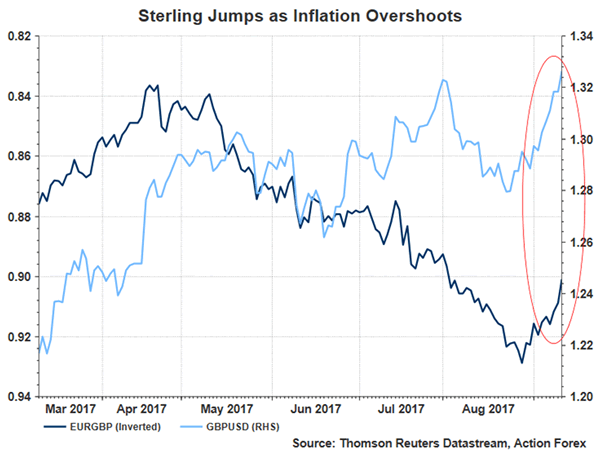
Sterling Hovers Near 1-year High After Robust UK Inflation Data. The pound extended its rally from the previous trading session, buoyed by upbeat CPI results and positive expectations for the BOE decision later this week. Sterling was little changed at $1.3286 following its ascent to $1.3300 overnight, its highest in a year.
Dollar Extends Rally Vs Yen, Hits 12-day High as US Yields Rise. The dollar extended its sharp rally against the yen on Wednesday as the pair shows the highest correlation to U.S. yields and is benefiting from the latest rise in yields. The dollar was up 0.1 percent at 110.270 yen and at its highest in almost two weeks.
Australia’s Westpac Consumer Confidence Jumped In September
For the 24 hours to 23:00 GMT, the AUD declined 0.14% against the USD and closed at 0.8019.
LME Copper prices declined 2.0% or $135.5/MT to $6601.5/MT. Aluminium prices declined 0.8% or $17.5/MT to $2083.0/MT.
In the Asian session, at GMT0300, the pair is trading at 0.8034, with the AUD trading 0.19% higher against the USD from yesterday's close, following upbeat consumer confidence data from Australia.
Overnight data revealed that Australia's Westpac consumer confidence index climbed to a level of 97.9 in September, compared to a reading of 95.5 in the prior month.
The pair is expected to find support at 0.8008, and a fall through could take it to the next support level of 0.7981. The pair is expected to find its first resistance at 0.8055, and a rise through could take it to the next resistance level of 0.8075.
Looking ahead, market participants will focus on Australia's unemployment rate for August and consumer inflation expectation for September, both slated to release in the early hours of tomorrow.
The currency pair is showing convergence with its 20 Hr and 50 Hr moving averages.

Euro Trading On A Stronger Footing In The Asian Session
For the 24 hours to 23:00 GMT, the EUR rose 0.06% against the USD and closed at 1.1971.
In economic news, the US NFIB small business optimism index surprisingly climbed to a level of 105.3 in August, compared to a reading of 105.2 in the prior month, while markets were expecting the index to fall to a level of 104.8. Additionally, the nation's JOLTs job openings registered an unexpected rise to a level of 6170.0K in July, defying market consensus for a drop to a level of 6000.0K. In the previous month, JOLTs job openings had recorded a revised level of 6116.0K.
In the Asian session, at GMT0300, the pair is trading at 1.1985, with the EUR trading 0.12% higher against the USD from yesterday's close.
The pair is expected to find support at 1.1943, and a fall through could take it to the next support level of 1.1901. The pair is expected to find its first resistance at 1.2010, and a rise through could take it to the next resistance level of 1.2035.
Going ahead, investors will direct their attention to the release of the Euro-zone's industrial production for July as well as Germany's final consumer price inflation for August, both slated to release in a few hours. Additionally, the US monthly budget statement for August, due to release later in the day, will be on investors' radar.
The currency pair is trading above its 20 Hr and 50 Hr moving averages.

British Annual Inflation Surged 2.9% In August
For the 24 hours to 23:00 GMT, the GBP rose 0.9% against the USD and closed at 1.3296, surging to a one-year high level, after larger-than-expected rise in UK inflation reinvigorated hopes that the Bank of England (BoE) will raise interest rates sooner than expected.
Data indicated that Britain's consumer price index (CPI) climbed more-than-expected by 2.9% on a yearly basis in August, matching a five-year high level recorded in May 2017 and exerting fresh pressure on the BoE to make moves with interest rates to try and limit soaring inflation. Markets had expected the CPI to gain 2.8%, after recording a rise of 2.6% in the prior month.
In the Asian session, at GMT0300, the pair is trading at 1.3315, with the GBP trading 0.14% higher against the USD from yesterday's close.
The pair is expected to find support at 1.3219, and a fall through could take it to the next support level of 1.3123. The pair is expected to find its first resistance at 1.3363, and a rise through could take it to the next resistance level of 1.3411.
Going forward, UK's ILO unemployment rate data for the three months to July, set to release in a few hours, will pique significant amount of investor attention.
The currency pair is trading above its 20 Hr and 50 Hr moving averages.

Japanese Yen Trading Higher In The Morning Session
For the 24 hours to 23:00 GMT, the USD rose 0.85% against the JPY and closed at 110.21.
In the Asian session, at GMT0300, the pair is trading at 110.04, with the USD trading 0.15% lower against the JPY from yesterday’s close.
Overnight data showed that Japan’s business survey index (BSI) of large manufacturing industries rose more-than-anticipated to a level of 9.4 on a quarterly basis in 3Q 2017. In the previous quarter, index registered a level of -2.9.
The pair is expected to find support at 109.46, and a fall through could take it to the next support level of 108.87. The pair is expected to find its first resistance at 110.46, and a rise through could take it to the next resistance level of 110.87.
Moving ahead, traders will keep a close watch on Japan’s final industrial production data for July, due to release tomorrow.
The currency pair is showing convergence with its 20 Hr moving average and trading above its 50 Hr moving average.

Swiss Franc Reverses Its Losses This Morning
For the 24 hours to 23:00 GMT, the USD rose 0.45% against the CHF and closed at 0.9598.
In the Asian session, at GMT0300, the pair is trading at 0.9589, with the USD trading 0.09% lower against the CHF from yesterday’s close.
The pair is expected to find support at 0.9551, and a fall through could take it to the next support level of 0.9514. The pair is expected to find its first resistance at 0.9622, and a rise through could take it to the next resistance level of 0.9656.
Ahead in the day, investors will eye Switzerland’s producer & import prices data for August.
The currency pair is showing convergence with its 20 Hr moving average and trading above its 50 Hr moving average.

Loonie Trading On A Stronger Footing In The Morning Session
For the 24 hours to 23:00 GMT, the USD rose 0.65% against the CAD and closed at 1.2180.
In the Asian session, at GMT0300, the pair is trading at 1.2163, with the USD trading 0.14% lower against the CAD from yesterday’s close.
The pair is expected to find support at 1.2101, and a fall through could take it to the next support level of 1.2038. The pair is expected to find its first resistance at 1.2208, and a rise through could take it to the next resistance level of 1.2252.
Going ahead, traders will look forward to Canada’s Teranet/ National Bank house price index for August.
The currency pair is showing convergence with its 20 Hr moving average and trading above its 50 Hr moving average.

BOE To Maintain Status Quo With New Comer On Dovish Side
We expect the BOE to vote 7-2 to leave the Bank rate unchanged at 0.25% and the asset purchase at 435B pound. Despite overshooting of inflation, most members would remain cautious and cite slow economic growth and Brexit uncertainty as reasons for keeping the monetary policy accommodative. However, the MPC is expected to adopt a more hawkish tone and strengthen the warning of a weak sterling. The new deputy governor Dave Ramsden would be voting for the first time. He is perceived as a dove amidst his warning of dire consequences after Brexit. He is expected to vote to maintain the status quo in the first 9-member MPC meeting since May.
Upside Surprise in August inflation
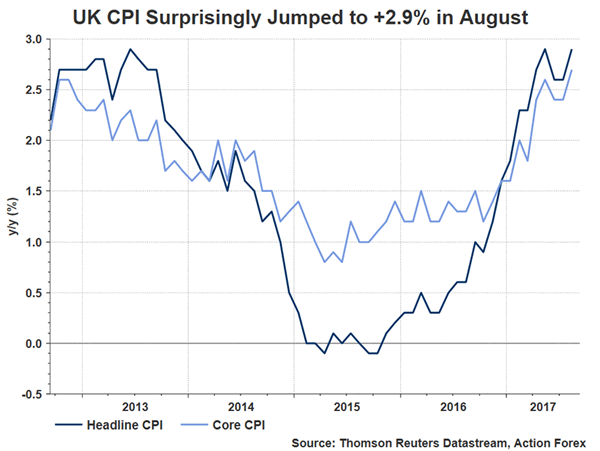
Headline CPI in the UK surprisingly rose to +2.9% y/y in August, from +2.6% a month ago. The market had anticipated a milder increase to +2.8%. The rise was driven by the +4.7% y/y jump in clothes prices and strong motor fuel prices. Core inflation rose to +2.7% from +2.4%, above consensus of +2.5% and the highest since 2011. Food inflation slipped to +2.8% from +3.3% , while energy inflation soared to +5.3% from 3.7%. Separately, input PPI improved to +7.6% y/y in August, from +6.2% a month ago, while output PPI rose to +3.4% y/y from +3.2%. It is believed that pound's weakness since the Brexit referendum is driving price levels higher. Overshooting of inflation has intensified speculations that BOE would turn more hawkish at the upcoming meeting. The BOE's OIS market is now pricing a 35% chance of a November hike, climbing to 44% in December
Soft Data Elsewhere
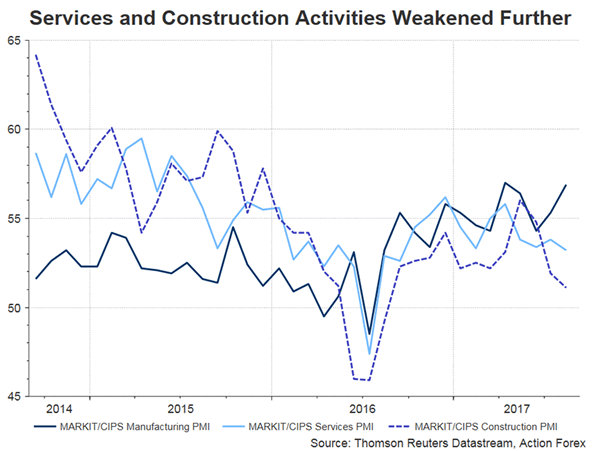
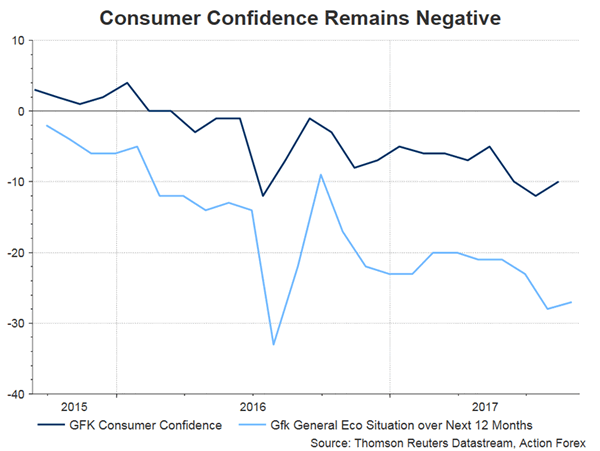
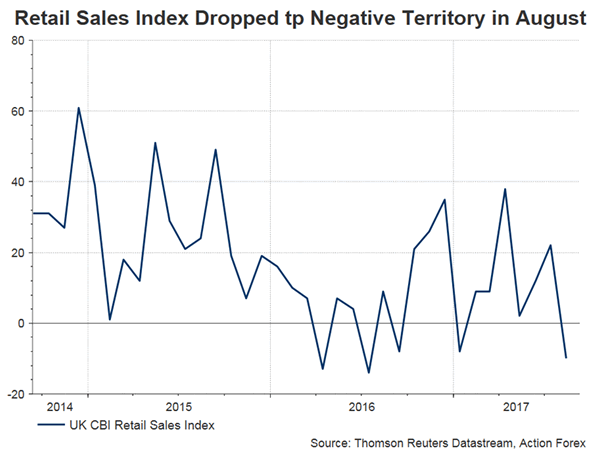
However, we retain the view that the MPC would remain on hold in September, and likely for the rest of the year, as macroeconomic data have remained soft. On the PMIs, although the manufacturing PMI rose to a 4-month high of 56.9 in August, it failed to offset the weakness in the services and construction sectors. The services PMI fell to an 11-month low of 53.2 while the construction PMI declined to 51.1, the lowest in a month. The services sector take up 80% og UK's economy. Consumer confidence improved modestly in August with the GfK's consumer confidence index rising to -10 from -12 in July. However, a negative reading signaled that more people were pessimistic over the economic outlook. Retail sales rebounded in August. However, risks remained to the downside as Brexit uncertainty and high inflation might constrain consumption.
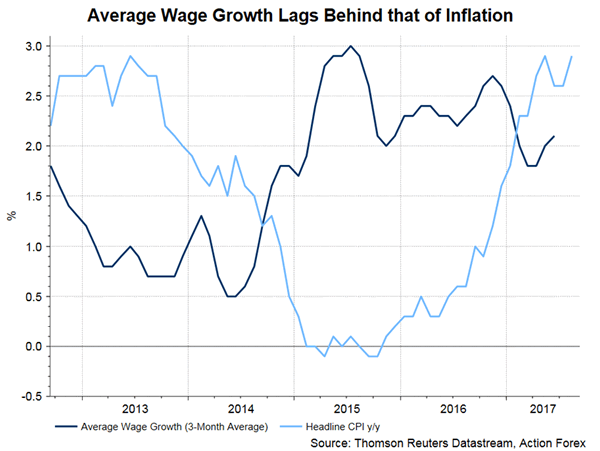
The country's GDP growth confirmed at +0.3% q/q in 2Q17. The expenditure breakdown revealed that consumption growth fell to +0.1% q/q, while business investment showed no growth from both a quarter and a year ago. The job market is robust. While average wage growth has shown signs of improvement, the momentum remains way below that of inflation. This situation, if persists, would weigh on household spending.
Brexit Negotiation
The progress is slower than expected. The next round of negotiations, originally scheduled on September 18, is postponed by a week. Media reports suggested that UK's PM Theresa May was preparing to make an "important intervention" on the talks. Previous rounds of negotiations were hardly productive. While the UK urged the EU to be more flexible and to move to trade deals, the EU insisted that the “divorce bill” issue has to be resolved first. EU's chief negotiator Michael Barnier noted last week that he was “very disappointed” by the UK government as it “seems to be backtracking” on commitments to the bill.
While the hawkish members, mainly Michael Saunders and Ian McCafferty, would warn of strong inflation on the economy, the rest would consider the overall economic environment and uncertain outcome of Brexit as key factors to keep the monetary policy unchanged. However, the BOE might deliver more hawkish message, warning the market of underestimating the urgency of a rate hike.
European Open Briefing: Asian Equity Markets Were Mixed Early On Wednesday
Global Markets:
- Asian stock markets: Nikkei rose 0.49 %, Shanghai Composite fell 0.09 %, Hang Seng down 0.30 %, ASX 200 climbed 0.05 %
- Commodities: Gold at $1335.52 (+0.20 %), Silver at $17.93 (+0.21 %), WTI Oil at $48.20 (-0.06 %), Brent Oil at $54.13 (-0.28%)
- Rates: US 10-year yield at 2.15, UK 10-year yield at 1.13, German 10-year yield at 0.39
News & Data:
- (AUD) Westpac Consumer Sentiment 2.5 % vs -1.2 % previous
- (EUR) French Non-Farm Payrolls Q2 0.4 % vs 0.5 % expected
- (GBP) CPI y/y 2.9 % vs 2.8 % expected
- (GBP) PPI Input m/m 1.6 % vs 1.2 % expected
- (GBP) RPI y/y 3.9 % vs 3.7 % expected
- (USD) JOLTS Job Openings 6.17 M vs 5.96 M expected
- (JPY) BSI Large Manufacturing Conditions (Q3) 9.4 vs 4.8 expected
- (JPY) PPI y/y 2.9 % vs 3.0 % expected
- Wall Street ends at record high, led by banks; Apple weighs- RTRS
Markets Update:
Asian equity markets were mixed early on Wednesday, as broad gains in financials lifted stocks in Australia and Japan, though China’s markets underperformed. Global risk appetite returned this week, with all three major U.S. stock indexes hitting fresh highs overnight as geopolitical tensions eased. The Wall Street closed at record levels following comments about tax reform and fading investor fears.
USD/JPY is currently seen trading at 110.09 down from the highs of over 110.20 early in Tokyo session as the dollar inched 0.1 percent lower against the yen, but remained well above last Friday's 10-month low of 107.32. The Yen had lost 0.7 percent against the US Dollar on Tuesday.
The Australian Dollar was little changed and was last seen trading at 0.8026 against the US Dollar. The Aussie only managed to add a few pips in spite of slightly positive consumer sentiment data by Westpac +2.5 % against the -1.2 % previous. On the other hand, the New Zealand Dollar fell early in the session, dropping to lows around 0.7260 against the US dollar, currently the Kiwi has recovered most of it’s losses and is seen trading above 0.7290.
EUR/USD is currently seen trading at 1.1981 after the EUR gained 0.1 percent against the US Dollar, which is currently expressing weakness. The dollar index, which tracks the dollar against a basket of 6 currencies was down 0.1 percent at 91.79, nonetheless holding well above Friday's 2-1/2-year low of 91.011.
Upcoming Events:
- 07:15 GMT – (CHF) PPI m/m
- 08:30 GMT – (GBP) Average Earnings Index 3m/y
- 08:30 GMT – (GBP) Claimant Count Change
- 08:30 GMT – (GBP) Unemployment Rate
- 12:30 GMT – (USD) PPI m/m
- 12:30 GMT – (USD) Core PPI m/m
- 12:30 GMT – (USD) Crude Oil Inventories
- 14:00 GMT – (AUD) RBA Assist Gov Debelle Speaks