

Sample Category Title
USD/JPY Mid-Day Outlook
Daily Pivots: (S1) 108.34; (P) 109.09; (R1) 109.54; More...
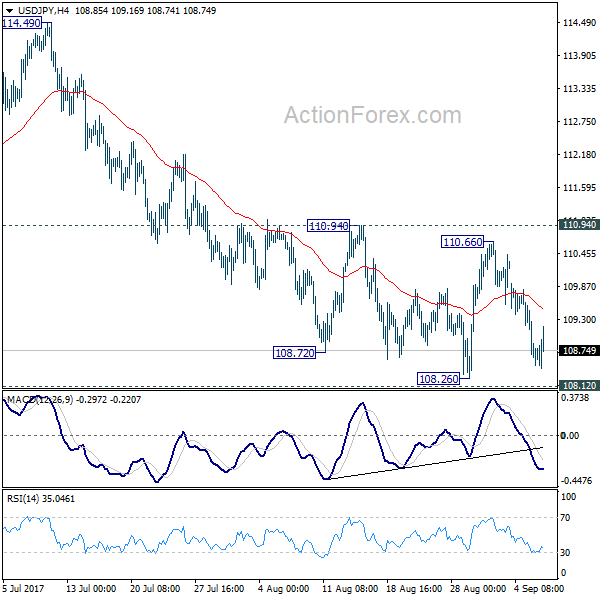
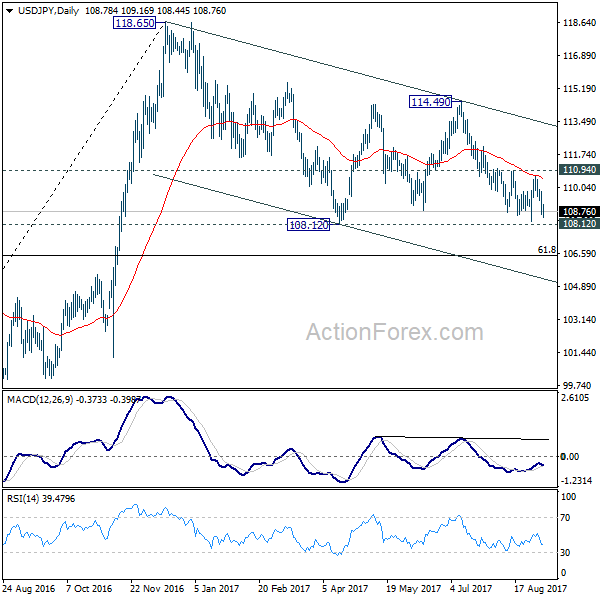
Intraday bias in USD/JPY remains mildly on the downside for 108.12/26 support zone. Decisive break there will resume the whole corrective decline from 118.65. Next target will be 61.8% retracement of 98.97 to 118.65 at 106.48. In any case, outlook will remain cautiously bearish as long as 110.94 resistance holds.
In the bigger picture, the corrective structure of the fall from 118.65 suggests that rise from 98.97 is not completed yet. Break of 118.65 will target a test on 125.85 high. At this point, it's uncertain whether rise from 98.97 is resuming the long term up trend from 75.56, or it's a leg in the consolidation from 125.85. Hence, we'll be cautious on topping as it approaches 125.85. If fall from 118.65 extends lower, downside should be contained by 61.8% retracement of 98.97 to 118.65 at 106.48 and bring rebound.
Trade Idea Wrap-up: USD/CHF – Buy at 0.9500
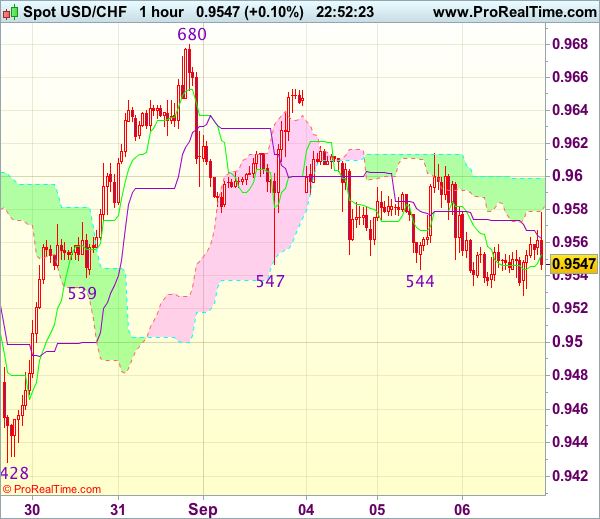
USD/CHF - 0.9543
Most recent candlesticks pattern : N/A
Trend : Down
Tenkan-Sen level : 0.9553
Kijun-Sen level : 0.9562
Ichimoku cloud top : 0.9599
Ichimoku cloud bottom : 0.9582
Original strategy :
Buy at 0.9500, Target: 0.9600, Stop: 0.9465
Position : -
Target : -
Stop : -
New strategy :
Buy at 0.9500, Target: 0.9600, Stop: 0.9465
Position : -
Target : -
Stop : -
As the greenback has remained under near term pressure and consolidation with initial downside bias remains, hence weakness to 0.9520-25 cannot be ruled out, however, if our view that low has been formed at 0.9428 last week is correct, downside would be limited to 0.9500 and bring another rebound later. Above 0.9615-20 would suggest low is possibly formed, bring test of 0.9653-55 resistance, break there would bring another rise to 0.9680 but break there is needed to add credence to this view and extend gain to resistance at 0.9698-99.
In view of this, we are inclined to buy dollar on further subsequent decline. Below 0.9490-00 would risk weakness to 0.9470 but still reckon downside would be limited to 0.9450 and said support at 0.9428 should remain intact, bring another rebound later.
Trade Idea Wrap-up: GBP/USD – Buy at 1.3005
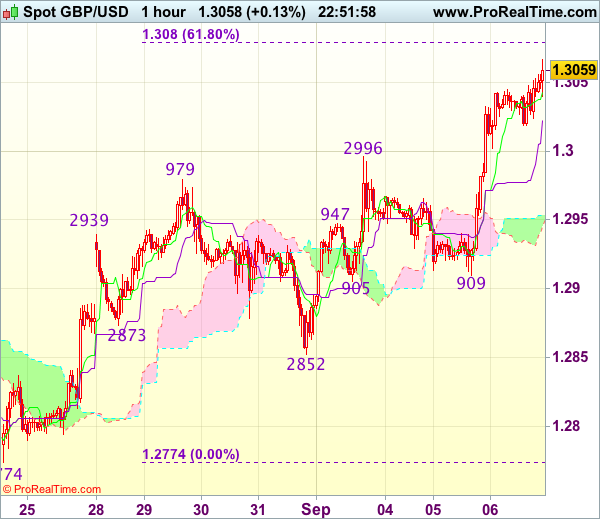
GBP/USD - 1.3063
Most recent candlesticks pattern : N/A
Trend : Near term up
Tenkan-Sen level : 1.3047
Kijun-Sen level : 1.2930
Ichimoku cloud top : 1.2953
Ichimoku cloud bottom : 1.2950
Original strategy :
Buy at 1.2970, Target: 1.3070, Stop: 1.2935
Position : -
Target : -
Stop : -
New strategy :
Buy at 1.2970, Target: 1.3070, Stop: 1.2935
Position : -
Target : -
Stop : -
Yesterday’s rally above previous resistance at 1.3032 confirms recent rise from 1.2774 has resumed and mild upside bias remains for this move to extend further gain towards dynamic resistance at 1.3080 (61.8% Fibonacci retracement of 1.3269-1.2774) but near term overbought condition would prevent sharp move beyond 1.3100 and reckon 1.3140-50 would hold, risk from there is seen for a retreat to take place later.
In view of this, would not chase this rise here and would be prudent to buy cable on pullback as previous resistance at 1.2996 should limit downside and bring another rise. Below the Ichimoku cloud (now at 1.2950-53) would defer and risk weakness to 1.2930 but only break of support at 1.2905-09 would signal top is formed.
USD/CAD Mid-Day Outlook
Daily Pivots: (S1) 1.2333; (P) 1.2375; (R1) 1.2415; More....
USD/CAD dives to as low as 1.2146 after BoC rate hike, as recent decline extends. Intraday bias stays on the downside. Fall from 1.3793 should target target next long term fibonacci level at 1.2048. Downside momentum as seen in daily MACD is picking up again. Firm break of 1.2048 will carry larger bearish implication and target 61.8% projection of 1.3793 to 1.2412 from 1.2777 at 1.1924 next. On the upside, above 1.2335 minor resistance will turn intraday bias neutral first. But out look will remain bearish as long as 1.2662 resistance holds.
In the bigger picture, price actions from 1.4689 medium term top are seen as a correction pattern. Such corrective fall is expected to extend to 50% retracement of 0.9406 to 1.4869 at 1.2048. At this point, we'd look for strong support from there to contain downside and bring rebound. Break of 1.2777 resistance will indicate reversal and turn outlook bullish for 1.3793 key resistance. However, sustained break of 1.2048 will dampen this view and carry larger bearish implications and bring deeper decline to 61.8% retracement at 1.1424 and below.
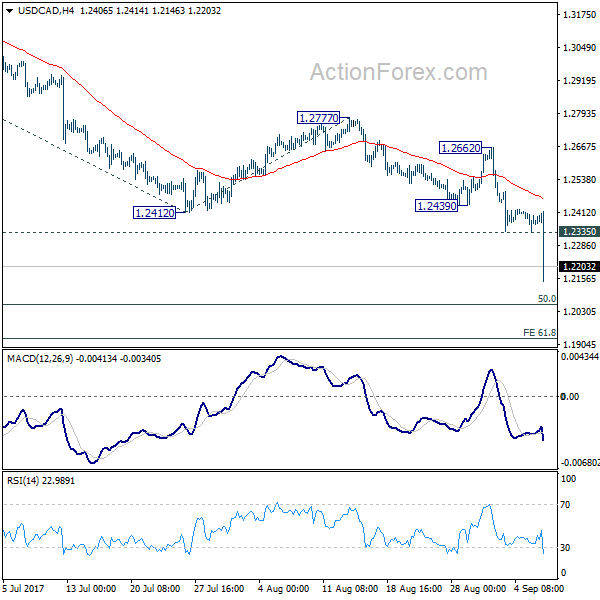
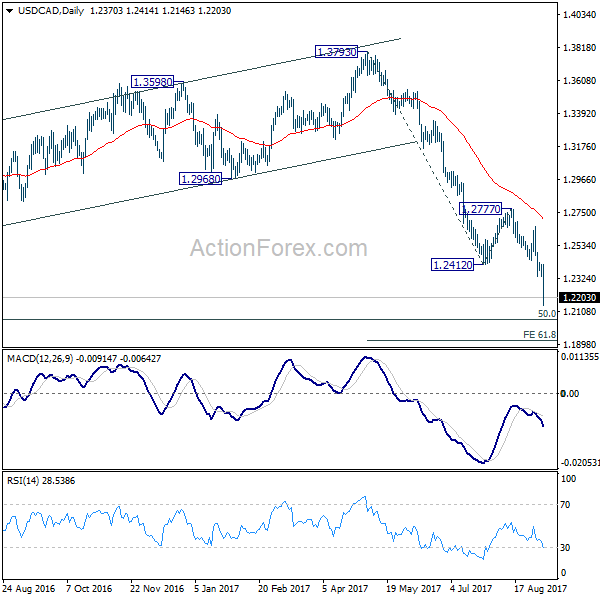
Canadian Dollar Surges after Bank of Canada hikes Interest Rates
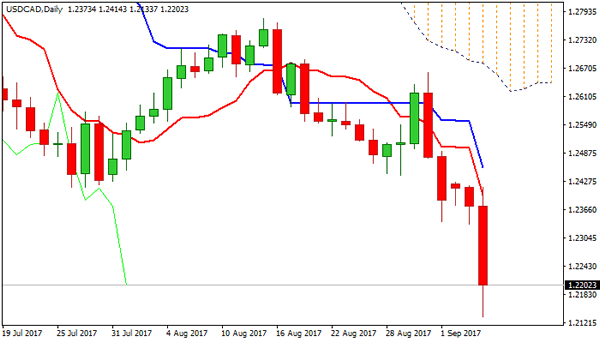
Canadian dollar surged to the highest since June 2015 against its US counterpart after Bank of Canada decided to hike interest rates by additional 25 bps to 1% (BoC hike rates in July by 0.25% for the first time in seven years).
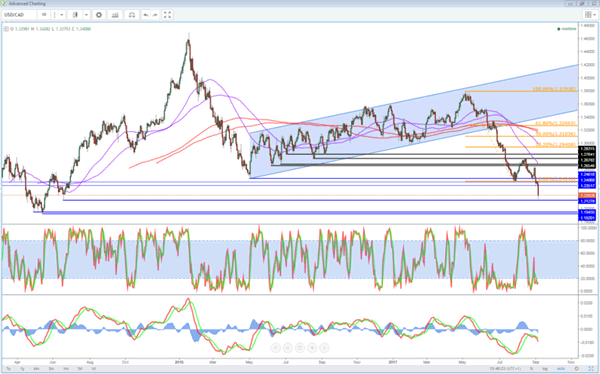
The USDCAD pair crashed after the decision, falling some 270 pips to fresh over two-year low at 1.2133.
The central bank's action was seen unlikely, according to the latest polls that showed 22% possibility of changing interest rates on today's meeting. Subsequent bounce on profit-taking after strong fall regained levels above 1.2200 handle but limited corrective action is seen before bears resume towards next targets at 1.2046 (50% of 2011/2016 0.9405/1.4688 ascend) and psychological 1.2000 level.
The pair is on track for strong bearish daily close which will mark the fifth straight close in red that is expected to weigh on the action in coming sessions.
Res: 1.2250; 1.2300; 1.2335; 1.2370
Sup: 1.2133; 1.2100; 1.2046; 1.2000
Trade Idea Wrap-up: EUR/USD – Sell at 1.1980
EUR/USD - 1.1939
Most recent candlesticks pattern : N/A
Trend : Up
Tenkan-Sen level : 1.1932
Kijun-Sen level : 1.1919
Ichimoku cloud top : 1.1915
Ichimoku cloud bottom : 1.1891
Original strategy :
Sell at 1.1980, Target: 1.1880, Stop: 1.2015
Position : -
Target : -
Stop : -
New strategy :
Sell at 1.1980, Target: 1.1880, Stop: 1.2015
Position : -
Target : -
Stop : -
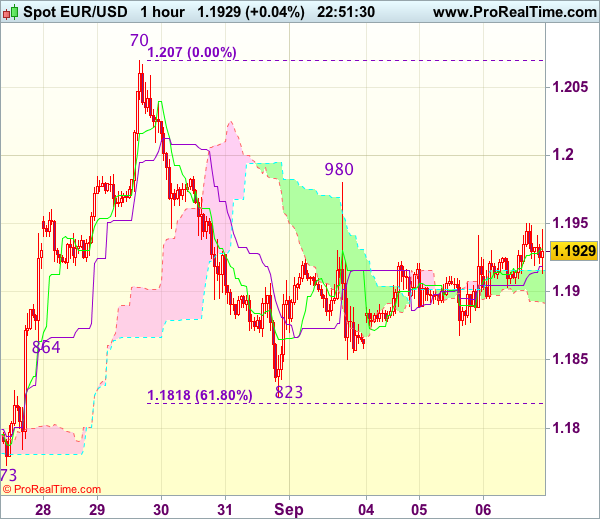
Yesterday’s cable-led rebound suggests consolidation with initial upside bias would be seen and gain to 1.1950-55 cannot be ruled out, however, reckon upside would be limited to resistance at 1.1980 and bring another decline later. Below 1.1885-90 would bring weakness to 1.1850, break there would signal the rebound from 1.1823 has ended, then test of this level would follow, break there would add credence to our view that top has been formed at 1.2070 earlier and extend the fall from there to 1.1815-18 (61.8% Fibonacci retracement of 1.1662-1.2070), then 1.1790-00 but downside should be limited to previous support at 1.1773.
In view of this, we are looking to sell euro again on recovery as 1.1980 resistance should limit upside. Only a firm break above said resistance at 1.1980 would abort and signal the fall from 1.2070 has ended at 1.1823, bring further gain to 1.2000 and possibly towards 1.2025-30.
BoC Sends CAD Soaring With Shock Rate Hike
Does the BoC Have More Hikes in Store?
The Bank of Canada unexpectedly raised interest rates on Wednesday by 25 basis points, triggering a sharp appreciation in the Canadian dollar and taking it to more than two-year lows against the greenback.
Having only raised interest rates for the first time since 2010 at the last meeting, traders were clearly of the belief that the BoC would hold off today and take a more cautious approach to tightening. Especially as there appeared no urgent need to do so, with inflation still well below target at 1.2%. Clearly policy makers at the central bank did not share this view, raising the overnight target rate to 1% and citing the stronger than expected economy in the process.
Interestingly, the BoC did also reference elevated household indebtedness and the impact that these rate rises could have on it. Perhaps the role of the consumer in the strong performance of the economy, driven by debt, is at least part of the reason the central bank is taking such pre-emptive action, despite price pressures not warranting it.
Given how sudden and drastic - by recent standards - the BoC's moves have been, traders may now be wondering what more we can expect from the central bank. Today's rally in the loonie may not just represent surprise at this particular decision but also a recalculation of what the central bank may do going forward. Two rate hikes in a row after such a sustained period of none is a bold move and traders may now be expecting more in the months ahead.
USDCAD
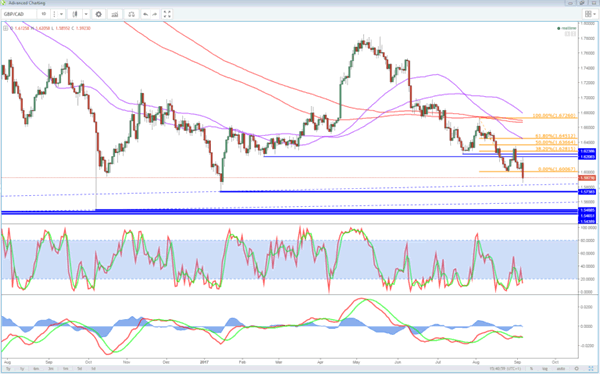
GBPCAD
Trade Idea Wrap-up: USD/JPY – Sell at 109.55
USD/JPY - 108.88
Most recent candlesticks pattern : N/A
Trend : Sideways
Tenkan-Sen level : 108.82
Kijun-Sen level : 108.86
Ichimoku cloud top : 109.81
Ichimoku cloud bottom : 109.41
Original strategy :
Sell at 109.40, Target: 108.40, Stop: 109.75
Position : -
Target : -
Stop : -
New strategy :
Sell at 109.55, Target: 108.55, Stop: 109.90
Position : -
Target : -
Stop : -
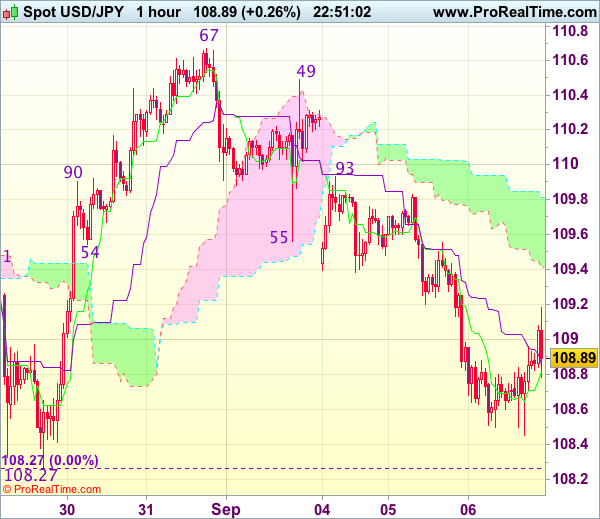
As dollar has recovered after falling to 108.45, suggesting consolidation above this level would be seen and corrective bounce to 109.40 cannot be ruled out, however, reckon upside would be limited to 109.55-60 and bring another decline, below said support would extend weakness towards last week’s low at 108.27 but break there is needed to retain bearishness and extend the fall from 114.50 to another previous chart support at 108.13, having said that, the greenback needs to penetrate this chart support to confirm early selloff from 118.66 has resumed for subsequent weakness to 107.70-75 which is likely to hold from here.
In view of this, we are looking to sell dollar on further recovery as 109.55-60 should limit upside and bring another decline later. Above 109.80-83 would abort and signal low is formed instead, bring a stronger rebound to 110.00-05 but price should falter well below resistance at 110.49.
BOC Surprisingly Hikes Rate For Second Consecutive Meeting
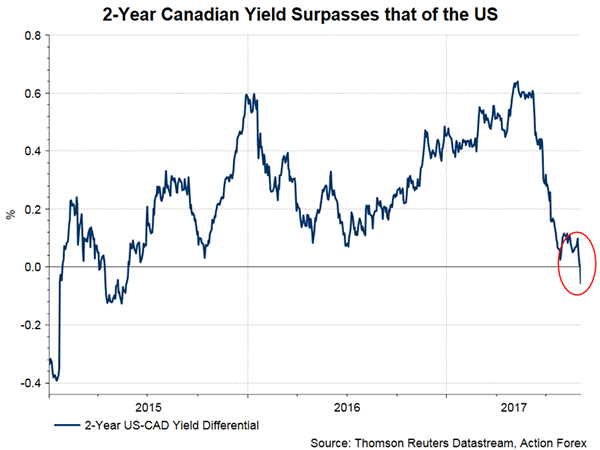
In a surprising move, BOC increased the policy rate by +25 bps to 1% in September, following a rate hike in July. Policymakers cited the better-than-expected economic developments as a key reason for the removal of stimuli from the market. However, they remained cautious over a number of issues including excess capacity, subdued inflation, geopolitical risks and the strength in Canadian dollar. On the future tightening path, the central bank stressed that it is "not predetermined" and "will be guided by incoming economic data and financial market developments as they inform the outlook for inflation". We believe the progress of NAFTA renegotiations and other trade-related issues, the inflation outlook, the housing market developments and the Fed's balance sheet reduction would be key factors driving BOC's rate decision.
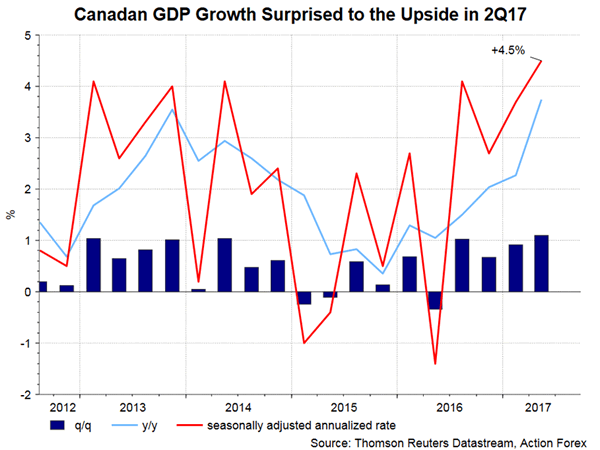
Real GDP growth accelerated to +4.5% in 2Q17, form +3.7% in the prior quarter, marking the best 4-quarter performance since 2006 and well above BOC's estimate of 3%. Contribution to growth came mainly from private consumption and gross capital formation. As BOC noted in the accompanying statement, "recent economic data have been stronger than expected, supporting the Bank's view that growth in Canada is becoming more broadly-based and self-sustaining". It also acknowledged that consumer spending was robust. Yet, BOC maintained a cautious note, signaling "a moderation in the pace of economic growth in the second half of 2017".
While admitting weak inflation, policymakers acknowledged "a slight increase in both total CPI and the Bank's core measures of inflation, consistent with the dissipating negative impact of temporary price shocks and the absorption of economic slack". They continued to caution over the "excess capacity" in the job market, as well as the subdued growth in "wage and price pressures"
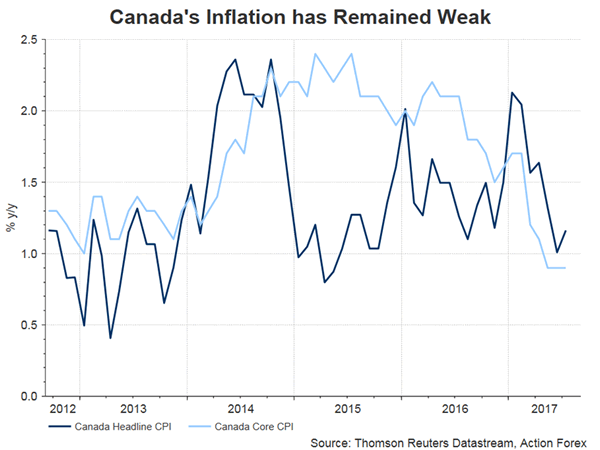
While raising the policy rates for two consecutive meetings, BOC stressed that "future monetary policy decisions are not predetermined and will be guided by incoming economic data and financial market developments as they inform the outlook for inflation". It emphasized that "particular focus will be given to the evolution of the economy's potential", the "labour market conditions" and "the sensitivity of the economy to higher interest rates".
Outlook
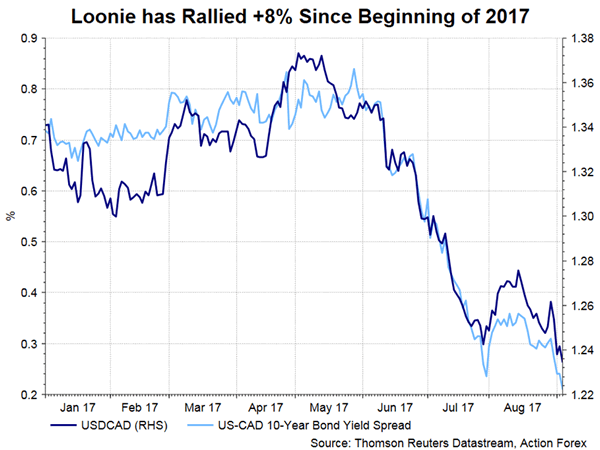
In our opinions, BOC's future monetary decision would be dependent on the following issues. First, the third and fourth rounds of NAFTA renegotiations would take place in end-September and end-October respecitlvely. The highly uncertain outcomes signal the centla bank would be cautious. As an export-oriented economy with the US the biggest trading partner, the new trade relations would affect Canada's economic growth outlook. Exchange rate would be closely watched too. Although Canadian dollar has risen about +8% against US dollar since the beginning of the year, the trade-weighted index is still not elevated. Therefore, we do not see exchange rate a threat to the coutry's exports for now. Second, although BOC noted the imporvement in inflation, both headline and core readings have styaed far below the +2% target. Further stregnth in the loonie might cotinue to weigh on inflaiton. Third, there have been signs of a softer housing market as a report by tge Canadian Real Estate Association shows that national home sales dropped for a fourth consecutive month, by-2.1% m/m in July. Finally, BOC would be paying close attention to the Fed balance sheet reduction plan. In July, the Fed indicated that balance sheet reduction would begin "relatively soon". We expect a formal announcement would come in the upcoming meeting on September 20.
Dollar Struggles, But Few Additional Losses
- European equities opened weaker today, copying yesterday's weakness on Wall Street, but turned positive afterwards in an uneventful trading session. US stock markets gain around 0.3% at the start of dealings.
- US Non-manufacturing ISM rebounded in August to 55.3 from 53.9 in July when the index fell sharply. The outcome was near expectations.
- Bank of Canada raised its official rate for a second meeting in a row to 1% from 0.75%. Consensus was divided over the outcome. As a result in a first reaction the Canadian dollar rose 2 big figures against the US dollar.
- Hungary and Slovakia suffered blows as the EU's top court dismissed their objections to the EU's refugee quota plan, paving the way for an intensifying conflict between Brussels and eastern member states who have ruled out complying with the law.
- Germany's finance minister has called for the ECB to dump its bond buying programme and negative interest rates, saying the eurozone's recovery was now strong enough to support a return to "normal" monetary policy.
- The Catalan parliament is expected to approve plans for a referendum to break away from Spain, setting it on a collision course with the Spanish government which has vowed to stop it. Lawmakers are set to vote on the law approving an October 1 referendum in the coming hours, and it is likely to be approved as the pro-independence parties have a majority in the regional parliament.
- France plans to pass legislation by the end of 2017 to phase out all oil and gas exploration and production on its mainland and overseas territories by 2040, becoming the first country to do so, according to a draft bill presented on Wednesday.
- Hurricane Irma, one of the most powerful Atlantic storms in a century, churned across northern Caribbean islands with a potentially catastrophic mix of fierce winds, surf and rain, en route to a possible Florida landfall at the weekend.
Rates
Waiting game
Global core bonds lost slightly ground today with Bunds marginally underperforming US Treasuries. Positively oriented stock markets after a weak opening and a surge in oil prices ($53/barrel to $54/barrel) explain the (modest) decline. Rumours about an explosion near North Korea caused a temporary hick-up, but it was rapidly erased. The EMU eco calendar was empty while a smaller than forecast US Trade deficit didn't bother traders. The upcoming US non-manufacturing ISM and Bank of Canada rate decision remain wildcards, but ahead of tomorrow's ECB meeting many investors will probably remain sidelined.
At the time of writing, the German yield curve bear flattens with yields up to 1.6 bps (2-yr) higher. US yields shift up to 0.8 bps (10-yr) higher. From a technical point of view, the US 5-yr (1.69%), 10-yr (2.10%) and 30-yr (2.68%) yields fail to regain yesterday's lost support levels for now. On intra-EMU bond markets, 10-yr yield spreads versus Germany are nearly unchanged with Spain slightly underperforming (+2 bps) ahead of tomorrow's auction.
The German Finanzagentur tapped the on the run 5-yr Bobl (€3B 0% Oct2022). Total bids amounted to €3.94B, slightly above the €3.7B average at the previous 4 Bobl auctions. This amount of bids remains rather low. The Bundesbank set aside €0.56B for secondary market operations resulting in an official bid cover 1.6. The auction tailed 1 cent.
Currencies
Dollar struggles, but few additional losses
The dollar remains in the defensive across the board as global uncertainty and political noise from Washington deprive the US currency from highly needed interest rate support. That said, for now, the US currency hasn't broken any technically relevant levels yet. EUR/USD trades in the 1.1935 area. USD/JPY hovers in the high 108 area.
This morning, Asian equities traded mixed to slightly lower, but the losses were limited given the volatility in the US yesterday. The yen held near recent highs against the dollar (108.65/70 area). EUR/USD showed no consistent reaction on recent global uncertainty. The pair was little changed at around 1.1915. Other euro cross rates (EUR/JPY, EUR/GBP, …) felt some stronger headwinds.
In Europe, there was again no dominant theme to guide trading in the major USD or euro cross rates. Several economic and non-economic issues (Korea, US political and budget issues, tomorrow's ECB decision) swirled and clouded investors' outlook. There was no clear cross market directional trend. German factory orders were slightly softer than expected, but this wasn't the market's focus. The US trade deficit was almost as expected. Global uncertainty caused European markets to open with a slight risk-off bias. Core yields held near the recent lows but didn't decline any further. The same applies for USD/euro interest rate differentials. Global uncertainty kept the dollar in the defensive against the euro and the yen. USD/JPY hovered in the mid 108 area in early European dealings, but regained a few ticks as equity sentiment improved slightly later in the session. EUR/USD kept a cautious upward bias and settled in the lower half of the 1.19 big figure. The recent top (low of the dollar) remains on the radar.
After the close of this report, the US non-manufacturing ISM will be published. Later this evening, the Fed's Beige book is scheduled for release. For now, the assessment on the dollar hasn't changed. The US currency remains in the defensive. Good eco data might help, but the dollar needs renewed interest rate support and an easing in global and domestic (political) uncertainty. On the euro side of the story, the question is whether Draghi can/wants to convince markets that a strong euro will cause a slower path of ECB policy normalisation. This last question should be answered by tomorrow evening.
Sterling technical rebound continues
There was again hardly any economic news from the UK. Over the previous days, no news was good enough news to support a technical sterling rebound and this pattern continued today. EUR/GBP held near the recent lows even as EUR/USD remains well bid. EUR/GBP trades in the 0.9140 area. Sterling also gained a few more ticks against the dollar. Cable trades in the mid 1.30 area. There was again plenty of Brexit noise from politicians on both sides of the English channel. However, it didn't prevent a further sterling short squeeze.