Sample Category Title
Trade Idea: GBP/JPY – Sell at 147.00
GBP/JPY - 145.95
Recent wave: Medium term low formed at 120.50 and (A)-(B)-(C) major correction has commenced with (A) leg ended at 148.45, hence wave (B) is unfolding for retreat to 131.00-10.
Trend: Near term up
Original strategy:
Buy at 145.15, Target: 147.15, Stop: 144.55
Position: -
Target: -
Stop: -
New strategy :
Sell at 147.00, Target: 145.00, Stop: 147.60
Position: -
Target: -
Stop:-
Although sterling rose to 147.60 earlier this week, the subsequent retreat after faltering below last week’s high at 147.75 suggests further consolidation below this level would be seen with mild downside bias for test of 145.30 support, however, a sustained breach below there is needed to signal top has been formed at 147.75, bring retracement of recent rise to 144.70, then 144.50 but 144.20 should limit downside and price should stay well above 143.30, bring rebound later.
In view of this, we are looking to sell sterling on recovery as 147.00 should limit upside, bring another decline. Above 147.60 would risk test of said resistance at 147.75 but break there is needed to revive bullishness and extend recent upmove to previous resistance at 148.10, above there would bring headway to 148.50, then towards 149.00.
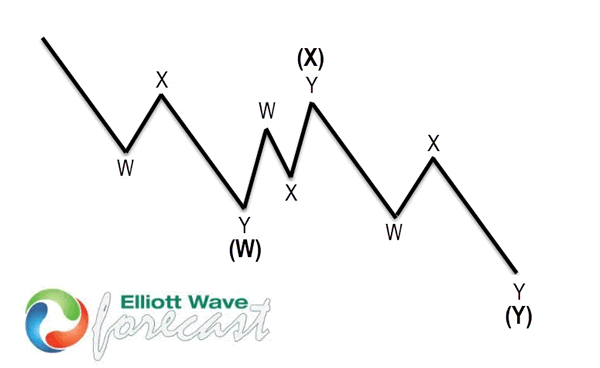
Our preferred count is that larger degree wave V with circle is unfolding from 251.12 with wave (I) 219.34, (II): 241.38 and wave (III) is subdivided into 1: 192.60, 2: 215.89 (23 Jul 2008) and wave 3 ended at 118.87 earlier in 2009. The correction from there to 162.60 is wave 4 which itself is a double three and is labeled as first a-b-c ended at 151.53, followed by wave x at 139.03, 2nd a ended at 162.60, 2nd b at 146.75 and 2nd c leg of wave 4 ended at 163.00. Therefore, the decline from 163.00 to 116.85 is now treated as wave 5 which also marked the end of larger degree wave (III), hence wave (IV) major correction has commenced for retracement of the wave (III) from 241.38 and upside target at 183.95-00 (50% Fibonacci retracement of the wave (II) from 241.38) had been met, a drop below 160.00 would suggest wave (IV) has ended at 195.85, bring decline in wave (V) for initial weakness to 130 (already met) and 120.

USD/JPY Analysis: Finds Support At Weekly S1
On Tuesday, the USD/JPY currency pair continued to trade lower, but lost its momentum in the evening when the pair traded in a relatively narrow range. The US Dollar is gradually approaching the upper channel boundary which is being reinforced by the 55-hour SMA circa 112.30. Thus, it is likely that the pair continues to trade sideways ahead of US fundamentals at 1230GMT. In case of solid data, the Greenback should breach the channel and surge to the upside until the 100-hour SMA, at least. Meanwhile, the nearest support levels are set by the weekly S1 and the monthly PP at 111.70/111.39, accordingly. The former worked effectively at halting the pair yesterday; thus the same scenario may repeat today once again

XAU/USD Analysis: Extends Gains
The yellow metal broke the resistance line, which was discovered on Tuesday. Due to that reason it can be assumed that, as the bullion forms and reveals the new medium term trend, various short term levels of significance are likely going to become obsolete in the matter of hours. However, the basic hypothesis remains the same. The commodity price is set to surge in the upcoming weeks. In regards to the next few trading sessions, it could be observed on Wednesday morning that the bullion had bounced off a short term resistance line and began a retreat. Although, the commodity price was about to be supported by the 55-hour SMA, which as approaching the bullion from the downside just above the 1,235 mark.

Trade Idea: EUR/JPY – Sell at 129.50
EUR/JPY - 129.13
Recent wave: wave v of (C) ended at 94.12 and major correction in wave A has ended at 149.79
Trend: Near term up
Original strategy:
Buy at 128.00, Target: 130.50, Stop: 127.40
Position: -
Target: -
Stop: -
New strategy :
Sell at 129.50, Target: 127.50, Stop: 130.10
Position: -
Target: -
Stop:-
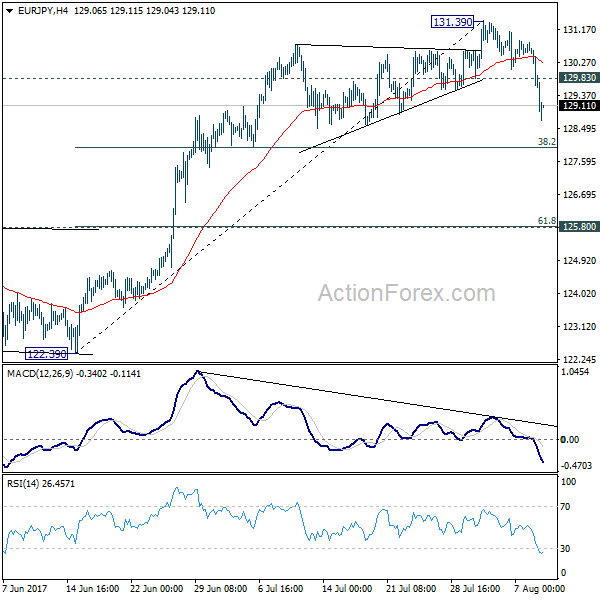
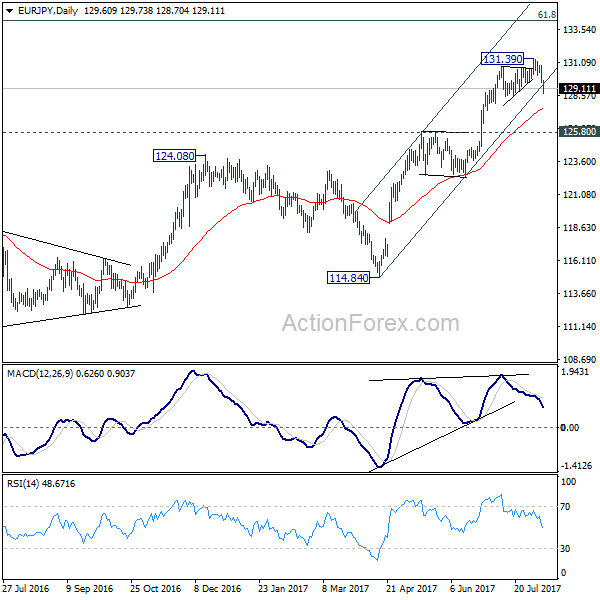
Although the single currency recovered after finding support 128.49, as euro has retreated after meeting resistance at 129.75, suggesting consolidation below this level would be seen and weakness to 128.70-75 is likely, however, break of said support at 128.49 is needed to signal top has been formed at 130.77 early last week, bring retracement of recent upmove to 128.00, then towards previous support at 127.44 which is likely to hold from here.
In view of this, we are looking to turn short on recovery as 129.50 should limit upside. Above 130.10-15 would risk a stronger recovery but still reckon said resistance at 130.77 would hold from here, bring retreat later. Only break of 130.77 would signal recent upmove is still in progress and extend gain to 131.00, then 131.50-60.
Our latest preferred count is that wave (ii) is ABC-X-ABC which ended at 123.33 and wave (iii) is unfolding with wave iii ended at 100.77, followed by wave iv at 111.57 and wave v as well as the wave (iii) has ended at 97.04, followed by wave (iv) at 111.43 and wave (v) has ended at 94.12 which is also the end of the larger degree v, this also implied the major wave (C) has also ended there, hence major correction has commenced from there with (A) leg unfolding in its lower degree wave c which has possibly ended at 145.69. Under this count, A-B-C wave (B) has commenced with A leg ended at 136.23, wave B at 143.79 and wave C has possibly ended at 149.79.
Our larger degree count is that the decline from 139.26 is wave (C) and is sub-divided into a diagonal triangle i-ii-iii-iv-v with wave i - 105.44, wave ii- 123.33, wave iii - 97.03, wave iv - 111.43, followed by the final wave v as well as the end of wave (C) at 94.12, this also mark the bottom of larger degree wave B. Under this count, major rise in wave C has commenced as an impulsive wave with minor wave III ended at 145.69, wave V is still in progress for further gain to 150.00. Having said that, this so-called wave V could well be the first leg of larger degree 5-waver wave C and this wave C should bring at least a retest of wave A top at 169.97 (July 2008).

GOLD Short-Term Bullish Momentum Continues, SILVER Short-Term Bullish Momentum, CRUDE OIL Upside Pressures Are Growing.
GOLD Short-term bullish momentum continues.
Gold's is trading higher after the precious metal reached the $1200 level. Hourly support is now given at $1204 (10/07/2017 high). Hourly resistance lies at 1238 (18/07/2017 high). Expected to show further strengthening.
In the long-term, the technical structure suggests that there is a growing upside momentum. A break of 1392 (17/03/2014) is necessary ton confirm it, A major support can be found at 1045 (05/02/2010 low)

SILVER Short-term bullish momentum.
Silver is pushing higher after the bounce still bouncing from hourly support given at 15.18 (10/07/2017 low). Key resistance is given at a distance at 17.75 (06/06/2017 high). the commodity has broken the 16-mark. The pair is set to inch higher.
In the long-term, the death cross indicates that further downsides are very likely. Resistance is located at 25.11 (28/08/2013 high). Strong support can be found at 11.75 (20/04/2009).

CRUDE OIL Upside pressures are growing.
Crude Oil is trading higher. Hourly support is given at 43.65 (10/07/2017 low). Expected to monitor resistance given at 47.32 (04/07/2017).
In the long-term, crude oil has recovered after its sharp decline last year. However, we consider that further weakness are very likely. Strong support lies at 35.24 (05/04/2016) while resistance can now be found at 55.24 (03/01/2017 high).

Foreign Exchange Market Commentary: EUR/USD, USD/JPY, GBP/USD, GOLD, WTI CRUDE, DJIA, FTSE100, DAX
EUR/USD
The American dollar suffered from a major political setback late Monday that sent it nose-diving against all of its major rivals on Tuesday. The EUR/USD pair rallied up to 1.1582, the highest since May 2016, pulling back modestly ahead of the close, but settling anyway at its highest for the year. News that two GOP senators announced they won't support moving forward with the Obamacare repeal bill, leaving the party without the majority enough to move the bill, sent an already weakened greenback tumbling, as seems the so long promised tax reform is far from being discussed this summer, when Trump can't even get support with healthcare.
In the data front, Germany released its July ZEW sentiment survey, which showed that the economic outlook remains positive, although the index eased from the previous month. Business sentiment in the country came in at 17.5, down from previous 18.6, while the EU economic sentiment index resulted at 35.6 from previous 37.2. The US released some minor figures, but none of them relevant enough to affect the USD. Attention now flips to Thursday, when the ECB will have a monetary policy meeting. Despite expected to reduce is QE, the market believes that a formal announcement will come in September, but anyway will be looking for some hints this time.
From a technical point of view, the pair remains biased north, with scope to extend its advance in the short term up to 1.1615, May 2016 high. Intraday, the pair is extremely overbought more as a result of the bullish breakout of its latest range than amid continued gains over the last few sessions, leaving room for additional gains ahead. In the 4 hours chart, the price holds far above all of its moving averages, whilst technical indicators have turned lower, but remain within overbought territory, indicating limited selling interest around the pair.
Support levels: 1.1525 1.1490 1.1460
Resistance levels 1.1580 1.1615 1.1645

USD/JPY
The USD/JPY pair fell down to 111.68, its lowest since June 30th, to end the day around 112.00. The soft tone of European equities and a slide in US Treasury yields backed the rally of the Asian currency, in the absence of local data, with the Japanese calendar empty until next Thursday, when the Bank of Japan will have an economic policy meeting and the country will release its trade balance figures. The US 10-year note benchmark fell down to 2.27%, while the 2-year note interest eased to 1.35%. Technically, the pair managed to bounce on an approach to the 50% retracement of its latest bullish run at 111.60, the immediate support, but technical readings support additional slides ahead, given that in the 4 hours chart, the pair settled well below its 100 SMA and barely above the 200 SMA, whilst technical indicators have bounced modestly from oversold readings, but remain within negative territory. A break below the mentioned Fibonacci support, the pair has scope to extend its slide towards 110.90, where the pair presents multiple intraday lows from last June.
Support levels: 111.60 111.20 110.90
Resistance levels: 112.30 112.70 113.10

GBP/USD
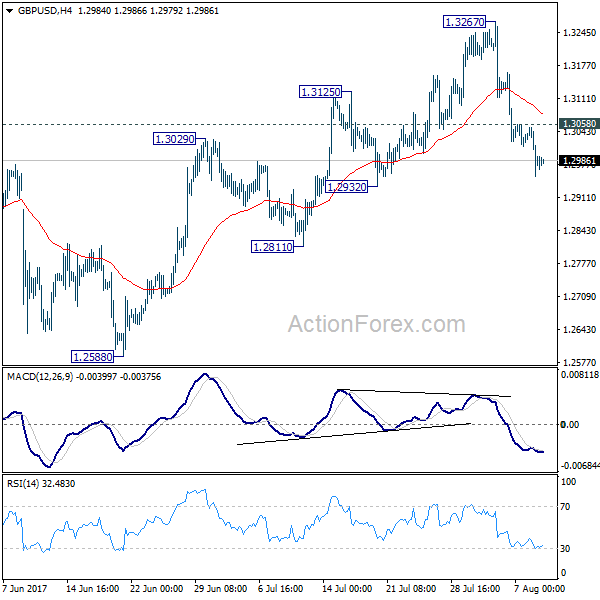
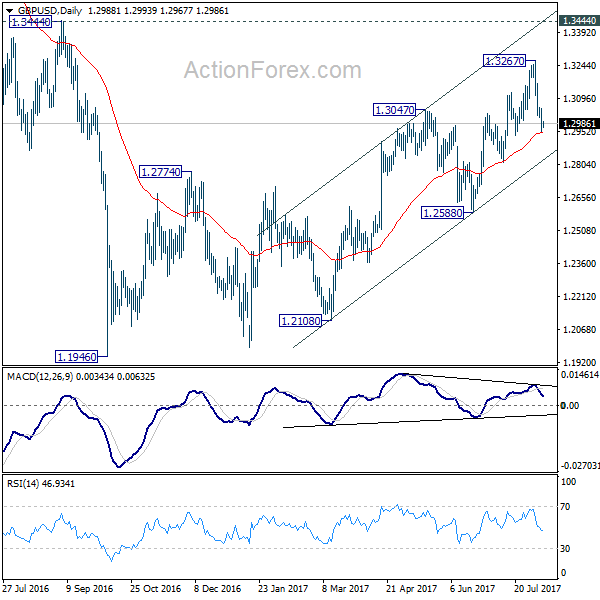
The GBP/USD pair advanced up to 1.3125 a fresh 2017 high at the beginning of the day, but changed course early Europe, and fell to 1.3004, after UK inflation data surprised to the downside. The consumer price index remained unchanged in June, and rose by 2.6% in the same month, but compared to a year earlier, retreating from May's 2.9% and casting doubts over a possible rate hike in the near-term. Also, core inflation slowed to 2.4% YoY from 2.6% a month ago, while the producer price index slowed for the second time this year, with factory output prices up 3.3% on the year, down from previous 3.6%. Carney presented the new £10 bill in the afternoon and said that today's data is consistent with BOE's projections that inflation will stay above target for some time, somehow confirming what the market suspected about a delay in a rate hike. The pair managed to bounce amid persistent dollar's weakness, with the 4 hours chart now showing that the price is battling to recover above an anyway bullish 20 SMA, whilst the RSI indicator aims modestly higher within neutral levels, and the Momentum heads lower around its 100 line, all of which limits chances of a bearish move, but is not enough to confirm a firmer recovery.
Support levels: 1.3000 1.2965 1.2920
Resistance levels: 1.3070 1.3125 1.3160

GOLD
Spot gold surged to a fresh July high, of $1,244.47a troy ounce, ending the day a few cents below it, amid broad dollar's weakness. The commodity accelerated its recovery, underpinned by arising political jitters in the US, and on fading prospects of strong tightening coming from the Fed. Additionally, the bright metal found support from increasing physical demand coming from India, one of the world's largest consumer of gold. The steady recovery that left the price at two-week highs seems poised to extend according to the daily chart, as the price advanced further above its 20 and 200 DMAs, whilst technical indicators are currently crossing their mid-lines, entering positive territory. The 100 DMA in the mentioned chart stands flat around 1,252.50, acting as resistance for this Wednesday. In the 4 hours chart, technical indicators have eased modestly, but remain within extreme overbought territory, but the price is well above its 20 and 100 SMAs, with the shortest crossing above the largest, anticipating some additional advances for the upcoming sessions.
Support levels: 1,237.95 1,228.30 1,216.60
Resistance levels: 1,245.20 1,252.50 1,261.90

WTI CRUDE OIL
Crude oil prices edged higher on Tuesday, with West Texas Intermediate crude futures ending the day at $46.41 a barrel, backed by a report saying that Saudi Arabia is considering cutting crude exports, by 1 million barrels a day, also helped by dollar's weakness, as investors rushed away from the American currency. Ahead of US stockpiles reports, the daily chart for the commodity shows that buying interest surged on a test of a Fibonacci support, the 38.2% retracement of its latest slide at 45.90, while the 20 DMA maintains a bullish slope a few cents below it, as technical indicators bounced from their mid-lines, all of which supports additional advances ahead, although the commodity would need to break above the 47.00 level to be able to advance further, level that attracted sellers last week. Shorter term, and according to the 4 hours chart, the technical outlook is neutral-to-bullish, as the price settled above a bullish 20 SMA, but technical indicators lost upward strength, now hovering around their mid-lines.
Support levels: 45.90 45.20 44.60
Resistance levels: 46.60 47.10 47.70

DJIA
Wall Street closed the day mixed, with the Dow Jones Industrial Average down 53 points, to 21,576.03, but the Nasdaq Composite and the S&P ending higher and at record highs, with the first up 29 points, to 6,344.31 and the second adding 0.06%, to end at 2,460.61. The technical sector was the best performers, but banks fell on the back of soft earnings reports. Goldman Sachs was the worst performer within the DJIA after reporting a 40% decline in trading business. Advancers, on the other hand, were led by Johnson & Johnson that closed 1.93% higher. US indexes reversed its early losses, with the Dow's daily chart showing that, despite closing in the red, the positive tone persists as strong buying interest contained the decline around a bullish 20 DMA, currently at 21,467, whilst technical indicators retreat within positive territory, still well above their mid-lines. In the 4 hours chart, and for the short term, the index is bearish, having broken below a now flat 20 SMA, and with technical indicators heading lower within negative territory.
Support levels: 21,531 21,467 21,411
Resistance levels: 21,581 21,645 21,682

FTSE100
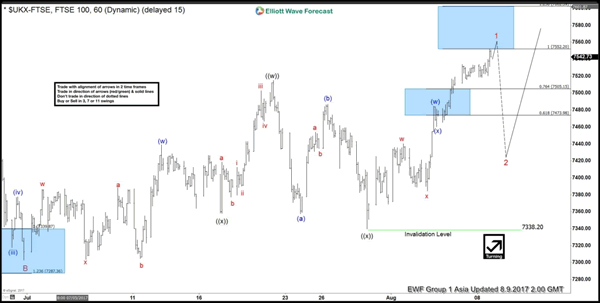
The FTSE 100 saw a limited decline, ending the day at 7,390.22, down 0.19% or 14 points, with a weaker Pound preventing UK shares from falling sharply. Earnings reports across the region disappointed, weighing on the main indexes. Within the Footsie, Experian led decliners with a 2.05% loss, as the company's results fell short of market's expectations, followed by Barclays that ended 1.91% lower. G4S was the best performer, up 3.43%, followed by British Land CO which added 3.15%. The daily chart for the London index presents a neutral stance, with technical indicators flat around their mid-lines and the benchmark settling above a bearish 20 DMA. In the 4 hours chart, the index continues developing below all of its moving averages, while technical indicators turned marginally higher, but are stuck around their mid-lines, failing to provide clear directional clues.
Support levels: 7,362 7,333 7,304
Resistance levels: 7,413 7,439 7,482

DAX
European equities closed mixed, with the German DAX down 44 points or 0.35%, to 12,587.16. Most sectors closed lower, with only eight members up, led by Deutsche Lufthansa that added 2.28%, after the company reported earnings before interest and taxes of €1,042 million in the first half of 2017. Deutsche Boerse was the worst performer, ending the day 1.53% lower, followed by Merck that lost 1.50%. The daily chart for the index shows that it retreated towards its 20 DMA that presents a modest bearish slope, while the 100 and 200 DMAs remain well below the shortest, whilst technical indicators hover around their mid-lines, with no clear directional strength. In the 4 hours chart, the index settled above all of its moving averages, now a few points below a bullish 20 SMA, whilst technical indicator extended their slides, with the Momentum indicator having entered negative territory and the RSI indicator around 52. The index could extend its decline on a break below 12,542, Friday's low, and a strong static support area, as it presents multiple intraday highs and lows around the level in the past few weeks.
Support levels: 12,541 12,488 12,432
Resistance levels: 12,621 12,665 12,710

Trade Idea: AUD/USD – Buy at 0.7840
AUD/USD – 0.7926
Recent wave: Wave 5 ended at 1.1081 and major correction has commenced for fall to 0.7000 and then towards 0.6500-10
Trend: Near term up
Original strategy :
Sold at 0.7650, stopped at 0.7690
Position: - Short at 0.7650
Target: -
Stop: - 0.7690
New strategy :
Buy at 0.7840, Target: 0.8000, Stop: 0.7780
Position: -
Target: -
Stop:-
Although aussie retreated earlier this month to 0.7571, renewed buying interest emerged there and the pair has rallied since, signaling recent upmove has resumed and some sort of impulsive waves (1 2, (i)(ii), i ii) is unfolding with minor wave iii is now in progress, hence further gain to 0.8000 would be seen, however, near term overbought condition should limit upside to 0.8040-50 and price should falter below 0.8100, risk from there is seen for a wave iv correction to take place later this month.
In view of this, would not chase this rise here and we are looking to buy aussie on subsequent pullback as 0.7840-50 should limit downside, bring another upmove later. Below support at 0.7786 would defer and suggest wave iii top is formed, bring correction in wave iv to 0.7750 but wave i top at 0.7712 should remain intact.
On the 4-hour chart, the move from 0.8066 is the wave 5 with i: 0.8860, ii: 0.8315, wave iii is an extended move ended at 1.0183, iv: 0.9706 and wave v has ended at 1.1081 (also the top of entire wave 5). The subsequent selloff is the major correction which is unfolding as ABC-X-ABC and 2nd A leg has ended at 0.8848, followed by a-b-c wave B which ended at 0.9758, hence, 2nd C wave is now in progress and indicated downside target at 0.7000 and 0.6950 had been met, so further fall to 0.6710-20 cannot be ruled out.

Euro Pauses After Gaining On Trump’s Healthcare Woes
The euro is marginally lower in the Wednesday session. Currently, EUR/USD is trading at 1.1520. On the release front, there are no major eruozone events on the schedule. In the US, construction data will be in the spotlight, with the release of Building Permits and Housing Starts. Both indicators are expected to improve in the June releases.
The euro continues to look sharp against the US dollar. The currency has posted monthly gains since March and is up 0.09% in July. Investors have given the euro a thumbs-up, as the euro-area economy has improved in 2017, buoyed by stronger growth and lower unemployment. On Tuesday, the euro pushed above the 1.15 line, its highest level since May 2016. The euro took advantage of increased political risk in the US, as President Trump's health care act appears to have floundered in the Senate.
The Trump administration hasn't had much success in its dealings with Congress, but this week has been particularly difficult. Trump's proposed health care bill which replaces much of Obamacare, has stalled in the Senate, before lawmakers even voted on the bill. With some conservative Republicans against the bill, it's questionable if the Republicans can craft a new proposal which could be passed before Congress takes a recess in August. Trump had promised to pass a health care before the summer break, so his credibility will take another hit if he's unable to do so. With this latest defeat, there is growing skepticism as to whether Trump will be able to convince Congress to pass other key parts of his agenda – tax reform and fiscal spending. The Republicans also have egg on their faces, as they have been unable to pass any significant legislation since Trump took over, despite having control of both houses of Congress and the White House. This paralysis on Capitol Hill has deepened investor pessimism about the Trump administration and has hurt the US dollar.
Investors are keeping a close eye on the ECB, which holds its monthly policy meeting on Thursday. The bank is not expected to announce any tapering of its asset-purchase program (QE), nor change the end date of the scheme, which is December. The cautious ECB was stunned last month when comments by ECB President Mario Draghi about tweaking QE triggered a sharp rally by the euro. If the eurozone economy continues to show strong numbers, we could see the ECB make some adjustments in its September meeting. In December 2016, the bank tapered QE while extending the scheme until December, and this type of scenario could be adopted once again. Analysts will be combing through the July statement, as well as Draghi's press conference, looking for any nuances to tweaks which could hint at substantive changes to come in September.
How to Identify and Trade the Strongest Part of a Trend – Part 2
In the previous article, we looked at how traders can ignore the moving average and instead focus on just the Average Directional Index (ADX) and the Moving Average Convergence and Divergence (MACD) indicators to determine the trend strength.
Before reading this article, it is ideal to refer to the first part of this series to gain insight and context into this trading system.
After defining the trading rules that govern the trend strength, in this part, we look at defining the trading rules and how to trade using the ADX and the MACD indicators.
Trading rules – ADX and MACD
For uptrend, long positions:
- MACD > signal line
- ADX > 20 (or 30)
- Long on closing price with stops at the nearest swing low
- Book profits regularly and trail the stops
For downtrend, short positions:
- MACD < signal line
- ADX > 20 (or 30)
- Short on closing price with stops at the nearest swing high
- Book profits regularly and trail the stops
An important distinction to be made here is that while the above rules only signal the trend and don't necessarily mean that traders should enter the trade when the conditions are met.
Once the trend is determined, traders will then have to look for price levels or pullbacks where they can enter into the trend.
In the first example below we have a long position that was taken in the uptrend. Here, after the ADX and MACD signaled the uptrend, the next step was to wait for a pullback in prices, following which a long position is set up.
The trade's take profit levels are set at 1:1 and 1:2 which occurs as the uptrend nears exhaustion.

Long position in a strong uptrend
In the next example, we have a short position which is taken based on the downtrend that was signaled by the ADX and the MACD system.
Here, we can see that the MACD signals a bearish trend with the ADX already above the 20-line. Following the initial decline and the pull back and the eventual breakout we can see that price eventually reaches target 1 and target 2.

Short position in a strong downtrend
The main benefit of using this approach to technical trading is the fact that the system signals you when the trend is the strongest. Therefore, traders can expect to see strong moves in the direction of the trend almost immediately.
Even the stop loss levels that are used are also relatively tight, and the system makes use of a 1:1 and a 1:2 take profit level which is used to limit the risks or the losses.
Trading with ADX and MACD – Pros and cons
The pros and cons of this trading system are quite straight forward. For starters, this trading system is ideal for traders who prefer to enter a trade when the markets are trending strongly. This helps to minimize the losses while also improving the probability of the trades.
On the other hand, traders will need to wait for long periods of time or will have to look for multiple currencies or instruments in order to find the right trading signals.
Traders might succumb to the temptations of entering the trade early on without both the rules being met which could lead to losses. Thus traders who do not have the patience to wait for the right conditions to be met will find that this system will be difficult to work with.
Having said that, seasoned traders will find trading with the ADX and MACD a relatively simple system to trade that also comes with simple trading rules.
EUR/GBP Important Volatility, EUR/CHF Selling Pressures Arise, BITCOIN Continued Increase.
EUR/GBP Important volatility.
EUR/GBP has failed to monitor strong support at 0.8719 (16/06/2017 low).The pair is moving sideways. Yet, expected to show renewed monitoring of support given at 0.8719.
In the long-term, the pair has largely recovered from recent lows in 2015. The technical structure suggests a growing upside momentum. The pair is trading above from its 200 DMA. Strong resistance can be found at 0.9500 psychological level.

EUR/CHF Selling pressures arise.
EUR/CHF is still trading above psychological level at 1.1000. Selling pressures are very weak at the moment. Hourly support is located at a distance at 1.0922 (30/06/2017 low). Expected to inch higher.
In the longer term, the technical structure is mixed. Resistance can be found at 1.1200 (04/02/2015 high). Yet,the ECB's QE programme is likely to cause persistent selling pressures on the euro, which should weigh on EUR/CHF. Supports can be found at 1.0184 (28/01/2015 low) and 1.0082 (27/01/2015 low).

BITCOIN Continued increase.
Bitcoin has well recovered after the sell-off this weekend. Strong hourly resistance can be found at 2417 (13/07/2017 high) and hourly support is now given at 1852 (14/07/2017 low). Expected to show some sustained short-term bullish momentum.
In the long-term, the digital currency has had an exponential growth. There are decent likelihood that the asset will consolidate above $1500. Long-term support is given at $1464 (04/05/2017 low).