Sample Category Title
USD/CHF Mid-Day Outlook
Daily Pivots: (S1) 0.9637; (P) 0.9682; (R1) 0.9730; More...
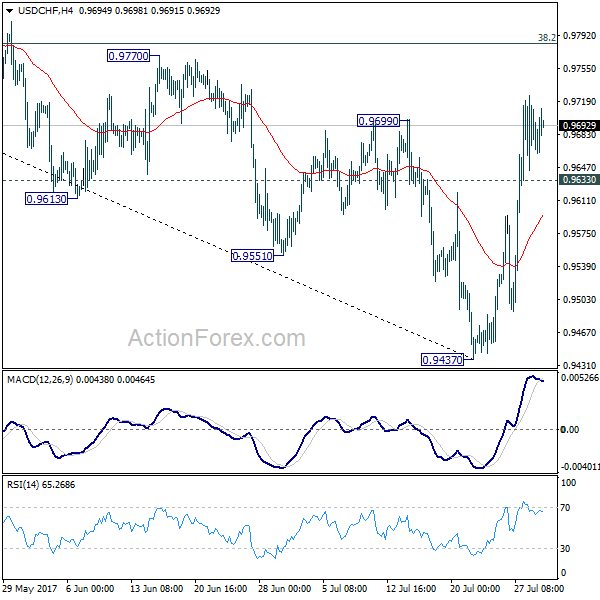
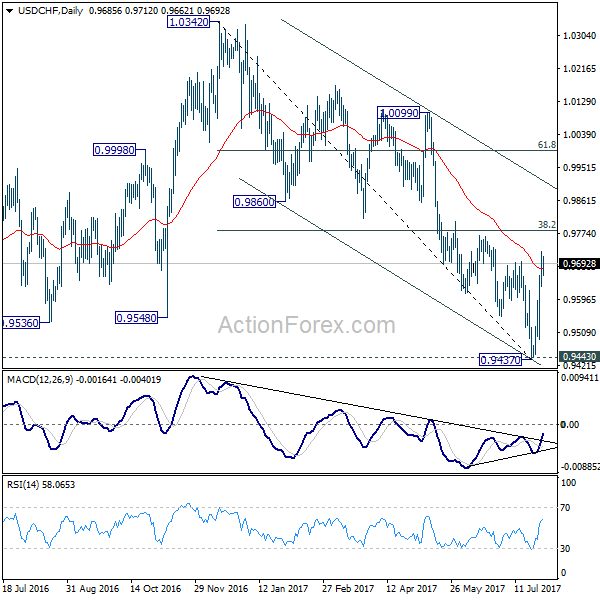
With 0.9633 minor support intact, intraday bias in USD/CHF remains on the upside for further rise. Prior break of 0.9699 resistance suggests near term reversal after defending 0.9443 key support. Further rally should be seen to 38.2% retracement of 1.0342 to 0.9437 at 0.9783 first. Break will target channel resistance (now at 0.9899). On the downside, below 0.9633 minor support will turn intraday bias neutral and bring consolidations first.
In the bigger picture, current development argues that USD/CHF has successfully defended 0.9443 key support level. And long term range trading in 0.9443/1.0342 is extending with another rise. At this point, there is no sign of an up trend yet. Hence, while further rise is expected in USD/CHF, we'll start to be cautious on loss of momentum above 61.8% retracement of 1.0342 to 0.9437 at 0.9996.
USD/JPY Mid-Day Outlook
Daily Pivots: (S1) 110.36; (P) 110.84; (R1) 111.14; More...
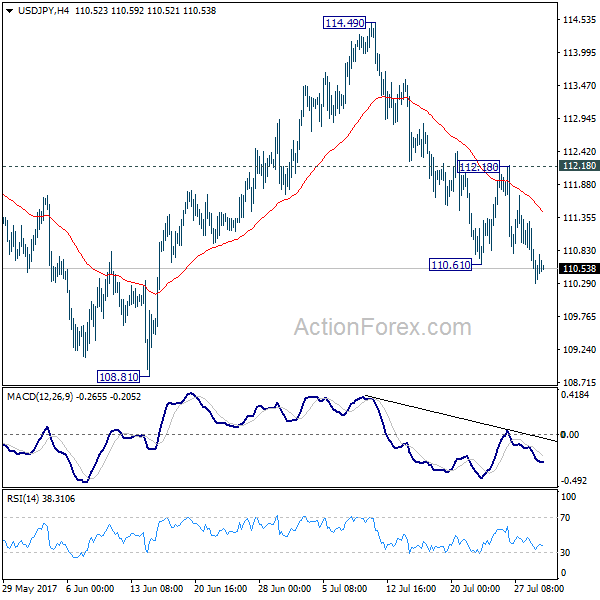
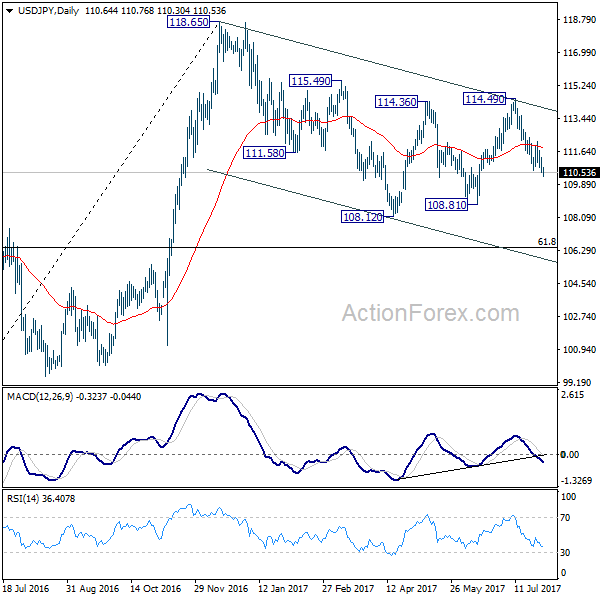
Intraday bias in USD/JPY remains on the downside at this point. Current decline from 114.49 should extend to 108.81 support first. Break there will resume whole correction from 118.65 and target 61.8% retracement of 98.97 to 118.65 at 106.48. Nonetheless, break of 112.18 resistance will dampen this bearish view and turn focus back to 114.49 resistance instead.
In the bigger picture, the corrective structure of the fall from 118.65 suggests that rise from 98.97 is not completed yet. Break of 118.65 will target a test on 125.85 high. At this point, it's uncertain whether rise from 98.97 is resuming the long term up trend from 75.56, or it's a leg in the consolidation from 125.85. Hence, we'll be cautious on topping as it approaches 125.85. If fall from 118.65 extends lower, down side should be contained by 61.8% retracement of 98.97 to 118.65 at 106.48 and bring rebound.
GBP/USD Mid-Day Outlook
Daily Pivots: (S1) 1.3077; (P) 1.3115; (R1) 1.3168; More...
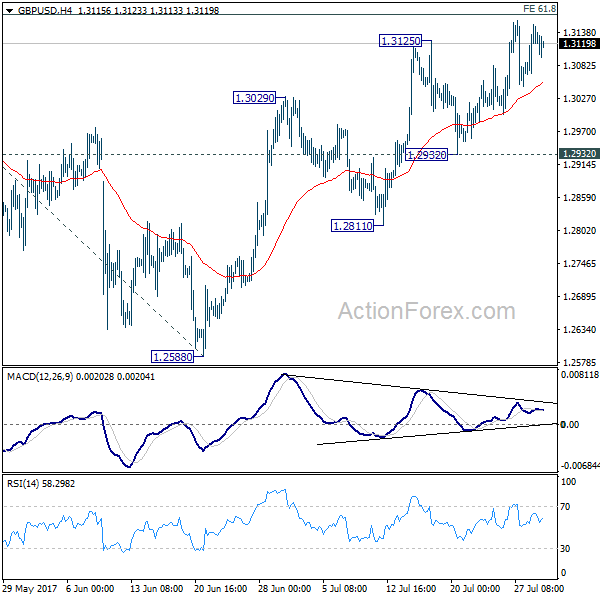
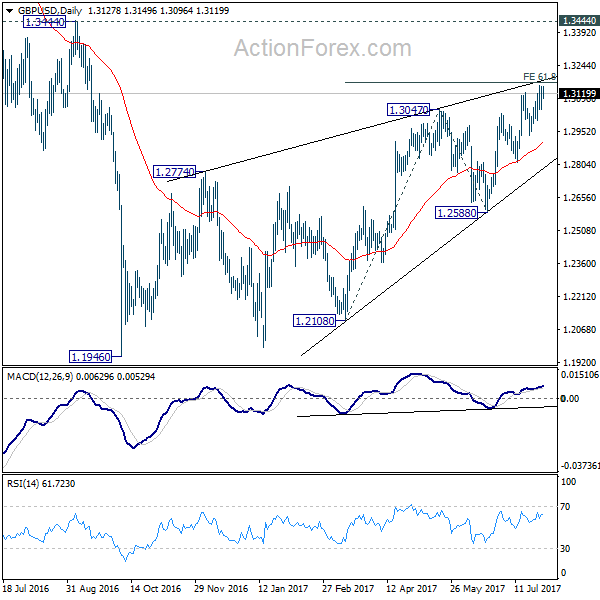
Further rise could be seen in GBP/USD but outlook is overall unchanged. Price actions from 1.1946 are seen as a corrective pattern. Considering bearish divergence condition in 4 hour MACD, we'd stay cautious on strong resistance from 61.8% projection of 1.2108 to 1.3047 from 1.2588 at 1.3168 to limit upside. Break of 1.2932 support will be the first sign of reversal and will turn bias to the downside to target 1.2588 key support next. Though, sustained break of 1.3168 will bring further rise towards 1.3444 before completing the correction.
In the bigger picture, overall, price actions from 1.1946 medium term low are seen as a corrective pattern that is still in progress. While further upside is expected, larger outlook remains bearish as long as 1.3444 key resistance holds. Down trend from 1.7190 (2014 high) is expected to resume later after the correction completes. And break of 1.2588 will indicate that such down trend is resuming.
EUR/USD Mid-Day Outlook
Daily Pivots: (S1) 1.1690; (P) 1.1726 (R1) 1.1783; More...
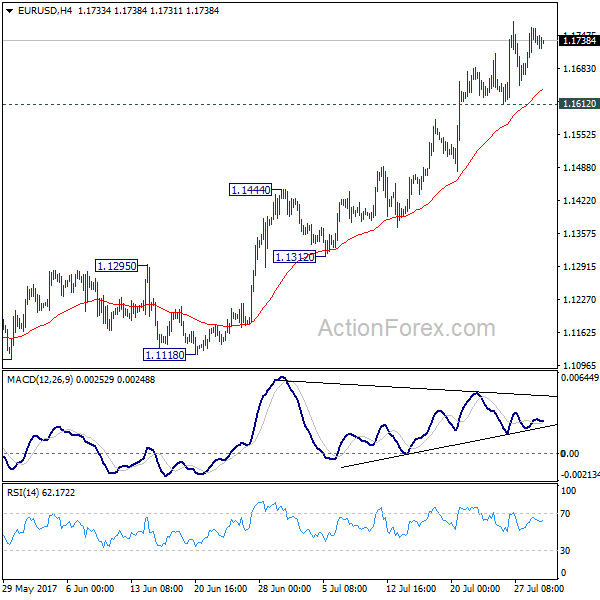
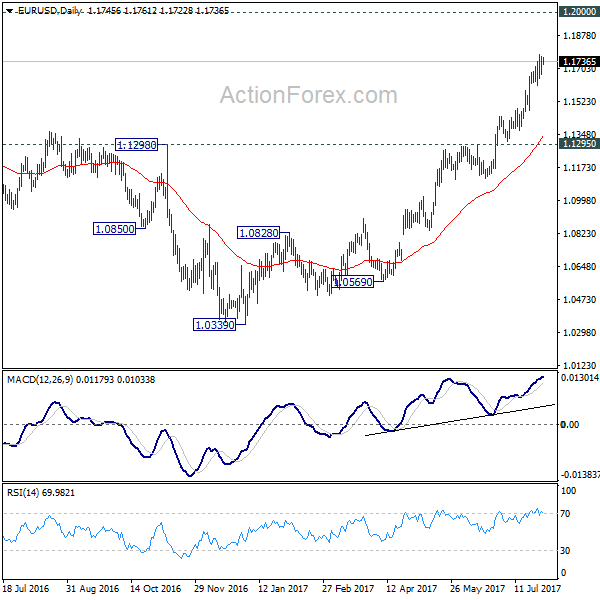
No change in EUR/USD's outlook. With 1.1612 minor support intact, further rise is expected at this point. Whole rise from 1.0339 low is still in progress and should target 1.2 handle next. Nonetheless, considering bearish divergence condition in 4 hour MACD, break of 1.1612 will indicate short term topping and bring lengthier consolidation first.
In the bigger picture, an important bottom was formed at 1.0339 on bullish convergence condition in weekly MACD. Sustained break of 55 month EMA (now at 1.1760) will pave the way to key fibonacci level at 38.2% retracement of 1.6039 (2008 high) to 1.0339 (2017 low) at 1.2516. While rise from 1.0339 is strong, there is no confirmation that it's developing into a long term up trend yet. Hence, we'll be cautious on strong resistance from 1.2516 to limit upside. But for now, medium term outlook will remain bullish as long as 1.1295 support holds, in case of pull back.
Yen and Dollar Mildly Higher as Markets Consolidate, Eurozone Core CPI Hit Four Year High
Yen and Dollar trade mildly firmer today as markets are staying consolidation mode ahead of the key events ahead, including RBA, BoE and US NFP. Economic data from Eurozone are positive but provide little inspiration to the common currency. Meanwhile, commodity currencies are trading generally lower even though WTI crude oil extends recent rise and breaches 50 handle briefly. Released from Canada, IPPI dropped -0.1% mom in June, below expectation of -0.3% mom. RMPI dropped -3.7% mom, below expectation of -2.2% mom.
Eurozone core inflation jumped to four year high
Eurozone headline CPI was unchanged at 1.3% yoy in July, in line with consensus. Meanwhile, core CPI unexpected ticked up by 0.1% to 1.2% yoy. That's the highest reading in four years since August 2013. Unemployment rate dropped to 9.1%, lowest since 2009. The data continued to paint a positive picture for the Eurozone. And that also affirm the view that ECB will at least announce tapering of asset purchases of some sort in September, or by latest October. ECB President Mario Draghi also indicated that QE discussion would begin in autumn. Also from Eurozone, German retail sales rose strongly by 1.1% mom in June, well above expectation of 0.2% mom.
ECB governing council member Sabine Lautenschlaeger said in a newspaper remarks that "the expansionary monetary policy has both advantages and side effects. As time passes, the positive effects get weaker and the risks increase." And, she urged that "it's important to prepare for the exit in good time." But she noted that "what's crucial in that context is a stable trend in the rate of inflation towards our objective of just under 2 percent. It's not quite there yet."
UK mortgage approvals dropped slightly
UK mortgage approvals dropped from 65.11k to 64.70k in June, indicating that lenders have approved fewest mortgages since last September. M4 money supply dropped -0.2% mom, below expectation of 0.2% mom rise. There are a number of interesting points to watch in the upcoming BoE Super Thursdays. One of the three MPC members who voted for a hike, Kristin Forbes, has left. It's uncertain what her replace will vote for. The calls for a rate hike in response to surging inflation cooled after CPI miss. If BoE doesn't raise it inflation forecast in the Quarterly Inflation Report, such rate hike talks will recede even quickly. Also, BoE might follow IMF and lower its own GDP forecast, which will be Sterling negative.
Released early today, official China PMI manufacturing dropped to 51.4 in July, down from 51.7 and missed expectation of 51.5. Official non-manufacturing PMI dropped to 54.5, down from 54.9. Japan industrial production rose 1.6% mom in June, housing starts rose 1.7% yoy. New Zealand building permits dropped -1.0% mom in June. Australia TD securities inflation rose 0.1% mom in July.
RBA to stand pat
The RBA meeting due tomorrow would bring no change in the monetary policy. However, the central bank's "neutral rate" rhetoric gave Aussie a boost. At the July meeting minutes, RBA noted that neutral nominal cash rate is currently at around 3.5%, "given that medium-term inflation expectations were well anchored around 2.5%, although there is significant uncertainty around this estimate". We would like to see if policymakers do any tweak or elaboration on such reference this week. RBA's Monetary Policy Statement due on Friday would provide update economic forecasts.
EUR/USD Mid-Day Outlook
Daily Pivots: (S1) 1.1690; (P) 1.1726 (R1) 1.1783; More...
No change in EUR/USD's outlook. With 1.1612 minor support intact, further rise is expected at this point. Whole rise from 1.0339 low is still in progress and should target 1.2 handle next. Nonetheless, considering bearish divergence condition in 4 hour MACD, break of 1.1612 will indicate short term topping and bring lengthier consolidation first.
In the bigger picture, an important bottom was formed at 1.0339 on bullish convergence condition in weekly MACD. Sustained break of 55 month EMA (now at 1.1760) will pave the way to key fibonacci level at 38.2% retracement of 1.6039 (2008 high) to 1.0339 (2017 low) at 1.2516. While rise from 1.0339 is strong, there is no confirmation that it's developing into a long term up trend yet. Hence, we'll be cautious on strong resistance from 1.2516 to limit upside. But for now, medium term outlook will remain bullish as long as 1.1295 support holds, in case of pull back.
Economic Indicators Update
| GMT | Ccy | Events | Actual | Forecast | Previous | Revised |
|---|---|---|---|---|---|---|
| 22:45 | NZD | Building Permits M/M Jun | -1.00% | 7.00% | 6.90% | |
| 23:50 | JPY | Industrial Production M/M Jun P | 1.60% | 1.50% | -3.60% | |
| 01:00 | AUD | TD Securities Inflation M/M Jul | 0.10% | 0.10% | ||
| 01:00 | CNY | Manufacturing PMI Jul | 51.4 | 51.5 | 51.7 | |
| 01:00 | CNY | Non-manufacturing PMI Jul | 54.5 | 54.9 | ||
| 05:00 | JPY | Housing Starts Y/Y Jun | 1.70% | 0.10% | -0.30% | |
| 06:00 | EUR | German Retail Sales M/M Jun | 1.10% | 0.20% | 0.50% | |
| 08:30 | GBP | Mortgage Approvals Jun | 65K | 65K | 65K | |
| 08:30 | GBP | M4 Money Supply M/M Jun | -0.20% | 0.20% | -0.10% | |
| 09:00 | EUR | Eurozone Unemployment Rate Jun | 9.10% | 9.20% | 9.30% | 9.20% |
| 09:00 | EUR | Eurozone CPI Estimate Y/Y Jul | 1.30% | 1.30% | 1.30% | |
| 09:00 | EUR | Eurozone CPI - Core Y/Y Jul A | 1.20% | 1.10% | 1.10% | |
| 12:30 | CAD | Industrial Product Price M/M Jun | -1.00% | -0.30% | -0.20% | 0.10% |
| 12:30 | CAD | Raw Materials Price Index M/M Jun | -3.70% | -2.20% | -1.80% | -1.70% |
| 13:45 | USD | Chicago PMI Jul | 60.8 | 65.7 | ||
| 14:00 | USD | Pending Home Sales M/M Jun | 1.00% | -0.80% |
DAX Starts Week with Gains as German Retail Sales Jumps
The DAX index has moved higher in the Monday session. In the European session, DAX is trading at 12,196.00, up 0.25% on the day. On the release front, German Retail Sales climbed 1.1%, easily beating the estimate of 0.1%. Eurozone CPI Flash Estimate remained unchanged at 1.3%, matching the forecast. On Tuesday, the eurozone releases Preliminary Flash GDP, with an estimate of 0.6%.
The robust German economy continues to impress, and there was positive news on Monday, as retail sales climbed 1.1% in June. This marked the strongest gain since February. Last week, GfK German Consumer Climate strengthened for a fourth straight month, as the German consumer is optimistic about economic conditions and this has translated into strong spending. However, the fly in the ointment remains inflation, which is stuck at low levels. The lack of inflation is a pressing concern for ECB policymakers, and there is little chance that the bank will end its quantitative easing program before December, if inflation levels don't move upwards. German policymakers would like Brussels to tighten policy, but the ECB has to worry about other eurozone members, whose economies are not as strong as Germany. If the eurozone economy continues to improve in the third quarter, the ECB could send out some cautious hints about plans to tighten policy, which would send the euro to higher levels.
It's become an all-too-familiar pattern out of Washington – trouble for the White House has soured investor appetite and weighed on global stock markets. It was déjà vu on Friday, as President's struggling healthcare bill gasped its final breath as the bill was defeated in the Senate after three Republican lawmakers joined the Democrats and voted against the bill. This is another setback for President Trump, who has been unable to get Congress to pass any significant legislation, despite the Republicans controlling both the House and the Senate. Trump will now be able to focus on other issues such as tax reform, but investors are skeptical as to whether the President will have the support he needs in Congress to pass major legislation. The euro climbed to 1.7777 on Friday, its highest level since January 2015. The currency's gains weighed on the DAX, which lost ground but managed to recover before the end of the Friday session.
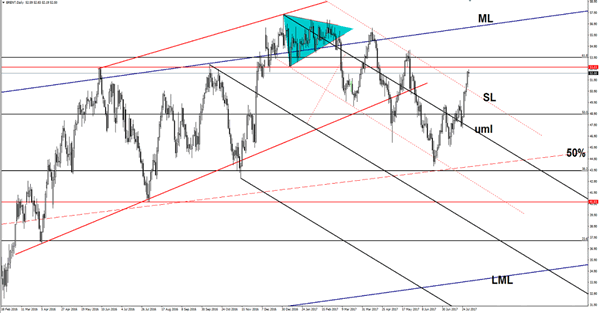
Brent Right Below Next Upside Target
Brent is trading right above the 52.50 level and was almost to reach the 53.03 major static resistance in the morning, but the sellers have stepped in and have forced it to slip below the 52.66 Friday's high. Is still expected to approach and reach the 53.03 and the 61.8% retracement level, where he may fid resistance again.
USD/CHF Sits above Strong Support
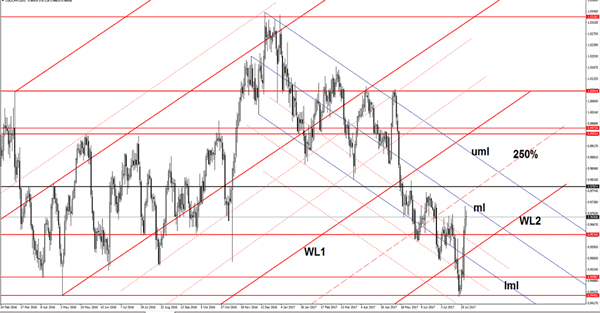
Price rallied in the last week, but failed to reach and retest the median line (ml) of the descending pitchfork. Could decrease to retest the 0.9634 level (resistance turned into support) before will try to take out the dynamic resistance. We could have a great buying opportunity if it will come to retest the second warning line (WL2) as well, while a valid breakout above the median line (ml) will confirm an important upside movement.
USD/CAD Around Critical Support
Price increased today as the USD has received a helping hand from the USDX, which has increased a little after the Friday's massive drop. USD/CAD is located in a major support area, needs a bullish spark to be able to really start a bounce back
The outlook is bearish because the dollar index could decrease further in the upcoming days till will reach the 92.49 static support. USD/CAD is under massive pressure on the Daily chart, could drop anytime, we'll see what impact will have the US and the Canadian data.
The Canadian RMPI is forecasted to drop by 3.2% in June, more versus the 1.8% decrease in the former reading period, while the IPPI is expected to decrease by 0.3%, more compared to the 0.2% drop in the former reading period.
You should know that the US data could shake the currency market, the Chicago PMI may drop from 65.7 to 60.8 points, signaling an expansion slowdown, while the Pending Home Sales are expected to increase by 0.9%, more after the 0.8% drop in the previous reporting period.
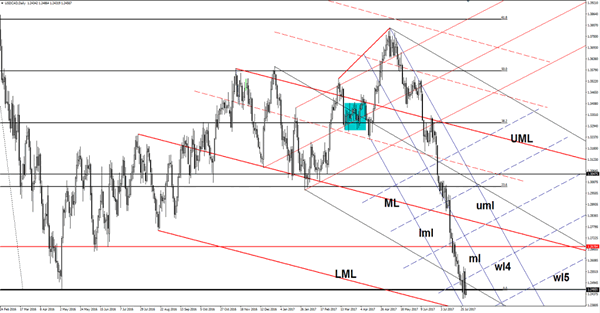
USD/CAD decreased sharply on Friday and invalidated the breakout above the fourth warning line (wl4) and above the lower median line (black down sloping line). Right now is pressuring the 1.2460 broken support, we'll see what will happen in the upcoming hours as the fundamental factors should take the lead.
A good US data and poor Canadian reports will help the USD to drag the price higher, but another disappointment from the US will send the rate much much below the 1.2413 level. We may have a larger rebound only if the rate will come back and will stabilize above the 1.2460 critical support.
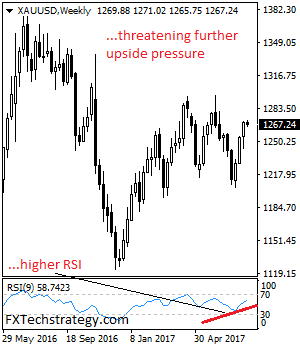
GOLD – Recovers Further,Looks To Extend Upside Pressure
GOLD - With the commodity seeing higher price close the past week, more strength is likely in the new week. On the downside, support comes in at the 1,260.00 level where a break will turn attention to the 1,250.00 level. Further down, a cut through here will open the door for a move lower towards the 1,240.00 level. Below here if seen could trigger further downside pressure targeting the 1,230.00 level. Conversely, resistance resides at the 1,280.00 level where a break will aim at the 1,290.00 level. A turn above there will expose the 1,300.00 level. Further out, resistance stands at the 1,310.00 level. Its weekly RSI is bullish and pointing higher suggesting further. All in all, GOLD looks to recover further higher.