Sample Category Title
Eco Data 7/5/17
[php_everywhere] [/php_everywhere]
Eco Data 7/4/17
[php_everywhere] [/php_everywhere]
Eco Data 7/3/17
[php_everywhere] [/php_everywhere]
Summary 7/3 – 7/7
Monday, Jul 3, 2017
[php_everywhere] [/php_everywhere]
Tuesday, Jul 4, 2017
[php_everywhere] [/php_everywhere]
Wednesday, Jul 5, 2017
[php_everywhere] [/php_everywhere]
Thursday, Jul 6, 2017
[php_everywhere] [/php_everywhere]
Friday, Jul 7, 2017
[php_everywhere] [/php_everywhere].
Weekly Economic and Financial Commentary
U.S. Review
Consumer Remains on Solid Footing
- There were two key takeaways from economic data released this week. First, current economic conditions are positive for the U.S. consumer, who remain confident about the labor market providing opportunity for continued income growth, and are comfortable making economic decisions accordingly.
- Second, disappointment may be setting in for those expecting a strong rebound in the factory sector. Tax cuts and other public policy expectations have not come to fruition as soon as some had hoped following the election. Data show a recovery, but it is slow and gradual. Orders and shipments data have yet to signal a major pickup for the factory sector is imminent.
Reality Sets In
The U.S. economy expanded 1.4 percent in the first quarter of the year, which was a larger-than-expected upgrade in the final look at GDP this week. The improvement was largely on the personal consumption line, which actually rose 1.1 percent in Q1, much stronger than the 0.3 percent first estimated. Still somewhat soft relative to recent performance, the consumption portion of the U.S. economy had a decent start to the year, which adds to our confidence that Q2 GDP will get a solid boost from consumption.
Surveys of consumers continue to support expectations of a solid Q2 performance for consumption. The Conference Board's Survey of Consumer Confidence in June confirmed an upbeat assessment of the present economic situation. The measure has surged over the past six months, hitting a cycle high in March. Headline consumer confidence gave back some of that gain in subsequent months on diminishing strength in the expectations component. Consumers' assessment of their current economic situation has continued its steady climb upward. Progress toward the policy objectives that had boosted expectations in the first months of the new administration has likely been slower than some anticipated. Although some disappointment may have set in, the economic reality—the labor market in particular—is getting positive reviews from an increasing share of consumers surveyed.
Consumers' positive assessment of their current situation was reinforced by the continued strength seen in personal income growth. Personal income rose another 0.4 percent in May, besting expectations of 0.3 percent. Disposable income was up a strong 0.5 percent, and was even stronger in real terms as the lack of price pressures, particularly at the gas pump, left more money in consumers' pocket in May. The PCE deflator declined 0.1 percent on the month, continuing a string of soft inflation prints. The PCE deflator is followed closely by the Fed, and the year-over-year increase of 1.4 percent in both headline and core PCE is quite far from the FOMC target of 2 percent.
Manufacturing activity has yet to ramp up significantly, as had been suggested by sentiment measures from the sector early in the year. To be sure, factories are faring far better than this time last year and continue to pull themselves out of the rout that had plagued the sector for nearly two years. Continued uncertainty surrounding trade, health care and tax reform appears to have diminished expectations in the business sector, which appear to be holding off investment spending, which weighs on demand from U.S. factories. The second quarter started off slow, with new orders down 1.1 percent in May, declining for the second month. Core capital goods, which exclude defense and aircraft and provide a useful proxy for business investment in GDP, have softened. Shipments of core goods declined 0.2 percent in May, and orders also declined, suggesting a significant bounce by the end of Q2 is unlikely. Both orders and shipments of core goods are running at the softest three month annualized rate of 2017. The convergence of soft and hard data at a lower level of activity enforces our call that the factory sector is in for a slow and steady improvement, at least until some clarity emerges on fiscal policy.


U.S. Outlook
ISM Manufacturing • Monday
The ISM manufacturing index has hovered just shy of 55 over the past two months, a modest pullback from levels seen in Q1. The new orders and production components were a solid 59.5 and 57.1, respectively, in May, but both of these readings were below their six-month averages. This softening in new orders and production has corresponded with a deceleration in the hard data for capital goods orders. Encouragingly, after seven straight months of sub-50 readings for the backlog of orders component, this measure of activity in the pipeline snapped the streak in February and has held steady in the mid-50s since.
We expect the ISM index to remain near the 55 mark in June. While this is lower than the robust readings registered to start the year, it is still consistent with incremental improvement in the manufacturing sector relative to the past couple years; the ISM index remained below the 55 mark for all of 2015 and 2016.
Previous: 54.9 Wells Fargo: 55.0 Consensus: 55.0

Trade Balance • Thursday
The trade deficit widened to start Q2, as imports rose strongly while exports edged down. A decline in automobiles and parts and consumer goods exports weighed, leading to the second consecutive month the value of exports declined. Imports were boosted by a surge in consumer goods and cell phones in particular.
Unless exports bounce back strongly in May and June, sequential growth in real exports of goods and services likely will be weak in Q2. On the other hand, sequential growth in real imports likely will be fairly solid in the second quarter. In other words, real net exports likely will exert a modest drag on overall real GDP growth in the current quarter. We expect that export growth generally will remain positive going forward, although it likely will fall short of import growth. As illustrated in the middle chart, trade in real goods has accelerated as economic growth has firmed both domestically and abroad.
Previous: -$47.6B Wells Fargo: -$46.1B Consensus: -$46.2B

Employment • Friday
On trend, nonfarm employment growth has gradually been slowing since early 2015, as slack in the labor market continues to diminish and secular demographic headwinds limit growth in the labor force. Of late, the retail sector has been a major drag on employment growth, shedding 52,000 jobs over just the past three months. Education & health, leisure & hospitality and professional & business services have led job growth.
With the unemployment rate at a cycle-low of 4.3 percent and employment gradually decelerating, the attention on wage growth (or lack thereof) continues to grow. Average hourly wage growth remains well below the peak of previous cycles amid relatively benign inflation and sluggish labor productivity growth. With job openings at a record high and survey data suggesting positions are increasingly hard to fill, the stage is set for somewhat faster wage growth later this year.
Previous: 138,000 Wells Fargo: 170,000 Consensus: 177,000

Global Review
Confidence Abounds in the Eurozone
- Confidence indicators are surging across the Eurozone. Although indices of business and consumer confidence appear to be overstating the underlying pace of growth at present, the economic expansion that is underway in the euro area appears to be increasingly self-sustaining.
Japanese Economy Continues to Grind Along
- The modest pace of expansion that has been underway in Japan appears to have continued in Q2. Until inflation moves higher, however, the Bank of Japan (BOJ) likely will keep its foot firmly on the accelerator of monetary accommodation.
Confidence Abounds in the Eurozone
If confidence indicators are to be believed, the Eurozone economy is booming at present. As shown in the bottom chart on page 1, the Ifo index of German business sentiment rose to 115.1 in June, the highest reading in at least 26 years, and consumer confidence in Germany reached a 16-year high. Consumer confidence in France shot up to a 10-year high in June, no doubt spurred higher by the election of President Macron in May and his impressive legislative win earlier this month. The Italian index of consumer confidence also moved higher during the month.
That said, confidence indicators have consistently overstated the underlying strength of the Eurozone economy in recent years. Industrial production (IP) in Germany was up 2.3 percent in the February-April period relative to the same three-month period last year (see graph on page 1). This growth rate in German IP is solid, but it is hardly reflective of "boom." Strength in French consumer confidence has yet to translate into robust growth in French consumer spending on a sustained basis (top chart).
The Eurozone economy may not be exactly "booming," but it does seem that the current economic expansion, which has been underway now for four years, is becoming increasingly selfsustaining. Indeed, ECB President Draghi gave a speech this week in which he talked about the broadening and the strengthening in the Eurozone economic recovery. But he also noted that inflation in the overall euro area remains well below the ECB's target of "below, but close to, 2 percent over the medium term." Although the ECB may further "taper" its quantitative easing program later this year, we continue to believe that the Governing Council will refrain from raising interest rates until well into 2018.
Japanese Economy Continues to Grind Along
Data released this week indicate that the Japanese economy, where real GDP was up 1.3 percent on a year-over-year basis in Q1 2017, continues to grow at a modest pace. Japanese IP dropped 3.3 percent in May relative to the previous month, which, on the surface, looks awful. However, the plunge in IP in May was not sharp enough to reverse the 4.0 percent jump that was registered in April. Moreover, the year-over-year growth rate, which is shown in the middle chart, is more reflective of the underlying trend in Japanese IP at present. A similar monthly pattern (i.e., strength in April followed by relative weakness in May) was also observed in Japanese retail spending. On a yearago basis, retail sales in Japan were up 2.0 percent in May.
The pace of economic growth in Japan at present is not strong enough to lift inflation, however. The overall rate of CPI inflation was just 0.4 percent in May, well short of the BoJ's 2 percent target (bottom chart). Although some foreign central banks are starting to indicate that it may soon be appropriate to remove some monetary accommodation (see "Interest Rate Watch" on page 6), the BoJ seems content to keep its quantitative easing program firmly in place for the foreseeable future. Consequently, we believe that the Japanese yen will remain on the defensive versus most major currencies.


Global Outlook
China Caixin PMIs • Tuesday
The Caixin manufacturing and service PMIs for China will be released early next week. The manufacturing index is expected to remain in contractionary territory, at 49.8, following a May reading of 49.6. The recent pullback in manufacturing activity suggests that the secondary sector, which includes manufacturing, construction and utilities production, softened in Q2, following a strong 6.4 percent growth rate in Q1. The secondary sector accounts for roughly 40 percent of the value added in the Chinese economy, thus markets will be watching this release closely.
The service PMI is also on the docket for next week for the secondlargest economy in the world. China's service sector expanded at a faster pace in May, indicating renewed momentum in the sector after deceleration in the previous four months. The divergent trends in the PMI indices will be closely monitored if they widen further.
Previous: Manufacturing (49.6); Services (52.8) Consensus: Manufacturing (49.8)

Eurozone Retail Sales • Wednesday
Next Wednesday, retail sales for May are set to be released for the euro area. Economic activity has been gaining momentum in the Eurozone, indicating that economic growth in the area is becoming self-sustaining. Eurozone GDP expanded 1.9 percent in Q1 (year over year) and is expected to increase 1.8 percent in Q2. Retail sales in Germany, the largest economy in the euro area, grew 4.8 percent year-over-year in May, according to data released this morning. In Spain, retail sales grew 3.8 percent in May on a year-over-year basis, its quickest pace since November 2016.
Sentiment indicators in the Eurozone are quite strong at present and the hard data seem to be catching up with the feelings of economic optimism. In fact, this past week, Mario Draghi noted the strengthening character of the Eurozone recovery and recognized that the factors restraining inflation are temporary, and suggested that continued monetary policy would become less accommodative.
Previous: 0.1% (Month-over-Month) Consensus: 0.4% (Month-over-Month)

U.K. Industrial Production • Friday
U.K. industrial production (IP) data for May is slated to be released next Friday. IP increased 0.2 percent in April and is expected to increase 0.4 percent in May, on a month-over-month basis. The 0.2 percent gain in April fell well short of the 0.7 percent consensus forecast. Factory output rose 0.2 percent, missing the 0.8 percent expected gain. The weaker-than-expected figures cause a bit of concern, especially in the wake of the general election results in which the governing Conservative Party lost seats in parliament—a result which likely weakened its position in the Brexit negotiations.
Also scheduled for a Friday release are manufacturing production and construction output. All three indicators, taken together, will present a more complete picture of production in the U.K. GDP is expected to increase 1.7 percent in Q2, year over year, a slowdown from the 2.0 percent growth in Q1.
Previous: 0.2% Consensus: Consensus: 0.4% (Month-over-Month)

Point of View
Interest Rate Watch
Sovereign Bonds Reverse Course
Yields on longer-dated Treasury securities jumped this week, with the 10-year up 13 bps from last Friday and the 10yr/2yr spread steepening (top chart).
The decline in Treasuries largely began after European Central Bank President Mario Draghi delivered some hawkish language this week that hinted at a reversal of ECB stimulus amid a broadening recovery and budding reflation in the euro area. European sovereign debt sold off in reaction, with the yield on the 10-year German Bund rising 20 bps this week (middle chart). ECB officials attempted to tamp down the rhetoric in subsequent statements, but the damage had already been done. As we have noted in previous reports, the expansion in Europe is increasingly self-sustaining, and our forecast looks for real GDP in the Eurozone to accelerate modestly in coming quarters.
The case for a more hawkish stance from the world's central banks was not limited to just Europe. After a run of better-thanexpected economic indicators and a solid print for GDP growth in Q1, Canada's first step toward monetary policy normalization could come as soon as July. The last time the BoC adjusted its benchmark overnight rate was in July 2015 when it cut the overnight rate to 0.50 percent, where it has remained subsequently. Until recently, we expected the Bank of Canada to remain on hold, but we think a quarter point rate hike at the July 12 meeting is now the more likely course of action.
Economic data in the U.S. this week were also generally supportive of higher rates. Despite a miss in durables goods orders, consumer confidence surprised to the upside. The present situation component surged to 146.3; this reading marked the most upbeat assessment by consumers of their current situation since 2001 (bottom chart). Real GDP growth in the United States was also revised higher yesterday, buoyed by another upward revision to personal consumption growth. We look for generally solid U.S. economic data next week as well, including another cycle-low for the unemployment rate, to signal stronger growth ahead for bondholders.


Credit Market Insights
Cloud Looms Over Consumers' Expectations and Confidence
The Federal Reserve Bank of New York published the results from its May 2017 Survey of Consumer Expectations (SCE), which offers data on consumers' experiences and expectations related to credit demand and credit access. The monthly results showed that households' expectation of inflation declined on a oneyear and three-year ahead horizon. Inflation uncertainty one- and three-year ahead remains at a series low.
Consumers' expectations of their future financial situation and spending growth, however, worsened compared to the previous month. In addition, consumers are expecting home prices to rise 3.5 percent higher. The lack of inventory continues to apply upward pressure on home prices and is starting to weigh on sales. However, with low mortgage rates and strong buyer traffic we expect demand to remain elevated as more homes are put up on the market.
Despite fewer signs of future-optimism, consumer confidence remains elevated as consumers feel positive about the economy today and upbeat about the labor market. The downward trend of future expectations appears, in our opinion, to be from the uncertainty surrounding public policy. That said, the Fed pays attention more to the direction of inflation expectations. With weakening inflation expectations, a case could be made against a September rate hike.
Topic of the Week
Developing Country Debt
External debt in the developing economies has risen noticeably over the past few years, growing to more than $6 trillion in 2014 from less than $4 trillion in 2009. Although the outstanding debt stock has subsequently edged lower, most of that decline is attributable to China, where external debt dropped from nearly $1 trillion in 2014 to about $500 billion last year. Excluding China, the amount of external debt in our sample of countries remains near its 2014 peak. The unsustainable buildup in external debt in the 1990s was partially responsible for the series of financial crises that swept through the developing world in 1997-1998— should we be worried?
It is important to note that countries get into financial difficulties not so much because of the outstanding amount of debt per se, but rather because of their inability to service that debt. Debt service is the amount of interest and amortization payments that a country needs to pay every year, and as a country's debt service ratio rises, its ability to adequately service its external debts declines, everything else equal. As shown in the top graph, the ratio of debt service payments to exports for the 21 economics in our sample stood at roughly 26 percent in 1997. The ratio has edged closer to this point over the past few years due to the buildup in external debt and slow growth in exports. Nevertheless, the ratio today for the non-Chinese developing economies remains below its 1997 level. In other words, the ability of developing economies to service their external debt is better today than it was 20 years ago.
Furthermore, developing economies have deeper pockets today than they did in 1997. External debt is a liability for developing economies. But they also have assets, namely foreign exchange (FX) reserves, which can be used to service the debt. In that regard, the FX reserves of the 21 economies in our sample mushroomed to roughly $5.8 trillion at the end of 2016 from $500 billion in 1997. In short, the ability of the developing world to service its external debt is generally stronger today than it was at the onset of the so-called Asian financial crisis. A reoccurrence of the financial crises in 1997-98 does not appear to be imminent.


Hawkish Central Bank Rhetoric Rattles Markets
Highlights
- Bond markets sold off sharply this week on remarks from monetary policymakers. Bond yields rose by 20 to 25 basis points in Germany and the UK, respectively. Yields on Treasuries also rose, but markedly less as U.S. data has underwhelmed.
- Momentum in personal spending dissipated slightly from the strong performance in the previous two months. Gains in real income surprised to the upside, and should underpin spending going forward.
- We look forward to next week's employment report as a potential market mover. We expect a relatively robust print of 170 thousand jobs and unemployment to hold steady at 4.3%.

U.S. - Hawkish Central Bank Rhetoric Rattles Markets
Global markets were volatile in recent days. Bond markets sold off sharply since mid-week on remarks from monetary policymakers. Central bankers in the Eurozone and the UK have indicated that meaningful economic improvements should begin to warrant the removal of accommodative monetary policy measures. This hawkish sentiment saw bond yields rise by 20 to 25 basis points in Germany and the UK, respectively. Yields on Treasuries also rose, but markedly less as U.S. data has underwhelmed. The relatively softer U.S. data also led the dollar lower vis-à-vis the euro and the pound.
The lower U.S. dollar also helped to shore up oil prices that have been led higher recently by curtailed production related to maintenance of Alaskan sites and a storm in the Gulf of Mexico. Still, US stockpiles have remained high this summer, with oil prices likely to remain relatively anchored during the rest of the year.
Expectations of less-stimulative policy going forward have also led stock markets to retrench as investors across the Atlantic readied themselves for what may be end an era of cheap money. At the same time, comments by Fed Chair Janet Yellen on Tuesday indicated that the Fed is keeping a close eye on stock markets valuations, injecting further caution into U.S. equity markets.
Still, the U.S. data came in relatively weak this week. While still supportive of growth in the second quarter, momentum in personal spending dissipated slightly from the strong performance in the previous two months. Gains in real income surprised to the upside, and should underpin spending going forward (Chart 1). But, this was partly related to the weakness in prices, which underperformed in May, corroborating anemic CPI growth on the month (Chart 2). There was also weakness in durable goods orders, which fell in May according to the advance estimate, suggesting weaker capital investment in the second quarter.
But, not all data were soft. Consumer confidence metrics rose according to both the Conference Board and University of Michigan surveys. Moreover, the goods trade balance narrowed slightly in May as automotive exports rebounded following two consecutive months of underperformance. With domestic US auto sales peaking last year, global demand will play an increasingly important role for growth in the sector. Exports should also get some support from a weaker greenback. We look forward to next week's ISM manufacturing survey results to echo these positive developments, with readings poised to expand, mirroring upbeat regional surveys for June.
The string of data that has missed expectations recently has been leading markets to push out the timeline for further rate hikes, with another hike this year now priced in below 50%. This is particularly the case for inflation, which has been stubbornly weak, while wage growth has recently lost some momentum too. We look forward to next week's employment report as a potential market mover. We expect a relatively robust print of 170 thousand jobs and unemployment to hold steady at 4.3%. Moreover, with unemployment near its natural rate, we expect that wage growth should once again accelerate. This should help underpin the inflation outlook and could bolster the case for another rate hike by year end.


Canada - Rate Hikes Coming, Just A Matter Of When
It was a good week for Canada's loonie, as it pushed above 77 US cents to a 9-month high. Oil prices provided some support, moving back above US$45 per barrel.
However, the more important driver of currency strength of late has been the Bank of Canada, where hawkish remarks by senior officials over the past few weeks have prompted markets to bring forward expectations of when the tightening cycle will begin. Comments from Governor Poloz this week – that rate cuts have done their job and excess capacity is being used up – echoed this sentiment, signaling that it is no longer a question of if the Bank of Canada will hike rates, but when. As of this morning, markets had priced in a nearly 80% chance that the Bank will hike the overnight rate at the next meeting in July. As a result, 5- and 10-yr bond yields rose by about 25 basis points on the week to a 3-month high.
The Bank of Canada is clearly responding to the stellar growth that the Canadian economy has recorded in the second half of last year and first quarter of 2017. And, this momentum has carried over into the second quarter. This morning's April GDP report showed that the economy expanded by 0.2% during the month, putting it on track to meet our expectations of 2.9% (annualized) for the quarter as a whole. This should help to close the output gap – or eliminate the excess capacity – in the current quarter.
Moreover, this morning's release of the Business Outlook Survey – which the Bank of Canada tends to put a lot of weight on – showed that business activity is continuing to gain momentum. Firms expect sales growth to improve further and hiring intentions shot up to record levels. Still, inflation expectations edged down, with the bulk of respondents forecasting price growth in the 1-2% range.
Price pressures are perhaps the only thing missing that would solidify a July hike. All of the Bank's core measures of inflation have been flat or trending down this year and remain on the low end of the 1-3% target range. And expectations among businesses suggest that inflationary pressures will be limited. However, monetary policy acts with a lag. And given that the Bank of Canada's research suggests that core inflation should be bottoming, it could very well feel that a July hike is justified.
All told, the heat of the continued rhetoric by Governor Poloz this week, strong growth data and associated market reaction are all working in the direction of a rate hike at the central bank's July 12th fixed announcement date. At the same time, however, inflation is still the Bank of Canada's single mandate and has yet to show any signs of moving toward target. As such, although markets have priced in a hike for July, we believe there is little risk of waiting a bit longer (i.e., October). This will give the Bank a little more time to ensure that inflationary pressures are beginning to materialize as expected, and to obtain more clarity surrounding the impact of recently announced housing measures in some regions, as well as the direction of oil prices. Should the Bank of Canada hike rates in July, markets should be cautious about pricing in too much additional tightening given the soft inflation backdrop.


U.S.: Upcoming Key Releases
U.S. ISM Manufacturing Index - June
Release Date: July 3, 2017
May Result: 54.9
TD Forecast: 55.5
Consensus: 55.0
TD looks for ISM Manufacturing to strengthen to 55.5 in June on a broadening improvement in regional soft data. ISM-adjusted empire manufacturing reached a six-year high in June and while the Philly Fed Index drifted lower on an ISM-adjusted basis, it still remains near cycle-highs and firmly entrenched in expansionary territory. Chicago PMI also surprised to the upside in June, coming in just shy of the previous cycle high set in 2011. This should bode well for market sentiment, though we note that inflation and hard data are far more important for the Fed in the current environment.

U.S. Employment - June
Release Date: July 7, 2017
Previous Result: 138k, unemployment rate 4.3%
TD Forecast: 179k, unemployment rate 4.3%
Consensus: 180k, unemployment rate 4.3%
We expect June nonfarm payroll employment to pick up to a respectable 170k pace in June after registering a disappointing 138k gain in May. At this stage of the cycle we expect gains above 200k to be fewer and far between, though upside surprises cannot be excluded. We do expect, however, job gains to remain above its breakeven pace needed for further declines in slack (estimated at roughly 80-100k). Jobless claims have stabilized near record lows, household sentiment (e.g., Conference Board) has stayed robust and business survey indicators (regional Fed indexes) have also maintained recent strength. On balance, both hard data and surveys point to a June pickup, though we await additional labor market measures (ISM in particular) before finalizing our forecast.
The unemployment rate is expected to be unchanged at 4.3%. The number of unemployed workers fell for four consecutive months through May, which at this stage of the cycle looks unsustainable. With some stabilization in June paired with ongoing employment growth, we see risks as balanced for a stable reading for the unemployment rate. On wages, calendar effects point to a stronger 0.3% m/m increase in average hourly earnings, leaving the year-on-year pace higher at 2.7%. With realized inflation becoming a more deciding factor on the path of future rate hikes, wage growth will be key to watch in the coming months amid heightened concerns over the Phillips curve.

Canada: Upcoming Key Releases
Canadian International Trade - June
Release Date: July 6, 2017
April Result: -$0.37bn
TD Forecast: -$0.80bn
Consensus: N/A
The international trade deficit is forecast to widen to $0.80bn in May on a sizeable pullback in energy exports and an increase in import activity. Non-energy exports should post a moderate decline and add to the drag from energy, where a sharp decline in prices will overshadow a flat or modest increase in volumes. We see downside risks to motor vehicle exports after a sharp decline in manufacturing shipments and a deteriorating outlook for US auto sales new countervailing duties on softwood lumber, announced in late April, should weigh on exports of forestry products. Factory prices will also weigh on nominal exports, having fallen 0.2% on the month. On the other hand, we see import activity edging higher on robust domestic demand.
So the goods-export revival is not quite happening and Canada's competitive positive position remains under challenge, mainly due to high unit labour costs relative to the US and Mexico. In addition to the potential drag we may get from housing activity in May, the second quarter could mark the top to Canada's economic rebound. This is probably as good as it gets and the summer could be bumpier than what we have been accustomed to lately.

Canadian Employment - June
Release Date: July 7, 2017
May Result: 55k, unemployment rate 6.6%
TD Forecast: 5k, unemployment rate 6.6%
Consensus: N/A
Canadian job growth is forecast to slow to a 5k pace in June after the robust 55k in May. Details should add a downbeat tone to the report, as we expect to see a partial reversal of last month's rotation into full time and private sector hiring. Manufacturing employment should cool after surging 25k jobs in May, its strongest month since 2002. We expect finance, insurance and real estate (FIRE) employment to remain soft amid a slowdown in the Toronto housing market. The unemployment rate should remain stable at 6.6%, but the risks are skewed for it to drift lower to 6.5% on a moderation in labour force growth.
While we look for a number of sharp improvements in April's report to unwind partially, we expect policy makers to look through the weakness in any single month and focus on the encouraging trend that has solidified over the last six months, although the market reaction could be higher than normal, especially if we get a miss, given the current speculations surrounding an upcoming rate hike.

Week Ahead Dollar Weaker After Hawkish Comments From Central Banks
US jobs report and Fed minutes to guide markets
The US dollar is lower against most majors amid hawkish rhetoric from central banks and improving economic conditions around the globe. The U.S. Federal Reserve has raised interest rates twice in 2017 and continues to hint at more tightening measures before the end of the year. American fundamentals have been mixed and the rising concerns about the Trump administration's ability to get to pass pro-growth policies are weighing on the dollar despite the efforts of the central bank.
The Fourth of July holiday in the United States will make an already packed economic calendar even more compressed. The notes from the Federal Open Market Committee (FOMC) meeting in June will be released on Wednesday, July 5 at 2:00 pm EDT. Employment data out of the US will start pouring in on Thursday with the release of the ADP private payrolls report at 8:15 am EDT and the weekly Unemployment claims. The main event will be the release of the U.S. non farm payrolls (NFP) report on Friday, July 7 at 8:30 am EDT with investors looking for signs of inflation in the wages component to reaffirm the Fed's hawkish view.

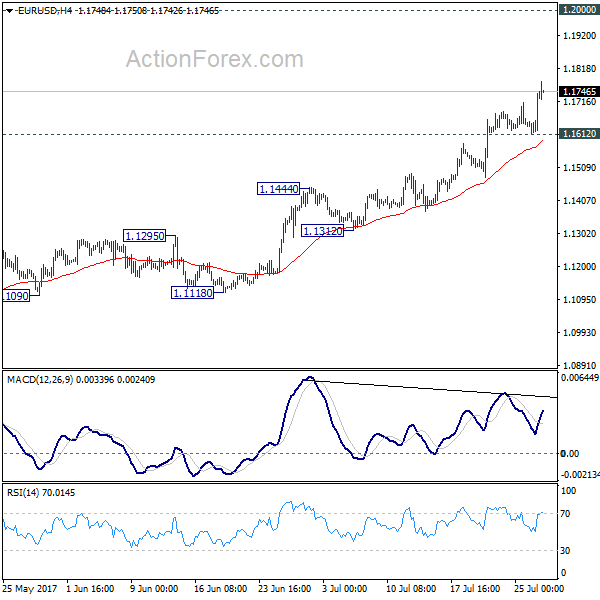
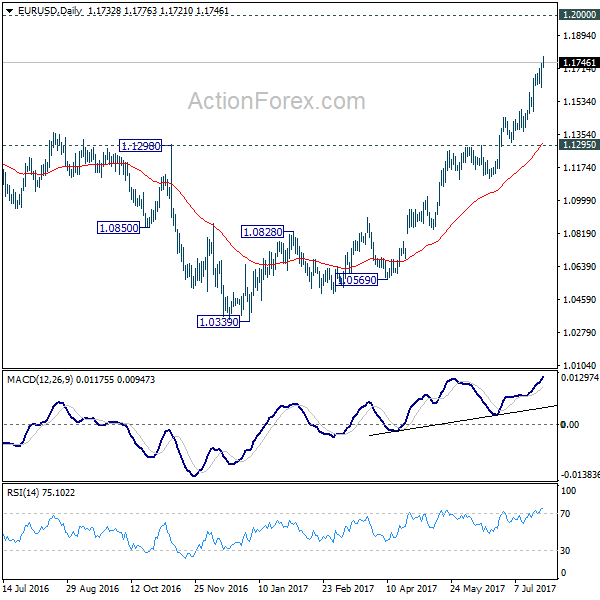
The EUR/USD gained 1.859 percent in the last five trading days. The single currency is higher against the USD as central bank rhetoric from the Bank of Canada (BoC), the Bank of England (BoE) and the European Central Bank (ECB) came in too close to each other and are signalling an end to low rates. The Fed has done its part with two rate hikes this year and a balance sheet reduction plan expected to kick off in the fourth quarter, but political risk in the US has impaired the dollar with uncertainty on major policies being introduced as promised after the presidential elections.
The European Central Bank (ECB) Forum in Portugal served as the perfect stage for the central bank to join the Bank of Canada and the Bank of England in their hawkish views as it appears the Fed will not be alone in tightening monetary policy in the coming months.
Employment data out of the US next week will be pivotal for the direction of the USD if there is significant improvement in wage growth. The US has posted solid job gains, but the quality of those positions is being questioned, in order to make a dent in the market perception the inflation signals have to be strong to further validate the current rate hike path of the central bank.

The USD/CAD lost 2.213 in the last five days. The currency pair is trading at 1.2966 as economic indicators and hawkish rhetoric has boosted the loonie while the political uncertainty in the US has impacted the US dollar. The pair has decisively broken through the 1.30 price level and the loonie rally will keep going as the market heads into next week's US employment data on a short trading week due to the Fourth of July holiday.
The Fed will release the notes from its latest Federal Open Market Committee (FOMC). The US central bank hiked rates by 25 basis points as expected but with inflation remaining low and some obvious dissenters like Minnesota's Fed Kashkari it will be insightful to learn what form the debate took shape as it helps forecasters model the upcoming decisions from the central bank regarding rates and the reduction of the balance sheet which seems to be a more agreeable subject amongst policy makers.
Canadian economic output rose in April by 0.2 percent as expected. On a yearly basis the economy is growing at a 3.3 percent rate, the biggest gain since 2014. Services are leading the way with an improvement in commodities and a slowdown in manufacturing the major highlights. Next week CAD traders will be tracking the release of the Canadian Trade Balance on Thursday, July 6 at 8:30 am EDT and the employment report on Friday, July 7 at 8:30 am EDT for guidance on the path of the loonie.

Oil gained 7.114 on the last week. The price of West Texas Intermediate is trading at $45.11 amid some financial institutions are buying at what they think is the bottom. Citibank is calling for a rebound of crude after two weeks were oil inventories have been subdued. There has not been any evidence of improvement in demand and the tug of war between the Organization of the Petroleum Exporting Countries (OPEC) and the US shale producers will continue to keep the black stuff trading in a range as data supports one side over the other.
Goldman Sachs was less bullish and issued a note reducing the oil prices forecast for next quarter after Nigeria and Libya productions ended their disruptions and continue to be exempt from the OPEC oil cut agreement. GS is pointing to a $47.50 price per barrel of WTI, which was a significant downgrade from the previous $55 price level.
Crude has advanced 6.2 percent in the last week as the downward pressure due to the oversupply concerns has eased. OPEC members will meet with other producers in Russia to discuss the next steps to stabilize energy prices after they have already agreed to extend the crude production cut until March of 2018. Maintenance and disruptions due to a storm in the Gulf of Mexico reduced the level of US inventories and gave oil a chance to record its best rally of the year and yet prices will be net negative in June. The start of the driving season in the US has not been too favourable for crude addressing the biggest issue yet to be tackled by producers, the apparent lack of demand worldwide.
Market events to watch this week:
Sunday, July 2
- 9:45 pm CNY Caixin Manufacturing PMI
Monday, July 3
- 4:30 am GBP Manufacturing PMI
- 10:00 am USD ISM Manufacturing PMI
- 9:30 pm AUD Retail Sales m/m
Tuesday, July 4
- 12:30 am AUD RBA Rate Statement
- 4:30 am GBP Construction PMI
- Tentative GBP Inflation Report Hearings
Wednesday, July 5
- 4:30 am GBP Services PMI
- 2:00 pm USD FOMC Meeting Minutes
- 9:30 pm AUD Trade Balance
Thursday, July 6
- 8:15 am USD ADP Non-Farm Employment Change
- 8:30 am CAD Trade Balance
- 8:30 am USD Unemployment Claims
- 10:00 am USD ISM Non-Manufacturing PMI
- 11:30 am USD Crude Oil Inventories
Friday, July 7
- 4:30 am GBP Manufacturing Production m/m
- 8:30 am CAD Employment Change
- 8:30 am CAD Unemployment Rate
- 8:30 am USD Average Hourly Earnings m/m
- 8:30 am USD Non-Farm Employment Change
*All times EDT
Q2 Business Outlook Survey Confirms Firming Canadian Economy
Highlights:
- Expected future sales and employment intentions both rose sharply. Investment intentions ticked lower but from elevated Q1 levels and with a more optimistic tone to the accompanying commentary.
- Indicators of capacity pressures rose sharply. The share of businesses reporting difficulty meeting demand rose to its highest since Q2/2015.
- Most respondents expect inflation in the Bank of Canada's 1-3% target range although with an increase in those expecting something in the bottom-half of that range.
Our Take:
The Bank of Canada's Q2 Business Outlook Survey showed improved Canadian business optimism once again in Q2 and will reinforce now widely-held expectations that the Bank of Canada could hike interest rates as soon as the July 12th policy announcement. Expected future sales growth and hiring intentions both rose with the latter easily hitting a record high. Investment intentions dipped but from a very high Q1 reading that matched the second-highest on record. Comments from the bank - which often reflect underlying details not reported in the 'standard' data release - suggested that firms have, encouragingly, "become more focused on expanding capacity to accommodate stronger demand." Consistent with the need to expand capacity, the share of businesses reporting difficulties meeting demand rose sharply as did the reported intensity of labour shortages.
A report from Bank of Canada researchers earlier this week argued that 'soft' indicators like the BOS have been a better predictor of official monetary policy decisions than 'hard' indicators, like GDP growth. Even that distinction, though, is becoming increasingly unnecessary given another strong April GDP report this morning. Thus, both 'soft' and 'hard' data increasingly argue that the current extremely low level of interest rates is no longer needed to support the economy.
Canadian Dollar Higher After Steady Growth And Central Bank Survey
The Canadian dollar continued to rally versus the US dollar after the release of the gross domestic product (GDP) earlier today showed a monthly gain of 0.2 percent in line with expectations. The USD/CAD lost 0.29 percent in the last 24 hours as the loonie advanced against its US counterpart after the positive GDP and Bank of Canada (BoC) business survey validate the hawkish rhetoric launched two weeks ago that has put a rate hike firmly on the table. Senior monetary policy members have said that the rate cuts from 2015 have done their job and the central bank could be ready to remove some stimulus. The market was taken by surprise by the change of tune, and is now pricing in a 70 percent chance of an interest rate hike in July.
The USD is having the worst quarter since 2010 despite the hawkish rhetoric from the U.S. Federal Reserve. Political uncertainty in the White House and a divisive healthcare reform delayed to after the Fourth of July Senate recess have put downward pressure on the dollar. The Fed does not have a monopoly on optimism as other central bank have joined the chorus as economic growth has improved in Canada, the United Kingdom and Europe. Central bankers are pointing to an end of stimulus, but with little details or actions as of yet. The Fed remains the most proactive central bank with four 25 basis points rate hikes (two this year) and the end of its quantitative easing program. the next step is the reduction of its massive balance sheet which could happen before the end of the year.
The Bank of Canada is a special case as the European Central Bank (ECB) and the Bank of England (BoE) have quantitive easing programs that will have to be gradually wound down whereas Stephen Poloz can jump on the rate hike bandwagon with relative speed. The BoC governor also does not have to worry about a vote as there is no monetary policy committee.
The timing of the first rate hike will be challenging. The three factors driving the loonie will have to be taken into consideration. Oil prices have been stable but the showdown between the US shale producers and the OPEC output deal nations is not addressing the tepid demand for energy around the world. Nafta renegotiations starting in August could change the economic landscape for Canada and that is something the central bank will have to address. The third factor is the Fed itself. The American economy has been softer in 2017 raising questions about what impact a third rate hike and a lower Fed balance sheet could have in the second half of the year.
The USD/CAD lost 0.379 in the last 24 hours. The currency pair is trading at 1.2966 as economic indicators and hawkish rhetoric has boosted the loonie while the political uncertainty in the US has impacted the US dollar. The pair has decisively broken through the 1.30 price level and the loonie rally will keep going as the market heads into next week's US employment data on a short trading week due to the Fourth of July holiday.
The Fed will release the notes from its latest Federal Open Market Committee (FOMC). The US central bank hiked rates by 25 basis points as expected but with inflation remaining low and some obvious dissenters like Minnesota's Fed Kashkari it will be insightful to learn what form the debate took shape as it helps forecasters model the upcoming decisions from the central bank regarding rates and the reduction of the balance sheet which seems to be a more agreeable subject amongst policy makers.
Canadian economic output rose in April by 0.2 percent as expected. On a yearly basis the economy is growing at a 3.3 percent rate, the biggest gain since 2014. Services are leading the way with an improvement in commodities and a slowdown in manufacturing the major highlights. Next week CAD traders will be tracking the release of the Canadian Trade Balance on Thursday, July 6 at 8:30 am EDT and the employment report on Friday, July 7 at 8:30 am EDT for guidance on the path of the loonie.
Oil gained 0.372 on Friday. The price of West Texas Intermediate is trading at $45.11 amid some financial institutions are buying at what they think is the bottom. Citibank is calling for a rebound of crude after two weeks were oil inventories have been subdued. There has not been any evidence of improvement in demand and the tug of war between the Organization of the Petroleum Exporting Countries (OPEC) and the US shale producers will continue to keep the black stuff trading in a range as data supports one side over the other.
Goldman Sachs was less bullish and issued a note reducing the oil prices forecast for next quarter after Nigeria and Libya productions ended their disruptions and continue to be exempt from the OPEC oil cut agreement. GS is pointing to a $47.50 price per barrel of WTI, which was a significant downgrade from the previous $55 price level.
Crude has advanced 6.2 percent in the last week as the downward pressure due to the oversupply concerns has eased. OPEC members will meet with other producers in Russia to discuss the next steps to stabilize energy prices after they have already agreed to extend the crude production cut until March of 2018. Maintenance and disruptions due to a storm in the Gulf of Mexico reduced the level of US inventories and gave oil a chance to record its best rally of the year and yet prices will be net negative in June. The start of the driving season in the US has not been too favourable for crude addressing the biggest issue yet to be tackled by producers, the apparent lack of demand worldwide.
Market events to watch this week:o
Sunday, July 2
- 9:45 pm CNY Caixin Manufacturing PMI
Monday, July 3
- 4:30 am GBP Manufacturing PMI
- 10:00 am USD ISM Manufacturing PMI
- 9:30 pm AUD Retail Sales m/m
Tuesday, July 4
- 12:30 am AUD RBA Rate Statement
- 4:30 am GBP Construction PMI
- Tentative GBP Inflation Report Hearings
Wednesday, July 5
- 4:30 am GBP Services PMI
- 2:00 pm USD FOMC Meeting Minutes
- 9:30 pm AUD Trade Balance
Thursday, July 6
- 8:15 am USD ADP Non-Farm Employment Change
- 8:30 am CAD Trade Balance
- 8:30 am USD Unemployment Claims
- 10:00 am USD ISM Non-Manufacturing PMI
- 11:30 am USD Crude Oil Inventories
Friday, July 7
- 4:30 am GBP Manufacturing Production m/m
- 8:30 am CAD Employment Change
- 8:30 am CAD Unemployment Rate
- 8:30 am USD Average Hourly Earnings m/m
- 8:30 am USD Non-Farm Employment Change
*All times EDT
RBA & Riksbank Meetings, US Jobs Report & FOMC Minutes, Other Key Data in Focus
Next week's market movers
- In Australia, the RBA is expected to keep its policy unchanged. In light of recent encouraging developments in the economy, we see the case for a more upbeat message by policymakers.
- Sweden's Riksbank is also likely to stand pat. We expect officials to shift to a more optimistic bias, following in the footsteps of the Norges Bank and the ECB.
- In the US, employment data for June and the minutes from the latest FOMC meeting will keep investors busy.
- We also get key economic data from Japan, the UK, the US, and Canada.
On Monday, during the Asian morning, the Bank of Japan will release its Tankan business confidence survey for Q2. The forecast is for all of the survey's indices to have risen, something supported by the Reuters Tankan Diffusion Index, which rose notably from the previous quarter on average. An increase in all of these prints would signal that both large and small Japanese firms are feeling more optimistic about current conditions as well as their future outlook. We expect Japanese equity markets to benefit from such an upbeat report, as it could be a signal that GDP growth is set to pick up more steam moving forward. Turning to monetary policy, such strong Tankan prints could add fuel to recent speculation that the BoJ may begin to communicate a plan for its eventual exit from QQE. However, as inflationary pressures remain subdued in Japan, we maintain our view that the Bank is unlikely to alter its current QQE framework any time soon.

In the US, the ISM manufacturing PMI for June is expected to have ticked up. However, taking a look at the preliminary Markit manufacturing PMI for the month, we believe that the risks surrounding the ISM index are tilted to the downside. The Markit index slid to 52.1 from 52.7 in May, pointing to the slowest improvement in overall business conditions since September 2016.

From the UK, we get the manufacturing PMI for June. Then on Tuesday we get the construction index for the same month and subsequently on Wednesday, the service-sector print. The forecast is for all of these indices to have declined. Should these prints show that the UK ended Q2 on a soft footing, and that economic growth may have slowed further, that would likely pour some cold water on market expectations regarding a BoE rate hike at one of the upcoming meetings.

Turning to the political spectrum, Monday marks the end of the 10-day deadline given to Qatar to comply with a list of 13 demands issued by Saudi Arabia, the UAE, Bahrain and Egypt. Qatar is required to shut down the Turkish military base in the country, shut down the Al-Jazeera news network, curb diplomatic ties with Iran, sever all ties to "terrorist organizations", pay reparations for damages caused by Qatari policies in recent years, and more. If Qatar agrees to comply, the four Arab nations will lift the sanctions they imposed earlier in June. However, it is not clear what happens if Qatar fails to meet these demands. In the optimistic scenario, the four Arab nations could simply keep their sanctions in place, which is likely to have little market impact. This is supported by recent comments from the UAE Foreign Minister, who said that "the alternative is not escalation, the alternative is parting of ways". In the unlikely event that the situation does escalate though, investors' risk appetite may be impacted, with safe haven assets likely to be the main beneficiary. Oil prices could gain in the short-term as well, as the risk of supply disruptions would likely increase.
Markets will stay closed in Canada in Celebration of Canada Day, and will close early in the US ahead of Independence Day.
On Tuesday, during the Asian day, the RBA will announce its rate decision and the forecast is for no change in policy. In recent gatherings, officials maintained a neutral tone overall, but appeared somewhat worried with regards to the labor and housing markets, indicating that developments in these two sectors warrant careful monitoring. The two most recent employment reports from Australia have been stellar, while the house price inflation has begun to cool according to the latest Residential Property Index. As such, we think that policymakers are likely to tone down their concerns at this meeting. Having said that though, we don't expect any dramatic shift in rhetoric, but rather a slightly more upbeat tone, as the RBA will probably want to examine more than a couple of months' worth of data before making material changes to its bias.

During the European day, the Riksbank will announce its own policy decision. Without a forecast available, we see the case for the world's oldest central bank to remain on hold. At its latest gathering back in April, the Riksbank extended the duration of its QE program by 6 months to December 2017 and pushed somewhat further out the timing for its first planned rate hike. The tone of the meeting statement was quite cautious, indicating that it will take longer before inflation stabilizes around 2%, and citing considerable uncertainty over political developments abroad. A few weeks after that meeting, the Bank announced plans to move away from its strict 2% inflation target and to introduce a target range of ±1% from 2%. This implies that policymakers may be more tolerant of subdued inflation, which reduces the likelihood for any further easing measures. What's more, European political risks have dissipated notably following the French election, something that could be reflected in the meeting statement. The combination of these factors makes us believe that the Bank is likely to appear more optimistic this time. In fact, we would not rule out the prospect that the Riksbank follows in the recent footsteps of the Norges Bank and the ECB, by also removing its interest rate easing bias.

Markets will remain closed in the US for Independence Day.
On Wednesday, the Fed releases the minutes of its June policy gathering, where the Committee raised the Federal funds rate by 25bps. In the statement accompanying the decision, Fed officials noted that they expect to begin normalizing the Bank's balance sheet later this year in a slow and predictable manner. Meanwhile, they kept the "dot plot" largely unchanged, signaling that one more rate hike is on the cards for this year. In our view, market participants will dig into the minutes for more details on the timing of the balance sheet normalization, as well as any discussion with regards to the timing of the next rate increase. At the time of writing, the market is anticipating the next hike to come in May 2018. This shows that the dot plot has not convinced the financial community, which may need stronger hints before it prices in another hike for 2017.
Our own view is that the Fed will indeed proceed with another hike this year. The Committee has repeatedly pointed out that the softness in the economic data for Q1 is transitory. Indeed, the Atlanta Fed GDPNow model adds credibility to that scenario by indicating that GDP growth rebounded to 2.9% in Q2, while the June employment report is expected to show that the labor market continues to tighten. The key risks to our view are a second quarter of soft GDP and/or further slowdown in the nation's core inflation.

On Thursday, from the US, we get the ADP employment report for June and the ISM non-manufacturing index for the same month. Getting the ball rolling with the ADP report, the forecast is for the private sector to have added 178k, much less than the 253k print in May. Nevertheless, this would still be a decent print and if met, it may increase speculation that Friday's NFP will also meet its forecast of 183k. Nonetheless, we have to sound a note of caution. Even though this is the only major gauge of the NFP, the correlation the two numbers has fallen notably during the last few months.

Now, let's pass the torch to the ISM index. Expectations are for the index to have slid somewhat, but to have remained well above the 50 mark that separates expansion from contraction. The case for a decline in the ISM index is supported by a similar move in the Markit services index for the month, which signaled the slowest upturn in service sector output since March.
On Friday, all eyes will be on the US employment report for June. The forecast is for nonfarm payrolls to have risen by 183k, more than the 138k in May. The unemployment rate is expected to have remained unchanged at 4.3%, while average hourly earnings are expected to have accelerated in monthly terms. Overall, this would be another employment report consistent with further tightening in the labor market, which will be pleasant news for FOMC policymakers. The financial world is currently anticipating the next increase in the Federal funds rate to come in May 2018, while the Fed's "dot plot" points to such a move coming by the end of this year. Therefore, if the June jobs report is indeed as robust as expected, it could confirm the Fed's view that the recent softness in economic data is transitory and could bring forth market expectations with regards to the next hike. Having said that though, we believe that the economic indicators that will play the biggest role on the timing of the next move are the nation's CPIs. Following three months of declining inflation rates, a decent rebound is needed to materially increase the probability for a hike this year.

We also get employment data for June from Canada, though no forecast is yet available. Neither the Markit nor the Ivey PMIs for the month have been released yet, implying that we do not have any gauges of how the labor market fared in June. In any case, these data will be closely tracked amid recent signals from BoC policymakers that a tightening move may be on the cards soon. Another month of solid employment gains could add fuel to such speculation. Having said that, even though the BoC may indeed appear more hawkish soon, we doubt that an actual rate hike is looming. We would need to see a significant pickup in the nation's core CPI rate that has declined for 3 consecutive months now before we join those who are calling for an immediate rate increase.