

Sample Category Title
Earnings Lift European Shares
A slew of upbeat updates from European firms helped the region's benchmark index rise on Wednesday and recoup some of the previous session's sharp losses, though weakness among construction firms and cyclical sectors weighed.
The pan-European STOXX 600 index rose up 0.2 percent while the blue chips were flat in percentage terms.
Dutch semiconductor equipment maker ASML, up 3.7 percent, boosted the tech sector. The firm beat quarterly earnings estimates thanks to strong demand from manufacturers of memory chips.
Europe's tech sector has gained more than 14 percent so far this year, but worries over stretched valuations, especially among U.S. peers, have put the brakes on this rally.
Strong first-half profit growth boosted shares in Georg Fischer 6 percent to the top of the STOXX, while French video games maker Ubisoft jumped more than 5 percent on the back of a strong sales update.
Overall earnings in the second quarter are expected to grow by 7.9 percent from the same period last year, which would be an increase of 5.6 percent excluding the energy sector, according to Thomson Reuters I/B/E/S estimates.
“We would like to see those stronger earnings coming through and Europe really turning a corner,” said Dafydd Davies, partner at Charles Hanover Investments.
Energy stocks fell 0.1 percent, putting pressure on Britain's FTSE 100, while banks were 0.2 percent lower, extending yesterday's slide as Goldman Sachs put pressure on U.S. lenders.
Heavy losses for builder NCC and lock maker Assa Abloy weighed on the construction sector, which fell 0.6 percent.
NCC slumped more than 9 percent after its second quarter pretax profit came in below expectations, while Assa Abloy dropped 8.5 percent after saying that demand in China had turned sour again in the second quarter.
Cross-border deal-making rolled on with Reckitt Benckiser up 1.3 percent after saying it would sell its food business to U.S. spice and herbs co McCormick & Co Inc for $4.2 bln. Reckitt shares were the biggest boosts on the FTSE 100.
Shares in Spanish firms Aena and Abertis were suspended following a report that the Spanish airport operator had studied a possible takeover offer for the highway concessions company.
Daily Technical Analysis: EURUSD, GBPUSD, USDJPY, USDCHF
EURUSD
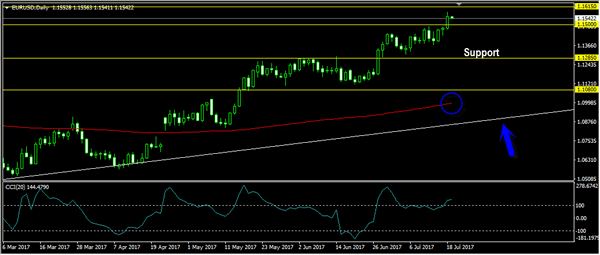
The EURUSD had a bullish momentum yesterday topped at 1.1583. The bias remains bullish in nearest term testing 1.1615 (weekly EMA 200 and 2016 high). A clear break above that area could trigger further bullish pressure testing 1.1712 area (2015 high). Immediate support is seen around 1.1510. A clear break below that area could lead price to neutral zone in nearest term testing 1.1470 area but as long as stay above 1.1285 key support I remain bullish and any downside pullback should be seen as a good opportunity to buy.
GBPUSD
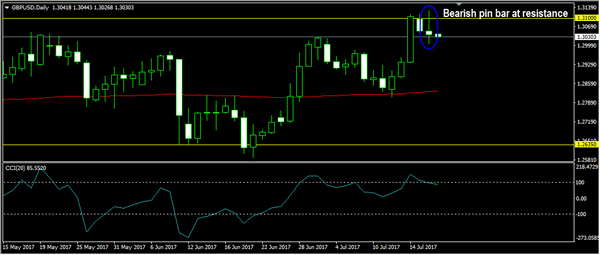
The GBPUSD attempted to push higher yesterday topped at 1.3125 but whipsawed to the downside and closed lower at 1.3039, formed a bearish pin bar as you can see on my daily chart below. I still prefer a bullish scenario at this phase, but a bearish pin bar formed at a key resistance level (1.3100) is always a serious threat to a bullish run. The bias is bearish in nearest term testing 1.2950 region. On the upside, we need a clear break and consistent movement above 1.3100 to continue the bullish scenario targeting 1.3350 or higher. On the other hand, a clear break and daily close below 1.2950 would expose 1.2850/00 support area.
USDJPY
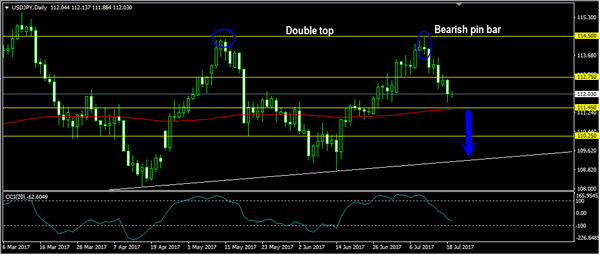
The USDJPY had a bearish momentum yesterday bottomed at 111.68. The bias remains bearish in nearest term testing 111.45 as a part of the bearish phase after formed a double top formation (114.50) and bearish pin bar as you can see on my daily chart below. A clear break and daily close below 111.45 would expose 110.25 support area and the trend line support. Immediate resistance is seen around 112.35. A clear break above that area could lead price to neutral zone in nearest term testing 112.75 region. Overall I remain neutral.
USDCHF
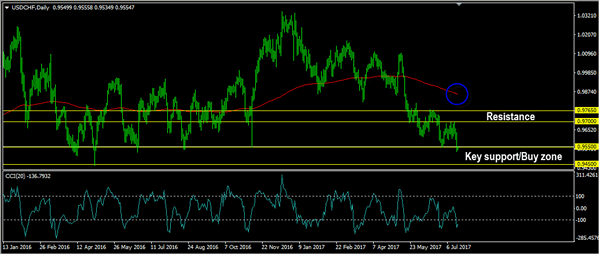
The USDCHF had a bearish momentum yesterday bottomed at 0.9523. The bias remains bearish in nearest term testing 0.9450 but note that 0.9550 – 0.9450 remains a key support and good place to buy with a tight stop loss below 0.9450. Immediate resistance is seen around 0.9580. A clear break above that area could lead price to neutral zone in nearest term testing 0.9630 area but key resistance remains at 0.9700 – 0.9756 region. On the downside, a clear break and daily close below 0.9450 would expose 0.9250 region.
Technical Outlook: WTI Oil Is Holding In Extended Range Ahead Of EIA Crude Inventories Data
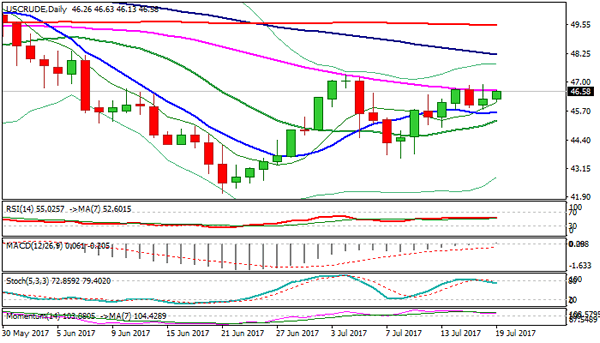
WTI Oil was threading water during the past few sessions and holding within 100-pips range, with upside attempts being capped by 55SMA and 10 SMA holding the downside.
The oil price moved higher on Wednesday after previous day's release of API report showed strong draw in gasoline inventories (5.5 million barrels) which offset unexpected build in crude inventories (1.6 million barrels vs forecasted draw of 3.5 million barrels).
However, rising output from OPEC producers continues to weigh and keep the upside limited.
Technical studies remain bullishly aligned and supportive for final push towards key near-term barrier at $47.30 (04 July high / base of widening daily cloud), break of which would generate strong bullish signal.
Meanwhile, oil price may remain in prolonged consolidation as daily slow stochastic reversed from overbought territory.
Dips should be ideally contained by 10SMA ($45.68) and rising 20SMA ($45.28) in extension, to keep bullish stance intact.
Focus in on today's EIA weekly crude stocks report which shows forecast for a draw of 3.2 million barrels (well below previous week's 7.5 million barrels draw) but release at / above forecasted level should keep oil prices supported.
Disappointing numbers in oil crude stocks today (release below forecasted level or build of inventories) may put oil prices under fresh pressure.
Res: 46.61, 46.90, 47.30, 48.23
Sup: 46.13, 45.80, 45.68, 45.28
Elliott Wave Analysis: USDCAD Searching For A Base, Wave Four Correction In View
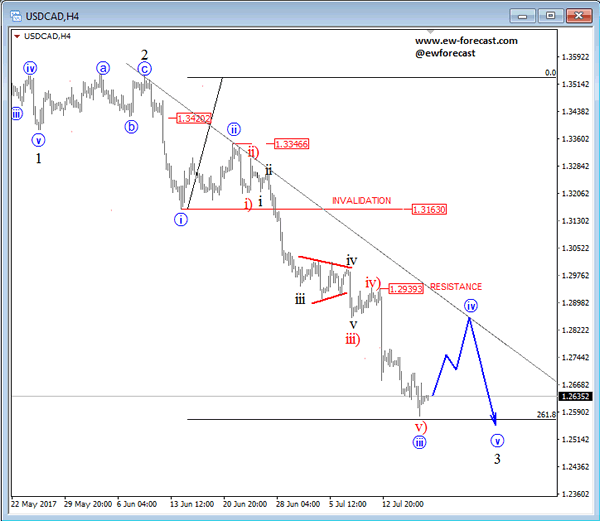
USDCAD is making a sharp decline for the last few weeks, currently trading south within red wave v), which we now see it as the final piece of an extended blue wave three. If that is the case, then current drop can now face some limited downside near the Fibonacci ratio of 261.8%, so be aware of a new three wave recovery this week. Ideally we will see blue wave iv pullback unfold to the area of a former wave four, up to 1.2940 resistance.
USDCAD, 4H
Technical Outlook: AUDUSD Eyes 0.8000 Target, Australian Jobs Data In Focus
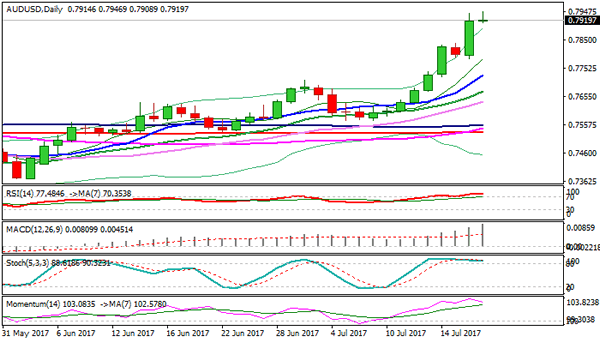
The Aussie dollar is holding firm tone and consolidating above 0.7900 handle on Wednesday, following strong rally the day before, inspired by hawkish RBA minutes.
Stretched third wave from 0.7571 trough extended above its FE 200% at 0.7933 but gains were so far limited at 0.7946 (today's marginally higher high/the highest since mid-May 2015).
The pair may extend lower as RSI/slow stochastic are strongly overbought on daily chart, with dips expected to find solid supports at 0.7850/00 zone (hourly cloud base / Fibo 38.2% of 0.7572/0.7946 upleg), before bulls resume towards target at 0.8000.
Australian jobs data, due on Thursday, are in focus. Unemployment is expected to tick higher to 5.6% in June from 5.5% in May, while the number of employed in June is expected to increase by 15K which is well below previous month's increase by 42K.
Res: 0.7946, 0.8000, 0.8044, 0.8114
Sup: 0.7908, 0.7889, 0.7850, 0.7800
Technical Outlook: Spot Gold – Rising Hourly Cloud Should Contain Corrective Dips Before Bulls Resume Towards $1246/47 And $1250...
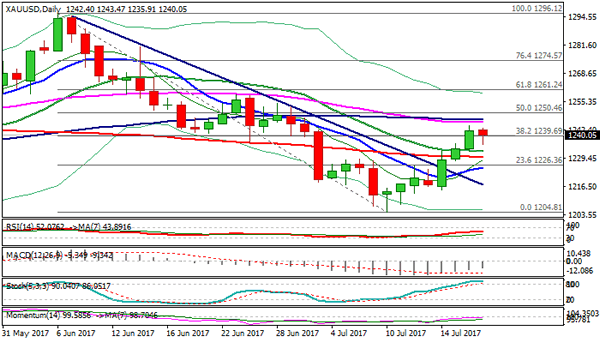
Spot Goldis consolidating after strong three-day rally that peaked at $1244 on Tuesday but maintaining firm near-term tone.
Monday's close above double-Fibonacci barrier at $1239 has generated strong bullish signal for further advance.
Cracked daily Kijun-sen ($1242) is capping for now, with extended consolidation on overbought slow stochastic on daily chart, seen as likely near-term scenario.
Rising thick hourly cloud (spanned between $1235/30) underpins the action and should contain extended corrective dips, before fresh upside action (cloud base is reinforced by 200SMA).
Immediate targets lay at $1246/47 (converged 55/100SMA's), followed by $1250 (50% retracement of $1296/$1204 descend) and daily cloud base ($1255).
Only return below $1230 pivot would sideline near-term bulls and signal stronger easing.
Res: 1244, 1246, 1247, 1250
Sup: 1235, 1230, 1225, 1220
EUR/USD Elliott Wave Analysis
EUR/USD – 1.1527
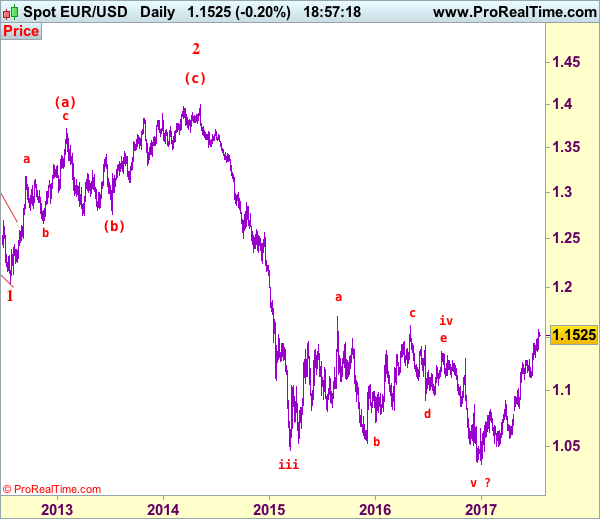
EUR/USD: Wave (c) of 2 ended at 1.3993 and wave 3 of III has commenced for weakness to 1.0411 (1.236 of wave 1), then 1.0000.
The single currency has surged again after brief pullback to 1.1370 last week, adding credence to our bullish view that the upmove from 1.0340 low is still in progress and indicated upside targets at 1.1480-85 (50% projection of 1.0570-1.1296 measuring from 1.11190) and 1.1565-70 (61.8% projection) had been met, upside bias remains for this move to extend headway to previous chart resistance at 1.1616, then 1.1660, however, reckon another previous resistance at 1.1714 would hold on first testing due to near term overbought condition and price should falter below 1.1800-10, risk from there is seen for a retreat later.
Our preferred count on the daily chart remains that a wave (II) from 1.2329 ended at 1.5145 with A-leg ended at 1.4720, followed by wave B at 1.2457, the wave C from there was also a 3 legged move and is labeled as (a): 1.3739, (b): 1.2885, the wave iii of the 5-waver (c) from 1.2885 has ended at 1.4339 and wave iv is a triangle ended at 1.3878 and wave v formed a top at 1.5145. The decline from there is a 5-waver (C) with minor wave (i) of I of (C) ended at 1.4218 with wave (ii) ended at 1.4580, wave (iii) ended at 1.3267 and wave (iv) ended at 1.3692 and wave (v) ended at 1.1876, this is also the low of wave I of (C) and wave II ended at 1.4940, hence wave III is now in progress with a diagonal wave 1 ended at 1.2042, the breach of previous support at 1.1876 (wave I trough) adds credence to our view that the wave 2 has ended at 1.3993, wave 3 has commenced for further weakness to 1.0411, then towards 1.0000.
On the downside, whilst initial pullback 1.1475-80 is likely, reckon downside would be limited to 1.1435 minor support and bring another rise later. Below 1.1435 would defer and bring test of said support at 1.1370 (last week’s low) but only break there would signal a temporary top is formed instead, bring correction to 1.1312 support, however, downside should be limited to 1.1250 and price should stay well above support at 1.1109-19, then euro shall head north again.
Recommendation: Stand aside for this week
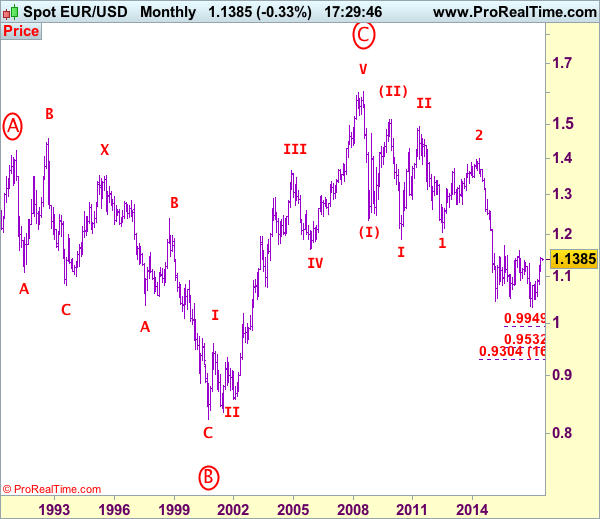
Euro's long-term uptrend started from 0.8228 (26 Oct 2000) with an impulsive structure. The rise from 0.8228 to 0.9593 (5 Jan 2001) is labeled as wave I, the retreat to 0.8352 (6 Jul 2001) is wave II and the rally to 1.3670 (31 Dec 2004) is wave III. Wave IV from there ended at 1.1640 (15 Nov 2005), the subsequent upmove to 1.6040 (July 15, 2008) is treated as wave V, the major selloff from the record high of 1.6040 to 1.2329 (October 27, 2008) signals a reversal has taken place with (I) leg ended at 1.2329 and once (II) ended at 1.5145, wave (III) itself is an extended move with I: 1.1876 and complex wave II ended at 1.4902, wave III has commenced with wave 1 and 2 ended at 1.2042 and 1.3993 respectively, wave 3 of III is now unfolding for weakness towards parity.
USD/JPY Elliott Wave Analysis
USD/JPY - 112.05
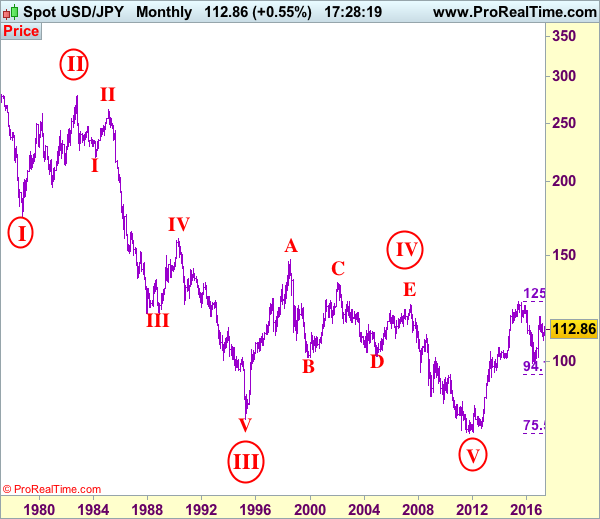
USD/JPY – Wave V of larger degree circle V has possibly ended at 75.31 and major correction has commenced and already met indicated target at 125.00.
Although the greenback extended gain to 114.50 earlier this month, lack of follow through buying on break of previous resistance at 114.39 and the subsequent retreat suggest the entire corrective rebound from 108.13 has possibly ended there (tentatively wave b top), hence consolidation with downside bias is seen for the retreat from 114.50 to extend weakness to 111.45-50, then 110.95-00, however, reckon downside would be limited to 110.60-65 and price should hold above 110.00. Only break of support at 108.82 would provide confirmation and signal wave c has commenced for retest of 108.13 first.
Our preferred count is that, triangle wave IV (with circle) ended at 101.45 and the circle wave V brought dollar down to the record low of 75.31 in 2011 and the subsequent rebound signal major correction has commenced with A leg ended at 84.19, followed by wave B at 77.14 and impulsive wave C is now unfolding (indicated upside target at 125.00 had been met) for gain towards 127.00 level. In the event dollar drops below support at 99.01, this would confirm medium term decline from 125.86 top (2015 high) has resumed for subsequent weakness to 98.00 and possibly 97.00.
Under this count, this wave C is unfolding as impulsive waves with (1) (2), 1 2 ended at 80.67, 79.07, 82.84 and 81.69 respectively, hence the extended wave 3 has ended at 103.74 and wave 4 correction of recent upmove should bring weakness to 92.57, then towards 90.88 but psychological support at 90.00 should limit downside and bring another rally later in wave 5, indicated target at 125.00 had been met and gain to 127.00 cannot be ruled out but reckon price would falter below 130.00.
On the upside, whilst initial recovery to 112.65-70 is likely, reckon 113.40-50 would limit upside and bring another decline later to aforesaid downside targets. Above 113.55-60 would bring another bounce to 114.00, then test of said resistance at 114.50 but only break there would extend the corrective rise from 108.13 to 114.90-00, then towards previous resistance at 115.51 which is likely to hold on first testing.
Recommendation: Sell at 113.50 for 111.50 with stop above 114.50.

On the monthly chart, we have changed our preferred count that an impulsive wave is unfolding with major wave III with circle ended at 79.75, then followed by wave IV with circle and is labeled as a triangle with A: 147.64 (11 August, 1998), B: 101.25, C: 135.20, D: 101.67 and E leg ended at 124.14 to end the wave IV with circle. Hence, wave V with circle commenced from there and hit a record low of 75.31, however, the subsequent strong rebound signals this circle wave V has possibly ended there, hence gain to (indicated upside target at 122.00 and 125.00 had been met), the retreat from 125.86 suggests wave A of major correction has ended there and wave B correction back to 99.00, then 95.00 would be seen, however, reckon downside would be limited to 90.00, bring another rebound in wave C next year.
BoJ To Reiterate Dovish Stance, USD/RUB To Weaken
Heading into BoJ meeting short JPY
While other major central banks have shifted bias toward tighten we don't anticipate that the BoJ will follow. Despite political pressure and questions over the effectiveness of unorthodox policy, the BoJ should reiterated its currently monetary policy strategy at its two-day monetary policy meeting. Japan remains far from its inflation target of 2% and is likely to lower its CPI forecast for 17-2018, therefore immediate pressure to change approach is lower than other nations. However, the BoJ has already shifting its focus from JGB purchases, already slowing from ¥80trn per year as member recognizing reaching quantitative limits, to yield curve control. While this strategy is likely to have a less direct effect on domestic inflation (although balance sheet expansion in Japan failed to impress), yields curve management enable BoJ to widen interest rate spread and easily influence the highly interest rate sensitive JPY. BoJ comments should be focused on their ability to control the curve including but not limited to pinning the 10yr JGB yields at 0%.
Markets might be discussing potential of Kuroda's exiting from its ultra-accommodative policy we won't see any hints at this meeting. Interestingly to policy board members that consistently resisted Kuroda expansionist policy were Takahide Kiuchi and Takehiro Sato are both leaving after this monetary policy meeting.
With the Fed preparing to shrink its balance sheet and the ECB expected to contemplate asset purchase tapering, both subtle ways of tightening. Yields curves in US and European should steepen further. We are slightly optimistic that the Fed will hike rates by 25bp in Dec, yet markets in the last weeks have backed away from this hawkish view. Only 40bp are pricing in to the Fed Fund rate down from 55bp only a week ago, while US 10yr yields dropped 13bp to 2.26%. A repricing of tighter rates in the US should pushed USDJPY back towards 114. BoJ steadfast in their dovish ways while the Fed and ECB marching toward the exit should reverse current JPY strength. We would reload long USDJPY at 111.80/90 level for a mid-term move towards 114.49.
Russia: Unemployment declines but the economic situation looks mixed
Since the 2008 crisis, unemployment rate is declining and the data that will be released today will approach 5%. The metric is expected to print lower at 5.1% versus 5.2% a month earlier.
The jobless rate is then declining but the proportion of unemployed person having higher education is growing. Yet, the ruble collapse in 2014 has created strong difficulties for companies to hire those skilled workers. On top of that it is clear that there are now more people with higher education than 10 years ago. As a result the proportion is naturally growing.
Meanwhile, real disposable income is falling for the 4th consecutive month (-0.4% in June). On the other hand, retail sales have grown 1.1% y/y in June after the positive increase of 0.1% y/y in May. However, that was at least three years that the annualized retail sales growth was negative. Inflation have increased by 4.4% y/y in June. It is the highest rate since February.
The Russia key rate has been lowered at 9%. The differential with inflation is still important and we should see the CBR tightening its monetary policy at a slow pace as growth remains weak. The last GDP data, the Q1 has shown a positive print, even though weak, at 0.5%.
We then believe that the ruble is set to appreciate but the appreciation should remain limited due to the CBR intervention. We target 56 before year-end.
DAX In Holding Pattern Ahead Of ECB Statement
The DAX index is unchanged in the Wednesday session. With no major events on the schedule, we can expect investors to concentrate on earnings news, so it could continue to be a quiet day for the DAX. Currently, the DAX is trading at 12,430.00, unchanged on the day. On Thursday, the ECB will release its monthly rate statement.
The Trump administration continues to flounder, as a key plank in Trump's agenda appears dead in the water. Trump's proposed health care bill, which replaces much of Obamacare, has stalled in the Senate before lawmakers even voted on the bill. With some conservative Republicans against the bill, it's questionable if the Republicans can craft a new proposal which could be passed before Congress takes a recess in August. Trump had promised to pass a health care before the summer break, so his credibility will take another hit if he's unable to do so. With this latest defeat, there is growing skepticism as to whether Trump will be able to convince Congress to pass other key parts of his agenda – tax reform and fiscal spending. The Republicans also have egg on their faces, as they have been unable to pass any significant legislation since Trump took over, despite having control of both houses of Congress and the White House. This paralysis on Capitol Hill has deepened investor pessimism about the Trump administration and has hurt the US dollar.
Investors are keeping a close on the ECB, which holds its policy meeting on Thursday. What can we expect from Mario Draghi & Co.? The bank is unlikely to make any changes to its asset-purchase program (QE). With the eurozone showing improvement in 2017, there has been speculation that the bank might taper QE or change the expected end of the scheme, which is December of this year. The ECB makes every attempt to avoid shaking up the markets, but this policy doesn't always work. Case in point – at the ECB forum in June, upbeat comments by ECB President Mario Draghi about tweaking QE led to a sharp rally by the euro. If the eurozone economy continues to show strong numbers, we could see the ECB make some adjustments in its September meeting. In December 2016, the bank tapered QE while extending the scheme until December, and this type of scenario could be adopted once again. Analysts will be combing through the July statement, as well as Draghi's press conference, looking for any nuances to tweaks which could hint at substantive changes to come in September.