Sample Category Title

EM Asia FX Feeling The Pressure From Falling Oil Prices

Falling oil prices have dampened local market sentiment, and despite falling US yields overnight the USD remained solid outside of JPY motioning a market shift to risk aversion

When oil prices decline they have a negative pass through to regional currencies and with the greenback carving out gains against the broader G-10 landscape, local currencies should fall out of favour near-term

The MSCI inclusion of A-shares should provide a longer term boost to local markets, and the incision is structured such that there's a huge incentive for China to keep reforms on track so that the participation weights will broaden as more reforms get introduced. Long term this should provide capital inflow to the mainland and reduce pressure on the RMB complex. Reports t of sporadic currency interventions at yesterday's close on the CNY has helped Yuan sentiment, but strong dollar narrative continues to carry the day.

North Korea headlines are creating a risk ripple after South Korea's military said a drone found earlier this month on a mountain near the Demilitarized Zone border was confirmed to have been from North Korea and described it as a “grave provocation.” Also, the fallout from the Warmbier tragedy is more likely to gather pace as President Trump pulled few punches on his condemnation of North Korea.

The Ringgit continues to tarnish on the weaker oil price narrative and the hawkish Fed storyline.

Market Morning Briefing: Persistent Moderate Hawkish Stance By The Fed

STOCKS

Dow (21467.14, -0.29%) has tested a crucial long term resistance near 21500 which could possibly hold for the coming weeks. An upward extension if seen could take it to 21600, but this could form a near term top for now. A downward correction towards 21300 is possible in the near term.

Dax (12814.79, -0.58%) came off sharply from levels below 13000. Note that 13000 is a crucial medium term resistance and could possibly keep the index below 13000 for the coming sessions. But while the 13000 levels holds, we could see some movement in the 13000-12700 region.

Shanghai (3143.45, +0.11%) is almost stable while above 3120. Movement within 3120 and 3180 may continue for a few more sessions before the index starts to move up. For now the next couple of sessions could see a sideways consolidation.

Nikkei (20183.90, -0.23%) opened with a gap up and if it manages to break above 20300, it could move up sharply towards 20500-20600 levels.

Nifty (9657.55, +0.72%) was almost stable yesterday but looks potentially bullish for the near term while above 9600. A re-test of 9700-9710 is possible in the near term.

COMMODITIES

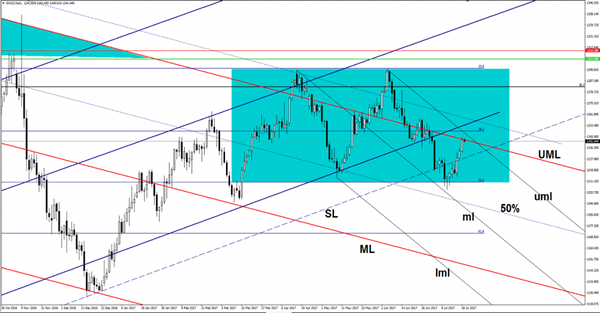
Muted price action had been seen in Gold (1247) as it remains in a slow corrective move which may take it to the support of 1230 but if the support holds, a quick bounce towards 1262 can’t be ruled out. Silver (16.49) is also moved lower in line with our expectation. A close above 16.50 could open up 16.95 levels within a couple of days. Both gold and silver are oversold in near term time frame.

Copper (2.55) is trading within the narrow range of 2.54-2.67. Only above 2.68, higher resistances of 2.84 can come into consideration, but a daily close below 2.55 could open up 2.45 and 2.35 levels as well. We wait for further directional clarity on a break on either side of 2.55 and 2.67 levels.

Nothing new to add as market is waiting for today’s U.S weekly crude inventory data (8:00 pm, IST) with an expectation of a shortage (-1.2 MB) in inventory. If the anticipation of -1.2 M Barrel of shortage will match the actual outcome then that could be beneficial for both Brent and WTI. Otherwise a surplus or a less than expected shortage could bring further bearish possibilities into consideration.As of now, Brent (45.95) and WTI (43.48) are trading below their respective supports of 46.68 and 44 with an immediate trading range of 43.50-46.70 for Brent and 38.72-44 WTI. If Brent and WTI manage to close above 47 and 44.50 in today’s post inventory session, another attempt for 49.62and 46.45 can be seen. As Brent and WTI are oversold in near term time frame, a shortage (either at per or more than the expectation) in US weekly crude oil inventory could activate short term buying momentum in the market.

FOREX

Persistent moderate hawkish stance by the Fed officials despite the recent soft US macro data keeps Dollar strong against all the majors.

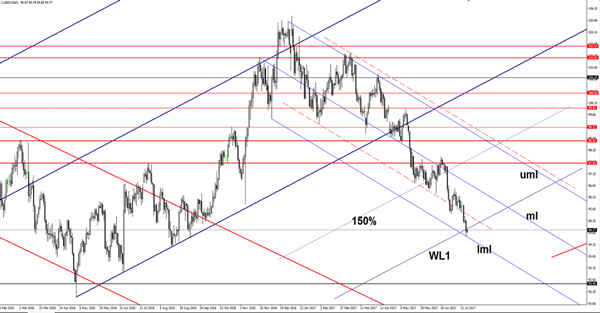
In line with expectations, Dollar Index (97.72) has tested our resistance of 97.80 already and as long as it stays above 97.50, the rise may extend to 98.10-40 and then 99.00+

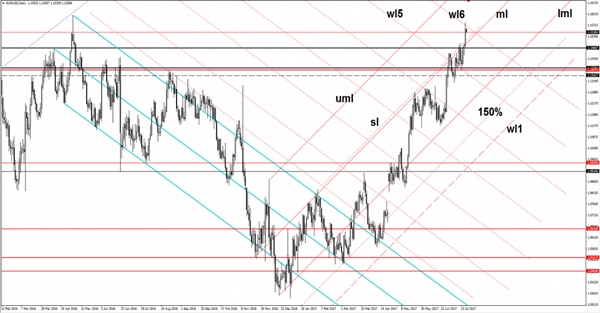
Euro (1.1135) has weakened from our resistance of 1.1215 and registered a fresh swing low at 1.1115 in the last session. A break below the support of 1.1100-1.1090 may increase the bearish momentum and in that case, Dollar Index may find it easier to climb above 98.00 levels.

Dollar-Yen (111.21) has hit a high at 111.78, close to our initial target of 112.00, before retreating for a normal correction. As long as the support of 110.60-50 holds, the uptrend remains intact and the targets of 112-113 remain unchanged.

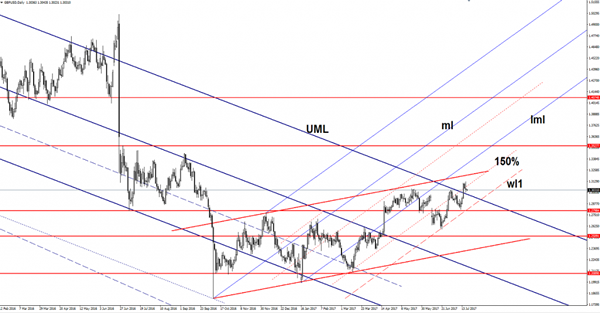
Pound (1.2630) has met our downside target of 1.2600 in a single session following the continued concern of the BOE governor over the Brexit impact on the economy. The immediate downside may be limited to 1.2540 and a corrective bounce may emerge by the end of the week from either 1.2600 or 1.2550-40.

Aussie (0.7570) is testing our support of 0.7570-60 which may hold and push the currency back to 0.7625-50 levels.

Dollar-Rupee (64.50) may test the levels of 64.60-70 today and while the resistance of 64.70-75 is expected to hold, our view of continued "range trade" between 64.70-10 will be put to the test over the next couple of days.

INTEREST RATES

The US yields have dipped after rising sharply for the last 2-sessions. The 5Yr, 10YR and 30Yr are trading at 1.76%, 2.15% and 2.74% compared to previous levels of 1.79%, 2.19% and 2.79% respectively.

The US 10-5Yr (0.40%) yield spread is testing important support near current levels and could bounce back in the near term.

Lazy Days Of Summer – Not So

Lazy Days of Summer – Not so

Those lazy days of summer are about to turn into the hazy, crazy days of summer given the abundance of risk narratives that lie ahead. Risk aversion reared its ugly head on Tuesday as headline risk reminded us that of what lies ahead and what key drivers will influence our trading decisions in the months ahead.

At the centre of the debate lies the Fed policy. It’s abundantly clear from the deluge of Fed speaks that the FOMC are preparing the field to move the goalposts. While the Fed message is clear, the market’s air of apprehension is thick as the recent run of US economic data does not entirely support the Fed’s current tack.

Another layer of complexity to the inflation narrative, oil prices have officially entered a bear market as Oils plummeted 2 % after reports of rising output from Nigeria Libya, both OPEC members exempt from the production cut deal, made headlines. Traders are showing little fear of from an ineffectual OPEC, and with inventory levels adding to the bearish sentiment, the markets look headed for a test of $40.00 WTI

The far-reaching effect of the Oil slide was felt on US equity market as the Dow slipped from record highs weighted down by energy stocks. The Tech-laden NASDAQ also laggard suggesting market jitters are setting on over tax reform. It’s clear the Republicans are trying to the right the fiscal reform ship, but with so many issues to be ironed out (raising the debt ceiling for one), it remains a close call whether the changes will pass.

On the US special election front, in Georgia Democrat Jon Ossoff or Republican Karen Handel are hoping to succeed the seat vacated by health secretary Tom Price. Thi runs off will be viewed as a major sentiment driver for the Trump presidency.

China MSCI inclusion

The door is finally open and China’s locally-traded A shares will comprise just 0.7 percent of MSCI’s global emerging-markets gauge, with 222 companies added and the weighting will increase over time as China adds further market reforms. The MSCI inclusion bodes well over the long term if the Mainland regulators move forward with Yaun internationalisation and regulatory reform. But investors are still cautious knowing the Pboc, and Financial Regulators continue to change the rules of engagement, so caution will likely persist.

The CNH has rallied this morning on the anticipation of increased capital inflows.

The Pound

It was a cruel overnight session for Sterling bulls after Carney quashed any hope for a rate hike. There was some optimism for the GBP after the hawkish surprise of three MPC members voting for a BoE rate hike last week, but all that has faded. And with DUP talks faltering the pound was utterly helpless as traders knocked it lower until some semblance of support emerged around 1.2600.

Japanese Yen

The yen is on the move in early trade as the risk complex wobbles on sliding oil prices but remains relatively resilient despite the abundance of risk aversion hitting the markets. The pair remains tentatively supported on dips feeding off the hawkish Fed hike from last week, but risk aversion continues to ripple

USD/CAD Canadian Dollar Lower After Oil Falls Ahead Of Inventories

The Canadian dollar is falling versus the US dollar on Tuesday following the fall in crude prices and hawkish Fedspeak. The loonie has slipped against the greenback as crude is touching 7 month lows after oversupply concerns as Organization of the Petroleum Exporting Countries (OPEC) members Libya and Nigeria are back to full output after sorting several disruptions.

Central banks appear to have retaken the steering wheel in June. The Bank of Canada (BoC) surprised markets with hawkish comments from its Deputy Governor Carolyn Wilkins that were later followed up by Governor Stephen Poloz putting a rate hike firmly on the table. The timing was not discussed but as other central banks are getting ready to engage in major monetary policy shifts this year the BoC has issued rhetoric to say it is sticking with the pack.

The CAD appreciated after the comments from Canadian policy makers even in a week that featured the second interest rate hike by the U.S. Federal Reserve in 2017 and a weaker outlook on oil prices. The mood this week has changed slightly as Fed speakers have for the most part supported the decision of the Federal Open Market Committee (FOMC) and keep forecasting sustained growth that would validate 1 or 2 more rate hikes with the possibility of a reduction of the US central bank’s massive balance sheet.

The fall in oil prices has also sapped the momentum of the Canadian currency as despite the best efforts of the government and the central bank the economy is still heavily dependant on natural resources.

The Fed is most likely to hike at its September or December FOMC meetings. Markets are now pricing in a move by the BoC in October, which conveniently falls in between. If the Fed refrains from raising its benchmark rate in September, the end of the year becomes a huge possibility. Stephen Poloz has shown he prefers to be proactive and might try to anticipate a move by the Fed and the European Central Bank (ECB) that is also expected to either being tapering its QE program or raise rates, or both before the end of the year.

The USD/CAD gained 0.346 percent in the last 24 hours. The currency pair is trading at 1.3266 after falling oil prices and hawkish rhetoric kept the USD higher against the Canadian currency. Central bank moves have shifted once again the pricing of the USD/CAD pair. The Fed is now expected to hike in September or December. The CME FedWatch tool is giving the September FOMC meeting a 14 percent probability, while December enjoys a 50 percent chance based on Fed funds future prices.

The biggest risk for the CAD and the economy before the end of the year is the renegotiation of NAFTA. Earlier today agriculture ministers from the three partner nations said that there are few differences over trade but the combative tone from the Trump administration ahead of the start of negotiations. The BoC is sure to get a feel for how the talks shape up when they start in late August. Mexican officials have said that the conversations should not go beyond December.

Oil fell 1.876 on Tuesday. The price of West Texas Intermediate is trading at $43.26 on fears of oversupply now that Libya and Nigeria have sorted their local disruptions to production. Both nations are exempt from the OPEC production cut agreement given their fragile infrastructure and political climate.

Oil got a boost late in the day when the American Petroleum Institute released its weekly inventories showing a 2.7 million barrel drawdown in crude stocks and a 300,000 barrels buildup in gasoline. The drawdown of crude stocks was higher than expected, while the gasoline inventories increased by less than expected. The move in oil prices will be confirmed once the Energy Information Administration (EIA) released the official weekly US crude inventories on Wednesday, at 10:30 am EDT.

Market events to watch this week:

Tuesday, June 20
2:30 am CHF SNB Chairman Jordan Speaks
4:45 am CHF SNB Chairman Jordan Speaks

Wednesday, June 21
10:30 am USD Crude Oil Inventories
4:00 pm NZD RBNZ Rate Statement
5:00 pm NZD Official Cash Rate

Thursday, June 22
8:30 am CAD Core Retail Sales m/m
8:30 am USD Unemployment Claims

Friday, June 23
8:30 am CAD CPI m/m

Gold Stabilizes After Week Starts With Losses

Gold is showing little movement in the Tuesday session, after falling 0.87% on Monday. In North American trade, spot gold trading at $1243.60 per ounce. On the release front, the current account deficit increased to $117 billion, but this beat the forecast of $124 billion. On Wednesday, the US will release Existing Home Sales and Crude Oil Inventories.

Is the US headed for another weak disappointing quarter? Last week ended on a disappointing note, as construction and consumer confidence reports missed expectations. Building Permits dropped to 1.17 million, its lowest level since August 2016. Housing Starts were also week, as the reading of 1.09 million marked the lowest since November 2016. There is concern that the soft construction numbers could weigh on second-quarter GDP. There was more bad news from UoM Consumer Sentiment, which dipped to 94.7 in May, marking a 7-month low. This is significant, as it is the indicator's lowest reading since President Trump took office, and points to consumer unease with how the US economy is being handled. There are troubling signs that the June UoM report could be even lower, coming after the Comey testimony which has damaged Trump's credibility even further. The labor market remains strong, but this has not translated into stronger consumer spending, which accounts for some two-thirds of economic growth.

As expected, the Federal Reserve raised rates last week, the second increase this year. What surprised the markets was not the rate move, but rather the upbeat tone of the rate statement. Fed policymakers noted that the labor market remained strong, and dismissed weak inflation levels as being temporary. On Monday, Federal Reserve of New York President Charles Dudley continued the upbeat message, cautioning the Fed against halting its current tightening cycle. Dudley said that the tight labor market should lead to higher wages, which in turn would push inflation to the Fed's target of 2.0%. Gold is closely linked to interest rate movement, and dropped considerably after Dudley's statement. If the Fed continues to send out a hawkish message, the odds of a rate hike in December (or even in September) are likely to increase, which could spell trouble for gold prices.

Yen Quiet Ahead of BoJ Minutes

USD/JPY is showing little movement in the Tuesday session, as the pair trades at 111.50 in North American trade. On the release front, the BoJ will release the minutes of its April policy meeting. In the US, the current account deficit increased to $117 billion, but this beat the forecast of $124 billion. On Wednesday, the US will release Existing Home Sales and Crude Oil Inventories.

Japan's economy has shown improvement in 2017, as stronger global economic conditions have increased demand for Japanese exports. This in turn has buoyed the manufacturing sector. Still, inflation remains well below the BoJ's target of 2.0%, and this means that the bank will likely stick to its guns and maintain its ultra-accommodative monetary policy, which includes negative (short term) interest rates and an asset-purchase program of JPY 80 billion/year. The bank acknowledged the stronger economy in last week's rate statement, saying that private consumption was showing "increased resilience". This was more hawkish than the April statement, when the bank said that private consumption was "resilient". The economy has shown improvement in 2017, as stronger global demand has boosted the Japanese manufacturing and export sectors. There have been calls for the bank to lower its inflation goal, but BoJ Haruhiko Kuroda has insisted said that the ultra-loose policy would continue until the 2% target is achieved. The IMF is closely monitoring the BOJ's monetary policy, and on Monday, David Lipton, the IMF's first deputy managing director said that it supported the BoJ's target of 2.0%. At the same time, Lipton expressed doubt as to whether the bank's current policy would push inflation up to this level.

The Federal Reserve raised rates last week, but what surprised the markets was the upbeat tone of the rate statement. Fed policymakers noted that the labor market remained strong, and dismissed weak inflation levels as being temporary. On Monday, Federal Reserve of New York President Charles Dudley continued the upbeat message, cautioning the Fed against halting its current tightening cycle. Dudley said that the tight labor market should lead to higher wages, which in turn would push inflation to the Fed's target of 2.0%. If the Fed continues to send out a hawkish message, the odds of a rate hike in December (or even in September) are likely to increase.

Dollar Posts One-Month High; Sterling Hurt by Carney; Oil at 7-Month Lows

Today's European session was lacking major economic releases and as a result forex market traders placed most of their bets in reaction to comments by Fed officials, as well as remarks by Bank of England Governor Mark Carney who drove down expectations of a rate hike coming soon by the Bank.

The dollar index, a measure of the greenback's strength versus the currencies of major US trading partners, rose to a one-month high of 97.79 in today's trading. The greenback was helped by the comments of New York Fed President and FOMC voting member William Dudley who yesterday said that the Fed should remain on a path of rate normalization as diverting from that would risk inflation surging in the future and proving detrimental to the US economy. In addition and in response to recent weak inflation data, Dudley expressed optimism that wage growth will pick up and drive inflation to the Fed's target of 2%. It is noteworthy that Dudley's comments are usually perceived to be on the dovish side. Dallas Fed President, another FOMC voting member, Robert Kaplan is scheduled to give a speech at 19:00 GMT.

Turning to specific dollar pairs, dollar/yen hit a more than three-week high today when it reached 111.85. The greenback failed to maintain momentum though and the pair was last more or less flat on the day around 111.50. In the meantime, euro/dollar was marginally down at 1.1140, while most dollar gains on the day were recorded versus the pound.

As soon as the text of BoE Governor Mark Carney's speech at Mansion House became available today, it led to steep declines of the pound versus other majors such as the dollar and the euro. Carney disappointed market participants by saying that now is not the time to raise interest rates. This follows rising expectations that the BoE is closer to a rate hike after a greater-than-anticipated number of Monetary Policy Committee (MPC) members supported such a move during the Bank's latest meeting. Pound/dollar posted a two-month low of 1.2610 in today's trading, while euro/pound was last trading comfortably above the 0.88 handle – the pair started the day at 0.8749. Sterling is likely to face added volatility ahead of Brexit and other political developments.

In terms of US data, the country's current account deficit widened in the first quarter of the year, reaching $116.8 billion from the previous quarter's upwardly revised $114.0bn (from $112.4bn before). The rise was below expectations of a deficit amounting to $123.8bn. As a percentage of GDP, the deficit in the current account grew to 2.5% during the quarter from 2.4% in the previous quarter. Dollar/yen barely moved upon immediate release of the data.

Out of Germany, monthly producer prices declined more than expected in May. Specifically, they recorded a fall by 0.2%, slightly below the 0.1% decline expected. The figure also negatively compares to April's 0.4% growth. On a yearly basis, producer prices grew by 2.8% during the month, below forecasts of a 2.9% growth and April's 3.4%. The euro didn't have much of a reaction relative to the dollar and the pound as the data hit the markets in early European trading hours.

The outcome of today's bi-weekly dairy auction, which tends to affect the kiwi as New Zealand is a major dairy exporter, is expected to follow soon.

Concluding with oil, WTI and Brent crude both fell to seven-month lows today with losses nearing 3.0% on both benchmarks. WTI and Brent were last trading close to the day's lows at $42.94 and $45.66 a barrel respectively. The decline was attributed to indications of rising production in Libya and Nigeria, the two OPEC member countries which are not bound by OPEC's deal to cut production.

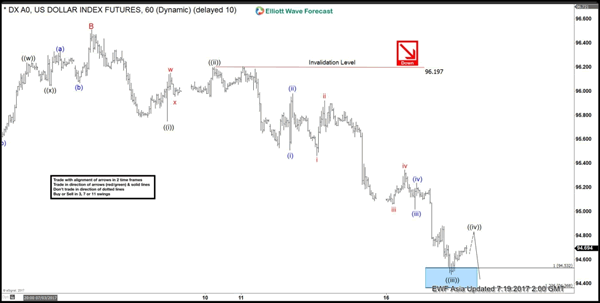
US$ Index (DXY), Important Bottoming and 8% Rally?

Nearer term $ index outlook :

In the Jun 13th email said that further short term downside below that Jun 6th bottom at 96.50 was favored, but such weakness would be limited and part of a larger bottoming. The market did indeed slip to a slight new low at 96.30 on Jun 14th before sharply reversing that day, and has continued higher since. Lots of positives add to that view of a bottom and include the rapid reversal from that slight new low (sign of underlying strength), likely completion of the 5 wave decline from at least the May 9th high at 102.25, bullish technicals (see bull divergence/buy mode on the daily macd) and view of an approaching more major low (eventual gains above that Jan high at 103.80, see longer term below). At this point, there is still no confirmation of a more important low "pattern-wise" (5 waves up for example), leaving open some scope for another few weeks of this broader ranging/bottoming. Also don't forget that the long held "ideal" area to form a more major top in eur/$ is above at 1.1425/75 (top of 2 year falling wedge, seen email from yesterday) and in turn adds to this risk of a further period of bottoming in the US$ index/DXY (inverse relationship). Nearby resistance is seen at 98.15/30 (both the bearish trendline from Apr 10th and the broken falling support line from Feb), with a break/close clearly above arguing more substantial gains more directly ahead. Nearby support is seen at the bull trendline from Dec 15th (adjusts for that Jun 14th spike), and again that whole 96.15/30 area (Jun 14th low, falling support line from Feb). Bottom line : quick bounce back from that slight new low 96.30 adds to the view of that larger bottoming, but still with some risk of another few weeks of chopping as part of the process.

Strategy/position:

Long Jun 8th above that bear t-line from May 11th (then 96.65, closed at 96.80). For now given that risk for a further period of this larger bottoming, would use an aggressive stop on a close 15 ticks below that bull t-line from Jun 15th. However, with such a break (if it occurs) seen part of this larger bottoming, will rebuy 96.35 if taken out (and then stopping on a close 15 ticks below the falling support line from Feb). Remember it will often take a couple of attempts as these larger bottoms form before more substantial gains are finally seen.

Long term outlook:

No change as the view since mid May of a month or so of ranging with a downward bias as a more major bottom approaches, continues to play out. As discussed above, that more major bottom may finally be "complete"/in place and with eventual gains back to the Jan high at 103.80 (and even above) favored. In the big picture, the 3 wave rally from the May 2016 low at 91.90 to the Jan 3rd high at 103.80 (A-B-C) argues a large "complex" topping, and still favor the view of a huge rising wedge since May 2015. Though seen as a reversal pattern, wedges break down into 5 legs and "ideally" targets a final upleg back to that Jan high at 103.80 (and even just above) in that final leg (wave V). But as mentioned above, there does remain some risk for another few weeks of ranging/bottoming before more substantial upside is seen (see in red on weekly chart/2nd chart below). Bottom line : in process of a major bottoming and with eventual gains above the Jan high at 103.80 after.

Strategy/position:

With the market seen in process of a major bottoming (and eventual gains above 103.80), looking to switch the longer term bias to bullish. So for now would switch on a close above 98.45 (just above that 98.15/30 resistance area) or 96.35 (given the risk for further bottoming).

Current:

Near term : long Jun 8th at 96.80, scope for a further period of ranging/basing ahead.
Last : long May 5 at 98.75.stopped May 16 below t-line from Feb (98.45, closed 98.10).

Longer term : major bottoming for eventual gains above that Jan 103.80 high, see entry strategy above.
Last: :bull bias May 5 at 98.75 to neutral may 16th at 98.10.

Trade Idea Wrap-up: USD/CHF – Hold long entered at 0.9705

USD/CHF - 0.9748

Most recent candlesticks pattern : N/A

Trend                                    : Near term up

Tenkan-Sen level                  : 0.9741

Kijun-Sen level                    : 0.9744

Ichimoku cloud top                 : 0.9733

Ichimoku cloud bottom              : 0.9722

Original strategy :

Bought at 0.9705, Target: 0.9805, Stop: 0.9690

Position : - Long at 0.9705

Target :  - 0.9805

Stop : - 0.9690

New strategy  :

Hold long entered at 0.9705, Target: 0.9805, Stop: 0.9690

Position : - Long at 0.9705

Target :  - 0.9805

Stop : - 0.9690

As the greenback found renewed buying interest at 0.9695 and staged a strong rebound, retaining our bullishness and suggesting the pullback from 0.9771 has ended there, hence upside bias remains for a retest of said resistance, break there would extend recent rise from 0.9613 low to resistance at 0.9808 but reckon previous resistance at 0.9825 would hold from here due to near term overbought condition, bring retreat later.

In view of this, we are holding on to our long position entered at 0.9705. Below said support at 0.9695 would defer and risk weakness towards said support at 0.9641 but only break there would abort and revive bearishness, this would also suggest the rebound from 0.9613 has ended instead, bring retest of this level later.

Trade Idea Wrap-up: GBP/USD – Sell at 1.2715

GBP/USD - 1.2635

Most recent candlesticks pattern   : N/A

Trend                                 : Near term down

Tenkan-Sen level                 : 1.2685

Kijun-Sen level                    : 1.2692

Ichimoku cloud top              : 1.2788

Ichimoku cloud bottom        : 1.2755

Original strategy :

Sell at 1.2715, Target: 1.2615, Stop: 1.2750

Position : - 

Target :  -

Stop : -

New strategy  :

Sell at 1.2715, Target: 1.2615, Stop: 1.2750

Position : -

Target :  -

Stop : -

As cable has fallen again and broke below indicated support at 1.2635, adding credence to our view that recent decline has resumed and bearishness remains for further fall to 12600-05, then towards 1.2575-80, however, near term oversold condition would limit downside to 1.2550 and reckon 1.2520-25 would hold from here, risk from there is seen for a rebound later. 

In view of this, we are looking to sell cable on recovery as 1.2715-20 should limit upside. Only above 1.2755-60 would abort and suggest an intra-day low is formed instead, bring a stronger rebound to 1.2780 but price should falter below said resistance at 1.2818.