Sample Category Title
EUR/USD Channel Breakout
Remember last week, we had EUR/USD reaching channel resistance?
Here's a refresher of the chart if your memory is a little hazy on hump day (we can all relate, don't worry!):
EUR/USD Daily:
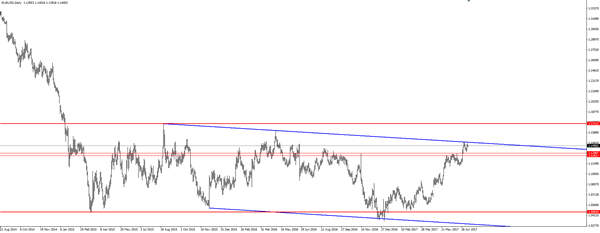
As you can see, this was the third touch of the daily channel resistance level. Just keep in mind that price is still 250 pips or so away from the horizontal level that makes the top of the horizontal range that we're also watching, but it was hugely significant resistance none the less.
The point we made around that chart was this:
If you're already long off that previous hourly resistance turned support level, then you're sitting pretty right now and can afford to hold for a higher time frame break out.
It was this EUR/USD intraday breakout and retest of resistance as support that gave us that line and very well done to those of you that managed to hold your nerve. You certainly got paid in the end!
I've used a 4 hour chart below, simply because it shows the daily channel breakout the clearest. But of course you can look at it on whatever time frame suits you.
EUR/USD 4 Hourly:
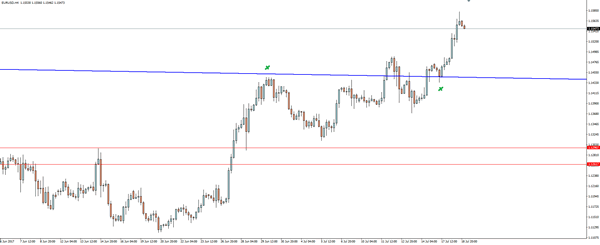
A clear breakout, (another) retest of previous resistance as support and then a momentum push higher.
If you're a technical trader, this entire narrative is pure art.
Best of probabilities to you.
The Washington Sinkhole
Currency markets kicked into overdrive as a massive political sinkhole forms in Washington sending a strong bid across US fixed income and hauling the US dollar lower.
The market has been waiting for the Trump failure cascade to begin and yesterday's health care headlines once again bring into question the administration's ability to enact on their key legislative promises leaving investors in limbo and the USD sagging.
But factoring in doubt about the US economy, over reaching equity markets and inflation that seems to have gone missing in action, uncertainty rages at so many levels it's no wonder investors look for cover under the US Fixed income umbrella as storm clouds gather overhead ( The latest JPMorgan Treasury Client Survey showed the lowest levels of shorts in longer-dated US Treasuries since April 17. Bloomberg).
Australian Dollar
Besides the all consuming US political quagmire, currency speculators continue to pin their hopes on hawkish central bank follow through. And this bias saw the Aussie dollar propel to a two year high on the back of RBA minutes which were interpreted hawkish by the markets. Unquestionably one of the best Aussie dollar frenzies in a while as dealers took the panel's discussion of a neutral rate of 3.5% cash rate as a signal the RBA is joining the G10 central bank policy U-turn.
There's been much debate over night and even this morning the first call was regarding the scope to which the RBA was hawkish. I suspect the move is as much about trend following as it is about dealers falling for the seductive allure of catching a central bank policy shift. Nevertheless, price action can not be ignored and if the RBA wants to push back on this move, Debelle will be on the wires Friday and Lowe early next week. The buzz on the street is tactical shorts are building ahead of the RBA speeches
Euro
The ECB “sources” were back at it overnight signalling limited appetite to shift policy language at this meeting. Regardless, the market does not want to be late to this party and although the likely timing of the policy change is September meeting or even Jackson Hole, the broader droopy USD narrative is supporting Euro risk appeal. The big question going into this week's ECB meeting is whether or not any governing council's eyebrows are raised about the elevated Euro level.While there may be some pushback, it's more likely the sagging USD narrative wins out.Regardless traders are pretty giddy about the tactical trading opportunities that the ECB meeting does offer.
Gold Rally Continues as Trump Stumbles
Gold has posted gains for a third straight day, as the pair is up 0.67% in the Tuesday session. In the North American session, spot gold is trading at $1242.50 per ounce. In economic news, there are no major US events on the schedule. On Wednesday, the US releases of Building Permits and Housing Starts.
Gold is on a roll, having gained 2.1% since Friday. The metal moved higher after US CPI and retail sales disappointed, and the rally has continued this week. Gold prices have climbed on Tuesday after President Trump suffered a major setback, as his health care bill has stalled in the Senate, even before being brought to the floor for a vote. After two key Republicans announced they would not support the bill, the Republican leadership said it will not attempt to advance a health care proposal before Congress takes a recess in August. This decision is a blow for Trump, who had made a new health care act a key part of his agenda. With this latest defeat, there is growing skepticism as to whether Trump will be able to convince Congress to pass other key parts of his agenda – tax reform and fiscal spending. The Republicans also have egg on their faces, as they have been unable to pass any significant legislation since Trump took over, despite having control of both houses of Congress and the White House.
The US economy remains in good shape, and the labor market is close to capacity, with unemployment at just 4.3 percent. Still, inflation levels remain low. The Federal Reserve has tried to convince the markets that it's only a matter of time before inflation levels move higher. This stance was reiterated by Fed Chair Janet Yellen last week, as she testified before congressional and senate committees. In her testimony, Yellen admitted that the Fed was at a loss to explain the lack of inflation, but insisted that it was "premature to conclude that the underlying inflation trend is falling well short of 2 percent", and that with a strong labor market "the conditions are in place for inflation to move up". Despite the Fed's assurances, the markets aren't buying in, with a rate hike considered extremely unlikely in September. As for a December increase, the odds are currently at just 47%, according to the CME Group. Consumer spending and inflation numbers were soft in June, and the disappointing numbers will do little to improve market skepticism about one last rate hike this year.
Pound Drops After Weak CPI Report
GBP/USD has posted slight losses in the Tuesday session. In the North American session, GBP/USD is trading at 1.3030. In economic news, British CPI was unexpectedly soft, posting a gain of 2.6%. This missed the estimate of 2.9%. In the US, there are no major events on the schedule. On Wednesday, the focus will be on construction numbers, with the release of Building Permits and Housing Starts.
British CPI surprised the markets, as the gain of 2.6% in June was lower than the 2.9% reading a month earlier. This was the first time this year that inflation levels have not increase from the previous reading. The soft data eases the pressure on the BoE to raise rates in order to curb high inflation levels. Policymakers at the BoE have been at odds over raising rates – even though inflation is high, the economy has been showing signs of weakness, raising concerns that the economy does not need higher interest rates.
Britain and European Union negotiators met in Brussels on Monday, marking the start of substantive negotiations on Britain's exit from the EU. After weeks of "discussions about what to discuss", the UK agreed to the European demand that the negotiations would focus on the rights of EU citizens in the UK and Britain's bill for leaving the EU, before entering talks on a new trade agreement. Britain has presented its position on guaranteed rights for EU citizens living in the UK, but EU negotiators have said that this offer doesn't go far enough. The EU has handed Britain an exit bill of EUR 69 billion, and although the May government has agreed that it owes funds to Brussels, it certainly will counter with a much lower figure. With significant gaps between the parties on both of these issues, the negotiations promise to be difficult. Another complication is internal dissent within the May government, with senior officials at odds over a 'transition period' for Britain after leaving Brexit. Finance Minister Philip Hammond has suggested a transition period of two years, but Brexit Secretary David Davis has said he wants the UK completely out of the single market when Brexit negotiations terminate in March 2019.
President Trump suffered a major setback this week after Trump's proposed health bill which replaces much of Obamacare, has stalled in the Senate, after two Republicans announced they would not support the bill. The Republican leadership has admitted defeat, saying it will not attempt to advance the health care proposal before Congress takes a recess in August. This decision is a blow for Trump, who had made a new health care act a key part of his agenda. With this latest defeat, there is growing skepticism as to whether Trump will be able to convince Congress to pass other key parts of his agenda – tax reform and fiscal spending. The Republicans also have egg on their faces, as they have been unable to pass any significant legislation since Trump took over, despite having control of both houses of Congress and the White House.
Inflation levels in the US have been stubbornly low, despite a generally strong economy and a tight labor market. Still, the Federal Reserve remains convinced that it's only a matter of time before inflation levels move higher. This stance was reiterated by Fed Chair Janet Yellen last week, as she testified before congressional and senate committees. With the labor market close to capacity and the unemployment rate at just 4.4%, economists are puzzled why this hasn't translated into higher inflation. In her testimony, Yellen admitted that the Fed was at a loss to explain the lack of inflation, but insisted that it was "premature to conclude that the underlying inflation trend is falling well short of 2 percent", and that with a strong labor market "the conditions are in place for inflation to move up". Is Yellen's argument just wishful thinking? The markets aren't buying in, with a rate hike considered extremely unlikely in September. As for a December increase, the odds are currently at just 47%, according to the CME Group. Consumer spending and inflation numbers were soft in June, and the disappointing numbers will do little to improve market skepticism about one last rate hike this year.
Gold Pushes Higher as Dollar Sinks
Gold prices continued to recover on Tuesday, buoyed by a weaker US dollar, which came under pressure following news that the Republican healthcare bill was probably going to be rejected by the Senate. This implies that Trump's tax reform agenda may be now more difficult to implement and may take longer to arrive, as the cuts in healthcare were expected to finance some of the promised fiscal measures.
Meanwhile, Fed rate hike expectations remain subdued in the aftermath of last week's disappointing US data, with market pricing suggesting less than 50% probability for another hike this year.
Combined, these factors make us believe that the greenback could remain on the back foot over the next few days, especially given the absence of any Fed speakers or major US economic indicators this week. Therefore, we think that gold prices could remain supported for a while, even in the absence of any risk-off news.
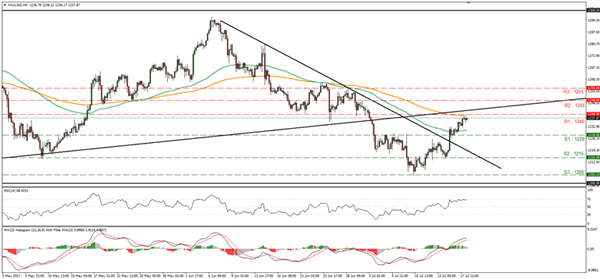
XAU/USD traded higher on Friday, following the disappointing US data, breaking above the downtrend line taken from the peak of the 7th of June and the resistance (now-turned-into-support) hurdle of 1228 (S1). Even though such a break would normally change our short-term view to positive, the fact that the yellow metal is still trading below a prior uptrend line drawn from the low of 27th of January makes us hesitant to trust further advances.
We would like to see a decisive move above the crossroads of that uptrend line and the resistance barrier of 1240 (R1) before we become confident that the latest recovery will continue. A potential upside break of that area could initially aim for our next resistance area of 1248 (R2).
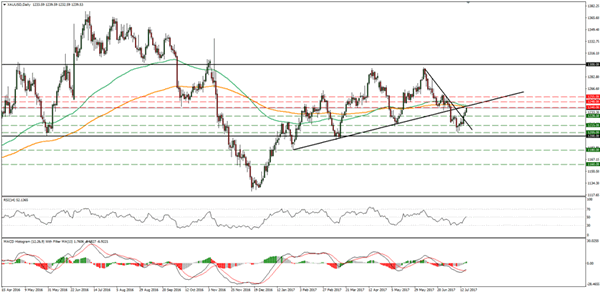
Switching to the daily chart, we see that gold has been trading in a sideways range since the end of January, between the 1200 and 1300 territories. The fact that the latest recovery in prices began from near the lower bound of that range increases the likelihood for further upside extensions in our view, perhaps towards the upper bound of the range.
However as we already noted, we prefer to wait for a clear break above the aforementioned crossroad before we turn our eyes higher.
Dollar at Fresh 10-month Low; Sterling Hurt by Weaker-than-Expected Inflation
In terms of economic releases, UK inflation numbers were by far the most important release during today's European session. The downside miss hurt sterling which posted a ten-month high versus the dollar earlier in the session. In other news, the currency markets were once again anything but deaf to political developments, pushing the dollar to new lows on the seeming inability by the Trump administration to repeal and replace Obamacare.
The dollar index, a broader gauge of the US currency's strength, experienced considerable losses today. The measure was last down by nearly 0.7%, touching a more than ten-month low of 94.48. Excluding the British pound, the greenback was down against all currencies that constitute the dollar index. Market participants are interpreting the latest fallback on the repeal of Obamacare (as two more Republican senators said they will oppose the current Republican bill) as indicating that future efforts by the Trump administration to promote pro-growth policies will also fail to materialize. Dollar/yen reached a two-week low of 111.76 in today's trading, while it was down 0.6% during afternoon European trading hours.
Regarding data out of the US, June import prices fell by 0.2% as expected. The respective figure for exports showed an identical percentage decline, though expectations were for it to remain flat. The dollar did not notably move relative to other majors within the initial minutes of data release.
Out of the UK, June inflation data fell short of expectations, pushing the pound lower as markets believe the numbers lower the odds for a rate hike during next month's Bank of England policy meeting. Specifically, the inflation rate came in at 2.6% on an annual basis in June, below forecasts and last month's 2.9%. Month-on-month, inflation experienced zero growth, below the 0.2% that was expected and May's respective rate at 0.3%. Core inflation, which excludes volatile energy and food products, fell to 2.4% year-on-year from 2.6% in the preceding month. Pound/dollar traded 0.3% down on the day in afternoon European trading hours. Earlier in the day and before inflation figures went public, sterling was advancing relative to the greenback, posting a ten-month high of $1.3125. In the meantime, euro/pound was last up by a sizable 1.1%, eyeing the 0.89 handle.
The monthly German ZEW survey, gauging investor morale for the month of July in Europe's largest economy, negatively surprised today. In particular, the index measuring economic sentiment fell to 17.5 from 18.6 during the prior month. Expectations were for a reading of 18.0. In addition, the measure gauging investors' perceptions of the economy's current condition declined to 86.4 from June's 88.0 which also coincided with analysts' forecasts. The deterioration in sentiment was attributed to the appreciating euro, something which is not favored by German exporters as their products appear less attractive to foreign buyers. Despite the fall, the German economy is expected to grow solidly throughout the rest of the year, remaining resilient to global threats. Euro/dollar didn't react much upon immediate release of the data.
Euro/dollar posted significant gains today, rising to a fourteen-and-a-half-month high of 1.1582. The pair was last challenging that high for a potential close further up on the day. The European Central Bank will be holding a policy meeting on Thursday.
Today's bi-weekly dairy auction, which tends to affect the kiwi as New Zealand is a major dairy exporter, showed prices increasing by 0.2% relative to two weeks ago. The New Zealand dollar didn't react much to the data relative to its US counterpart. Kiwi/dollar was last up 0.5%, recovering from losses earlier in the day after softer than expected inflation figures out of New Zealand.
Diverting from forex markets to commodities, WTI and Brent crude were last trading at $46.49 and $48.96 a barrel, up 1.0% and 1.1% on the day respectively. Gold, which benefitted from dollar weakness, last traded close to the two-week high of $1242.40 an ounce hit today.
Yen Rally Continues on Trump Setback
USD/JPY has resumed its rally in the Tuesday session. In the North American session, the pair is trading at 111.70, down 0.80% on the day. On the release front, there are no Japanese events on the schedule. In the US, there are three minor indicators. On Wednesday, the focus will be on construction numbers, with the release of Building Permits and Housing Starts. The Bank of Japan will release a monetary policy statement.
All eyes will be on the BoJ on Wednesday, as policymakers meet for a policy meeting. Unlike other central banks, such as the ECB and the Federal Reserve, there are no expectations of a tightening of monetary policy in the near future. However, investors will be looking for any tweaks to current monetary policy, which could trigger some movement from the yen. Inflation continues to hover below 1.0%, well below the BoJ's target of 2%. Most analysts expect the bank to push back the timeline for the 2% target, which is currently "around fiscal 2018", but do not anticipate the bank lowering the target. The BoJ has consistently said that it will not reduce its radical stimulus program until inflation levels move higher. Given current economic conditions, this is unlikely before 2018 at the earliest.
President Trump can't seem to catch a break. There was more bad news this week, as his health care bill, which replaces much of Obamacare, has stalled in the Senate, after two Republicans announced they would not support the bill. The Republican leadership has admitted defeat, saying it will not attempt to advance the health care proposal before Congress takes a recess in August. This decision is a major setback for President Trump, who had made a new health care act a key part of his agenda. Despite Republican control of both houses of Congress and the White House, no major legislation has been passed since Trump took over as president 6 months ago. With this latest defeat, there is growing skepticism as to whether Trump will be able to convince Congress to pass other key parts of his agenda – tax reform and fiscal spending.
Inflation levels in the US have been stubbornly low, despite a generally strong economy and a tight labor market. Still, the Federal Reserve remains convinced that it's only a matter of time before inflation levels move higher. This stance was reiterated by Fed Chair Janet Yellen last week, as she testified before congressional and senate committees. With the labor market close to capacity and the unemployment rate at just 4.4%, economists are puzzled why this hasn't translated into higher inflation. In her testimony, Yellen admitted that the Fed was at a loss to explain the lack of inflation, but insisted that it was "premature to conclude that the underlying inflation trend is falling well short of 2 percent", and that with a strong labor market "the conditions are in place for inflation to move up". Is Yellen's argument just wishful thinking? The markets aren't buying in, with a rate hike considered extremely unlikely in September. As for a December increase, the odds are currently at just 47%, according to the CME Group. Consumer spending and inflation numbers were soft in June, and the disappointing numbers will do little to improve market skepticism about one last rate hike this year.
Canadian Dollar Rises After US Health-Care Stumbles
The Canadian dollar rose on Monday afternoon after it became clear that the Republican health care bill was facing collapse after two senators withdrew their support. As the Asian session got underway on Tuesday the loonie continued to appreciate versus the greenback with growing market concerns about the ability of the Trump Administration to push through other reforms. Pro-growth policies were a promise of the Trump campaign with tax reform and infrastructure spending driving the US dollar rally at the beginning of the year. When the Trump administration started to lose momentum and spent its political capital on divisive issues like immigration and health care other reforms were pushed further down the list.
The loonie had a strong performance last week as the USD retreated as US data disappointed with slow inflation and falling retail sales. The Bank of Canada (BoC) hiked rates for the first time in 7 years after switching the rhetoric in the past month. The Canadian benchmark rate rose by 25 basis points to 0.75 percent. The market is still pricing in a second rate hike this year, but Canadian inflation and high levels of household debt could change the mind of the central bank.
The CAD will have to wait until Friday to get a major indicator release when the Canadian retail sales and inflation data will be published. For now US political uncertainty and the "America First" objectives of the NAFTA renegotiation could have a negative effect on the Canadian currency.
The USD/CAD lost 0.441 in the last 24 hours. The currency pair is trading at 1.2595 after the US healthcare reform will not make it to the Senate floor as two more senators have come out against it. The loonie recovered from losses near the session close on Monday when the NAFTA renegotiation objectives were released by the United States.
The trade agreement will be up for review in mid-August and as part of the process, the US has to outline to the legislative branch its intentions and objectives. While the document was filled with an America First rhetoric that is the template of the Trump Administration the issue that will be a point of contention will be the focus on deficit reductions. The Mexican Economy Minister Ildefonso Guajardo has already spoken out against this "mercantilist" view of trade. The Mexican minister would rather focus on how to expand commerce, not reduce it, but also praised the US for putting forth that there will be no reintroduction of quotas and tariffs during the renegotiation process.
The USD/CAD has touched weekly lows of 1.2581 during the last five trading sessions. NAFTA uncertainty put the pair at a high of 1.2944 very close to breaking the 1.30 price level, but the anxiety about the Trump Administration's ability to work with a Republican majority house and Senate have risen. A somewhat dovish Fed last week and weak economic indicators in the US have offered no support for the buck as it looks for next week's Federal Open Market Committee (FOMC) meeting for further guidance.
Energy prices jumped 0.42 percent in the last 24 hours. The price of West Texas Intermediate is trading at $46.66 after Saudi Arabia published a report revealing it is considering further export cuts. The price of energy has been erratic as the Organization of the Petroleum Exporting Countries (OPEC) production cut agreement and the rise in US shale production have offset each other.
The Energy Information Administration (EIA) published a forecast yesterday with total shale regions oil output in August rising by 113,000 barrels per day. Total output in the month could reach 5.59 million barrels per day compared with 5.5 in June. Oil prices retreated at the start of the week after gaining more than 5 percent last week.
Energy prices have been dictated by weekly changes in US crude inventories and reports from the Organization of the Petroleum Exporting Countries (OPEC) led production cut agreement. Oil rigs have increased production in the United States taking advantage of the stability provided by the production cut deal. Demand specially in China is giving optimistic signals to producers and could be the tie breaker between the two opposing forces. Oil producers that are part of the agreement will meet in Russia on July 24 to discuss the current market situation and review the compliance levels.
Market events to watch this week:
Wednesday, July 19
- 8:30 am USD Building Permits
- 10:30 am USD Crude Oil Inventories
- 9:30 pm AUD Employment Change
- Tentative JPY Monetary Policy Statement
Thursday, July 20
- Tentative JPY BOJ Outlook Report
- Tentative JPY BOJ Policy Rate
- 2:30 am JPY BOJ Press Conference
- 4:30 am GBP Retail Sales m/m
- 7:45 am EUR Minimum Bid Rate
- 8:30 am EUR ECB Press Conference
- 8:30 am USD Unemployment Claims
Friday, July 21
- 8:30 am CAD CPI m/m
- 8:30 am CAD Core Retail Sales m/m
*All times EDT
US Politics Pushing the Dollar Down the Hill
- European stock corrected lower with the German Dax clearly underperforming at -1.3% on euro strength. US stock markets opened modestly lower after Congress failed to repeal Obamacare.
- The UK inflation unexpectedly slowed to 2.6% Y/Y in June while a stabilisation at 2.9% was expected. The core CPI also failed to stay flat at 2.6% Y/Y and instead fell to 2.4%. This gives respite to BoE members concerned that price growth is getting out of hand.
- Prime Minister Theresa May told her ministers to show the "strength and unity" Britain needs and keep discussions private, blaming hostile briefing to journalists on colleagues who are "not taking their responsibilities seriously".
- The ZEW's index on the current German economic situation dipped slightly, reaching 86.4 in July from 88 in June. That's a slight miss compared to the forecast of 88. The expectations index also dipped from 18.6 to 17.5 (consensus 18). For the EMU, the ZEW for current conditions rose to 28.7 from 20.5 and the expectations slid to 35.6 from 37.7.
- The ECB's Q2 Bank Lending Survey shows improvement in supply and demand conditions in the EMU banking sector. Credit standards were eased for corporate and mortgage loans while consumer loans tightened marginally. Banks expect a further easing of supply conditions and a continued strengthening of loan demand for Q3.
- Republicans in the US House of Representatives unveiled an outline of their 2018 budget proposals. The blueprint would allow an overhaul of the tax code to pass Congress without support from Democrats, along with a partial repeal of the Dodd-Frank reform law and $203 billion in savings from mandatory federal programs over 10 years.
Rates
Small upward bias in thin trading
Global core bonds traded with a small upward bias for second straight session, but volumes remain very low. US Treasuries outperformed German Bunds. Several "global" factors favoured core bonds. First, European equity markets corrected lower with the German Dax underperforming (-1.5%) on euro strength (caused by Trump's failure to repeal Obamacare). Second, inflation readings (New-Zealand, UK) continue to slide from Q1 levels and disappointed on the downside of expectations. Additionally, the Riksbank downplayed their "policy turn" by confirming readiness to lower interest rates further. Third, eco data failed to paint a rosy picture. The German ZEW-indicator lost slightly more ground than forecast in July while US price indices printed mixed. Finally, investors keep Thursday's ECB meeting in mind. We expect Draghi to stick to last month's script and keep an announcement of APP's future for Jackson Hole (end of August) and/or the September policy meeting. From a technical point of view, the German Bund tested 161.68 (previous neckline double top), but a break didn't occur.
At the time of writing, the German yield shifts 1.1 bp to 1.4 bps lower with the belly of the curve slightly outperforming the wings. Changes on the US yield curve range between -0.4 bps (2-yr) and -3.6 bps (10-yr). On intra-EMU bond markets, 10-yr yield spread changes versus Germany are nearly unchanged with Italy (-2 bps) and Spain (-3 bps) outperforming.
Currencies
US politics pushing the dollar down the hill
Dollar selling remained the name of the game today. Trump administration's inability to repeal Obamacare pushed the dollar off the hill and this move continued throughout the day. EUR/USD extended gains beyond the 1.1489/1.15 resistance and trades currently at about 1.1565/70. USD/JPY dropped below the 112 handle.
Overnight, the dollar came under broad pressure as divisions within the US Republicans made a repeal of Obamacare unlikely. This failure reinforced investors' doubt about the administration's ability to execute profound reforms. EUR/USD jumped from 1.1480 to the 1.1535/40 area. USD/JPY dropped to the low 112 area. The uncertainty also weighed on Asian equities, but losses were modest.
The repositioning from Asia continued in Europe as investors adapted positions further after the break of key technical levels in several cross rates (EUR/USD, AUD/USD ….). The dollar decline took a breather mid-morning, but the US currency never gave the impression that a rebound was imminent. German ZEW investor sentiment was slightly softer than expected but didn't hurt the euro. On the contrary, a new wave of USD selling pushed EUR/USD to the 1.1560 area late in the morning. USD/JPY held up slightly better and drifted to the 112 level. Interest rate differentials are no big issue in the current USD decline. It was mostly follow-though repositioning due a loss of confidence in US politics with risks of negative fallout on the US economy.
US import prices were close to expectations and had no impact on USD trading. USD selling persisted as US investors joined the overnight USD decline. Risk sentiment also turned negative, pushing USD/JPY below the 112 barrier (currently 111.85). EUR/USD trades in the 1.1565/70 area, holding near the recent multi-month high. Dollar selling remains the way of least resistance.
Sterling nosedives as inflation eases
Sterling was mostly driven by technical considerations of late. Eco data came again in play today with the UK price data. UK headline inflation was flat on a monthly basis and declined from 2.9% Y/Y to 2.6% Y/Y (2.9% was expected). Core inflation also unexpectedly eased to 2.4%. Over the previous month, the debate on a BoE rate hike flared up (both inside and outside the BoE). A central bank of course isn't supposed to make its policy decision dependent on the most recent (inflation) data. Even so, with the risk of 3.0% + inflation out of the way, today's inflation report definitively eases pressure on the BoE to tighten policy anytime soon. EUR/GBP jumped from the 0.88 area and trades currently in the 0.8885 area. EUR/USD strength reinforced the move. Cable lost abound a full big figure despite broad-based US weakness, trading in the 1.3020 area.
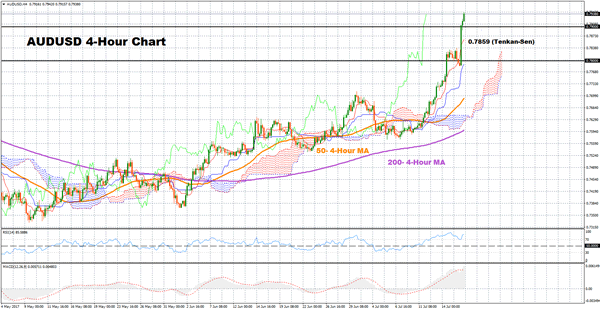
AUDUSD Overbought above 0.7900 Key-level; Correction to the Downside Expected
AUDUSD has shot higher, breaking the 0.7900 key level and recording a fresh two-year high. However, the odds of a trend reversal are increasing in the short-term, as the pair is currently in under overbought conditions.
On a four-hour chart, the bias is bullish, as the Tenkan-Sen and the Kinjun-sen are positively sloping after the former crossed above the latter on July 10. Meanwhile, the MACD has turned from negative to positive and managed to rise above its signal line. Nevertheless, the RSI suggests that the pair might lose momentum as the oscillator itself has been fluctuating in an overbought territory since July 12.
If prices continue increasing, a possible resistance might emerge around the psychological level of 0.8000, which was tested repeatedly back in 2015. Further movements to the upside would meet the previous top of 0.8123, the highest mark recorded since May 2015.
Alternatively, if the pair moves downwards, the psychological key-level of 0.7900 could act as an immediate support, while further declines would target the area around the Tenkan-sen point of 0.7859. A violation of this point would open the way towards the key level of 0.7800 as a support.