Sample Category Title
Dollar Steady Post-CPI as Yen Slips; Aussie Faces Key Jobs Test
Dollar showed minimal reaction, other than some initial jitters, to November’s US CPI data, holding steady within its range as the report largely aligned with expectations. Headline inflation edged up, while core inflation remained flat, refusing to trend lower. With no surprise, the data cleared the way for a 25bps rate cut by Fed next week, with Fed fund futures pricing a near-certainty at 99.9%. However, the real focus has shifted to January, where the likelihood of a pause remains high at over 75%. Fed’s outlook, therefore, appears relatively unchanged, with policymakers likely to reassess conditions early next year amid ongoing uncertainties surrounding fiscal and trade policies under the incoming US administration.
In contrast, Japanese Yen is facing broad declines despite stronger-than-expected wholesale inflation data. November’s Corporate Goods Price Index rose by 3.7% yoy, accelerating from October’s 3.6% and marking the fastest pace since mid-2023. This suggests renewed inflationary pressures in corporate prices, creating a dilemma for BoJ, which continues to face subdued consumption despite robust wage growth. after all, Markets anticipate another rate hike imminently, whether at this week’s meeting or in January. Ultimately, the timing of the move may not significantly alter Yen’s trend.
Overall for the day so far, Swiss Franc is currently the strongest one. Canadian Dollar is the second, awaiting BoC's rate cut while Dollar is third. Yen is the worst for now. Aussie and Kiwi follow next on speculations that China would allow Yuan to weaken next year to cushion some of the impacts of renewed tariff war with the US. Euro and Sterling are positioning in the middle.
Australian Dollar will be the focus again in the upcoming Asian session, with Australian job data featured. Aussie continues to struggle, weighed down by a confluence of negative factors. The RBA’s surprise dovish policy shift has added to speculation of a possible February rate cut, though May remains the base case for many analysts. Furthermore, China’s stimulus pledges have failed to inspire sustained confidence, and markets are now grappling with concerns that Beijing may allow the Yuan to weaken further in 2025 to counter US tariffs. Traders are now awaiting Australia’s job data, which could tilt the balance further toward an earlier easing by RBA if it signals significant labor market loosening.
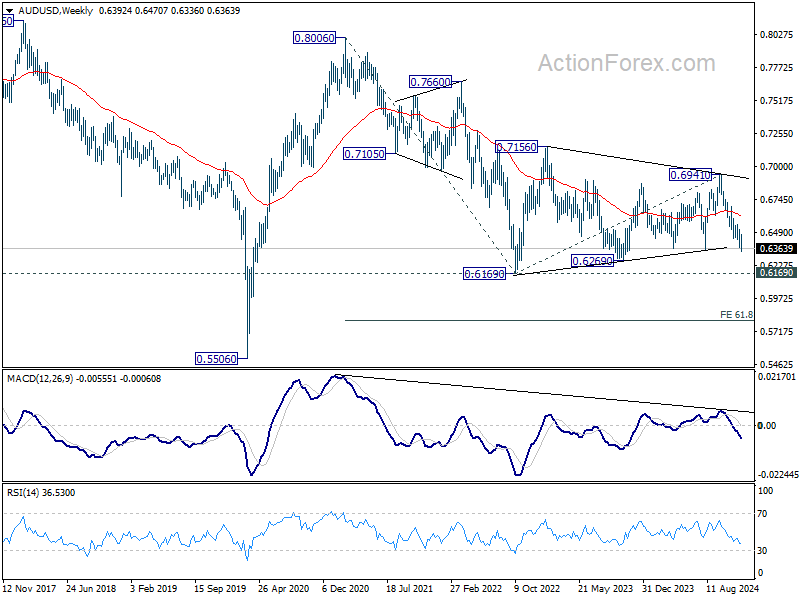
Technically, AUD/USD will soon enter into an important medium term support zone of 0.6169/6269 on next fall. Strong support could be seen there, at least on first attempt, to bring rebound. While AUD/USD would stay bearish even with a rebound, it would be hard for it to break through 0.6169, not until RBA's easing has commenced and we'd know the pace.
In Europe, at the time of writing, FTSE is up 0.31%. DAX is up 0.03%. CAC is up 0.37%. UK 10-year yield is down -0.0156 at 4.314. Germany 10-year yield is down -0.021 at 2.102. Earlier in Asia, Nikkei rose 0.01%. Hong Kong HSI fell -0.77%. China Shanghai SSE rose 0.29%. Singapore Strait Times fell -0.54%. Japan 10-year JGB yield rose 0.006 to 1.072.
US CPI accelerates to 2.7% in Nov, core CPI unchanged at 3.3%
November’s US inflation data came in line with expectations, showing no significant progress toward easing price pressures further. Headline CPI rose 0.3% mom, supported by a 0.3% mom rise in the shelter index, which accounted for nearly 40% of the monthly increase. Food prices rose by 0.4% mom, while the energy index rose 0.2% mom. Core CPI, excluding volatile food and energy prices, also rose by 0.3% mom.
On an annual basis, headline CPI ticked up from 2.6% yoy in October to 2.7% yoy in November, aligning with market forecasts. Core CPI, excluding the volatile food and energy components, remained steady at 3.3% yoy. Among key categories, food prices increased 2.4% yoy, while energy prices remained a deflationary force, falling -3.2% yoy.
RBA's Hause: Australia more seriously affected by global trade war because of China reliance
RBA Deputy Governor Andrew Hauser addressed the implications of US President-elect Donald Trump’s proposed tariffs at an event today. He highlighted that while higher global tariffs could depress activity across supply chains, the full extent of the effects would depend on various factors, including currency adjustments and fiscal responses in affected economies.
“Given this uncertainty, it is important that we don’t prejudge the implications of tariffs for policy but monitor developments closely and stand ready to respond appropriately as the facts emerge,” Hauser stated.
Hauser pointed out Australia’s unique vulnerability due to its trade exposure, with over 80% of its iron ore exports destined for China, which accounts for three-quarters of global iron ore imports.
This heavy reliance on China increases the risk of significant disruptions if Beijing becomes the target of punitive tariffs or if global trade realigns along geopolitical lines.
“This seems to suggest that Australia could find itself more seriously affected by a global trade war than some of the average exposure data suggest,” Hauser noted.
USD/JPY Mid-Day Outlook
Daily Pivots: (S1) 151.18; (P) 151.69; (R1) 152.47; More...
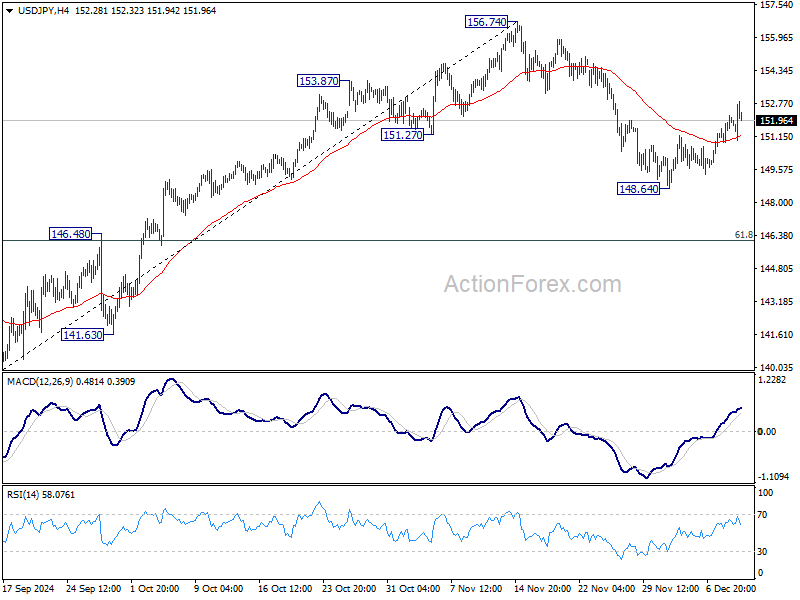
Intraday bias in USD/JPY remains mildly on the upside for the moment. Corrective pullback from 156.74 could have completed at 148.64, and larger rise from 139.57 might be still in progress. Further rally would be seen to retest 156.74 first. Firm break there will target 161.94 high next. For now, this will be the favored case as long as 148.64 support holds.
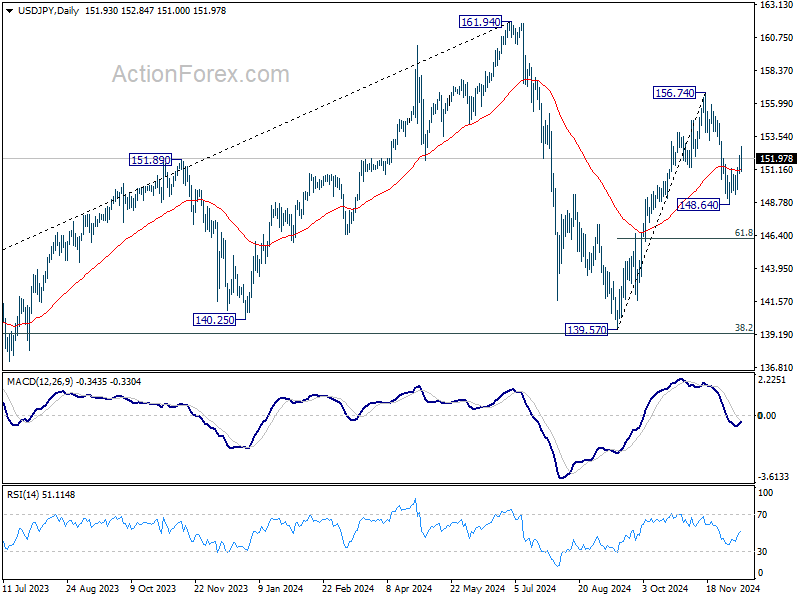
In the bigger picture, price actions from 161.94 are seen as a corrective pattern to rise from 102.58 (2021 low). The range of medium term consolidation should be set between 38.2% retracement of 102.58 to 161.94 at 139.26 and 161.94. Nevertheless, sustained break of 139.26 would open up deeper medium term decline to 61.8% retracement at 125.25.
USD/CAD Steady Ahead of BoC Rate Decision
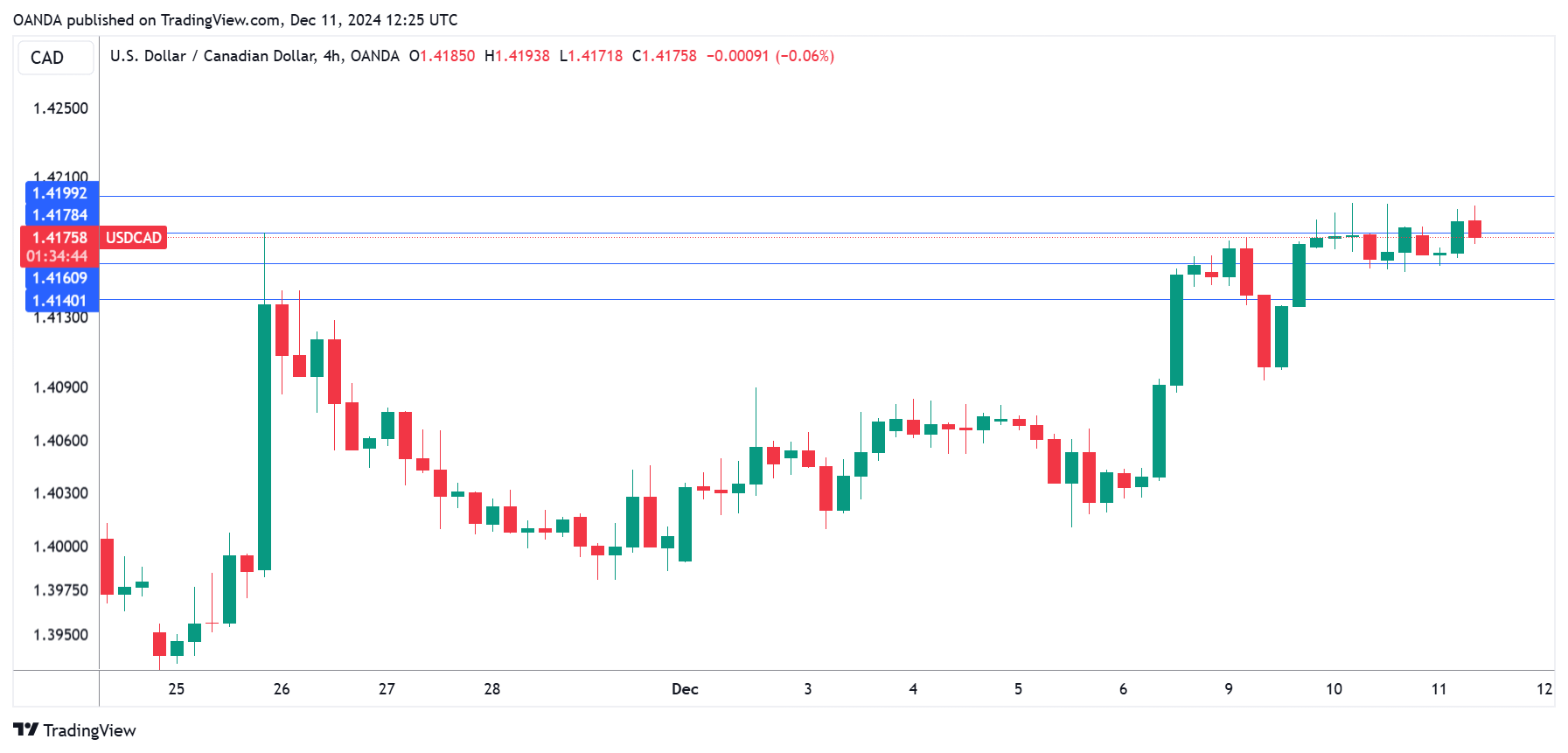
The Canadian dollar is drifting on Wednesday, ahead of the Bank of Canada rate decision later today. In the European session, USD/CAD is trading at 1.4181, up 0.10% at the time of writing.
BoC expected to slash rates by 50 basis points
The Bank of Canada is widely expected to end the year on a bang with a dramatic 50-bp cut at today’s rate meeting. The markets have priced in a 50-bp cut at 90%, so it would be a massive surprise if the BoC opts for a modest cut of 25 basis points. The BoC has cut interest rates four times this year, including a jumbo 50-basis point rate cut in October.
BoC policymakers can point to low inflation and a cool labor market to support the case for an oversized 50-bp cut. At the same time, the central bank doesn’t want to get too aggressive in its easing cycle, as core inflation remains around 2.5%, above the BoC’s target of 2%. If the BoC delivers a 50-bp cut, we could see the Canadian dollar lose ground.
Investors are keeping a close eye on the US inflation report which also will be released today. The November report is expected to show that CPI ticked higher. The market estimate stands at 2.7% y/y (vs. 2.6% in Oct.) and 0.3% m/m (vs. 0.2% in Oct.). This is somewhat about the Federal Reserve’s target of 2% but that hasn’t prevented the Fed from cutting rates twice this year. The Fed meets on Dec. 18 and the odds of a 25-bp cut are 86%, according to the CME’s FedWatch tool. A surprising drop in inflation would raise expectations of a 50-bp cut but the Fed appears on track for a modest 25-bp cut.
USD/CAD Technical
- USD/CAD is testing resistance at 1.4178. Next, there is resistance at 141.99
- 1.4160 and 1.4139 are the next support levels
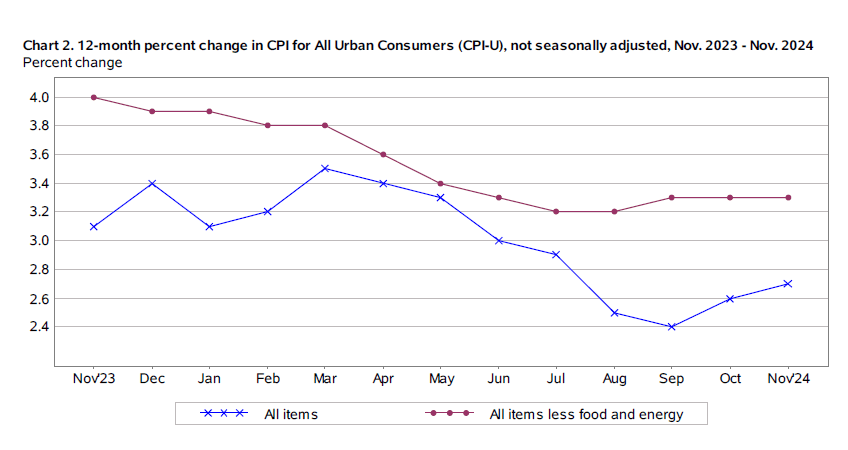
US CPI accelerates to 2.7% in Nov, core CPI unchanged at 3.3%
November’s US inflation data came in line with expectations, showing no significant progress toward easing price pressures further. Headline CPI rose 0.3% mom, supported by a 0.3% mom rise in the shelter index, which accounted for nearly 40% of the monthly increase. Food prices rose by 0.4% mom, while the energy index rose 0.2% mom. Core CPI, excluding volatile food and energy prices, also rose by 0.3% mom.
On an annual basis, headline CPI ticked up from 2.6% yoy in October to 2.7% yoy in November, aligning with market forecasts. Core CPI, excluding the volatile food and energy components, remained steady at 3.3% yoy. Among key categories, food prices increased 2.4% yoy, while energy prices remained a deflationary force, falling -3.2% yoy.
GBP/JPY Daily Outlook
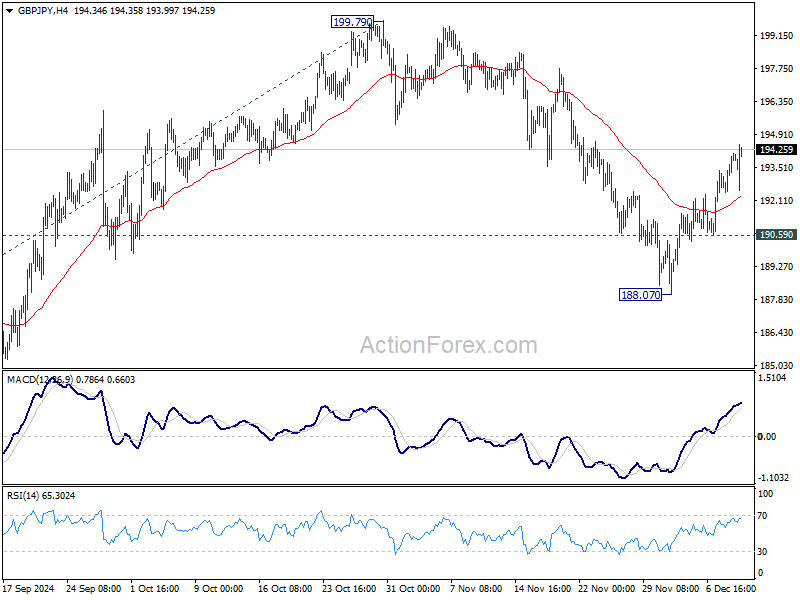
Daily Pivots: (S1) 192.99; (P) 193.57; (R1) 194.67; More...
No change in GBP/JPY's outlook, as it stays bearish as long as 55 D EMA (now at 193.97) holds. On the downside, below 190.59 minor support will bring retest of 188.07 first. Break there will target 183.70 support next. However, sustained trading above the EMA will bring stronger rebound back to 199.79 resistance instead.
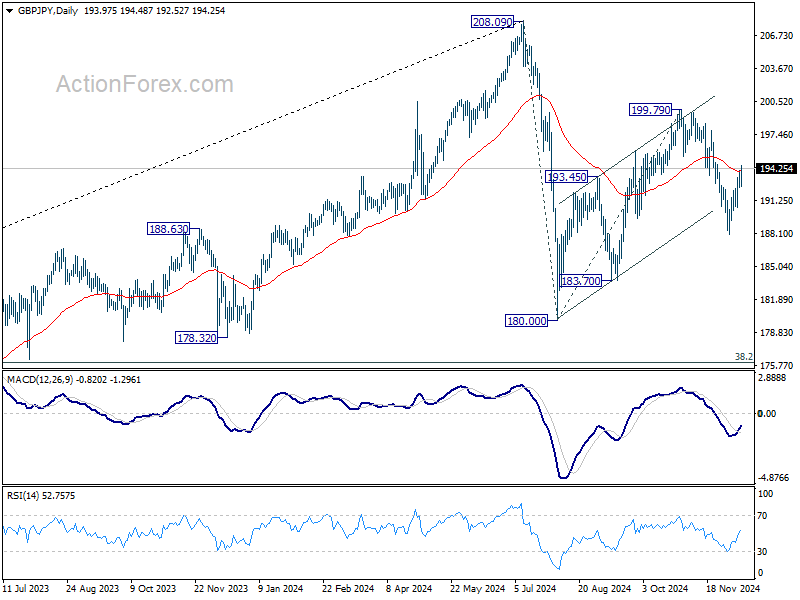
In the bigger picture, price actions from 208.09 are seen as a correction to whole rally from 123.94 (2020 low). The range of consolidation should be set between 38.2% retracement of 123.94 to 208.09 at 175.94 and 208.09. However, decisive break of 175.94 will argue that deeper correction is underway.
EUR/JPY Daily Outlook
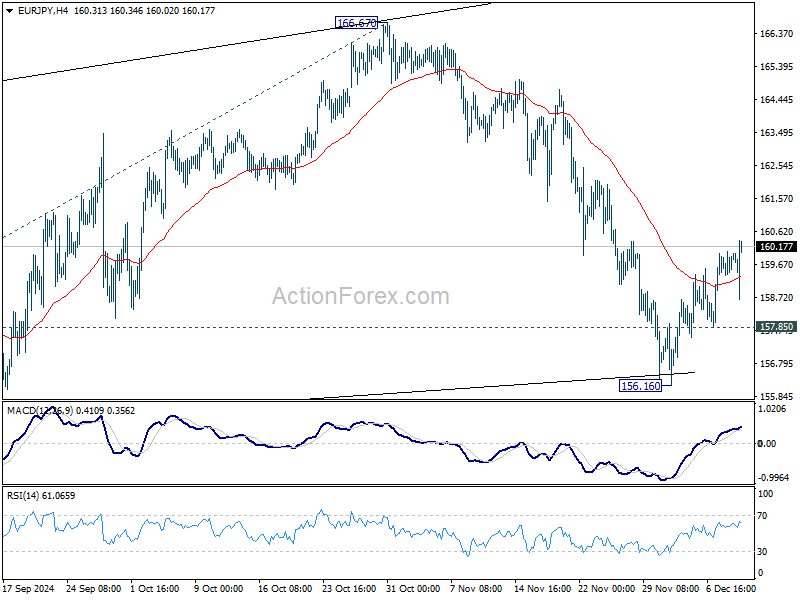
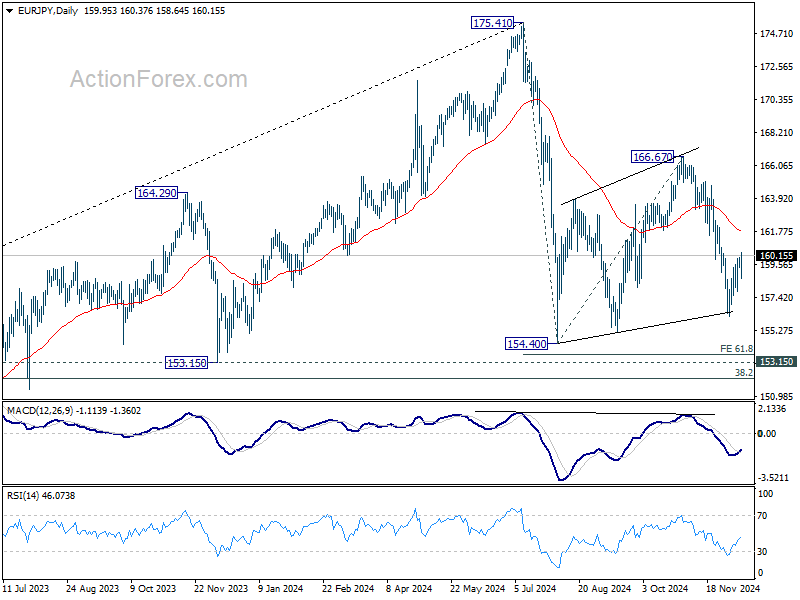
Daily Pivots: (S1) 159.53; (P) 159.80; (R1) 160.25; More...
No change in EUR/JPY's outlook. While recovery from 156.16 might extend, further decline is expected as long as 55 D EMA (now at 161.83) holds. On the downside, below 157.85 minor support will bring retest of 156.16 first. Break there will target 154.40 low next.
In the bigger picture, price actions from 175.41 are seen as correction to rally from 114.42 (2020 low). The range of consolidation should have been set between 38.2% retracement of 114.42 to 175.41 at 152.11 and 175.41 high. However, decisive break of 152.11 would argue that deeper correction is underway.
EUR/GBP Daily Outlook
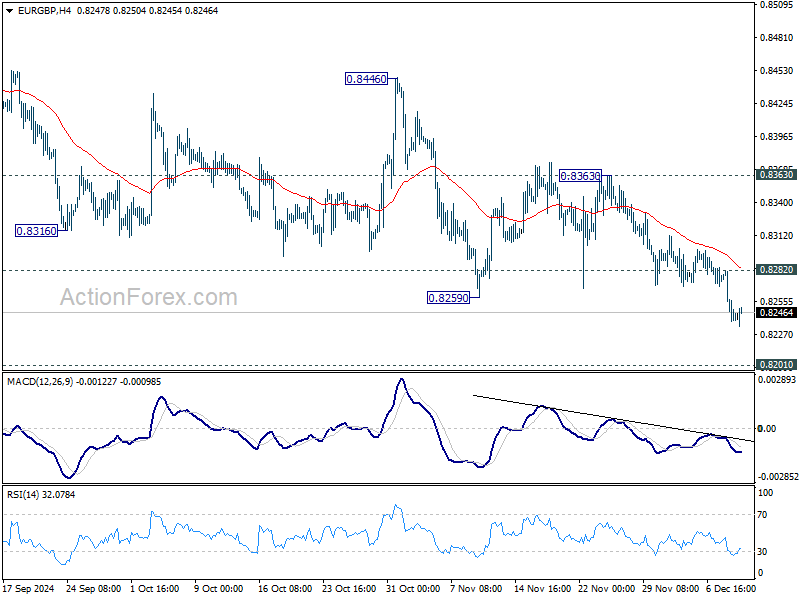
Daily Pivots: (S1) 0.8227; (P) 0.8255; (R1) 0.8272; More...
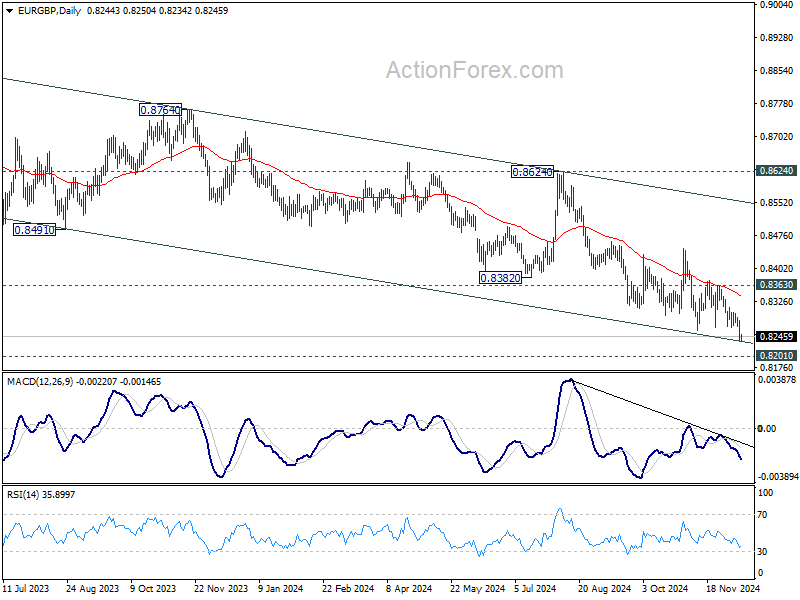
Intraday bias in EUR/GBP remains on the downside. Current fall is part of the larger down trend, and should target 0.8201 key support level next. Strong support could be seen there to bring rebound. On the downside, above 0.8282 minor resistance will turn intraday bias neutral first. Further break of 0.8363 resistance will be the first signal of bullish trend reversal. However, sustained break of 0.8201 will carry larger bearish implications.
In the bigger picture, down trend from 0.9267 (2022 high) is in progress. Next target is 0.8201 (2022 low), but strong support should be seen there to bring rebound. However, outlook will remain bearish as long as 0.8624 resistance holds even in case of strong rebound. Decisive break of 0.8201 will indicate long term bearish reversal.
EUR/AUD Daily Outlook
Daily Pivots: (S1) 1.6410; (P) 1.6475; (R1) 1.6571; More...
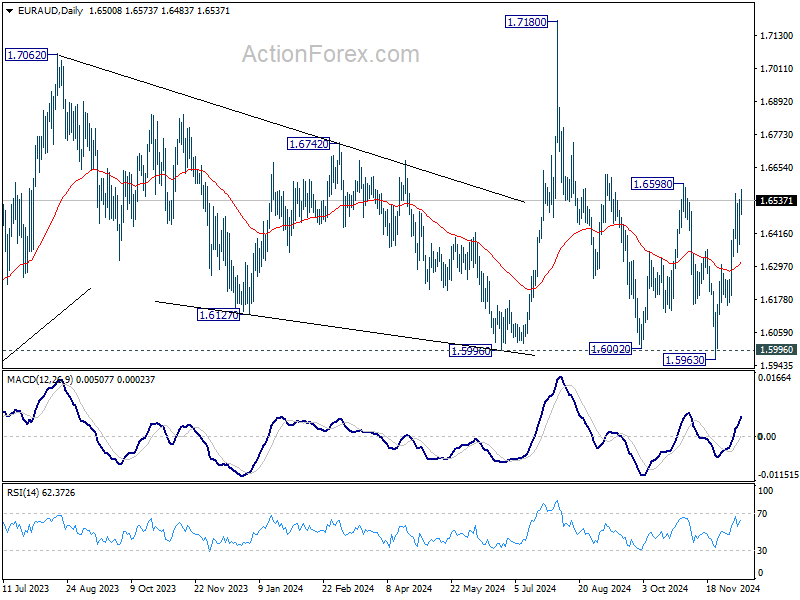
EUR/AUD's rally from 1.5963 is resuming by breaching 1.6559. Intraday bias is back on the upside. Firm break of 1.6598 resistance will confirm that whole fall from 1.7180 has complete with three waves down to 1.5963, and target a test on 1.7180 next. For now, further rally is in favor as long as 1.6349 support holds, in case of retreat.
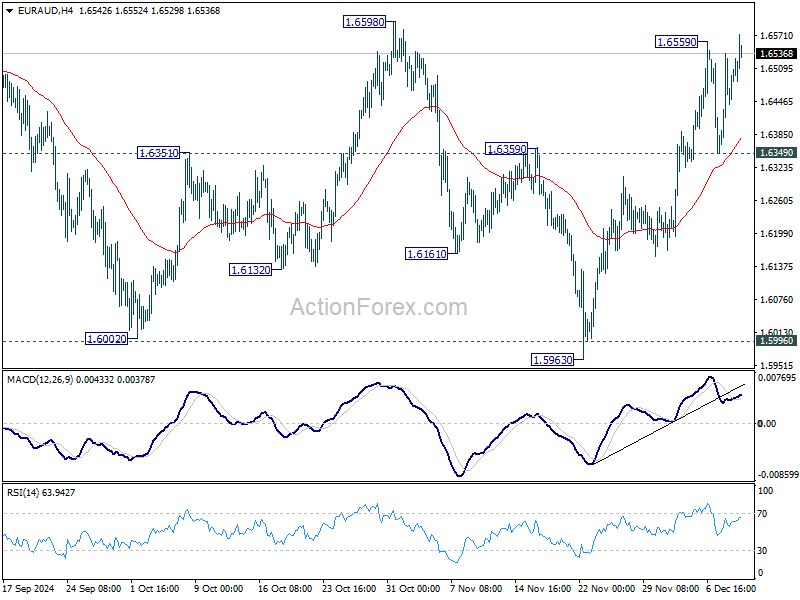
In the bigger picture, EUR/AUD is still holding on to 1.5996 key support despite brief breach. Larger up trend from 1.4281 (2022 low) is still in favor to resume through 1.7180 at a later stage. Nevertheless, sustained break of 1.5995 will indicate that such up trend has completed. Deeper decline would be seen to 61.8% retracement of 1.4281 to 1.7180 at 1.5388, even as a correction.
EUR/CHF Daily Outlook
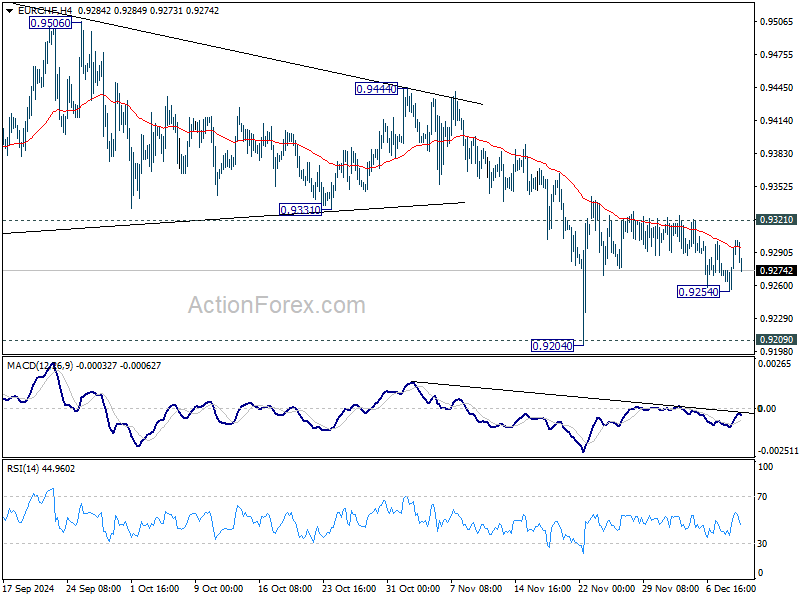
Daily Pivots: (S1) 0.9258; (P) 0.9293; (R1) 0.9329; More....
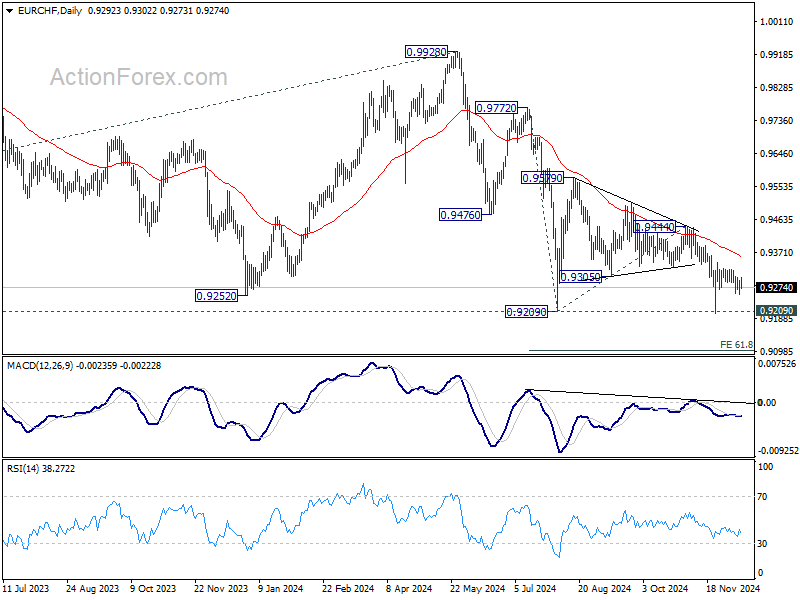
Intraday bias in EUR/CHF is turned neutral again with current recovery. But another decline is mildly in favor with 0.9321 resistance intact. Below 0.9254 will bring retest of 0.9204 low. Firm break of 0.9204/9 will indicate larger down trend resumption. Nevertheless, break of 0.9321 resistance will turn bias back to the upside to resume the rebound from 0.9204 instead, and that would be an early sign of bullish reversal for the near term.
In the bigger picture, outlook will now stay bearish as long as 0.9444 resistance holds. Decisive break of 0.9209 low will resume long term down trend to 61.8% projection of 0.9772 to 0.9209 from 0.9444 at 0.9096 next.
US Inflation and Dollar Index (DXY) : A Pre-CPI Analysis
- The upcoming US CPI data release on December 11th is a key event for markets, as it could influence the Fed’s decision on interest rates at its December 18th meeting.
- While a rate cut is widely expected, a higher-than-forecast CPI print could raise questions about the Fed’s path forward.
- The US Dollar has strengthened recently, partly due to positive economic data and a risk-off sentiment in markets. Can the Dollar continue its rise?
The upcoming release of the US Consumer Price Index (CPI) data on December 11, 2024, is set to draw the attention of market participants. Scheduled for release at 8:30 a.m. EST, Inflation may be starting to play on the minds of the Fed once more following an uptick in average hourly earnings as well.
Another factor raising inflation concerns are comments by President Elect Trump who stated that he is not sure he will be available to control the potential inflationary impact of his tariff proposals. However, as many have pointed out, tariffs may just be a negotiating tactic.
Heading toward the Fed meeting on December 18, market participants are pricing in around an 86% probability of a 25 bps rate cut. Inflation in my opinion is unlikely to change that narrative with any change to policy likely to come at the Feds January meeting.
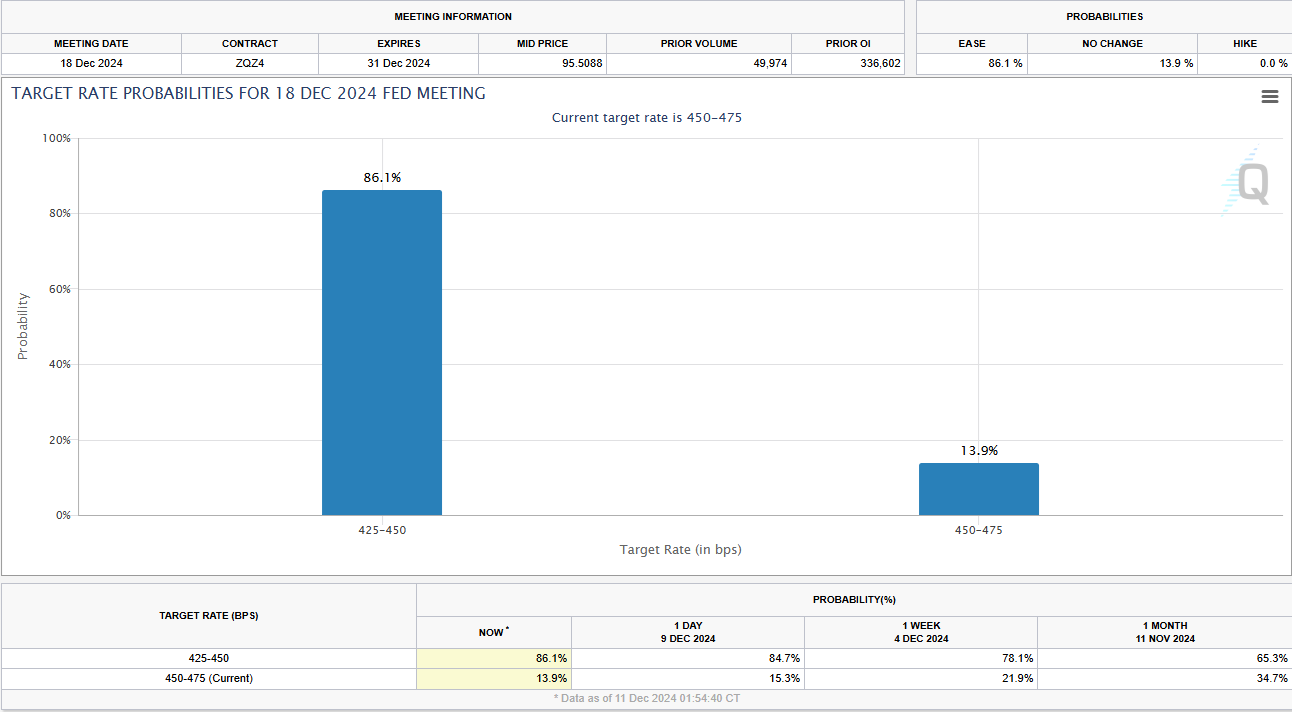
Source: CME FedWatch Tool (click to enlarge)
What is the Expected CPI Print?
Analysts predict that overall inflation (headline CPI) will go up slightly to 2.7% from 2.6% over the last year. Core inflation, which ignores food and energy price changes, is expected to stay the same at 3.3%. On a monthly basis, both measures are likely to rise by 0.3%.
This shows that inflation is steady but still a concern. Factors like stable housing costs and lower energy prices are expected to play a role in these changes.
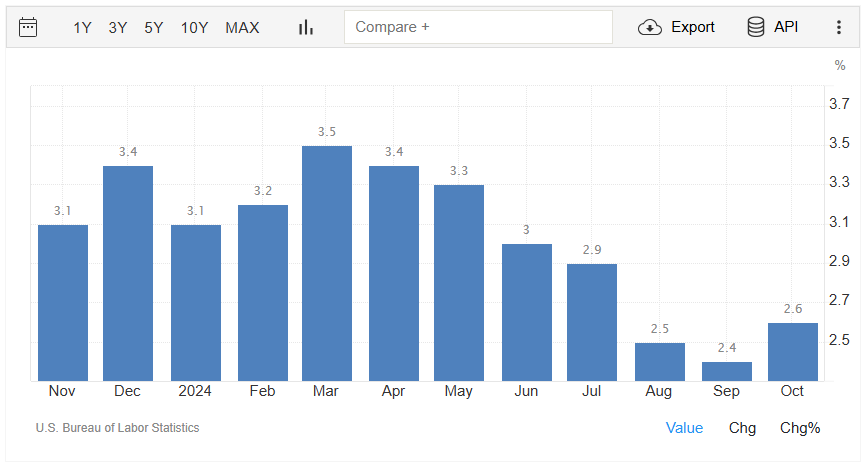
Source: TradingEconomics (click to enlarge)
The big question is whether this will be enough to result in any change to the Fed decision this month? Most Fed members have recently said they plan to cut interest rates by 0.25% at the December meeting. The Fed are also in their ‘blackout period’ at present, which means we have nothing else but the CPI data to go on ahead of the Fed meeting.
It’s easy to think the Fed is done worrying about inflation, but if core inflation goes above the expected 0.3% for the month, this could lead to a change in the probability of a rate cut even if it might not delay it. A high core CPI reading could make it more of a 50/50 proposition although i would still lean toward a rate cut.
An increase in the CPI prints, particularly the core reading could then in theory be responsible for another leg higher in the US Dollar index (DXY).
Technical Analysis – US Dollar Index (DXY)
From a technical standpoint, the dollar has strengthened this week, partly because of the very positive small business optimism report released yesterday. It’s not surprising that US business owners are excited about possible tax cuts and fewer regulations next year.
This coupled with a risk of tone at the start of the week which helped boost the US Dollars safe haven appeal have left the US Dollar Index eyeing acceptance above the 107.00 handle.
There is a trendline break which has come to fruition and hints at further US Dollar upside. Based on the rules of a trendline break the overall target of the breakout is around the 107.50 which could come into play on a higher US CPI reading.
The implications of this on other assets could be broad ranging with it likely to effect US equities, currencies and bond markets.
US Dollar Index (DXY) Daily Chart, December 11, 2024
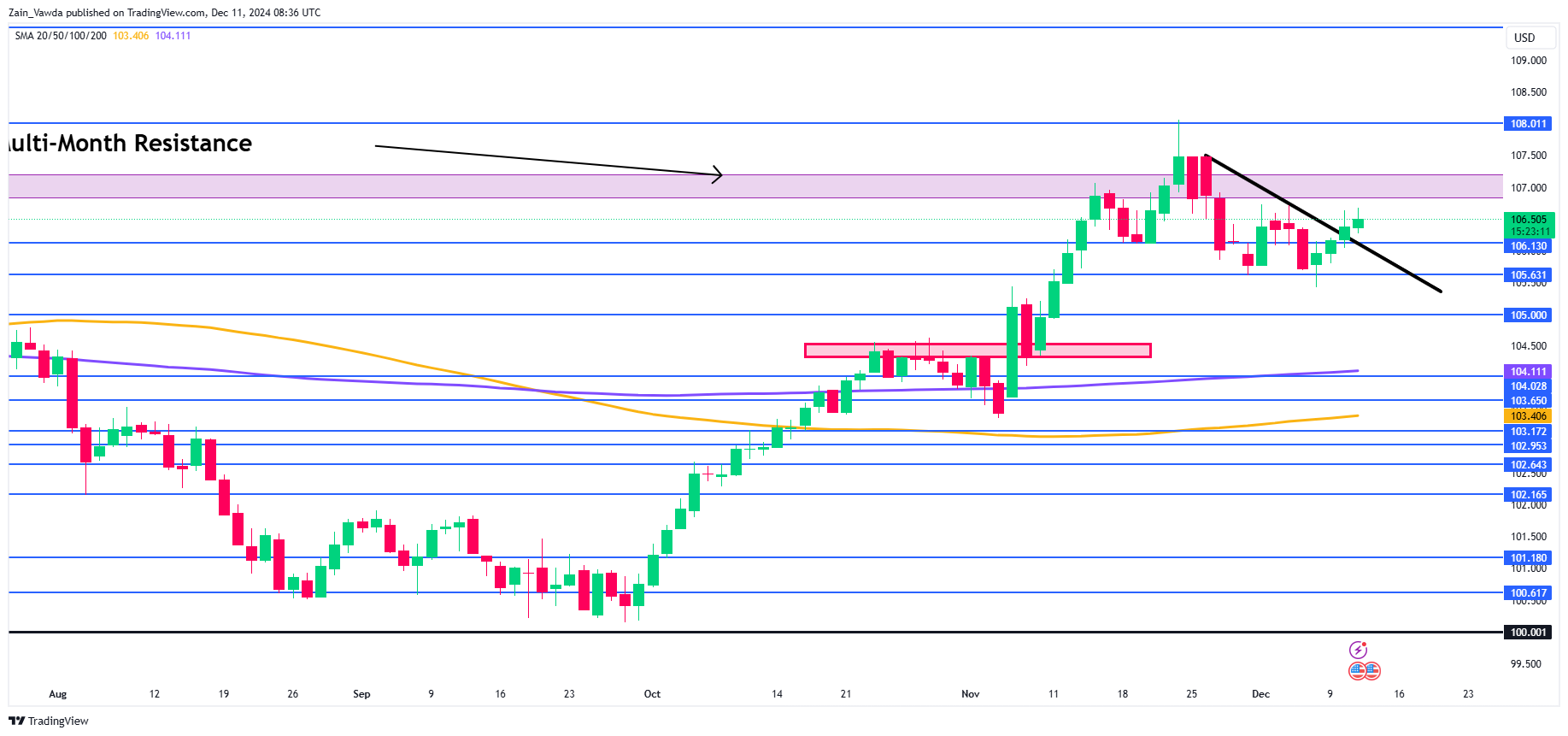
Source: TradingView.com (click to enlarge)
Support
- 106.13
- 105.63
- 105.00
Resistance
- 107.00
- 107.50
- 108.00
USDCAD Gears Down as BoC Rate Decision Looms
- USDCAD slows pace after fresh four-year high
- Bears wait below 1.4150, but uptrend could stay intact
- BoC rate announcement due at 14:45 GMT
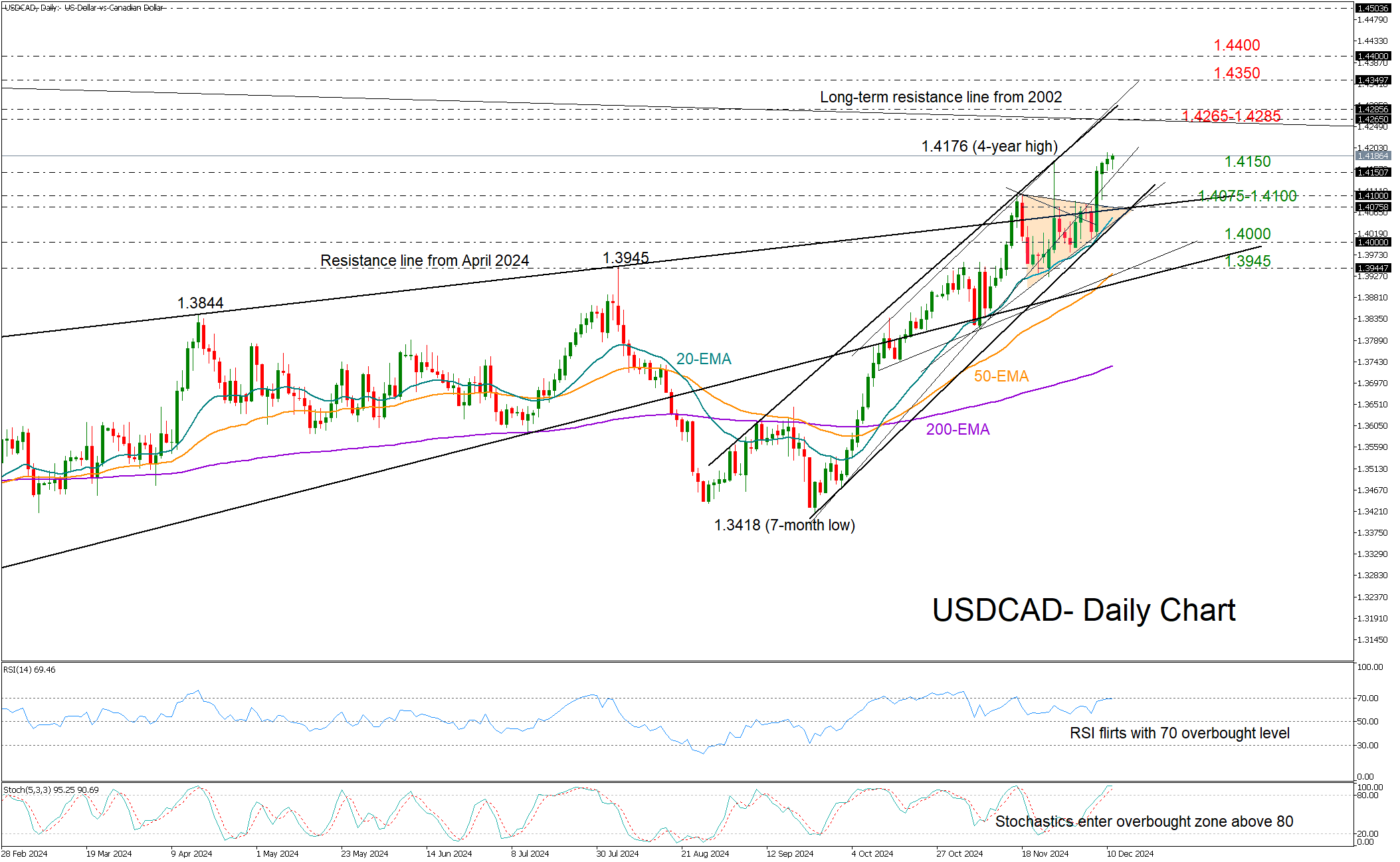
USDCAD broke above a neutral symmetrical triangle with a bang last Friday, surpassing November's four-year high of 1.4176, but since then the pair has been losing pace, raising questions about whether the rally is nearing a peak.
With the RSI and the stochastic oscillator hanging near overbought levels, a slowdown is likely. Yet only a drop below the 1.4150 barrier could activate fresh selling orders toward the 1.4075-1.4100 area. Another failure there could confirm additional losses toward the 1.4000 level, while a steeper decline could push toward the 50-day exponential moving (EMA) at 1.3945.
On the upside, if the bulls successfully claim the 1.4200 number, they could next target the 1.4265-1.4285 resistance trendline zone. A continuation above 1.4300 could take a halt near 1.4350 or around the 1.4400 mark.
Overall, USDCAD is still in a positive trajectory and any potential declines could present a “buying the dip” opportunity. A move below 1.4150 could trigger the next bearish action, whilst a move above 1.4200 could shift the attention back to the upside.