

Sample Category Title
US Economy Grows At Slowest Pace Since 2014
'There is enough reason to doubt the growth slowdown for the Fed to stay the course on tightening, especially with a bigger-than-expected pop in employment costs.' - Chris Low, FTN Financial
The US economy expanded at its weakest pace since the Q1 of 2014 in the three-month period to March, as consumer spending barely rose; however, a rise in business investment and improving pay growth held out hopes that the economy would regain momentum in the upcoming quarters. The Department of Commerce reported on Friday that the economy grew at a 0.7% annual pace in the Q1, following the preceding quarter's 2.1% and falling behind expectations for a 1.3% climb. The March quarter growth raised doubts over the Trump administration's ability to boost GDP growth and deliver economic reforms. Consumer spending, the largest contributor to US economic growth, advanced just 0.3%, the weakest since 2009. The Q1 economic slowdown was partially driven by the unusually warm weather, high volatility in inventories and the strong US Dollar. However, Friday's data showed a pickup in both wage and business investment growth. Therefore, analysts suggest that economic growth will likely rebound in the upcoming months. Moreover, the report showed a jump in inflation that would probably please the Federal Reserve and force it to raise rates at a quicker than expected pace. The next interest rate hike is largely expected to come in June.
EUR/USD Analysis: Opens Red
'The dollar shrugged off early modest losses in holiday-thinned Asian trading on Monday, while solid European inflation data underpinned the euro.' – Reuters Tokyo markets team
Pair's Outlook
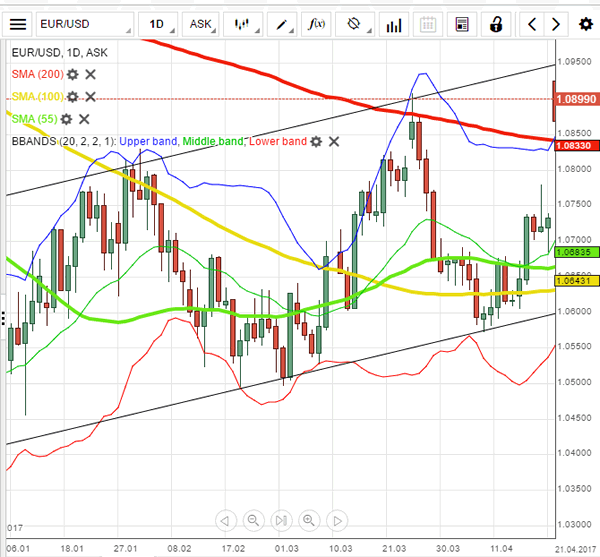
EUR/USD opened in the red zone on the daily chart, showing a solid downward movement just after it had opened significantly above Friday's closing price. The motion is currently being cut by the weekly Pivot Point at 1.0890, but the area might not be enough to keep the cross above Friday's opening level. The next potential target could be 1.0856, the upper boundary of the hourly unconfirmed channel with the 200-hour SMA at 1.0837 coming up next. In case the motion reverses, 1.0888 could come into play on the upside.
Traders' Sentiment
SWFX traders remain bearish, as 59% of open positions are short, and 54% of trader set up orders are to sell the Euro.
GBP/USD Analysis: To Begin Edging Lower
'GBP/USD should be capped in front of raised range resistance (1.30-32) and is likely to slide back towards the centre of its 1.20-1.32 rang.' – Westpac (based on FXStreet)
Pair's Outlook
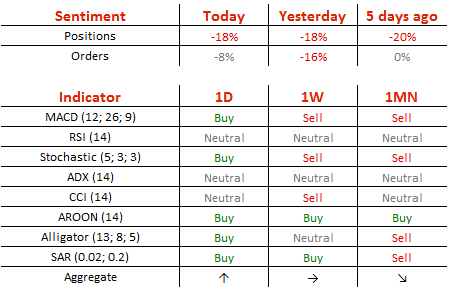
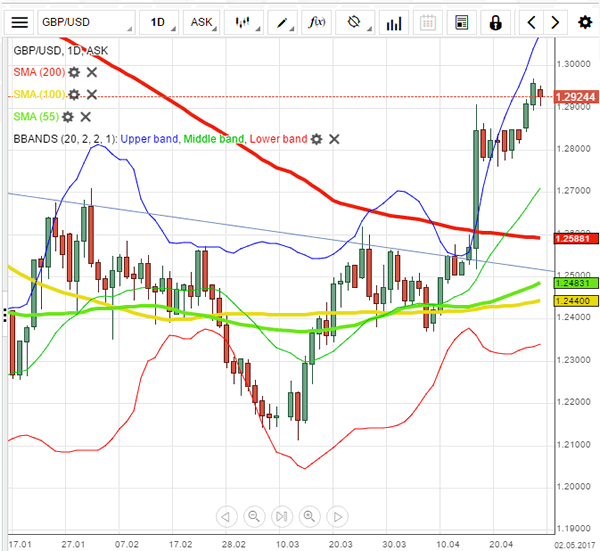
Substantially weak US GDP data on Friday allowed the British Pound to take the upper hand and experience another leg up. As a result, the Cable got close to retesting the broadening rising wedge's resistance line, thus, a U-turn today is the most probable outcome. The weekly pivot point is providing immediate support just under the 1.29 mark, but losses are expected to exceed this level, with focus falling on the weekly S1 at 1.2829. However, technical indicators in the daily timeframe are giving distinctly bullish signals, suggesting a close in the green zone is possible. There is room for a rally, where the 1.30 handle is likely to be the intraday ceiling.
Traders' Sentiment
There are 51% of traders holding short positions today (previously 50%), while 60% of all pending orders are to sell the Buck.
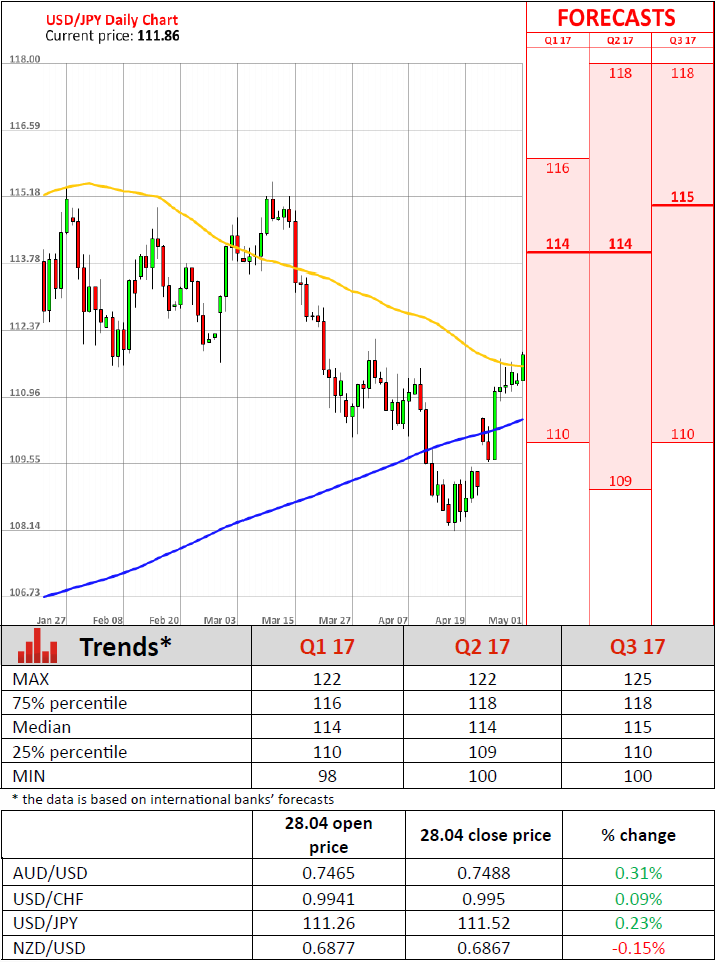
USD/JPY Analysis: Attempts To Pierce 55-Day SMA
'Dollar/yen is holding up, despite the weaker U.S. GDP.' – Mizuho Securities (based on Reuters)
Pair's Outlook
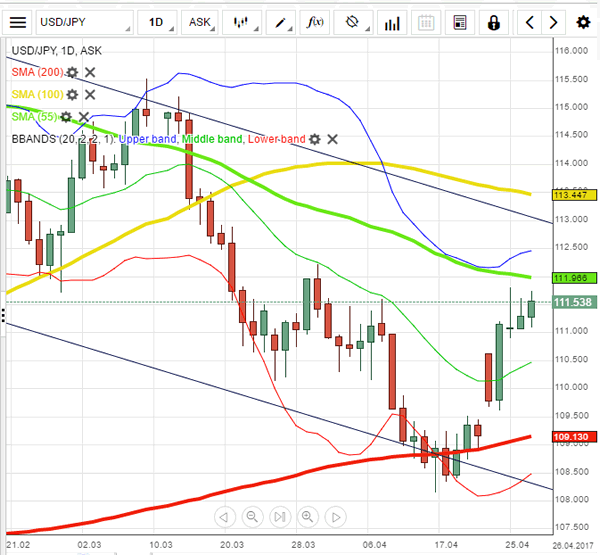
In spite of a an extremely weak US GDP reading on Friday, the US Dollar managed to outperform the Japanese Yen, adding 27 pips. The Buck managed to retain its strength over the weekend, eager to take another shot at climbing over the 55-day SMA. The given SMA represents immediate resistance, which is considered to be the only solid obstacle on the path towards the descending channel's resistance line. The Greenback appears to be lacking impetus to breach the 55-day SMA at the moment, therefore, a close at 111.60 or lower remains highly possible, especially since technical indicators keep giving mixed signals and the RSI specifically is close to the turnaround point.
Traders' Sentiment
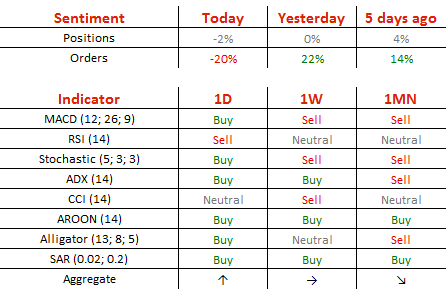
Today 53% of all open positions are long, compared to 51% on Friday. Meanwhile, the number of purchase orders inched up from 57 to 67%.
Gold Analysis: Opens Inside Previous Range
'Spot gold gave back Friday's gains as the dollar bounced and slipped 0.35 percent to $1,262.90 an ounce.' – Shinichi Saoshiro (based on Reuters)
Pair's Outlook
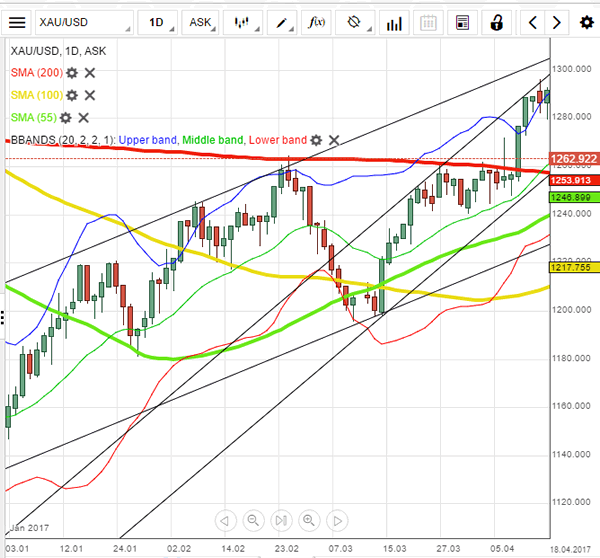
Gold continued the indecisiveness on the daily chart maintaining the overall ranging motion by slipping from the top it had managed to post on Friday. A strong red candle showed daily risks being skewed to the downside, setting eye on 1,260.48, the weekly S1. The amplitude of the dip might be a certain display of today's trading range, as no levels in between are likely to mess with the motion. Upside potential is likely to be cut around 1,269.43/77 where a cluster of resistances are to provide supply in case XAU/USD takes a different path over the day.
Traders' Sentiment
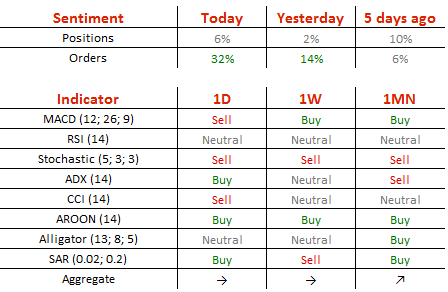
SWFX market sentiment remains bearish, as 53% of open positions are short. However, 63% of pending commands are to buy the bullion.
The Main Focus Of The Trading Week Is On The US, Australia, And The EU
Need to know
The main focus of the trading week is on the US, Australia, and the EU. The central banks of both Australia and the United States will announce their interest rate decisions, release their monetary policy decisions, and offer official statements. Another key news event, the US Non-Farm Payroll (NFP) figures, will be released on Friday. Last but not least, both Federal Reserve (Fed) chair Yellen and ECB (European Central Bank) President Draghi are expected to speak this trading week.
Coming up
Bank holiday takes place on Monday, 1 May.
Many European countries and China have official public holidays on the 1st of May. The list of countries which are offering a national holiday include major financial hubs such as the UK, Germany, France, Italy and Switzerland.
Why should you care? The Forex, CFD, and financial markets could be slower and quieter in their price movements and volatility due to the fact that major financial hubs are having a day off.
Interest rate decision by the RBA (Australia) is announced on Tuesday, 2 May.
The Reserve Bank of Australia (RBA) is announcing its interest rate decision. The decision is made by the Reserve Bank Board members who need to reach a common consensus on the best rate for the country considering price stability, full employment, and the eneral economic prosperity of the Australian people.
Why should you care? The interest rate is a critical factor in the value of a currency. Higher interest rates are more attractive and increase demand whereas lower interest rates lead to lower demand. The previous rate is 1.5%, and the forecasted figure is 1.5%.(*)
British manufacturing PMI is announced on Tuesday, 2 May.
The PMI figure is an index based on surveyed purchasing managers in the manufacturing industry. The survey asks about 600 managers to rate the level of business conditions, including new orders, employment, and production.
Why should you care? A figure above 50.0 indicates industry expansion whereas a number below 50.0 indicates contraction. The previous figure is 54.2 and the current forecast is 54.0.(*)
German, EU and New Zealand unemployment figures are announced on Tuesday, 2 May.
Unemployment figures indicate the percentage of the work force that is unemployed and actively seeking employment. On Tuesday traders can expect multiple unemployment figures from Germany, the EU in total and New Zealand.
Why should you care? Full employment could lead later on to inflation which in turn could lead to a hike of the interest rate. A lack of employment could have the opposite effect. The previous EU unemployment rate is 9.5%, the forecast is 9.4%.(*) The previous German unemployment is 5.8%, the forecast is 5.8%.(*) Both the previous unemployment rate and current forecast for New Zealand is 5.2%.(*)
The US interest rate decision and FOMC statement take place on Wednesday, 3 May.
The Federal Reserve (Fed) of the United States is announcing its interest rate decision, which is a key part of monetary policy and currency valuation. The FOMC statement communicates the monetary policy towards the public, traders, and investors which indicates their voting, commentary, and their economic outlook.
Why should you care? The changes in the FOMC statement indicate how the board members have changed their view on the economic development of the US. The interest rate decision is expected to stay at 1.0%, the same as the previous announcement.(*)
ECB President and Fed Chair Speak on Thursday and Friday, 4 and 5 May.
The President of the ECB (European Central Bank) Draghi and the Fed (Federal Reserve - US Central Bank) Yellen are expected to speak. Draghi will offer a speech at the Jean Monnet Foundation in Switzerland whereas Yellen is expected to speak at Brown University in Providence.
Why should you care? The president of a central bank always receives attention when he or she speaks because of their influence on nation's or currency bloc's monetary policy and interest rate decisions.
Australian Monetary policy meeting minutes are released on Friday, 5 May.
The meeting minutes provide detailed records about how the Australian board members view the current and future economic conditions. The upcoming meeting offers more understanding and information what influenced their decision to set interest rates as they are.
Why should you care? Many factors influence an interest rate decision, which is a critical part of understanding the demand for any currency. Understanding how the board members of a central bank view and analyse those factors is of importance to all traders and investors.
US NFP figures and unemployment rate are announced on Friday, 5 May.
The Non-Farm Payroll (NFP) figures are one of the most important statistics during the month as they indicate the number of employed people in the US. Job creation is an important leading indicator of consumer spending. The US unemployment figure shows the percentage of the work force that is unemployed and actively seeking employment.
Why should you care? The figures that are higher or lower than the forecast tend to impact the financial markets. The NFP previous figure is 98k and the forecast is 185k.(*) The previous unemployment figure is 4.5% and the forecast is 4.6%.(*)
Daily Technical Analysis: EUR/JPY Bullish SHS Pattern And Possible Breakout
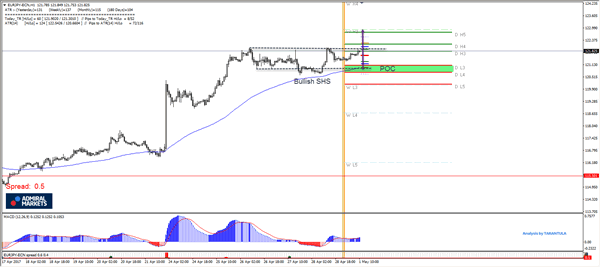
In the midst of a bank holiday, the EUR/JPY is moving in a steady uptrend trying to reach 122.54 full ATR projection. The pair has formed a bullish shoulder-head-shoulder pattern also known as inverted head and shoulders. A strong 1h momentum breakout above 122.00 should target 122.16 (D H4) followed by 122.54 and 122.80 (D H5/W H3 confluence). In the case of retracement, pay attention to POC 120.75-90 (D L3, left shoulder bottom, ATR pivot, EMA 89). The rejection should target 122.00 and above-mentioned levels if breakout happens.
W L3 - Weekly Camarilla Pivot (Weekly Interim Support)
W H3 - Weekly Camarilla Pivot (Weekly Interim Resistance)
W H4 - Weekly Camarilla Pivot (Strong Weekly Resistance)
D H4 - Daily Camarilla Pivot (Very Strong Daily Resistance)
D L3 – Daily Camarilla Pivot (Daily Support)
D L4 – Daily H4 Camarilla (Very Strong Daily Support)
POC - Point Of Confluence (The zone where we expect price to react aka entry zone)
Technical Outlook: USDJPY – Extension Above Weekly Cloud, Eyes Immediate Target At 112.18, Fed Is In Focus For More...
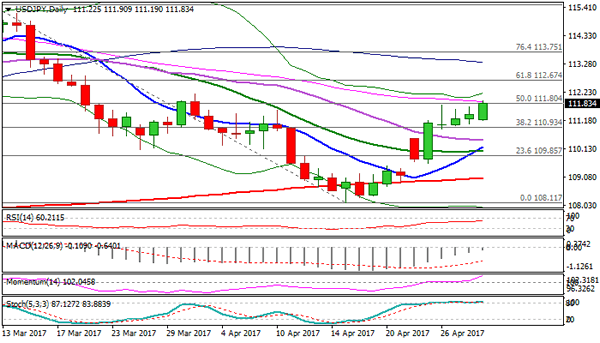
Strong bullish signals are generating on Monday's fresh acceleration above weekly cloud top (above which the pair closed last week) and probe above next pivots at 111.80/87 (weekly Tenkan-sen/daily 55SMA). Broader dollar bulls received boost on lift above weekly cloud and may accelerate through next key barrier at 112.18 (31 Mar high) for further retracement of larger 115.49/108.11 descend. Repeated close above weekly cloud will be seen as confirmation of bullish continuation, however, focus is on the tone of Fed's meeting that ends on Wednesday that is expected to give fresh direction signals for the greenback.
Res: 112.18, 112.67, 113.00, 113.36
Sup: 111.36, 111.19, 110.85, 110.44
EURUSD Intraday View
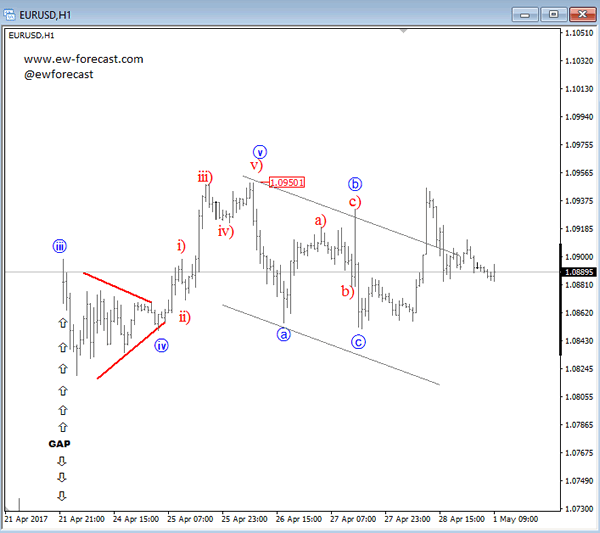
European markets are closed today in in observance of Labor Day so we can expect limited price action and no real breakouts or trend changes yet. That said, EURUSD can see another test of 1.0950 high if we consider that drop was made in three waves at the end of last week. But we still think that upside is going to be limited, so reversal may follow sometime this week.
EURUSD, 1H
Equities Higher, USD Mixed Following Averted Shutdown Of US Congress
Global equities rose with U.S. futures, fixed income retreated and JPY weakened as a tentative deal by the U.S. Congress to avert a government shutdown overshadowed weaker economic data from China and the U.S. over the past few days. Per Republican and democratic aides, the U.S. House and Senate negotiators reached a tentative bipartisan agreement Sunday night on a $1.1 trillion bill to keep the government open through the end of September. The news triggered a swing in markets after equities and currencies' traders had been loath to take additional risk ahead of a busy week for macro-economic events and data.
Japanese equities advanced to their highest level since March after their best week of the year. With Japan225 holding firm above 19300. JPY weakened for the fifth day out of six, comfortably holding above 111.50. Gold has retreated to 1260 following the retracement of US treasuries.
Oil is holding at its lowest level in a month trading just above 49.00 with high inventories dragging on markets that have been grappling with a global supply glut for the last few years. Iran's oil minister said on Saturday that “OPEC and non-OPEC countries had given positive signals for an extension of output cuts, which Tehran would also back”. The Organization of the Petroleum Exporting Countries (OPEC)meets this month to discuss oil supply policy.
Trading volumes are lower than average due to the Labor Day/May Day holiday in Asia and Europe. Later this week Japan will be closed for a three-day holiday.
Traders will be watching comments from a policy meeting of the Federal Open Market Committee this week with the monthly U.S. employment report on Friday being a major focus. We will also see corporate earnings from global heavyweights. The second round of the French presidential election takes place May 7, candidate Marine Le Pen said Monday she would begin negotiations on a euro exit immediately if elected. Traders are also weighing the possibility of escalating tension between the U.S. and North Korea.