Sample Category Title
USDCAD Canadian Dollar Lower After Lumber Tariffs
Trump Administration Playing Hardball Ahead of NAFTA renegotiation
The Canadian dollar is lower against the greenback after early tweeting from US President Trump and a confirmation later by the Department of Commerce on new tariffs against Canadian softwood lumber producers. Commerce Secretary Wilbur Ross said that Canada has been a “generally a good neighbour, but that doesn't mean they don't have to play by the rules”. The US is targeting five Canadian lumber exporters of receiving subsidies making it hard for US producers to compete.
Secretary Ross wanted to get the lumber dispute out of the way ahead of the NAFTA talks which at this point look like a tense affair given the opening salvo by the United States.
Economic data out on Wednesday was not supportive of the US dollar with the Conference Board's consumer confidence index fell to 120.3 after a forecast of 123.7. The drop came after a 16 year high last March at 125.6. Confidence still remains strong, but so far retail sales have not reflected the improved assessment from consumers if they don't spend.
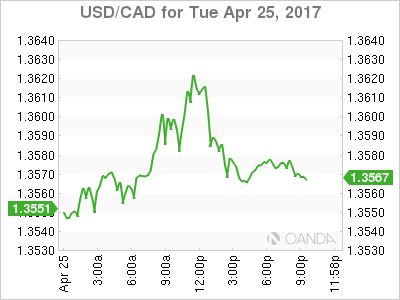
The USD/CAD gained 0.51 percent in the last 24 hours. The currency pair is trading at 1.3588 after the comments from the Trump administration announced a tariff on softwood lumber that could reach 24 percent. Canadian Prime Minister Justin Trudeau reacted by vowing to protect Canadian interests.
The move from Washington had been unexpected as Canada had avoided being in the line of fire of Trump, unlike Mexico and China. The news was specially negative for the CAD ahead of a renegotiation of Nafta. Trump made it one of his campaign promises to tear the deal. He has softened his tone on the trade agreement, looking for a renegotiation now, but echoing back to his inauguration it will be with an America first in mind.
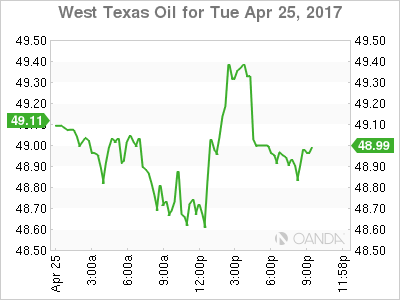
West Texas gained 0.39 percent on Tuesday trading. The price of a barrel of WTI is trading at $49.11 after having traded below $49 earlier in the day. Crude prices have been volatile as investors face uncertainty regarding the effect the Organization of the Petroleum Exporting Countries (OPEC) production cut has accomplished and if a six month extension could offset the ramp in production from US shale producers.
Russia is set to discuss the extension to the deal on May 24, one day ahead of the OPEC general meeting in Vienna. While compliant with the first agreement Russian production is usually slow in the first half of the year so little sacrifices were made. Extending the deal would require sensitive conversations with its largest producers who have already cut 250,000 of barrels of output.
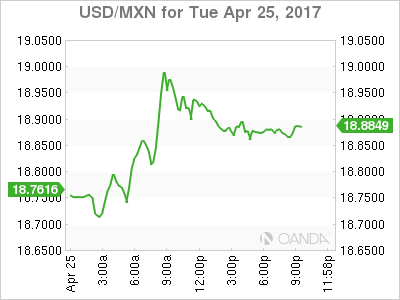
The USD/MXN gained 1.034 percent on Tuesday. The currency is trading 18.9034 after Trump once again tweeted about the Wall along the Mexican border. He wanted to be clear that dropping the funding request from the bill to avoid a government shutdown does not mean he is not still going to pursue it.
The peso also depreciated after the lumber tariffs against Canada were announced as a border tax has been mentioned as a funding mechanism to pay for Trump's Wall. Nafta currencies were higher after the Macron and Le Pen result in the first round of the French presidential elections with crude adding support by ending a multi-session slide only to face Trump caused market turbulence.
Retail sales in Canada and US crude oil inventories will share the spotlight on Wednesday. The market is expecting a drop in retail sales of 0.2 percent while crude is forecasted to show another 1 million barrel drawdown.
Market events to watch this week:
Wednesday, April 26
8:30am CAD Core Retail Sales m/m
10:30am USD Crude Oil Inventories
11:50pm JPY Monetary Policy Statement
Thursday, April 27
Tentative JPY BOJ Outlook Report
Tentative JPY BOJ Policy Rate
2:30am JPY BOJ Press Conference
7:45am EUR Minimum Bid Rate
8:30am EUR ECB Press Conference
8:30am USD Core Durable Goods Orders m/m
8:30am USD Unemployment Claims
Friday, April 28
4:30am GBP Prelim GDP q/q
8:30am CAD GDP m/m
8:30am USD Advance GDP q/q
EUR/JPY Back For Another Test Of Resistance
We're back after the ANZAC Day break in Australia and I wanted to immediately pick up basically where we left off with the Euro.
Flicking through my Euro pair watchlist, it's EUR/JPY that immediately caught my eye this morning, after testing higher time frame trend line resistance at the same time as EUR/USD tests horizontal resistance.
Take a look at the level that EUR/JPY is back testing on the daily chart:
EUR/JPY Daily:
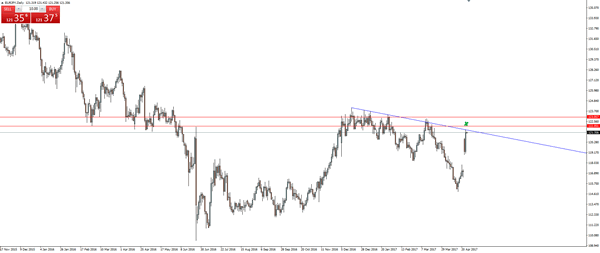
We have spoken about this EUR/JPY confluence of resistance before, and already had the trend line drawn in from that previous profitable short trade.
The French election gap up and rally obviously changed things quick-smart, but as we keep finding time after time, even after these big fundamental shifts, higher time frame technical levels are so often still respected.
Where the Euro goes from here all depends on how the market views which way the second round of French election voting will go. As a trader, the key for us isn't to try to predict the result as such. It's to put ourselves in the best possible position to take advantage of a major market repricing if the predictions are wrong.
With EUR rallying across the forex board, it's pretty obvious to see which direction the market thinks the result is going to go. Do you agree? Then how are you going to trade it?
Trump Tax & ECB Hint
We've spent the past six months getting to know Donald Trump and a playbook is beginning to emerge. It was evident in the trade as USD/CAD hit a 14-month high on Tuesday. Euro soared ahead on chatter that the ECB may hint at tapering in June. Australian CPI is due up next. The stocks rally stopped out the DOW30 short and USDCAD long Premium trades, while the EURUSD long from Friday hit its final target. 8 of the last 10 EURUSD trades in the Premium Insights since the Dec Fed hike have hit all targets.
Actions from Trump follow a three-part arc. First is the hint, the act itself and then damage control by his staff. The latest example was his spat with Canada over dairy.
He first mentioned Canada last week on a trip to Wisconsin when he said dairy farmers were being treated unfairly. On Tuesday, he slapped tariffs on Canadian lumber as part of the response. Afterwards, Commerce Sec Wilbur Ross downplayed the move and said Canada was a good neighbour.
In terms of trading, the time to sell CAD was on the first mention, even though it didn't include a specific threat. Trump appears to speak off-the-cuff but he's repeatedly show that it's part of an agenda and that was the case with Canada. The time to buy back CAD was shortly after the act itself. The tariffs sent USD/CAD up through 1.36 on Tuesday to the highest since last year when oil was bottoming. The loonie staged a small recovery back to 1.3560 on Ross' comments.
Along with that arc, the pattern has been that the first move from Trump is the strongest. When he bombed Syria, the fear was that it was the start of a campaign, but it's gone quiet since. Expect Trump to move on from Canada now.
As for USD/CAD, Trump isn't the only factor. Oil climbed a half-cent Tuesday but it remains in a downtrend. Meanwhile, the French election result and hopes for a Trump tax cut are the driving force in broader markets.
But if you apply our arc to the tax story, you had the hint on Friday. That was the time to buy risk assets. The 'plan' itself has largely been leaked so that may mark the top. In the aftermath his staff will play down parts of the plan that are unrealistic.
Aside from Trump, Australian and New Zealand traders returned from holiday today and that Aussie Q1 CPI report is on the agenda at 0130 GMT. The consensus is for a 2.2% y/y rise with the trimmed mean up 1.8%. Expect a big AUD move on any miss.
Pound Gains Ground as US Consumer Confidence Slides
GBP/USD has posted moderate gains on Tuesday, erasing the losses which marked the Monday session. In North American trade, the pair is trading at 1.2830. On the release front, British Public Sector Net Borrowing posted a debt of GBP 4.4 billion, larger than the estimate of 2.6 billion. In the US, CB Consumer Confidence dropped to 120.3, missing the forecast of 123.7 points. There was better news from the housing and manufacturing sectors. New Home Sales rose to 621 thousand, well above the estimate of 590 thousand. As well, the Richmond Manufacturing Index came in at 20 points, above the forecast of 18 points.
On Monday, European leaders met in Brussels to discuss a united front in the Brexit negotiations. Britain wants any deal to include the financial sector, but the Europeans are working on a draft that would exclude the financial sector, it is governed by EU rules. There are also likely to be sharp disagreements over the size of Britain's debt to the EU. For now, the British government is concentrating on the June election, but after that things could get nasty between the UK and the EU. If the Brexit talks run into trouble, that could spell bad news for the British pound.
President Trump will have to reach out to the Democrats in order to avoid a shutdown of the federal government on Saturday. Congress must pass a spending bill which will fund the government until October, but the bill requires the backing of 60 senators. This means that the Republicans (who control 52 seats) will need the support of 8 Democrats. This has led to bipartisan negotiations, and it's reasonable to expect that these talks could go down to the wire, as both sides try to stick to their positions and try not to blink first. The last shutdown was in 2013, lasting 17 days. Another shutdown would be embarrassing for Trump, as it would start on his 100th day in office and would cast doubts on his ability to push his budget and tax plan through Congress.
Trade Idea Wrap-up: USD/CHF – Stand aside
USD/CHF - 0.9932
Most recent candlesticks pattern : N/A
Trend : Near term down
Tenkan-Sen level : 0.9938
Kijun-Sen level : 0.9945
Ichimoku cloud top : 0.9948
Ichimoku cloud bottom : 0.9947
New strategy :
Stand aside
Position : -
Target : -
Stop : -
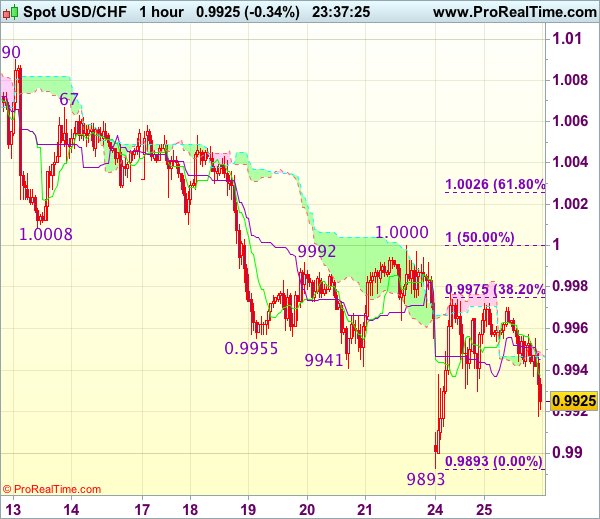
Although dollar has slipped again after faltering below resistance at 0.9981 and near term downside risk remains for weakness towards yesterday’s low at 0.9893, break there is needed to confirm recent decline from 1.0108 has resumed and extend weakness to 0.9865-70 (2 times extension of 1.0108-1.0008 measuring from 1.0067) but reckon support at 0.9831 would hold from here, bring rebound later.
In view of this, would be prudent to stand aside in the meantime. Above 0.9960 would prolong consolidation, bring another bounce to 0.9981 but break of 1.0000-08 resistance is needed to signal low is formed instead, bring rebound to 1.0025-30 (61.8% Fibonacci retracement of 1.0108-0.9893), however, price should falter below resistance at 1.0067.
Trade Idea Wrap-up: GBP/USD – Buy at 1.2710
GBP/USD - 1.2833
Most recent candlesticks pattern : N/A
Trend : Near term up
Tenkan-Sen level : 1.2824
Kijun-Sen level : 1.2809
Ichimoku cloud top : 1.2808
Ichimoku cloud bottom : 1.2807
Original strategy :
Buy at 1.2710, Target: 1.2850, Stop: 1.2675
Position : -
Target : -
Stop : -
New strategy :
Buy at 1.2710, Target: 1.2850, Stop: 1.2675
Position : -
Target : -
Stop : -
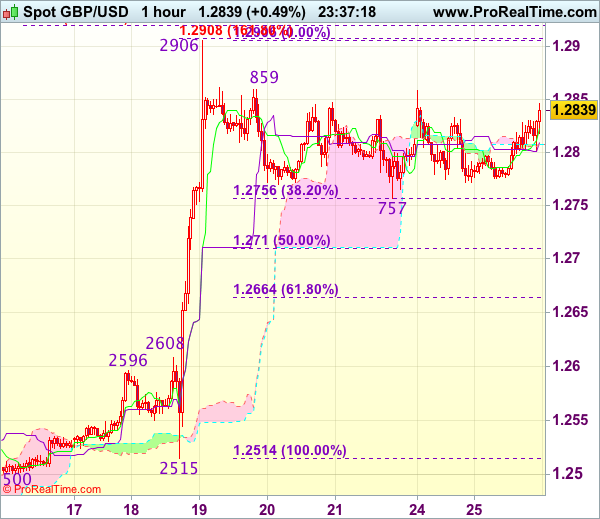
Cable has remained confined within near term established range and further sideways trading is in store, whilst another test of Friday’s low at 1.2757 cannot be ruled out, reckon downside should be limited to 1.2700-10 (50% Fibonacci retracement of 1.2515-1.2906) and bring another rally, break of 1.2859 would signal the pullback from 1.2906 has ended, bring retest of this level, above there would extend recent upmove to 1.2920-30 (2 times extension of 1.2365-1.2575 measuring from 1.2500), then 1.2950 but loss of upward momentum should prevent sharp move beyond 1.2990-00 (1.236 times projection of 1.2109-1.2616 measuring from 1.2365 and psychological resistance).
In view of this, would not chase this rise here and would be prudent to buy cable on subsequent pullback as downside should be limited to 1.2710 (50% Fibonacci retracement of 1.2515-1.2906), bring another rise. Below 1.2700 would defer and signal top has been formed, risk correction to 1.2660-65 (61.8% Fibonacci retracement of 1.2515-1.2906) and price should stay well above 1.2608-16 (previous resistance now support).
Trade Idea Wrap-up: EUR/USD – Buy at 1.0900
EUR/USD - 1.0940
Most recent candlesticks pattern : N/A
Trend : Near term up
Tenkan-Sen level : 1.0906
Kijun-Sen level : 1.0888
Ichimoku cloud top : 1.0832
Ichimoku cloud bottom : 1.0809
New strategy :
Buy at 1.0900, Target: 1.1000, Stop: 1.0865
Position : -
Target : -
Stop : -
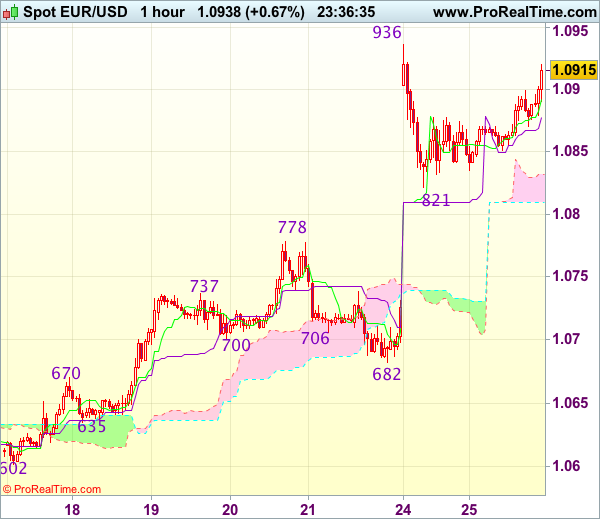
Current break of yesterday’s high at 1.09367 signals recent upmove has resumed and bullishness remains for the erratic upmove from 1.0340 low to extend further gain to 1.0975-80 and possibly towards 1.1000 which is likely to hold on first testing due to loss of momentum, risk from there is seen for a retreat later.
In view of this, would not chase this rise here and would be prudent to buy euro on pullback as 1.0900 should limit downside. Below 1.0870 would defer and suggest an intra-day top is formed, risk weakness towards support at 1.0851 but another previous support at 1.0821 should hold from here.
Trade Idea Wrap-up: USD/JPY – Buy at 110.40
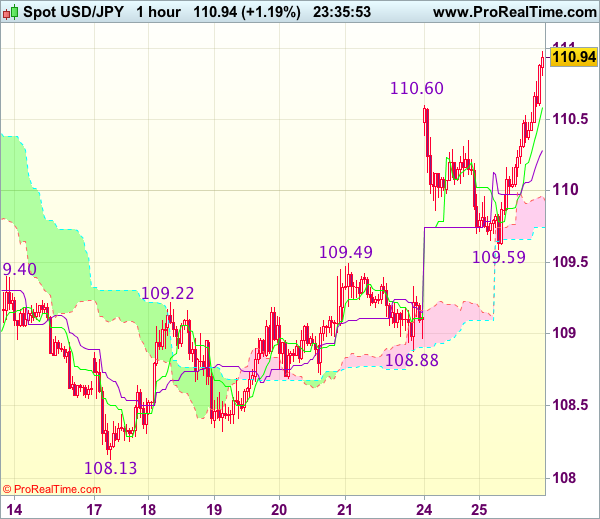
USD/JPY - 110.93
Most recent candlesticks pattern : N/A
Trend : Near term up
Tenkan-Sen level : 110.60
Kijun-Sen level : 110.30
Ichimoku cloud top : 109.97
Ichimoku cloud bottom : 109.74
New strategy :
Buy at 110.40, Target: 111.40, Stop: 110.05
Position : -
Target : -
Stop : -
The greenback has surged and broke above previous resistance at 110.60, suggesting recent rise low 108.13 low is still in progress and bullishness remains for this move to bring at least a strong retracement of early downtrend, hence further gain to 111.20-25 and possibly towards resistance at 111.58 would be seen, however, near term overbought condition should prevent sharp move beyond 111.90-00 and price should falter well below resistance at 112.20.
In view of this, would not chase this rise here and would be prudent to buy dollar on subsequent pullback as the Kijun-Sen (now at 110.30) should limit downside, bring another rally. Below 110.00-05 would defer and suggest top is possibly formed, risk weakness to 109.80 but break of support at 109.59 is needed to provide confirmation.
Consumer Confidence Still High Despite April Pullback
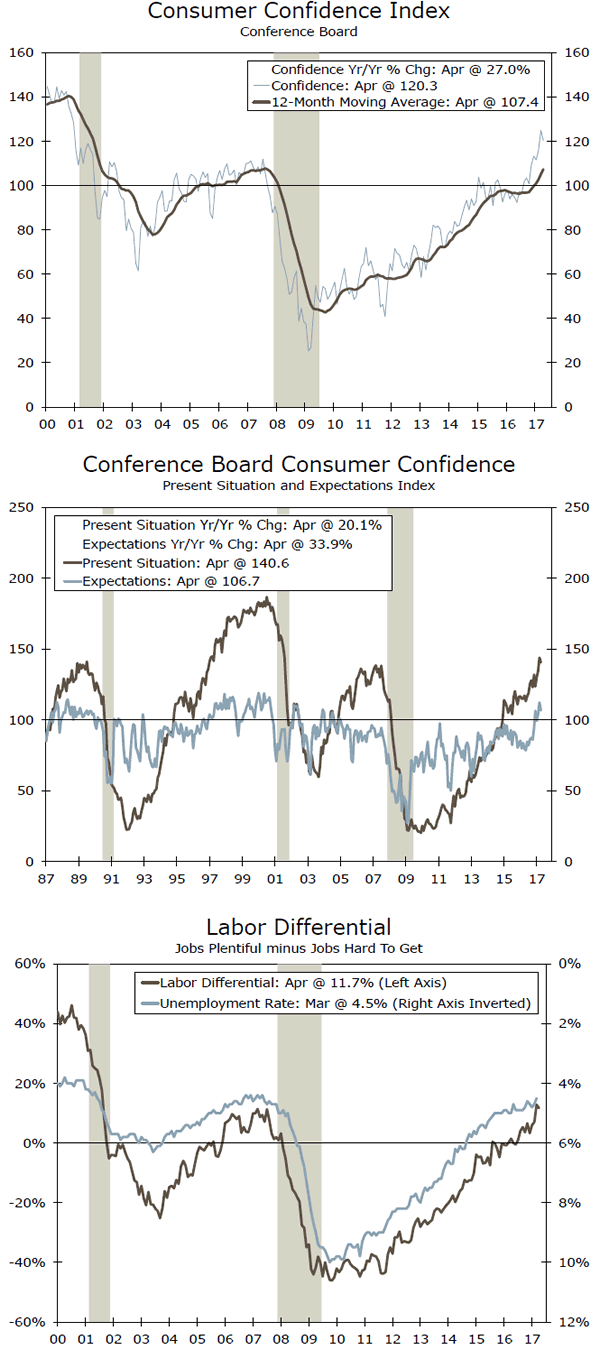
Consumer confidence fell a bit more than expected in April but, at 120.3, remains near a 12-year high. Consumers' views of both present and expected conditions were dialed back, but remain at solid levels.
Paring Back Only Some of Last Month's Surge
Consumer confidence fell 4.6 points in April to 120.3. The pullback was a bit more than expected and followed a downward revision to the March reading. Nevertheless, the index still stands at its second highest reading of the expansion and above the highs of the past expansion.
We expected some giveback in consumer confidence following the trouble late last month surrounding the proposed revision in the Affordable Care Act and the signal it sent that it may be much tougher for Washington to pass new policies than what consumers and the market expected. The stock market slid following the preliminary cut off to the March survey, while yesterday's rally that erased those losses fell outside the April response date.
Assessments of the Labor Market Still Favorable
The pullback in confidence reflected a decline in assessments of both present conditions and expectations. The present situation index fell 3.3 points to a still-solid reading of 140.6. Consumers' views of current employment conditions deteriorated slightly relative to March, but continue to point to a labor market that has improved markedly over the past year. The share of workers reporting jobs are plentiful slipped by one point, while the share reporting that jobs are hard to get was nearly unchanged. The labor differential, the difference between these two series, fell 1.1 point to 11.7 in April, holding most of the leap in March. Compared to a year ago, the labor differential is up more than 10 points and suggests that consumers' view of the labor market has improved more than other measures, such as the unemployment rate.
Looking further out, consumers' expectations for the next six months were somewhat less upbeat. The expectations index fell nearly six points. Following the softer-than-expected March payrolls report, the share of respondents expecting more jobs ahead fell 3.8 points, while the share expecting fewer jobs rose a touch. Income expectations followed suit, with the share of consumers expecting to see their incomes increase falling back near February levels. The share expecting income to decrease, however, remained at a post-recession low.
Confidence Level Still Supportive of Consumer Spending in Q2
Although readings of consumer confidence have been particularly disjointed from households spending in recent months, the index remains at a level supportive of a pickup in spending in the second quarter. Real personal consumption spending in the first quarter looks to have been held down by a number of one-off factors, including depressed utilities spending from relatively warm winter weather, but, with the labor market continuing to improve, we expect a rebound in the second quarter.
USD/JPY Extends Gains; EUR/USD Holds Near 1.09
Headlines
European equities didn't face the traditional setback after yesterday's stellar gains. Instead they added another 0.5%. US stock markets opened positive as well (+0.5%) with the Dow Jones outperforming (+0.1%). A lot of huge corporates posted good Q1 earnings (Eli Lilly, Caterpillar, McDonalds, Dupont…)
The Richmond Fed Manufacturing index declined less than expected in April, from 22 to 20 (vs 16 expected). Consumer confidence disappointed though, falling from a downwardly revised 124.9 to 120.3 in April (vs 122.5 expected). Especially the "expectations" component faced a setback. Housing data were better than forecast.
Kikuo Iwata, deputy governor of the central bank, says it's too early for the Bank of Japan to reveal its simulations for exiting its monetary easing program as its 2% price target remains distant.
Banks across the euro zone are set to tighten access to credit for companies in the second quarter but lending volumes are still seen rising, helped by ultralow rates, the ECB indicated in its bank lending survey. Corporate credit standards eased somewhat in the first quarter, broadly in line with earlier expectations.
The German government has slightly raised its growth forecasts for Europe's biggest economy for this year and next due to increased optimism about rising global demand, two senior government officials told Reuters. The government now expects gross domestic product (GDP) to expand by 1.5% in 2017 and by 1.7% in 2018.
Caterpillar cut its forecast for full year earnings per share because of higher restructuring costs, even as it forecasts stronger than expected sales and revenues for 2017, which could suggest a recovery in global markets for construction, energy and mining.
Rates
French elections cleared. focus back on ECB exit?
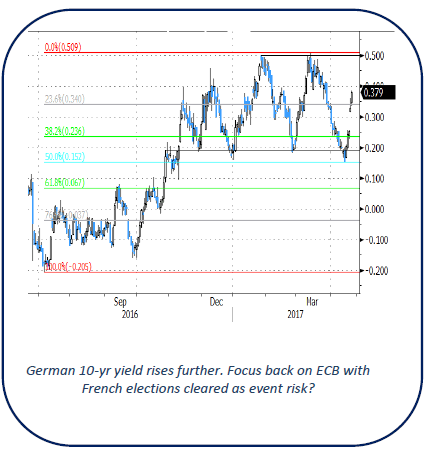
Global core bonds lost ground today. German Bunds underperformed US Treasuries at the long end of the curve suggesting that European investors' focus turns to the ECB's normalisation process with French elections out of the way. We think that the ECB will calibrate its APP again later this year by lowering the amount of monthly purchases again. We don't expect any communication at Thursday's policy meeting though. Heavy supply was additionally negative today for bonds (see below). The European eco calendar (empty), stock markets (0%-0.5%), and oil prices (flat) didn't provide impetus for trading. US eco data printed mixed. Housing data and the Richmond Fed manufacturing index surprised on the upside of expectations, but the more important consumer confidence disappointed. The US Note future made a small uptick after the release, but we don't expect sustained gains.
At the time of writing, the German yield curve bear steepens with yields 1.4 bps (2-yr) to 6.7 bps (30-yr) higher. Changes on the US yield curve vary between +2.9 bps (2-yr) and +4 bps (5-yr). On intra-EMU bond markets, 10-yr yield spread changes versus Germany range between -3 bps (Portugal) and +1 bp (Italy). Greece slightly outperforms (-6 bps).
The German Finanzagentur held a €4B 2-yr Schatz auction (0% Mar2019). Total bids amounted only €3.78B, below the €5.08B average at the previous 4 Schatz auctions and below the amount on offer (real bid cover 0.9). The Bundesbank set aside €0.78B for secondary market operations, resulting in an official bid cover of 1.2. The auction yield (-0.69%) was the highest since November last year. The Dutch debt agency tapped the 10-yr DSL (€2.1B 0.75% Jul2027) for up to €3B. The amount sold was in the lower half of the €2-3B target range. The US Treasury starts its end-of-month refinancing operation with a $26B 2-yr Note auction. Currently, the WI trades around 1.27%.
Currencies
USD/JPY extends gains; EUR/USD holds near 1.09
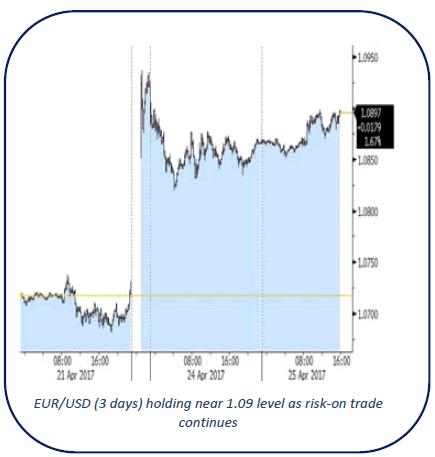
The post-Macron risk-on trade continued today, but, understandably, at a slower pace than yesterday. Equities and especially core bond yields trended further north. The risk-on sentiment had again a mixed impact on the dollar as both EUR/USD and USD/JPY trended cautiously higher. EUR/USD is retesting the 1.09 big figure. The USD/JPY upleg accelerated during the day. The pair is changing hands in the 110.70 area.
Overnight, Asian equities eked out more gains even as global markets pondered the impact of President Trump's tax proposals and a spending bill that the needs to be approved soon to avoid a government shutdown. For now, it didn't hamper the global risk rally. The yen weakened slightly after yesterday evening's setback. USD/JPY returned to the 110 area. EUR/USD held near 1.0865, where it was most of yesterday's session.
European markets continued the Asian trend. European equities maintained a positive intraday bias. Of course, the gains were modest as investors digested yesterday's steep gains. Core bond yields rose another few basis points. Interest rate differentials widened slightly in favour of the dollar at the short end of the curve but narrowed at the long end. EUR/USD held a narrow range just below 1.09. So, the post-Macron top remained within reach. USD/JPY also maintained a cautious upward bias, drifting to the 110.50 area.
Risk sentiment remained positive early in US dealings. US equity futures were supported by strong results for several US bellwethers including Dupont, Caterpillar and others. Initially, the risk on trade supported USD/JPY, EUR/JPY and EUR/USD at the same time. However, strong US housing data gave the dollar a better bid capping the topside of EUR/USD as the pair retested the 1.09 area. USD/JPY trended higher to the 110.75 area going into the US midmorning data. These data were mixed. US new home sales were very strong and the Richmond Fed manufacturing index decline less than expected (from 22 to 20). However, consumer confidence dropped more than expected. The immediate impact on the dollar is limited. EUR/USD again tries to regain the 1.09 big figure. USD/JPY remains well bid in the 110.70 area.
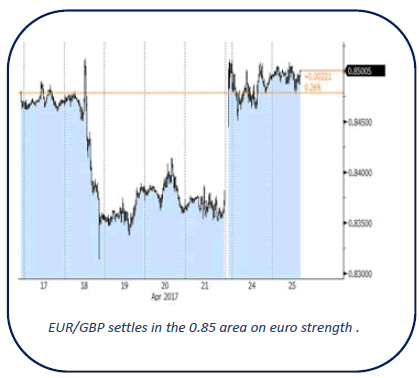
EUR/GBP off the recent lows on euro strength
The March budget data were the only UK specific data on the agenda today. The March deficit was slightly wider than expected at £5.1 bln. Disappointing VAT revenues might be another indication that UK consumers are pressured by the rising prices. As usual, the impact of the report on sterling trading was limited. EUR/GBP still held a very tight sideways range around the 0.85 big figure. Cable traded with a slight upward bias intraday and returned north of 1.28 (currently 1.2820). This cross rate also stabilized within the tight range that was in place since UK PM announced early elections last week.