Sample Category Title
GBPUSD – Upbeat CPI Data Send Cable Above Daily Cloud
Sterling gained strong support from upbeat CPI numbers, on 2.3% y/y in Feb vs 2.1% forecast and 0.7% m/m release beat the forecast at 0.5%.
Cable surged through daily cloud in immediate reaction on data and met next target at 1.2457 (Fibo 76.4% of 1.2568/1.2107 downleg), with 1.2476 (27 Feb high) and psychological 1.2500 barrier being in focus.
Better-than-expected inflation data are expected to further boost BoE’s hawkish hold from last week’s MPC meeting for early interest rate hike.
Broken daily cloud top now acts as immediate support, with the pair looking for daily close above it to confirm strong bullish stance.
Next support lies at 1.2408 (100 SMA) and guarding daily cloud base at 1.2379 that marks lower pivot.
Res: 1.2476, 1.2500, 1.2521, 1.2568
Sup: 1.2435, 1.2408, 1.2379, 1.2337
USD Index Trading In A Simple Zig-Zag, More Weakness In View
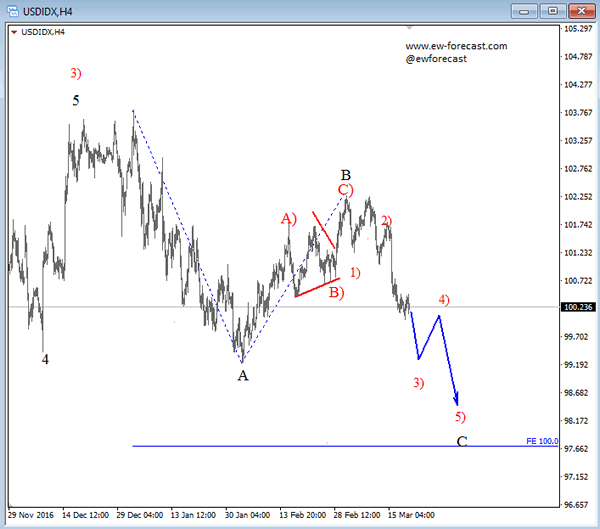
On the 4h chart of USD Index we see price trading within a higher degree three wave decline and current bearish breakdown may be part of wave C. At the moment we see price trading within the strongest and steepest sub-wave 3). If we are on the right track, then even more weakness may follow within the mentioned wave and ideally towards the 98.00 region.
USD Index, 4H
Macron Seen as the Winner of the First French Debate
Overnight, Emmanuel Macron, a centrist politician and former economy minister, was seen as the winner of the first French Presidential debate. According to a snap opinion poll, Macron was more convincing than his four rivals. Market participants may have interpreted this as diminishing Le Pen's chances to win, which propelled the euro higher after the debate ended. The poll also showed that the second most convincing candidate was Mélenchon, with Fillon and Le Pen tied for third place.
According to the debate poll, Le Pen could even fail to make it to the second voting round, which suggests that political risks may be receding in Eurozone. As such, we think that the near-term path for the euro is to the upside. EUR/JPY rebounded from 120.70 (S1) in the aftermath of the debate and during the early European morning Tuesday, it looks to be headed for the 121.45 (R1) resistance zone. Although the structure on the 4-hour chart still suggests a short-term downtrend, the positive sentiment towards the common currency could result in more upside extensions, at least today. A decisive break above 121.45 (R1) is likely to open the way for our next resistance of 122.25 (R2), marked by the peak of the 17th of March.
The case for further euro gains is also amplified by the increased market attention towards the prospect of "ECB normalization". The latest signals from the Bank suggest there is diminished willingness among the Governing Council for any more extraordinary easing measures. However, in order to assume that the medium-term outlook of EUR/JPY has turned back positive, we would like to see a decisive close above the downside resistance line taken from the peak of the 14th of December and the 123.50 area. The main risk to our EUR-positive view is incoming French polls showing Le Pen gaining back ground, despite her seemingly poor performance in this debate. In such a case, EUR/JPY gains are likely to remain limited below the aforementioned downside resistance line.
UK PM May to officially trigger Article 50 next week
According to recent media reports, the UK government is set to trigger Article 50 of the Lisbon Treaty and commence the formal process of leaving the EU on Wednesday, the 29th of March. The office of the PM also expressed its desire for the negotiations to begin at the earliest after the triggering. Even though the UK's intent to invoke Article 50 before the end of March had been signalled multiple times and should not have come as a surprise to investors, the pound still came under selling pressure on the news.
In our view, once the negotiations begin, the forthcoming direction of sterling will likely be decided by media headlines regarding what each side is actually pursuing. Having said that, considering that much of the "hard Brexit" rhetoric may already be priced into the battered pound, we believe that the political risks surrounding GBP are likely asymmetrical. Any positive developments during the negotiation process could generate a bigger upside reaction than the corresponding downside in case of the anticipated "hard Brexit" stance. Besides the political developments, today's inflation data may prove critical for sterling as well (see below).
RBA minutes drag the Aussie somewhat lower
Overnight, the minutes of the RBA's March policy meeting showed a slightly more cautious tone compared to the meeting statement. The Bank highlighted that employment growth had continued to be concentrated in part-time jobs and that wage growth remained low, suggesting that the labor market may not be as strong as the headline employment figures indicate. As a reminder, the RBA has a twin mandate to promote full employment in addition to price stability and as such, these signals may have been interpreted by investors as increasing somewhat the probability for further easing. As such, the AUD came under selling interest in the following hours, though the reaction was not huge. Despite these cautious signals, we do not expect the RBA to actually take any action in the foreseeable future. The Bank has repeatedly highlighted that further rate cuts could amplify financial stability risks, something that we believe will be enough to stay the Bank's hand, absent some serious deterioration in the outlook for inflation and/or employment.
Today's highlights
During the European day, the UK will release its CPI data for February. The forecast is for both the headline and the core rates to have risen, something supported by the UK services PMI for the month, which showed that rapidly rising input costs led to the largest increase in prices charged by service providers for eight and a half years. At the latest BoE gathering, some members noted that they would consider reducing stimulus should there be any further upside news on the prospects for growth or inflation, while Kristyn Forbes actually voted for an immediate hike. This suggests that in case the CPIs accelerate further as expected, then in addition to the "Brexit" negotiations, another big market theme for GBP traders is likely to be whether the BoE will reduce its asset purchases, or even hike rates at some point in the foreseeable future. Such speculation could bring the pound under renewed buying interest. GBP/USD is currently trading between the support of 1.2340 (S1) and the downside resistance line drawn from the peak of the 2nd of February. Accelerating CPIs could prove the catalyst for a clear break above the aforementioned downside line and the 1.2420 (R1) resistance, something that could pave the way for the 1.2470 (R2) hurdle. Switching to the daily chart, we see that Cable remains within the wide sideways range between 1.2100 and 1.2850. Thus, the medium-term outlook remains flat in our view. Nevertheless, the fact that the latest recovery came from near the lower bound of that sideways channel increases the possibilities for the rate to continue trading north within the range.
As for the speakers, we have three on the agenda: Bank of England Governor Mark Carney, New York Fed President William Dudley and Kansas Fed President Esther George. Any comments on monetary policy from Governor Carney may be of special interest to investors, as he will be speaking shortly after the release of the inflation data.
EUR/JPY
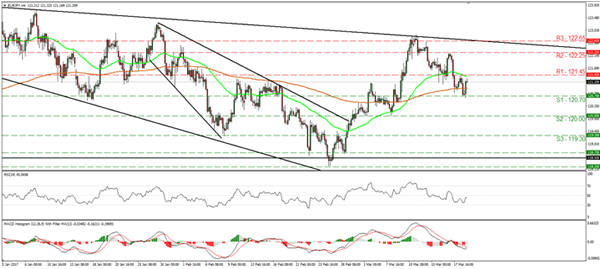
Support: 120.70 (S1), 120.00 (S2), 119.30 (S3)
Resistance: 121.45 (R1), 122.25 (R2), 122.65 (R3)
GBP/USD
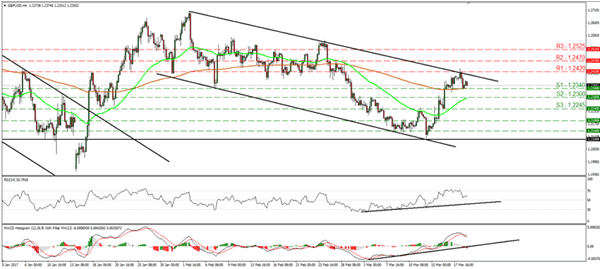
Support: 1.2340 (S1), 1.2300 (S2), 1.2245 (S3)
Resistance: 1.2420 (R1), 1.2470 (R2), 1.2525 (R3)
Canadian Wholesale Trade Improves Markedly In January
'The auto sector drove wholesaling crazy in January, enough for at least some eyebrows to be raised at what is typically seen as a second-tier Canadian economic indicator.' - Avery Shenfeld, CIBC
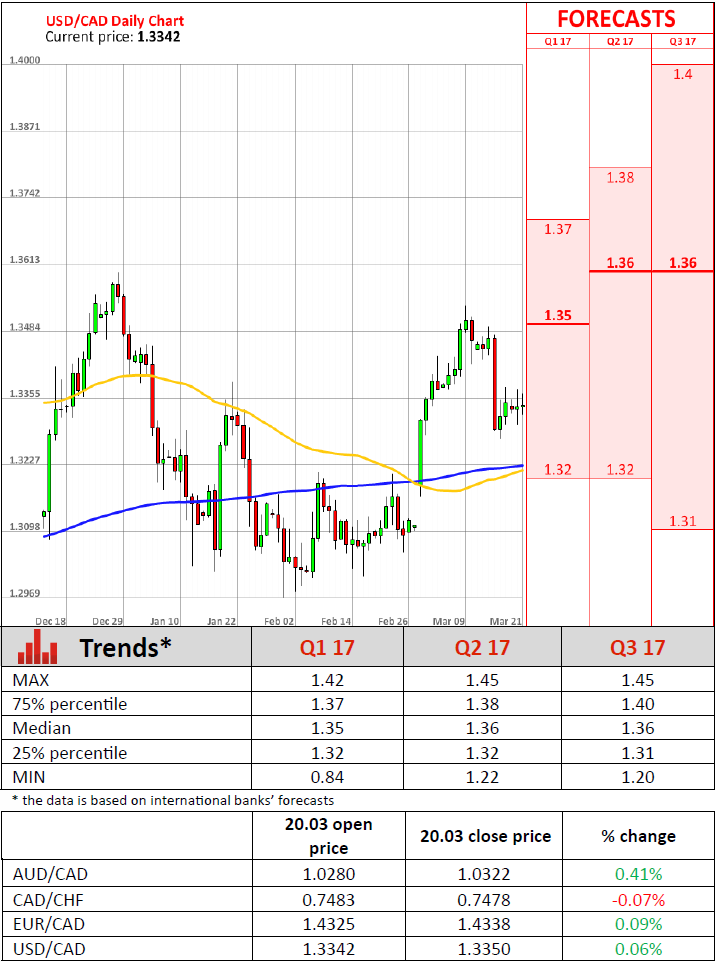
Canadian wholesale sales rose markedly in January, posting the largest monthly gain in more than seven years. Statistics Canada reported wholesale sales advanced 3.3% to a record C$59.09 billion, while analysts anticipated an increase of 0.3%. Meanwhile, December's 0.7% rise was revised down to 0.3%. January's figure marked the biggest climb since November 2009, when sale rose 3.8%. In volume terms, wholesale trade advanced 3.4% in January. Sales rose in four out of the seven sectors, accounting for 55% of total wholesale trade. The increase was mainly driven by higher demand in the motor vehicles and parts sector, where sales climbed 17.1%, posting the biggest monthly gain since August 2005 and ending a two-month streak of declines. Excluding this sector, wholesale sales climbed 0.3% in January. Sales in the personal and household goods sector rose 3.0%, as sales of entertainment equipment and household appliances posted a 30.6% jump. In the meantime, sales in the miscellaneous sector fell 1.0%, driven by lower demand in the agricultural supplies industry. Monday's data combined with the stronger-than-expected manufacturing sales, trade and job creation suggest that the Canadian economy started the year with solid growth.
Reserve Bank Of Australia Expresses Concerns Over Housing Market
'The acceleration in house price inflation in the fourth quarter of last year has undoubtedly continued into the start of this year and will remain a thorn in the side of the Reserve Bank of Australia for a while yet.' - Paul Dales, Capital Economics
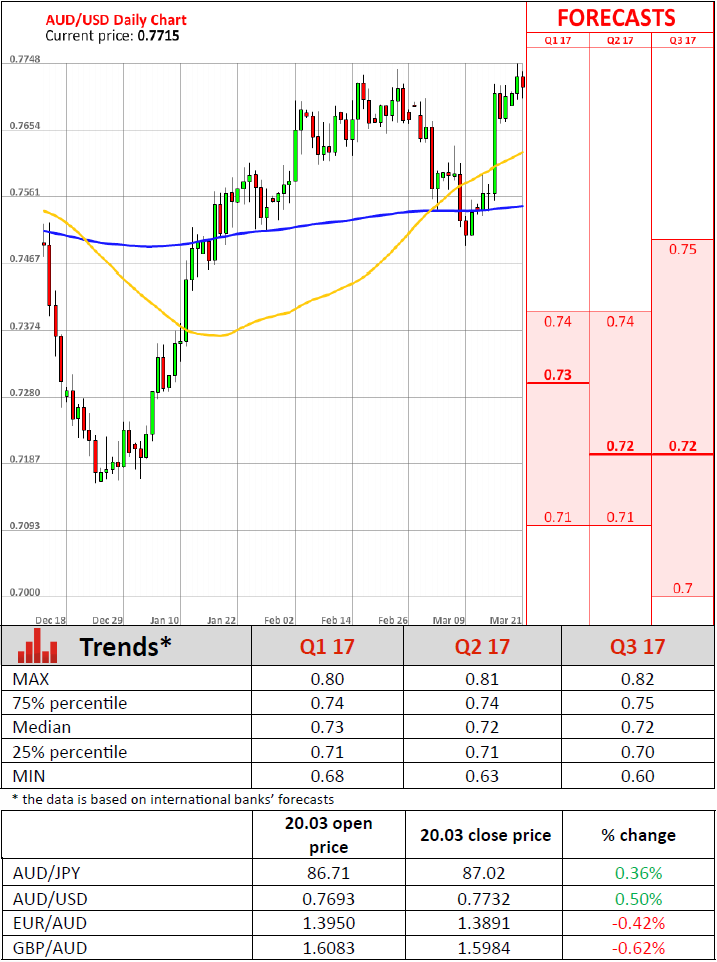
The minutes, which were released on Tuesday, showed that members of the RBA were generally upbeat about both global and domestic economic growth. Policymakers said that global industrial production and merchandise trade improved markedly over the last several months. Furthermore, members saw significant improvements in global business sentiment and inflation. According to the minutes, economic growth climbed 1.1% in the Q4 of 2017, following a 0.5% contraction in the September quarter, which was triggered by temporary factors. The economy managed to recover in the December quarter thanks to solid export growth and a rebound in consumption and business investment. Nevertheless, members pointed to mixed labour market trends, as the economy saw strong growth in part-time employment and low wage growth. Moreover, data released last week showed that the Australian jobless rate rose unexpectedly to 5.9% in February. Members of the committee noted that financial markets were quite over the previous month, as investors turned their attention to the March meeting of the Federal Reserve and the upcoming European elections. Policymakers also expressed concerns over the Australian housing market, pointing to a steep rise in prices since the global financial crisis.
USDJPY Corrects Higher Before Final Push Towards 112.00/111.60 Targets
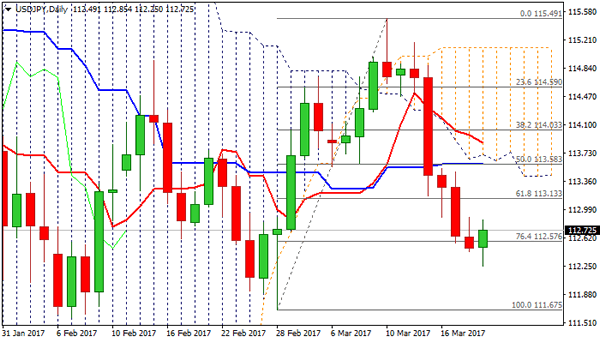
The pair bounces from fresh three-week low at 112.25 posted yesterday, with daily close below 112.57 (Fibo 76.4% of 111.67/115.49 rally), generating bearish signal and exposing round-figure support at 112.00, ahead of key short-term support at 111.57/67 zone (07/28 Feb lows that formed higher base.
Current move higher could be seen as correction that should be ideally capped under 113.00 (top of hourly Ichimoku cloud).
Extended upticks are expected to stay under strong 113.50 resistance zone (daily cloud base/Kijun-sen / 20/30 SMA’s), before bears resume.
Only firm break here would sideline bears and signal stronger correction.
Res: 112.88, 113.00, 113.34, 113.50
Sup: 112.57, 112.25, 112.00, 111.67
GBPUSD Attacks Daily Cloud Again Ahead Of UK CPI Data
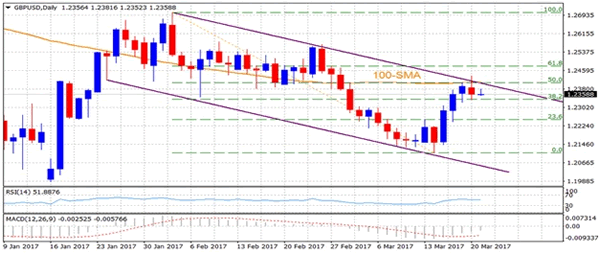
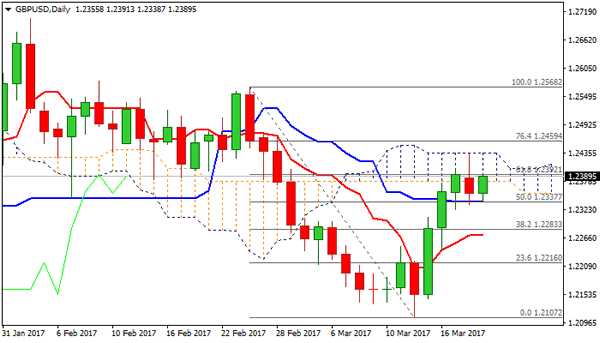
Cable is attempting again into daily cloud, after cloud top (1.2435) capped Monday's action and subsequent dip resulted in daily close below the cloud. The pair came under pressure on announcement that UK will start formal divorce process with the EU on Mar 29, but dips were so far limited and contained by daily Kijun-sen at 1.2337. This keeps in play post-Fed bullish sentiment, seeing scope for renewed attempts through daily Ichimoku cloud (spanned between 1.2379 and 1.2435). Bullish setup of most of daily MA's and fresh momentum, keeps upside scenario favored, ahead of release of UK inflation data (due at 09:30 GMT, forecasted at 2.1% vs 1.8% previous month). Release above the forecast is expected to boost the pair for renewed attempt through 100SMA (1.2410) and attack at daily cloud top pivot (1.2435). Firm break above the cloud would accelerate towards 1.2459 (Fibo 76.4% of 1.2568/1.2107) and would expose psychological 1.2500 barrier. Conversely, repeated failure at daily cloud and repeated close below it, would generate negative signal. Daily Kijun-sen marks next downside trigger, loss of which would increase risk of reversal.
Res: 1.2410, 1.2435, 1.2459, 1.2476
Sup: 1.2379, 1.2337, 1.2309, 1.2271
EUR/USD Breaks Resistance On Tuesday
'The euro rose, approaching a six-week high, as political concerns in the region were seen as easing after a poll showed anti-euro candidate Marine Le Pen losing ground in the French presidential debate.' – Chikako Mogi, Bloomberg
Pair's Outlook
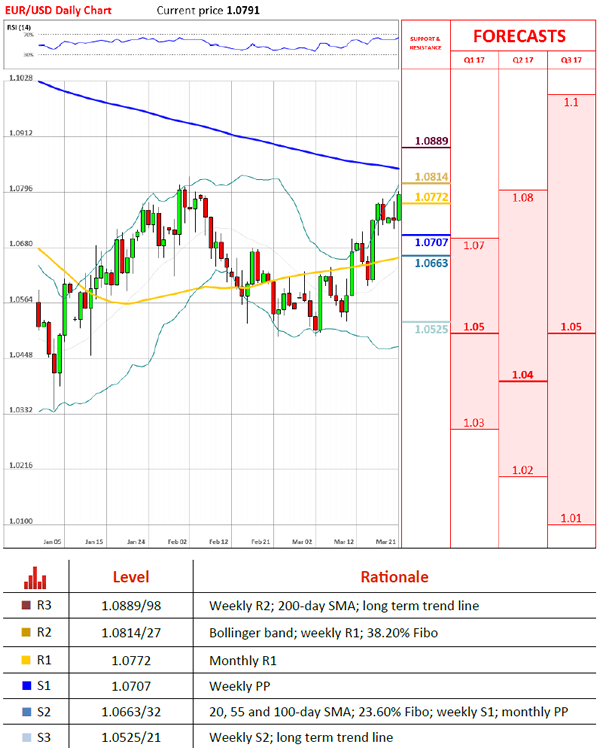
On Tuesday morning the common European currency surged against the US Dollar and managed to break through the resistance put up by the monthly R1, which is located at the 1.0772 level. The currency pair has set its course to the next resistance level, where it is likely to stop or even change direction. Above the rate there is a resistance cluster consisting of two notable levels of significance, as the weekly R1 is located at 1.0814, and the 38.20% Fibonacci retracement level is at the 1.0826 level. Moreover, the Fibonacci retracement level is strengthened by the upper Bollinger band, which is located at 1.0827.
Traders' Sentiment
Traders remain bearish on the pair, as 60% of open positions are short, and 56% of trader set up orders are to sell the Euro.
GBP/USD Still Unable To Reclaim 1.24
'Despite the doom and gloom hanging over sterling, it has held up well this year – if so traders are to be surprised with some sort of plan or minor victory from the UK government, we could in fact see GBP trading higher in a relief rally.' – ThinkMarkets (based on Reuters)
Pair's Outlook
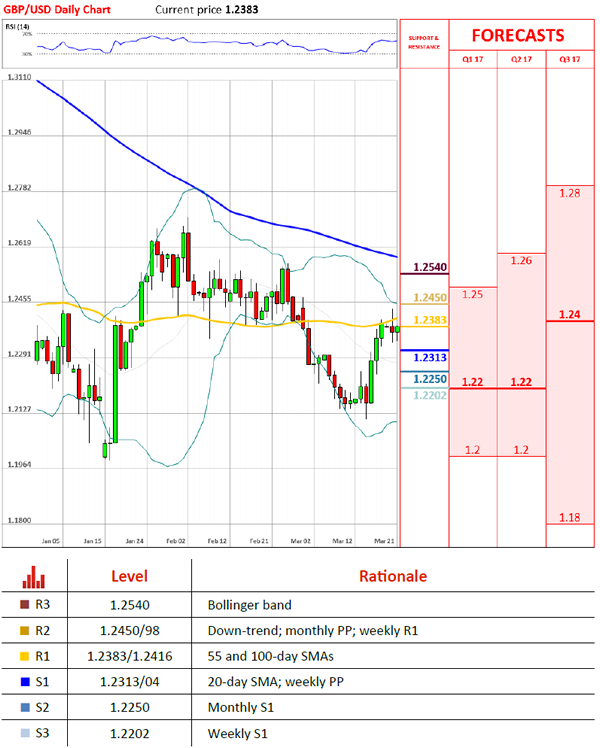
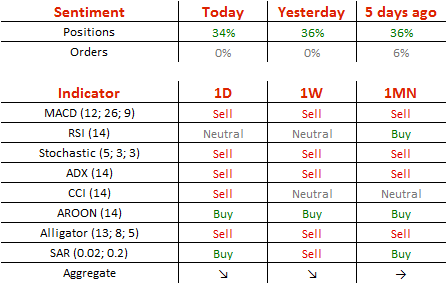
On Monday, the GBP/USD currency pair experienced a small bearish correction, after having surged for three consecutive days last week. The situation mostly remains unchanged, with the exception of the immediate resistance area now being slightly stronger, as the 55-day SMA is now bolstering the 100-day one. However, technical studies are now giving bearish signals in the daily timeframe, suggesting that Cable could struggle to appreciate again. Ultimately, the Pound is required to stabilise above the 1.24 level in order to reach the nine-month down-trend. In case bears take over the market, the 1.23 mark is expected to hold, as it is reinforced by the weekly PP and the 20-day SMA.
Traders' Sentiment
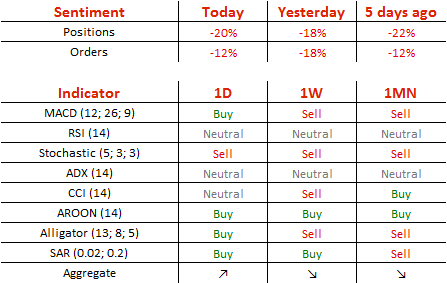
Today 67% of traders holding long positions (previously 68%), whereas pending orders are still equally divided between buy and sell ones.
USD/JPY Attempts To Preserve The Channel Pattern
'Among safe haven currencies, investors extended their JPY short exposure by about 30% before the BOJ policy meeting.' – Deutsche Bank (based on FXStreet)
Pair's Outlook
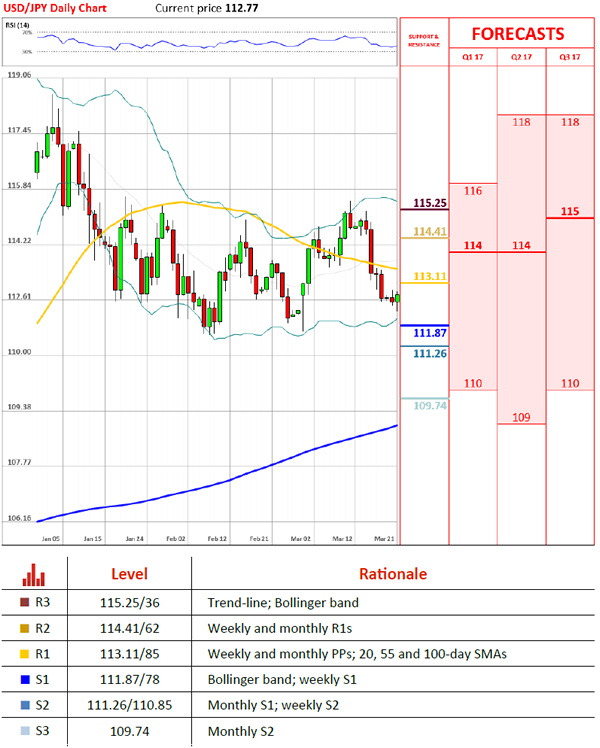
Even though the USD/JPY pair remained relatively unchanged yesterday, a small bearish development was still sufficient for the exchange rate to stabilise below the ascending channel's support line. Nevertheless, the Buck still has the opportunity to recover and, thus, preserve the pattern. However, a rally beyond 113.00 is unlikely to occur, as a tough resistance cluster is located beyond that area. Since technical studies are unable to confirm the possibility of the positive outcome, we should not rule out the risk of a seventh consecutive decline taking place, with the nearest area to limit the losses located only around 111.80.
Traders' Sentiment
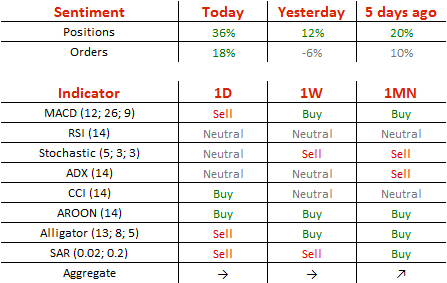
There are 68% of traders being long the Greenback today (previously 56%), while the share of buy orders surged from 47 to 59%.