

Sample Category Title
USD/CHF Mid-Day Outlook
Daily Pivots: (S1) 0.8645; (P) 0.8666; (R1) 0.8684; More…
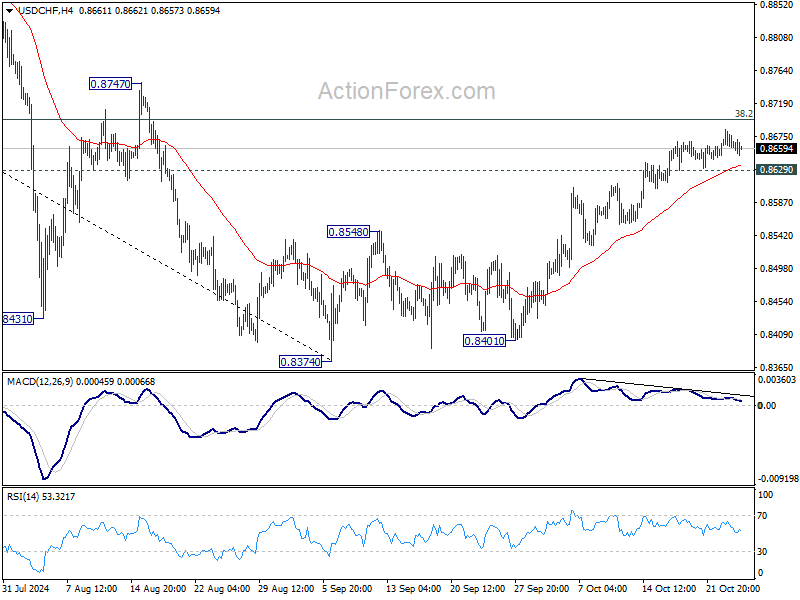
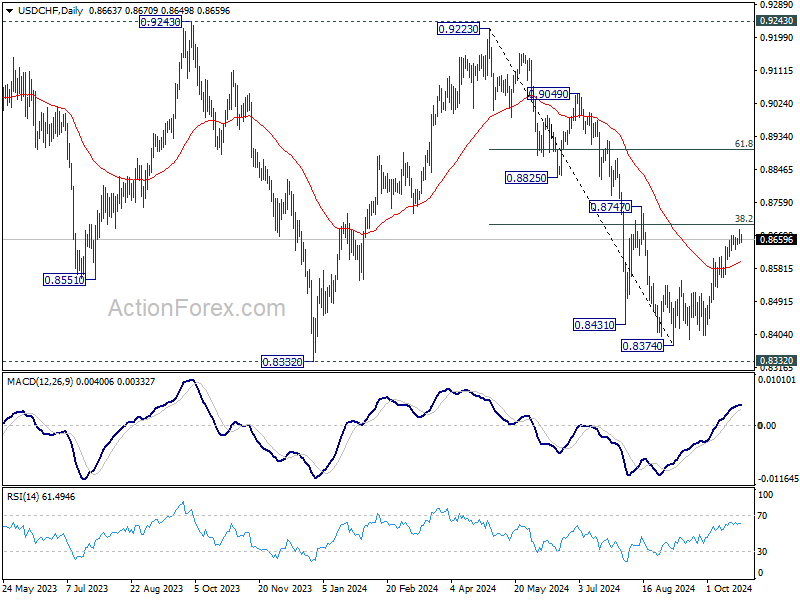
Despite loss of momentum as seen in 4H MACD, further rise is still in favor in USD/CHF with 0.8629 minor support intact. Firm break of 38.2% retracement of 0.9223 to 0.8374 at 0.8698 will argue that fall from 0.9223 has completed at 0.8374, after defending 0.8332 low. Further rally should then be seen to 61.8% retracement at 0.8899 next. On the downside, below 0.8629 minor support will indicate short term topping, and turn bias back to the downside for pullback.
In the bigger picture, price actions from 0.8332 (2023 low) are currently seen as a medium term corrective pattern, with fall from 0.9223 as the second leg. Strong support could be seen from 0.8332 to bring rebound. Yet, overall outlook will continue to stay bearish as long as 0.9243 resistance holds. Firm break of 0.8332, however, will resume larger down trend from 1.0146 (2022 high).
GBP/USD Mid-Day Outlook
Daily Pivots: (S1) 1.2887; (P) 1.2941; (R1) 1.2974; More...
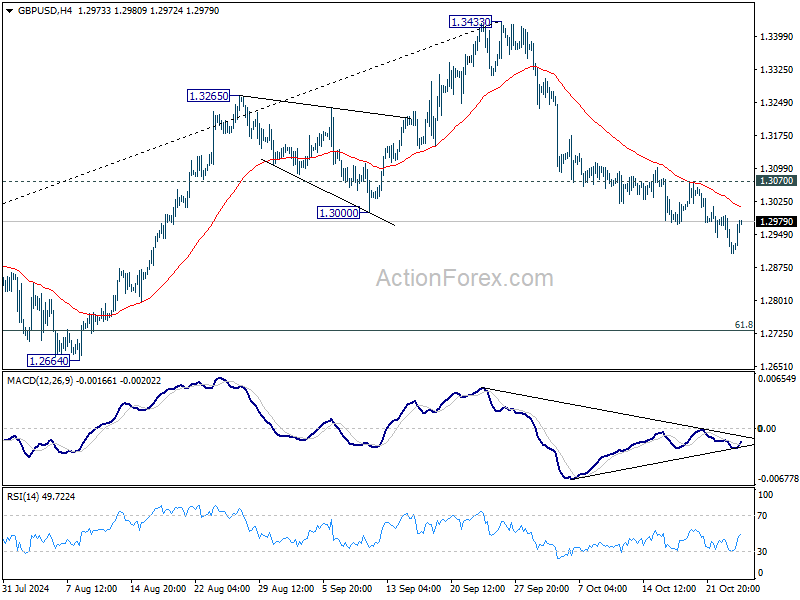
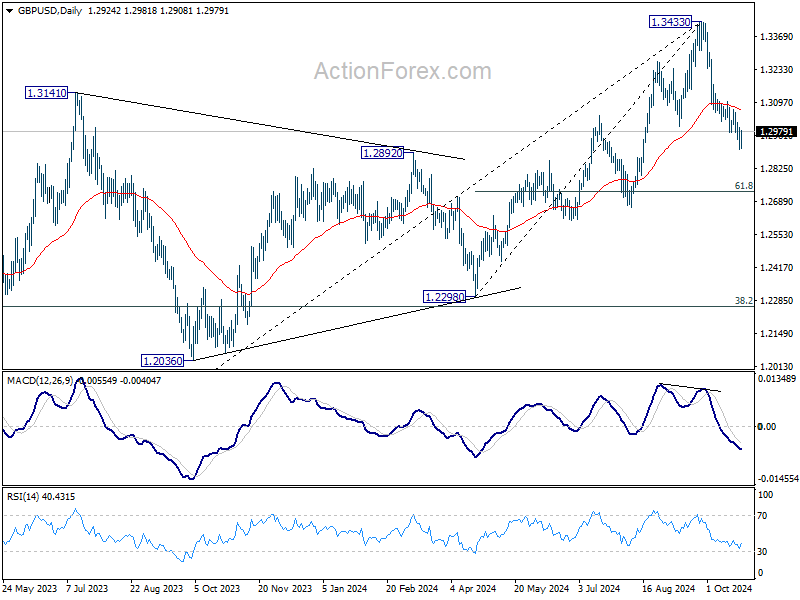
Further decline is expected in GBP/USD as long as 1.3070 resistance holds, despite loss of momentum as seen in 4H MACD. Fall from 1.3433 should target 61.8% retracement of 1.2298 to 1.3433 at 1.2732. However, firm break of 1.3070 resistance will indicate short term bottoming, and turn bias back to the upside for stronger rebound.
In the bigger picture, considering mildly bearish divergence condition in D MACD, a medium term top is likely in place at 1.3433 already. Price actions from there are seen as correction to whole up trend from 1.0351 (2022 low). Deeper decline would be seen to 38.2% retracement of 1.0351 to 1.3433 at 1.2256, which is close to 1.2298 structural support. Strong support should be seen there to bring rebound.
EUR/USD Mid-Day Outlook
Daily Pivots: (S1) 1.0760; (P) 1.0783; (R1) 1.0806; More...
Further decline is expected in EUR/USD despite loss of downside momentum as seen in 4H MACD. Firm break of 61.8% retracement of 1.0447 to 1.1213 at 1.0740 will extend the fall from 1.1213 to 1.0601 support next. Nevertheless, break of 1.0871 will indicate short term bottoming, and turn bias back to the upside for stronger rebound.
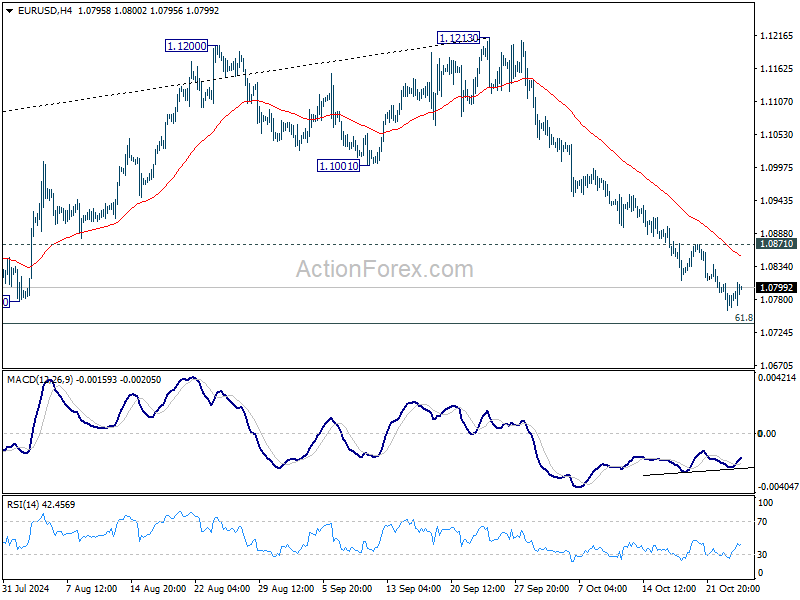
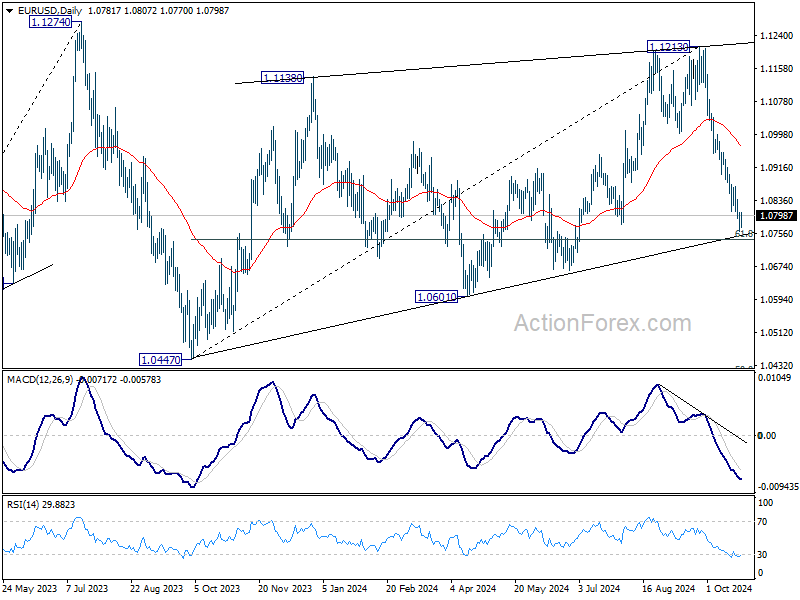
In the bigger picture, price actions from 1.1274 (2023 high) are seen as a consolidation pattern to up trend from 0.9534 (2022 low), with fall from 1.1213 as the third leg. Downside should be contained by 50% retracement of 0.9534 (2022 low) to 1.1274 at 1.0404, to bring up trend resumption at a later stage.
Euro Offered Relief With PMI Data Backing 25bps ECB Cut in Dec
The forex markets are relatively calm today, as major currency pairs and crosses gyrate within familiar ranges, digesting recent moves, and awaiting fresh data. Euro is having a slight recovery, supported by mixed PMI data that reflected an improving outlook in Germany, offset by a more concerning deterioration in France. Inflationary pressures continue to linger, which suggests ECB might lean towards a 25bps rate cut in December rather than a 50bps reduction. However, it's important to note that Euro's recovery remains weak, with plenty of data still expected ahead of the next meeting weeks away.
Japanese Yen is also recovering modestly following verbal intervention by Japanese officials after the currency briefly dipped through the 153 mark against Dollar. While the intervention has paused further selling pressure, Yen lacks strong momentum needed for a more sustained rebound. The currency’s next move will continue to depend heavily on yield differentials between Japan and the US/Europe, as well as the outcome of Japan’s snap election on October 27. With these two significant factors still unresolved, traders may still push Yen lower ahead of the election, keeping the currency vulnerable.
Overall in the currency markets, Dollar is staying as the strongest performer for the week so far, followed by Canadian, and then Swiss Franc. Yen is still the weakest, followed by Aussie and then Kiwi. Euro and Sterling are positioning in the middle with the Pound having a slight upper hand.
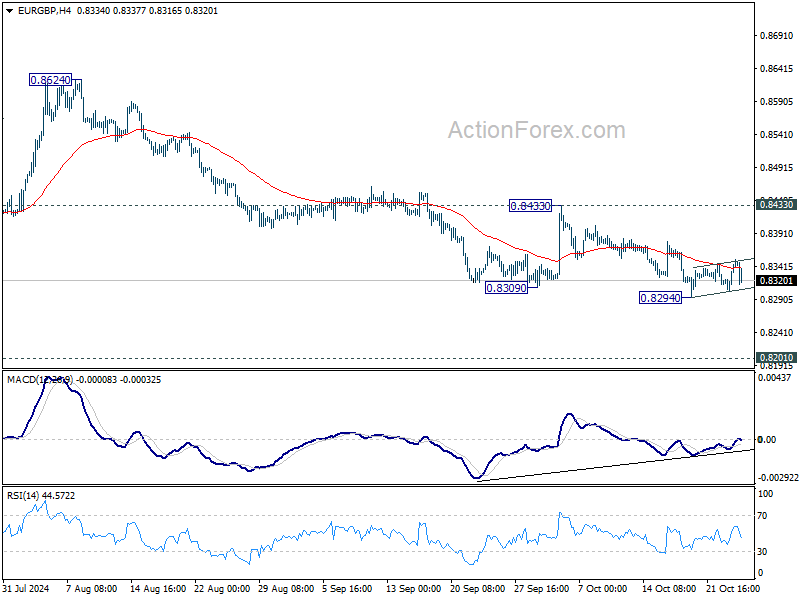
Technically, EUR/GBP's consolidation pattern from 0.8924 temporary low might have completed after rejected by 55 4H EMA twice. Focus is back on 0.8294. Firm break there will resume larger down trend down trend. But strong support should emerge around 0.8201 key long term support to bring sustainable rebound. So the next time could be an opportunity to buy the cross.
In Europe, at the time of writing, FTSE is up 0.46%. DAX is up 0.64%. CAC is up 0.50%. UK 10-year yield is up 0.0420 at 4.249. Germany 10-year yield is down -0.047 at 2.264. Earlier in Asia, Nikkei rose 0.10%. Hong Kong HSI fell -1.30%. China Shanghai SSE fell -0.68%. Singapore Strait Times rose 0.12%. Japan 10-year JGB yield fell -0.0209 to 0.958.
US initial jobless claims falls to 227k vs exp 245k
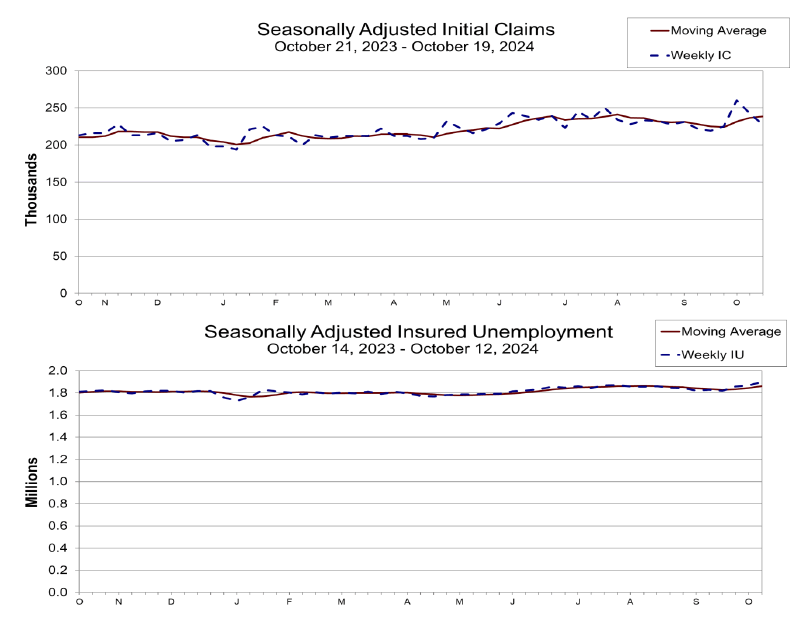
US initial jobless claims fell -15k to 227k in the week ending October 19, well below expectation of 245k. Four-week moving average of initial claims rose 2k to 238.5k.
Continuing claims rose 28k to 1897k in the week ending October 12. Four-week moving average of continuing claims rose 18k to 1861k.
UK PMI composite hits 11-month low as business confidence wavers
UK business activity weakened in October, with both the manufacturing and services sectors showing signs of slowing momentum. PMI Manufacturing index dropped from 51.5 to 50.3, marking a 6-month low, while PMI Services index fell from 52.4 to 51.8, an 11-month low. Consequently, Composite PMI also declined to an 11-month low, slipping from 52.6 to 51.7.
Chris Williamson, Chief Business Economist at S&P Global Market Intelligence, attributed this slump to "gloomy government rhetoric" and rising uncertainty ahead of the Budget. He added that external risks, such as conflicts in the Middle East, the ongoing war in Ukraine, and the upcoming US elections, have further dampened economic confidence.
The early PMI data suggests that the UK economy grew at a meagre 0.1% quarterly rate in October. However, Williamson noted that further cooling of input cost inflation, now at its lowest level in four years, could allow BoE to take a "more aggressive stance" toward rate cuts if the economic slowdown persists.
Eurozone PMIs: Persistent price pressures lean ECB toward 25bps Dec cut, not 50bps
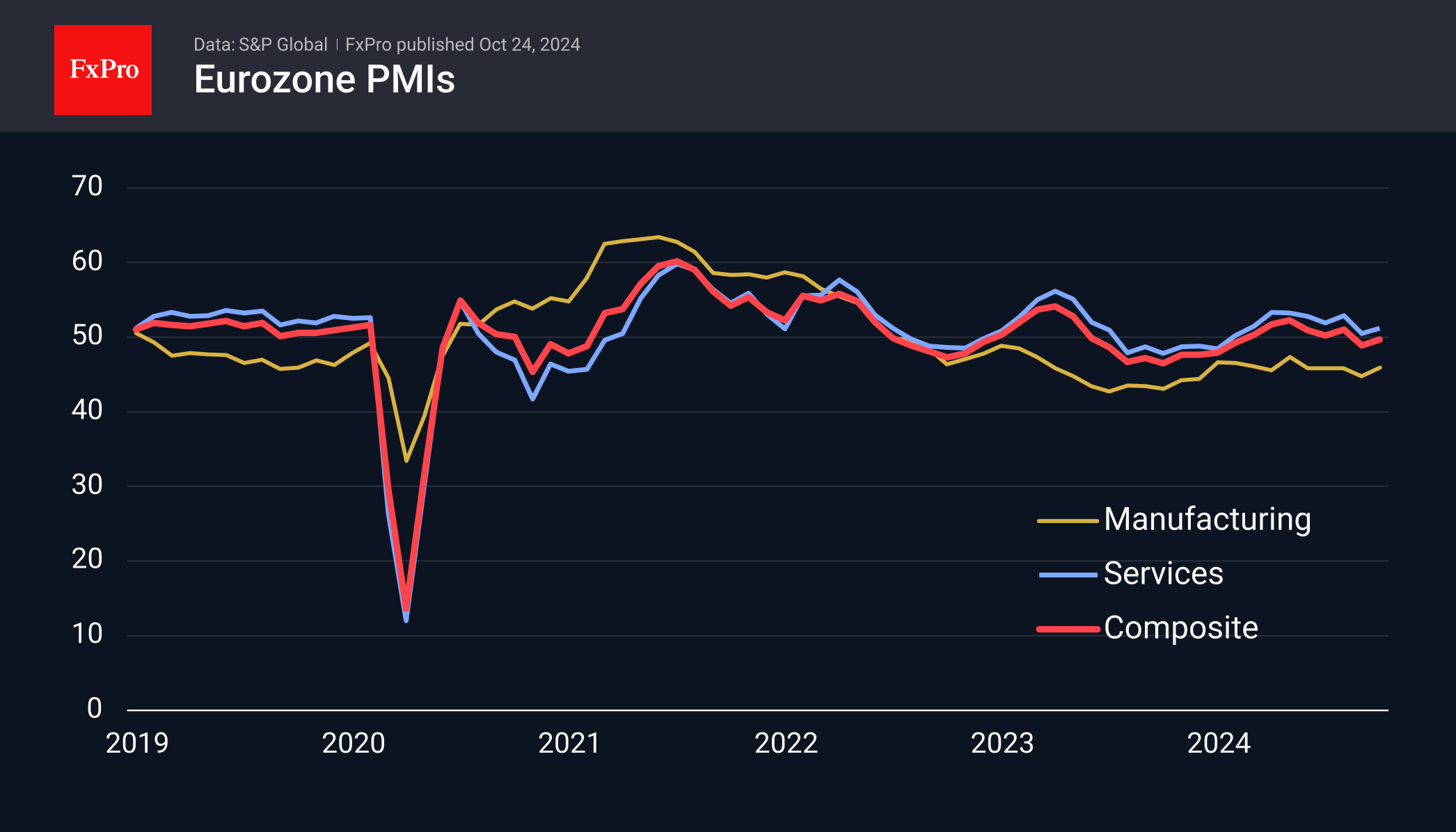
Eurozone's economic activity showed mixed signals in October, with PMI Manufacturing rising slightly from 45.0 to 45.9, while PMI Services fell marginally from 51.4 to 51.2. As a result, Composite PMI ticked up slightly to 49.7 from 49.6, but remained below the 50-point mark, indicating ongoing economic contraction.
Cyrus de la Rubia, Chief Economist at Hamburg Commercial Bank, described the Eurozone as "stuck in a bit of a rut," noting that the economy contracted for the second consecutive month. While the manufacturing sector continues to slump, its negative impact is being balanced out by minor gains in services. De la Rubia added, "For now, it is not clear whether we will see a further deterioration or an improvement in the near future."
According to de la Rubia, for ECB, the data present an "unwelcome surprise," particularly in the services sector. Inflationary pressures appear to be lingering, driven by wage growth, which has been pushing up costs and selling prices for service providers.
This persistent inflation suggests that the ECB may lean towards a 25bps rate cut in December, as opposed to the larger 50bps cut some had speculated.
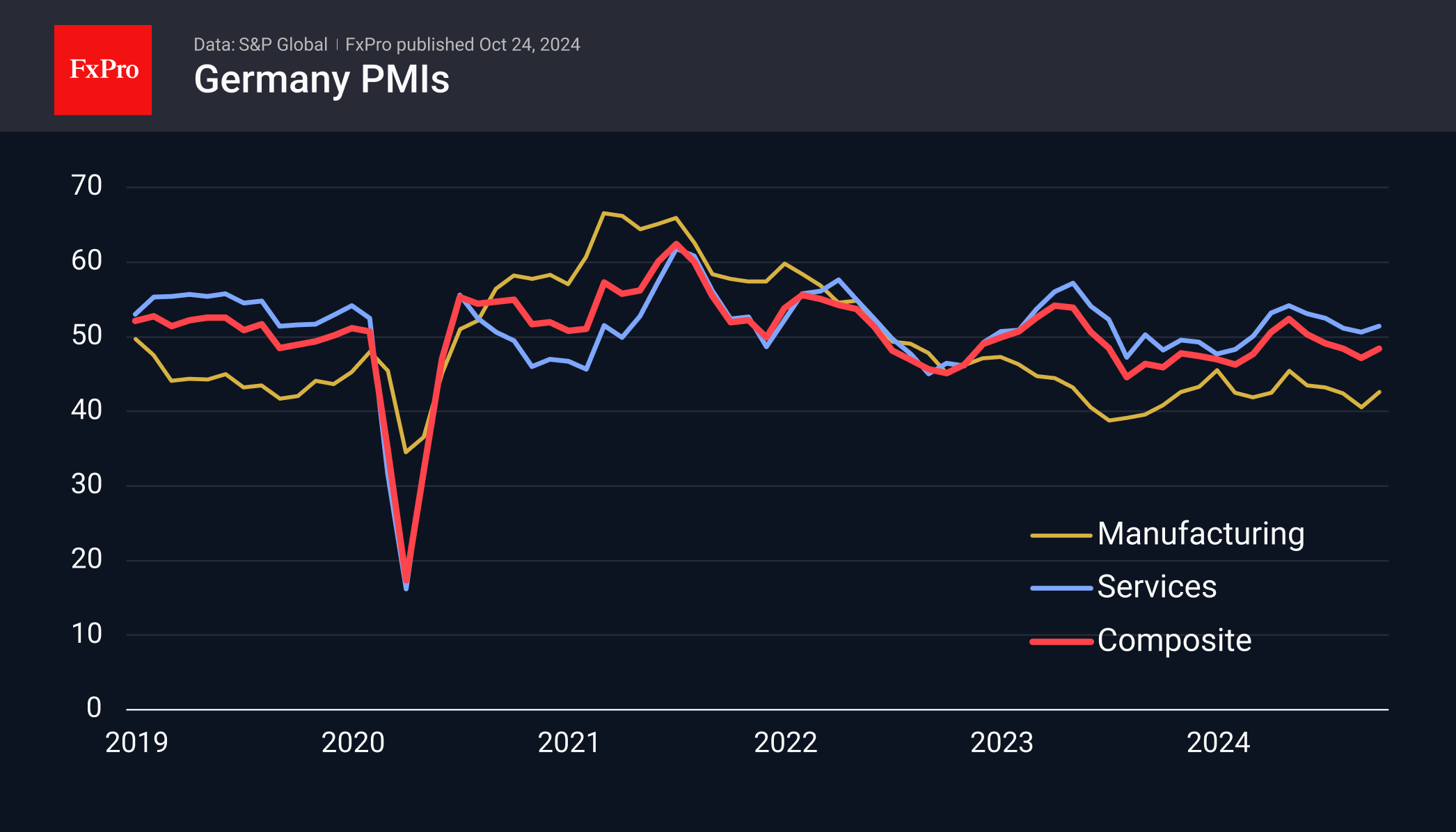
Germany PMI Manufacturing index rose to 42.6 from 40.6, while PMI Services climbed to 51.4 from 50.6. This led to a rise in Composite PMI to 48.4 from 47.5.
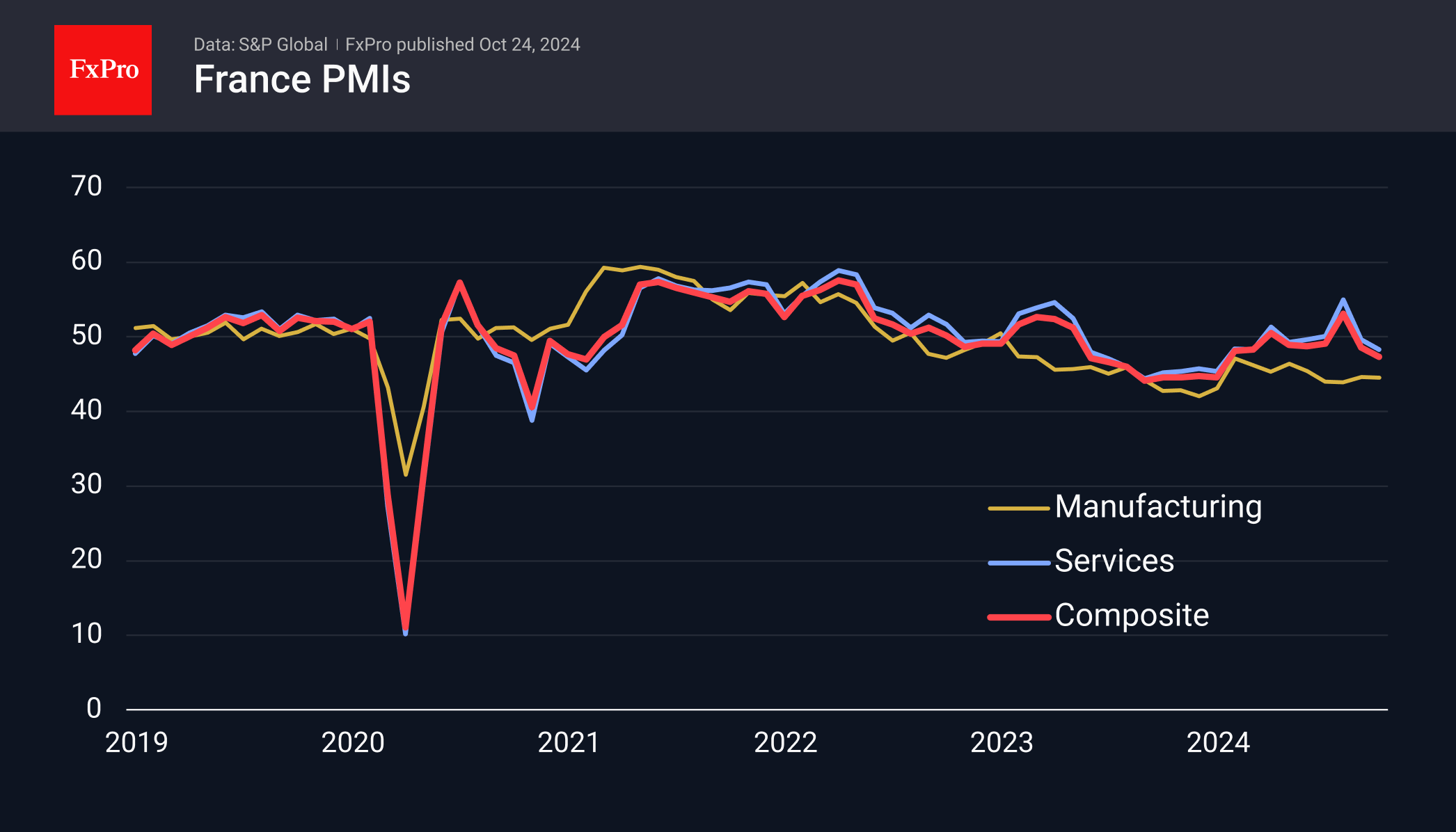
France PMI Manufacturing edged down slightly from 44.6 to 44.5. More notably, Services PMI dropped to 48.3 from 49.6, hitting a 7-month low, while Composite PMI fell from 48.6 to 47.3, its lowest point in nine months.
ECB's Holzmann: 50bps cut in Dec unlikely, but can't be ruled out
Austrian ECB Governing Council member Robert Holzmann, one of the more hawkish voices, signaled that a 25bps cut is "probable" at the December meeting. While a larger, half-point cut isn't "impossible", it's unlikely.
Holzmann emphasized caution, saying, “I’m still concerned that inflation might prove stronger than expected,” reflecting his hesitation in moving too quickly toward easing.
Despite acknowledging some downside risks, he remarked, "I don’t see enough of them to conclude that they dominate," adding that the view of risks being tilted to the downside is still a minority on the ECB Governing Council.
Separately, Slovenia's ECB Governing Council member Bostjan Vasle echoed the sentiment, expressing support for "going to neutral in measured steps.”
Vasle noted that while data has shown improvement, inflation "has not yet been defeated," and discussions about undershooting the inflation target are premature. He further commented, "Once we get closer to neutral, it may be appropriate to align our language accordingly."
Japan’s private sector falls into contraction as PMI services plunges to 20-month low
Japan's private sector slipped into contraction territory at the beginning of Q4, with PMI Manufacturing index declining from 49.7 to 49.0 in October. The services sector saw a much sharper fall, with PMI Services tumbling from 53.1 to 49.3, its worst reading since February 2022. As a result, PMI Composite also dropped from 52.0 to 49.4, the weakest figure since November 2022.
According to Usama Bhatti, economist at S&P Global Market Intelligence, Japan’s economic slowdown has become more pronounced, with firms attributing the downturn to a "muted economy and subdued new order inflows."
Business confidence for the coming year also took a hit, softening to the lowest level since August 2020. Bhatti noted that the "stubbornness of high prices" and ongoing economic weakness are weighing on overall sentiment.
Australian's PMI manufacturing hits 53-month low, inflation pressures easing
Australia’s manufacturing sector continues to struggle, with PMI Manufacturing index slipping slightly from 46.7 to 46.6 in October, marking its lowest point in 53 months. According to Judo Bank’s Matthew De Pasquale, key indicators such as output and new orders have dropped to levels that signal the sector is "on the verge of recession."
However, services sector, which accounts for over 80% of the country's economic output, showed modest improvement. PMI Services ticked up from 50.5 to 50.6, and new business activity rose to its highest level since May, suggesting some resilience. De Pasquale noted that while business growth remains "soft," the outlook for the services sector is improving with new business activity at the highest level since May
Inflation also appears to be moderating. Input cost pressures fell to their lowest levels since the onset of pandemic-induced inflation in 2021. Final prices, particularly in services, are also trending downward. De Pasquale added that inflation "remains on track" to return to RBA's target range of 2% to 3%.
EUR/USD Mid-Day Outlook
Daily Pivots: (S1) 1.0760; (P) 1.0783; (R1) 1.0806; More...
Further decline is expected in EUR/USD despite loss of downside momentum as seen in 4H MACD. Firm break of 61.8% retracement of 1.0447 to 1.1213 at 1.0740 will extend the fall from 1.1213 to 1.0601 support next. Nevertheless, break of 1.0871 will indicate short term bottoming, and turn bias back to the upside for stronger rebound.
In the bigger picture, price actions from 1.1274 (2023 high) are seen as a consolidation pattern to up trend from 0.9534 (2022 low), with fall from 1.1213 as the third leg. Downside should be contained by 50% retracement of 0.9534 (2022 low) to 1.1274 at 1.0404, to bring up trend resumption at a later stage.
US initial jobless claims falls to 227k vs exp 245k
US initial jobless claims fell -15k to 227k in the week ending October 19, well below expectation of 245k. Four-week moving average of initial claims rose 2k to 238.5k.
Continuing claims rose 28k to 1897k in the week ending October 12. Four-week moving average of continuing claims rose 18k to 1861k.
Eurozone PMI Temporarily Helps the Euro but Is Unlikely to Change the Trend
On Thursday, S&P Global released flash estimates for the October PMIs across major regions. The significance of this data increases over time, and in Europe, it often influences market trends.
The European data was mixed, but the currency market focused on stronger-than-expected numbers from Germany.
In France, the services sector is experiencing a deeper decline following a boost from the Olympics. The services index dropped from 49.6 to 48.3, marking its lowest point since the end of last year. Meanwhile, the manufacturing PMI remains in contraction territory at 44.5, staying below 50 for the second consecutive month. The composite index also fell to a nine-month low of 47.3.
Index estimates for Germany shifted the euro’s trajectory, beating forecasts by a wide margin. The services index rose to 51.4 after four months of decline. The manufacturing PMI rose from 40.6 to 42.6, although 40.7 was expected. This rebound offers some reassurance, as German manufacturing, as measured by the PMI, has been in contraction territory since July 2022. As a result, the composite index stands at 48.4 in October, remaining below the 50 mark for the past four months.
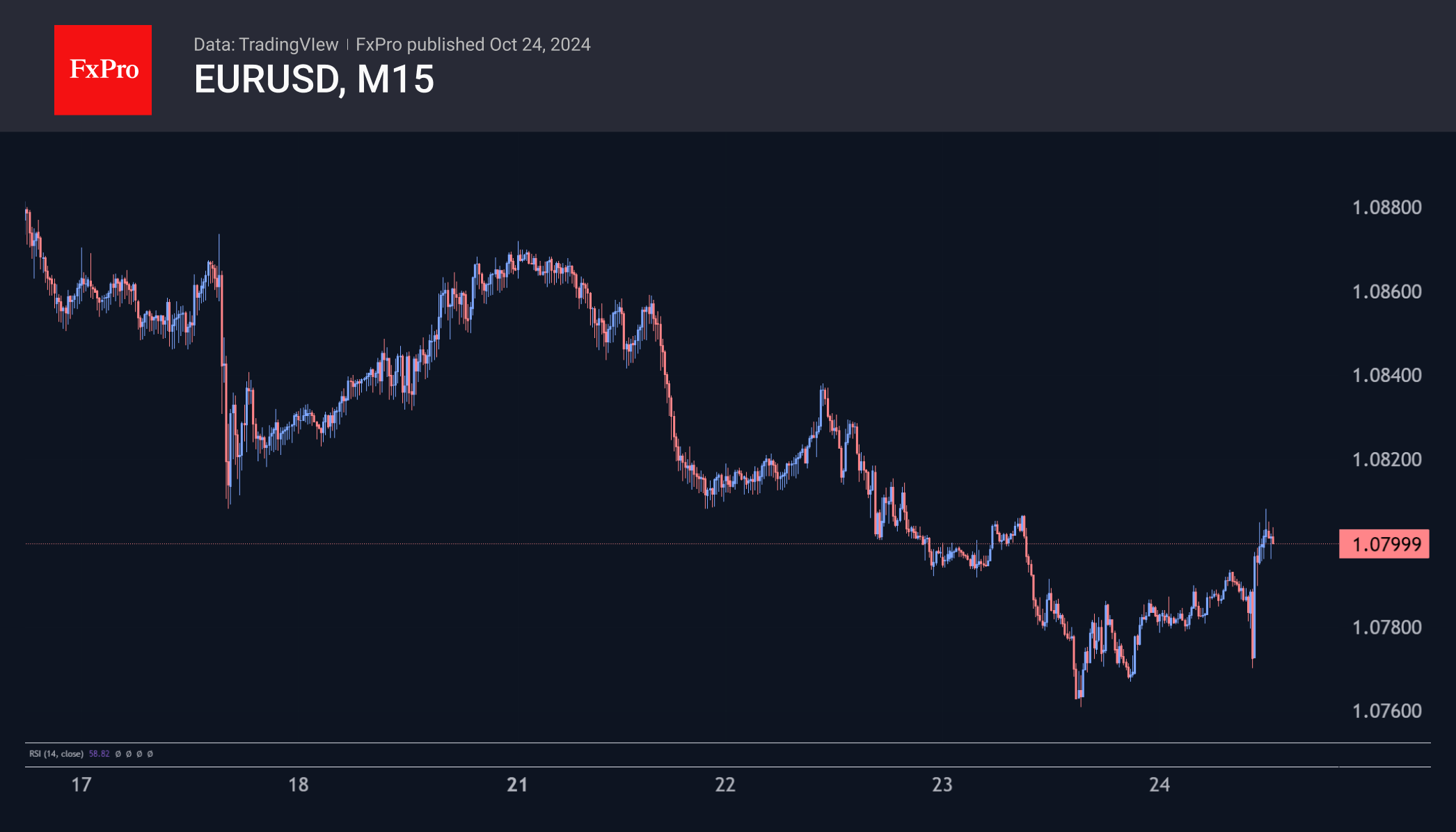
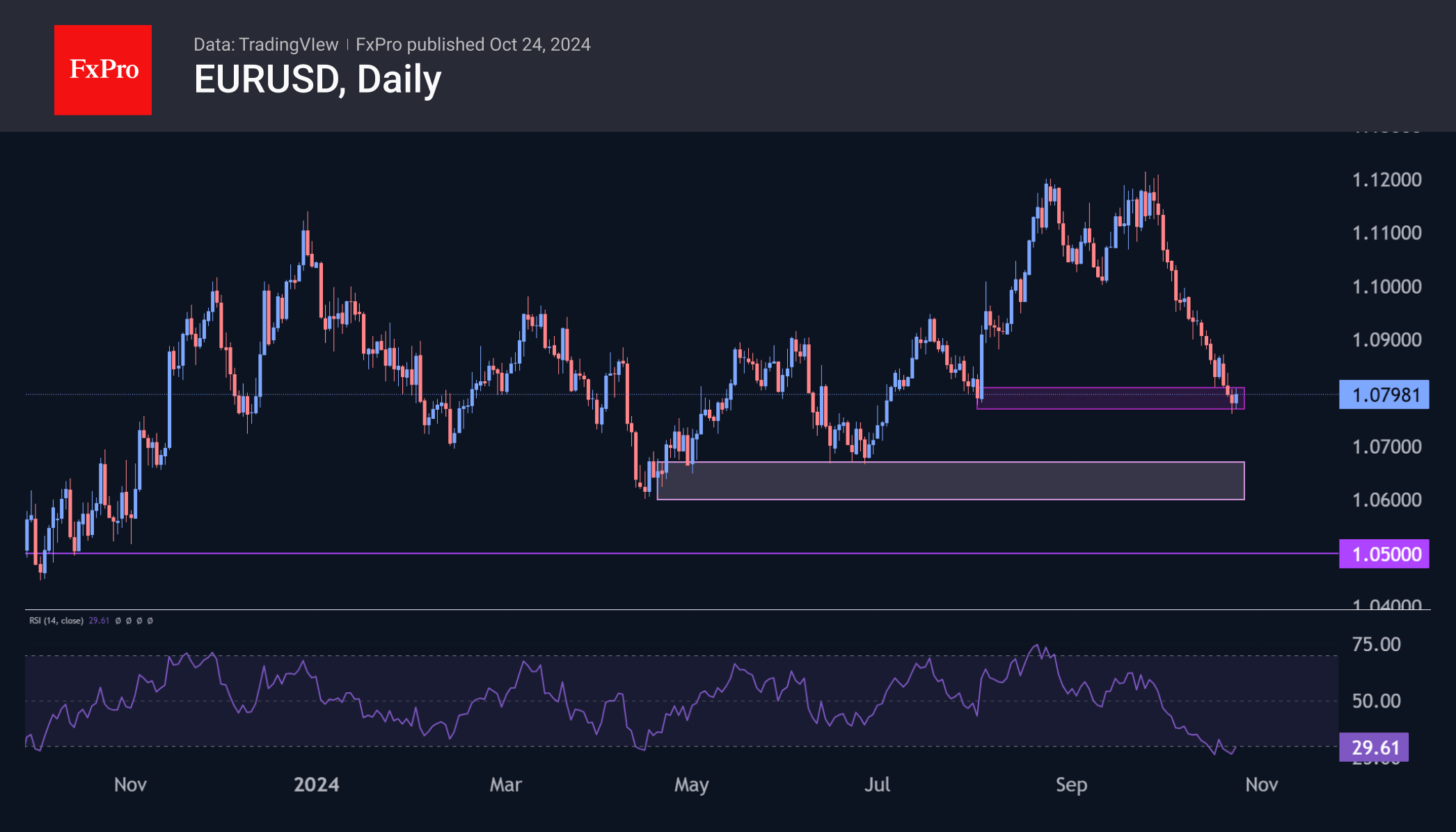
Investors and traders clearly saw the light at the end of the tunnel, as they noted the slight reversal of the German PMIs towards growth, prompting a 0.35% jump in the EUR/USD immediately after the release. However, in the short term, the single currency struggled to break above the 1.08 level, which appears to act as local resistance.
The PMI data for the entire Eurozone exceeded expectations for the manufacturing sector, with the index reaching a five-month high of 45.9. Meanwhile, growth in the services sector picked up slightly, as the composite index increased from 48.9 to 49.7, remaining in contraction territory.
Better-than-expected German data helped the euro pause its decline. Against this backdrop, EURUSD may be able to start a corrective bounce after its almost continuous failure since the end of September. However, the improvement is too modest to affect the ECB’s dovish tone on interest rates in the coming weeks. The central bank is still expected to cut rates actively.
WTI Crude Oil Meets Downtrend Line Again
- WTI crude oil surpasses 20- and 50-day SMAs
- Technical oscillators are mixed
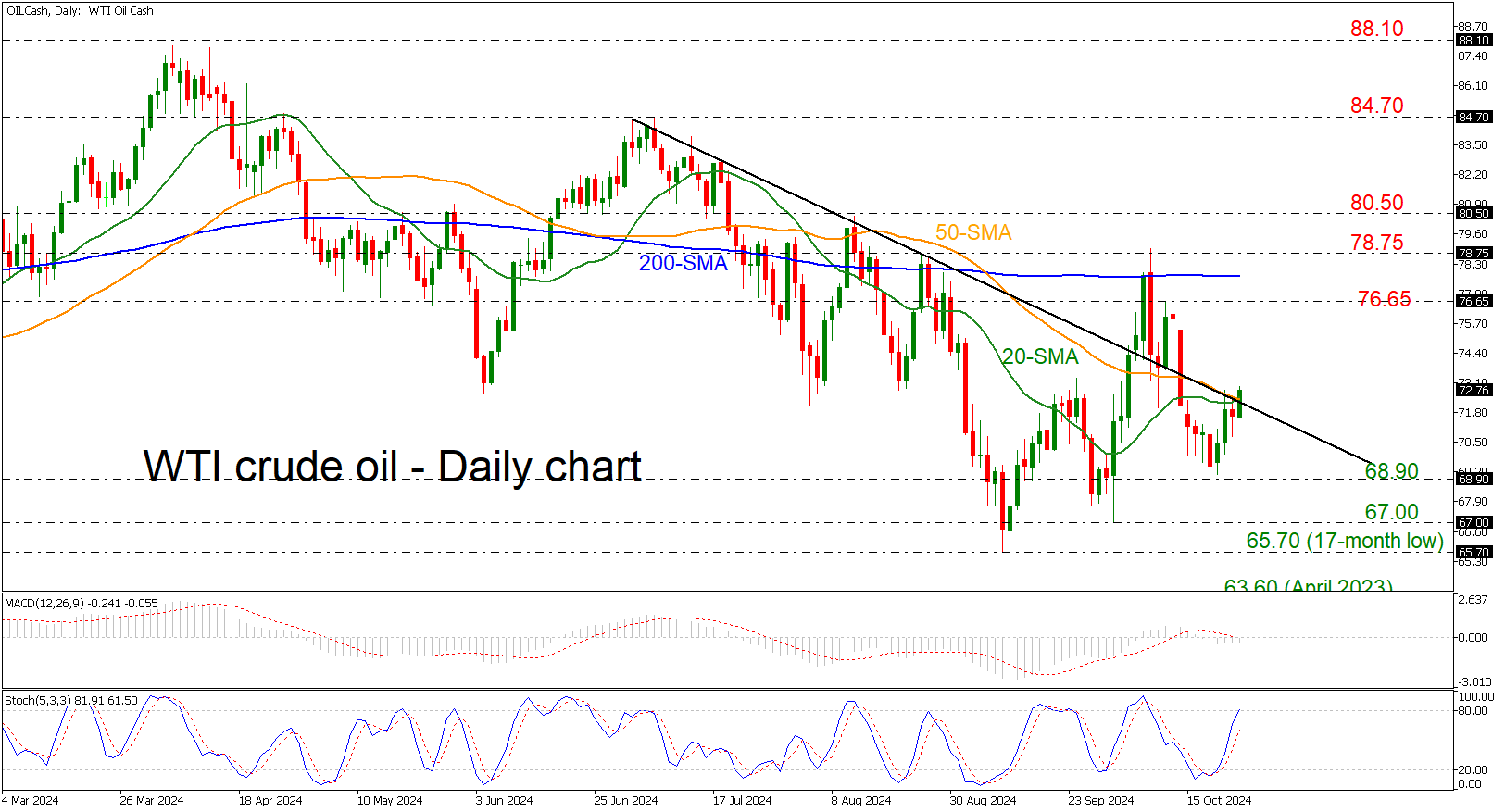
WTI crude oil futures are experiencing a new bullish wave, meeting the medium-term descending trend line again near the 73.00 level after the significant rebound off the 68.90 support level.
Technically, the MACD oscillator is moving horizontally still beneath its trigger and zero lines; however, the stochastic oscillator is climbing above the 80 level, confirming the upside momentum in the market. Moreover, the price is standing above the 20- and 50-day simple moving averages (SMAs).
If there is a steeper bullish move, the commodity may retest the 76.65 resistance and the significant 200-day SMA at 77.85 that failed to surpass it in the preceding days. A successful climb above it could endorse the positive scenario, hitting the next levels of 78.75 and 80.50.
On the flip side, a retreat below the downtrend line could take the bears near the previous trough of 68.90 and the 67.00 round number. More downside pressure could open the way for the 17-month low of 65.70.
In summary, WTI crude oil is battling against the downward trend line and exhibiting indications of improvement in the medium-term outlook.
GBPJPY at 3-Month High
- GBPJPY marks new higher high; remains restricted
- Resistance near 198.50; support seen around 196.00
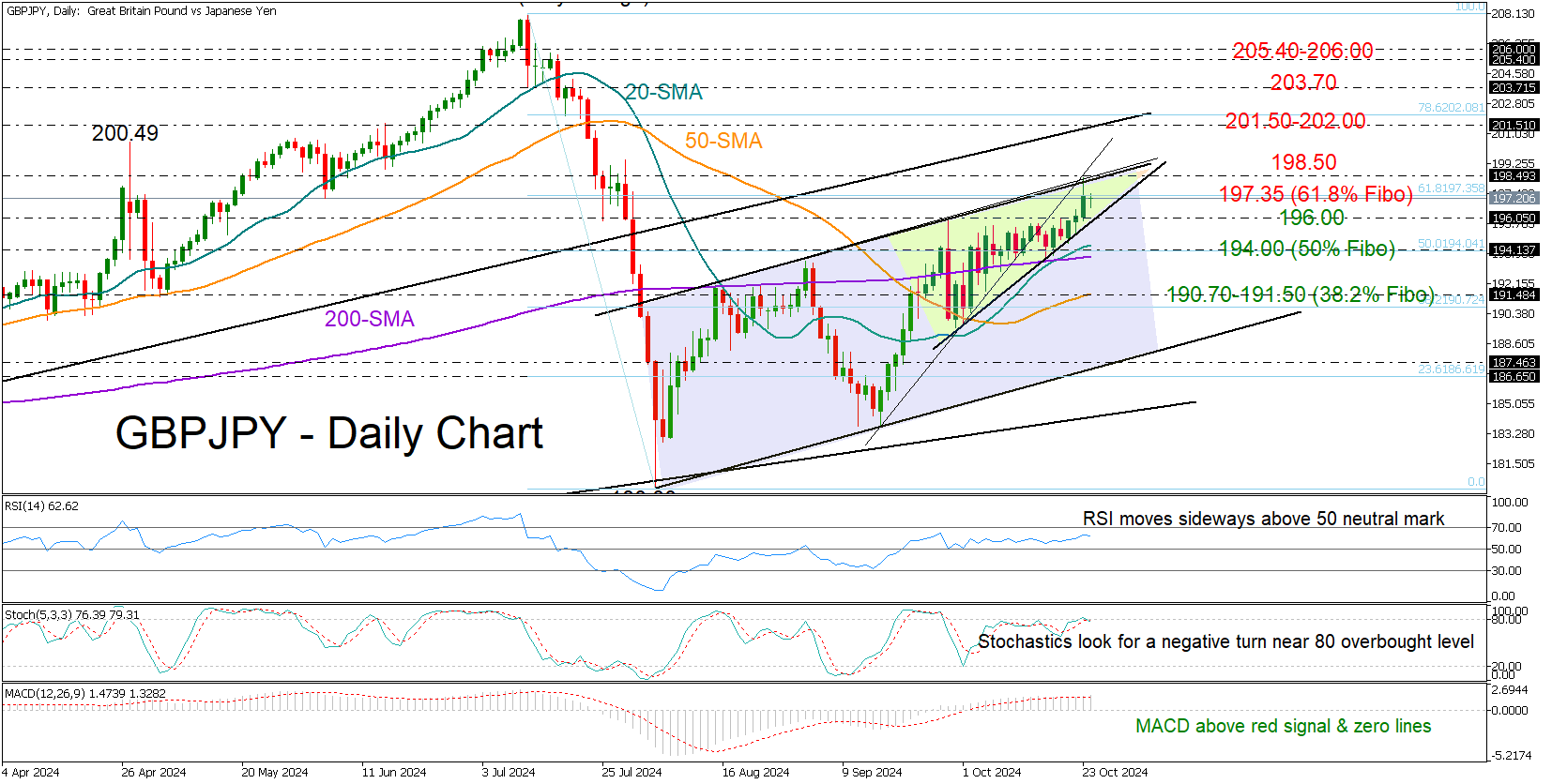
GBPJPY charted a three-month high of 198.42 at the top of a bullish channel, increasing speculation that a new bearish wave could soon start, especially after the close below the 61.8% Fibonacci retracement at 197.35.
Technical indicators are showing mixed signals: the stochastic oscillator is poised for a decline, while the RSI and MACD remain in bullish territory. The 20-day SMA crossing above the 50- and 200-day SMAs suggests potential trend continuation, but a bearish rising wedge is currently creating uncertainty.
If the price breaks above 198.50, the next resistance could occur between 201.50 and 202.00. Continued buying may then push the pair to 203.70 and then towards the 205.40-206.00 zone.
Alternatively, a slide below the 196.00 number could find initial support around the 194.00 area, where the 20- and 200-day SMAs as well as the 50% Fibonacci level are positioned. Further losses could retest the 50-day SMA and the 38.2% Fibonacci of 190.70, a break of which could cause a dramatic downfall towards the channel’s lower band currently seen at 187.20.
In short, GBPJPY is in a cautious area, with decisive movements above 198.50 or below 196.00 likely guiding future price action.
EUR/USD Outlook: Overall Negative PMI Data and Dovish ECB to Weigh on Current Recovery Attempts
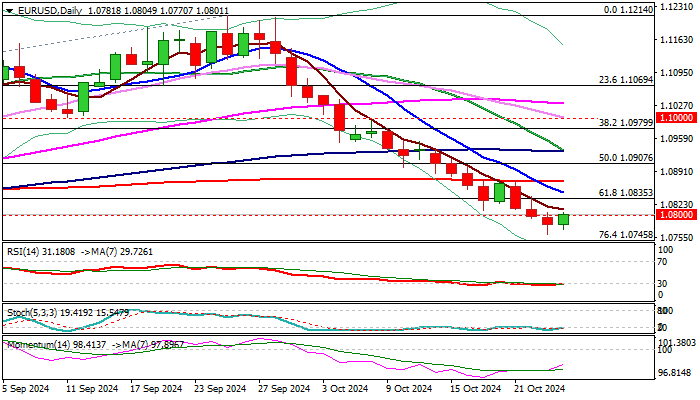
EURUSD edges higher on Thursday morning as oversold daily studies prompted partial profit taking.
Recovery is unlikely to be significant as the pair is in a larger downtrend, driven by negative technical and fundamentals.
Release of PMI data from EU, Germany and France showed that French business activity contracted more in October, while results from Germany were slightly better and numbers from the EU bloc fell below expectations.
According to the latest releases, manufacturing sector continues to suffer with no firm signs of significant recovery in the horizon, while services sector performs better as PMI numbers remain above 50 threshold which divides contraction from growth (Germany, EU) but overall picture shows that business activity is still contacting.
Adding to euro’s negative outlook were the latest dovish comments from ECB officials which suggest that the central bank should keep cutting interest rates until monetary policy enters the territory that stimulates economic growth.
Fresh recovery attempts probe through broken 1.0800 level and eyeing resistances at 1.0835/48 (broken Fibo 61.8% / falling 10DMA) with 200DMA (1.0869) marking solid barrier which should cap upticks.
Res: 1.0835; 1.0848; 1.0869; 1.0907.
Sup: 1.0761; 1.0745; 1.0700; 1.0666.
Has Bitcoin Completed a Correction?
Market Picture
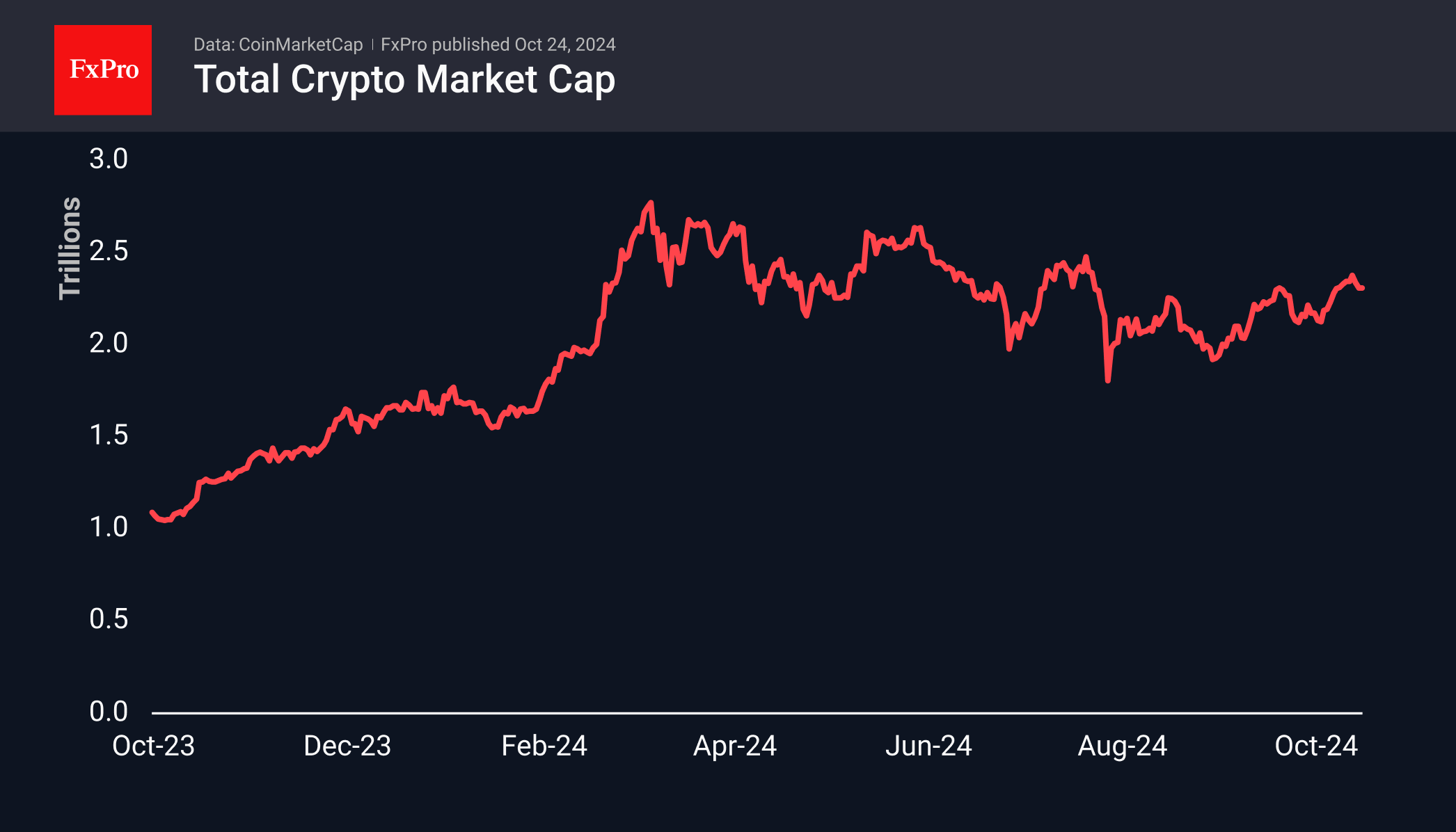
The cryptocurrency market has been rising since the start of the day on Thursday, recovering strongly from Wednesday’s late afternoon sell-off in the wake of global financial markets. At its lowest point, the market capitalisation was down to $2.23 trillion, and at the time of writing, it had risen to $2.32 trillion (+0.1% in 24 hours). The market’s intraday movements will reveal whether this marks the bears’ last stand or if the current rebound is just a bull trap.
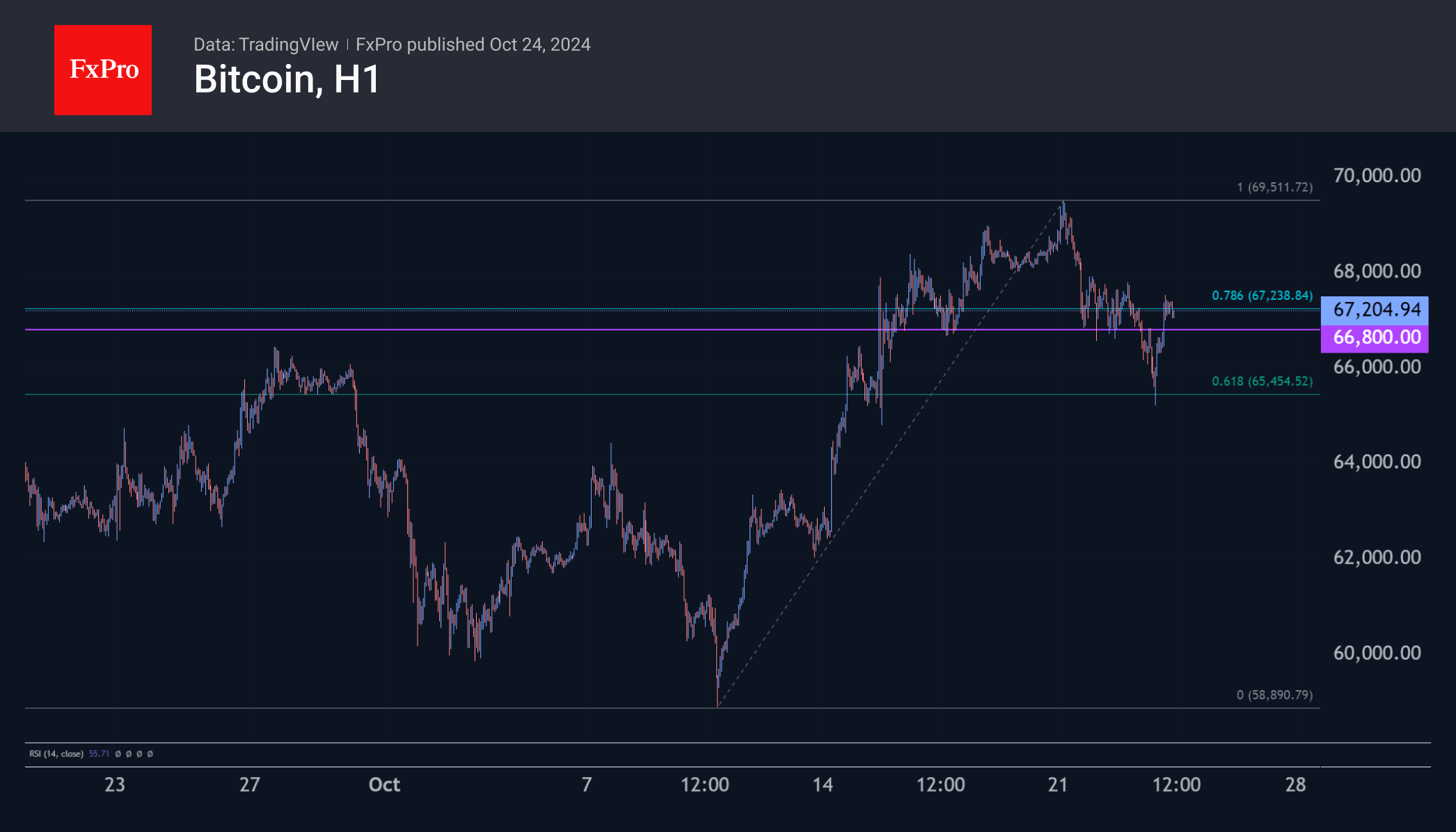
Bitcoin’s intraday dynamics are bullish. Wednesday’s end-of-day lows saw a flash drop below $65.5K, completing a 61.8% Fibonacci retracement of the 10-21 October rally. A quick exit to the recent highs at $69.5K would make the main scenario an extension of the upside with the potential to strengthen to $76K before further consolidation.
News Background
According to CryptoQuant, 94% of the Bitcoin supply is ‘long’, with the median purchase price hovering around $55K. Such high levels of unrealised profits have historically served as a precursor to significant BTC corrections.
Retail demand for Bitcoin returned to pre-ATH levels in March. This contrasts with the first quarter when large players largely drove demand.
Bernstein reiterated its prediction of a $200K price for the first cryptocurrency by the end of next year, calling it ‘conservative’. BTC’s investment appeal is increasing against the backdrop of rising US government debt and the threat of inflation.