

Sample Category Title
EUR/USD Mid-Day Outlook
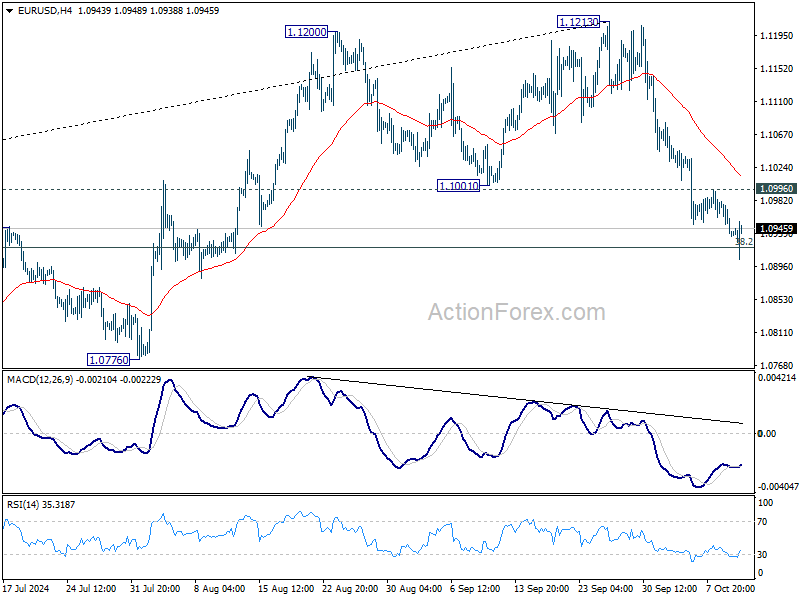
Daily Pivots: (S1) 1.0920; (P) 1.0956; (R1) 1.0975; More....
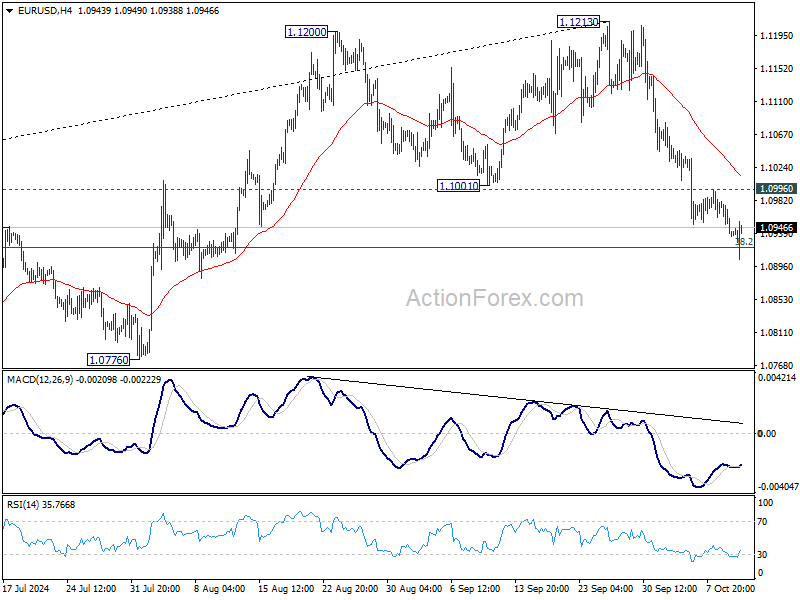
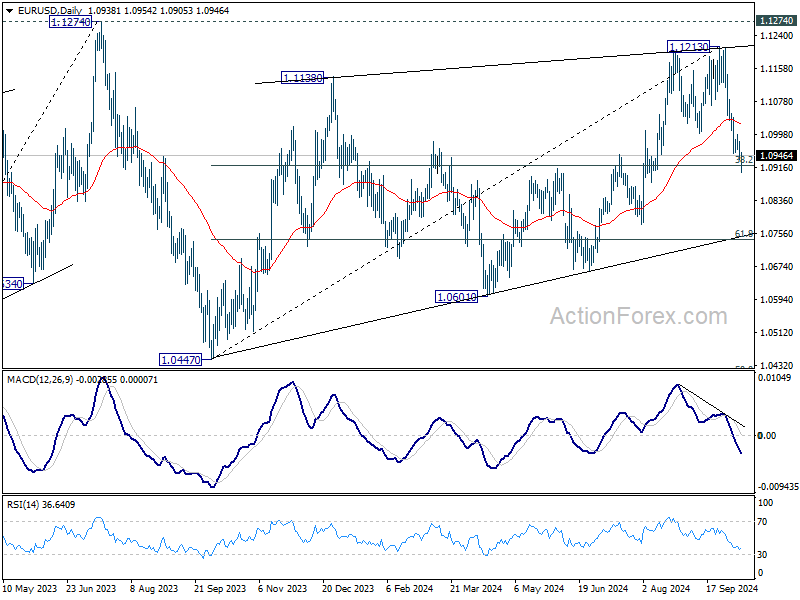
Intraday bias in EUR/USD stays on the downside for the moment. Sustained break of 38.2% retracement of 1.0447 to 1.1213 at 1.0920 will argue that fall from 1.1213 is the third leg of the corrective pattern from 1.1274. In this case, deeper decline would be seen to 61.8% retracement at 1.0740 next. On the upside, above 1.0996 minor resistance will turn intraday bias neutral again first.
In the bigger picture, rejection by 1.1274 resistance suggests that corrective pattern from 1.1274 (2023 high) is not completed yet. Instead, decline from 1.1213 might be another falling leg. Sustained break of 55 W EMA (now at 1.0877) will validate this case, and bring deeper fall towards 1.0447 support again.
GBP/USD Mid-Day Outlook
Daily Pivots: (S1) 1.3049; (P) 1.3081; (R1) 1.3107; More...
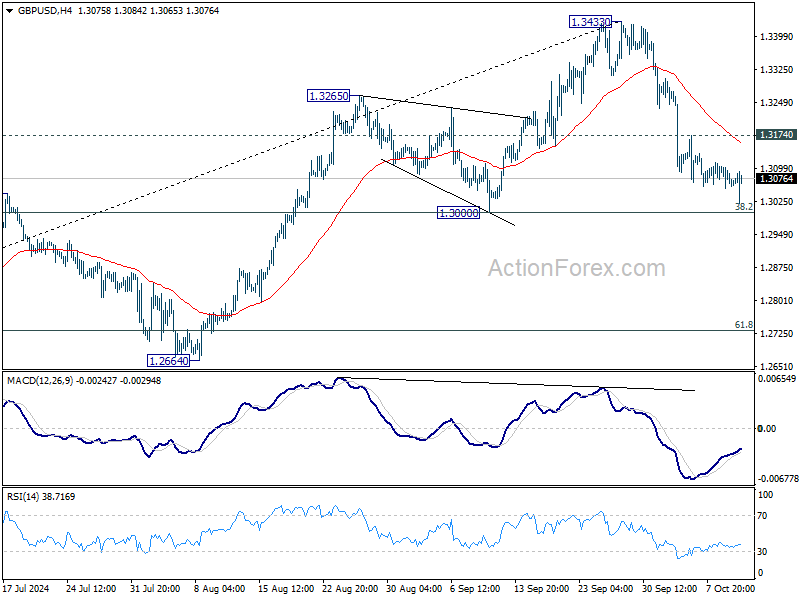
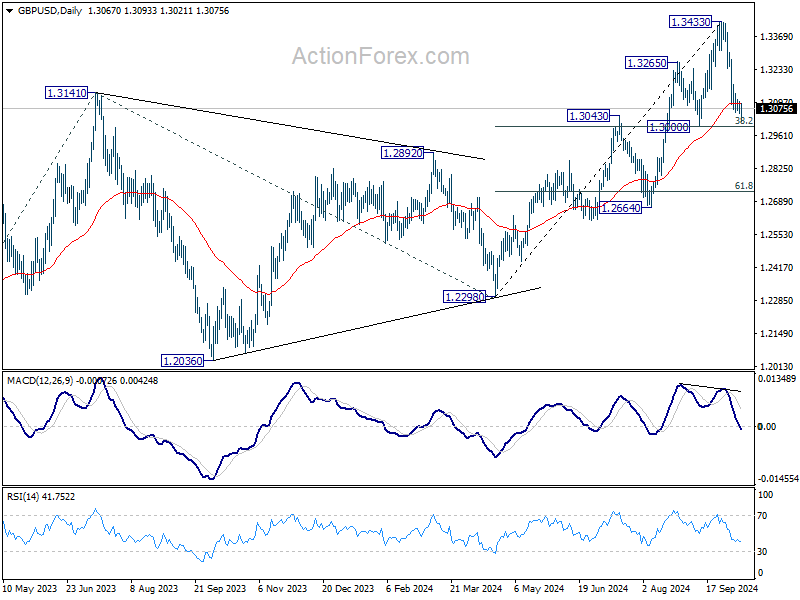
Outlook in GBP/USD is unchanged and intraday bias stays neutral. While corrective fall from 1.3433 might extend lower, strong support should be seen from 1.3000 cluster support (38.2% retracement of 1.2298 to 1.3433 at 1.2999) to contained downside. Above 1.3174 minor resistance will turn bias back to the upside for stronger rebound. However, decisive break of 1.3000 will carry larger bearish implications.
In the bigger picture, as long as 1.3000 support holds, the up trend from 1.0351 (2022 low) is still in progress. Next target is 61.8% projection of 1.0351 to 1.3141 from 1.2298 at 1.4022. However, considering mild bearish divergence condition in D MACD, decisive break of 1.3000 will argue that a medium term top is already in place, and bring deeper fall back to 1.2664 support next.
USD/CHF Mid-Day Outlook
Daily Pivots: (S1) 0.8579; (P) 0.8594; (R1) 0.8624; More…
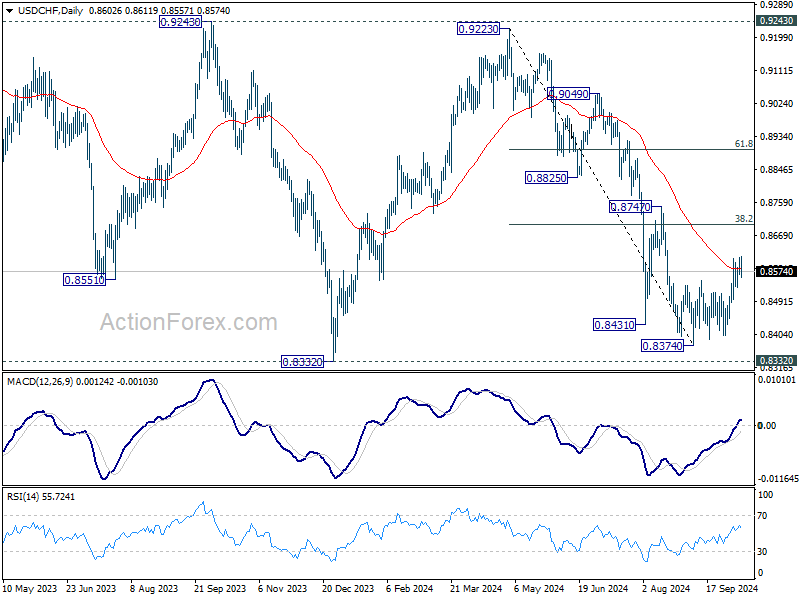
Intraday bias in USD/CHF remains mildly on the upside with 0.8529 minor support intact. Rebound from 0.8374 is in progress for 38.2% retracement of 0.9223 to 0.8374 at 0.8698. Sustained break there will argue that fall from 0.9223 has completed after defending 0.8332 low. Next target will be 61.8% retracement at 0.8899. On the downside, below 0.8529 minor support will turn intraday bias neutral again first.
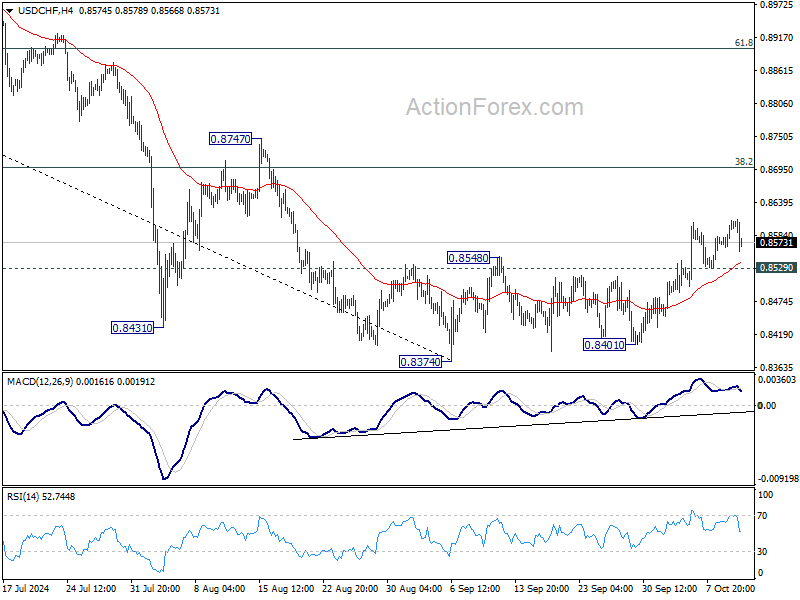
In the bigger picture, price actions from 0.8332 (2023 low) are currently seen as a medium term corrective pattern, with fall from 0.9223 as the second leg. Strong support could be seen from 0.8332 to bring rebound. Yet, overall outlook will continue to stay bearish as long as 0.9243 resistance holds. Firm break of 0.8332, however, will resume larger down trend from 1.0146 (2022 high).
US: Progress on Inflation Front Stalls in September, Supporting Smaller 25bps Cut in Nov
The Consumer Price Index (CPI) rose 0.2% month-on-month (m/m) in September, a tenth of a percentage point (pp) above the consensus forecast. On a twelve-month basis, CPI fell to 2.4% (from 2.5% in August).
- Energy prices (-1.9% m/m) were again a drag on headline inflation, almost entirely driven by a pullback in gasoline prices (-4.0% m/m). Conversely, food prices sharply accelerated last month, rising 0.4% m/m – its strongest monthly gain since January.
Excluding food and energy, core prices rose 0.3% m/m, as it did the preceding month. The twelve-month change ticked up 0.1pp to 3.3%, while the three-month annualized rate rose to 3.1% (from 2.1% in August).
Price growth on core services rose a "soft" 0.4% m/m (0.38% m/m unrounded), in line with August's gain.
- Primary shelter costs were up 0.3% m/m, following a gain of 0.5% m/m in August. The deceleration was driven by a slowing in both Owners' Equivalent Rent (to 0.4% m/m from an outsized gain of 0.5% m/m in August) and Rent of Primary Residence (0.3% from 0.4% m/m). Over the last twelve months, primary shelter costs are up 5.1%, well off their 2023 highs of over 8% but still a few percentage points above the pre-pandemic pace of growth when inflation was running closer to 2%.
- Non-housing services inflation (aka "supercore") rose by 0.4% m/m, also matching last month's gain. The continued strength was primarily driven by another strong advance in vehicle insurance (+1.2% m/m), airline fares (+3.2% m/m) and medical costs (+0.7% m/m).
Core goods prices ticked higher by 0.2% m/m, with higher apparel (+1.1% m/m) and new (+0.2% m/m) and used (+0.3% m/m) vehicle prices all contributing to September's uptick.
Key Implications
This morning's CPI report showed little progress on the inflation front in September. Even with some cooling in shelter costs, service prices remained elevated, while core goods added to overall inflationary pressures (a first in seven months), pushing the three-month annualized rate up to 3.1% – the firmest pace of price growth since May.
With progress on the inflation front stalling and last week's employment report still showing a relatively sturdy labor market, the Fed is likely to slow the pace of rate cuts next month and deliver two additional quarter-point cuts by year-end. While further cuts are in the pipeline for 2025, the Fed will remain data dependent as they continue to adjust the policy rate lower.
USD/JPY Mid-Day Outlook
Daily Pivots: (S1) 148.43; (P) 148.89; (R1) 149.78; More...
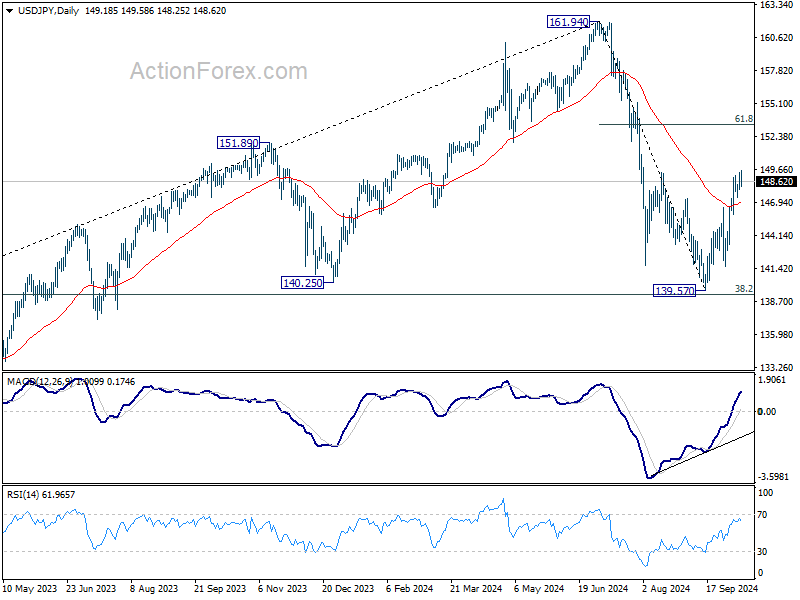
USD/JPY dips in early US session but stays above 147.33 minor support. Intraday bias stays on the upside, as rise from 139.57 short term bottom is still in progress. Current rally is seen as the second leg of the corrective pattern from 161.94. Next target is 61.8% retracement of 161.94 to 139.57 at 153.39. On the downside, below 147.33 minor support will turn intraday bias neutral again first.
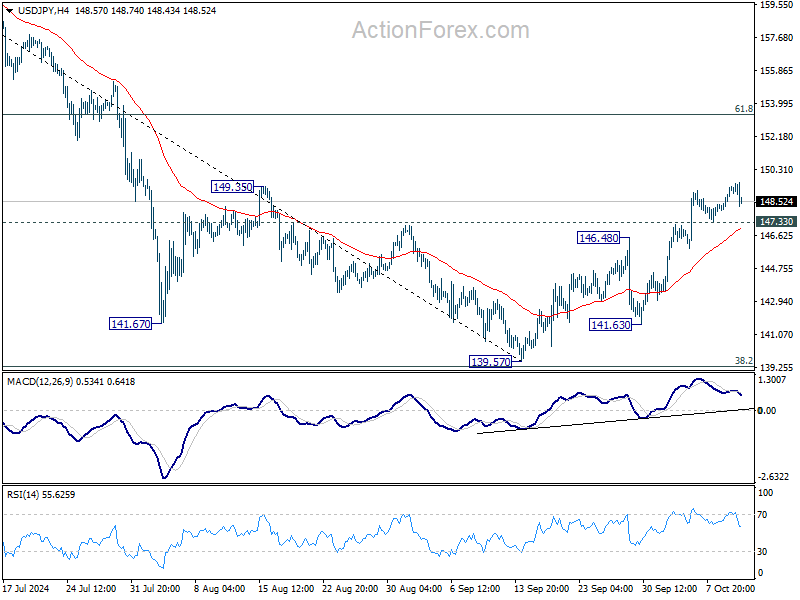
In the bigger picture, price actions from 161.94 are seen as a corrective pattern to rise from 102.58 (2021 low). The range of medium term consolidation should now be set between 38.2% retracement of 102.58 to 161.94 at 139.26 and 161.94. Nevertheless, sustained break of 139.26 would open up deeper medium term decline to 61.8% retracement at 125.25.
Dollar Struggles for Direction Amid Mixed Signals: Strong Inflation vs. Weak Jobs Data
Dollar is struggling to find a clear direction after a set of contrasting economic data sent mixed signals to the markets. On one side, inflationary pressures remain elevated, especially with core inflation ticking up, signals that Fed won't be able to accelerate its policy easing. On the other hand, the unexpectedly sharp rise in initial jobless claims has sparked concerns about amore severe slowdown in the employment market.
Market expectations for Fed remain largely unchanged, with Fed funds futures still pricing in over 80% probability of a 25 bps rate cut in both November and December. Beyond these two meetings, however, the future path of monetary easing looks even more uncertain now.
For the day, Japanese Yen leads in strength, supported by comments from a top BoJ official signaling that more rate hikes could still be on the table. Swiss Franc is the second strongest, followed by New Zealand Dollar. Conversely, Canadian Dollar is the weakest, trailed by Euro and British Pound, while Dollar and Australian Dollar are mixed in middle positions.
Looking at the broader picture for the week, Dollar continues to lead as the strongest currency, followed by Swiss Franc and Yen. Commodity currencies, including the New Zealand Dollar, Canadian Dollar, and Australian Dollar, remain under pressure. Euro and Sterling are in the middle of the pack.
Technically, as there is prospect of deeper retreat in Dollar, here are some levels to watch, including 1.0996 minor resistance in EUR/USD. 1.3174 minor resistance in GBP/USD, 0.8529 minor support in USD/CHF, and 147.33 minor support in USD/JPY. Dollar's near term rally would still be intact if these levels hold. But firm break of them, in particular if simultaneously, will indicate that Dollar selloff has returned.
In Europe, at the time of writing, FTSE is down -0.07%. DAX is down -0.07%. CAC is down -0.23%. UK 10-year yield is up 0.021 at 4.206. Germany 10-year yield is up 0.002 at 2.265. Earlier in Asia, Nikkei rose 0.26%. Hong Kong HSI rose 2.98%. China Shanghai SSE rose 1.32%. Singapore Strait Times fell -0.29%. Japan 10-year JGB yeld rose 0.0252 to 0.959.
US CPI slows to 2.4% yoy in Sep, but core CPI rises to 3.3% yoy
US CPI rose 0.2% mom in September, above expectation of 0.1% mom. CPI core (less food and energy) rose 0.3% mom, above expectation of 0.2% mom, and Shelter costs rose 0.2% mom. Food prices rose 0.4% mom. Together, these two indexes contributed over 75 percent of the monthly all items increase. Energy index fell -1.9% mom.
Over the 12-month period, CPI ticked down from 2.5% yoy to 2.4% yoy, above expectation of 2.3% yoy. That's still the lowest level since February 2021. CPI core ticked up from 3.2% yoy to 3.3% yoy, above expectation of 3.2% yoy. Energy index fell -6.8% yoy while food index rose 2.3% yoy.
US initial jobless claims surges to 258k, highest since mid-2023
US initial jobless claims jumped sharply by 33k to 258k in the week ending October 5, well above expectation of 231k. That's also the highest level since mid-2023. Four-week moving average of initial claims rose 7k to 231k.
Continuing claims rose 42k to 1861k in the week ending September 28. Four-week moving average of continuing claims rose 4.5k to 1832k.
ECB Minutes: Caution on inflation as rate cuts expected to continue
Following the ECB's 25bps rate cut in September, the minutes reveal a cautious stance on future monetary easing, emphasizing the need to rely on a broader evaluation of data, rather than any single metric. While members agreed that further reductions in policy restrictiveness would depend on incoming data, they stressed that "data-dependence" should not be misinterpreted as "data point-dependence" , and mechanical response to short-term inflation figures.
The committee highlighted that a "gradual and cautious approach" remains appropriate, as uncertainties around inflation persist. Despite some signs of improvement, it is still too early to declare the inflation battle won. Concerns over upward revisions in core inflation projections and recent surprises in services inflation were also noted.
ECB emphasized that the "real test" of inflation stability would come in 2025, when the impact of wage growth and productivity gains would be clearer.
For now, markets expect another rate cut at the upcoming October meeting, with a follow-up move in December also largely anticipated.
BoJ's Himino: Rate hikes to continue if economic outlook aligns
BoJ Deputy Governor Ryozo Himino made it clear at a conference today that the central bank if the economic and price forecasts outlined in the July Outlook Report are realized, "the bank will accordingly continue to raise the policy interest rate and adjust the degree of monetary accommodation."
He emphasized that future decisions will be data-dependent, with each meeting assessing the evolving outlook, stating that the BoJ is “not on a preset course.”
Himino addressed the surprise and market disruption following BoJ’s unexpected rate hike in July, acknowledging that the central bank faced criticism for its communication approach.
He conceded, “There’s no silver bullet to improving communications,” but stressed the bank’s strong commitment to refining how it conveys policy decisions to the markets.
Japan's PPI rises 2.8% yoy in Sep, import prices tumble
Japan’s PPI rose by 2.8% yoy in September, a notable increase from the previous month’s 2.6% yoy and well above the market's expectation of 2.3% yoy.
A significant development was the shift in import prices. Yen-based import price index dropped sharply by -2.6% yoy, turning negative for the first time in eight months. This is a stark reversal from the 10.7% yoy rise recorded as recently as July. Export prices also followed a similar downward trend, falling by -1.0% yoy after previously rising by 2.5% yoy.
On a month-over-month basis, PPI remained flat at 0.0% mom, while yen-based import price index decreased by -2.9% mom, and the export price index fell by -1.7% mom. The decline in both import and export prices reflects a combination of softer global demand and a stronger Yen.
USD/JPY Mid-Day Outlook
Daily Pivots: (S1) 148.43; (P) 148.89; (R1) 149.78; More...
USD/JPY dips in early US session but stays above 147.33 minor support. Intraday bias stays on the upside, as rise from 139.57 short term bottom is still in progress. Current rally is seen as the second leg of the corrective pattern from 161.94. Next target is 61.8% retracement of 161.94 to 139.57 at 153.39. On the downside, below 147.33 minor support will turn intraday bias neutral again first.
In the bigger picture, price actions from 161.94 are seen as a corrective pattern to rise from 102.58 (2021 low). The range of medium term consolidation should now be set between 38.2% retracement of 102.58 to 161.94 at 139.26 and 161.94. Nevertheless, sustained break of 139.26 would open up deeper medium term decline to 61.8% retracement at 125.25.
US CPI slows to 2.4% yoy in Sep, but core CPI rises to 3.3% yoy
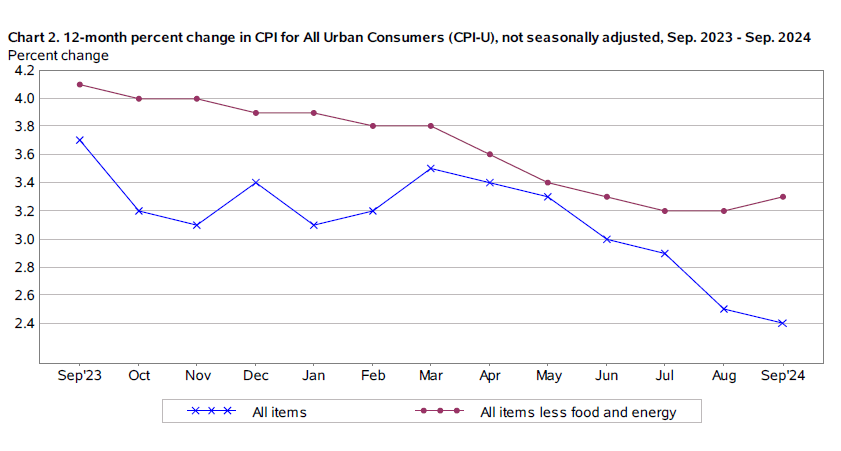
US CPI rose 0.2% mom in September, above expectation of 0.1% mom. CPI core (less food and energy) rose 0.3% mom, above expectation of 0.2% mom, and Shelter costs rose 0.2% mom. Food prices rose 0.4% mom. Together, these two indexes contributed over 75 percent of the monthly all items increase. Energy index fell -1.9% mom.
Over the 12-month period, CPI ticked down from 2.5% yoy to 2.4% yoy, above expectation of 2.3% yoy. That's still the lowest level since February 2021. CPI core ticked up from 3.2% yoy to 3.3% yoy, above expectation of 3.2% yoy. Energy index fell -6.8% yoy while food index rose 2.3% yoy.
US initial jobless claims surges to 258k, highest since mid-2023
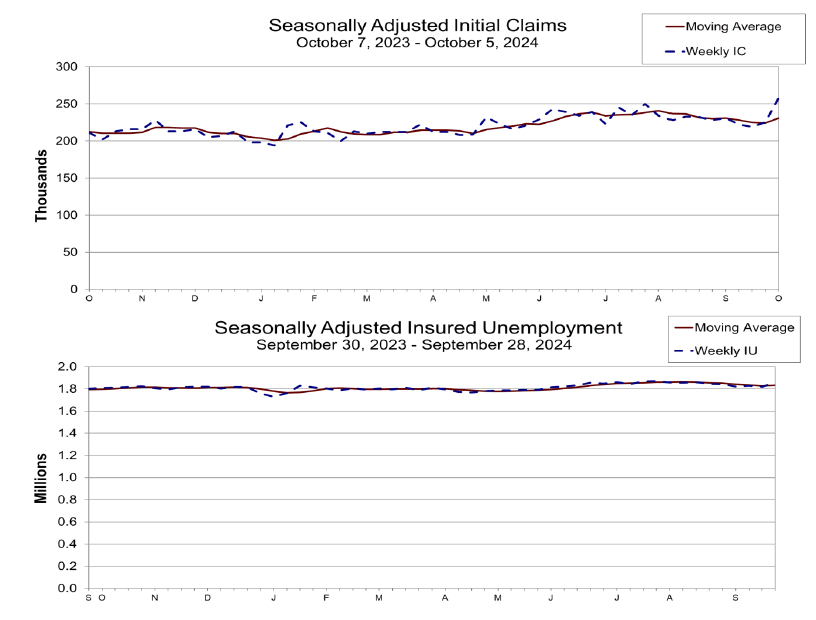
US initial jobless claims jumped sharply by 33k to 258k in the week ending October 5, well above expectation of 231k. That's also the highest level since mid-2023. Four-week moving average of initial claims rose 7k to 231k.
Continuing claims rose 42k to 1861k in the week ending September 28. Four-week moving average of continuing claims rose 4.5k to 1832k.
ECB Minutes: Caution on inflation as rate cuts expected to continue
Following the ECB's 25bps rate cut in September, the minutes reveal a cautious stance on future monetary easing, emphasizing the need to rely on a broader evaluation of data, rather than any single metric. While members agreed that further reductions in policy restrictiveness would depend on incoming data, they stressed that "data-dependence" should not be misinterpreted as "data point-dependence" , and mechanical response to short-term inflation figures.
The committee highlighted that a "gradual and cautious approach" remains appropriate, as uncertainties around inflation persist. Despite some signs of improvement, it is still too early to declare the inflation battle won. Concerns over upward revisions in core inflation projections and recent surprises in services inflation were also noted.
ECB emphasized that the "real test" of inflation stability would come in 2025, when the impact of wage growth and productivity gains would be clearer.
For now, markets expect another rate cut at the upcoming October meeting, with a follow-up move in December also largely anticipated.
(ECB) Monetary policy accounts
Account of the monetary policy meeting of the Governing Council of the European Central Bank held in Frankfurt am Main on Wednesday and Thursday, 11-12 September 2024
10 October 2024
1. Review of financial, economic and monetary developments and policy options
Financial market developments
Ms Schnabel noted that since the Governing Council’s previous monetary policy meeting on 17-18 July 2024 there had been repeated periods of elevated market volatility, as growth concerns had become the dominant market theme. The volatility in risk asset markets had left a more persistent imprint on broader financial markets associated with shifting expectations for the policy path of the Federal Reserve System.
The reappraisal of expectations for US monetary policy had spilled over into euro area rate expectations, supported by somewhat weaker economic data and a notable decline in headline inflation in the euro area. Overnight index swap (OIS) markets were currently pricing in a steeper and more frontloaded rate-cutting cycle than had been anticipated at the time of the Governing Council’s previous monetary policy meeting. At the same time, survey expectations had hardly changed relative to July.
Volatility in US equity markets had shot up to levels last seen in October 2020, following the August US non-farm payroll employment report and the unwinding of yen carry trades. Similarly, both the implied volatility in the euro area stock market and the Composite Indicator of Systemic Stress had spiked. However, the turbulence had proved short-lived, and indicators of volatility and systemic stress had come down quickly.
The sharp swings in risk aversion among global investors had been mirrored in equity prices, with the weaker growth outlook having also been reflected in the sectoral performance of global equity markets. In both the euro area and the United States, defensive sectors had recently outperformed cyclical ones, suggesting that equity investors were positioning themselves for weaker economic growth.
Two factors could have amplified stock market dynamics. One was that the sensitivity of US equity prices to US macroeconomic shocks can depend on prevailing valuations. Another was the greater role of speculative market instruments, including short volatility equity funds.
The pronounced reappraisal of the expected path of US monetary policy had spilled over into rate expectations across major advanced economies, including the euro area. The euro area OIS forward curve had shifted noticeably lower compared with expectations prevailing at the time of the Governing Council’s July meeting. In contrast to market expectations, surveys had proven much more stable. The expectations reported in the most recent Survey of Monetary Analysts (SMA) had been unchanged versus the previous round and pointed towards a more gradual rate path.
The dynamics of market-based and survey-based policy rate expectations over the year – as illustrated by the total rate cuts expected by the end of 2024 and the end of 2025 in the markets and in the SMA – showed that the higher volatility in market expectations relative to surveys had been a pervasive feature. Since the start of 2024 market-based expectations had oscillated around stable SMA expectations. The dominant drivers of interest rate markets in the inter-meeting period and for most of 2024 had in fact been US rather than domestic euro area factors, which could partly explain the more muted sensitivity of analysts’ expectations to recent incoming data.
At the same time, the expected policy divergence between the euro area and the United States had changed signs, with markets currently expecting a steeper easing cycle for the Federal Reserve.
The decline in US nominal rates across maturities since the Governing Council’s last meeting could be explained mainly by a decline in expected real rates, as shown by a breakdown of OIS rates across different maturities into inflation compensation and real rates. By contrast, the decline in euro area nominal rates had largely related to a decline in inflation compensation.
The market’s reassessment of the outlook for inflation in the euro area and the United States had led to the one-year inflation-linked swap (ILS) rates one year ahead declining broadly in tandem on both sides of the Atlantic. The global shift in investor focus from inflation to growth concerns may have lowered investors’ required compensation for upside inflation risks. A second driver of inflation compensation had been the marked decline in energy prices since the Governing Council’s July meeting. Over the past few years the market’s near-term inflation outlook had been closely correlated with energy prices.
Market-based inflation expectations had again been oscillating around broadly stable survey-based expectations, as shown by a comparison of the year-to-date developments in SMA expectations and market pricing for inflation rates at the 2024 and 2025 year-ends.
The dominance of US factors in recent financial market developments and the divergence in policy rate expectations between the euro area and the United States had also been reflected in exchange rate developments. The euro had been pushed higher against the US dollar owing to the repricing of US monetary policy expectations and the deterioration in the US macroeconomic outlook. In nominal effective terms, however, the euro exchange rate had depreciated mildly, as the appreciation against the US dollar and other currencies had been more than offset by a weakening against the Swiss franc and the Japanese yen.
Sovereign bond markets had once again proven resilient to the volatility in riskier asset market segments. Ten-year sovereign spreads over German Bunds had widened modestly after the turbulence but had retreated shortly afterwards. As regards corporate borrowing, the costs of rolling over euro area and US corporate debt had eased measurably across rating buckets relative to their peak.
Finally, there had been muted take-up in the first three-month lending operation extending into the period of the new pricing for the main refinancing operations. As announced in March, the spread to the deposit facility rate would be reduced from 50 to 15 basis points as of 18 September 2024. Moreover, markets currently expected only a slow increase in take-up and no money market reaction to this adjustment.
The global environment and economic and monetary developments in the euro area
Mr Lane started by reviewing inflation developments in the euro area. Headline inflation had decreased to 2.2% in August (flash release), which was 0.4 percentage points lower than in July. This mainly reflected a sharp decline in energy inflation, from 1.2% in July to -3.0% in August, on account of downward base effects. Food inflation had been 2.4% in August, marginally up from 2.3% in July. Core inflation – as measured by the Harmonised Index of Consumer Prices (HICP) excluding energy and food – had decreased by 0.1 percentage points to 2.8% in August, as the decline in goods inflation to 0.4% had outweighed the rise in services inflation to 4.2%.
Most measures of underlying inflation had been broadly unchanged in July. However, domestic inflation remained high, as wages were still rising at an elevated pace. But labour cost pressures were moderating, and lower profits were partially buffering the impact of higher wages on inflation. Growth in compensation per employee had fallen further, to 4.3%, in the second quarter of 2024. And despite weak productivity unit labour costs had grown less strongly, by 4.6%, after 5.2% in the first quarter. Annual growth in unit profits had continued to fall, coming in at -0.6%, after -0.2% in the first quarter and +2.5% in the last quarter of 2023. Negotiated wage growth would remain high and volatile over the remainder of the year, given the significant role of one-off payments in some countries and the staggered nature of wage adjustments. The forward-looking wage tracker also signalled that wage growth would be strong in the near term but moderate in 2025.
Headline inflation was expected to rise again in the latter part of this year, partly because previous falls in energy prices would drop out of the annual rates. According to the latest ECB staff projections, headline inflation was expected to average 2.5% in 2024, 2.2% in 2025 and 1.9% in 2026, notably reaching 2.0% during the second half of next year. Compared with the June projections, the profile for headline inflation was unchanged. Inflation projections including owner-occupied housing costs were a helpful cross-check. However, in the September projections these did not imply any substantial difference, as inflation both in rents and in the owner-occupied housing cost index had shown a very similar profile to the overall HICP inflation projection. For core inflation, the projections for 2024 and 2025 had been revised up slightly, as services inflation had been higher than expected. Staff continued to expect a rapid decline in core inflation, from 2.9% this year to 2.3% in 2025 and 2.0% in 2026. Owing to a weaker economy and lower wage pressures, the projections now saw faster disinflation in the course of 2025, resulting in the projection for core inflation in the fourth quarter of that year being marked down from 2.2% to 2.1%.
Turning to the global economy, Mr Lane stressed that global activity excluding the euro area remained resilient and that global trade had strengthened in the second quarter of 2024, as companies frontloaded their orders in anticipation of shipping delays ahead of the Christmas season. At the same time downside risks were rising, with indicators signalling a slowdown in manufacturing. The frontloading of trade in the first half of the year meant that trade performance in the second half could be weaker.
The euro had been appreciating against the US dollar (+1.0%) since the July Governing Council meeting but had been broadly stable in effective terms. As for the energy markets, Brent crude oil prices had decreased by 14%, to around USD 75 per barrel, since the July meeting. European natural gas prices had increased by 16%, to stand at around €37 per megawatt-hour amid ongoing geopolitical concerns.
Euro area real GDP had expanded by 0.2% in the second quarter of this year, after being revised down. This followed 0.3% in the first quarter and fell short of the latest staff projections for real GDP. It was important not to exaggerate the slowdown in the second quarter of 2024. This was less pronounced when excluding a small euro area economy with a large and volatile contribution from intangible investment. However, while the euro area economy was continuing to grow, the expansion was being driven not by private domestic demand, but mainly by net exports and government spending. Private domestic demand had weakened, as households were consuming less, firms had cut business investment and housing investment had dropped sharply. The euro area flash composite output Purchasing Managers’ Index (PMI) had risen to 51.2 in August from 50.2 in July. While the services sector continued to expand, the more interest-sensitive manufacturing sector continued to contract, as it had done for most of the past two years. The flash PMI for services business activity for August had risen to 53.3, while the manufacturing output PMI remained deeply in contractionary territory at 45.7. The overall picture raised concerns: as developments were very similar for both activity and new orders, there was no indication that the manufacturing sector would recover anytime soon. Consumer confidence remained subdued and industrial production continued to face strong headwinds, with the highly interconnected industrial sector in the euro area’s largest economy suffering from a prolonged slump. On trade, it was also a concern that the improvements in the PMIs for new export orders for both services and manufacturing had again slipped in the last month or two.
After expanding by 3.5% in 2023, global real GDP was expected to grow by 3.4% in 2024 and 2025, and 3.3% in 2026, according to the September ECB staff macroeconomic projections. Compared to the June projections, global real GDP growth had been revised up by 0.1 percentage points in each year of the projection horizon. Even though the outlook for the world economy had been upgraded slightly, there had been a downgrade in terms of the export prices of the euro area’s competitors, which was expected to fuel disinflationary pressures in the euro area, particularly in 2025.
The euro area labour market remained resilient. The unemployment rate had been broadly unchanged in July, at 6.4%. Employment had grown by 0.2% in the second quarter. At the same time, the growth in the labour force had slowed. Recent survey indicators pointed to a further moderation in the demand for labour, with the job vacancy rate falling from 2.9% in the first quarter to 2.6% in the second quarter, close to its pre-pandemic peak of 2.4%. Early indicators of labour market dynamics suggested a further deceleration of labour market momentum in the third quarter. The employment PMI had stood at the broadly neutral level of 49.9 in August.
In the staff projections output growth was expected to be 0.8% in 2024 and to strengthen to 1.3% in 2025 and 1.5% in 2026. Compared with the June projections, the outlook for growth had been revised down by 0.1 percentage points in each year of the projection horizon. For 2024, the downward revision reflected lower than expected GDP data and subdued short-term activity indicators. For 2025 and 2026 the downward revisions to the average annual growth rates were the result of slightly weaker contributions from net trade and domestic demand.
Concerning fiscal policies, the euro area budget balance was projected to improve progressively, though less strongly than in the previous projection round, from -3.6% in 2023 to -3.3% in 2024, -3.2% in 2025 and -3.0% in 2026.
Turning to monetary and financial analysis, risk-free market interest rates had decreased markedly since the last monetary policy meeting, mostly owing to a weaker outlook for global growth and reduced concerns about inflation pressures. Tensions in global markets over the summer had led to a temporary tightening of financial conditions in the riskier market segments. But in the euro area and elsewhere forward rates had fallen across maturities. Financing conditions for firms and households remained restrictive, as the past policy rate increases continued to work their way through the transmission chain. The average interest rates on new loans to firms and on new mortgages had stayed high in July, at 5.1% and 3.8% respectively. Monetary dynamics were broadly stable amid marked volatility in monthly flows, with net external assets remaining the main driver of money creation. The annual growth rate of M3 had stood at 2.3% in July, unchanged from June but up from 1.5% in May. Credit growth remained sluggish amid weak demand.
Monetary policy considerations and policy options
Regarding the assessment of the inflation outlook, the dynamics of underlying inflation and the strength of monetary policy transmission, Mr Lane concluded that confidence in a timely return of inflation to target was supported by both declining uncertainty around the projections, including their stability across projection rounds, and also by inflation expectations across a range of indicators that remained aligned with a timely convergence to target. The incoming data on wages and profits had been in line with expectations. The baseline scenario foresaw a demand-led economic recovery that boosted labour productivity, allowing firms to absorb the expected growth in labour costs without denting their profitability too much. This should buffer the cost pressures stemming from higher wages, dampening price increases. Most measures of underlying inflation, including those with a high predictive content for future inflation, were stable at levels consistent with inflation returning to target in a sufficiently timely manner. While domestic inflation was still being kept elevated by pay rises, the projected slowdown in wage growth next year was expected to make a major contribution to the final phase of disinflation towards the target.
Based on this assessment, it was now appropriate to take another step in moderating the degree of monetary policy restriction. Accordingly, Mr Lane proposed lowering the deposit facility rate – the rate through which the Governing Council steered the monetary policy stance – by 25 basis points. This decision was robust across a wide range of scenarios. At a still clearly restrictive level of 3.50% for the deposit facility rate, upside shocks to inflation calling into question the timely return of inflation to target could be addressed with a slower pace of rate reductions in the coming quarters compared with the baseline rate path embedded in the projections. At the same time, compared with holding the deposit facility rate at 3.75%, this level also offered greater protection against downside risks that could lead to an undershooting of the target further out in the projection horizon, including the risks associated with an excessively slow unwinding of the rate tightening cycle.
Looking ahead, a gradual approach to dialling back restrictiveness would be appropriate if the incoming data were in line with the baseline projection. At the same time, optionality should be retained as regards the speed of adjustment. In one direction, if the incoming data indicated a sustained acceleration in the speed of disinflation or a material shortfall in the speed of economic recovery (with its implications for medium-term inflation), a faster pace of rate adjustment could be warranted; in the other direction, if the incoming data indicated slower than expected disinflation or a faster pace of economic recovery, a slower pace of rate adjustment could be warranted. These considerations reinforced the value of a meeting-by-meeting and data-dependent approach that maintained two-way optionality and flexibility for future rate decisions. This implied reiterating (i) the commitment to keep policy rates sufficiently restrictive for as long as necessary to achieve a timely return of inflation to target; (ii) the emphasis on a data-dependent and meeting-by-meeting approach in setting policy; and (iii) the retention of the three-pronged reaction function, based on the Governing Council’s assessment of the inflation outlook, the dynamics of underlying inflation and the strength of monetary policy transmission.
As announced in March, some changes to the operational framework for implementing monetary policy were to come into effect at the start of the next maintenance period on 18 September. The spread between the rate on the main refinancing operations and the deposit facility rate would be reduced to 15 basis points. The spread between the rate on the marginal lending facility and the rate on the main refinancing operations would remain unchanged at 25 basis points. These technical adjustments implied that the main refinancing operations and marginal lending facility rates would be reduced by 60 basis points the following week, to 3.65% and 3.90% respectively. In view of these changes, the Governing Council should emphasise in its communication that it steered the monetary policy stance by adjusting the deposit facility rate.
2. Governing Council’s discussion and monetary policy decisions
Economic, monetary and financial analyses
Looking at the external environment, members took note of the assessment provided by Mr Lane. Incoming data confirmed growth in global activity had been resilient, although recent negative surprises in PMI manufacturing output indicated potential headwinds to the near-term outlook. While the services sector was growing robustly, the manufacturing sector was contracting. Goods inflation was declining sharply, in contrast to persistent services inflation. Global trade had surprised on the upside in the second quarter, likely owing to frontloaded restocking. However, it was set to decelerate again in the third quarter and then projected to recover and grow in line with global activity over the rest of the projection horizon. Euro area foreign demand followed a path similar to global trade and had been revised up for 2024 (owing mainly to strong data). Net exports had been the main demand component supporting euro area activity in the past two quarters. Looking ahead, though, foreign demand was showing signs of weakness, with falling export orders and PMIs.
Overall, the September projections had shown a slightly improved growth outlook relative to the June projections, both globally and for the major economies, which suggested that fears of a major global slowdown might be exaggerated. US activity remained robust, despite signs of rebalancing in the labour market. The recent rise in unemployment was due primarily to an increasing labour force, driven by higher participation rates and strong immigration, rather than to weakening labour demand or increased slack. China’s growth had slowed significantly in the second quarter as the persistent downturn in the property market continued to dampen household demand. Exports remained the primary driver of growth. Falling Chinese export prices highlighted the persisting overcapacity in the construction and high-tech manufacturing sectors.
Turning to commodities, oil prices had fallen significantly since the Governing Council’s previous monetary policy meeting. The decline reflected positive supply news, dampened risk sentiment and the slowdown in economic activity, especially in China. The futures curve suggested a downward trend for oil prices. In contrast, European gas prices had increased in the wake of geopolitical concerns and localised supply disruptions. International prices for both metal and food commodities had declined slightly. Food prices had fallen owing to favourable wheat crop conditions in Canada and the United States. In this context, it was argued that the decline in commodity prices could be interpreted as a barometer of sentiment on the strength of global activity.
With regard to economic activity in the euro area, members concurred with the assessment presented by Mr Lane and acknowledged the weaker than expected growth outcome in the second quarter. While broad agreement was expressed with the latest macroeconomic projections, it was emphasised that incoming data implied a downward revision to the growth outlook relative to the previous projection round. Moreover, the remark was made that the private domestic economy had contributed negatively to GDP growth for the second quarter in a row and had been broadly stagnating since the middle of 2022.
It was noted that, since the cut-off for the projections, Eurostat had revised data for the latest quarters, with notable changes to the composition of growth. Moreover, in earlier national account releases, there had already been sizeable revisions to backdata, with upward revisions to the level of activity, which had been broadly taken into account in the September projections. With respect to the latest release, the demand components for the second quarter pointed to an even less favourable contribution from consumption and investment and therefore presented a more pessimistic picture than in the September staff projections. The euro area current account surplus also suggested that domestic demand remained weak. Reference was made to potential adverse non-linear dynamics resulting from the current economic weakness, for example from weaker balance sheets of households and firms, or originating in the labour market, as in some countries large firms had recently moved to lay off staff.
It was underlined that the long-anticipated consumption-led recovery in the euro area had so far not materialised. This raised the question of whether the projections relied too much on consumption driving the recovery. The latest data showed that households had continued to be very cautious in their spending. The saving rate was elevated and had rebounded in recent quarters in spite of already high accumulated savings, albeit from a lower level following the national accounts revisions to the backdata. This might suggest that consumers were worried about their economic prospects and had little confidence in a robust recovery, even if this was not fully in line with the observed trend increase in consumer confidence. In this context, several factors that could be behind households’ increased caution were mentioned. These included uncertainty about the geopolitical situation, fiscal policy, the economic impact of climate change and transition policies, demographic developments as well as the outcome of elections. In such an uncertain environment, businesses and households could be more cautious and wait to see how the situation would evolve.
At the same time, it was argued that an important factor boosting the saving ratio was the high interest rate environment. While the elasticity of savings to interest rates was typically relatively low in models, the increase in interest rates since early 2022 had been very significant, coming after a long period of low or negative rates. Against this background, even a small elasticity implied a significant impact on consumption and savings. Reference was also made to the European Commission’s consumer sentiment indicators. They had been showing a gradual recovery in consumer confidence for some time (in step with lower inflation), while perceived consumer uncertainty had been retreating. Therefore, the high saving rate was unlikely to be explained by mainly precautionary motives. It rather reflected ongoing monetary policy transmission, which could, however, be expected to gradually weaken over time, with deposit and loan rates starting to fall. Surveys were already pointing to an increase in household spending. In this context, the lags in monetary policy transmission were recalled. For example, households that had not yet seen any increase in their mortgage payments would be confronted with a higher mortgage rate if their rate fixation period expired. This might be an additional factor encouraging a build-up of savings.
Reference was also made to the concept of permanent income as an important determinant of consumer spending. If households feared that their permanent income had not increased by as much as their current disposable income, owing to structural developments in the economy, then it was not surprising that they were limiting their spending.
Overall, it was generally considered that a recession in the euro area remained unlikely. The projected recovery relied on a pick-up in consumption and investment, which remained plausible and in line with standard economics, as the fundamentals for that dynamic to set in were largely in place. Sluggish spending was reflecting a lagged response to higher real incomes materialising over time. In addition, the rise in household savings implied a buffer that might support higher spending later, as had been the case in the United States, although consumption and savings behaviour clearly differed on opposite sides of the Atlantic.
Particular concerns were expressed about the weakness in investment this year and in 2025, given the importance of investment for both the demand and the supply side of the economy. It was observed that the economic recovery was not expected to receive much support from capital accumulation, in part owing to the continued tightness of financial conditions, as well as to high uncertainty and structural weaknesses. Moreover, it was underlined that one of the main economic drivers of investment was profits, which had weakened in recent quarters, with firms’ liquidity buffers dissipating at the same time. In addition, in the staff projections, the investment outlook had been revised down and remained subdued. This was atypical for an economic recovery and contrasted strongly with the very significant investment needs that had been highlighted in Mario Draghi’s report on the future of European competitiveness.
Turning to the labour market, its resilience was still remarkable. The unemployment rate remained at a historical low amid continued robust – albeit slowing – employment growth. At the same time, productivity growth had remained low and had surprised to the downside, implying that the increase in labour productivity might not materialise as projected. However, a declining vacancy rate was seen as reflecting weakening labour demand, although it remained above its pre-pandemic peak. It was noted that a decline in vacancies usually coincided with higher job destruction and therefore constituted a downside risk to employment and activity more generally. The decline in vacancies also coincided with a decline in the growth of compensation per employee, which was perceived as a sign that the labour market was cooling.
Members underlined that it was still unclear to what extent low productivity was cyclical or might reflect structural changes with an impact on growth potential. If labour productivity was low owing to cyclical factors, it was argued that the projected increase in labour productivity did not require a change in European firms’ assumed rate of innovation or in total factor productivity. The projected increase in labour productivity could simply come from higher capacity utilisation (in the presence of remaining slack) in response to higher demand. From a cyclical perspective, in a scenario where aggregate demand did not pick up, this would sooner or later affect the labour market. Finally, even if demand were eventually to recover, there could still be a structural problem and labour productivity growth could remain subdued over the medium term. On the one hand, it was contended that in such a case potential output growth would be lower, with higher unit labour costs and price pressures. Such structural problems could not be solved by lower interest rates and had to be addressed by other policy domains. On the other hand, the view was taken that structural weakness could be amplified by high interest rates. Such structural challenges could therefore be a concern for monetary policy in the future if they lowered the natural rate of interest, potentially making recourse to unconventional policies more frequent.
Reference was also made to the disparities in the growth outlook for different countries, which were perceived as an additional challenge for monetary policy. Since the share of manufacturing in gross value added (as well as trade openness) differed across economies, some countries in the euro area were suffering more than others from the slowdown in industrial activity. Weak growth in the largest euro area economy, in particular, was dragging down euro area growth. While part of the weakness was likely to be cyclical, this economy was facing significant structural challenges. By contrast, many other euro area countries had shown robust growth, including strong contributions from domestic demand. It was also highlighted that the course of national fiscal policies remained very uncertain, as national budgetary plans would have to be negotiated during a transition at the European Commission. In this context, the gradual improvement in the aggregated fiscal position of the euro area embedded in the projections was masking considerable differences across countries. Implementing the EU’s revised economic governance framework fully, transparently and without delay would help governments bring down budget deficits and debt ratios on a sustained basis. The effect of an expansionary fiscal policy on the economy was perceived as particularly uncertain in the current environment, possibly contributing to higher savings rather than higher spending by households (exerting “Ricardian” rather than “Keynesian” effects).
Against this background, members called for fiscal and structural policies aimed at making the economy more productive and competitive, which would help to raise potential growth and reduce price pressures in the medium term. Mario Draghi’s report on the future of European competitiveness and Enrico Letta’s report on empowering the Single Market stressed the urgent need for reform and provided concrete proposals on how to make this happen. Governments should now make a strong start in this direction in their medium-term plans for fiscal and structural policies.
In particular, it was argued that Mario Draghi’s report had very clearly identified the structural factors explaining Europe’s growth and industrial competitiveness gap with the United States. The report was seen as taking a long-term view on the challenges facing Europe, with the basic underlying question of how Europeans could remain in control of their own destiny. If Europe did not heed the call to invest more, the European economy would increasingly fall behind the United States and China.
Against this background, members assessed that the risks to economic growth remained tilted to the downside. Lower demand for euro area exports, owing for instance to a weaker world economy or an escalation in trade tensions between major economies, would weigh on euro area growth. Russia’s unjustified war against Ukraine and the tragic conflict in the Middle East were major sources of geopolitical risk. This could result in firms and households becoming less confident about the future and global trade being disrupted. Growth could also be lower if the lagged effects of monetary policy tightening turned out stronger than expected. Growth could be higher if inflation came down more quickly than expected and rising confidence and real incomes meant that spending increased by more than anticipated, or if the world economy grew more strongly than expected.
With regard to price developments, members concurred with the assessment presented by Mr Lane in his introduction and underlined the fact that the recent declines in inflation had delivered good news. The incoming data had bolstered confidence that inflation would return to target by the end of 2025. Falling inflation, slowing wage growth and unit labour costs, as well as higher costs being increasingly absorbed by profits, suggested that the disinflationary process was on track. The unchanged baseline path for headline inflation in the staff projections gave reassurance that inflation would be back to target by the end of 2025.
However, it was emphasised that core inflation was very persistent. In particular, services inflation had continued to come in stronger than projected and had moved sideways since November of last year. Recent declines in headline inflation had been strongly influenced by lower energy prices, which were known to be very volatile. Moreover, the baseline path to 2% depended critically on lower wage growth as well as on an acceleration of productivity growth towards rates not seen for many years and above historical averages.
Conversely, it was stressed that inflation had recently been declining somewhat faster than expected, and the risk of undershooting the target was now becoming non-negligible. With Eurostat’s August HICP flash release, the projections were already too pessimistic on the pace of disinflation in the near term. Moreover, commodity prices had declined further since the cut-off date, adding downward pressure to inflation. Prices for raw materials, energy costs and competitors’ export prices had all fallen, while the euro had been appreciating against the US dollar. In addition, lower international prices not only had a short-term impact on headline euro area inflation but would ultimately also have an indirect effect on core inflation, through the price of services such as transportation (e.g. airfares). However, in that particular case, the size of the downward effect depended on how persistent the drop in energy prices was expected to be. From a longer perspective, it was underlined that for a number of consecutive rounds the projections had pointed to inflation reaching the 2% target by the end of 2025.
At the same time, it was pointed out that the current level of headline inflation understated the challenges that monetary policy was still facing, which called for caution. Given the current high volatility in energy prices, headline inflation numbers were not very informative about medium-term price pressures. Overall, it was felt that core inflation required continued attention. Upward revisions to projected quarterly core inflation until the third quarter of 2025, which for some quarters amounted to as much as 0.3 percentage points, showed that the battle against inflation was not yet won. Moreover, domestic inflation remained high, at 4.4%. It reflected persistent price pressures in the services sector, where progress with disinflation had effectively stalled since last November. Services inflation had risen to 4.2% in August, above the levels of the previous nine months.
The outlook for services inflation called for caution, as its stickiness might be driven by several structural factors. First, in some services sectors there was a global shortage of labour, which might be structural. Second, leisure services might also be confronted with a structural change in preferences, which warranted further monitoring. It was remarked that the projection for industrial goods inflation indicated that the sectoral rate would essentially settle at 1%, where it had been during the period of strong globalisation before the pandemic. However, in a world of fragmentation, deglobalisation and negative supply shocks, it was legitimate to expect higher price increases for non-energy industrial goods. Even if inflation was currently low in this category, this was not necessarily set to last.
Members stressed that wage pressures were an important driver of the persistence of services inflation. While wage growth appeared to be easing gradually, it remained high and bumpy. The forward-looking wage tracker was still on an upward trajectory, and it was argued that stronger than expected wage pressures remained one of the major upside risks to inflation, in particular through services inflation. This supported the view that focus should be on a risk scenario where wage growth did not slow down as expected, productivity growth remained low and profits absorbed higher costs to a lesser degree than anticipated. Therefore, while incoming data had supported the baseline scenario, there were upside risks to inflation over the medium term, as the path back to price stability hinged on a number of critical assumptions that still needed to materialise.
However, it was also pointed out that the trend in overall wage growth was mostly downwards, especially when focusing on growth in compensation per employee. Nominal wage growth for the first half of the year had been below the June projections. While negotiated wage growth might be more volatile, in part owing to one-off payments, the difference between it and compensation per employee – the wage drift – was more sensitive to the currently weak state of the economy. Moreover, despite the ongoing catching-up of real wages, the currently observed faster than expected disinflation could ultimately also be expected to put further downward pressure on wage claims – with second-round effects having remained contained during the latest inflation surge – and no sign of wage-price spirals taking root.
As regards longer-term inflation expectations, market-based measures had come down notably and remained broadly anchored at 2%, reflecting the market view that inflation would fall rapidly. A sharp decline in oil prices, driven mainly by benign supply conditions and lower risk sentiment, had pushed down inflation expectations in the United States and the euro area to levels not seen for a long time. In this context it was mentioned that, owing to the weakness in economic activity and faster and broader than anticipated disinflation, risks of a downward unanchoring of inflation expectations had increased. Reference was made, in particular, to the prices of inflation fixings (swap contracts linked to specific monthly releases for euro area year-on-year HICP inflation excluding tobacco), which pointed to inflation well below 2% in the very near term – and falling below 2% much earlier than foreseen in the September projections. The view was expressed that, even if such prices were not entirely comparable with measured HICP inflation and were partly contaminated by negative inflation risk premia, their low readings suggested that the risks surrounding inflation were at least balanced or might even be on the downside, at least in the short term. However, it was pointed out that inflation fixings were highly correlated with oil prices and had limited forecasting power beyond short horizons.
Against this background, members assessed that inflation could turn out higher than anticipated if wages or profits increased by more than expected. Upside risks to inflation also stemmed from the heightened geopolitical tensions, which could push energy prices and freight costs higher in the near term and disrupt global trade. Moreover, extreme weather events, and the unfolding climate crisis more broadly, could drive up food prices. By contrast, inflation might surprise on the downside if monetary policy dampened demand more than expected or if the economic environment in the rest of the world worsened unexpectedly.
Turning to the monetary and financial analysis, members largely concurred with the assessment provided by Ms Schnabel and Mr Lane in their introductions. Market interest rates had declined significantly since the Governing Council’s previous monetary policy meeting in July. Market participants were now fully pricing in a 25 basis point cut in the deposit facility rate for the September meeting and attached a 35% probability to a further rate cut in October. In total, between two and three rate cuts were now priced in by the end of the year, up from two cuts immediately after the June meeting. The two-year OIS rate had also decreased by over 40 basis points since the July meeting. More generally it was noted that, because financial markets were anticipating the full easing cycle, this had already implied an additional and immediate easing of the monetary policy stance, which was reflected in looser financial conditions.
The decline in market interest rates in the euro area and globally was mostly attributable to a weaker outlook for global growth and the anticipation of monetary policy easing due to reduced concerns about inflation pressures. Spillovers from the United States had played a significant role in the development of euro area market rates, while changes in euro area data – notably the domestic inflation outlook – had been limited, as could be seen from the staff projections. In addition, it was noted that, while a lower interest rate path in the United States reflected the Federal Reserve’s assessment of prospects for inflation and employment under its dual mandate, lower rates would normally be expected to stimulate the world economy, including in the euro area. However, the concurrent major decline in global oil prices suggested that this spillover effect could be counteracted by concerns about a weaker global economy, which would naturally reverberate in the euro area.
Tensions in global markets in August had led to a temporary tightening of conditions in some riskier market segments, which had mostly and swiftly been reversed. Compared with earlier in the year, market participants had generally now switched from being concerned about inflation remaining higher for longer in a context of robust growth to being concerned about too little growth, which could be a prelude to a hard landing, amid receding inflation pressures. While there were as yet no indications of a hard landing in either the United States or the euro area, it was argued that the events of early August had shown that financial markets were highly sensitive to disappointing growth readings in major economies. This was seen to represent a source of instability and downside risks, although market developments at that time indicated that investors were still willing to take on risk. However, the view was also expressed that the high volatility and market turbulence in August partly reflected the unwinding of carry trades in wake of Bank of Japan’s policy tightening following an extended period of monetary policy accommodation. Moreover, the correction had been short-lived amid continued high valuations in equity markets and low risk premia across a range of assets.
Financing costs in the euro area, measured by the interest rates on market debt instruments and bank loans, had remained restrictive as past policy rate increases continued to work their way through the transmission chain. The average interest rates on new loans to firms and on new mortgages had stayed high in July, at 5.1 and 3.8% respectively. It was suggested that other elements of broader financing conditions were not as tight as the level of the lending rates or broader indicators of financial conditions might suggest. Equity financing, for example, had been abundant during the entire period of disinflation and credit spreads had been very compressed. At the same time, it was argued that this could simply reflect weak investment demand, whereby firms did not need or want to borrow and so were not prepared to issue debt securities at high rates.
Against this background, credit growth had remained sluggish amid weak demand. The growth of bank lending to firms and households had remained at levels not far from zero in July, with the former slightly down from June and the latter slightly up. The annual growth in broad money – as measured by M3 – had in July remained relatively subdued at 2.3%, the same rate as in June.
It was suggested that the weakness in credit dynamics also reflected the still restrictive financing conditions, which were likely to keep credit growth weak through 2025. It was also argued that banks faced challenges, with their price-to-book ratios, while being higher than in earlier years, remaining generally below one. Moreover, it was argued that higher credit risk, with deteriorating loan books, had the potential to constrain credit supply. At the same time, the June rate cut and the anticipation of future cuts had already slightly lowered bank funding costs. In addition, banks remained highly profitable, with robust valuations. It was also not unusual for price-to-book ratios to be below one and banks had no difficulty raising capital. Credit demand was considered the main factor holding back loan growth, since investment remained especially weak. On the household side, it was suggested that the demand for mortgages was likely to increase with the pick-up in housing markets.
Monetary policy stance and policy considerations
Turning to the monetary policy stance, members assessed the data that had become available since the last monetary policy meeting in accordance with the three main elements of the Governing Council’s reaction function.
Starting with the inflation outlook, the latest ECB staff projections had confirmed the inflation outlook from the June projections. Inflation was expected to rise again in the latter part of this year, partly because previous sharp falls in energy prices would drop out of the annual rates. It was then expected to decline towards the target over the second half of next year, with the disinflation process supported by receding labour cost pressures and the past monetary policy tightening gradually feeding through to consumer prices. Inflation was subsequently expected to remain close to the target on a sustained basis. Most measures of longer-term inflation expectations stood at around 2%, and the market-based measures had fallen closer to that level since the Governing Council’s previous monetary policy meeting.
Members agreed that recent economic developments had broadly confirmed the baseline outlook, as reflected in the unchanged staff projections for headline inflation, and indicated that the disinflationary path was progressing well and becoming more robust. Inflation was on the right trajectory and broadly on track to return to the target of 2% by the end of 2025, even if headline inflation was expected to remain volatile for the remainder of 2024. But this bumpy inflation profile also meant that the final phase of disinflation back to 2% was only expected to start in 2025 and rested on a number of assumptions. It therefore needed to be carefully monitored whether inflation would settle sustainably at the target in a timely manner. The risk of delays in reaching the ECB’s target was seen to warrant some caution to avoid dialling back policy restriction prematurely. At the same time, it was also argued that monetary policy had to remain oriented to the medium term even in the presence of shocks and that the risk of the target being undershot further out in the projection horizon was becoming more significant.
Turning to underlying inflation, members noted that most measures had been broadly unchanged in July. Domestic inflation had remained high, with strong price pressures coming especially from wages. Core inflation was still relatively high, had been sticky since the beginning of the year and was continuing to surprise to the upside. Moreover, the projections for core inflation in 2024 and 2025 had been revised up slightly, as services inflation had been higher than expected. Labour cost dynamics would continue to be a central concern, with the projected decline in core and services inflation next year reliant on key assumptions for wages, productivity and profits, for which the actual data remained patchy. In particular, productivity was low and had not yet picked up, while wage growth, despite gradual easing, remained high and bumpy. A disappointment in productivity growth could be a concern, as the capacity of profits to absorb increases in unit labour costs might be reaching its limits. Wage growth would then have to decline even further for inflation to return sustainably to the target. These factors could mean that core inflation and services inflation might be stickier and not decline as much as currently expected.
These risks notwithstanding, comfort could be drawn from the gradual decline in the momentum of services inflation, albeit from high levels, and the expectation that it would fall further, partly as a result of significant base effects. The catching-up process for wages was advanced, with wage growth already slowing down by more than had previously been projected and expected to weaken even faster next year, with no signs of a wage-price spiral. If lower energy prices or other factors reduced the cost of living now, this should put downward pressure on wage claims next year.
Finally, members generally agreed that monetary policy transmission from the past tightening continued to dampen economic activity, even if it had likely passed its peak. Financing conditions remained restrictive. This was reflected in weak credit dynamics, which had dampened consumption and investment, and thereby economic activity more broadly. The past monetary policy tightening had gradually been feeding through to consumer prices, thereby supporting the disinflation process. There were many other reasons why monetary policy was still working its way through the economy, with research suggesting that there could be years of lagged effects before the full impact dissipated completely. For example, as firms’ and households’ liquidity buffers had diminished, they were now more exposed to higher interest rates than previously, and banks could, in turn, also be facing more credit risk. At the same time, with the last interest rate hike already a year in the past, the transmission of monetary policy was expected to weaken progressively from its peak, also as loan and deposit rates had been falling, albeit very moderately, for almost a year. The gradually fading effects of restrictive monetary policy were thus expected to support consumption and investment in the future. Nonetheless, ongoing uncertainty about the transmission mechanism, in terms of both efficacy and timing, underscored the continuing importance of monitoring the strength of monetary policy transmission.
Monetary policy decisions and communication
Against this background, members considered the proposal by Mr Lane to lower the deposit facility rate – the rate through which the Governing Council steered the monetary policy stance – by 25 basis points. As had been previously announced on 13 March 2024, some changes to the operational framework for implementing monetary policy would also take effect from 18 September. In particular, the spread between the interest rate on the main refinancing operations and the deposit facility rate would be set at 15 basis points. The spread between the rate on the marginal lending facility and the rate on the main refinancing operations would remain unchanged at 25 basis points. Accordingly, the deposit facility rate would be decreased to 3.50% and the interest rates on the main refinancing operations and the marginal lending facility would be decreased to 3.65% and 3.90% respectively.
Based on the updated assessment of the inflation outlook, the dynamics of underlying inflation and the strength of monetary policy transmission, it was now appropriate to take another step in moderating the degree of monetary policy restriction. The recent incoming data and the virtually unchanged staff projections had increased members’ confidence that disinflation was proceeding steadily and inflation was on track to return towards the 2% target in a sustainable and timely manner. Headline inflation had fallen in August to levels previously seen in the summer of 2021 before the inflation surge, and there were signs of easing pressures in the labour market, with wage growth and unit labour costs both slowing. Despite some bumpy data expected in the coming months, the big picture remained one of a continuing disinflationary trend progressing at a firm pace and more or less to plan. In particular, the Governing Council’s expectation that significant wage growth would be buffered by lower profits had been confirmed in the recent data. Both survey and market-based measures of inflation expectations remained well anchored, and longer-term expectations had remained close to 2% for a long period which included times of heightened uncertainty. Confidence in the staff projections had been bolstered by their recent stability and increased accuracy, and the projections had shown inflation to be on track to reach the target by the end of 2025 for at least the last three rounds.
It was also noted that the overall economic outlook for the euro area was more concerning and the projected recovery was fragile. Economic activity remained subdued, with risks to economic growth tilted to the downside and near-term risks to growth on the rise. These concerns were also reflected in the lower growth projections for 2024 and 2025 compared with June. A remark was made that, with inflation increasingly close to the target, real economic activity should become more relevant for calibrating monetary policy.
Against this background, all members supported the proposal by Mr Lane to reduce the degree of monetary policy restriction through a second 25 basis point rate cut, which was seen as robust across a wide range of scenarios in offering two-sided optionality for the future.
Looking ahead, members emphasised that they remained determined to ensure that inflation would return to the 2% medium-term target in a timely manner and that they would keep policy rates sufficiently restrictive for as long as necessary to achieve this aim. They would also continue to follow a data-dependent and meeting-by-meeting approach to determining the appropriate level and duration of restriction. There should be no pre-commitment to a particular rate path. Accordingly, it was better to maintain full optionality for the period ahead to be free to respond to all of the incoming data.
It was underlined that the speed at which the degree of restrictiveness should be reduced depended on the evolution of incoming data, with the three elements of the stated reaction function as a solid anchor for the monitoring and decision-making process. However, such data-dependence did not amount to data point-dependence, and no mechanical weights could be attached to near-term developments in headline inflation or core inflation or any other single statistic. Rather, it was necessary to assess the implications of the totality of data for the medium-term inflation outlook. For example, it would sometimes be appropriate to ignore volatility in oil prices, but at other times, if oil price moves were likely to create material spillovers across the economy, it would be important to respond.
Members broadly concurred that a gradual approach to dialling back restrictiveness would be appropriate if future data were in line with the baseline projections. This was also seen to be consistent with the anticipation that a gradual easing of financial conditions would support economic activity, including much-needed investment to boost labour productivity and total factor productivity.
It was mentioned that a gradual and cautious approach currently seemed appropriate because it was not fully certain that the inflation problem was solved. It was therefore too early to declare victory, also given the upward revisions in the quarterly projections for core inflation and the recent upside surprises to services inflation. Although uncertainty had declined, it remained high, and some of the key factors and assumptions underlying the baseline outlook, including those related to wages, productivity, profits and core and services inflation, still needed to materialise and would move only slowly. These factors warranted close monitoring. The real test would come in 2025, when it would become clearer whether wage growth had come down, productivity growth had picked up as projected and the pass-through of higher labour costs had been moderate enough to keep price pressures contained.
At the same time, it was argued that continuing uncertainty meant that there were two-sided risks to the baseline outlook. As well as emphasising the value of maintaining a data-dependent approach, this also highlighted important risk management considerations. In particular, it was underlined that there were alternative scenarios on either side. For example, a faster pace of rate cuts would likely be appropriate if the downside risks to domestic demand and the growth outlook materialised or if, for example, lower than expected services inflation increased the risk of the target being undershot. It was therefore important to maintain a meeting-by-meeting approach.
Conversely, there were scenarios in which it might be necessary to suspend the cutting cycle for a while, perhaps because of a structural decline in activity or other factors leading to higher than expected core inflation.
Turning to communication, members agreed that it was important to convey that recent inflation data had come in broadly as expected, and that the latest ECB staff projections had confirmed the previous inflation outlook. At the same time, to reduce the risk of near-term inflation data being misinterpreted, it should be explained that inflation was expected to rise again in the latter part of this year, partly as a result of base effects, before declining towards the target over the second half of next year. It should be reiterated that the Governing Council would continue to follow a data-dependent and meeting-by-meeting approach, would not pre-commit to a particular rate path and would continue to set policy based on the established elements of the reaction function. In view of the previously announced change to the spread between the interest rate on the main refinancing operations and the deposit facility rate, it was also important to make clear at the beginning of the communication that the Governing Council steered the monetary policy stance through the deposit facility rate.
Members also agreed with the Executive Board proposal to continue applying flexibility in the partial reinvestment of redemptions falling due in the pandemic emergency purchase programme portfolio.
Taking into account the foregoing discussion among the members, upon a proposal by the President, the Governing Council took the monetary policy decisions as set out in the monetary policy press release. The members of the Governing Council subsequently finalised the monetary policy statement, which the President and the Vice-President would, as usual, deliver at the press conference following the Governing Council meeting.
Monetary policy statement
Monetary policy statement for the press conference of 12 September 2024
Press release
Meeting of the ECB’s Governing Council, 11-12 September 2024
Members
- Ms Lagarde, President
- Mr de Guindos, Vice-President
- Mr Centeno*
- Mr Cipollone
- Mr Demarco, temporarily replacing Mr Scicluna*
- Mr Elderson
- Mr Escrivá
- Mr Holzmann*
- Mr Kazāks
- Mr Kažimír
- Mr Knot
- Mr Lane
- Mr Makhlouf
- Mr Müller
- Mr Nagel
- Mr Panetta
- Mr Patsalides
- Mr Rehn
- Mr Reinesch
- Ms Schnabel
- Mr Šimkus
- Mr Stournaras
- Mr Vasle*
- Mr Villeroy de Galhau*
- Mr Vujčić
- Mr Wunsch
* Members not holding a voting right in September 2024 under Article 10.2 of the ESCB Statute.
Other attendees
- Mr Dombrovskis, Commission Executive Vice-President**
- Ms Senkovic, Secretary, Director General Secretariat
- Mr Rostagno, Secretary for monetary policy, Director General Monetary Policy
- Mr Winkler, Deputy Secretary for monetary policy, Senior Adviser, DG Economics
** In accordance with Article 284 of the Treaty on the Functioning of the European Union.
Accompanying persons
- Ms Bénassy-Quéré
- Mr Gavilán
- Mr Haber
- Mr Horváth
- Mr Kroes
- Mr Luikmel
- Mr Lünnemann
- Mr Madouros
- Mr Nicoletti Altimari
- Mr Novo
- Ms Papageorghiou
- Mr Rutkaste
- Ms Schembri
- Mr Šiaudinis
- Mr Šošić
- Mr Tavlas
- Mr Ulbrich
- Mr Välimäki
- Mr Vanackere
- Ms Žumer Šujica
Other ECB staff
- Mr Proissl, Director General Communications
- Mr Straub, Counsellor to the President
- Ms Rahmouni-Rousseau, Director General Market Operations
- Mr Arce, Director General Economics
- Mr Sousa, Deputy Director General Economics
Release of the next monetary policy account foreseen on 14 November 2024.