

Sample Category Title
USD/JPY Eyes Fed Minutes
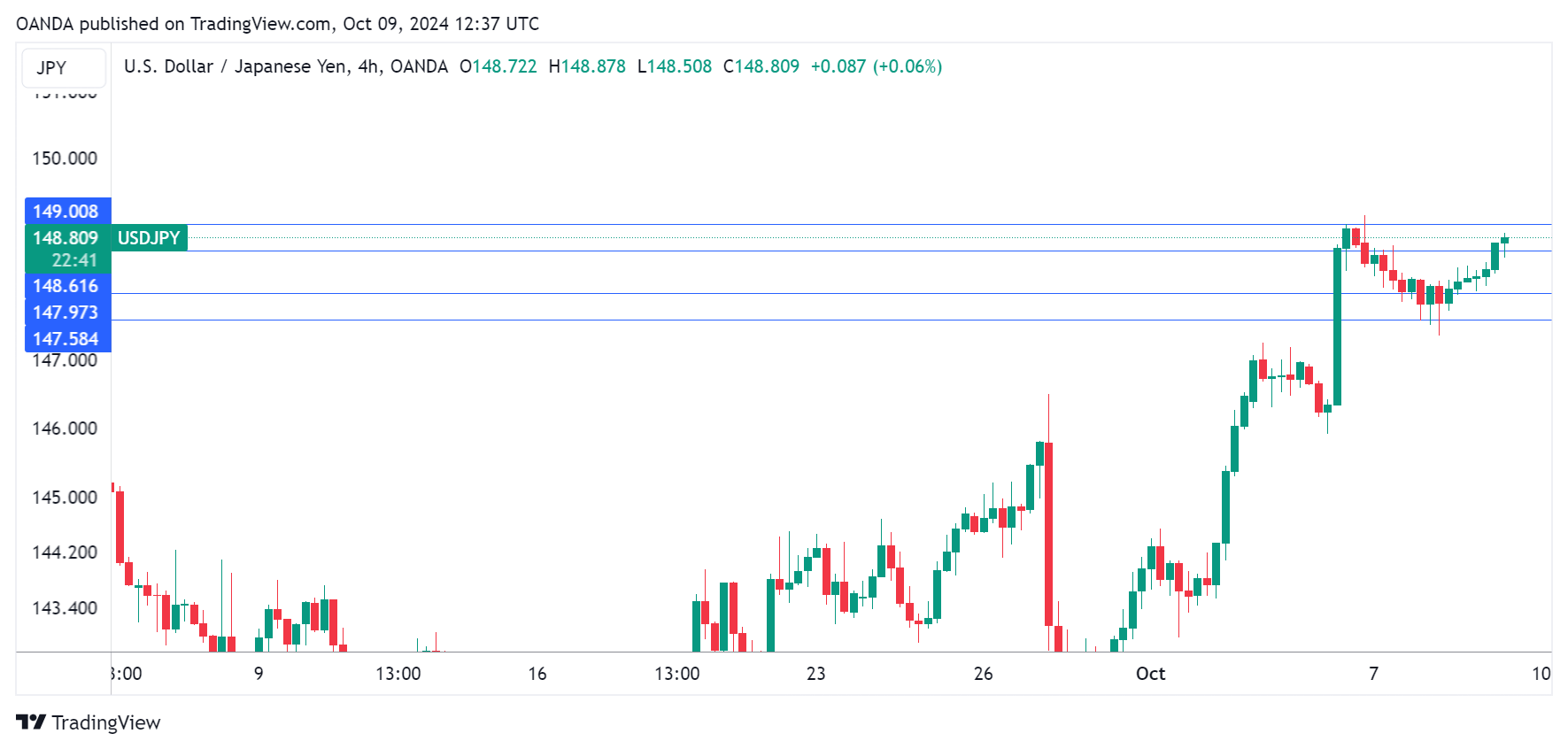
The yen has edged lower on Thursday in what has been a quiet week. In the European session, USD/JPY is trading at 148.72, up 0.36%.
Will Fed minutes provide clues for November meeting?
The Federal Reserve will release the minutes of the September meeting later today. That meeting was a milestone as the Fed delivered an oversized rate of 50 basis points, the first cut in over four years. The minutes should provide some insights into the Fed’s reasoning for the jumbo rate cut and perhaps clues as to its rate path. The September cut came after back-to-back employment reports were weaker than expected.
What can we expect from the Fed moving forward? Last week’s nonfarm payroll report of 254 thousand was much stronger than expected and the unemployment rate ticked lower to 4.1%. These latest figures have put Fed policy makers in a bind – employment is showing resilience while inflation has been falling. Fed member Philip Jefferson said on Tuesday that the risks to inflation and employment were evenly balanced. Jefferson added he was making decisions on a monthly basis and it’s likely that other Fed members are doing the same.
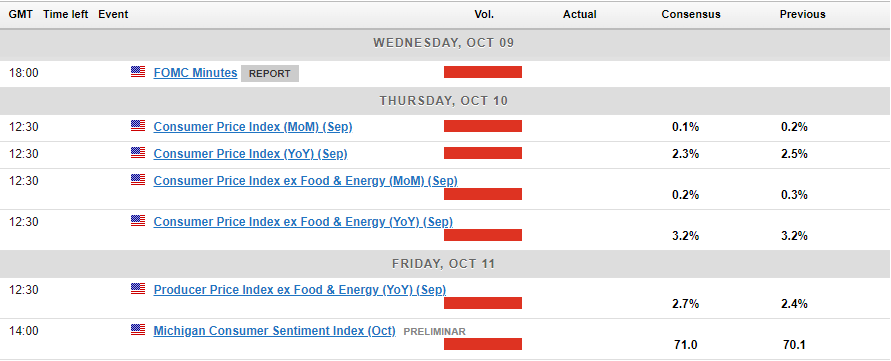
Market rate pricing continues to swing and currently, the probability of a 25-bps stands at 86%. That could change after Thursday’s inflation report, which is expected to fall to 2.3% in September, down from 2.5% in August.
In Japan, voters will head to the polls on October 27. New Prime Minister Shigeru Ishiba called the election just eight days after taking office. The yen has slumped during his short tenure, as Ishiba has backtracked on monetary policy, saying there is no need to raise interest rates.
USD/JPY Technical
- USD/JPY tested resistance at 148.61 earlier. Above, there is resistance at 149.01
147.97 and 147.57 are providing support
USD/JPY Mid-Day Outlook
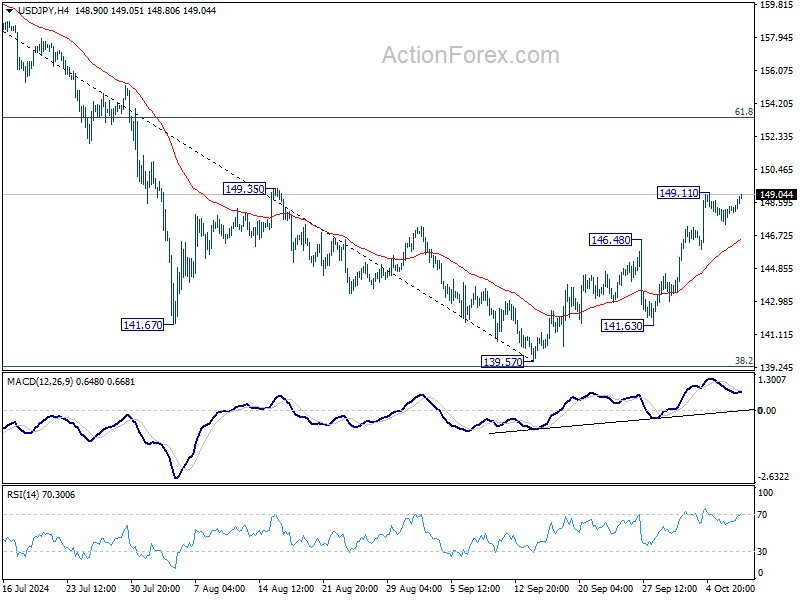
Daily Pivots: (S1) 147.57; (P) 147.97; (R1) 148.61; More...
Intraday bias in USD/JPY stays neutral for the moment. More consolidations could be seen below 149.11 temporary top. But further rise is expected as long as 141.63 support holds. Rise from 139.57 is seen as the second leg of the corrective pattern from 161.94. Break of 149.35 resistance will target 61.8% retracement of 161.94 to 139.57 at 153.39 next.
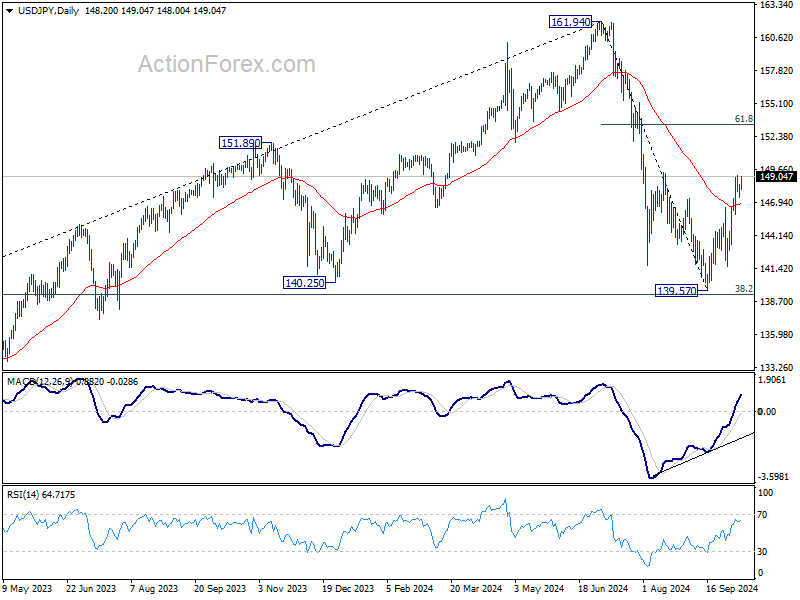
In the bigger picture, price actions from 161.94 are seen as a corrective pattern to rise from 102.58 (2021 low). The range of medium term consolidation should now be set between 38.2% retracement of 102.58 to 161.94 at 139.26 and 161.94. Nevertheless, sustained break of 139.26 would open up deeper medium term decline to 61.8% retracement at 125.25.
USD/CHF Mid-Day Outlook
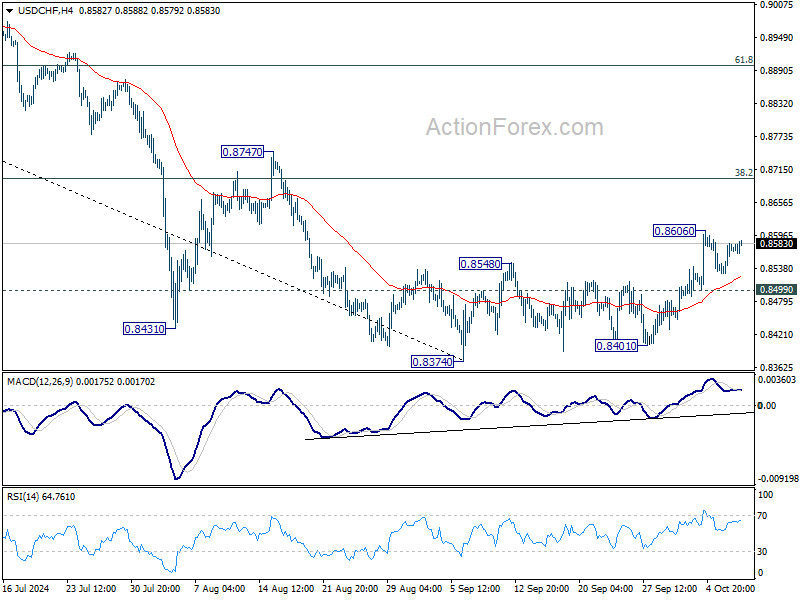
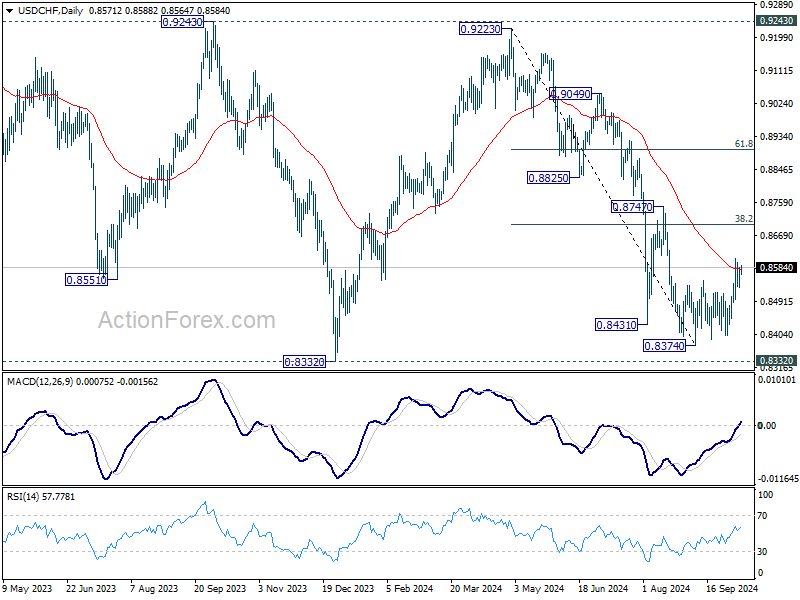
Daily Pivots: (S1) 0.8541; (P) 0.8562; (R1) 0.8595; More…
Intraday bias in USD/CHF stays neutral at this point. More consolidations could be seen below 0.8606 temporary top. But further rally is in favor as long as 0.8499 minor support holds. Above 0.8606 will target 38.2% retracement of 0.9223 to 0.8374 at 0.8698. Sustained break there will argue that fall from 0.9223 has completed after defending 0.8332 low. Next target will be 61.8% retracement at 0.8899. On the downside, break of 0.8499 will turn bias back to the downside for retesting 0.8374 low instead.
In the bigger picture, price actions from 0.8332 (2023 low) are currently seen as a medium term corrective pattern, with fall from 0.9223 as the second leg. Strong support could be seen from 0.8332 to bring rebound. Yet, overall outlook will continue to stay bearish as long as 0.9243 resistance holds. Firm break of 0.8332, however, will resume larger down trend from 1.0146 (2022 high).
GBP/USD Mid-Day Outlook
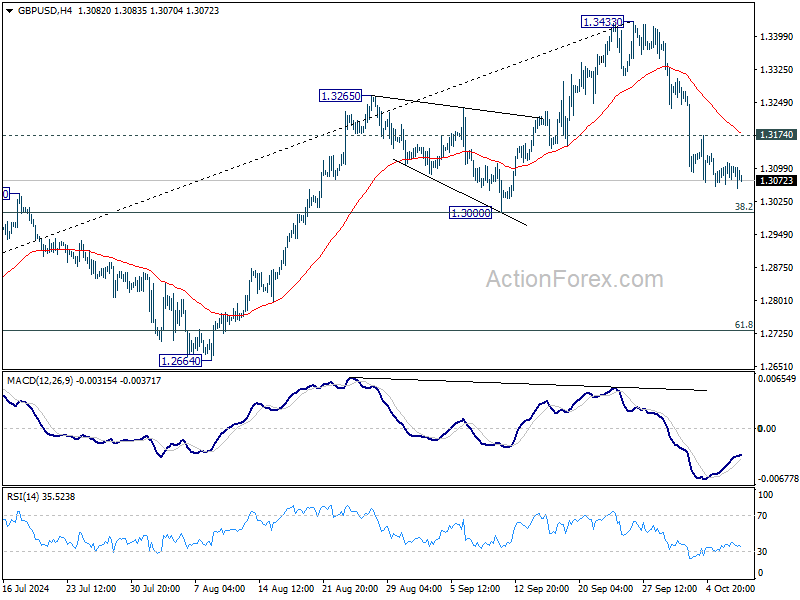
Daily Pivots: (S1) 1.3074; (P) 1.3094; (R1) 1.3124; More...
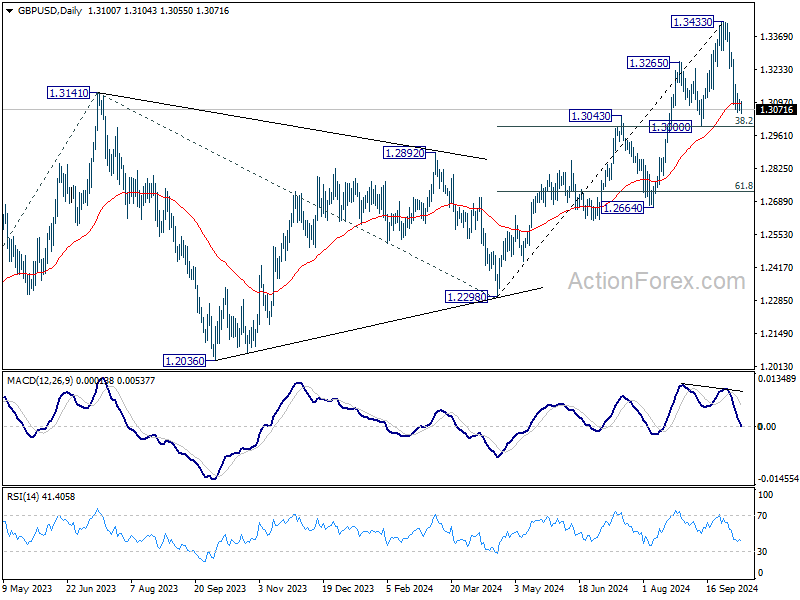
Intraday bias in GBP/USD Remains neutral at this point. While corrective fall from 1.3433 might extend lower, strong support should be seen from 1.3000 cluster support (38.2% retracement of 1.2298 to 1.3433 at 1.2999) to contained downside. Above 1.3174 minor resistance will turn bias back to the upside for stronger rebound. However, decisive break of 1.3000 will carry larger bearish implications.
In the bigger picture, as long as 1.3000 support holds, the up trend from 1.0351 (2022 low) is still in progress. Next target is 61.8% projection of 1.0351 to 1.3141 from 1.2298 at 1.4022. However, considering mild bearish divergence condition in D MACD, decisive break of 1.3000 will argue that a medium term top is already in place, and bring deeper fall back to 1.2664 support next.
EUR/USD Mid-Day Outlook
Daily Pivots: (S1) 1.0962; (P) 1.0980; (R1) 1.0998; More....
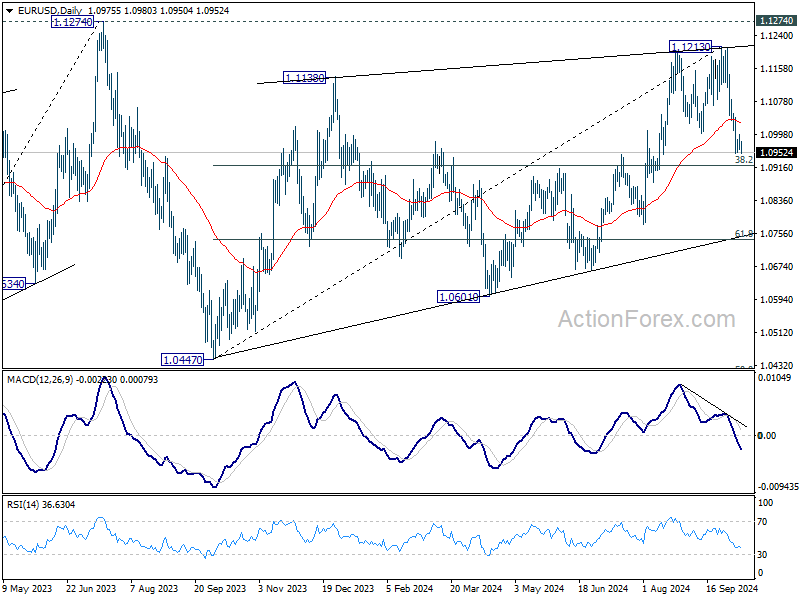
EUR/USD dips mildly today but stays above 1.0950 temporary low. Intraday bias remains neutral at this point. Further decline is expected as long as 1.1043 resistance holds. Below 1.0950 will target 38.2% retracement of 1.0447 to 1.1213 at 1.0920. Sustained break there will argue that fall from 1.1213 is the third leg of the corrective pattern from 1.1274. In this case, deeper decline would be seen to 61.8% retracement at 1.0740 next.
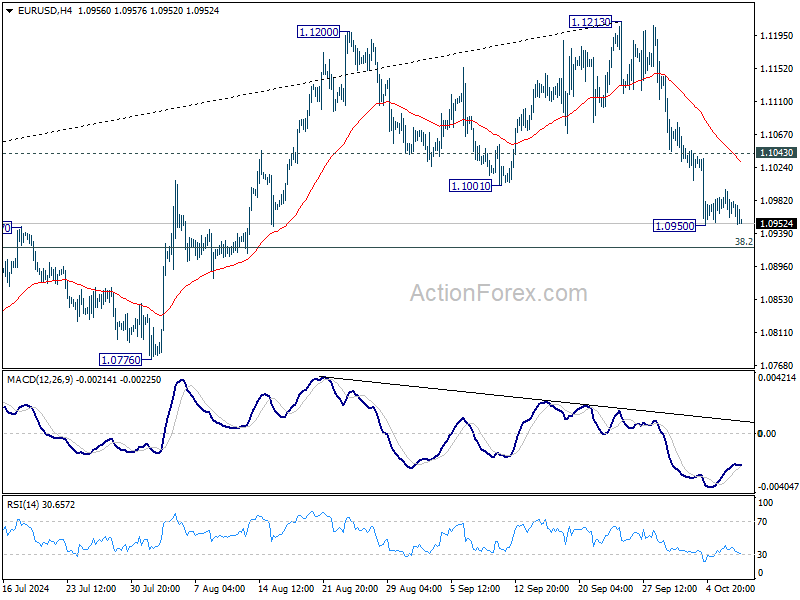
In the bigger picture, rejection by 1.1274 resistance suggests that corrective pattern from 1.1274 (2023 high) is not completed yet. Instead, decline from 1.1213 might be another falling leg. Sustained break of 55 W EMA (now at 1.0877) will validate this case, and bring deeper fall towards 1.0447 support again.
Dollar Edges Higher Ahead of FOMC Minutes; Commodity Currencies Continue to Struggle
Dollar is broadly stronger today, though the momentum behind the move is not particularly robust. Markets are awaiting insights from several Fed officials and the release of September FOMC minutes later in the US session. While Fed's direction on monetary easing is well understood, the pace of future rate cuts remains uncertain and is unlikely to be definitively answered by today's minutes.
At present, Fed funds futures suggest an 86.6% likelihood of a 25bps rate cut at the November meeting, with a slim 13.4% chance of no change. However, these probabilities could be significantly altered by tomorrow’s US CPI report. While today’s FOMC minutes are important, the inflation data is expected to carry much more weight in shaping near-term expectations about Fed’s next steps.
So far this week, Dollar is currently the strongest currency, followed by Swiss Franc and Yen. On the other end, Kiwi has been the weakest, trailed by Aussie and Canadian Dollar. It should be noted that, Dollar, Euro, Sterling, Swiss Franc, and Yen are holding within last week's ranges against each other. Commodity currencies, on the other hand, have broken to the downside. It's more about risk aversion for now.
The direction of Aussie and Kiwi will largely depend on upcoming developments in Asia, particularly in China and Hong Kong. The markets were left unimpressed by the lack of concrete stimulus measures from China’s National Development and Reform Commission earlier this week. Attention is now shifting to a press conference from China’s finance ministry, expected on Saturday, where more fiscal stimulus could be announced.
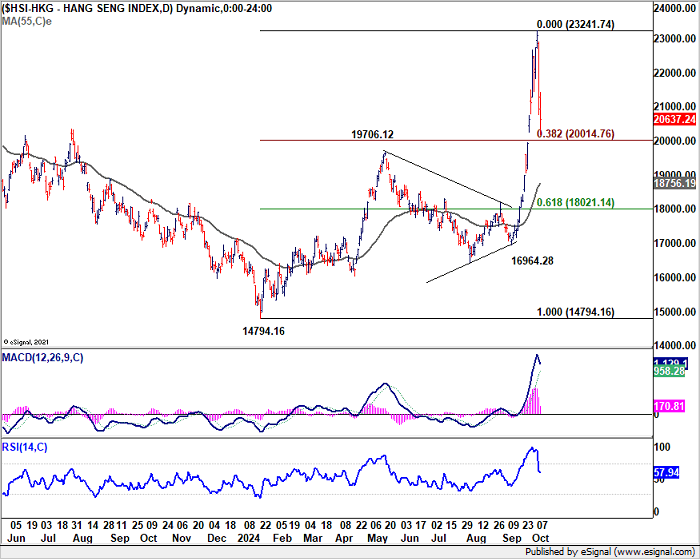
Technically, HSI is now eyeing a key cluster support level at around 20k mark. There lies 38.2% retracement of 14794.16 to 23241.75 at 20014.76, and 19706.12 resistance turned support is not far away. Strong bounce from this zone will keep near term outlook bullish for another rise through 23241.74 at a later stage. However, decisive break of 20k mark would sign that whole rise from this year's low at 14794.16 might be over.
 In Europe, at the time of writing, FTSE is up 0.13%. DAX is up 0.14%. CAC is up 0.22%. UK 10-year yield is down -0.011 at 4.176. Germany 10-year yield is down -0.003 at 2.247. Earlier in Asia, Nikkei rose 0.87%. Hong Kong HSI fell -1.38%. China Shanghai SSE fell -6.62%. Singapore Strait Times rose 0.56%. Japan 10-year JGB yield rose 0.0076 to 0.934.
ECB's Kazaks reaffirms call for further rate cuts
ECB Governing Council member Martins Kazaks reiterated his support for lowering interest rates further, pointing to the ongoing economic weakness in the Eurozone.
Speaking during a webcast, Kazaks emphasized the need for continued monetary easing, suggesting that rates should be adjusted step by step.
“If inflation in the next year really returns to a sustainable 2%, interest rates have to be on a neutral level,” he said.
ECB’s Kazimir not completely convinced on Oct rate cut
ECB Governing Council member Peter Kazimir struck a cautious tone today, signaling that while a rate cut next week is possible, he remains "not completely convinced" that ECB should move based on just one positive inflation reading.
Speaking to reporters, Kazimir acknowledged that September’s CPI dip below 2% for the first time since 2021 has fueled expectations of a rate cut, but he emphasized the need for a more comprehensive view of the economic data. "And we’ll have that key information in December," he added
He also downplayed concerns about the risk of inflation undershooting the 2% target, stating, "I definitely don’t wake up in a sweat thinking that the inflation rate should be well below 2%."
“On the contrary, we still lack sufficient confidence that we’re out of the woods and that the goal of sustainably being at 2% is entirely realistic," he warned.
ECB’s Villeroy signals likely rate cut next week, more to follow gradually
ECB Governing Council member François Villeroy de Galhau indicated today that a rate cut is "very probable" at the upcoming meeting next week.
Speaking on Franceinfo radio, Villeroy emphasized that this move "won’t be the last" in the current easing cycle. However, he added that the pace of future cuts will depend on how inflation evolves over time.
Villeroy stressed ECB’s commitment to gradual policy adjustments, saying the central bank will avoid making any "volatile moves." He remarked, "We are used to acting with gradualism, which means resolutely but without making too significant steps."
On inflation, Villeroy expressed confidence that price levels will stabilize at ECB's 2% target by early next year in France, and later in 2025 across Europe. However, he noted that fluctuations could still occur in the coming months.
RBNZ cuts rates by 50bps, citing weak economic conditions and excess capacity
As widely expected, RBNZ cut its Official Cash Rate by 50bps to 4.75%. In its accompanying statement, the central bank emphasized that this move was deemed "appropriate" to achieve and maintain low, stable inflation while minimizing "unnecessary instability" in output, employment, interest rates, and the exchange rate.
RBNZ highlighted that economic activity in New Zealand remains "subdued," with both business investment and consumer spending showing signs of weakness. Employment conditions are also softening, and low productivity growth is acting as a further constraint on activity.
The central bank pointed out that the economy is now in a state of "excess capacity," which is encouraging adjustments in price- and wage-setting behavior, aligning with a low-inflation environment. Falling import prices are aiding the disinflation process.
Additionally, RBNZ noted that despite the rate cut, OCR of 4.75% is still "restrictive" and leaves monetary policy well-positioned to handle any near-term surprises.
EUR/USD Mid-Day Outlook
Daily Pivots: (S1) 1.0962; (P) 1.0980; (R1) 1.0998; More....
EUR/USD dips mildly today but stays above 1.0950 temporary low. Intraday bias remains neutral at this point. Further decline is expected as long as 1.1043 resistance holds. Below 1.0950 will target 38.2% retracement of 1.0447 to 1.1213 at 1.0920. Sustained break there will argue that fall from 1.1213 is the third leg of the corrective pattern from 1.1274. In this case, deeper decline would be seen to 61.8% retracement at 1.0740 next.
In the bigger picture, rejection by 1.1274 resistance suggests that corrective pattern from 1.1274 (2023 high) is not completed yet. Instead, decline from 1.1213 might be another falling leg. Sustained break of 55 W EMA (now at 1.0877) will validate this case, and bring deeper fall towards 1.0447 support again.
ECB’s Kazaks reaffirms call for further rate cuts
ECB Governing Council member Martins Kazaks reiterated his support for lowering interest rates further, pointing to the ongoing economic weakness in the Eurozone.
Speaking during a webcast, Kazaks emphasized the need for continued monetary easing, suggesting that rates should be adjusted step by step.
“If inflation in the next year really returns to a sustainable 2%, interest rates have to be on a neutral level,” he said.
S&P 500, Nasdaq 100 – Futures Hold High Ground as US Considers a Breakup of Google
- The US Justice Department may force Google to divest parts of its business due to antitrust concerns.
- S&P 500 and Nasdaq 100: Despite market uncertainty, these indexes had a strong day on Tuesday, recovering from Monday’s losses.
- Following a disappointing update from the National Reform Commission in China, US-listed Chinese stocks like Alibaba, PDD Holdings, and JD.com experienced declines.
The major Wall Street Indexes fell in early European trade before recovering ahead of the US Open to trade flat on the day. Early losses were attributed to Alphabet’s Google as news broke on Tuesday that the US may ask a judge to force Google to divest parts of its business.
American authorities are looking at Google’s Chrome browser and android OS that the US says is used to maintain an illegal monopoly in online search. In what is a landmark case, a judge found in August that Google, which processes around 90% of US internet searches, had effectively built an illegal monopoly. The Justice department has proposed a few remedies, most of which will likely affect Google’s revenue. Google has faced similar challenges in the EU with a new antitrust regulator set to be appointed soon.
Surprisingly Alphabet shares are trading slightly higher on the day as we head into the US open.
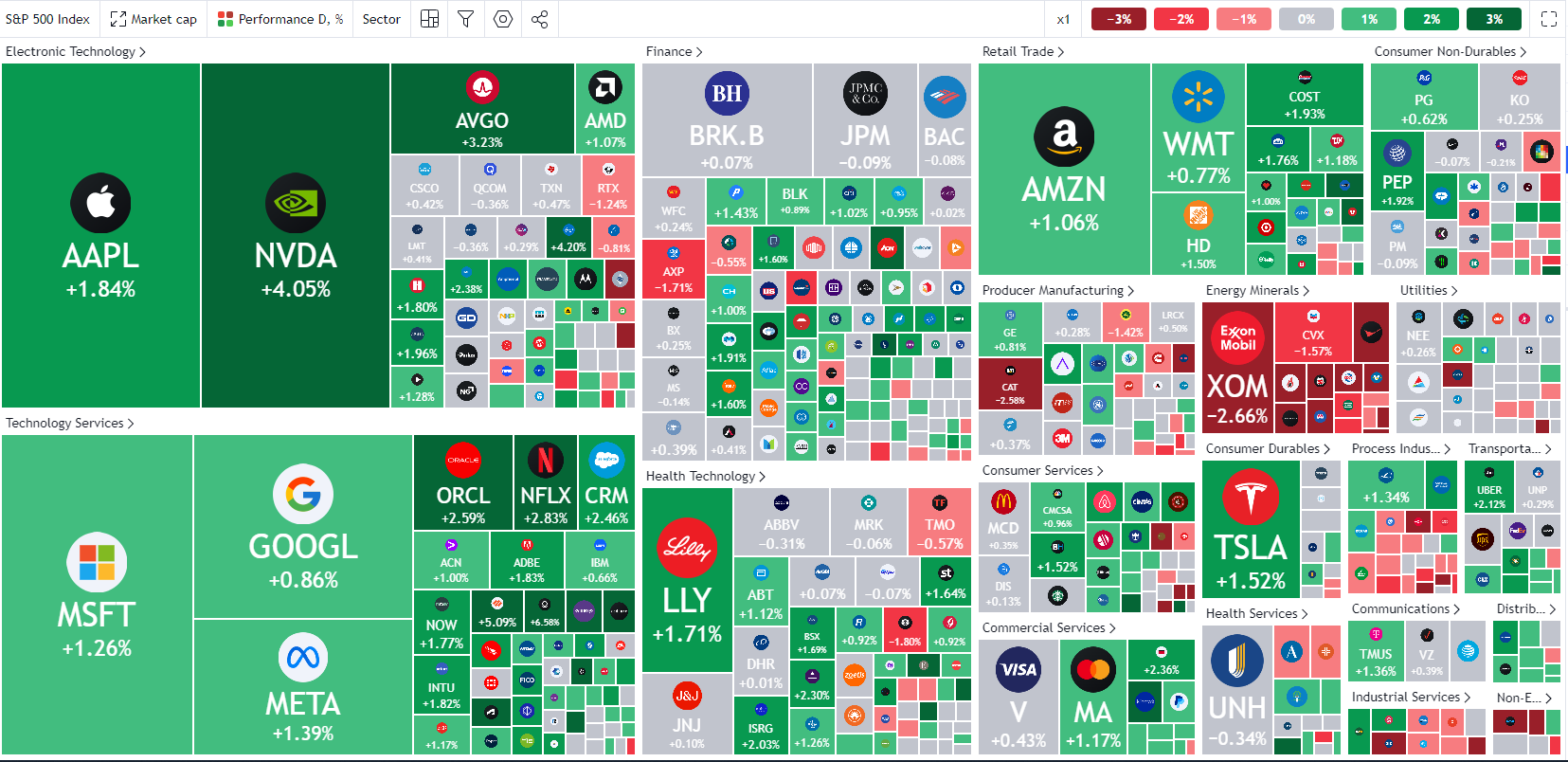
S&P 500 Heatmap Pre-US Open
Source: TradingView (click to enlarge)
The S&P 500 and Nasdaq 100 posted a strong day on Tuesday, wiping out Monday’s losses. Trading does appear to be choppy this week as there remains a host of uncertainty plaguing market sentiment.
The Fed minutes lie in wait today, before US inflation data and the start of earnings season. The Fed minutes are unlikely to have any impact today as markets have done a 360 since last week’s jobs data release.
Comments ahead of today’s meeting by Fed policymakers may actually have a larger impact in the absence of data releases. Markets are now overwhelmingly supporting a 25 bps cut from the Fed.
In other news Chinese stocks listed in the US fell today as markets digested what many considered a disappointing update from the National Reform Commission in China. This saw Alibaba Group BABA.N fall 3%, PDD Holdings PDD.O lost 3.6% and JD.Com JD.O dropped 4.2%.
Technical Analysis
S&P 500
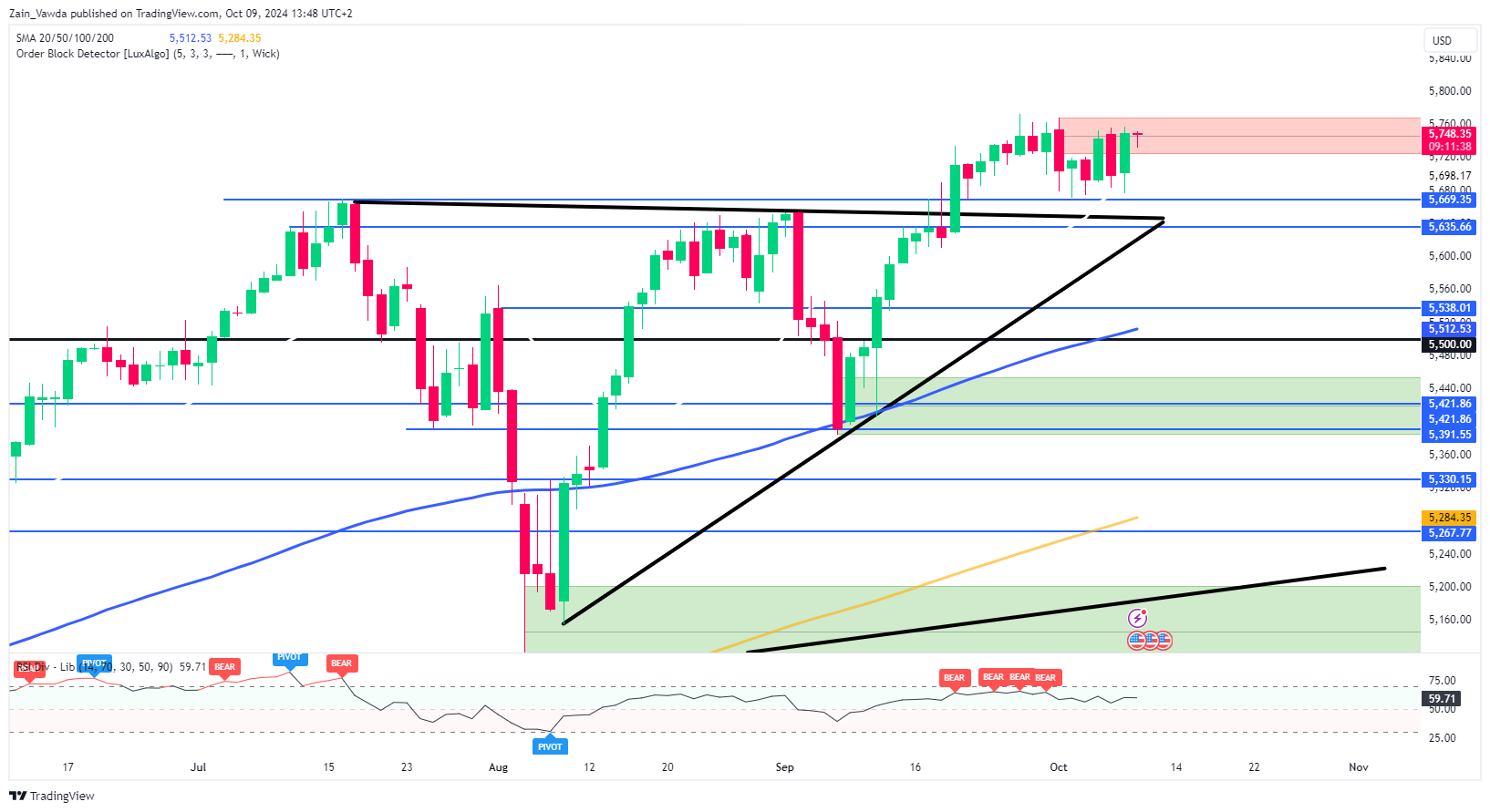
From a technical standpoint, the S&P is trading at a key resistance area where the most recent retracement began. Yesterdays bullish engulfing candle does hint at buying pressure,
The overall bullish play discussed in the weekly market outlook remains intact for now.
On the daily timeframe a break and daily candle close above 5760 may be needed for the rally to continue into tomorrow.
Immediate resistance rests at 5760 with a move above this level leading to the 5910 resistance handle. Conversely a move lower here will first need to break below support with a daily candle close below 5690 paving the way for more downside.
S&P 500 Daily Chart, October 9, 2024
Source: TradingView (click to enlarge)
Support
- 5691
- 5613
- 5538
Resistance
- 5760
- 5910
- 6000
New Zealand Dollar Sinks After RBNZ Cuts by 50 bps
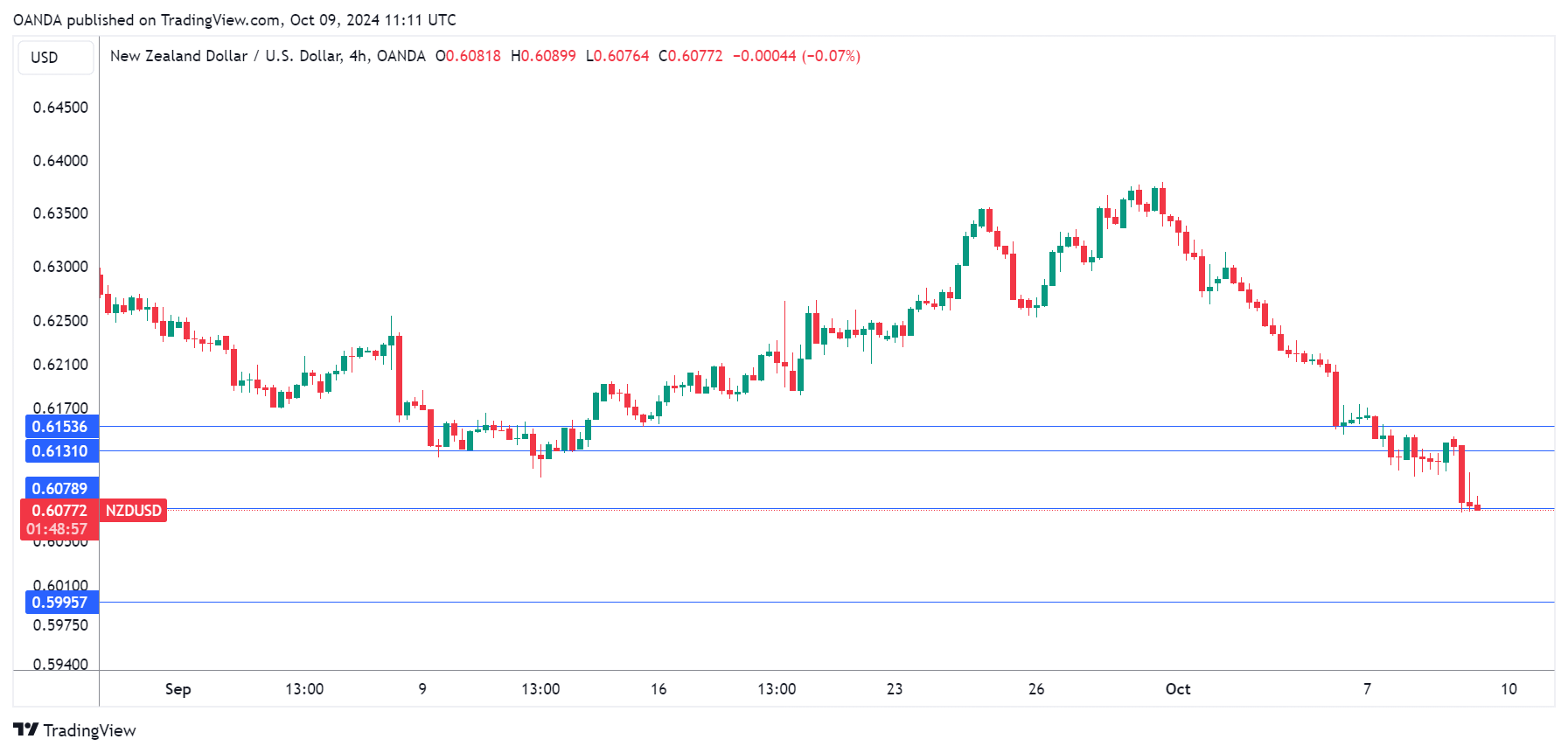
The New Zealand dollar is sharply lower on Wednesday. NZD/USD is trading at 0.6079 in the European session, down 0.96% on the day.
RBNZ slashes rates to 4.75%
The Reserve Bank of New Zealand lowered the cash rate by 50 basis points on Wednesday to 4.75%. The RBNZ cut rates by 25-bps in August, the first rate cut in over four years. The jumbo rate cut had been priced in by the markets but the dramatic move has sent the New Zealand dollar sharply lower.
The rate statement noted that inflation was within the target range and was “converging on the 2% midpoint”. This is a remarkable turnaround by the central bank, which only a few months ago was warning that inflation was too high and could force the Bank to raise rates. The RBNZ had projected that initial rate cut would not occur before mid-2025 but has moved up the timetable in dramatic fashion.
The decision to cut rates by 50 bps is not surprising, given that inflation has been falling and GDP contracted in the second quarter. New Zealand releases the quarterly inflation report next week and if inflation is within expectations, it could set up another rate cut at the November meeting.
The RBNZ would like to continue trimming rates but the sharp decline of the New Zealand dollar is a concern. The New Zealand dollar has plunged 4.25% in October and has slipped to a seven-week low. Today’s oversized cut sent the kiwi sharply lower and further cuts will add downward pressure on the currency.
NZD/USD Technical
- NZD/USD has pushed below several support levels and is testing support at 0.6079. Below, there is a monthly support level at 0.5995
- There is resistance at 0.6131 and 0.6153
ECB’s Kazimir not completely convinced on Oct rate cut
ECB Governing Council member Peter Kazimir struck a cautious tone today, signaling that while a rate cut next week is possible, he remains "not completely convinced" that ECB should move based on just one positive inflation reading.
Speaking to reporters, Kazimir acknowledged that September’s CPI dip below 2% for the first time since 2021 has fueled expectations of a rate cut, but he emphasized the need for a more comprehensive view of the economic data. "And we’ll have that key information in December," he added
He also downplayed concerns about the risk of inflation undershooting the 2% target, stating, "I definitely don’t wake up in a sweat thinking that the inflation rate should be well below 2%."
“On the contrary, we still lack sufficient confidence that we’re out of the woods and that the goal of sustainably being at 2% is entirely realistic," he warned.