

Sample Category Title
The Weekly Bottom Line: Government Shutdown Averted as Price Pressures Continue to Ease
U.S. Highlights
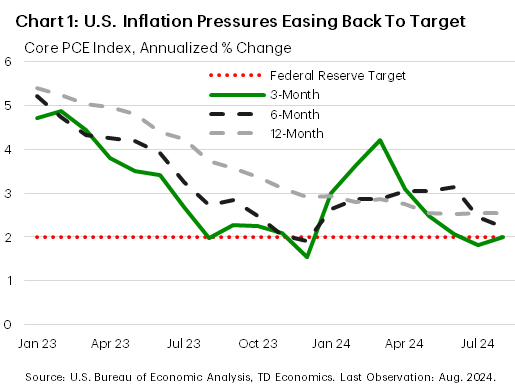
- The Federal Reserve’s preferred inflation metric, the core PCE index, continued to cool in August with the 3- and 6-month annualized trends converging closer to the Fed’s 2% target.
- Federal Reserve officials who spoke this week noted that the slowing labor market was a key consideration in their monetary policy decision last week and that further rate cuts were expected moving forward.
- Congress managed to pass a continuing resolution this week to fund the federal government through December 20th, removing the risk of a government shutdown until after the upcoming election.
Canadian Highlights
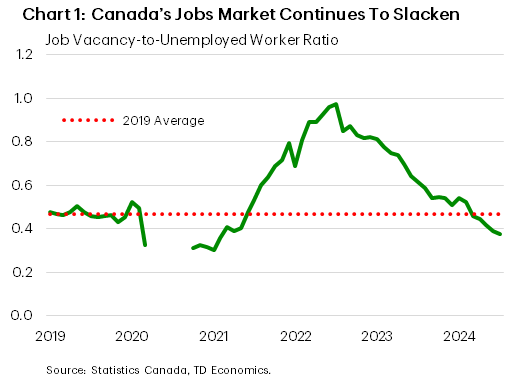
- Canada’s jobs market loosened again in July, with the ratio of job vacancies-to-unemployed workers falling further below its 2019 average.
- Canada’s economy grew by a better-than-expected 0.2% month-on-month in July. Still, third quarter growth will likely come in well shy of the BoC’s 2.8% projection.
- Population growth eased through Q2, although at 7.3% the temporary resident share of Canada’s population is far away from the federal target of 5% by 2027.
U.S. – Government Shutdown Averted as Price Pressures Continue to Ease
The first week of fall was largely consumed by lingering consternation regarding the Federal Reserve’s latest monetary policy decision. Federal Reserve officials who spoke this week provided further clarity on the central bank’s rationale to go big with the first rate cut in over four years, as the latest reading on inflation showed price pressures continued to cool in August. Financial markets were little changed on the week, with Treasury yields rising a few basis-points and the S&P 500 up 1.0% as of the time of writing.
Friday’s personal income & spending data release for August showed that the health of the American consumer remained favorable on aggregate through the end of the summer. Real personal consumption expenditures rose 0.1% relative to July, with goods spending roughly flat while service expenditures expanded. Consumers continued to receive support from healthy real disposable personal income gains (+3.1% year-on-year in August), although this growth has continued to moderate. This has led to some slowing in consumer spending, which has helped to push the three- and six-month annualized percentage change in core PCE inflation closer to the Fed’s 2% target after the flare-up earlier in the year (Chart 1).
With inflation pressures continuing to cool, the Federal Reserve’s downward policy path trajectory appears to continue to be supported by the incoming data. Federal Reserve officials who spoke this week broadly echoed the statements of Chair Powell last week, noting that the balance of risks has shifted towards the labor market and that ensuring a soft landing would merit looser financial conditions moving forward. Although the majority of officials who spoke this week were focused on downside risks to the economy, Governor Bowman, the lone dissenting vote from last week’s decision, noted that inflation risks remained elevated and that this would necessitate caution moving forward. Market pricing is roughly 50/50 between a quarter- and a half-point cut at the next meeting in November as of the time of writing.
Markets will likely be equally focused on fiscal policy risks moving forward with the U.S. election now less than six weeks away. Thankfully, Congress managed to avoid the risk of a government shutdown this week by passing a continuing resolution through to December 20th. However, with federal government funding and the debt limit suspension both now expiring at the end of the year, fiscal risks are likely to remain top-of-mind in the final two months of the year.
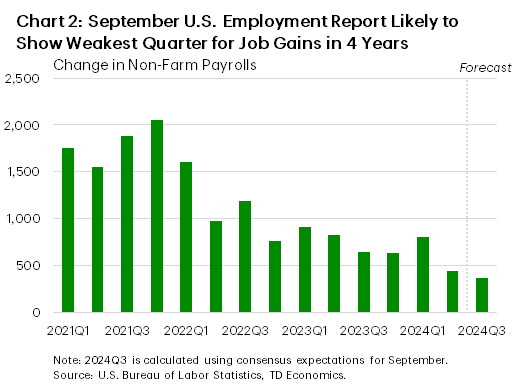
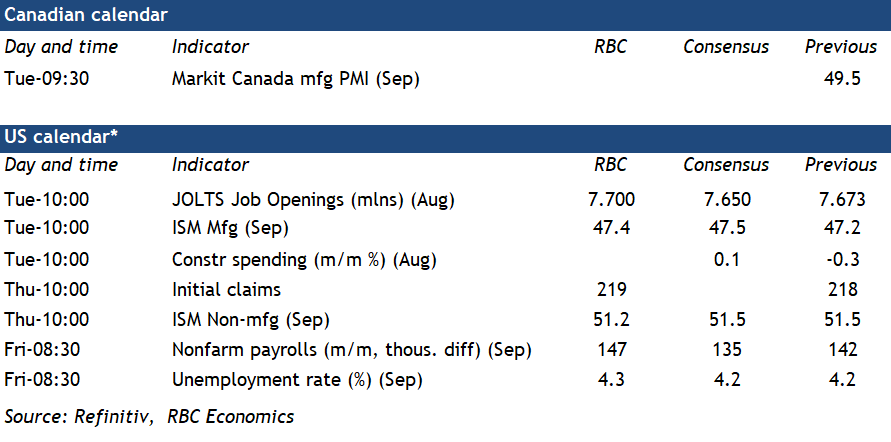
Looking ahead to next week, the biggest item on the docket will be the September employment report released on Friday, with consensus expectations for a gain of 130k jobs. This will likely cap-off the weakest quarter for job gains since the onset of the pandemic (Chart 2). Markets will also be watching Chair Powell’s speech at the National Association for Business Economics Annual Meeting on Monday, in addition to the Vice-Presidential debate in New York City on Tuesday.
Canada – Second Verse...Same as the First
It’s been clear for some time that the Canadian economy is operating with slack. The Bank of Canada certainly reinforced as much in their summer Monetary Policy Report, but perhaps the clearest signal is that Canada’s unemployment rate has jumped 1.6 percentage points from its 2023 low. This week’s economic dataflow simply reinforced this narrative. The payrolls report – which grabs fewer headlines than it’s timelier Labour Force Survey counterpart but shares a stronger correlation with GDP for many industries – showed that payrolls expanded by 0.2% month-on-month in July. Although this counts as an above-trend gain, it was paired with another sizeable decline in job vacancies, suggesting that the demand for future workers continues to shrink. Meanwhile, the job vacancy to unemployment ratio (a closely watched indicator of job market tightness) dropped yet again, pointing to further loosening (Chart 1).
The softening up in the labor market squares with what we’re seeing in the monthly GDP data. Canada’s economy managed to post a better-than-expected 0.2% monthly advance in July, but August’s preliminary estimate is calling for no growth. For the third quarter overall, industry-based GDP performances so far are flagging significant downside risk to the Bank of Canada’s hefty Q3 2.8% growth projection. This implies an even larger build-up of slack than policymakers had anticipated and provides some justification for a market that’s almost fully built in a 50 basis-point point move from the Bank of Canada at the October meeting. Also helpful from this perspective is the fact that crude oil prices continue to fall, weighed down this week by Saudi Arabia’s announcement that regardless of market conditions, they will begin increasing output on December 1st – doing away with their $100 per barrel unofficial price target.
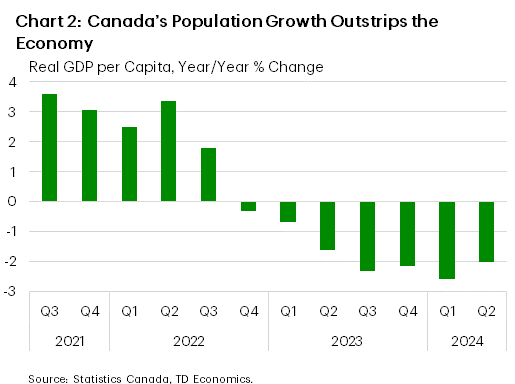
Lastly, Canada’s headline GDP growth has been flattered by robust population gains but, on a per capita basis, the economy is shrinking. This week’s population report confirmed this soft trend extended through the second quarter. Indeed, Canada’s population surged 3% year-on-year in Q2, against just a 0.9% increase in real GDP (Chart 2). Now, for a federal government trying to wrap their arms around Canada’s ballooning population, the report had some things to like. Namely, growth edged down from the prior quarter on the back of a smaller increase in temporary residents. In an encouraging sign for the government, non-permanent inflows have cooled for three straight quarters, although they remain elevated. Less encouraging was that the share of Canada’s population accounted for by temporary residents rose to 7.3% and could push even higher in the next quarter or two. This is a far cry from the government’s stated goal of getting this share down to 5% by 2027.
All told, Canadian events this week echoed many of the same trends that have been evident for the economy for some time and provided little scope to change our outlook on rates. Second verse, same as the first.
U.S. Unemployment Rate Likely Inched Higher in September
All eyes will be on U.S. jobs data on Friday for signs of weakness after the U.S. Federal Reserve kicked off its easing cycle with an outsized 50 basis point cut in September.
The Fed took pains to frame the cut (larger than earlier 25 basis point cuts from most other advanced economy central banks) as the beginning of a “recalibration” process rather than driven by urgent concerns about the economy. But, U.S. labour markets have shown signs of softening, even if at a very gradual pace, and Fed Chair Jerome Powell has reinforced that further weakening is a concern for the central bank.
The unemployment rate ticked down to 4.2% in August, but that only partially reversed an increase to 4.3% in July that triggered the so-called “Sahm Rule” recession indicator—when the three-month moving average of the unemployment rate rises by 0.5% or more relative to its low during the previous 12 months. In short, even the gradual increases in the U.S. unemployment rate to date have not happened historically outside of recessions. Job counts have continued to rise with much of the increase in unemployment coming from longer job searches for new entrants into the labour force, particularly younger workers, rather than layoffs, and initial jobless claims have remained low.
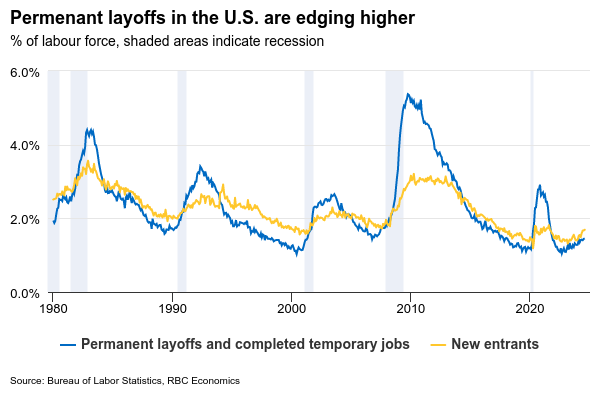
But the average 116,000 increase in payroll employment over the last three months was the softest since early 2021, and early estimates from the Bureau of Labor Statistics already have flagged that payroll employment earlier this year is overcounted by about 818,000 jobs. Hiring demand has continued to slow with job openings back down to pre-pandemic levels. Layoffs are still low, but they have been creeping gradually higher. Like the Sahm Rule for the unemployment rate, this is also unusual outside of recessions. Survey data suggests consumers are less confident in the job market than they were, and wage growth has been slowing.
Our base case assumption remains that labour markets are normalizing rather than faltering. We look for payroll employment to rise 147k in September and for the unemployment rate to tick back up to 4.3%—still historically low but up 0.5 percentage points from a year ago. Interest rates impact the economy with significant lags, and the Fed’s start to interest rate cuts will help limit headwinds from monetary policy in the year ahead. An exceptionally large government budget deficit also helps demand in the U.S. economy. Still, labour markets will be analyzed for further red flags with risks tilted to the downside for it, and the Fed’s policy rates.
Week ahead data watch
Weekly Economic & Financial Commentary: Consumer in the Spotlight
Summary
United States: Consumer in the Spotlight
- The personal income and spending data this week show that inflation remains in check, shed light on the staying power of the consumer and paint a more constructive backdrop for household finances moving forward. Real estate should be a beneficiary of lower interest rates as the Fed eases policy, yet housing activity remains slow.
- Next week: ISM Manufacturing (Tue.), ISM Services (Thu.), Employment (Fri.)
International: Eurozone Economy at Risk of Renewed Stumble
- The Eurozone September manufacturing and services PMIs were disappointing, with output and orders both softening, although they also indicated an overall softening in price pressures. We expect Eurozone expansion to continue, but now expect a slower pace of recovery than previously. Elsewhere, it was a busy week for international central banks. China, Sweden, Switzerland, Hungary, the Czech Republic and Mexico all lowered interest rates, while Australia held monetary policy steady.
- Next week: China PMIs (Mon.), Japan Tankan Survey (Tue.), Eurozone CPI (Tue.)
Credit Market Insights: Is the Tide Turning for Commercial Real Estate?
- When the Fed cut the policy rate by 50 bps last week, it marked what should be the beginning of the end of the worst CRE downturn since the global financial crisis. Although there are no shortage of obstacles ahead for CRE, the gap between the amount of maturing debt in need of refinancing and the available capital should be reduced with lower rates, thus limiting the extent to which stress mounts further.
Topic of the Week: Reasons Not to Panic About Looming Port Strikes
- Thousands of dockworkers are set to strike at East and Gulf coast U.S. ports this upcoming week if the International Longshoremen's Association (ILA) and the United States Maritime Alliance (USMX) cannot come to an agreement regarding wage negotiations. While work stoppages at these ports cannot be ruled out, and a prolonged worker stoppage could disrupt supply chains, our sense is that worries about major supply disruption are overstated.
Week Ahead – NFP on Tap Amid Bets of Another Bold Fed Rate Cut
- Investors see decent chance of another 50bps cut in November
- Fed speakers, ISM PMIs and NFP to shape rate cut bets
- Eurozone CPI data awaited amid bets for more ECB cuts
- China PMIs and BoJ Summary of Opinions also on tap
Will the Fed opt for a back-to-back 50bps rate cut?
Although the dollar slipped after the Fed decided to cut interest rates by 50bps and to signal that another 50bps worth of reductions are on the cards for the remainder of the year, the currency traded in a consolidative manner this week even with market participants penciling around 75bps worth of cuts for November and December. A back-to-back double cut at the November gathering is currently holding a 50% chance according to Fed funds futures.
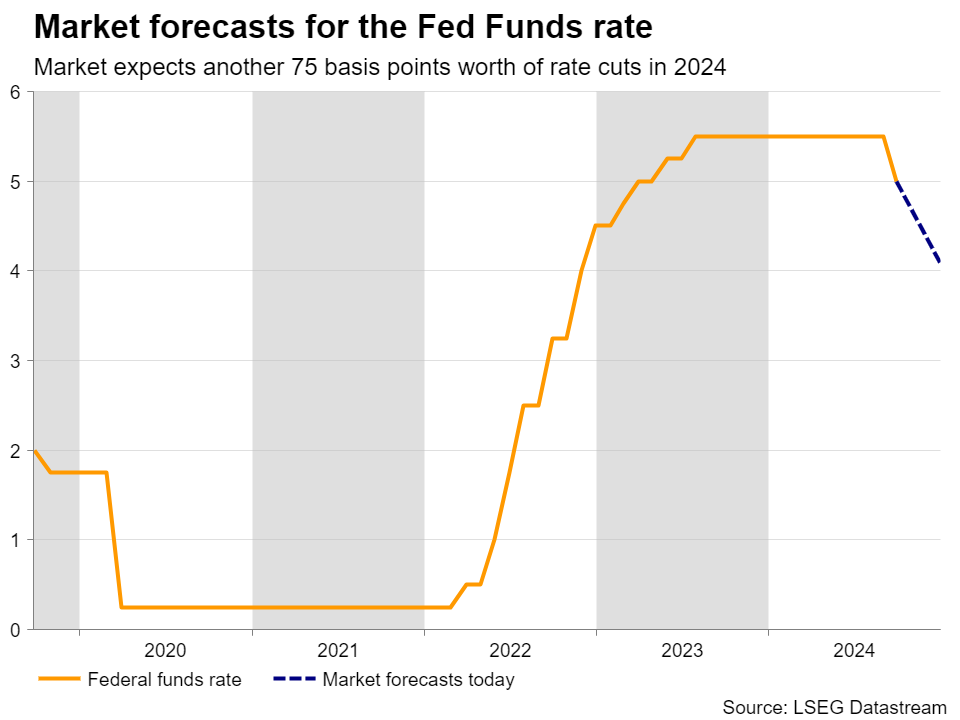
Ergo, with policymakers Christopher Waller and Neel Kashkari clearly favoring slower reductions going forward, the current market pricing suggests that there may be upside risks in case more officials share a similar view, or if incoming data corroborates so.
Next week, investors will have the opportunity to hear from a plethora of Fed members, including Fed Chair Powell on Monday, but given that the dot plot is already a relatively clear guide of how the Fed is planning to move forward, incoming data may attract more attention, especially Friday’s nonfarm payrolls.
ISM PMIs and NFP report to attract special attention
But ahead of the payrolls, the ISM manufacturing and non-manufacturing PMIs for September, on Tuesday and Thursday respectively, may be well scrutinized for early signs of how the world’s largest economy finished the third quarter. If the numbers agree with Powell’s view after last week’s decision that the economy is in good shape, then the dollar could gain as investors reconsider whether another bold move is necessary.
However, for the dollar to hold onto its gains, Friday’s jobs report may need to reveal improvement as well. Currently, the forecasts are suggesting that the world’s largest economy added 145k jobs in September, slightly more than August’s 142k, with the unemployment rate holding steady at 4.2%. Average hourly earnings are seen slowing somewhat, to 0.3% m/m from 0.4%.
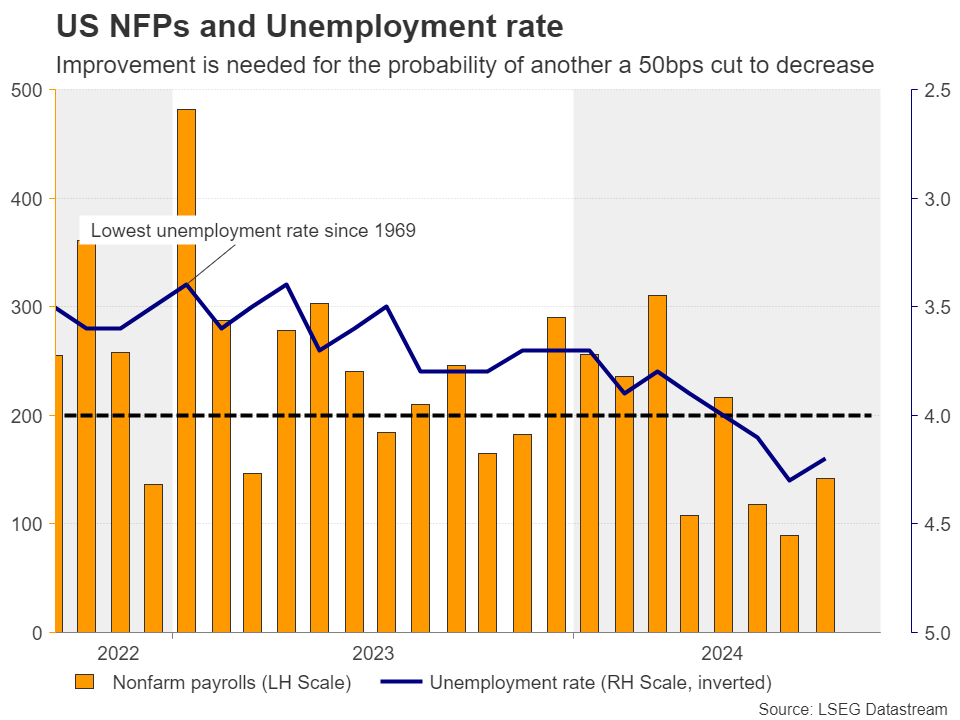
Overall, the forecasts are not pointing to a game-changing report, but any upside surprise coming on top of decent ISM prints and less-dovish-than-expected commentary by Fed policymakers could very well act as the icing on the cake of a bright week for the US dollar. Wall Street could also cheer potentially strong data, even if it translates into slower rate cuts ahead, as more evidence that the US economy is not heading into recession is nothing but good news.
Eurozone inflation in focus amid split ECB
In the Eurozone, the spotlight is likely to fall on the preliminary CPI data for September, due out on Tuesday. Even though Lagarde and her colleagues did not offer explicit signals regarding an October reduction, the disappointing PMIs encouraged market participants to increase bets of such an action. Specifically, the probability of a 25bps reduction at the October 17 meeting is currently at around 75%.
Having said that though, a Reuters report citing several sources noted yesterday that the October decision is seen as wide open. The report mentioned that the doves will fight for a rate cut following the weak PMIs, but they will likely face resistance from the hawks, who will argue for a pause. Some sources are talking about a compromise solution in which rates are kept on hold but reduced in December if data doesn’t improve.
Yet, the market’s base case scenario is rate cuts in both October and December, and a set of CPI numbers pointing to further slowdown in Euro area inflation could solidify that view.
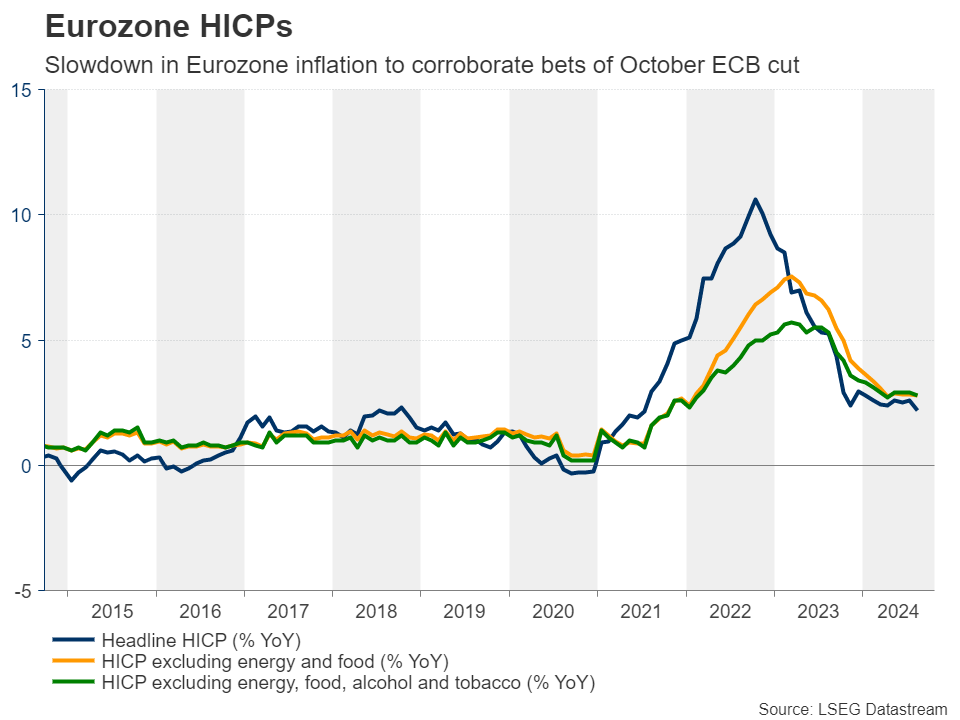
Euro/dollar could slip in such a case and extend its decline if the US data corroborates the notion that there is no need for the Fed to continue with aggressive rate reductions. That said, for a bearish reversal to start being considered, a decisive dip below the round figure of 1.1000 may be needed, as such a break may confirm the completion of a double top formation on the daily chart.
Will the Chinese PMIs signal contraction?
From China, we get the official PMIs for September on Monday. The composite PMI stood at 50.1 in August, just a tick above the 50 boom-or-bust zone that separates expansion from contraction, and it remains to be seen whether business activity improved this month, or whether it slipped into contractionary territory.
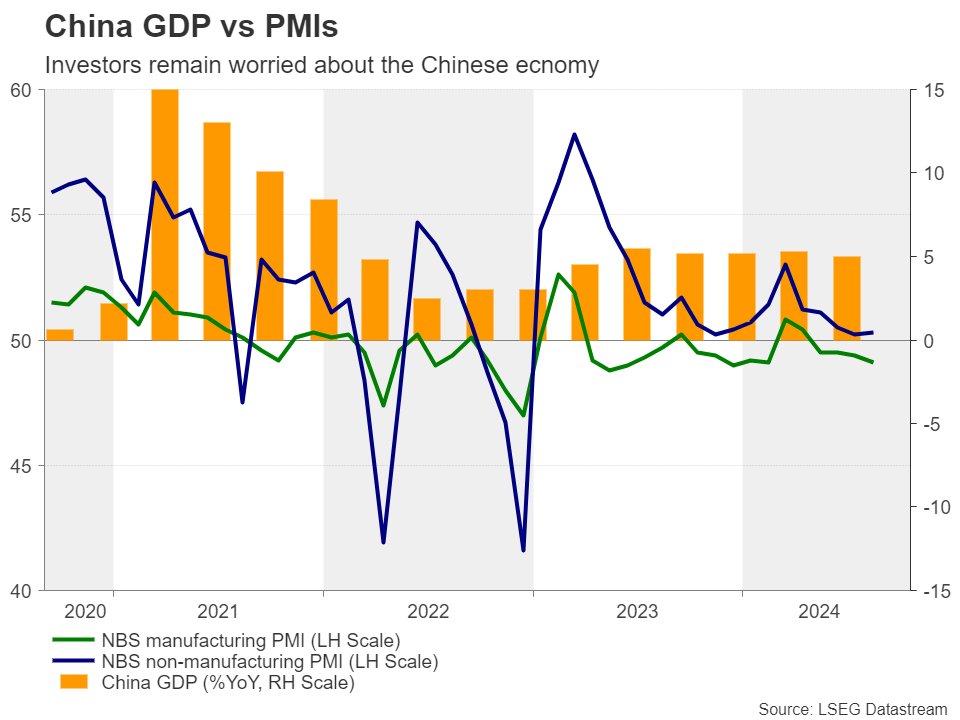
This week, the People’s Bank of China (PBoC) announced a series of stimulus measures to support economic activity and help the deeply wounded property sector. Yet, market participants were not particularly excited, with oil prices plunging due to easing concerns about supply disruptions in Libya and following reports that Saudi Arabia is ready to abandon its target of $100 per barrel.
The announcements of the Chinese measures did little to lift hopes that demand in the world’s top crude importer may be restored, as investors may still be holding the view that more fiscal help is needed.
With that in mind, a set of disappointing PMIs could encourage some further selling in oil prices, though any pullbacks in the aussie and the kiwi are likely to prove limited as these risk-linked currencies now seem to be enjoying the increase in broader risk appetite, which is evident by the latest rally on Wall Street.
BoJ’s Summary of Opinions also on the agenda
In Japan, the BoJ releases the Summary of Opinions from the latest decision, where policymakers kept interest rates unchanged but revised up their assessment on consumption due to rising wages. Governor Ueda said that they will keep raising rates if the economy moves in line with their outlook and thus, investors may dig into the summary for clues and hints on how likely another rate hike is before the end of the year.
Japan’s employment data for August, due out during the Asian session Tuesday, and the Tankan survey on Thursday, may also help in shaping investors’ opinion.
Weekly Focus – China Makes a Big Push to Turn the Economy
The big news this week was the barrage of new stimulus measures from China. At an economic briefing on Tuesday, People's Bank of China and financial regulators announced a wide range of measures to shore up the ailing economy: the policy rate was cut by 30bp, Reserve Requirement Ratios for banks were cut by 50bp, measures to increase buying in the stock market was launched and mortgage rates on existing loans will be cut by 50bp. On top of this reports suggested China's big banks will be recapitalized with 1 trillion CNY (142 billion USD). On Thursday, China top leaders dedicated their monthly meeting in the Politburo to the economy, which is not normally the case in September. They sent a clear signal that stimulus will be stepped up across the board and turning the economy has the number one priority now. It is the biggest round of stimulus since the current crisis started three years ago and could turn out to be China's 'whatever-it-takes' moment. We now see upside risk to our growth estimate of 4.8% this year and next.
The Chinese stock market rallied strongly all week and is up 15% from the start of the week (offshore stocks); albeit coming from very low levels. The CNY also strengthened significantly. It is probably not a coincidence the measures were launched a week before China goes into the one-week National Holiday starting on Tuesday as policy makers hope for the measures to lift confidence when millions of families get together across China.
It has also been an eventful week on the data front. Flash PMIs from the euro zone and US kicked off the week with disappointing readings. Euro manufacturing PMI slipped further to 44.8 from 45.8 signalling clear contraction and raising the chance that the ECB could cut rates again next month. Service PMI also dropped, although it was probably more related to the end of the Olympics. US manufacturing PMIs also disappointed but the service PMI stayed at robust levels alleviating recession fears. Focus is also still on US labour market data as they are key for Fed policy. This week provided a mixed bag with the 'jobs plentiful' index in the consumer confidence survey falling yet again signalling a further rise in unemployment. However, initial jobless claims was better than expected.
On the geopolitical front we saw escalation in the Middle East with extensive Israeli attacks in Lebanon (see Geopolitical Radar - Up the escalation ladder in the Middle East, 26 September). It is still not having much impact on markets, though, and oil prices actually dropped this week from USD75 per barrel to USD71.5 per barrel as Saudi Arabia plans to increase supply and a new agreement in Libya is also set to put more oil on the market.
Risk sentiment was generally improving this week with global stocks moving higher while bond yields and the USD moved broadly sideways. Metal prices saw a strong rally following the Chinese stimulus announcements.
Focus the coming week will be on the US labour market report where both payrolls and the unemployment rate will be key for guiding Fed policy. ISM for both manufacturing and services are also due. In the eurozone, the Flash CPI for September will be a key input going into the October meeting. We expect euro area HICP inflation to decline to 1.7% y/y (consensus 2.0% y/y) in September from 2.2% in August after lower-than-expected data this week from France and Spain.
US Dollar Index (DXY) Slides to Fresh Lows Post PCE Data
- US Dollar Index hits new yearly low after PCE inflation report came in softer than expected.
- PCE data shows personal income rose less than expected, PCE price index increased by 0.1% MoM, and core PCE increased by 0.1%, below expectations.
- DXY is on the edge of a cliff as rate cut bets and dovish Fed rhetoric weigh on the greenback.
The US Dollar Index (DXY) slid to a fresh yearly low in the aftermath of the US PCE inflation report. A softer than expected PCE print across the board ramped up bets for another 50 bps cut from the Fed in November.
The initial impact has seen the US Dollar lose ground to major counterparts and commodities like Gold and Silver tested recent highs. The DXY appears to be on the edge of a cliff as rate cut bets and dovish Fed rhetoric weigh on the greenback.
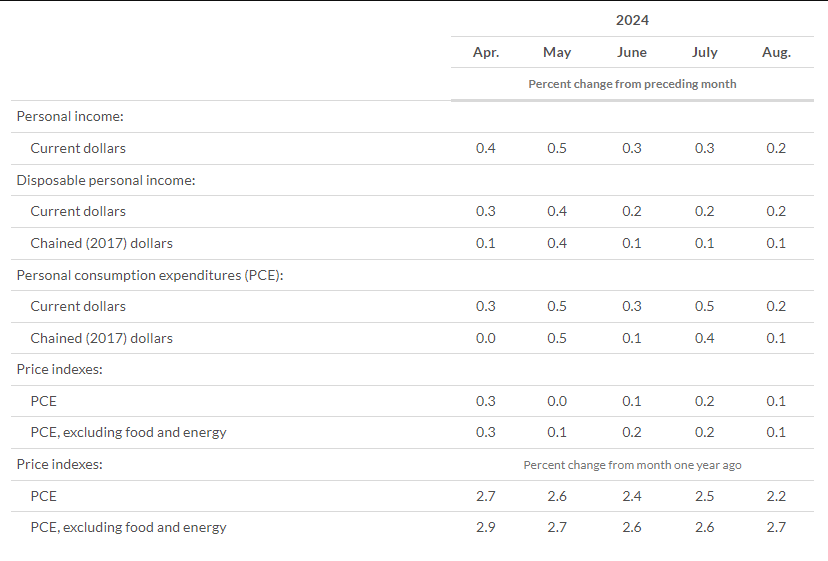
The PCE data showed that US personal income rose by less than expected. In August 2024, the US personal consumption expenditure (PCE) price index rose by 0.1% month-over-month, following a 0.2% increase in July, aligning with expectations. Service prices saw a 0.2% rise, while goods prices fell by 0.2%. The core PCE index, which excludes food and energy, also increased by 0.1%, down from 0.2% in July and below the anticipated 0.2%. Food prices went up by 0.1%, whereas energy prices dropped by 0.8%.
On an annual basis, the PCE inflation rate decreased to 2.2%, the lowest since February 2021, from 2.5% in July, and was below the expected 2.3%. The core rate slightly increased to 2.7% from 2.6%, meeting forecasts.
Source: Bureau of Economic Analysis
Markets will now keep an eye on the Michigan sentiment final numbers but barring any surprises this should not have much impact. Looking ahead, market attention will switch to US job numbers.
Traders are favoring a 50 bps cut in November but at this stage it is far from a certainty with Job numbers next week likely to play a major role.
Technical Analysis – US Dollar Index
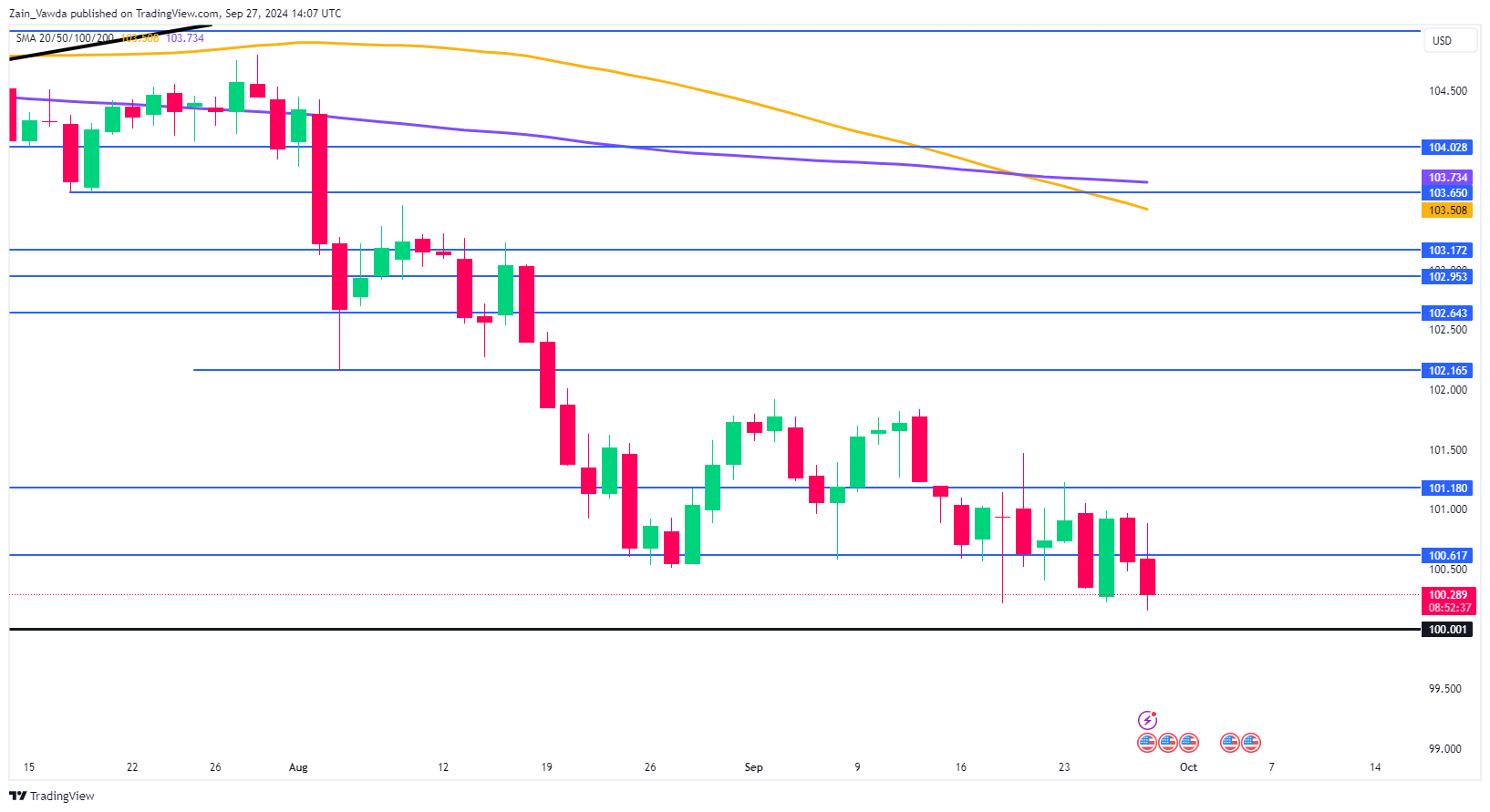
The US dollar has been flirting with fresh lows since the Fed meeting on September 18. A brief push lower post the PCE release followed but the index has since bounced back to trade at 100.308 at the time of writing.
The 100.00 psychological level is growing ever more vulnerable especially with the jobs data lined up next week. I had actually hoped for a slight bounce from the index today and Monday potentially as we enter the last day of the week, month and quarter.
However, it would appear that for now the bearish pressure is to be maintained with a late bounce on Monday still a possibility ahead of the NFP report on Friday
US Dollar Index Chart, September 27, 2024
Source: TradingView (click to enlarge)
Support
- 100.00
- 99.500
- 99.000
Resistance
- 100.61
- 101.18
- 101.80
USDJPY Driven by Japanese Fundamentals with Target at 142.00
- Bullish Corrective Scenario: Buy positions above 143.50 with a take profit (TP) at 144.00 or an extended target at 145.00, from where selling opportunities may resume.
- Bearish Scenario: Sell positions below 142.89 with a TP at 142.00, 141.74, and an extended target at 141.00.
- Bearish Pullback Scenario: Sell positions below 144.00 or 145.00 (where a confirmed entry point occurs) with a TP at 143.00 and an extended target at 142.00 in the short term.
Fundamental Analysis
Key Insights:
- Shigeru Ishiba’s victory in the Japanese elections and signals from BoJ policy are impacting USDJPY.
- The yen strengthens due to speculation over potential adjustments in Japanese monetary policy.
- The Fed’s dovish rhetoric could continue weakening the USD.
The Japanese yen strengthened against the dollar after Shigeru Ishiba won the LDP leadership election to become Japan’s prime minister, raising expectations for more active economic policies. Additionally, Tokyo’s Consumer Price Index (CPI) showed a 2.0% year-over-year increase in September, down from 2.6% in August, which could influence future adjustments by the Bank of Japan (BoJ).
The BoJ minutes revealed debates among officials on the speed at which interest rates should rise, reflecting the growing concern about the timing of future monetary policy adjustments.
Meanwhile, the USD faced bearish pressure following dovish remarks from Federal Reserve members. Governor Lisa Cook highlighted the need to consider "downside risks" to employment, suggesting potential rate cuts.
Technical Analysis
USDJPY, H2
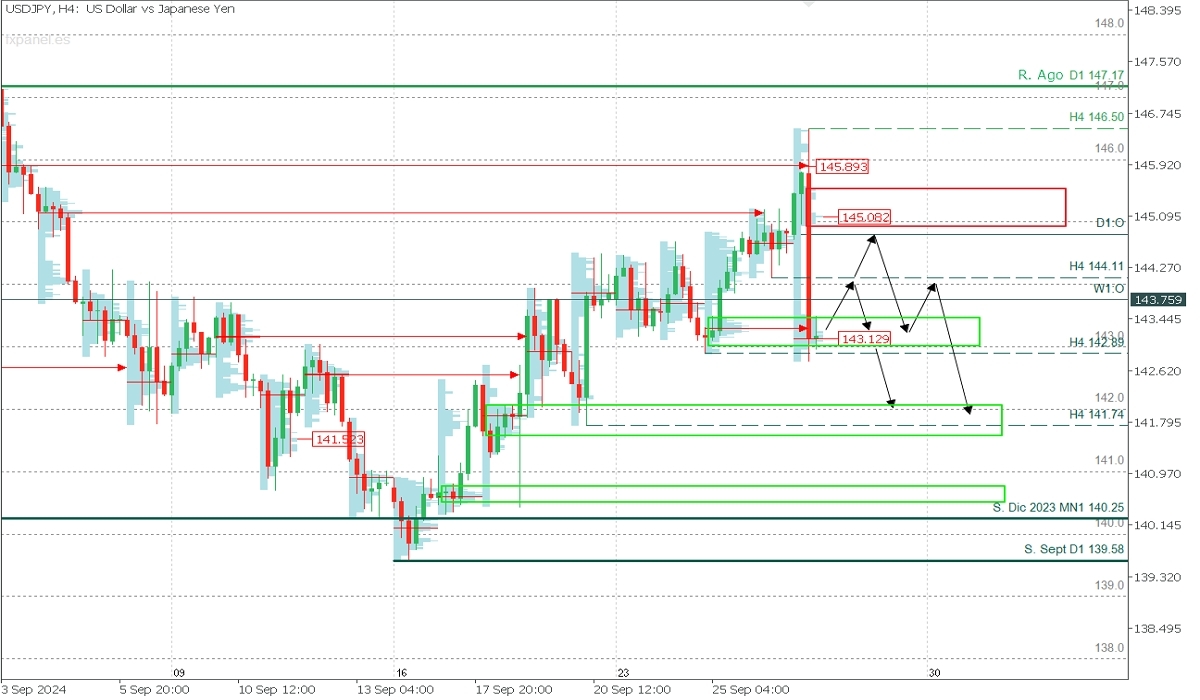
- Supply Zones (Selling): 145.08 and 145.89
- Demand Zones (Buying): 143.13, 142.00, and 140.60
The weekly bearish trend shows signs of continuation after the last two weeks’ corrective rally fell short of the August resistance, accelerating the decline after recent Japanese fundamentals.
The recent drop below the last validated support at 144.11 highlights yen recovery. After reaching the demand zone around 143.30, a pullback towards the broken support (now resistance) at 144.11 or a more extended supply zone around 145.00 is expected, from where selling can resume.
A bearish continuation and trend reversal will be confirmed if prices break below the demand zone around 143.30 and the support at 142.89, with a target in the coming days at the next demand zone around 142.00.
This bearish scenario will be invalidated if prices decisively break above the supply zone around 145.00, rising to challenge the resistance zone between 146.00 and 146.50, reversing the bearish momentum and preparing for a potential upward push toward the macro resistance at 147.17.
Japanese Yen Rises 1.3% vs Dollar on Political News/Economic Data
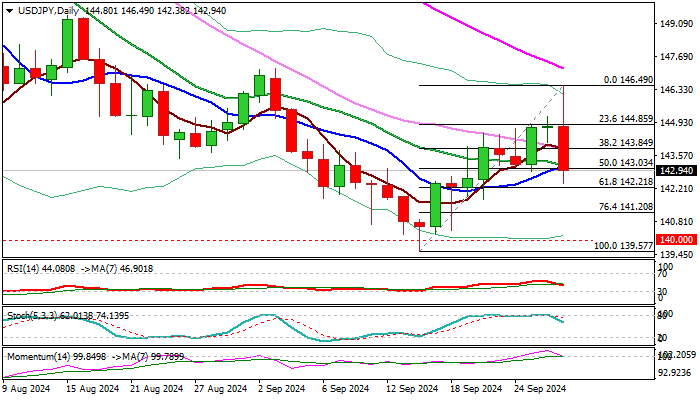
USDJPY rose to three-week high (146.49) and subsequently fell over three full figures on Friday, on speculations about new prime minister’s support to BOJ’s further policy tightening, which was seen as a violation of central bank’s independence, initially weakening yen and then sparking strong rally after news proved false.
Yen strengthened more after US data showed moderate increase in consumer spending in August, while inflation continued to slow, adding to expectations for another Fed outsized rate cut (bets are currently 50-50).
Technical structure is weakening on daily chart as falling 14-d momentum is cracking the centreline and about to break into negative territory, MA’s returned to full bearish setup, and a double bull-trap above 144.82 (Fibo 23.6% of 161.80/139.57).
Friday’s large bearish daily candle with long upper wick, to weigh on near-term action, along with falling and thickening daily cloud, which stays above the price.
Daily close below 143.00 zone (broken 50% of 139.57/146.49 /10DMA) to boost bearish signal and keep fresh bears firmly in play for extension through 142.21 (Fibo 61.8%) and 141.68 (Aug 5 spike low).
Res: 143.16; 143.84; 144.02; 144.85
Sup: 142.21; 142.00; 141.68; 141.20
Sunset Market Commentary
Markets
Today started somewhat as expected. French and Spanish September CPI data printed below consensus. French prices fell by 1.2% M/M to 1.5% Y/Y (from 2.2%), the first sub-2% reading since July 2021. Significantly lower fuel prices, but also lower services costs (turnaround after Olympics) drove the move. Spanish inflation was 0.1% M/M lower with only the second below 2% Y/Y-reading since March 2021 (1.7% from 2.4%). Core CPI slowed as well (2.4% from 2.7%) whereas markets expected a stabilization. Fuel prices were again the main culprit. EMU money markets nevertheless added to October ECB rate cut bets in the wake of the release. Their reasoning is simple: the only two key data points in the brief intermeeting period both surprised on the downside (PMI’s and now CPI’s). While markets currently attach an 80% probability to a follow-up rate cut, we still err on the side of the status quo. Recall ECB President Lagarde’s Q&A after the September meeting: “We are looking at a whole battery of indicators. And I’m saying that in particular because September will certainly deliver a low reading of inflation. Very likely. We expect, because of the base effect, particularly on energy, our inflation numbers to be up in the fourth quarter, so the last three months of 2024. But September is going to deliver a low reading.” In our interpretation, Lagarde basically hedged the September CPI figures with the central bank wanting more input on services and especially wages going into their final meeting this year. The ECB president can on Monday settle the debate when she appears in front of EU parliament. German yields lose 4 to 5 bps across the curve today. The euro initially dipped from levels near EUR/USD 1.1170 to 1.1130. The move was erased by the time of the release of US eco figures with bullish risk sentiment helping out. Key European stock markets add another 1% today. Disappointing US personal income/spending data (both +0.2% M/M in September) and a marginally lower core PCE deflator (0.1% M/M vs 0.2%) equally convinced (US) money markets to add to 50 bps Fed rate cut bets in November, our preferred scenario. Going into next week’s key eco data (ISM’s, payrolls) and Powell speech, the odds are perfectly in balance between 25 bps and 50 bps. US yields lose around 3 bps after the release, propelling EUR/USD back to first resistance at 1.1202/14. We stick to our sell USD on upticks approach. The trade-weighted dollar already set a minor new sell-off low at 100.16 with the 2023 low at 99.58 being the next target. USD/JPY’s drop from an intraday high of 146.20 to currently 142.70 helps explaining. JPY rebounded after results of the LDP leadership contest which was lost by a dovish BoJ advocate (Takaichi) in favour of Ishiba.
News & Views
Belgian inflation fell by 0.5% M/M in September to 3.06% Y/Y (from 0.0% M/M and 2.86% Y/Y) in August. Core inflation (ex-energy products and unprocessed food) was little changed at 2.80% from 2.78%. Energy inflation was an important factor at 6.72% Y/Y, compared to 6.96% last month and 14.01% in July. Electricity prices rose 14.8% Y/Y from 11.3%. For natural gas, it went from 103.0% last month to 138.1% this month. The increase is the result of the extinction of the impact of the basic package for electricity and natural gas. The disappearance of the package will have an increasing effect on inflation until February 2025. Services inflation is stable at 4.04%. Inflation for rents also remains stable at 4.74%. Inflation for food products (including alcoholic beverages) stands at 1.08% compared to 0.04% last month. Main monthly price increases concerned electricity (4.4%), natural gas (4.5%), travels abroad and city trips (2.6%), clothing (0.6%) and tobacco (3.9%. Plane tickets (-17.7%), motor fuels (-3.8%), hotel rooms (-10.0%), domestic heating oil (-2.9%), domestic trips (-9.9%), non-alcoholic beverages (-2.0%), alcoholic beverages (-1.8%), cleaning and maintenance products (-5.7%), confectionery (-2.0%) and meat (-0.8%) decreased. The estimate according to the European harmonised index (HICP flash estimate) amounts to 4.5% in September 2024.
The Brazilian unemployment rate unexpectedly declined from 6.8% to 6.6% in August. The consensus only expected a decline to 6.7%. The level is the lowest since current methodology which goes back to 2012. The strong labour market data come as Brazil’s central bank last week raised its policy rate by 25 bps to 10.75%, as its concerned about the inflationary impact of ongoing stronger than expected growth and a tight labour market. The BCB this week also already raised this year’s growth forecast (3.2% from 2.3%) and the inflation forecast over the period 2024-2026 to 4.3%-3.7%-3.3% from 4%-3.4%-3.2%. The real trades little changed near USD/BRL 5.44.
Graphs
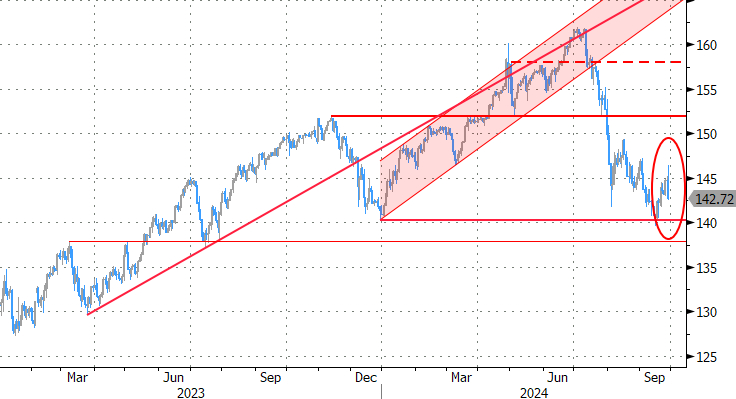
USD/JPY: yen rebounds after outcome LDP leadership contest. Dovish BoJ advocate lost run-off.
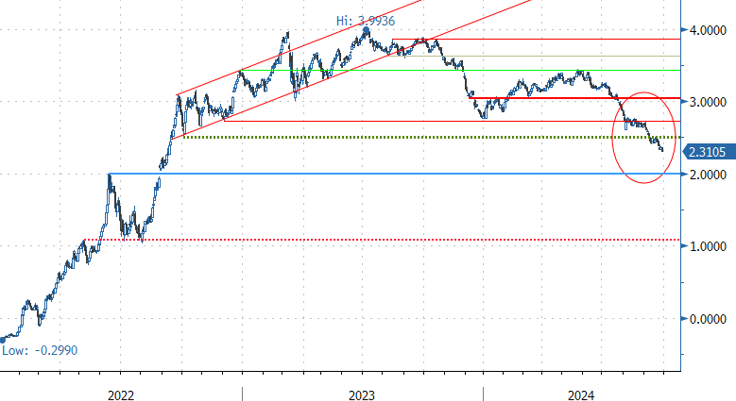
EU 2y swap rate: markets add to October ECB rate cut bets, pulling the front end of the curve to lowest levels since 2022
German Dax: German stocks are today’s outperforms as industrial stocks make comeback
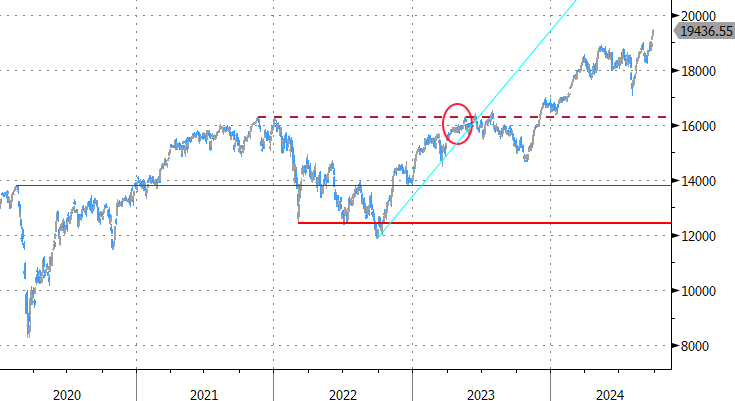
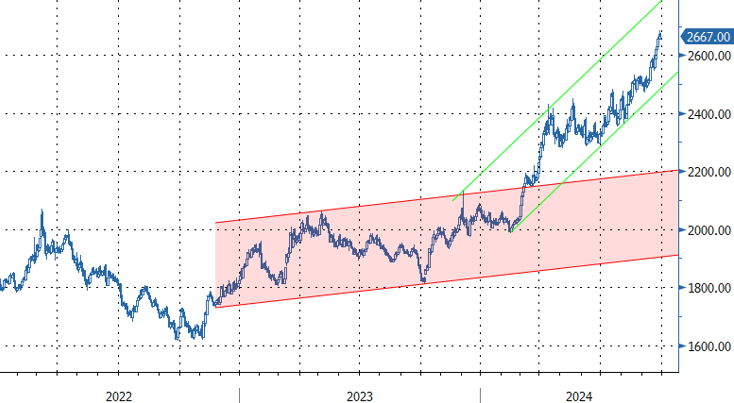
Gold extends rally as investors pile up on easing bets
U.S. Personal Income and Spending Grow Less Than Expected in August
Personal income grew 0.2% month-on-month (m/m) in August, down from July's 0.3% gain and below market expectations (0.4%).
Accounting for inflation and taxes, real personal disposable income grew a modest 0.1% for a third consecutive month.
Personal consumption expenditures grew 0.2% m/m in August. This was lower than the 0.5% recorded in July, and below market expectations (0.3%). Spending in real terms rose 0.1% m/m – much lower than the 0.4% gain recorded in July. Real spending was largely a result of increases in services outlays (0.2%), as goods spending was flat.
On inflation, the Fed's preferred inflation metric, the core PCE price deflator, rose 0.1% m/m, weaker than a 0.2% in the prior month. Thanks to base effects core PCE inflation rose from 2.6% to 2.7%. While the annual reading was in line with market expectations (2.7%), the monthly number came in marginally lower than expected (0.2%).
The personal savings rate declined to 4.8% in August from 4.9% in July (previously 2.9%).
Key Implications
Yesterday's release of the comprehensive annual GDP update revealed that the savings rate and income growth for the first half of the year were both stronger than previously reported. Thus it appears consumers had more gas in the tank to facilitate spending. Nonetheless, today's data suggests that they may be taking their foot off the pedal. Consumer spending is expected to remain subdued as the labor market continues to cool, though a greater savings buffer than previously thought could help to temper the slowdown.
On the inflation front, the Fed's preferred core measure continues to head in the right direction, even though base effects are boosting the yearly pace. Given that inflation continues to remain contained, the Fed will be paying even keener attention to labor market developments, with September payrolls data released next Friday as they calibrate further policy action.