Sample Category Title
USD/CHF Daily Outlook
Daily Pivots: (S1) 0.8971; (P) 0.8990; (R1) 0.9007; More…
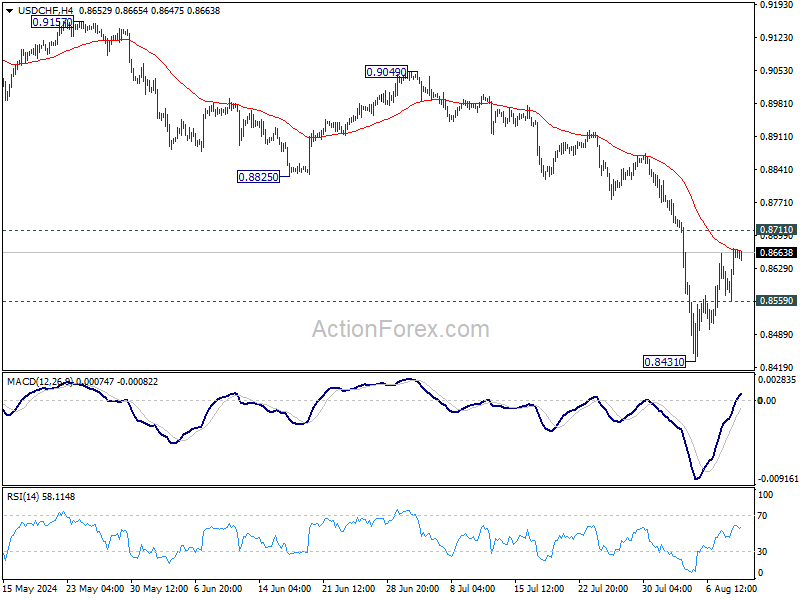
Intraday bias in USD/CHF stays mildly on the upside for channel resistance (now at 0.9034). Fall from 0.9223 might have completed as a three-wave corrective move to 0.8825. Firm break of channel resistance will target 0.9157 resistance next. On the downside, below 0.8956 minor support will turn intraday bias neutral gain first.
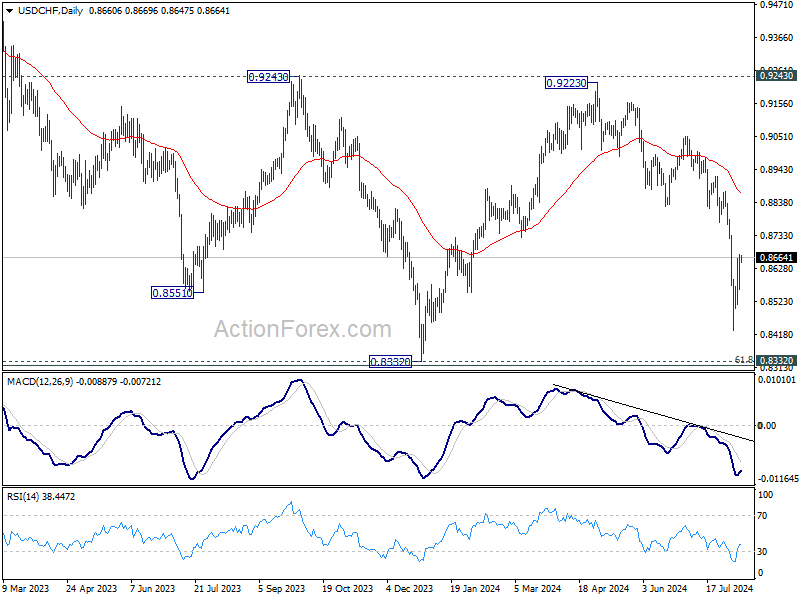
In the bigger picture, price actions from 0.8332 medium term bottom are seen as developing into a corrective pattern to the down trend from 1.0146 (2022 high). Rejection by 0.9243 resistance affirms this case, and maintains medium term bearishness. While more range trading could be seen between 0.8332/0.9243 first, downside breakout is mildly in favor at a later stage.
GBP/USD Daily Outlook
Daily Pivots: (S1) 1.2623; (P) 1.2642; (R1) 1.2665; More...
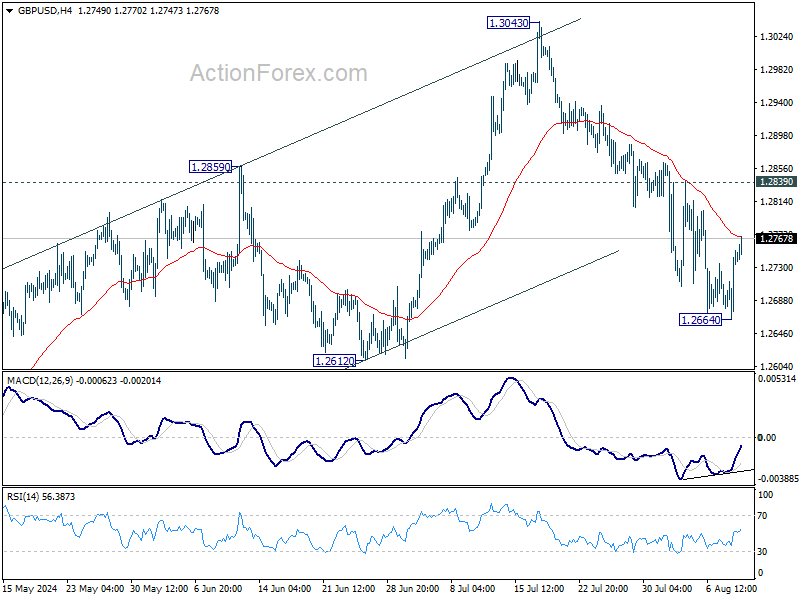
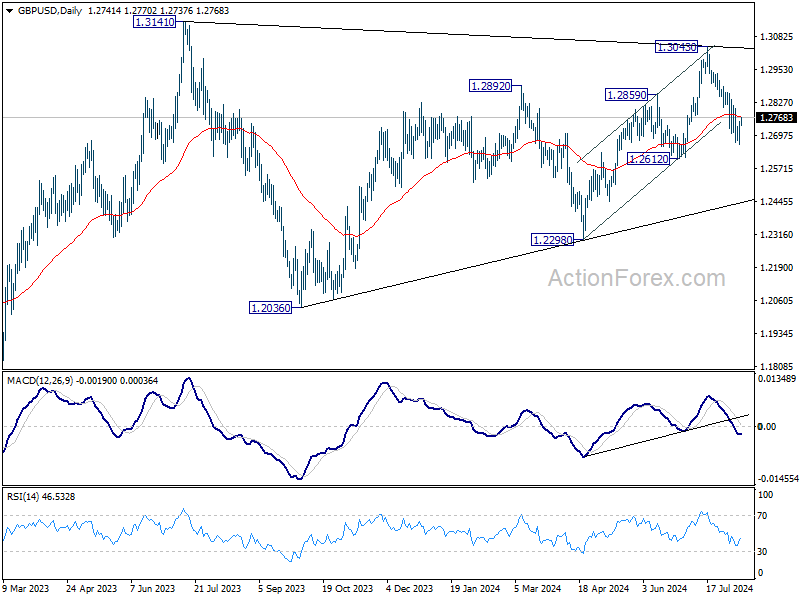
Intraday bias in GBP/USD stays neutral first. On the upside, firm break of 1.2702 resistance will argue that pull back from 1.2859 has completed, and bring retest of this high instead. Nevertheless, rejection by 1.2702 will keep risk on the downside. Sustained trading below 1.2633 resistance turned support will argue that whole rise from 1.2298 has completed, and target 1.2445 and below.
In the bigger picture, price actions from 1.3141 medium term top are seen as a corrective pattern that is still in progress. Break of 1.2445 support will confirm that another falling leg has started and target 1.2036 cluster support again (38.2% retracement of 1.0351 (2022 low) to 1.3141 at 1.2075. Nevertheless, break of 1.2892 resistance will argue that larger up trend from 1.0351is ready to resume through 1.3141.
Forex and Cryptocurrency Forecast
EUR/USD: Inflation in the US – Everything is Going According to Plan
Last week, specifically on Thursday, 27 June, the dollar received support from positive macroeconomic data from the US. The Department of Commerce reported that according to the final estimate, the US GDP grew by 1.4% in Q1, against the forecast of 1.3%. (According to the current Fed forecast, the country's real GDP will expand by 2.1% in 2024). Labour market statistics were also optimistic – the number of initial jobless claims in the US amounted to 233K, lower than both the forecast of 236K and the previous figure of 239K. Durable goods orders did not disappoint either, rising by 0.1% in May against the forecast of a decline of -0.1%. Against this backdrop, the DXY dollar index rose to 106.10, approaching April highs, and EUR/USD dropped to 1.0685.
However, the main events of the week were scheduled for Friday, 28 June, the last trading day of Q2. It is worth noting that the cash flows typical for the end of the quarter and the adjustment of trading positions at this time usually increase market volatility and can even cause chaotic movements in major currency pairs. Additionally, intrigue was added by the fact that on this day, the Bureau of Economic Analysis of the USA was to publish data on the Personal Consumption Expenditure (PCE) index for May. This indicator is the Fed's preferred inflation gauge and therefore influences decisions regarding interest rate changes.
According to preliminary estimates, the markets expected that the core index would decrease from 2.8% to 2.6% year-on-year and from 0.3% to 0.1% month-on-month. If this forecast were to come true, it would have strengthened expectations of an imminent easing of the American regulator's monetary policy. On the eve of the publication, market participants predicted that the first Fed rate cut would occur in September, with another one in November or December.
However, there was also an alternative scenario. On Wednesday, 26 June, Fed Board member Michelle Bowman stated that if the disinflation process in the US stalls, the regulator would have no choice but to resume tightening policy (QT).
The actual figures matched the forecasts exactly – core PCE decreased from 2.8% to 2.6% year-on-year and from 0.3% to 0.1% month-on-month. It is obvious that this result was already priced in, so it did not produce a "wow" effect on market participants, and after a brief dip, DXY returned to current levels.
The dollar was also supported by the President of the San Francisco Federal Reserve Bank, Mary Daly, who commented on the PCE data: "The Fed has not yet made a decision, but the PCE data is good news. [...] There is evidence that policy is sufficiently tight. [...] It takes more time for the policy to work. [...] If inflation remains stable or decreases slowly, rates will have to be raised longer."
As for the European Central Bank (ECB), unlike its overseas counterpart, it has already started the easing process (QE). At its meeting on 06 June, it already lowered the euro rate by 25 basis points (b.p.) to 4.25%. And as ECB representative Olli Rehn stated on 26 June, the market forecast for two more rate cuts in 2024 seems "reasonable". These words from Rehn signalled tolerance towards inflation spikes in the Eurozone, which is a negative factor for the common European currency.
The final point of the week, month, and quarter was set by the EUR/USD pair at 1.0713. The analyst forecast for the near future as of the evening of 28 June is as follows: 65% of expert votes were given for the pair's decline, 20% for its growth, and another 15% remained neutral. In technical analysis, 80% of trend indicators on D1 sided with the dollar and turned red, while 20% preferred the euro. Among oscillators, 75% were on the dollar's side, with the remaining 25% taking a neutral position. The nearest support for the pair is located in the zone of 1.0665-1.0670, followed by 1.0600-1.0615, 1.0565, 1.0495-1.0515, 1.0450, and 1.0370. Resistance zones are found around 1.0740-1.0760, then 1.0815, 1.0850, 1.0890-1.0915, 1.0945, 1.0980-1.1010, 1.1050, and 1.1100-1.1140.
The upcoming week will be rich in macroeconomic statistics. On Monday, 01 July and Tuesday, 02 July, preliminary data on such an important indicator as the consumer price index (CPI) in Germany and the Eurozone will be released, respectively. Speeches by ECB President Christine Lagarde and Fed Chair Jerome Powell are also scheduled for 01 and 02 July. In addition, on Monday and Wednesday, business activity indicators (PMI) in various sectors of the US economy will be known. But this is not the end of the flow of important information. Late in the evening of 03 July, the minutes of the last FOMC (Federal Open Market Committee) meeting of the Fed will be published. On Wednesday, 03 July, and Friday, 05 July, we will be flooded with statistics from the US labour market, including the unemployment rate and the number of new jobs created outside the agricultural sector (NFP). Traders should also keep in mind that 03 July is a short day in the US, and 04 July is a full holiday as the country celebrates Independence Day. And looking a bit further ahead, we remind you that early parliamentary elections will be held in France on Sunday, 07 July, the result of which could greatly affect the common European currency.
GBP/USD: Focus – On 04 July Elections
General parliamentary elections will be held not only in France but also in the United Kingdom, scheduled for Thursday, 04 July. Announcing this event, Prime Minister Rishi Sunak stated that he is proud of the "achievements of his government [Conservatives]". "Economic stability is the foundation of any success," he added, noting that the UK economy is still growing and inflation has returned to normal levels.
Despite Sunak's assurances, in May 2024, the monitoring company Ipsos reported that 84% of the population are "dissatisfied with how the government is managing the country". Current election forecasts based on public opinion polls show that 21.3% may vote for the Conservatives, 41.9% for their opponents, the Labour Party, and the rest for other parties.
It must be noted that the government of Rishi Sunak has several real achievements. On 19 June, data on consumer inflation (CPI) was published, and overall, the picture turned out to be quite good. The consumer price index month-on-month remained at the previous level of 0.3%, lower than the forecasted 0.4%. Year-on-year, the CPI decreased from 2.3% to 2.0%, reaching the Bank of England's (BoE) target for the first time since October 2021. The core index (Core CPI), which excludes volatile components such as food and energy prices, also showed a significant decrease from 3.9% to 3.5% year-on-year.
According to the report from the Office for National Statistics (ONS), presenting the final data on 28 June for Q1 2024, the UK economy grew by 0.7%, higher than the previous value and forecast of 0.6%. Year-on-year, real growth was 0.3%, exceeding the previous value and expectation of 0.2%. This was the best dynamic since Q4 2021.
If the UK parliamentary elections on 04 July and the inflation report on 17 July do not bring significant surprises, the markets predict that the BoE will start lowering rates at its nearest meeting on 01 August. According to ING bank strategists, "we still forecast that the Bank of England will start lowering rates in August and will begin to signal this in its speeches as soon as the general elections on 04 July are over". In their opinion, the likelihood of rate cuts by the Bank of England is much higher than those by the Fed, which will put pressure on the pound sterling. TDS company analysts, on the other hand, give the following forecast: "We believe a rate cut of 15 b.p. is expected in August, and about 50 b.p. in total for 2024". In several other market participant forecasts, it is also mentioned that by November, the reduction could be around 30 b.p.
GBP/USD ended the past five-day period exactly where it started – at 1.2644. The analyst forecast ahead of the parliamentary elections is unequivocal – 100% side with the dollar and expect the British currency to weaken. Regarding technical analysis on D1, there is also a clear advantage on the dollar's side. Trend indicators are in favour of the dollar at 65% to 35% red to green. Oscillators are 100% pointing south, with 20% signalling the pair is oversold. In case of further decline, the pair's levels and support zones are 1.2610-1.2620, 1.2540, 1.2445-1.2465, 1.2405, 1.2300-1.2330. In case of the pair's growth, it will meet resistance at levels 1.2675, 1.2700, 1.2740-1.2760, 1.2800-1.2820, 1.2860-1.2895, 1.2965-1.2995, 1.3040, and 1.3130-1.3140.
As for the events of the upcoming week, all investor attention is focused on the elections on 04 July. The next important event, as mentioned, will be the publication of the fresh inflation report in the United Kingdom on 17 July.
USD/JPY: Another Peak Conquered
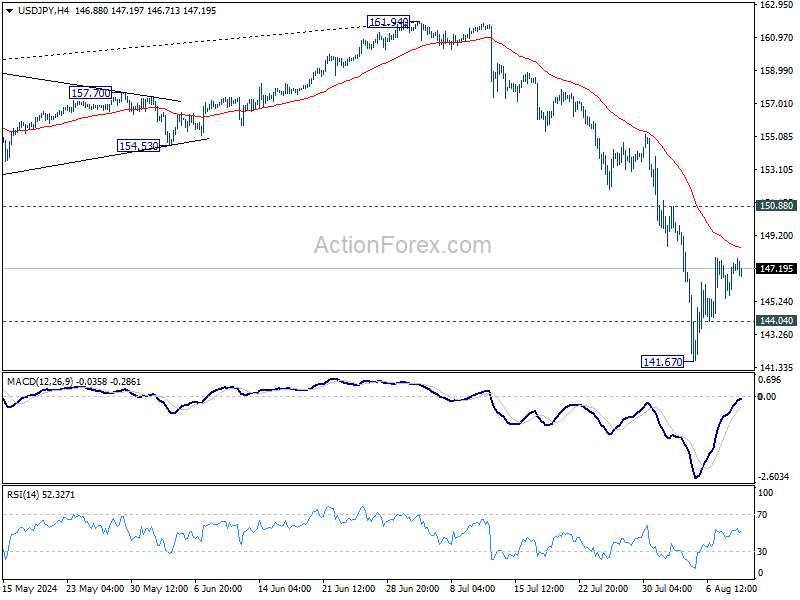
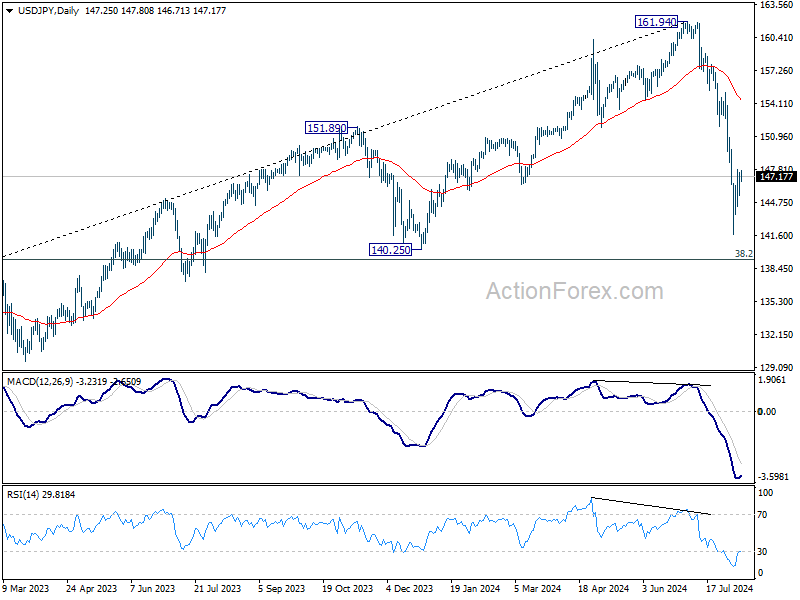
Last week, 75% of analysts expecting new currency interventions voted for the USD/JPY pair's retreat south, while the remaining 25% pointed north. The minority, as is often the case with the Japanese currency, turned out to be right: no interventions occurred, and the pair reached another peak – 161.28.
Frankly, there's nothing to comment on here – everything has been discussed dozens and hundreds of times. The problem of the yen's weakening lies in the ultra-loose monetary policy of the Bank of Japan (BoJ). And as long as it does not decisively turn towards tightening, the national currency will continue to lose its positions. Of course, for a while, the Ministry of Finance and the Central Bank can support its exchange rate with currency interventions. But spending billions and billions on something that disappears like ripples on water after a few days – is there any point in that? Can this be called monetary policy?
If inflation falls in major competing countries, in Japan, it rises. According to data published on Friday, 28 June, the Consumer Price Index (CPI) in Tokyo for the year ending in June rose to 2.3% compared to 2.2% for the previous period. The core CPI inflation (excluding volatile food prices) also increased to 2.1% year-on-year, which is higher than both the forecast of 2.0% and the previous value of 1.9%. Another core CPI index for Tokyo (excluding food and energy prices) decreased in June to 1.8% year-on-year compared to the previous value of 2.2%.
Of course, these are not jumps that warrant sounding a loud alarm – all indicators are "hovering" around the target 2.0%. This allows Japanese officials to pause, without changing the vector of their monetary policy, and to limit themselves to verbal "interventions". Thus, Japan's Finance Minister Shunichi Suzuki once again stated that he is "deeply concerned about excessive and unilateral movements in the Forex market" and expressed hope that "trust in the Japanese currency is maintained". Suzuki's colleague, Cabinet Secretary Yoshimasa Hayashi, delivered almost the same speech word for word. However, he added that the authorities "will take appropriate measures regarding excessive currency movements", hinting at another currency intervention.
This hint from Yoshimasa Hayashi scared 60% of experts who voted for the pair's southward movement and yen strengthening, 20% pointed north, and 20% took a neutral position. The opinion of the indicators is unambiguous, as they have never heard of interventions. Therefore, all 100% of trend indicators and oscillators on D1 are green, although a quarter of the latter are in the overbought zone. The nearest support level is around 160.25, followed by 159.20, 158.65, 157.60-157.80, 156.60, 155.45-155.70, 154.50-154.70, 153.60, 153.00, 151.90-152.15, 150.80-151.00. The nearest resistance is in the 160.85 zone, followed by 161.30 and 162.50.
In the upcoming week, the calendar highlights Monday, 01 July. On this day, the Tankan Large Manufacturers Index will be published. No other important macro statistics regarding the state of the Japanese economy are planned for the coming days.
CRYPTOCURRENCIES: Causes and Consequences of "Black Monday" on 24 June
Monday, 24 June, presented investors with a very unpleasant surprise – on this day, bitcoin's price fell below $60,000 for the first time since 03 May, reaching $58,468 at one point. Ethereum, in turn, fell below $3,250. Analysts highlight several reasons for the active sell-offs, noting that they reflect overall instability in global financial markets and uncertainty about monetary and regulatory policies in several leading countries, especially China and the US. However, there are also more specific factors that contributed to the development of the bearish trend.
In mid-June, the German government began selling off a huge amount of bitcoins (about 50,000 BTC) confiscated in January. Panic sentiment sharply intensified after the announcement on 24 June that creditor payments for the bankrupt crypto exchange Mt.Gox would begin in early July. The total amount of funds to be distributed among former clients is 162,100 BTC, roughly $10 billion. Bitcoin responded to this news with an 8% drop. It's no surprise – such a volume of coins flooding the free market can seriously knock down prices. In the derivatives market, long positions worth $177 million were forcibly liquidated, and the total financing rate for futures contracts turned negative for the first time in June, indicating that sales exceeded purchases.
It is precisely on the expectations of Mt.Gox debt payments that the flagship crypto asset's quotes reached the lowest level in the past eight weeks last Monday. In this situation, two things are encouraging. Firstly, the deadline for repayment falls on 31 October, and it's possible that payments will be made in parts over four months rather than all at once. And secondly, there is hope that not all creditors will rush to convert their bitcoins into fiat, but will hold onto them, hoping for price growth.
In addition to the above, BTC miners exerted some downward pressure on the market. It became known that their coin reserves reached a 14-year low, as they had to sell a significant amount of BTC due to the April halving to cover operational expenses. Recall that the cost of mining bitcoin, according to JPMorgan analysts, is $53,000. Historically, this cost level is a strong support for BTC/USD. However, even in March, JPMorgan did not rule out that after the halving, bitcoin could temporarily fall to $42,000.
In the absence of positive signals, the demand for spot bitcoin ETFs continues to decline, major market participants slow down their activity, and start to take profits. This also pressures the prices. CEO of investment company CryptoQuant Ki Young Ju calculated that over the past two weeks, bitcoin whales and miners set a record by selling coins worth $1.2 billion.
According to 10x Research, all last week, US spot BTC ETFs recorded investor outflows, and on 21 June, net outflow exceeded $105 million. 10x Research believes that bitcoin will now need to find a new price range to stabilize the decline and then find growth catalysts. In the medium term, according to 10x Research analysts, it is not worth expecting BTC to return above $70,000.
Popular analyst Matthew Hyland noted that the combined bitcoin balance on centralized exchanges reached a multi-year low. In theory, this could be seen as a bullish signal, but the crypto market leader is not yet eager to show an upward trend. Naturally, the publication of key US economic data could serve as a vector for further cryptocurrency movements. If the Fed takes its first step in easing its monetary policy in September, it could support risky assets, including bitcoin. According to Cryptology experts, the chances of bitcoin reaching a new all-time high by the end of September are quite high, and what is happening now is a phase of accumulation.
Despite the current decline, many investors remain optimistic, citing the cyclical nature of the crypto market. They also do not forget about the US elections. For example, former Goldman Sachs CEO Raoul Pal predicted significant bitcoin and cryptocurrency market growth in Q4 2024. In an episode of The Wolf Of All Streets podcast, the financier noted that risky assets like bitcoin usually rally against the backdrop of US presidential elections. "The final quarter of an election year is a real 'banana zone' for all assets. It always is," Pal optimistically stated, noting that the "banana zone" for cryptocurrencies in autumn is much more pronounced than, for example, for the Nasdaq index.
Bitcoin was also supported by billionaire Michael Saylor. His company, MicroStrategy, is one of the largest bitcoin holders in the world, with 205,000 BTC on its balance sheet. Despite the negative trend, it increased its reserves by another 11,931 BTC (over $700 million) in the past month alone. Saylor is convinced of the first cryptocurrency's ability to grow to $10 million with support from China and other factors. He believes that in the future, governments, especially China, will fully embrace the first cryptocurrency and integrate it into the state infrastructure. The entrepreneur declared all pre-bitcoin economic instruments obsolete. "Before Satoshi Nakamoto, economics was a pseudoscience. All economists before Satoshi tried to develop economic laws with shells, glass beads, pieces of paper, and credit instruments," the businessman wrote, calling bitcoin a "perfect asset."
In previous reviews, we already wrote that the launch of exchange-traded spot ETFs on Ethereum could give a certain boost to the digital asset market. On 25 June, SEC (US Securities and Exchange Commission) Chairman Gary Gensler noted that the registration process for new ETFs is "going smoothly," and the approval date depends on how quickly applicants submit adjusted S-1 forms. Bloomberg analysts call 02 July the expected approval date for new products. Reuters, citing anonymous sources, reports that a consensus has been reached between fund managers and the SEC in negotiations, and only the "final touches" remain.
Co-founder of venture company Mechanism Capital Andrew Kang stated that after the approval of ETH-ETF, Ethereum's rate could correct by 30%, falling to $2,400. In his opinion, at this stage, the main altcoin attracts much less attention from institutional investors compared to bitcoin. Based on this, ETH-ETF will attract only 15% of funds compared to what BTC-ETF received at the start.
Kang noted that to increase Ethereum's attractiveness among investors, its ecosystem needs to be positioned as a decentralized financial settlement layer, a global computer, or a Web3 application store. At the same time, it will be difficult to sell new ideas for Ethereum's application to funds, as the asset is perceived by investors as an overvalued stock of a large technology company.
Significantly more positively views the future of Ethereum Matt Hougan, CIO of Bitwise, a company managing cryptocurrency funds. In his opinion, the appearance of a long-awaited exchange product is undoubtedly a positive factor, and the net inflow of investments into ETH-ETF over the first 18 months will amount to $15 billion. In his analysis, he relies on the experience of Canada and the EU, where in similar products the inflow ratio for Ethereum and Bitcoin is approximately 1 to 4 (i.e., 25%). In other words, if in the first quarter of work for spot Bitcoin-ETF the total inflow was $26.9 billion, for Ethereum it is expected to be at the level of $6.7 billion. In this case, in three months of work, the leading altcoin could rise to $4,400-5,000.
CEO of SkyBridge Capital Anthony Scaramucci believes that the price of Ethereum could rise even higher, reaching $10,000-12,000. Regarding bitcoin, the entrepreneur allows for its growth to $170,000-250,000. The main driver, in his opinion, will be the further institutional acceptance of cryptocurrency. Scaramucci called the approval of spot exchange ETFs an important regulatory barrier breakthrough for attracting new capital. Thanks to this, in his opinion, the share of digital gold in the portfolios of major players will soon be about 3%.
As of the evening of Friday, 28 June, BTC/USD is trading at $60,190, and ETH/USD is in the $3,390 zone. The total crypto market capitalization is $2.24 trillion ($2.34 trillion a week ago). The bitcoin Fear & Greed Index (Crypto Fear & Greed Index) has dropped from 63 to 47 points over the past 7 days, moving from the Greed zone to the Neutral zone.
In conclusion, here is another observation from Matt Hougan. The CIO of Bitwise presented three reasons why long-term investments in both bitcoin and Ethereum are more advantageous compared to investing only in bitcoin. These are: 1. portfolio diversification 2. the opportunity to earn on very different ecosystems and 3. economic benefit.
Considering the difference in the capitalization levels of bitcoin and Ethereum, Hougan believes that 75% of the capital should be invested in BTC and 25% in ETH. According to calculations, over the period from May 2020 to May 2024, the yield of such an investment portfolio is 3% per annum higher than one that only contains bitcoin. However, Hougan acknowledges that in the shorter term, a portfolio including 100% BTC outperforms a diversified one. Moreover, investing only in bitcoin carries fewer risks due to its higher market capitalization and features such as limited coin issuance and a phased reduction in the inflation rate to zero.
Euro, European Equities Rally, But French Election Tempest Far From Over
Yes, Mesdames et Messieurs, the first round of the French legislative election went totally according to the plan for Marine Le Pen’s Nationally Rally which secured one vote over three and became the first far-right party to top the legislative elections in France. The New Popular Front – the alliance of left and greens - won 28% of the votes and Emmanuel Macron’s party posted a miserable 20%. The second round is due next weekend.
The kneejerk reaction was a jump in the euro in the early week trading. The EURUSD jumped past 1.0750, the euro-pound flirted with the 0.85 level and the European futures trade in the positive as a ‘buy the rumour sell the fact’ reaction to the election outcome - and also on chatter that National Rally may not secure an absolute majority in the second round. But there is a non-neglectable chance for Marine Le Pen and Mr, Bardella to win the parliamentary majority next week and that risk will unlikely let the euro run too high before more clarity.
The spread between the French and German 10-year yields topped 80bp last week, a level that has not been seen since the European debt crisis back more than a decade ago. But the French-German spread has room to widen and a Le Pen majority could revive that demon.
Across the Channel, the week starts with increased election vibes as well, because Brits will be headed to their own general election this Thursday with little suspense on the horizon. A Labour win is seen as a net positive for financial markets, and would benefit to banks, homebuilders and groceries the most according to JP Morgan. A Labour should also benefit to the British pound in the long run on hope of improved relations with Europe post- Brexit. In the short run, however, a Labour win is broadly priced in. Therefore the return of the Bank of England (BoE) doves following the election could keep the pound’s upside potential limited. Cable trades around its 50-DMA this morning and may not clear the 1.28 offers even after the election dust settles.
Good news from the data front
Released on Friday, the US core PCE slowed as expected in May as personal spending fell short of expectations. Combined to Thursday’s soft GDP number, last week’s US data was supportive of the Federal Reserve (Fed) doves. The S&P500 hit a fresh record, though closed the session in the negative.
But looking back, the S&P500 and Nasdaq had a stellar H1 thanks to the extension of the tech rally. It would be healthy to see the rally broaden to other sectors provided that the narrow breadth increases the risk of sudden and sharp selloffs. According to Bank of America, the algorithmic models boosted their exposure to technology to such extent that the stop-loss triggers became very tight. In numbers, the commodity trader advisors, so the automated trade models, can start unwinding their long positions when the US futures drop 2.8% or more, while this threshold was at 4% a month ago. This means that the margin for a misstep becomes narrower and the risk of long squeeze rises as the major US indices travel through uncharted territories on the shoulders of just a few tech names that are probably overpriced.
French Election: Public Spending Not Set to Rise Significantly
- Initial projections, alongside statements from Macron and Melenchon on Sunday, indicate that the most probable outcome is that no party will achieve an absolute majority, resulting in a 'hung parliament'. Hence, public spending in France is not set to rise significantly (see scenario 1, page 2).
- Projections indicate that National Rally (RN) won the first round with around 33.5% of the votes, which translates to 230-305 seats in the National Assembly. A party needs 289 to gain an absolute majority. The left-wing New Popular Front (NPF) came second with around 28.9% (120-200 seats) and Macron's centrist alliance (Ensemble) third with around 21.4% (60-125 seats). The final result is determined on Sunday 7 July.
- The most likely scenario (55% probability) is a 'hung parliament' in the National Assembly after the second round. In this main scenario, we thus expect the 10y yield spread between France and Germany to tighten by some 30bp to 40-60 bp within 3 months as fears over spending increases fade.
- Due to record-high voter turnout, approximately 300 constituencies will have three candidates in the final round. However, both Macron and left-wing leader Melenchon have pledged to withdraw candidates within the next 48 hours to defeat the RN.
- In the "cohabitation" scenario (35% probability) where Le Pen's party, Rassemblement National (RN), wins an absolute majority and Jordan Bardella becomes the next prime minister, we also expect the 10y yield spread between France and Germany to tighten, albeit to a less extend and trade between 50-60 bp within 3 months.
The first round of the election makes 'hung parliament' most likely
Initial projections, alongside statements from Macron and Melenchon on Sunday, indicate that the most probable outcome is that no party will achieve an absolute majority, resulting in a 'hung parliament'. Hence, public spending in France is not set to rise significantly (see scenario 1, page 2). The second most likely scenario is an absolute majority for the National Rally, especially if third candidates from the NPF and Ensemble do not withdraw as previously stated. Notably for the markets, the scenario where the left-wing NPF secures an absolute majority is considered the least likely, so the worst fears of spending increases should fade.
The most updated projections from four pollsters' show that the National Rally (RN) won the first round with around 33.5% of the votes, which translates to 230-305 seats in the National Assembly. Gaining an absolute majority requires a party to secure 289 seats, and while it is uncertain if National Rally (RN) has achieved this, it appears most likely that they have not. The left-wing New Popular Front (NPF) came second with around 28.9% (120-200 seats) and Macron's centrist alliance (Ensemble) third with around 21.4% (60-125 seats). The projection is not the actual result of the first-round, but it indicates that RN had a slightly worse result than polls suggested and Ensemble and NPF a slightly better result.
In the second round on Sunday, July 7, there will be runoffs between the two candidates who received the most votes along with any third or fourth candidate who garnered more than 12.5% of all eligible votes. Due to the record high voter turnout, it is estimated that around 300 constituencies will feature three candidates. This situation presents a clear advantage for the National Rally, as votes will be split between the centre and the left. However, the left-wing NPF leader, Melenchon, has encouraged all third-placed candidates from his group to withdraw in an effort to unite against the sRN along with Macron's Ensemble. Macron himself has called for "a broad, clearly democratic and republican alliance for the second round." He stated that they would withdraw candidates where they placed third to support those who uphold "the values of the republic" in defeating the National Rally. Candidates now have 48 hours to withdraw in what promises to be a period of intense negotiations that is crucial to monitor.
Three scenarios for the second-round result and their impact on markets
The most likely scenario (scenario 1, probability: 55%) is a 'hung parliament' where no group or party obtains an absolute majority in the National Assembly. In this scenario, the new government will need to seek ad-hoc support for legislation, necessitating compromise. Given the division in the French parliament we find it unlikely that the new government can find support for any larger increases in spending. As the government needs to use the so-called article 49.3 to pass legislation (including the budget) through without a majority, we find large changes in policies unlikely as it then requires that the government survives a "no confidence" vote. Consequently, we should expect a status quo in France and its public finances. In this main scenario, we thus expect the 10y yield spread between France and Germany will tighten to 40-50 bp within 3 months as fears over spending increases fade.
In the "cohabitation" scenario (scenario 2, probability 35%) where Le Pen's party, National Rally (RN), wins an absolute majority and Jordan Bardella becomes the next prime minister, we expect only a gradual implementation of the party programme and no large immediate increases in public spending. This is supported by the fact that RN has rolled back the costliest initiatives from the previous campaign. Bardella, who is the prime minister candidate has particularly softened his rhetoric's on EU and public spending and in a recent FT interview Bardella said that "I do not intend to go to war with Brussels" and that the EU fiscal rules of a maximum deficit of 3% of GDP "remains an objective" and that "it will require me to prioritise". Moreover, Bardella said he will undertake an audit of French public finances before deciding on spending priorities in the autumn. However, we note that his first priority will be to cut the VAT on energy and petrol, which will cost EUR12bn a year (0.4% of GDP) which he intends to fund this by raising various taxes, cutting tax loopholes and the France's contribution to the EU budget. Yet, we assess that ambitions of turning the fiscal policy substantially more expansionary will be dampened by the risk of exclusion from EU/ECB support programmes or possible punishment in financial markets. Hence, in the scenario where Le Pen's party wins an absolute majority, we also expect the 10y yield spread between France and Germany to tighten to 50-60 bp within 3 months.
In the third scenario, also a "cohabitation" situation, the left-wing New Popular Front (NPF) coalition secures an absolute majority (scenario 3, probability: 10%). Here, we anticipate an increase in public spending and potential confrontations with the EU. Unlike Bardella and RN, the left-wing alliance has maintained a firm stance in its communications recently. They want to increase spending by some €EUR150bn (5% of GDP) by 2026-2027, lower the pension age from 64 to 60, and at the same time increase taxes similarly in order not to increase the deficit. However, as details on funding are sparse and the risk of anti-establishment increases, we expect the immediate reaction in this scenario will likely be a significant increase in the spread between France and Germany to 100-150 bp within 3 months. Whether the government then will be able to work together in such a scenario is very uncertain though as the NPF coalition consists of four very different parties with contrasting views on topics such as Russia and Israel. Especially, it is important to note, that the left-wing coalition includes a more modest party like the socialist party with former president François Hollande, and we do not think they would tolerate market turmoil going this badly for a prolonged period, as they would lose all credibility of them being fit to govern in the future.
EUR/USD Daily Outlook
Daily Pivots: (S1) 1.0692; (P) 1.0708; (R1) 1.0731; More....
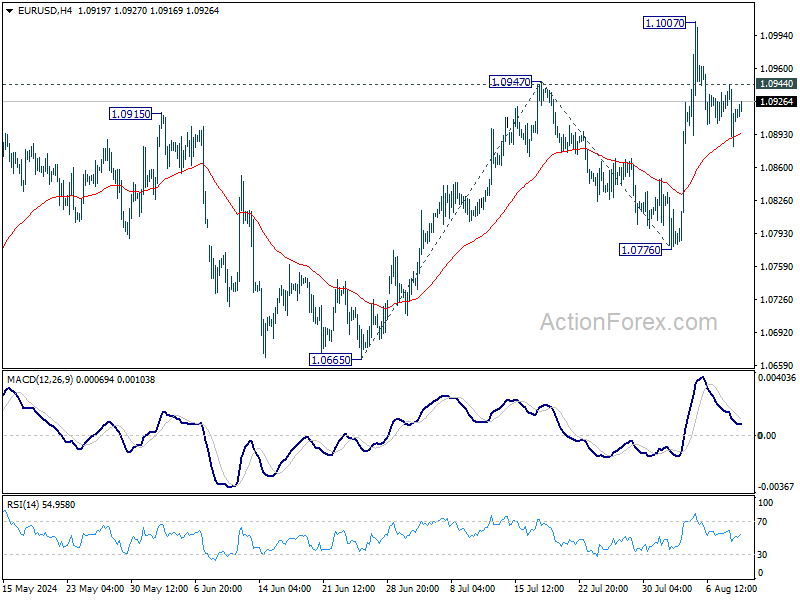
Immediate focus in now on 1.0760 resistance as EUR/USD extends the rebound from 1.0665. Decisive break there will argue that pull back from 1.0915 has completed. Intraday bias will be back on the upside for 55 D EMA (now at 1.0773) and above. Meanwhile, rejection by 1.0760 will maintain near term bearishness for another fall through 1.0665 later.
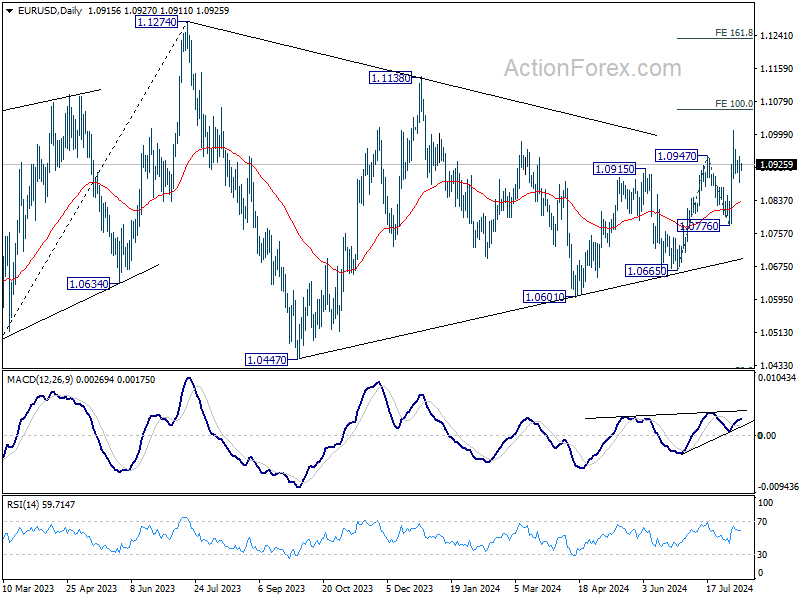
In the bigger picture, price actions from 1.1274 are viewed as a corrective pattern that's still in progress. Break of 1.0601 will target 1.0447 support and possibly below. For now, this will remain the favored case as long as 1.0915 resistance holds, in case of rebound.
Euro Rebounds on French Election Relief; Market Eyes Central Bank Minutes and Key Data
Euro is staging a solid rebound today, with investors feeling somewhat reassured by the preliminary results of French parliamentary elections. While the far-right National Rally made significant gains with approximately 34% of votes in the first round, this is insufficient for an outright majority in the second round scheduled for July 7. The National Rally's aggressive fiscal policy stance has heightened concerns over France's already strained fiscal situation. However, the prospect of a more centrist or balanced government composition is perceived as a positive development for Euro.
The days ahead are critical for French politics, as much depends on how President Emmanuel Macron's Together alliance, which garnered 20-23% of the vote, and the left-wing coalition New Popular Front, with 29% of the vote, will navigate their strategies to prevent the far-right from gaining control. It's important to remember that the initial vote percentages may not accurately predict the final seat distribution in the national assembly, adding another layer of uncertainty.
In the broader currency markets, Kiwi is trailing Euro as the second strongest currency today. Sterling is also showing strength, positioned as the third strongest, as it braces for its general elections on July 4. Conversely, Swiss Franc is the weakest performer due to Euro's rebound, with Yen and Australian Dollar following as the next weakest. Dollar and Canadian Dollar are showing moderate performance, positioned in the middle of the pack. Beyond the political developments, this week promises a slew of significant events, including the release of minutes from RBA, FOMC, and ECB meetings, alongside crucial data such as US non-farm payrolls and Eurozone inflation figures.
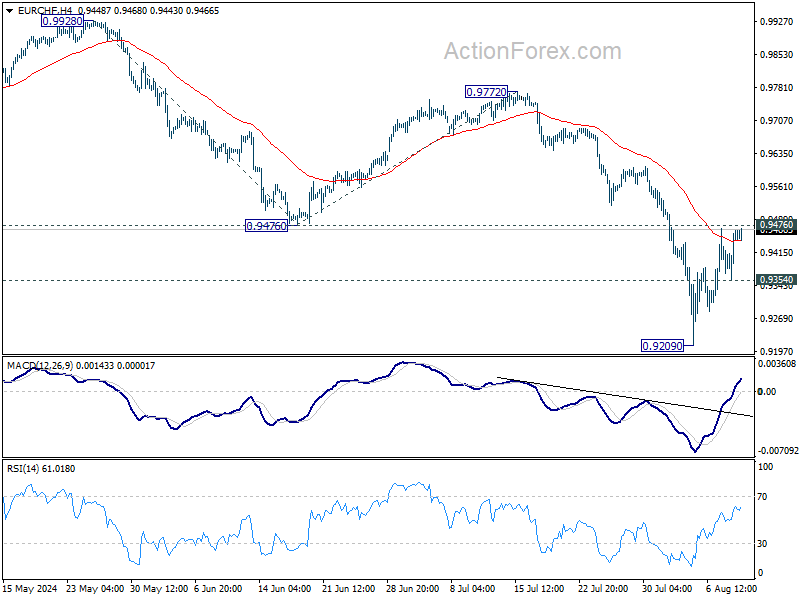
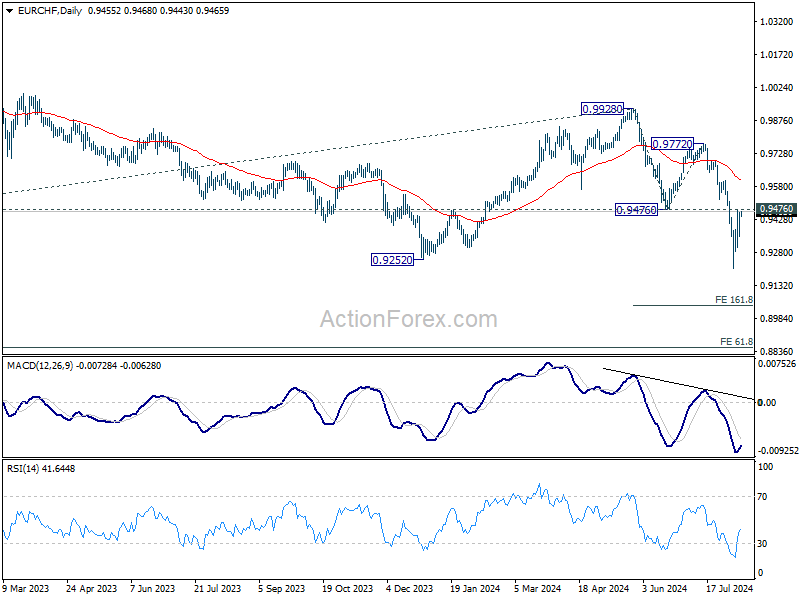
Technically, EUR/GBP's break of 0.8482 support turned resistance suggests that fall from 0.8643 has completed at 0.8396. While it's still early to call for bullish trend reversal, stronger rebound is anticipated in the near term through 55 D EMA (now at 0.8505). Focuses will also be on whether EUR/USD would break through 1.0760 resistance to start a stronger rally, and whether EUR/CHF would follow by breaking through 0.9683 resistance too.
In Asia, at the time of writing, Nikkei is down -0.04%. Hong Kong is on holiday. China Shanghai SSE is up 0.53%. Singapore Strait Times is up 0.08%. Japan 10-year JGB yield is up 0.0203 at 1.069.
Japan's Tankan manufacturing improves but non-manufacturing may have peaked
BoJ's closely watched Tankan survey revealed that while manufacturing sector showed continued improvement, sentiment among non-manufacturers appeared to have peaked, which may complicate BoJ's considerations for another rate hike later this month.
The Tankan survey reported that large manufacturing index rose from 11 to 13, reaching its highest level since March 2022. Large manufacturing outlook also increased from 10 to 14. However, non-manufacturing index dipped slightly from 34 to 33, marking its first decline in 16 quarters, and non-manufacturing outlook remained unchanged at 27.
Long-term corporate inflation expectations edged up, with companies forecasting inflation to hit 2.3% in three years and 2.2% in five years. Despite these rising expectations, the mixed sentiment data do not strongly support another imminent rate hike by BoJ.
In a separate development, an unscheduled revision to historical data indicated that Japan's real GDP contracted at an annualized rate of -2.9% in January-March, a much steeper decline than the previously estimated -1.8% contraction. This significant revision is likely to impact BoJ's upcoming quarterly growth and price forecasts, which are due at the July 30-31 policy meeting.
Japan's PMI manufacturing finalized at 50, stagnation amid cost pressures and weak demand
Japan's PMI Manufacturing index for June was finalized at 50.0, slightly down from May's 50.4, indicating a stagnation in the sector. S&P Global highlighted a marginal increase in manufacturing production, but new orders continued to decline, albeit slightly. Employment in the sector expanded, with business confidence reaching a six-month high.
Pollyanna De Lima at S&P Global Market Intelligence stated, "Notably, the latest PMI data revealed the first rise in Japanese factory production for over a year, and a rebound in business confidence."
However, she also pointed out significant challenges, including heightened cost pressures due to Yen depreciation, which increased the price of imported materials. Labor costs also strained budgets.
"There was clear evidence that the sharp rise in overall purchasing prices was not caused by supply-chain issues, as delivery times improved to the greatest extent in over 15 years," she added.
Consequently, manufacturers raised their selling prices at the highest rate in over a year, a move seen as unfavorable given the weak domestic and external demand.
China's Caixin PMI manufacturing rises to 51.8, growth continues but optimism dips
China's Caixin PMI Manufacturing index edged up from 51.7 to 51.8 in June, surpassing expectations of 51.2 and marking its highest level since May 2021. This rise keeps the index in expansionary territory for the eighth consecutive month. Notably, output price inflation reached an eight-month high, reflecting increased activity in the sector.
Wang Zhe, Senior Economist at Caixin Insight Group, noted, "Overall, the manufacturing sector kept improving in June, with supply, domestic demand, and exports continuing to grow." He highlighted that manufacturers increased their purchases, resulting in higher inventory and price levels. Despite this positive trend, optimism among surveyed companies fell significantly, suggesting that market expectations need further strengthening.
Fed, ECB, RBA minutes, Eurozone CPI, and US NFP on the radar
The upcoming week will feature significant minutes from three major central banks and a slew of key economic data. Investors and analysts will be closely monitoring these developments for any signals that might indicate future monetary policy directions.
The minutes from FOMC's June meeting are expected to attract substantial attention. The latest economic projections indicated a notable shift, showing only one expected rate cut this year, compared to three projected in March. This hawkish shift, underscored by 11 members favoring one or no cuts versus 8 members favoring two cuts, will be a primary focus. Additionally, any discussions about the long-term neutral rate, which has been raised, will be closely analyzed for further insights.
Also from the US, ISM indexes and Non-Farm Payroll report will be crucial data points. The manufacturing sector's brief revival seems to have faltered, with ISM manufacturing index staying below 50 since November 2022, except for March this year. Conversely, the services sector has shown resilience, rebounding strongly in May after dipping below 50 in April. While many market participants view September as the tentative month for the first rate cut, Fed might remain cautious about premature easing if the services sector continues to show strength and the job market sustains solid growth with high wage increases.
ECB's meeting accounts will be scrutinized for insights into the rationale behind June's rate cut, the first in the current easing cycle. The Governing Council's perspectives, especially those of Chief Economist Philip Lane, on the future path of policy easing will be critical. Additionally, Eurozone CPI flash report will provide crucial information for markets to adjust their expectations. Currently, it is likely that ECB will cut rates once or twice more this year, with the next one in September, but this outlook is not set in stone.
Minutes from RBA's June meeting will also be significant. Governor Michele Bullock has indicated that a rate cut was not even discussed at the meeting. The minutes might reveal how concerned the board is about upside inflation risks, which somewhat materialized in May's CPI data already. Any hints on what level of upside surprises in Q2 CPI data, due on July 31, might prompt an August rate hike will be closely watched by investors.
Other key economic data to watch include Japan's Tankan survey, China's Caixin PMIs, and Canada's employment figures.
Here are some highlights for the week:
- Monday: Japan Tankan survey, PMI manufacturing final, consumer confidence; China Caixin PMI manufacturing; Germany PMI flash; Swiss retail sales, PMI manufacturing; Eurozone PMI manufacturing final; UK PMI manufacturing final, M4 money supply, mortgage approvals; US PMI manufacturing final, ISM manufacturing, construction spending.
- Tuesday: New Zealand building permits; Japan monetary base; Australia RBA minutes; Eurozone CPI flash, unemployment rate; Canada PMI manufacturing.
- Wednesday: Australia retail sales, building approvals, China Caixin PMI services; Eurozone PMI services final, PPI; UK PMI services final; Canada trade balance; US ADP employment, trade balance, ISM services, factory orders, FOMC minutes.
- Thursday: Australia trade balance; Swiss unemployment rate, CPI; Germany factory orders; UK PMI construction; ECB meeting accounts.
- Friday: Japan household spending, leading indicators; Germany industrial production; France industrial production; trade balance; Swiss foreign currency reserves; Eurozone retail sales; Canada employment, Ivey PMI; US non-farm payrolls.
EUR/USD Daily Outlook
Daily Pivots: (S1) 1.0692; (P) 1.0708; (R1) 1.0731; More....
Immediate focus in now on 1.0760 resistance as EUR/USD extends the rebound from 1.0665. Decisive break there will argue that pull back from 1.0915 has completed. Intraday bias will be back on the upside for 55 D EMA (now at 1.0773) and above. Meanwhile, rejection by 1.0760 will maintain near term bearishness for another fall through 1.0665 later.
In the bigger picture, price actions from 1.1274 are viewed as a corrective pattern that's still in progress. Break of 1.0601 will target 1.0447 support and possibly below . For now, this will remain the favored case as long as 1.0915 resistance holds, in case of rebound.
Economic Indicators Update
| GMT | Ccy | Events | Actual | Forecast | Previous | Revised |
|---|---|---|---|---|---|---|
| 23:50 | JPY | Tankan Large Manufacturing Index Q2 | 13 | 11 | 11 | |
| 23:50 | JPY | Tankan Large Manufacturing Outlook Q2 | 14 | 10 | ||
| 23:50 | JPY | Tankan Non - Manufacturing Index Q2 | 33 | 33 | 34 | |
| 23:50 | JPY | Tankan Non - Manufacturing Outlook Q2 | 27 | 27 | ||
| 23:50 | JPY | Tankan Large All Industry Capex Q2 | 11.10% | 4% | ||
| 00:30 | JPY | Manufacturing PMI Jun F | 50 | 50.1 | 50.1 | |
| 01:45 | CNY | Caixin Manufacturing PMI Jun | 51.8 | 51.2 | 51.7 | |
| 05:00 | JPY | Consumer Confidence Jun | 36.4 | 36.5 | 36.2 | |
| 06:30 | CHF | Real Retail Sales Y/Y May | 2.50% | 2.70% | ||
| 07:30 | CHF | Manufacturing PMI Jun | 44.9 | 46.4 | ||
| 07:45 | EUR | Italy Manufacturing PMI Jun | 44.5 | 45.6 | ||
| 07:50 | EUR | France Manufacturing PMI Jun F | 45.3 | 45.3 | ||
| 07:55 | EUR | Germany Manufacturing PMI Jun F | 43.4 | 43.4 | ||
| 08:30 | GBP | Manufacturing PMI Jun F | 51.4 | 51.4 | ||
| 08:30 | GBP | M4 Money Supply M/M May | 0.20% | 0.10% | ||
| 08:30 | GBP | Mortgage Approvals May | 61K | 61K | ||
| 12:00 | EUR | Germany CPI M/M Jun P | 0.20% | 0.10% | ||
| 12:00 | EUR | Germany CPI Y/Y Jun P | 2.40% | |||
| 13:45 | USD | Manufacturing PMI Jun F | 51.7 | 51.7 | ||
| 14:00 | USD | ISM Manufacturing PMI Jun | 49.3 | 48.7 | ||
| 14:00 | USD | ISM Manufacturing Prices Paid Jun | 55.9 | 57 | ||
| 14:00 | USD | ISM Manufacturing Employment Index Jun | 51.1 | |||
| 14:00 | USD | Construction Spending M/M May | 0.30% | -0.10% |
China’s Caixin PMI manufacturing rises to 51.8, growth continues but optimism dips
China's Caixin PMI Manufacturing index edged up from 51.7 to 51.8 in June, surpassing expectations of 51.2 and marking its highest level since May 2021. This rise keeps the index in expansionary territory for the eighth consecutive month. Notably, output price inflation reached an eight-month high, reflecting increased activity in the sector.
Wang Zhe, Senior Economist at Caixin Insight Group, noted, "Overall, the manufacturing sector kept improving in June, with supply, domestic demand, and exports continuing to grow." He highlighted that manufacturers increased their purchases, resulting in higher inventory and price levels. Despite this positive trend, optimism among surveyed companies fell significantly, suggesting that market expectations need further strengthening.
Japan’s PMI manufacturing finalized at 50, stagnation amid cost pressures and weak demand
Japan's PMI Manufacturing index for June was finalized at 50.0, slightly down from May's 50.4, indicating a stagnation in the sector. S&P Global highlighted a marginal increase in manufacturing production, but new orders continued to decline, albeit slightly. Employment in the sector expanded, with business confidence reaching a six-month high.
Pollyanna De Lima at S&P Global Market Intelligence stated, "Notably, the latest PMI data revealed the first rise in Japanese factory production for over a year, and a rebound in business confidence."
However, she also pointed out significant challenges, including heightened cost pressures due to Yen depreciation, which increased the price of imported materials. Labor costs also strained budgets.
"There was clear evidence that the sharp rise in overall purchasing prices was not caused by supply-chain issues, as delivery times improved to the greatest extent in over 15 years," she added.
Consequently, manufacturers raised their selling prices at the highest rate in over a year, a move seen as unfavorable given the weak domestic and external demand.
Japan’s Tankan manufacturing improves but non-manufacturing may have peaked
BoJ's closely watched Tankan survey revealed that while manufacturing sector showed continued improvement, sentiment among non-manufacturers appeared to have peaked, which may complicate BoJ's considerations for another rate hike later this month.
The Tankan survey reported that large manufacturing index rose from 11 to 13, reaching its highest level since March 2022. Large manufacturing outlook also increased from 10 to 14. However, non-manufacturing index dipped slightly from 34 to 33, marking its first decline in 16 quarters, and non-manufacturing outlook remained unchanged at 27.
Long-term corporate inflation expectations edged up, with companies forecasting inflation to hit 2.3% in three years and 2.2% in five years. Despite these rising expectations, the mixed sentiment data do not strongly support another imminent rate hike by BoJ.
In a separate development, an unscheduled revision to historical data indicated that Japan's real GDP contracted at an annualized rate of -2.9% in January-March, a much steeper decline than the previously estimated -1.8% contraction. This significant revision is likely to impact BoJ's upcoming quarterly growth and price forecasts, which are due at the July 30-31 policy meeting.