Sample Category Title
Fed’s Williams foresees interest rate normalization starting this year
In an interview with BloombergTV. New York Fed President John Williams suggested that Fed is still on track to start cutting interest rates within the year.
"We will need to start a process at some point to bring interest rates back to more normal levels, and my own view is that process will likely start this year," Williams stated.
Regarding the recent inflation data, Williams did not regard it as a decisive shift in economic trends but acknowledged its impact on his assessments and future forecasts.
Williams also touched on the topic of the Federal Reserve's balance sheet management, specifically the ongoing quantitative tightening process. He advocated for a more measured pace in reducing the Fed's balance sheet, a strategy aimed at allowing more room for evaluation and adjustment.
Sunset Market Commentary
Markets
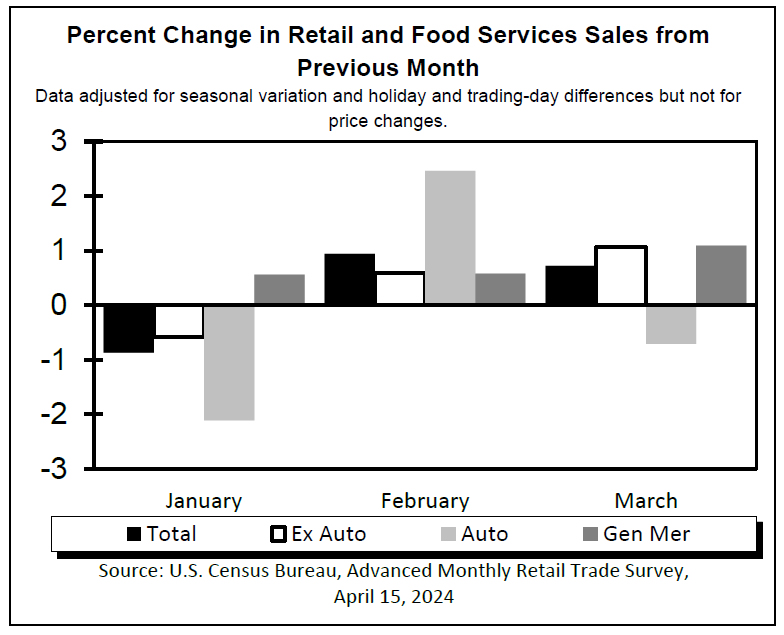
Geopolitics as a market theme tend to have a limited shelf life but investors this time really took it to the next level. Except for some minor bourse losses in Asia, Iran’s retaliatory attacks against Israel didn’t trigger the slightest risk aversion in Europe, quite the contrary. The EuroStoxx50 adds 1.5% and Wall Street rises 0.5-1%. Core bonds slipped. Yields gapped higher at the open with gains boosted by exceptionally strong US retail sales. The March edition crushed the bar, whatever the gauge, while the February readings were revised higher. Headline sales rose 0.7% m/m and core measures rose between 1 and 1.1%. 8 out of the 13 categories printed gains. The control group (excluding food, gas, building materials and car dealers) rose the most since February 2023 (1.1% m/m), boding well for the private consumption component in Q1 GDP growth. US yields jump between 7 and 9.5 bps across the curve with the likes of the 10y on track for a new YtD closing high. The 2y came less than 1 bp short of testing the 5% again. German yields add 6.6-7.2 bps. The Japanese yen greatly underperforms on currency markets with the risk-on mood and rising core bond yields bashing JPY to a new 34y low against the dollar. USD/JPY tops the 154 big figure. EUR/USD temporarily gave up all earlier gains after the retails sales were released. The pair hit an intraday low around 1.063, just shy of Friday’s YtD (intraday) low of 1.0623 before recovering marginally to 1.064 currently. Sterling strengthens against most peers in the run-up to an economic update that entails labour market data tomorrow, inflation figures Wednesday and retail sales Friday. EUR/GBP drops to 0.8534. Oil prices eased back below $90, suggesting few Middle East related supply concerns. Metal prices including aluminum do rise about 5% following the UK and US sanctioning Russian exports but that’s about half of the initial surge in Asian dealings.
More ECB speakers hit the wires today in the wake of the policy meeting last Thursday. Governing Council member Simkus sees a more than 50% of more than 3 rate cuts this year with a follow-up move in July after June. Slovakia’s Kazimir opened the door for a cut in June but didn’t want to commit on a path after June. Chief Economist Lane noted that the further inflation path is going to be bumpy. He expressed confidence inflation is heading back to 2% but added wage gains and services inflation remains elevated. Their comments had no intraday impact on markets.
News & Views
The Swedish government presented its 2024 Spring Budget today against the background of significantly falling inflation while the Swedish economy is in recession, with low GDP growth and rising unemployment. CPIF inflation is expected to average 2.1% this year, followed by 1.7% next year and 2% in 2026. GDP growth is set to accelerate from 0.7% this year, to 2.5% next year and 3.2% in 2026. Against this background and given fiscal leeway, Minister of Finance Svantesson presented an additional spending budget of SEK 17.3bn. The proposals are meant to navigate Sweden through the recession and safeguarding the welfare system, improve law enforcement and safety and security and stronger defense and crisis preparedness. The government forecasts a 1.2% of GDP budget shortfall this and a small 0.3% deficit in 2025 before returning to budget surpluses. The debt to GDP ratio is expected to peak at 31.8% this year, before falling back to 31.5% and 30% over the next two years. The Swedish krona recovers somewhat today in a better risk environment after testing the EUR/SEK YTD high just above 11.60 last week.
Rating agency Fitch commented on the Belgian pensions reform bill, approved by Federal Parliament earlier this month. Fitch judges that reforms (introduction of pension bonus, increased requirement to obtain the minimum pension, cap on the growth of some pensions to civil servants,…) are insufficient to alleviate the increasing cost pressures of an ageing population on public finances. Their positive impact is largely offset by an earlier increase in the minimum pension. Political fragmentation continues to complicate fiscal adjustment efforts in the face of high and rising public debt. This is also reflected in Fitch’s negative outlook on the AA- rating. A parliamentary monitoring committee suggested that the fiscal deficit would rise to 5.6% of GDP by 2027 (from 4.3% last year) in a no-policy change scenario. Inflation indexation is also having a negative net impact on the budget balance with general election and a potential political standstill looming as the next risk factor.
EUR/USD Mid-Day Outlook
Daily Pivots: (S1) 1.0599; (P) 1.0665; (R1) 1.0708; More...
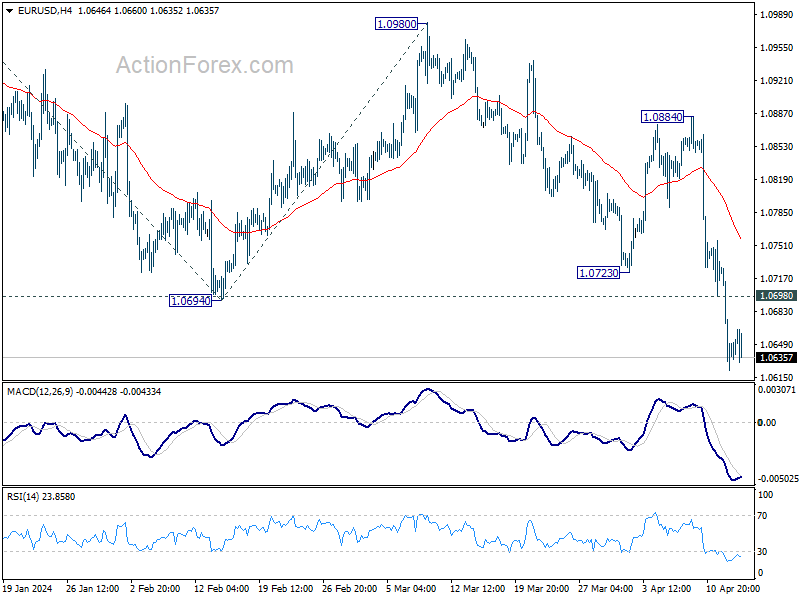
No change in EUR/USD's outlook and intraday bias stays on the downside. Current fall is part of the decline from 1.1138. Next target is 100% projection of 1.1138 to 1.0694 from 1.0980 at 1.0536 next. On the upside, above 1.0723 support turned resistance will turn intraday bias neutral and bring consolidations first, before staging another fall.
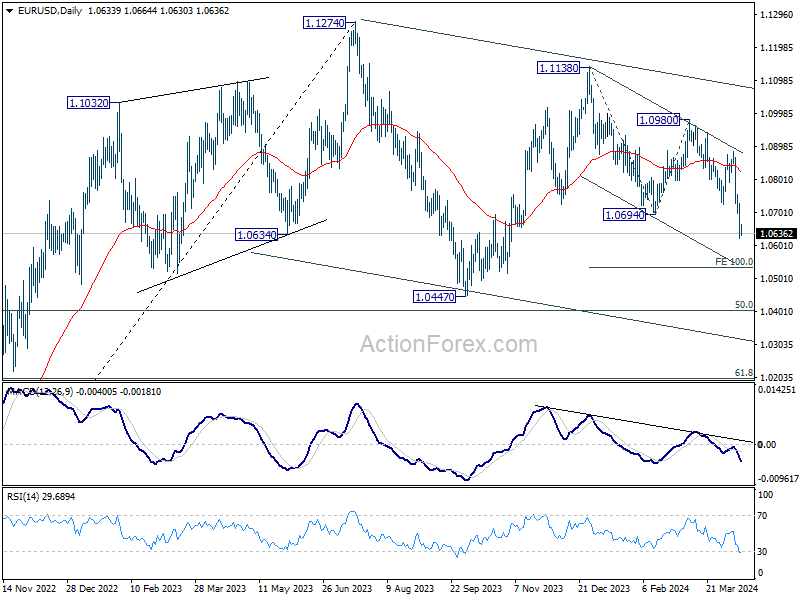
In the bigger picture, price actions from 1.1274 are viewed as a corrective pattern to rise from 0.9534 (2022 low). Current fall from 1.1138 is seen as the third leg. While deeper decline is would be seen to 1.0447 and possibly below. Strong support should emerge from 61.8% retracement of 0.9534 to 1.1274 at 1.0199 to complete the correction.
USD/CHF Mid-Day Outlook
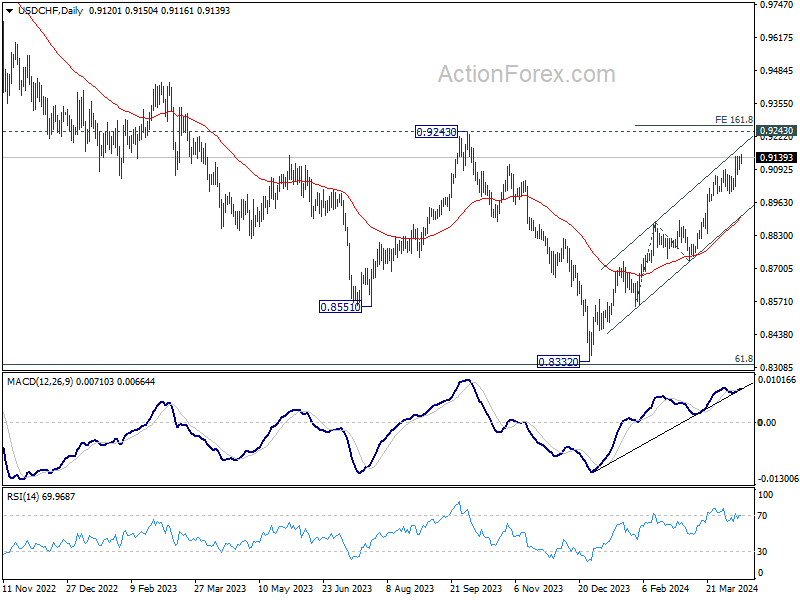
Daily Pivots: (S1) 0.9105; (P) 0.9126; (R1) 0.9164; More....
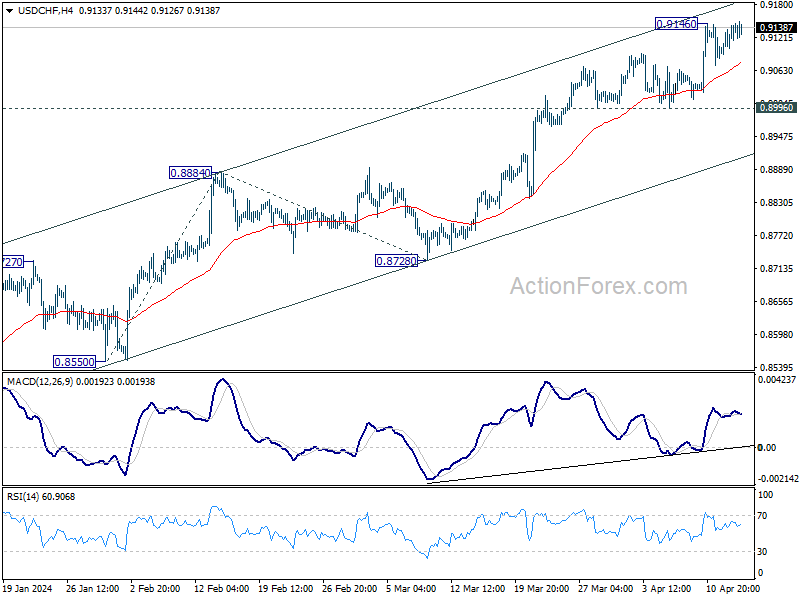
Intraday bias in USD/CHF stays neutral first. Consolidation from 0.9146 might still extend further. But further rally is expected as long as 0.8996 support holds. Firm break of 0.9146 will target 161.8% projection of 0.8550 to 0.8884 from 0.8728 at 0.9268.
In the bigger picture, price actions from 0.8332 medium term bottom as tentatively seen as developing into a corrective pattern to the down trend from 1.0146 (2022 high). Further rise would be seen as long as 0.8728 support holds. But upside should be limited by 0.9243 resistance, at least on first attempt. However, decisive break of 0.9243 will argue that the trend has already reversed and turn medium term outlook bullish.
USD/JPY Mid-Day Outlook
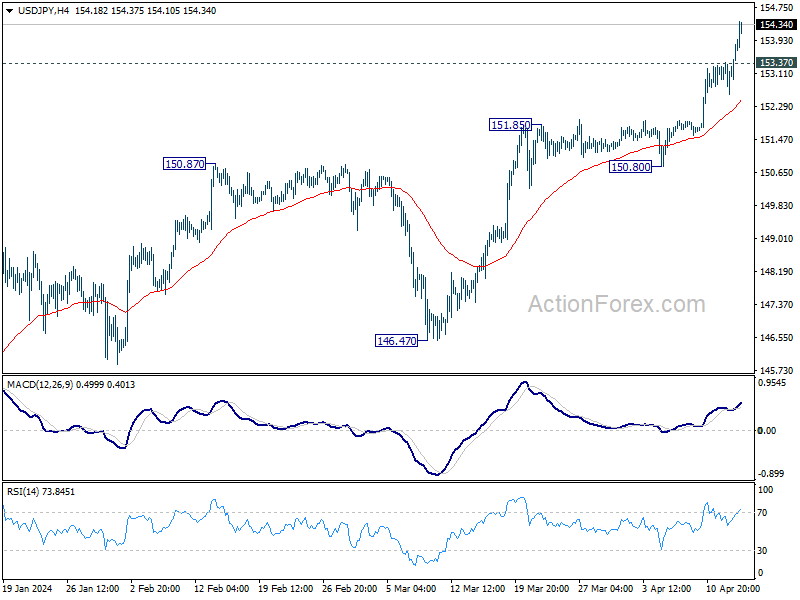
Daily Pivots: (S1) 152.78; (P) 153.08; (R1) 153.58; More...
Intraday bias in USD/JPY remains on the upside at this point. Current up trend is in progress for 155.20 fibonacci projection level next. On the downside, below 153.37 minor support will turn intraday bias neutral and bring consolidations again, before staging another rally.
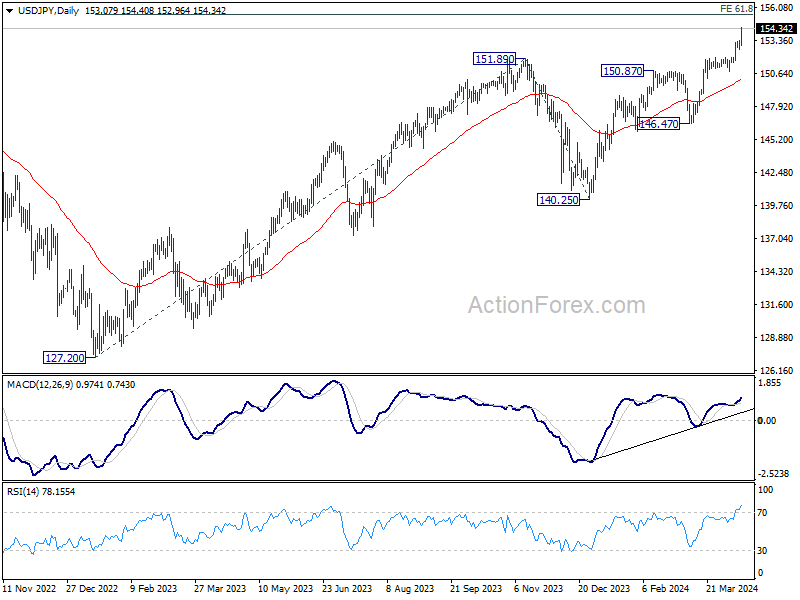
In the bigger picture, current rise from 140.25 is seen as the third leg of the up trend from 127.20 (2023 low). Next target is 61.8% projection of 127.20 to 151.89 from 140.25 at 155.20. Outlook will now remain bullish as long as 146.47 support holds, even in case of deep pullback.
U.S. Retail Sales Rebound in February
Retail sales rose by 0.7% month-on-month (m/m) in March, adding to February's upwardly revised 0.9 % gain (previously 0.6%). The increase was higher than the consensus forecast calling for a more modest increase of 0.4%
Trade in the auto sector was down -0.7% m/m, reflecting a decline at motor vehicle dealers (-0.9%), which was only partly offset by an increase in sales at automotive parts and accessory stores (1.9%).
Sales at gasoline stations rose a sizeable by 2.1% m/m, largely reflecting an uptick in gas prices. The building materials and equipment category rose a more modest 0.7% m/m.
Sales in the retail sales "control group", which excludes the above volatile components (autos, building materials and gas) and is used to estimate personal consumption expenditures (PCE), rose significantly on the month (1.1%) after rising by 0.3% m/m in February (revised from 0% previously).
- Among the control group, the largest positive contributions came from non-store retailers (2.7% m/m), miscellaneous store retailers (2.1% m/m) and department stores (1.1% m/m).
- The largest declines were at sporting goods stores (-1.8% m/m) and clothing and accessory stores (-1.6% m/m).
Food services & drinking places – the only services category in the retail sales report – rose by 0.4% m/m.
Key Implications
Once again U.S. consumers showed resilience by boosting retail spending in March and closing out the first quarter on an upswing. With sales picking up in the last two months, it was just sufficient to overcome the steep decline (-0.9%) in January. As such retail spending finished out Q1 with a marginal increase of 0.2% q/q (annualized). This is a sizeable step down from a 2.3% gain in Q4 2023. As the labor market continues to rebalance in 2024 and wage gains cool, spending is expected to follow a similar path.
That said, given the recent string of hotter-than-expected CPI inflation readings, Fed policymakers are unlikely to welcome the continued showing of resilient consumer spending evident in today's report. Worth watching is the strength of spending in the control group as this could show up in higher PCE spending. As FOMC members have noted on numerous occasions, the bar to cut rates depends on signs that inflation is moving sustainably toward two percent. While price movements on the goods side of the economy have been relatively tame, continued strong retail spending could upend that. As it stands, our call is currently for a July cut, but continued inflation persistence poses a risk to this view.
GBP/USD Mid-Day Outlook
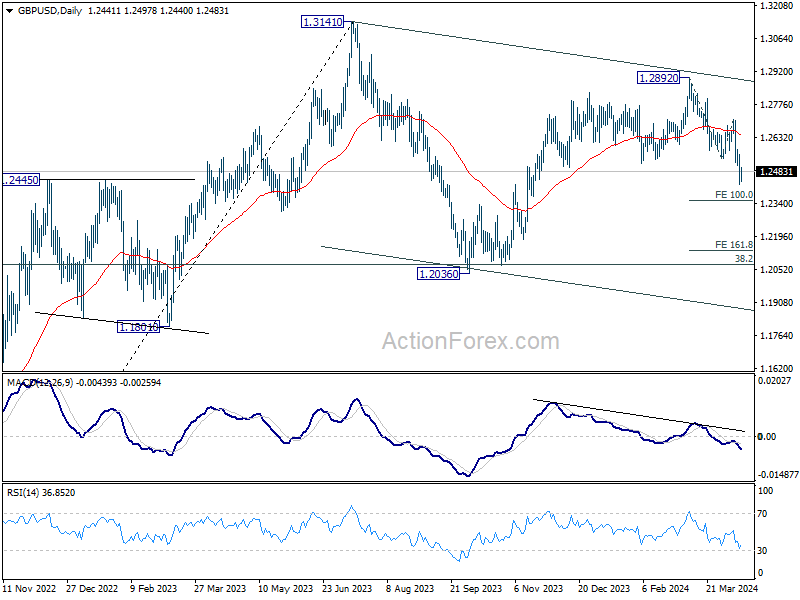
Daily Pivots: (S1) 1.2396; (P) 1.2481; (R1) 1.2535; More...
Intraday bias in GBP/USD is turned neutral with 4H MACD crossed above signal line. Some consolidations would be seen first, but recovery should be limited by 1.2577 minor resistance to bring another fall. On the downside, break of 1.2425 will resume the decline from 1.2892 to 100% projection of 1.2892 to 1.2538 from 1.2708 at 1.2354. Firm break there will target 161.8% projection at 1.2207 next.
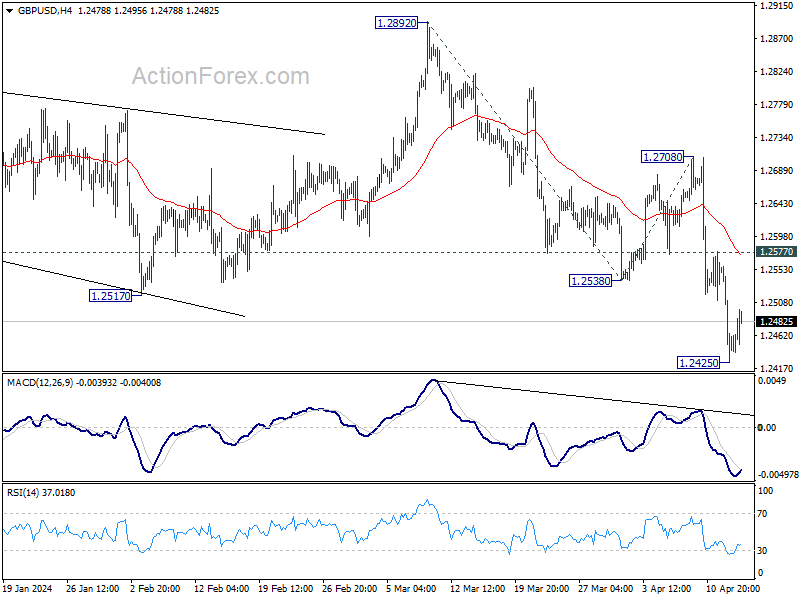
In the bigger picture, price actions from 1.3141 medium term top are seen as a corrective pattern to up trend from 1.0351 (2022 low). Fall from 1.2892 is seen as the third leg. Deeper decline would be seen to 1.2036 support and possibly below. But strong support should emerge from 61.8% retracement of 1.0351 to 1.2452 at 1.1417 to complete the correction.
Strong Retail Sales Spur Brief Dollar Bounce; More Consolidations First?
Dollar bounces slightly in early US trading following unexpectedly strong retail sales data. However, there is no clear follow through buying in the greenback for now. The only exception is USD/JPY which continues to make new 34-year highs. Against others, Dollar might extend its consolidation phase for a while longer, as the impact from rising treasury yields is offset by rebound in risk sentiment.
Despite improvements in Eurozone industrial production, Euro remains under pressure. ECB officials have presented a divided front, reflecting varying degrees of enthusiasm for ongoing monetary policy easing. While there is a general consensus on a prospective rate cut in June, the council is split on the path forward. Doves like ECB member Gediminas Simkus has voiced support for additional easing post-June. However, other members have adopted a more cautious approach, reluctant to commit to further actions beyond the initial rate cut.
In broader currency market movements, New Zealand Dollar trails Yen as the second weakest currency, adversely affected by disappointing service sector data. Conversely, Canadian Dollar leads as the strongest, with Australian Dollar and Sterling also showing robust performance. US Dollar holds a middle position awaiting range breakout.
In Europe, at the time of writing, FTSE is up 0.04%. DAX is up 1.32%. CAC is up 1.24%. UK 10-year yield is up 0.070 at 4.211. Germany 10-year yield is up 0.0654 at 2.424. Earlier in Asia, Nikkei fell -0.79%. Hong Kong HSI fell -0.72%. China Shanghai SSE rose 1.26%. Singapore Strait Times fell -1.09%. Japan 10-year JGB yield fell -0.0005 to 0.866.
US retail sales rises 0.7% mom in Jun, ex-auto sales up 1.1% mom
US retail sales rose 0.7% mom to 709.6B in June, above expectation of 0.4% mom. Ex-auto sales rose 1.1% mom to USD 575.5B, above expectation of 0.5% mom. Ex-gasoline sales rose 0.6% mom to USD 655.0B. Ex-auto and gasoline sales rose 1.0% mom. to USD 520.9B.
Total sales for the January through March period were up 2.1% from the same period a year ago.
ECB's Lane: Disinflation process necessarily bumpy at current phase
ECB Chief Economist Philip Lane described disinflation process as "necessarily bumpy" at the current phase. In a speech, he pointed out that headline inflation is expected to "fluctuate around current levels in the near term," influenced by base effects in energy sector and recent reversal of service inflation spikes caused by the early timing of Easter.
Meanwhile, Lane noting that while wage pressures are "gradually moderating," they remain above what would be considered normal or steady-state levels. He emphasized that achieving ECB's inflation target involves not just controlling wage growth but also managing profit margins across the economy.
Looking ahead to June Governing Council meeting, Lane indicated that ECB's decisions would be informed by "updated staff projections" and comprehensive data on wage and profit dynamics from the early months of the year. He suggested that if these updated assessments and data provide stronger confidence that inflation is converging to ECB's targets, it could be "appropriate to reduce the current level of monetary policy restriction."
ECB's Kazimir cautions on post-June monetary policy, stresses flexibility
ECB Governing Council member Peter Kazimir highlighted emphasized the importance of maintaining a flexible monetary policy stance beyond an initial rate reduction possibly in June. He underscored that the decision to lower rates in June should be viewed as a recalibration in response to improving economic conditions, rather than a firm commitment to continued easing.
"June is an opportunity to recalibrate our approach in light of improving economic conditions. Let's be clear: We are not pre-committing to a definite path post-June," Kazimir stated.
He elaborated, "Even after the first rate cut, our monetary policy will remain restrictive; it needs to."
Kazimir also addressed the broader implications of easing monetary policy, clarifying that "The notion of easing doesn't imply a commitment to specific future cuts but rather an openness to respond in kind, should the economic data advocate for it."
Moreover, Kazimir cautioned about the vulnerability of the economy to unexpected shocks, emphasizing the necessity for ECB to maintain its agility in policymaking.
ECB's Simkus anticipates three rate cuts this year, possibly four
ECB Governing Council member Gediminas Simkus forecasted three 25bps rate cuts for this year, with a potential for a fourth. "I see a higher than 50% chance there will be more than three cuts this year," he told reporters.
Simkus also highlighted that the ECB might not stop at just one rate cut in June, stating, "I see a higher than zero chance that an interest rate cut may follow also in July. The July decision will be important in setting the trajectory."
Regarding the pace and magnitude of these rate cuts, Simkus emphasized a cautious approach. He remarked that there is "no urgency to cut rates" by more than 25bps at a time, indicating he preference for gradual adjustments rather than larger, more aggressive cuts.
Eurozone industrial production rises 0.8% mom in Feb, EU up 0.7% mom
Eurozone industrial production rose 0.8% mom in February, matched expectations. Production increased by 0.5% for intermediate goods, 1.2% for capital goods, and 1.4% for durable consumer goods. On the other hand, production by -3.0% for energy, and -0.9% for non-durable consumer goods.
EU industrial production rose 0.7% mom. The highest monthly increases were recorded in Ireland (+3.8%), Hungary (+3.5%) and Slovenia (+3.3%). The largest decreases were observed in Croatia (-4.6%), Lithuania (-3.0%) and Belgium (-2.7%).
NZ BNZ services plummets to 47.5, signaling over 2% GDP contraction
New Zealand's service sector saw a significant downturn in March, as evidenced by BusinessNZ Performance of Services Index, which fell sharply from 52.6 to 47.5. This decline places the index back in contraction territory, and well below its long-term average of 53.4.
The components of the PSI painted a concerning picture: activity and sales saw a steep decline from 52.4 to 44.8. While employment showed a slight improvement, rising marginally from 49.4 to 50.1, new orders and business fell significantly from 55.5 to 48.3. Stocks and inventories also dropped from 52.2 to 46.9, and supplier deliveries was stagnant at 48.7.
Business sentiment mirrored these negative trends, with proportion of negative comments rising sharply to 63.0% in March, up from 57.3% in February and 53.0% in January. Respondents frequently cited ongoing recession and persistent inflationary pressures, including rising costs of living, as key factors impacting their operations.
BNZ Senior Economist Doug Steel stated, "Combining today's weak PSI activity with last week's similarly weak PMI activity, yields a composite reading that would be consistent with GDP falling by more than 2% compared to year-earlier levels. That is much weaker than what folk are forecasting."
GBP/USD Mid-Day Outlook
Daily Pivots: (S1) 1.2396; (P) 1.2481; (R1) 1.2535; More...
Intraday bias in GBP/USD is turned neutral with 4H MACD crossed above signal line. Some consolidations would be seen first, but recovery should be limited by 1.2577 minor resistance to bring another fall. On the downside, break of 1.2425 will resume the decline from 1.2892 to 100% projection of 1.2892 to 1.2538 from 1.2708 at 1.2354. Firm break there will target 161.8% projection at 1.2207 next.
In the bigger picture, price actions from 1.3141 medium term top are seen as a corrective pattern to up trend from 1.0351 (2022 low). Fall from 1.2892 is seen as the third leg. Deeper decline would be seen to 1.2036 support and possibly below. But strong support should emerge from 61.8% retracement of 1.0351 to 1.2452 at 1.1417 to complete the correction.
Economic Indicators Update
| GMT | Ccy | Events | Actual | Forecast | Previous | Revised |
|---|---|---|---|---|---|---|
| 22:30 | NZD | Business NZ PSI Mar | 47.5 | 53 | 52.6 | |
| 23:50 | JPY | Machinery Orders M/M Feb | 7.70% | 0.80% | -1.70% | |
| 06:30 | CHF | Producer and Import Prices M/M Mar | 0.10% | 0.20% | 0.10% | |
| 06:30 | CHF | Producer and Import Prices Y/Y Mar | -2.10% | -2.00% | ||
| 09:00 | EUR | Eurozone Industrial Production M/M Feb | 0.80% | 0.80% | -3.20% | |
| 12:30 | CAD | Manufacturing Sales M/M Feb | 0.70% | 0.70% | 0.20% | |
| 12:30 | CAD | Wholesale Sales M/M Feb | 0.00% | 0.80% | 0.10% | |
| 12:30 | USD | Empire State Manufacturing Index Apr | -14.3 | -9 | -20.9 | |
| 12:30 | USD | Retail Sales M/M Mar | 0.70% | 0.40% | 0.60% | |
| 12:30 | USD | Retail Sales ex Autos M/M Mar | 1.10% | 0.50% | 0.30% | |
| 14:00 | USD | Business Inventories Feb | 0.30% | 0.00% | ||
| 14:00 | USD | NAHB Housing Market Index Apr | 52 | 51 |
ECB’s Lane: Disinflation process necessarily bumpy at current phase
ECB Chief Economist Philip Lane described disinflation process as "necessarily bumpy" at the current phase. In a speech, he pointed out that headline inflation is expected to "fluctuate around current levels in the near term," influenced by base effects in energy sector and recent reversal of service inflation spikes caused by the early timing of Easter.
Meanwhile, Lane noting that while wage pressures are "gradually moderating," they remain above what would be considered normal or steady-state levels. He emphasized that achieving ECB's inflation target involves not just controlling wage growth but also managing profit margins across the economy.
Looking ahead to June Governing Council meeting, Lane indicated that ECB's decisions would be informed by "updated staff projections" and comprehensive data on wage and profit dynamics from the early months of the year. He suggested that if these updated assessments and data provide stronger confidence that inflation is converging to ECB's targets, it could be "appropriate to reduce the current level of monetary policy restriction."
US retail sales rises 0.7% mom in Jun, ex-auto sales up 1.1% mom
US retail sales rose 0.7% mom to 709.6B in June, above expectation of 0.4% mom. Ex-auto sales rose 1.1% mom to USD 575.5B, above expectation of 0.5% mom. Ex-gasoline sales rose 0.6% mom to USD 655.0B. Ex-auto and gasoline sales rose 1.0% mom. to USD 520.9B.
Total sales for the January through March period were up 2.1% from the same period a year ago.