

Sample Category Title
Sunset Market Commentary
Markets
The ECB kept its policy rates unchanged. A few members were already inclined to lower rates, but they eventually rallied behind the consensus. In it policy statement, the central bank altered its forward guidance preparing for a likely policy rate cut in June. “If the Governing’s Council’s updated assessment of the inflation outlook, the dynamics of underlying inflation and the strength of monetary policy transmission were to further increase its confidence that inflation is converging to the target in a sustained manner, it would be appropriate to reduce the current level of monetary policy restriction.” The central bank continues to follow a data-dependent – not Fed-dependent – and meeting-by-meeting approach to determine the appropriate level and duration of restriction. Lagarde refrained to committing to a specific policy rate path (beyond the June rate cut). EMU economic growth was weak in Q1 and risks to the economic outlook remain tilted to the downside. Tightness in the labour market is continuing to decline as witnessed by fewer job vacancies rather than high unemployment. Inflation is expected to fluctuate around current levels in the coming months and to then decline to target by mid next year, owing to weaker growth in labour costs, the unfolding effects of the restrictive monetary policy, and the fading impact of the energy crisis and the pandemic. Upside inflation risks come from higher energy and freight costs (geopolitics), wage dynamics and resilient profit margins. During the Q&A session, ECB Lagarde did what she does best: rereading parts of the monetary policy statement. She shied away from giving markets more color to the official declaration and managed to bore everyone out. In that respect, she managed to limit any market reactions/volatility so well done. Changes on the German yield curve currently range between flat (2-yr) and +2.1 bps (2-yr). The underperformance at the (very) long end of the curve suggests that markets remain vulnerable to a sell-off should the ECB overdo it on taking away policy restriction when the target hasn’t been reached yet. EUR/USD is a tad higher at 1.0750 with Lagarde also fending off questions on (the impact of) a weak currency should Fed and ECB monetary policy diverge.
US eco data again showed extremely low jobless claims (211k from 222k) while March producer prices rose by 0.2% M/M both for the headline and core measure). Both were in line with consensus. Tonight’s 30-yr Bond sale by the US Treasury is key. Weakness like in yesterday’s 10-yr auction suggests that the US Treasury sell-off can continue.
News & Views
Hungarian inflation unexpectedly accelerated from 0.7% m/m to 0.8% in March, leading to a smaller-than-anticipated moderation in y/y terms from 3.7% to 3.6%. A sharp drop in core inflation to 4.4% was mainly driven by favourable unprocessed food price base effects while other central bank core gauges remained at elevated levels well above 6%. Sticky services inflation (0.7% m/m) doesn’t bode well for future (core) CPI readings and neither do rising fuel prices which could rise another 2% m/m in April after adding 2.1% in March. KBC Economics forecasts inflation to pick up again in coming months towards an end-of-year target of around 5.5%. Combined with uncertainty related to ECB and Fed policy as well as domestic consumption picking up in 2024H2 this is expected to translate in a more cautious approach to monetary policy. Rate cuts could be downsized from 75 bps to 50 bps from April through June with a mere 50 bps of additional easing seen in the second half of this year (from 8.25% to 6.25%). The Hungarian forint marginally appreciated with EUR/HUF hovering near recent lows of 390. Hungarian swap yields skyrocket more than 20 bps. This move higher is shared by other CE countries though.
The OPEC in its monthly report stuck to the bullish demand forecasts made in the previous edition. The oil cartel continues to expect oil demand growing by 2.2mn barrels a day this year and by 1.8mn in 2025. "The robust oil demand outlook for the summer months warrants careful market monitoring, amid ongoing uncertainties, to ensure a sound and sustainable market balance," OPEC said in the report, adding that there is a chance the world economy could do better than expected this year. Despite sounding optimistic on demand, OPEC recently confirmed the current 2.2mn b/d output curbs to remain in place at least through June. That, amongst others, has pushed oil prices significantly lower over the recent months. Brent oil is currently hovering north of the $90/b.
USD/JPY Mid-Day Outlook
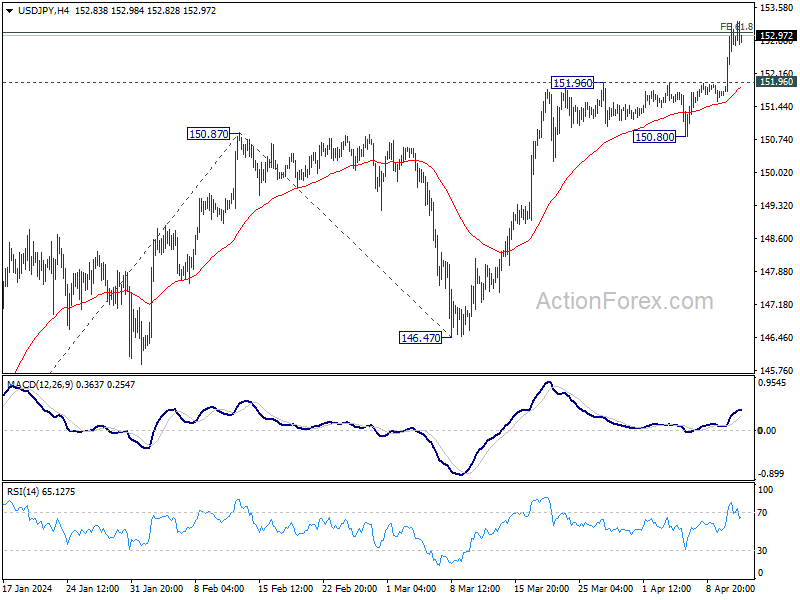
Daily Pivots: (S1) 152.09; (P) 152.66; (R1) 153.73; More...
No change in USD/JPY's outlook and intraday bias remains on the upside. Sustained break of 61.8% projection of 140.25 to 150.87 from 146.47 at 153.03 will target 155.20 projection level next. On the downside, below 151.95 support will turn intraday bias neutral again. But outlook will stay bullish as long as 150.80 support holds.
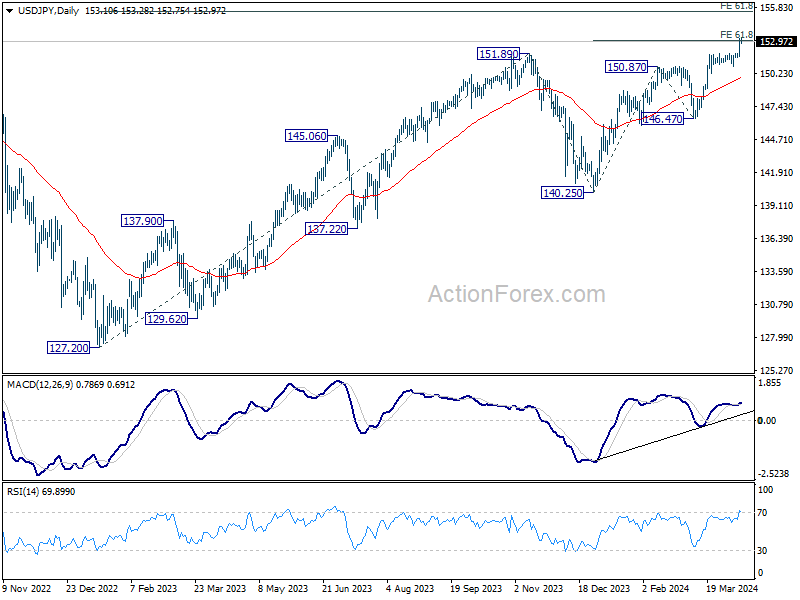
In the bigger picture, correction from 151.87 (2023) high could have completed at 140.25 already. Rise from 127.20 (2023 low), as part of the long term up trend, is probably ready to resume. Decisive break of 151.93 resistance (2022 high) will confirm this bullish case. Next medium term target will be 61.8% projection of 127.20 to 151.89 from 140.25 at 155.20. This will remain the favored case as long as 146.47 support holds, in case of another pullback.
USD/CHF Mid-Day Outlook
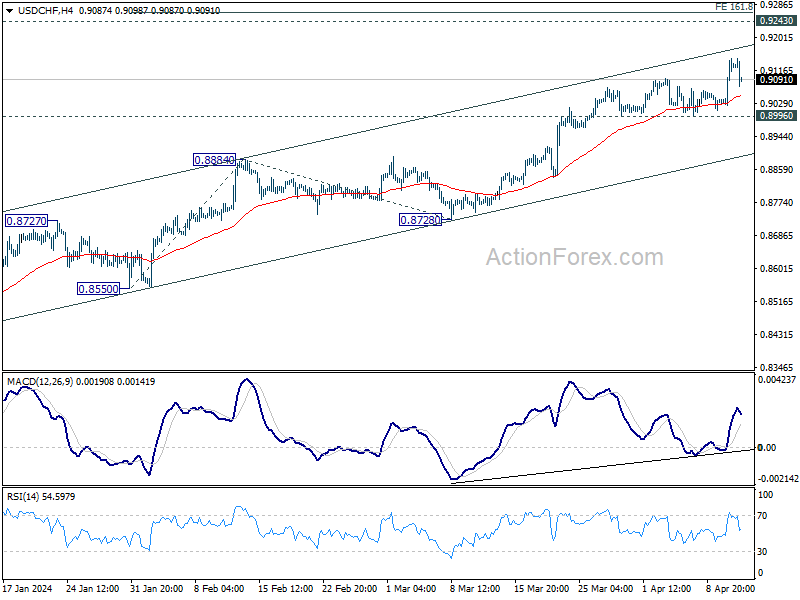
Daily Pivots: (S1) 0.9051; (P) 0.9100; (R1) 0.9177; More....
As long as 0.8996 support holds, further rally is expected in USD/CHF. Current rise is part of the whole rally from 0.8332. Next target is 161.8% projection of 0.8550 to 0.8884 from 0.8728 at 0.8818. However, break of 0.8996 will indicate short term topping, and turn bias back to the downside for deeper pullback.
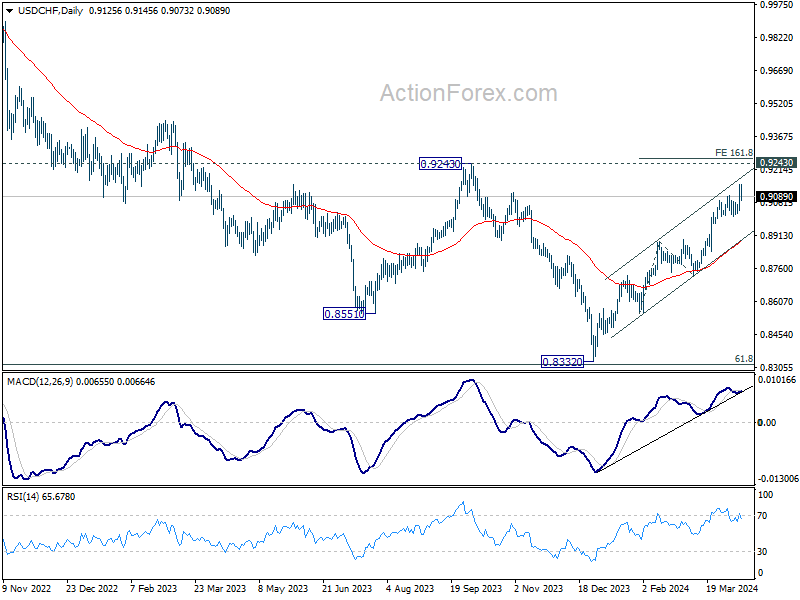
In the bigger picture, price actions from 0.8332 medium term bottom as tentatively seen as developing into a corrective pattern to the down trend from 1.0146 (2022 high). Further rise would be seen as long as 0.8728 support holds. But upside should be limited by 0.9243 resistance, at least on first attempt.
GBP/USD Mid-Day Outlook
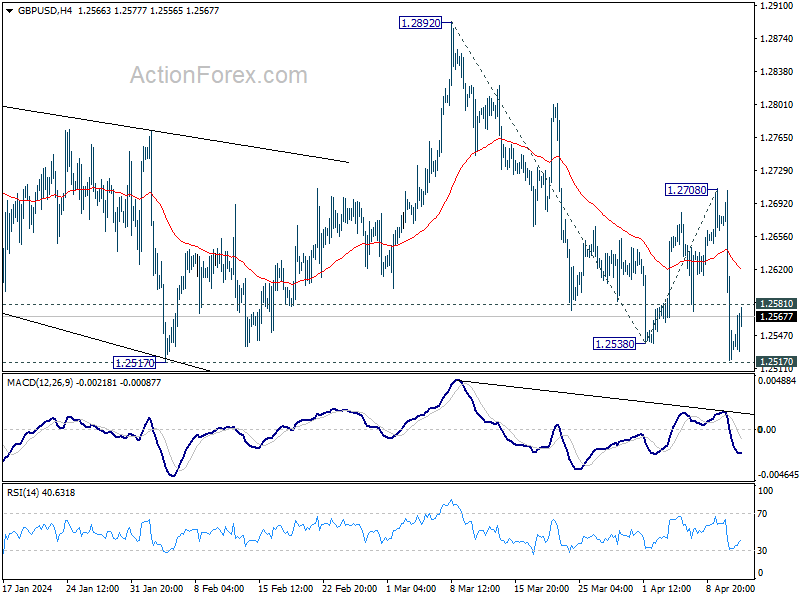
Daily Pivots: (S1) 1.2471; (P) 1.2589; (R1) 1.2659; More...
No change in GBP/USD's outlook and intraday bias stays on the downside. Decisive break of 1.2517 support will carry larger bearish implication. Next near term target will be 61.8% projection of 1.2892 to 1.2538 from 1.2708 at 1.2489. Firm break there could trigger downside acceleration to 100% projection at 1.2354. On the upside, above 1.2581 minor resistance will turn intraday bias neutral first. But risk will stay on the downside as long as 1.2708 resistance holds, in case of recovery.
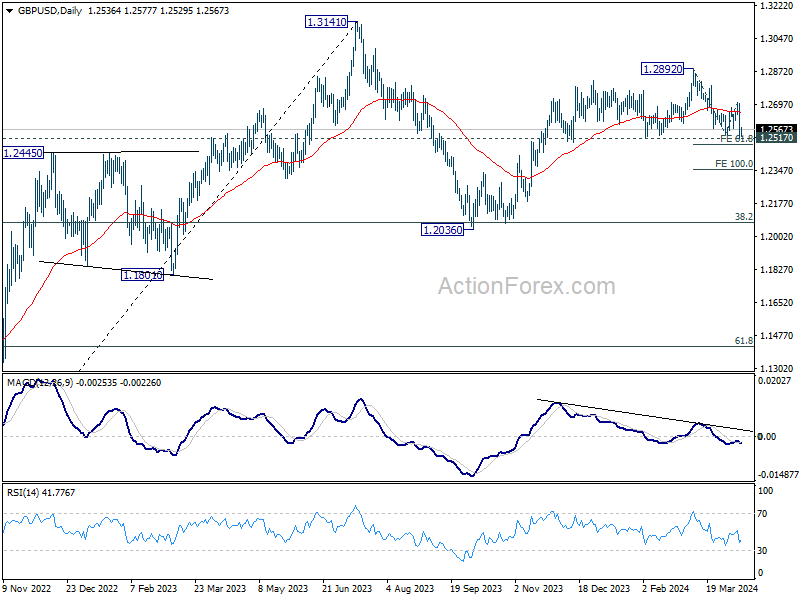
In the bigger picture, price actions from 1.3141 medium term top are seen as a corrective pattern to up trend from 1.0351 (2022 low). Rise from 1.2036 is seen as the second leg, which might still be in progress. But upside should be limited by 1.3141 to bring the third leg of the pattern. Meanwhile, firm break of 1.2517 support will argue that the third leg has already started for 38.2% retracement of 1.0351 (2022 low) to 1.3141 at 1.2075 again.
EUR/USD Mid-Day Outlook
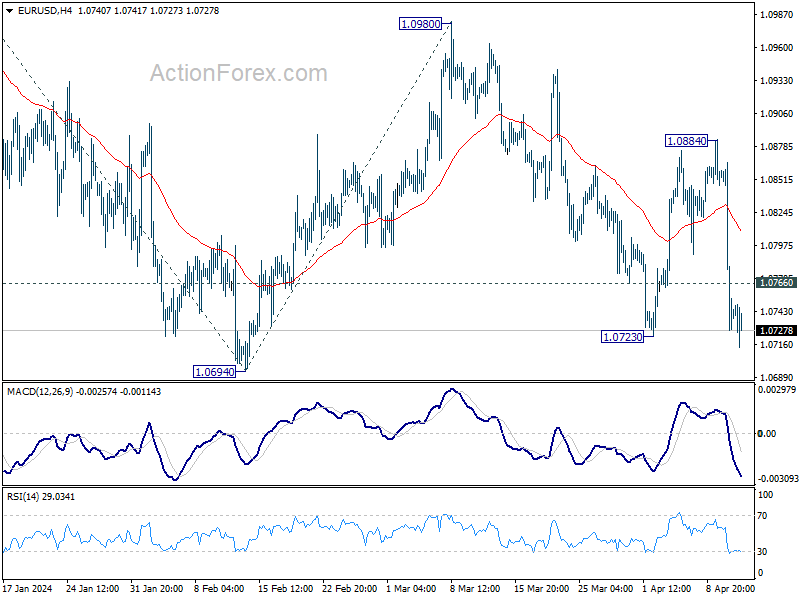
Daily Pivots: (S1) 1.0692; (P) 1.0779; (R1) 1.0830; More...
Intraday bias in EUR/USD remains on the downside at this point. Decisive break of 1.0694/0723 support zone will resume whole fall from 1.1138. Next target is 100% projection of 1.1138 to 1.0694 from 1.0980 at 1.0536. On the upside, above 1.0766 minor resistance will turn intraday bias neutral first. But risk will stay on the downside as long as 1.0884 resistance holds, in case of recovery.
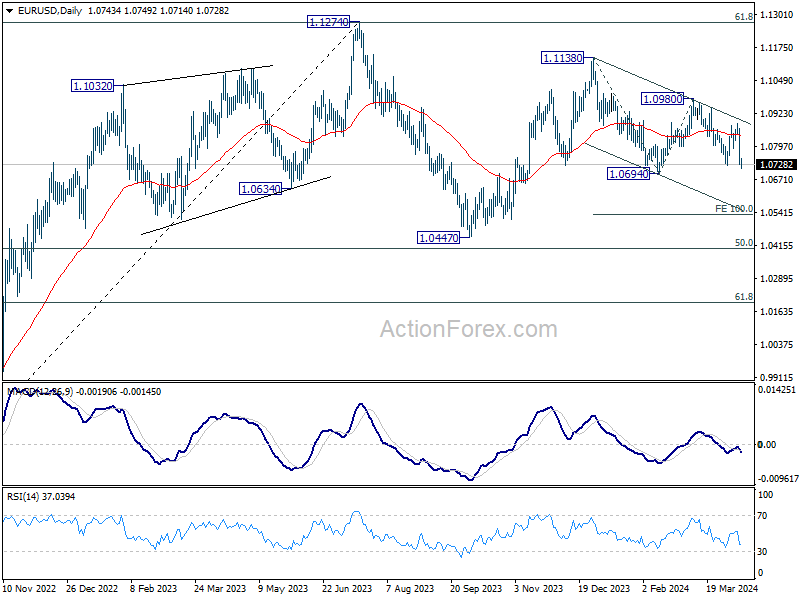
In the bigger picture, price actions from 1.1274 are viewed as a corrective pattern to rise from 0.9534 (2022 low). Rise from 1.0447 is seen as the second leg. While further rally could cannot be ruled out, upside should be limited by 1.1274 to bring the third leg of the pattern. Meanwhile, sustained break of 1.0694 support will argue that the third leg has already started for 1.0447 and possibly below.
Euro Declines After ECB Opens Door for Rate Cuts, Dollar Eases Following PPI Data
Euro weakens broadly following ECB's decision to maintain interest rates unchanged, coupled with explicit suggestions of a potential rate cut ahead. However, selloff has been relatively mild, primarily because ECB's statement didn't serve as a definitive pre-announcement of rate cuts, unlike its 2022 guidance on rate hike. Moreover, the conditional guidance regarding future rate adjustments had been largely anticipated, given previous communications from ECB officials. Still, risk is now mildly on the downside for the common currency, especially in crosses.
Concurrently, Dollar is also paring some of its post CPI strong gain, after PPI data came in lower than market expected. While the PPI report might not significantly hasten a Fed rate cut in June, it at least doesn't push it further in time. Meanwhile, the greenback's pullback remains slight. Renewed selloff in US stocks could trigger further gains for Dollar.
So far this week, Dollar remains the strongest currency, followed by New Zealand Dollar and Canadian Dollar. Euro lags as the weakest, trailed by Japanese Yen and Swiss Franc, with Australian Dollar and British Pound positioned in the middle of the pack.
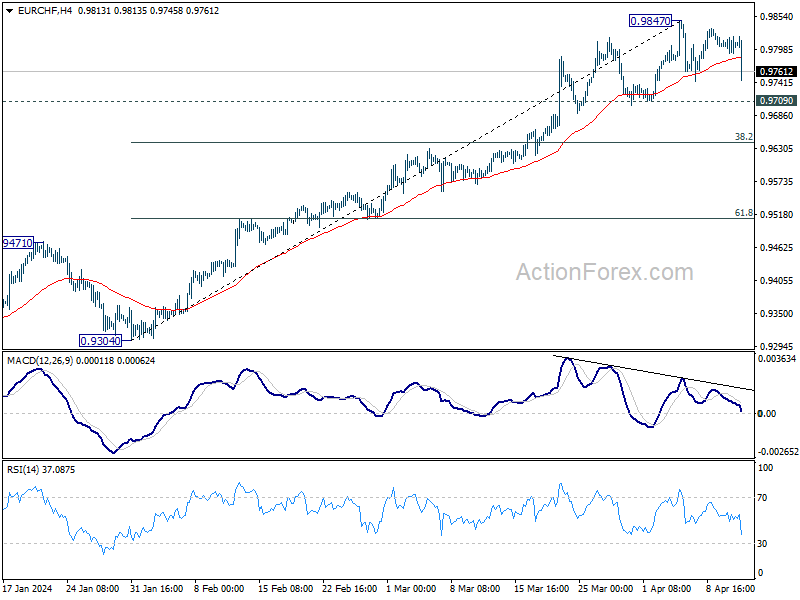
Technically, while EUR/CHF dips notably after ECB, it's staying well inside familiar range below 0.9847. Near term outlook stays bullish for now, and upside breakout through 0.9847 is expected next. However, firm break of 0.9709 will argue that at least correcting the rise from 0.9304, and target 38.2% retracement of 0.9304 to 0.9847 at 0.9640.
In Europe, at the time of writing, FTSE is down -0.14%. DAX is down -0.37%. CAC is flat. UK 10-year yield is up 0.021 at 4.175. Germany 10-year yield is down -0.0008 at 2.427. Earlier in Asia, Nikkei fell -0.35%. Hong Kong HSI fell -0.26%. China Shanghai SSE rose 0.23%. Singapore Strait Times fell -0.31%. Japan 10-year JGB yield surged 0.0586 to 0.857.
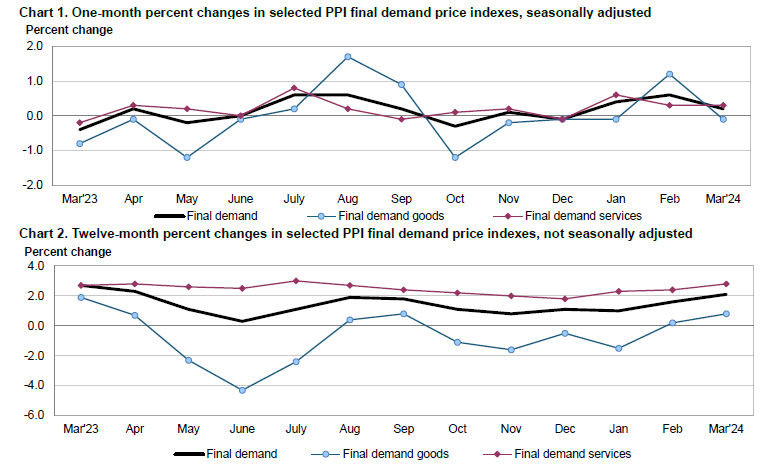
US PPI at 0.2% mom, 2.1% yoy in Mar, below expectations
US PPI for final demand rose 0.2% mom in March, below expectation of 0.3% mom. PPI final demand services rose 0.3% mom while final demand goods fell -0.1% mom.
For the 12-month period, PPI jumped from 1.6% yoy to 2.1% yoy, below expectation of 2.3% yoy. But that was still the highest reading since April 2023.
PPI for final demand less goods, energy, and trade services rose 0.2% mom. For the 12-month period, PPI for final demand less foods, energy and trade services rose 2.8% yoy.
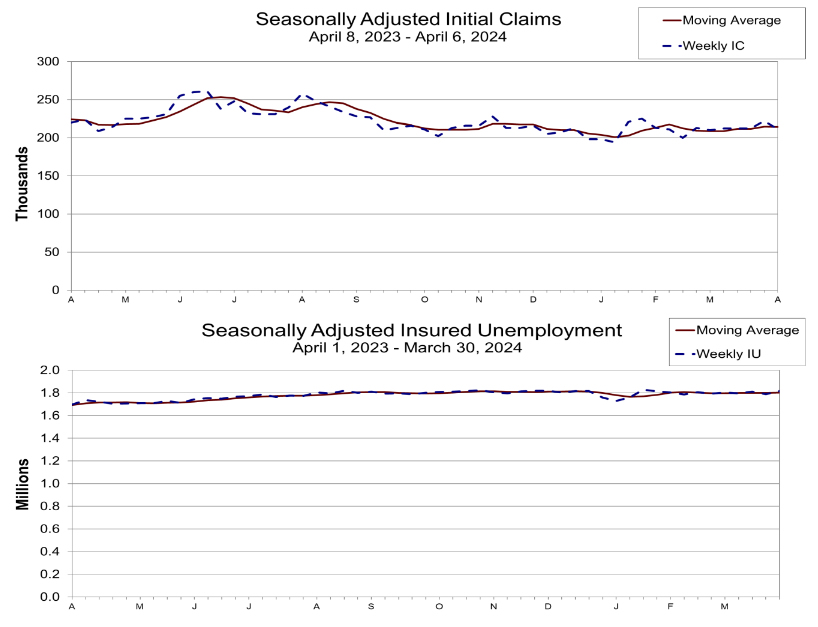
US initial jobless claims falls to 211k
US initial jobless claims fell -11k to 211k in the week ending April 6, below expectation of 215k. Four week moving average of initial claims fell -250 to 214k.
Continuing claims rose 28k to 1817k in the week ending March 30. Four-week moving average of continuing claims rose 3.5k to 1803k.
ECB explicitly opens door to rate cuts
ECB maintained its interest rates as widely expected, holding main refinancing rate and deposit rate at 4.50% and 4.00%. Most importantly, for the first time, the central bank explicitly indicated the possibility for future interest rate cuts, which would be seen as a conditional guidance for a June adjustment.
"If the Governing Council's updated assessment of the inflation outlook, the dynamics of underlying inflation and the strength of monetary policy transmission were to further increase its confidence that inflation is converging to the target in a sustained manner, it would be appropriate to reduce the current level of monetary policy restriction," ECB said. Nevertheless, the decision will still be data depended, and meeting-by meeting.
Current observations have "broadly confirmed" ECB's medium-term inflation outlook, with continued decline in inflation rates primarily driven by decreases in food and goods price inflation. Most measures of underlying inflation are showing signs of easing, and there is a gradual moderation in wage growth. Additionally, firms seem to be accommodating some of the labor cost increases within their profit margins, which is a positive development for inflationary pressures.
Meanwhile, financing conditions remain restrictive and previous interest rate hikes are still impacting demand, contributing to the downward pressure on inflation. Yet, the persistence of strong domestic price pressures, particularly in the services sector, indicates that services price inflation remains elevated.
BoE's Greene cautions inflation persistence more pronounced in UK than in US.
In an opinion piece in FT, BoE MPC member Megan Greene explicitly urges market participants to "stop comparing" the monetary policies of the UK and US.
Greene's commentary comes in the wake of the US March CPI inflation report released yesterday, which surpassed market expectations that "the Bank of England will cut rates earlier and by more than the Federal Reserve this year".
"The markets are moving rate cut bets in the wrong direction," Greene asserts, emphasizing that, contrary to market speculation, "rate cuts in the UK should still be a way off as well."
Highlighting the unique challenges faced by the UK economy, Greene notes the "double whammy" of a tight labor market coupled with a more substantial impact from energy price shocks, which has made "inflation persistence" a more pressing issue for the UK compared to the US and other advanced economies.
Japan's Suzuki and Kanda: No predetermined Yen levels for currency intervention
Japanese Yen's steep decline through 152 mark against Dollar overnight has put attention on potential currency intervention. However, responses from key officials today suggest a more measured approach is being considered at this point. In particular, Finance Minister Shunichi Suzuki acknowledged the mixed implications of a weakening Yen, with pros and cons. Its looks like Japan is not gearing up for direct intervention at the current level.
Suzuki highlighted the government is looking at the currency markets "with a high sense of urgency". But he also emphasized that Japan is "not just looking at levels" such as 152 or 153, but also the underlying factors driving Yen's depreciation.
Suzuki reiterated the government's preference for currency stability, emphasizing that exchange rates should reflect economic fundamentals rather than short-term volatilities.
Masato Kanda, Japan's top currency diplomat, echoed this sentiment by highlighting the recent pace of Yen's movements as "rapid." While not dismissing interventions, Kanda pointed out the absence of a fixed level that would trigger such actions. "I don't have any particular level in mind," he noted.
China's CPI falls back to 0.1%, PPI negative for 18th month
China's CPI slowed significantly from 0.7% yoy to 0.1% yoy in March, coming in below expectation of 0.4% yoy. Core CPI, which strips out food and energy prices, also decelerated from 1.2% yoy to 0.6% yoy. This shift was largely influenced by a notable -2.7% decrease in food prices, while non-food prices edged up rose 0.7%. Month-on-month, CPI declined -1.0% mom.
NBS attributed this March dip in CPI to a "seasonal decline in consumer demand following the holidays and the overall sufficient market supply."
In parallel, PPI, a measure of factory-gate prices, edged down further to -2.8% yoy from February's -2.7% yoy, aligning with market expectations. This continuation of downward trend for the 18th consecutive month emphasizes persistent deflationary pressures within the manufacturing sector. On a month-on-month basis, PPI contracted by -0.1%.
EUR/USD Mid-Day Outlook
Daily Pivots: (S1) 1.0692; (P) 1.0779; (R1) 1.0830; More...
Intraday bias in EUR/USD remains on the downside at this point. Decisive break of 1.0694/0723 support zone will resume whole fall from 1.1138. Next target is 100% projection of 1.1138 to 1.0694 from 1.0980 at 1.0536. On the upside, above 1.0766 minor resistance will turn intraday bias neutral first. But risk will stay on the downside as long as 1.0884 resistance holds, in case of recovery.
In the bigger picture, price actions from 1.1274 are viewed as a corrective pattern to rise from 0.9534 (2022 low). Rise from 1.0447 is seen as the second leg. While further rally could cannot be ruled out, upside should be limited by 1.1274 to bring the third leg of the pattern. Meanwhile, sustained break of 1.0694 support will argue that the third leg has already started for 1.0447 and possibly below.
Economic Indicators Update
| GMT | Ccy | Events | Actual | Forecast | Previous | Revised |
|---|---|---|---|---|---|---|
| 23:01 | GBP | RICS Housing Price Balance Mar | -4% | -6% | -10% | |
| 23:50 | JPY | Money Supply M2+CD Y/Y Mar | 2.50% | 2.40% | 2.50% | 2.40% |
| 01:00 | AUD | Consumer Inflation Expectations Apr | 4.60% | 4.30% | ||
| 01:30 | CNY | CPI Y/Y Mar | 0.10% | 0.40% | 0.70% | |
| 01:30 | CNY | PPI Y/Y Mar | -2.80% | -2.80% | -2.70% | |
| 08:00 | EUR | Italy Industrial Output M/M Feb | 0.10% | 0.50% | -1.20% | -1.40% |
| 12:15 | EUR | ECB Main Refinancing Operations Rate | 4.50% | 4.50% | 4.50% | |
| 12:15 | EUR | ECB Rate On Deposit Facility | 4.00% | 4.00% | 4.00% | |
| 12:30 | USD | PPI M/M Mar | 0.20% | 0.30% | 0.60% | |
| 12:30 | USD | PPI Y/Y Mar | 2.10% | 2.30% | 1.60% | |
| 12:30 | USD | PPI Core M/M Mar | 0.20% | 0.20% | 0.30% | |
| 12:30 | USD | PPI Core Y/Y Mar | 2.40% | 2.30% | 2.00% | |
| 12:30 | USD | Initial Jobless Claims (Apr 5) | 211K | 215K | 221K | 222K |
| 12:45 | EUR | ECB Press Conference | ||||
| 14:30 | USD | Natural Gas Storage | 14B | -37B |
US PPI at 0.2% mom, 2.1% yoy in Mar, below expectations
US PPI for final demand rose 0.2% mom in March, below expectation of 0.3% mom. PPI final demand services rose 0.3% mom while final demand goods fell -0.1% mom.
For the 12-month period, PPI jumped from 1.6% yoy to 2.1% yoy, below expectation of 2.3% yoy. But that was still the highest reading since April 2023.
PPI for final demand less goods, energy, and trade services rose 0.2% mom. For the 12-month period, PPI for final demand less foods, energy and trade services rose 2.8% yoy.
US initial jobless claims falls to 211k
US initial jobless claims fell -11k to 211k in the week ending April 6, below expectation of 215k. Four week moving average of initial claims fell -250 to 214k.
Continuing claims rose 28k to 1817k in the week ending March 30. Four-week moving average of continuing claims rose 3.5k to 1803k.
ECB explicitly opens door to rate cuts
ECB maintained its interest rates as widely expected, holding main refinancing rate and deposit rate at 4.50% and 4.00%. Most importantly, for the first time, the central bank explicitly indicated the possibility for future interest rate cuts, which would be seen as a conditional guidance for a June adjustment.
"If the Governing Council's updated assessment of the inflation outlook, the dynamics of underlying inflation and the strength of monetary policy transmission were to further increase its confidence that inflation is converging to the target in a sustained manner, it would be appropriate to reduce the current level of monetary policy restriction," ECB said. Nevertheless, the decision will still be data depended, and meeting-by meeting.
Current observations have "broadly confirmed" ECB's medium-term inflation outlook, with continued decline in inflation rates primarily driven by decreases in food and goods price inflation. Most measures of underlying inflation are showing signs of easing, and there is a gradual moderation in wage growth. Additionally, firms seem to be accommodating some of the labor cost increases within their profit margins, which is a positive development for inflationary pressures.
Meanwhile, financing conditions remain restrictive and previous interest rate hikes are still impacting demand, contributing to the downward pressure on inflation. Yet, the persistence of strong domestic price pressures, particularly in the services sector, indicates that services price inflation remains elevated.
(ECB) Monetary policy decisions
The Governing Council today decided to keep the three key ECB interest rates unchanged. The incoming information has broadly confirmed the Governing Council's previous assessment of the medium-term inflation outlook. Inflation has continued to fall, led by lower food and goods price inflation. Most measures of underlying inflation are easing, wage growth is gradually moderating, and firms are absorbing part of the rise in labour costs in their profits. Financing conditions remain restrictive and the past interest rate increases continue to weigh on demand, which is helping to push down inflation. But domestic price pressures are strong and are keeping services price inflation high.
The Governing Council is determined to ensure that inflation returns to its 2% medium-term target in a timely manner. It considers that the key ECB interest rates are at levels that are making a substantial contribution to the ongoing disinflation process. The Governing Council's future decisions will ensure that its policy rates will stay sufficiently restrictive for as long as necessary. If the Governing Council's updated assessment of the inflation outlook, the dynamics of underlying inflation and the strength of monetary policy transmission were to further increase its confidence that inflation is converging to the target in a sustained manner, it would be appropriate to reduce the current level of monetary policy restriction. In any event, the Governing Council will continue to follow a data-dependent and meeting-by-meeting approach to determining the appropriate level and duration of restriction, and it is not pre-committing to a particular rate path.
Key ECB interest rates
The interest rate on the main refinancing operations and the interest rates on the marginal lending facility and the deposit facility will remain unchanged at 4.50%, 4.75% and 4.00% respectively.
Asset purchase programme (APP) and pandemic emergency purchase programme (PEPP)
The APP portfolio is declining at a measured and predictable pace, as the Eurosystem no longer reinvests the principal payments from maturing securities.
The Governing Council intends to continue to reinvest, in full, the principal payments from maturing securities purchased under the PEPP during the first half of 2024. Over the second half of the year, it intends to reduce the PEPP portfolio by €7.5 billion per month on average. The Governing Council intends to discontinue reinvestments under the PEPP at the end of 2024.
The Governing Council will continue applying flexibility in reinvesting redemptions coming due in the PEPP portfolio, with a view to countering risks to the monetary policy transmission mechanism related to the pandemic.
Refinancing operations
As banks are repaying the amounts borrowed under the targeted longer-term refinancing operations, the Governing Council will regularly assess how targeted lending operations and their ongoing repayment are contributing to its monetary policy stance.
***
The Governing Council stands ready to adjust all of its instruments within its mandate to ensure that inflation returns to its 2% target over the medium term and to preserve the smooth functioning of monetary policy transmission. Moreover, the Transmission Protection Instrument is available to counter unwarranted, disorderly market dynamics that pose a serious threat to the transmission of monetary policy across all euro area countries, thus allowing the Governing Council to more effectively deliver on its price stability mandate.
The President of the ECB will comment on the considerations underlying these decisions at a press conference starting at 14:45 CET today.