

Sample Category Title
USD/CHF Daily Outlook
Daily Pivots: (S1) 0.9007; (P) 0.9018; (R1) 0.9029; More....
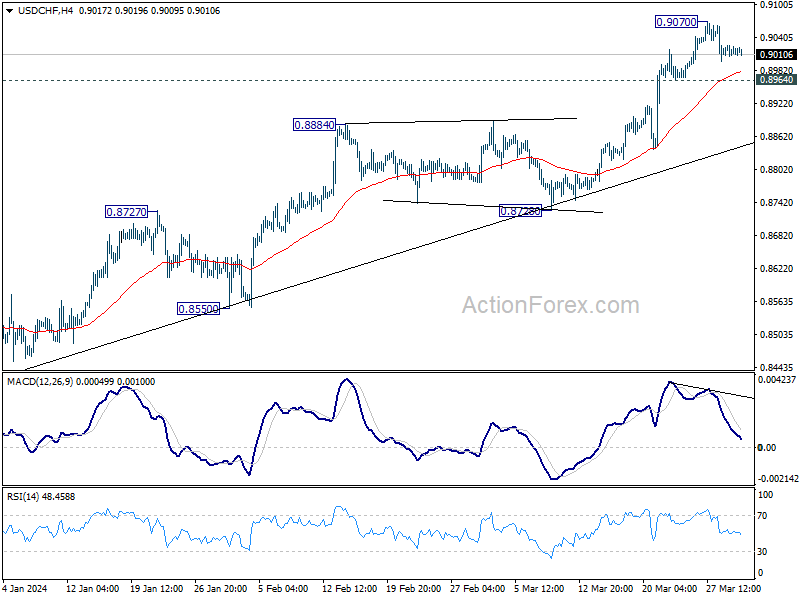
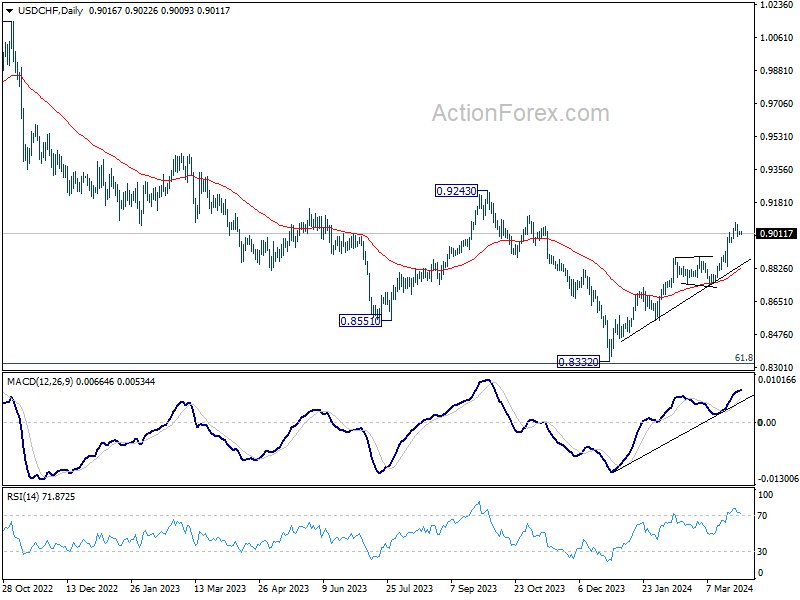
Intraday bias in USD/CHF remains neutral at this point. Some more consolidations could be seen, but further rally is expected as long as 0.8964 support holds. Firm break of 0.9070 will resume larger rise from 0.8332 towards 0.9243 key resistance next.
In the bigger picture, price actions from 0.8332 medium term bottom as tentatively seen as developing into a corrective pattern to the down trend from 1.0146 (2022 high). Further rise would be seen as long as 0.8728 support holds. But upside should be limited by 0.9243 resistance, at least on first attempt.
AUD/USD Daily Report
Daily Pivots: (S1) 0.6502; (P) 0.6517; (R1) 0.6530; More....
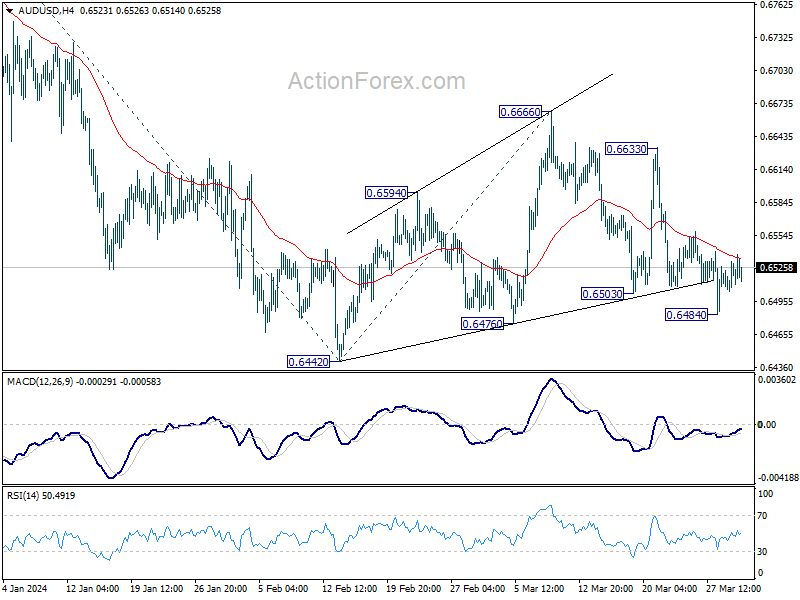
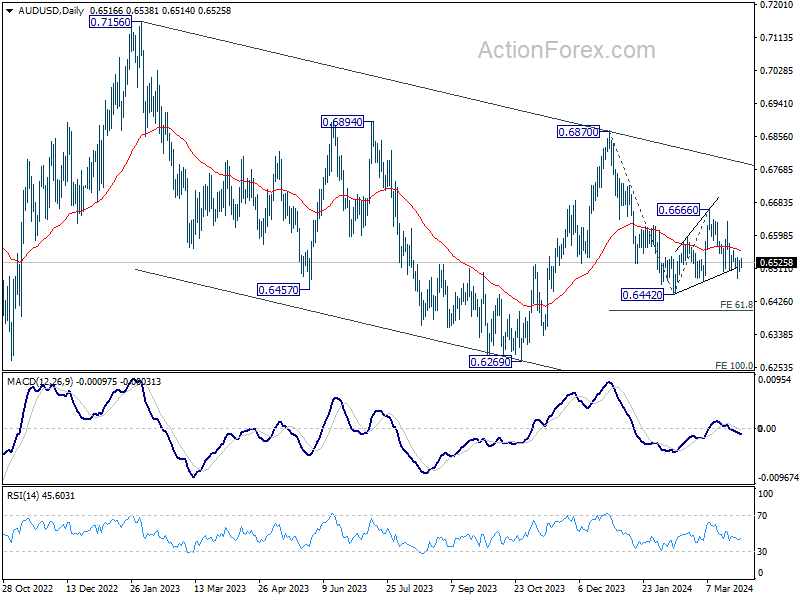
AUD/USD recovered after dipping to 0.6484 and intraday bias is neutral at this point. Risk will remain on the downside as long as 0.6633 resistance holds. Firm break of 0.6484 support will indicate that larger fall from 0.6870 is ready to resume, and turn bias to the downside for 0.6442 low.
In the bigger picture, price actions from 0.6169 (2022 low) are seen as a medium term corrective pattern to the down trend from 0.8006 (2021 high). Fall from 0.7156 (2023 high) is seen as the second leg, which might still be in progress. Overall, sideway trading could continue in range of 0.6169/7156 for some more time. But as long as 0.7156 holds, an eventual downside breakout would be mildly in favor.
USD/CAD Daily Outlook
Daily Pivots: (S1) 1.3528; (P) 1.3545; (R1) 1.3560; More...
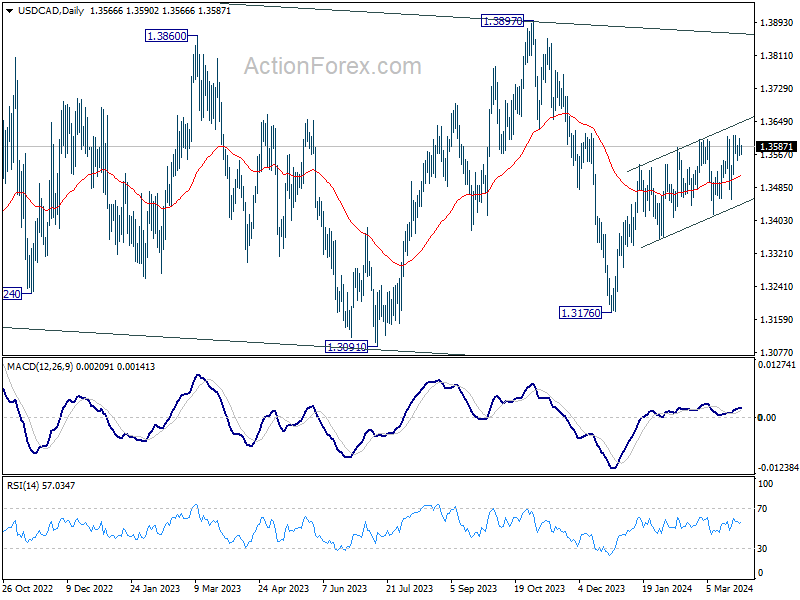
Intraday bias in USD/CAD remains neutral as range trading continues. On the upside, decisive break of 1.3612 resistance will resume whole rise from 1.3176 towards 1.3897 resistance. On the downside, firm break of 1.3419 support will argue that rebound from 1.3176 has completed. Near term outlook will be turned bearish for 1.3357 support first.
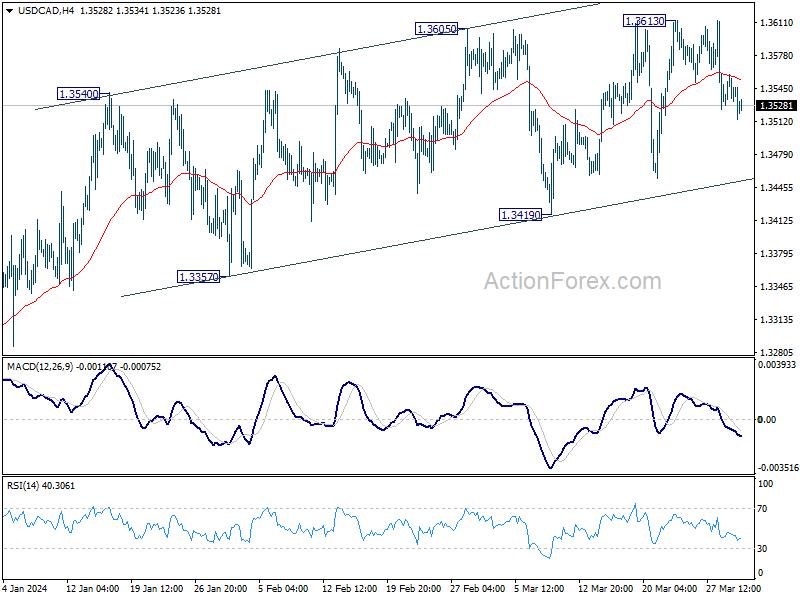
In the bigger picture, price actions from 1.3976 (2022 high) are viewed as a corrective pattern only. In case of another fall, strong support should emerge above 1.2947 resistance turned support to bring rebound. Overall, larger up trend from 1.2005 (2021 low) is still expected to resume through 1.3976 at a later stage.
EUR/CHF Daily Outlook
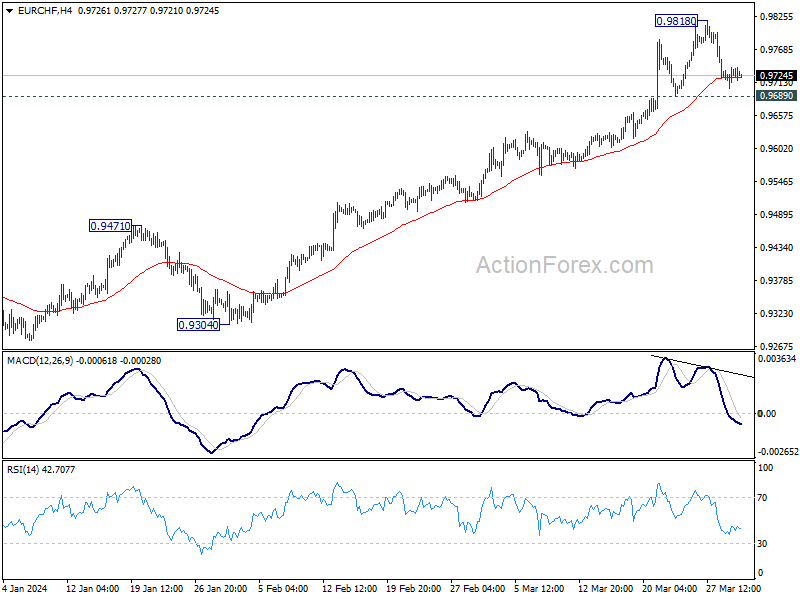
Daily Pivots: (S1) 0.9716; (P) 0.9727; (R1) 0.9746; More...
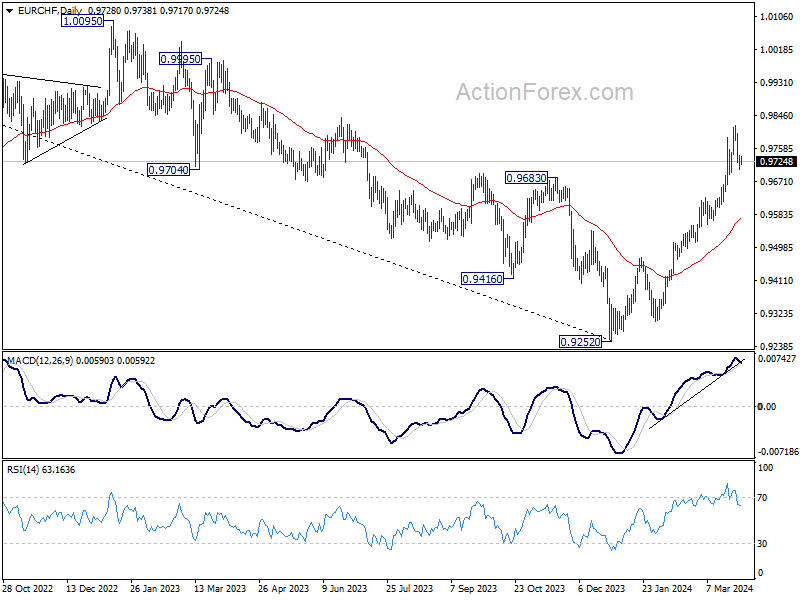
Intraday bias in EUR/CHF is turned neutral first with current retreat. Another rally is expected as long 0.9689 support holds. On the upside, above 0.9818 will resume the rise from 0.9252 towards 1.0095 key resistance next. Nevertheless, considering bearish divergence condition in 4H MACD, break of 0.9689 will indicate short term topping, and turn bias back to the downside for 55 D EMA (now at 0.9576) instead.
In the bigger picture, a medium term bottom should be in place at 0.9252 already, on bullish convergence condition in W MACD. Rise from there would now target 38.2% retracement of 1.2004 (2018 high) to 0.9252 (2023 low) at 1.0303, even as a correction to the down trend from 1.2004. This will remain the favored case as long as 55 D EMA (now at 0.9576) holds.
EUR/GBP Daily Outlook
Daily Pivots: (S1) 0.8534; (P) 0.8544; (R1) 0.8559; More...
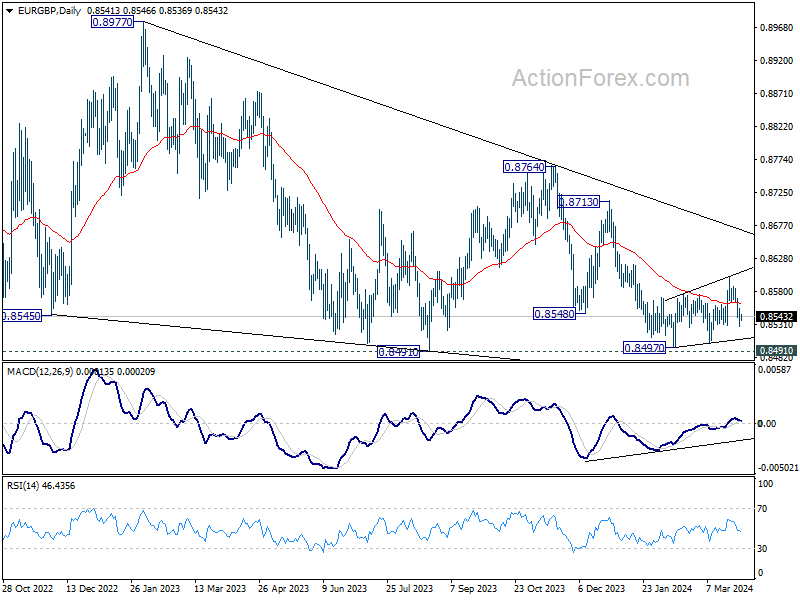
Intraday bias in EUR/GBP stays neutral at this point. On the downside, firm break of 0.8529 support will argue that the corrective recovery from 0.8497 has completed at 0.8601. Intraday bias will be back on the downside for retesting 0.8497 low next. On the upside, break of 0.8601 will resume the rebound instead.
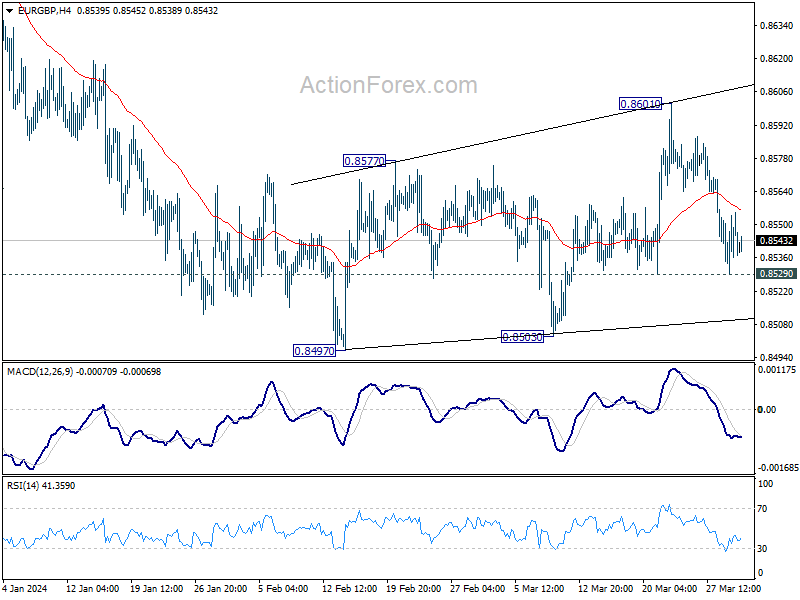
In the bigger picture, there is no clear sign that down trend from 0.9267 has completed, despite loss of downside momentum as seen in D MACD. As long as 0.8713 resistance holds, the down trend will remain in favor to resume through 0.8491 low at la later stage.
EUR/AUD Daily Outlook
Daily Pivots: (S1) 1.6532; (P) 1.6562; (R1) 1.6598; More...
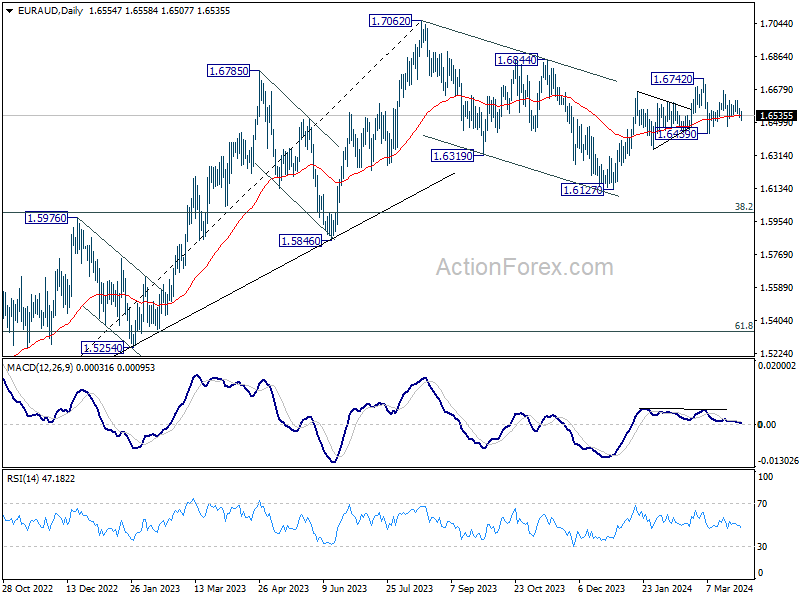
Range trading continues in EUR/AUD and intraday bias remains neutral. Near term outlook will stays cautiously bullish as long as 1.6439 support holds. On the upside, above 1.6677 will target 1.6742 first. Decisive break there will resume whole rise from 1.6127 and target 1.6844 resistance next.
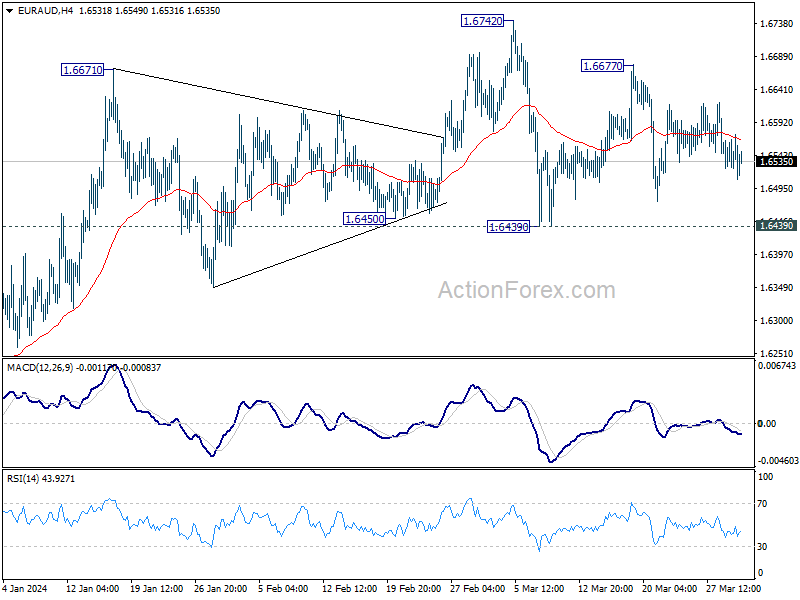
In the bigger picture, fall from 1.7062 medium term top is seen as a correction to the up trend from 1.4281 (2022 low). Break of 1.6844 resistance will argue that this up trend is ready to resume through 1.7062 high. In case of another fall, strong support should be seen around 1.5846 and 38.2% retracement of 1.4281 to 1.7062 at 1.6000 to bring rebound.
EUR/JPY Daily Outlook
Daily Pivots: (S1) 163.01; (P) 163.23; (R1) 163.51; More...
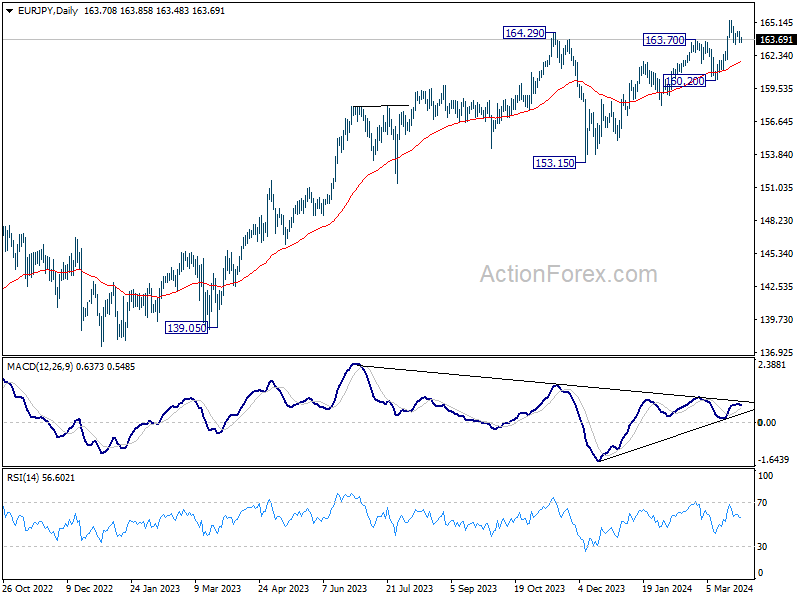
EUR/JPY dips further to 162.92 but recovered since then. Intraday bias stays neutral first. On the downside, below 162.92 will resume the decline from 165.33 short term opt, and target 160.20 structural support next. On the upside, however, break of 164.40 minor resistance will bring retest of 165.33 instead.
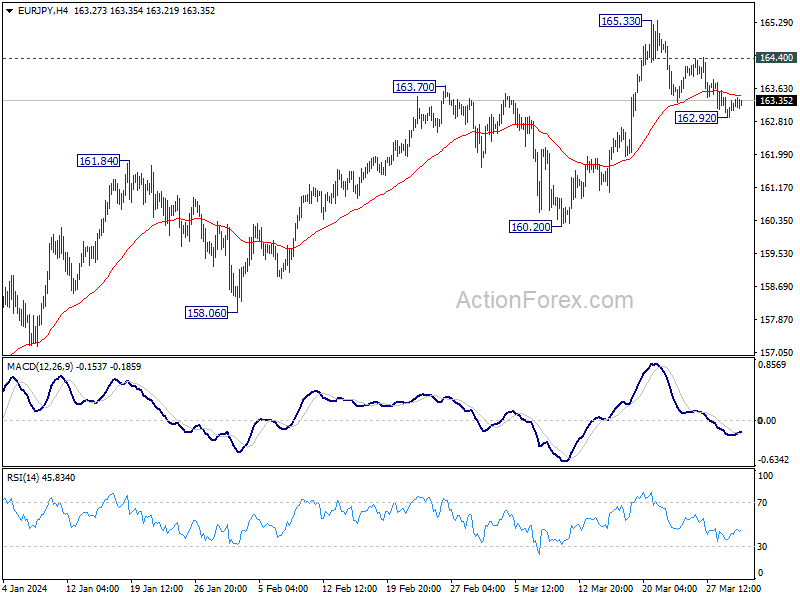
In the bigger picture, current rally is part of the up trend from 114.42 (2020 low), which is still in progress. Next target is 169.96 (2008 high). Break of 160.20 support is needed to be the first sign of medium term topping. Otherwise, outlook will stay bullish in case of retreat.
GBP/JPY Daily Outlook
Daily Pivots: (S1) 190.78; (P) 191.02; (R1) 191.25; More.....
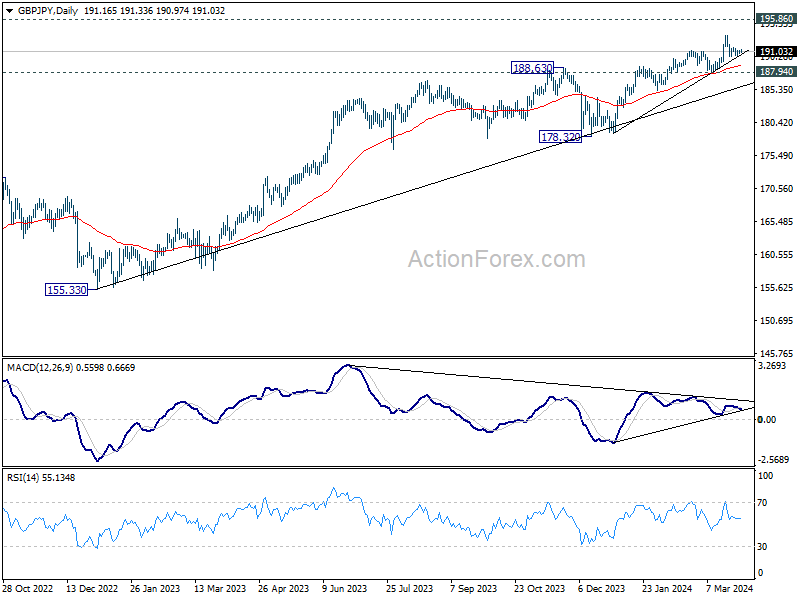
GBP/JPY is gyrating in tight range around 55 4H EMA and intraday bias remains neutral. More consolidations could be seen. But outlook will stay bullish as long as 187.94 support holds. On the upside, break of 193.51 will resume larger up trend towards 195.86 long term resistance.
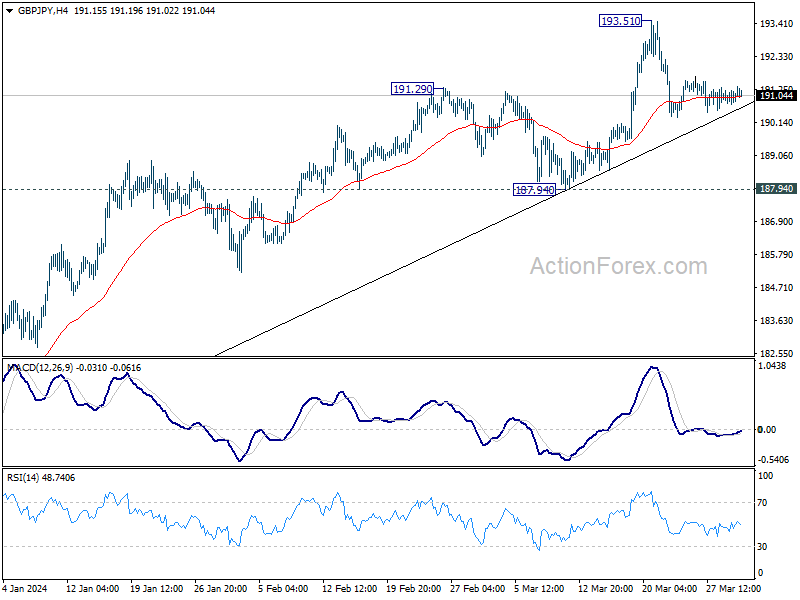
In the bigger picture, current rally is part of the up trend from 123.94 (2020 low), and is in progress for long term resistance (2015 high). Break of 187.94 support is needed to be the first sign of medium term topping. Otherwise, outlook will remain bullish in case of retreat.
Nikkei Dips on New Fiscal Year, Gold Soars to New Highs, Currencies Unmoved
Activity in global financial markets remain generally subdued due to the extended Easter holiday in many regions. Nevertheless, Japan's markets kicked off the new fiscal year on a tumultuous note, with Nikkei index having a sharp sell-off. Analysts have largely dismissed the latest quarterly Tankan survey as the catalyst for this downturn. Instead, the sell-off could be attributed to institutional investors engaging in profit-booking activities typical of the financial year's commencement. Meanwhile, Yen remained relatively stable, showing little reaction and maintaining a very tight range amid the market activity.
Currency markets elsewhere have mirrored this calm, with minimal activity observed among the major currencies. However, this tranquility could be disrupted by the upcoming ISM Manufacturing data release, which has the prospect of introducing some volatility. Moreover, the economic calendar ahead is brimming with significant events that could influence market dynamics, including US non-farm payroll, Eurozone CPI flash, Swiss CPI, and Canada's employment data, all poised to capture investors' attention in the days ahead.
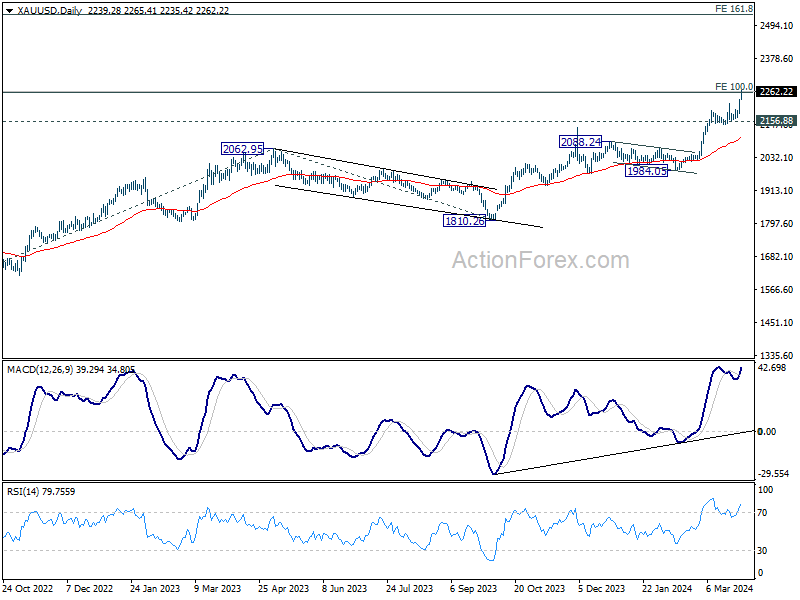
Technically, Gold's rally accelerates further in thin markets and hits new record high today. 100% projection of 1614.60 to 2062.95 from 1810.26 at 2258.61 is already met. Despite overbought conditions as seen in D RSI, there is no clear sign of topping yet. Sustained trading above 2258.61 will pave the way to 161.8% projection at 2535.69 in medium term. In any case, near term outlook will stay bullish as long as 2156.88 support holds.
Japan's Tankan survey: Service sector's optimism at highest since 1991
Japan's Q1 quarterly Tankan survey unveils mixed economic sentiment among the nation's large businesses. Service sector expressed their highest levels of optimism in over three decades, contrasting with a slight decline in confidence among manufacturers.
Large manufacturing index dropped from 13 to 11, still surpassing expectation of 10. However, outlook for large manufacturing firms saw modest increase from 8 to 10, slightly below forecasted 11.
On the brighter side, non-manufacturing index climbed from 32 to 34, exceeding expectations of 31 and marking the highest level since 1991. Despite this, non-manufacturing outlook remained steady at 27, falling short of anticipated 30.
Additionally, large all-industry Capex gauge, which measures capital expenditure plans across industries, is projected to grow by 4% in the new fiscal year. This figure, though positive, falls significantly below the anticipated 9.2% growth.
Japan's PMI manufacturing finalized at 48.2, worst of weakness has passed
Japan's PMI Manufacturing was finalized at 48.2 in March, up from February's 47.2, highest in four months.
Usamah Bhatti of S&P Global Market Intelligence noted that while the sector's performance remained "downbeat," there were emerging signs that the "worst of the weakness had passed". This observation is based on softer reductions observed in both output and new orders inflows.
However, it's important to highlight that the average PMI reading for Q1 stood at 47.8, indicating the weakest quarterly performance since Q3 2020, when it was 46.7.
Inflationary pressures "remained marked" Although the rate of input price inflation has moderated to its weakest in over three years, the challenge of high costs persists. In response to these pressures, selling price inflation has intensified to a three-month high, reflecting manufacturers' efforts to safeguard profit margins by transferring higher expenses onto their customers.
China's NBS PMI manufacturing rises to 50.8, first expansion in six months
China's official NBS PMI Manufacturing climbed from 49.1 to 50.8 in March, surpassing expectations of 50.1. This uptick not only marks the sector's first expansion in six months but also represents its highest reading in a year
Details showed notable increases in manufacturing production, which leaped from 49.8 to 52.2, and new orders, which surged from 49.0 to 53.0. Furthermore, new export orders rose from 46.3 to 51.3.
PMI Non-Manufacturing also showed positive momentum, climbing from 51.4 to 53.0, slightly above anticipated figure of 51.3. PMI Composite index, which encompasses both manufacturing and non-manufacturing activities, improved from 50.9 to 52.7,
Zhao Qinghe, senior statistician at NBS, attributed the March surge to increased production resumption efforts following Lunar New Year holiday, alongside improvement in market vitality.
China's Caixin PMI manufacturing ticks up to 51.1
China's Caixin PMI Manufacturing rose from 50.9 to 51.1 in March, above expectation of 51.0, marking the highest level in 13 months.
Wang Zhe, Senior Economist at Caixin Insight Group, noted acceleration in both supply and demand within sector with "overseas demand picking up".
Despite the overall improvement, employment continued "contraction. Additionally, "depressed price level worsened".
ECB members discuss rate cut, timing, and frequency
ECB Governing Council members Robert Holzmann, in an interview with Austria's Kronen Zeitung, noted the possibility of Europe reducing interest rates ahead of the US, citing the slower economic growth in Europe compared to its transatlantic counterpart.
Holzmann underscored that the timing of such cuts would "depend largely on what wage and price developments look like by June."
Yannis Stournaras, in remarks to Greece's Proto Thema, articulated a more aggressive stance, positing that "cutting rates four times this year, by 25 basis points each, is possible."
This perspective reveals a division within ECB, as Stournaras acknowledged skepticism among some colleagues who advocate for a more cautious approach to rate reductions.
Anticipating US ISMs and NFP, Eurozone CPI Flash, and more
This week is spotlighted by a series of heavyweight data releases from the US, including ISM indexes and non-farm payroll figures. The focal point for analysts and investors alike hinges on the insights these reports will provide into the ongoing concerns of inflationary pressures and labor market tightness. Notably, prices and employment components of ISM indexes, along with wage growth data from NFP, are poised to offer vital clues.
In light of recent comments from Fed Chair Jerome Powell, emphasizing the necessity of "more good inflation readings" before considering interest rate cuts, the anticipation surrounding these data releases is high. With Fed fund futures suggesting 63% probability of an initial rate cut in June, the market's confidence seems to hang in balance. The outcomes of this week's US data releases are poised to recalibrate these market expectations.
Shifting the gaze to Europe, Eurozone's CPI flash report stands as another central piece of this week's economic puzzle, with analysts keen to assess the pace of disinflation in both headline and core figures. ECB officials have been vocal about an impending rate cut this spring, with a consensus leaning towards June. The upcoming ECB meeting accounts are expected to echo this sentiment, providing further clarity on the bank's policy outlook.
Beyond these focal points, additional events deserving attention include Swiss CPI, employment data from Canada, minutes from RBA, and China's Caixin PMIs. Speculation abounds regarding SNB's next steps, particularly the possibility of another rate cut in June, contingent on forthcoming inflation data.
Here are some highlights of the week:
- Monday: Japan Tankan survey, PMI manufacturing final; China Caixin PMI manufacturing. Canada PMI manufacturing; US PMI manufacturing final, ISM manufacturing, construction spending.
- Tuesday: Japan monetary base; Australia RBA minutes; Germany CPI flash; Swiss PMI manufacturing, retail sales; Eurozone PMI manufacturing final; UK PMI manufacturing final; US factor orders.
- Wednesday: China Caixin PMI services; Eurozone CPI flash, unemployment rate; US ADP employment, PMI services final, ISM services.
- Thursday: New Zealand building permits; Australia building approvals; Swiss CPI; Eurozone PMI services final, PPI, ECB meeting accounts; UK PMI services final; Canada trade balance; US jobless claims, trade balance.
- Friday: Japan household spending, leading indicators; Australia trade balance; Germany factor orders, import prices; France industrial production; Swiss foreign currency reserves, SECO consumer climate; UK PMI construction; Eurozone retail sales; Canada employment, Ivey PMI; US non-farm payrolls.
GBP/JPY Daily Outlook
Daily Pivots: (S1) 190.78; (P) 191.02; (R1) 191.25; More.....
GBP/JPY is gyrating in tight range around 55 4H EMA and intraday bias remains neutral. More consolidations could be seen. But outlook will stay bullish as long as 187.94 support holds. On the upside, break of 193.51 will resume larger up trend towards 195.86 long term resistance.
In the bigger picture, current rally is part of the up trend from 123.94 (2020 low), and is in progress for long term resistance (2015 high). Break of 187.94 support is needed to be the first sign of medium term topping. Otherwise, outlook will remain bullish in case of retreat.
Economic Indicators Update
| GMT | Ccy | Events | Actual | Forecast | Previous | Revised |
|---|---|---|---|---|---|---|
| 23:50 | JPY | Tankan Large Manufacturing Index Q1 | 11 | 10 | 12 | 13 |
| 23:50 | JPY | Tankan Non - Manufacturing Index Q1 | 34 | 31 | 30 | 32 |
| 23:50 | JPY | Tankan Large Manufacturing Outlook Q1 | 10 | 11 | 8 | |
| 23:50 | JPY | Tankan Non - Manufacturing Outlook Q1 | 27 | 30 | 24 | 27 |
| 23:50 | JPY | Tankan Large All Industry Capex Q1 | 4.00% | 9.20% | 13.50% | |
| 00:30 | JPY | Manufacturing PMI Mar F | 48.2 | 48.2 | 48.2 | |
| 01:45 | CNY | Caixin Manufacturing PMI Mar | 51.1 | 51 | 50.9 | |
| 13:30 | CAD | Manufacturing PMI Mar | 49.7 | |||
| 13:45 | USD | Manufacturing PMI Mar F | 52.5 | 52.5 | ||
| 14:00 | USD | ISM Manufacturing PMI Mar | 48.5 | 47.8 | ||
| 14:00 | USD | ISM Manufacturing Prices Paid Mar | 52.8 | 52.5 | ||
| 14:00 | USD | ISM Manufacturing Employment Index Mar | 45.9 | |||
| 14:00 | USD | Construction Spending M/M Feb | 0.50% | -0.20% | ||
| 14:30 | CAD | BoC Business Outlook Survey |
Crude Oil Kicks Off the New Quarter on a Positive Footage
The week starts very slowly as most Western markets are closed for Easter holiday. The US revealed the latest core PCE print on a Good Friday and the Federal Reserve (Fed) Chair Jerome Powell spoke after the data. The headline figure came in line with the expectations at 2.8%, down from 2.9% printed a month earlier, the monthly figure came in at 0.3% as expected, but the prior month read was revised up to 0.5%. The bad news – for inflation – is that personal spending jumped more than expected in February, but the good news is – for inflation – personal income fell more rapidly than the expectations. Powell said that ‘the fact that the US economy is growing at such a solid pace, the fact that the labour market is still very, very strong, gives them the chance to just be a little more confident about inflation coming down before they take important steps.’
Of course, as the markets were mostly closed at the time the data came out and Powell spoke, we didn’t see much reaction on Friday. We see slight moves this Monday; the US 2-year yield is down to 4.60% at the time of writing, the 10-year yield hovers around 4.20% and the dollar index is steady near a 1.5 month high. Attention will shift to the US jobs data this week. Hopefully for the Fed, the data won’t be too strong to spoil the Fed cut expectations.
The EURUSD kicks off the week under pressure. The yen bulls are nowhere to be found, but the Nikkei index is sharply sold after the Bank of Japan’s (BoJ) Tankan index fell in the Q1 for the first time in a year. The large manufacturers see their business conditions deteriorate moving forward. Still there has been a notable improvement for manufacturers of petroleum and coal in Q1 thanks to recovery in oil prices. The US crude is up by nearly 20% since the beginning of the year on the back of tense geopolitical environment in the Middle East, a restrictive stance from OPEC when it comes to the supply cuts and robust demand expectations due to the lower interest rate bets from the major central banks. For now, the Chinese stimulus measures and an eventual Chinese recovery were not significantly priced in but China represents an important upside risk. The latest Chinese PMI numbers released during the weekend were encouraging. Both the manufacturing and the non-manufacturing PMI showed a faster-than-expected expansion in March. Especially, the non-manufacturing PMI jumped to 53 – the highest since last summer. Still, input prices fell for the first time since last summer on lower material prices to stimulate demand and the property crisis gave no signs of abating, meaning that the enthusiasm regarding the Chinese data should be taken with a pinch of salt. But the weekend data has a positive impact on oil prices on this slow Monday morning, which sees the barrel of oil trading at the highest level since the year started. OPEC meets this week and is expected to make no changes to its supply cut strategy. The cartel is set to extend supply cuts until the end of this quarter. The IEA expects supply deficit in 2024, while they were looking for a supply surplus in their prediction earlier this year. As a result, the upside risks in oil markets prevail and the positive factors should encourage a further rise of US crude to $85pb per barrel.
In equities, the first quarter ended last week with the S&P500 recording its best performance since 2019. The index gained more than 10% in the first three months of the year even though the Fed rate cut expectations went from six cuts for this year with the first that was supposed to happen in March, to only three cuts with the first rate cut supposed to come on June with a bit less than 70% probability attached to it according to the activity on Fed funds futures.
In Turkey, municipal elections of Sunday ended in tears for Erdogan-backed AKP leaders in major cities including Istanbul. Even though the news hint at a potential change – for better - in the future, we won’t see a meaningful change in the immediate aftermath of the municipal elections. The monetary policy will remain unchanged and the USDTRY - which is trading higher in the wake of the latest elections - should continue trending higher at a potentially higher speed as the central bank may put less effort to counter the lira’s depreciation now that the elections are behind.