Sample Category Title
Wedge Issue: What’s Driving the Gap Between CPI and PCE Inflation?
Summary
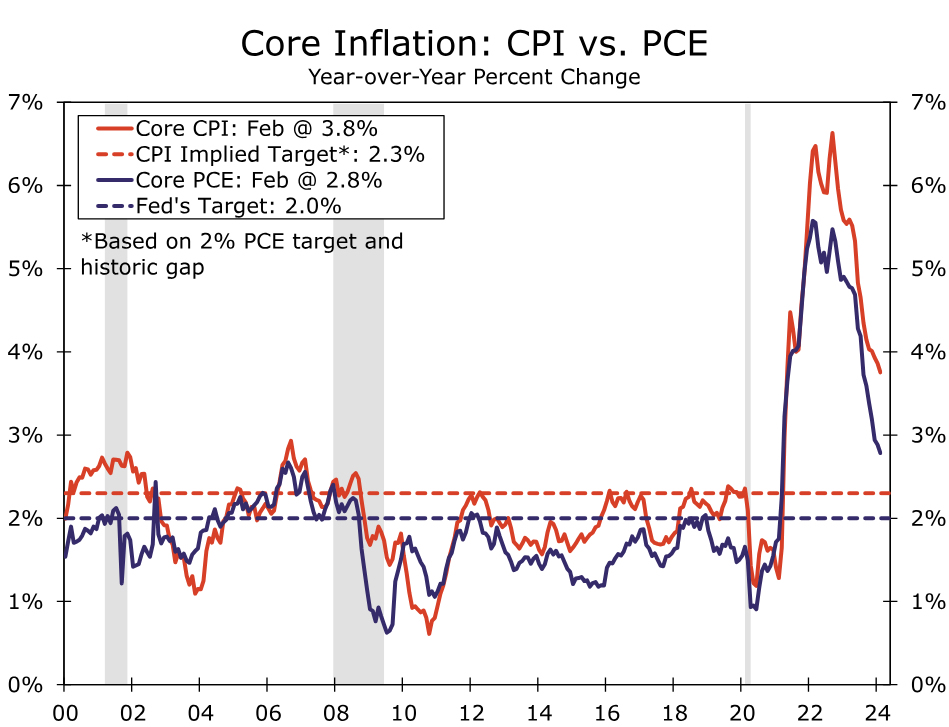
Progress in reining in inflation is further along by some measures relative to others. The gap between the two most prominent measures of U.S. inflation—the Consumer Price Index (CPI) and PCE deflator—is unusually wide at present. At 3.8%, the year-over-year rate of core CPI sits a full percentage point higher than core PCE inflation compared to a historical gap of 0.3 points. In this report, we discuss key differences in the construction and use of CPI and PCE indices, the drivers of the current wedge and what it could mean for the path of interest rates ahead.
- The CPI may be a more familiar measure of inflation than the PCE index given its long history and frequent use in price contracts. However, the FOMC benchmarks its 2% inflation target to the PCE deflator, making it more relevant for the path of monetary policy.
- The CPI and PCE index move closely together over time but can temporarily diverge due to differences in construction. The CPI focuses on consumers' direct expenditures paid for out-of-pocket. That makes it narrower in scope than the PCE index, which includes the cost of items purchased on behalf of households and purchases furnished without payment. The wider scope of the PCE leads to different category weightings, most notably for healthcare and housing. Different formulas and sources also contribute to the variation in reported price growth.
- On a categorical basis, housing has been by far the largest source of the inflation wedge the past year. While primary shelter inflation is up a little less than 6% by both the CPI and PCE index, it carries 2.5x the weight in the core CPI. As a result, primary shelter has contributed 1.5 percentage points more to the year-over-year rate of core CPI than core PCE. Motor vehicle insurance is also providing an unusually large boost to core CPI. In contrast, strength in services categories more heavily weighted in the core PCE index, such as healthcare, or out of scope of the core CPI, such as food services or nonprofit institutions, have helped to narrow the chasm between core CPI and core PCE the past year.
- We anticipate the gap between core CPI and core PCE when measured on a year-ago basis to remain uncharacteristically wide through the first half of 2025. Bringing the gap back down to its historical realm of 0.3 points will hinge heavily on shelter inflation returning near its pre-pandemic pace, which we estimate will occur around next spring. Slower growth in the CPI measure of motor vehicle insurance now that premiums have increased more than vehicles and repair service costs should also help to bring core CPI down closer in line with core PCE.
- We do not believe the inflation wedge is an issue for the FOMC. Fed officials continue to espouse optimism that shelter inflation, the most significant contributor at present, will ease further in the coming months. And although large, the current wedge between core CPI and core PCE is not unprecedented. A similarly sized wedge opened up in the late 1990s and in 2001 and 2009. As the pricing environment cools from its extreme state, the gap should diminish as well.
How Much Has Inflation Improved? Depends on How You Measure It
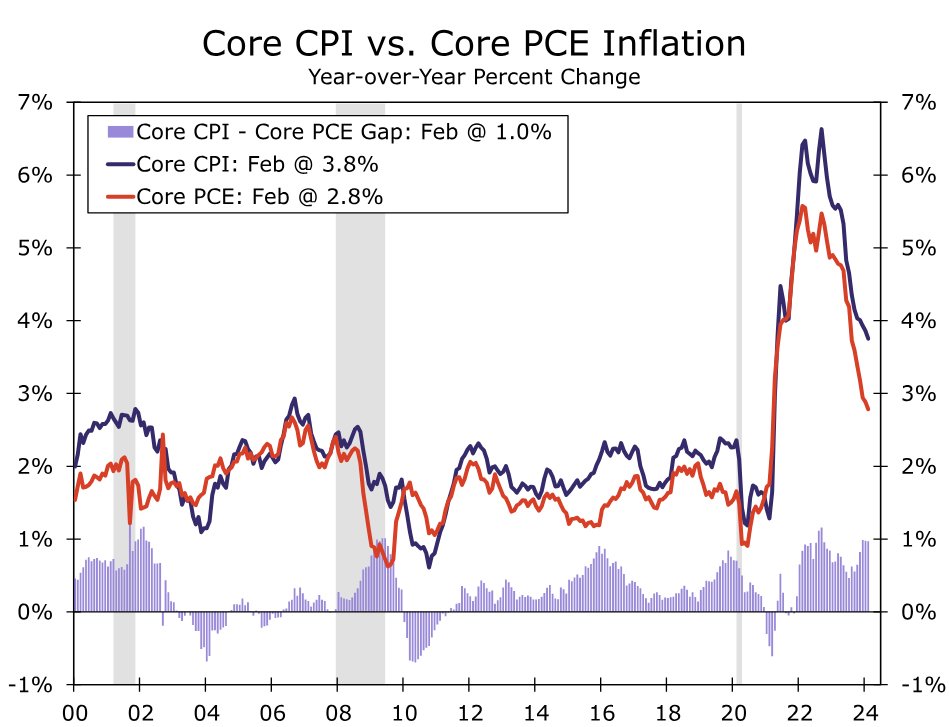
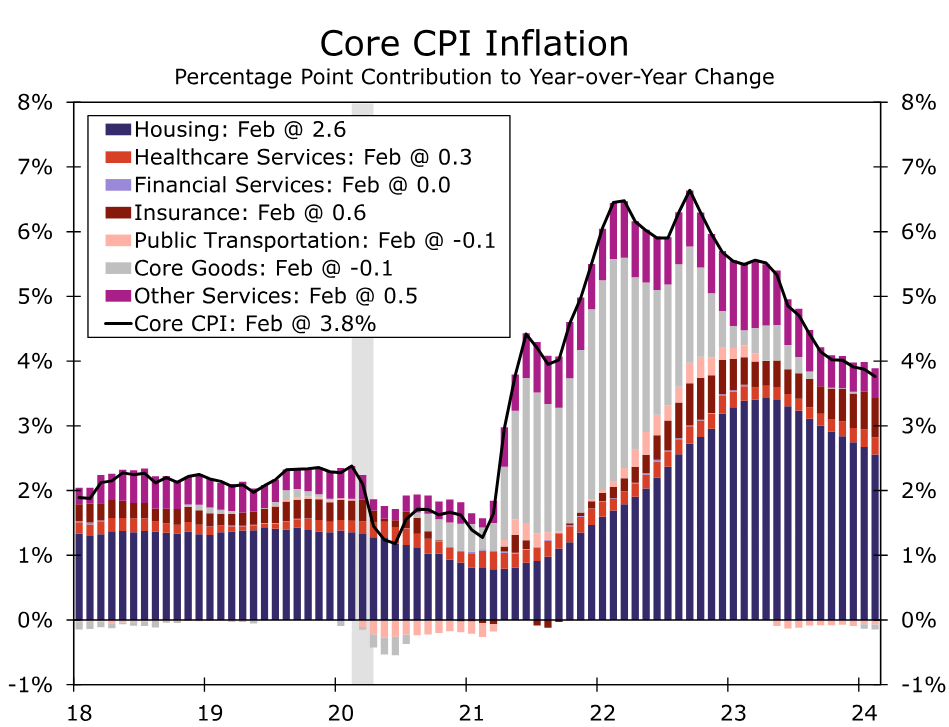
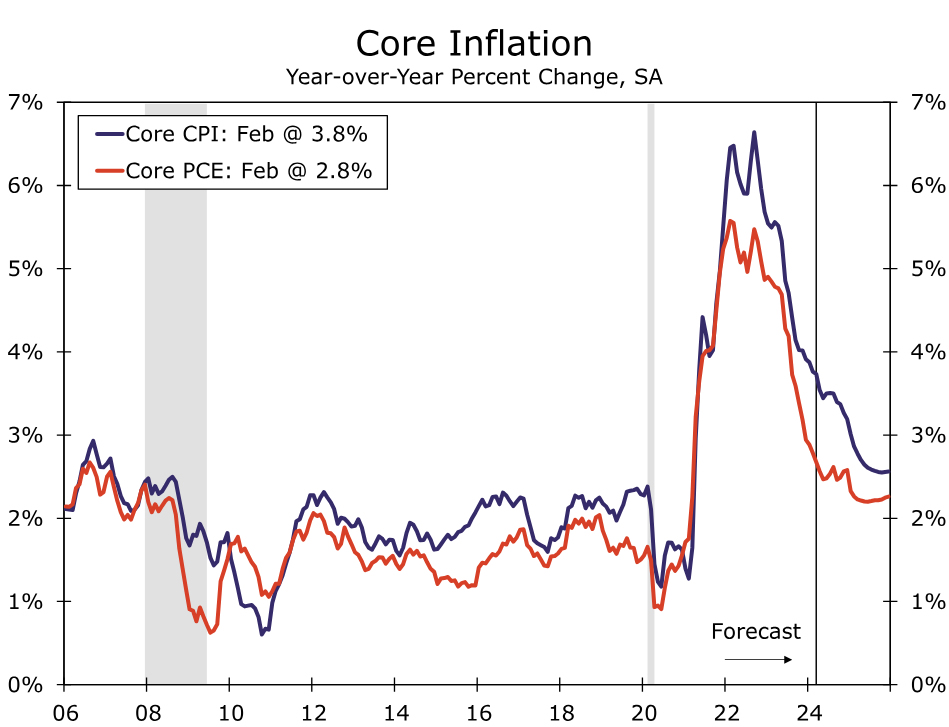
Inflation has fallen sharply since the fever-pitch reached in the summer of 2022. However, progress in fully quieting inflation is further along by some measures relative to others. The Consumer Price Index in the 12 months through February rose 3.2%, a full percentage point faster than its average pace from 2000-2019. Excluding the volatile categories of food and energy, the core CPI has made less progress in settling down, having increased 3.8% year-over-year in February. In comparison, the core PCE deflator has fallen back below 3%. The more marked improvement in PCE inflation over the past year relative to CPI has led to an unusually wide gap between the two most prominent measures of U.S. inflation (Figure 1). Since 2000, the core CPI deflator has run an average of 0.3 percentage points higher than the core PCE deflator, but the gap currently stands at 1.0 percentage point—near the top end of its range in recent decades. What's driving the wedge, and what could it mean for the path of interest rates and broader economy ahead?
Different Strokes for Different Folks: Uses of the CPI and PCE Deflator
There is no shortage of ways to look at inflation in the U.S. economy. Government agencies publish an array of price indices for goods and services consumed by different end users (e.g., businesses, households and the government), as well as sold by different types of producers (e.g., domestic or foreign). Among the various gauges of inflation, the Consumer Price Index (CPI) and Personal Consumption Expenditure Price Index (PCE deflator) are the most closely watched.
The CPI has a long history of being in the limelight and tends to be the most familiar measure of inflation. The CPI measures price changes for a representative basket of items purchased directly by consumers. Its focus on consumers' out-of-pocket costs leads it to align more closely with consumers' perceived inflation experience. The CPI is also widely used in wage contracts and by the government. For example, Social Security's annual cost of living adjustment (COLA) is based on the CPI while income eligibility for many government programs and federal tax brackets are adjusted with the CPI. Further, the nearly $2 trillion market for Treasury Inflation-Protected Securities (TIPS) adjusts principal returns for inflation using the CPI, tying the CPI directly to a large segment of the financial market.
The PCE deflator also has a key tie to financial markets and the economy writ large: the FOMC benchmarks its 2% inflation target to the PCE deflator. As the preferred inflation gauge of the Fed, the PCE deflator is more relevant for the path of U.S. monetary policy. While over time the CPI and PCE move closely together, unusually wide divergences, like that of today, may send different messages about price pressures in the economy and what may lie ahead for the setting of interest rates.
Why the Fed's a Fan of PCE Inflation
The Fed's preference for the PCE deflator can be chalked up to two primary attributes. First, it is wider in scope than the CPI and as a result, generates a more encompassing picture of inflation in the U.S. economy. Whereas the CPI measures the change in out-of-pocket costs to consumers, the PCE price index includes the cost of items purchased on behalf of households, such as medical care paid for by the government or employer-sponsored health insurance. The PCE deflator also incorporates implicit prices of items not directly purchased on the market or "furnished without payment." Examples include the cost of financial services like “free” checking accounts, brokerage fees, or nonprofit services.
Notably, the wider scope of the PCE can lead to significant differences in categorical weightings. Items not purchased directly by consumers or items that are also purchased on behalf of households carry a bigger weight in the PCE (e.g., financial services and medical care). In contrast, goods and services purchased directly by consumers bear a higher weight in the CPI (e.g., gasoline, vehicles and shelter).
Second, the PCE deflator and CPI are constructed using different statistical formulas. The PCE formula better accounts for the tendency of consumers to substitute away from products whose prices rise relatively quickly. A common example of this dynamic is if the price of beef is rising more quickly than chicken, consumers will substitute chicken for beef. This substitution effect leads to overall living costs rising more slowly than if measured by the fixed consumption basket in the CPI. As a result, policymakers view the PCE deflator as a more accurate barometer of the overall change in the economy's price level. The CPI “basket” is updated annually based on the Consumer Expenditure Survey to account for shifts in consumption, and the relative importance of CPI categories adjust monthly based on comparative price changes; however, the PCE method captures substitution effects more quickly by leveraging the expenditure data available for the same period. This “formula effect” leads to the CPI typically running higher than the PCE deflator.
Gap Accounting
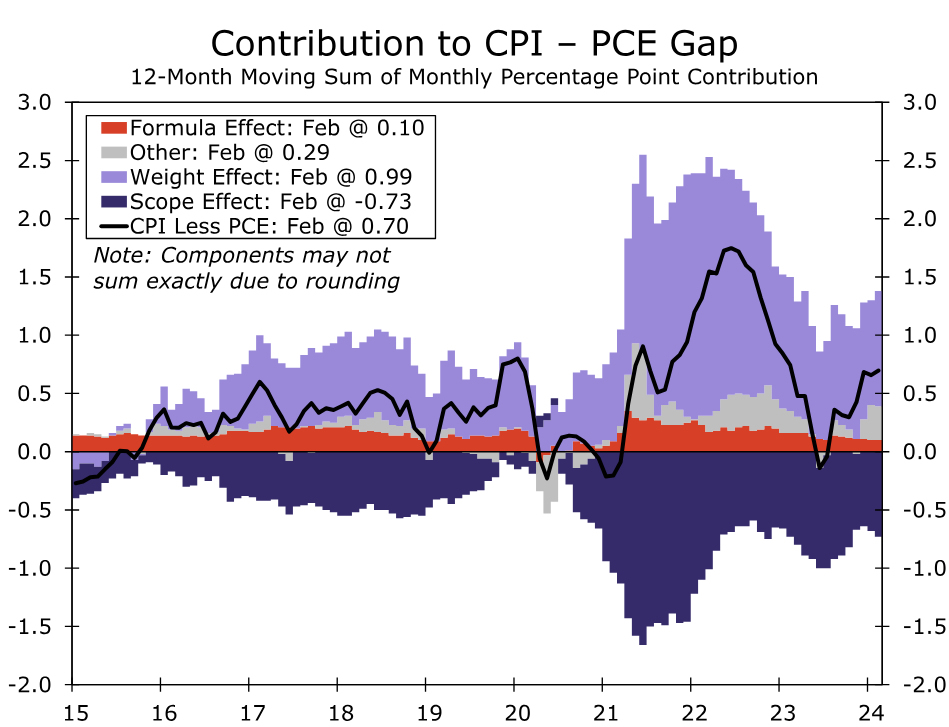
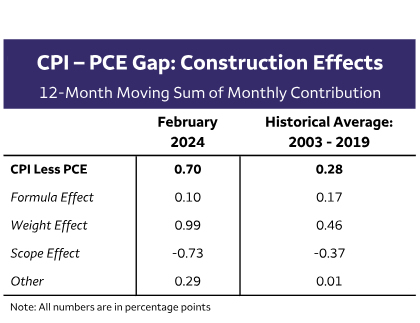
The unique scope, weighting and formulas of the CPI and PCE all influence the gap between the two inflation measures. The formula effect tends to be a persistent, but relatively small and stable source of the wedge (Figure 2). Over the past year, the formula difference has contributed 0.1 percentage point to the 0.7 point gap between the year-over-year rates of CPI and PCE inflation, fairly similar to its average since 2003 (Figure 3). Weighting has played by far the largest role in keeping the CPI running hotter than the PCE the past year, primarily due to the ongoing strength in shelter inflation. Other differences, such as seasonal adjustment or source of pricing data, historically have had little bearing on the gap, but over the past year have been another meaningful contributor (+0.3 points) to the wedge between CPI and PCE. The broader scope of the PCE deflator, in contrast, has helped to narrow the gap with CPI inflation over the past year by a historically large degree.
To help think about how the gap between the CPI and PCE deflator will evolve, we find it useful to also look at it on a categorical basis. We focus on the core indices given FOMC officials place greater emphasis on price growth excluding food and gas when considering the near-term outlook for interest rates.
Housing and Motor Vehicle Insurance Driving Historically Wide Wedge
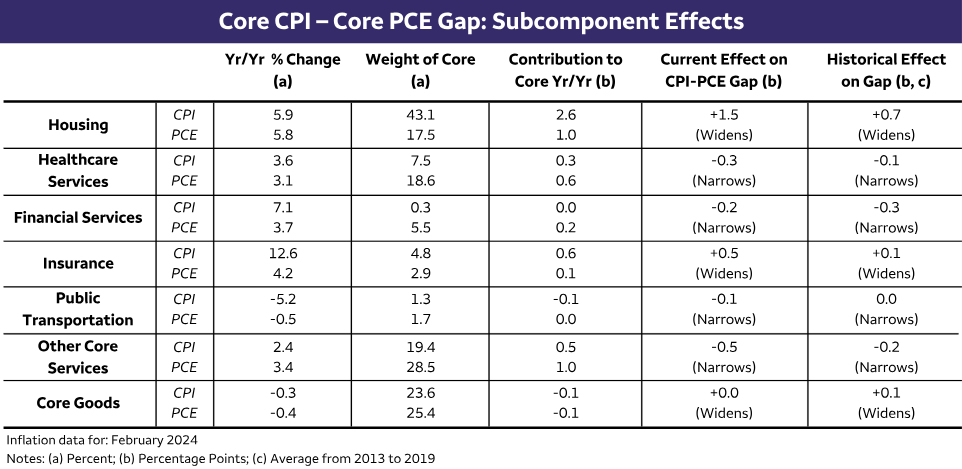
As shown in Figures 4 and 5, housing more than accounts for the 1.0 percentage point gap between core CPI and core PCE the past year. The PCE uses the CPI's primary rent and owners' equivalent rent measures as source data, so housing's more sizable contribution to core CPI boils down entirely to its larger weight (43% versus 18% in the core PCE index).
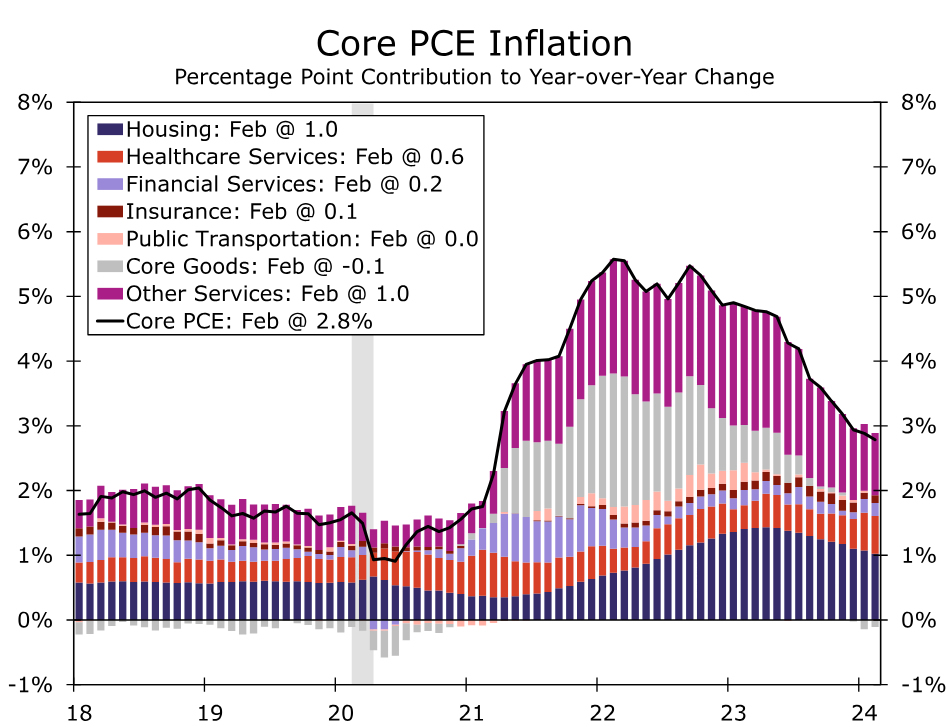
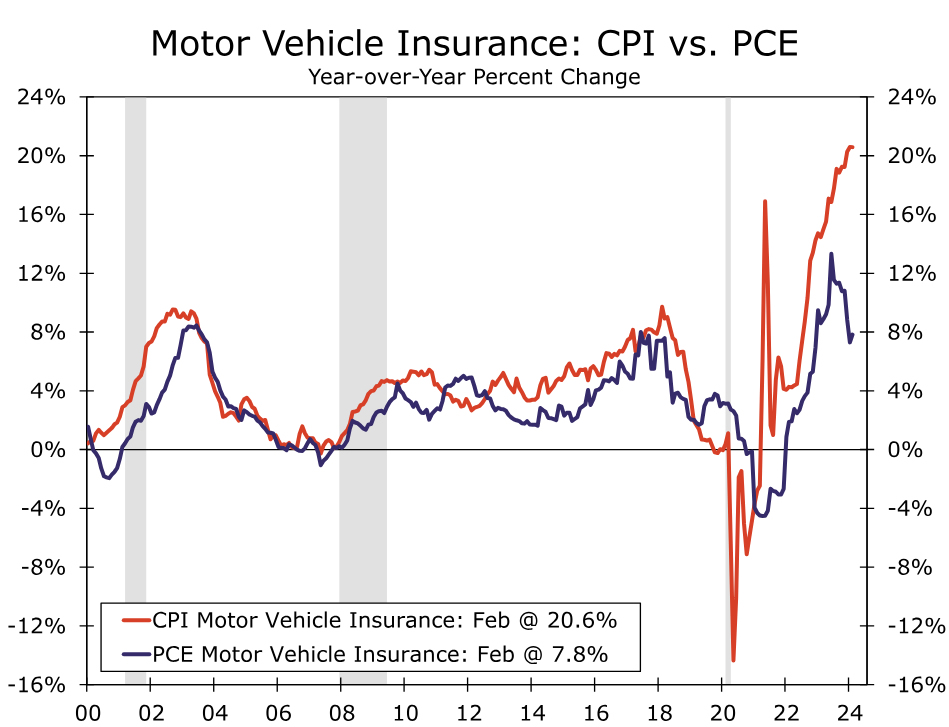
Rapidly rising costs for motor vehicles have also contributed to the relatively hotter rate of core CPI inflation recently. Motor vehicle insurance carries nearly four times the weight in the core CPI (3.5% versus 0.7% in PCE). In the CPI, insurance costs reflect the premiums paid by consumers, but not claims paid out by insurers on behalf of motorists. The PCE's net-revenue approach has contributed to motor vehicle insurance costs rising less dramatically since insurers' costs to cover claims have risen rapidly alongside higher vehicle repair and replacement costs (Figure 6). This pricing difference (part of the “other” category in Figure 5) in conjunction with a lower weighting, has led motor vehicle insurance over the past year to add less than 0.1 points to core PCE, compared to 0.7 points to the core CPI. Health and home insurance are also measured differently in the CPI and PCE but, in contrast to motor vehicle insurance, have narrowed the core CPI–PCE gap by a tenth over the past year.
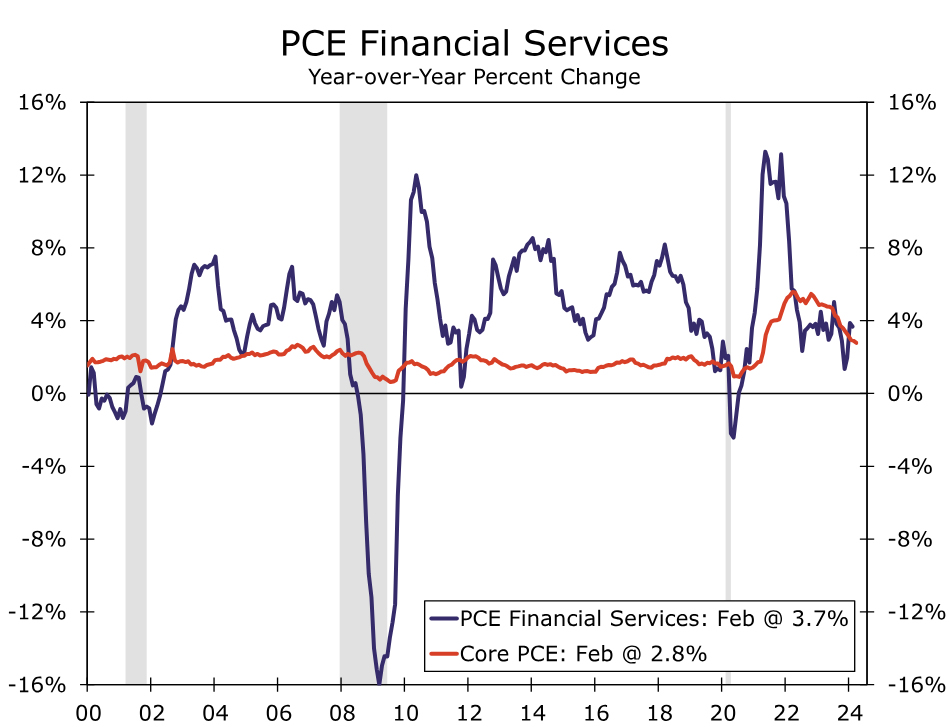
Further, financial services usually narrows the wedge between the two inflation measures, but recently this category has limited the wedge by less than normal. Financial services account for more than 5% of the core PCE deflator, compared to just a few tenths in the CPI as the cost of many financial service products are not paid for out of pocket. Over the past year, the PCE index for financial services has outpaced the broader core PCE, but by a smaller degree than exhibited over the past decade (Figure 7). Accordingly, it has provided less of a leg-up to PCE inflation than usual.
Healthcare and Other Services Limiting A Blowout
Healthcare services costs (ex-insurance) have grown more quickly in the CPI than in the PCE index over the past year. However, the PCE's greater weighting nevertheless leaves healthcare providing a bigger lift to the year-over-year rate of core PCE inflation, and thus has helped to narrow the current gap with the CPI. Healthcare services historically have contributed 0.1 point more to the year-over-year rate of core PCE than core CPI, but over the past year have added 0.2 points more.
Different methods for measuring airline fares, the lion's share of public transportation, also have whittled down the gap in core CPI and core PCE. The CPI sample consists largely of discount fares for non-business travel scheduled for either the same month or a month or two out. The corresponding PCE index uses Producer Price Index data for domestic airfare, which measures the change in average revenue per passenger (including business travelers) for flights departing during the reference month. Airfares as measured by the CPI are down just over 6% year-over-year, but are essentially flat per the PCE deflator.
Finally, an array of other services have offered a significant counterbalance to the wedge that shelter and motor vehicle insurance have driven between the core CPI and core PCE. These include categories out of scope of the CPI, like social services or nonprofit institutions serving households, both of which are running higher than the broader core PCE and effectively bringing it more in line with the core CPI. Core PCE inflation also includes food services, which is up 4.4% over the past year and is included in the headline CPI but excluded from the core CPI. A summary of the differences in current category contributions versus their historical effects on the core CPI–PCE gap is shown in Figure 8.
When the Dust Settles
Looking ahead, we expect the gap between core CPI and core PCE when measured on a year-ago basis to remain uncharacteristically wide through the first half of next year (Figure 9). On a quarterly annualized basis, the return to the ~0.3% realm should occur somewhat earlier; we estimate around the first quarter of 2025.
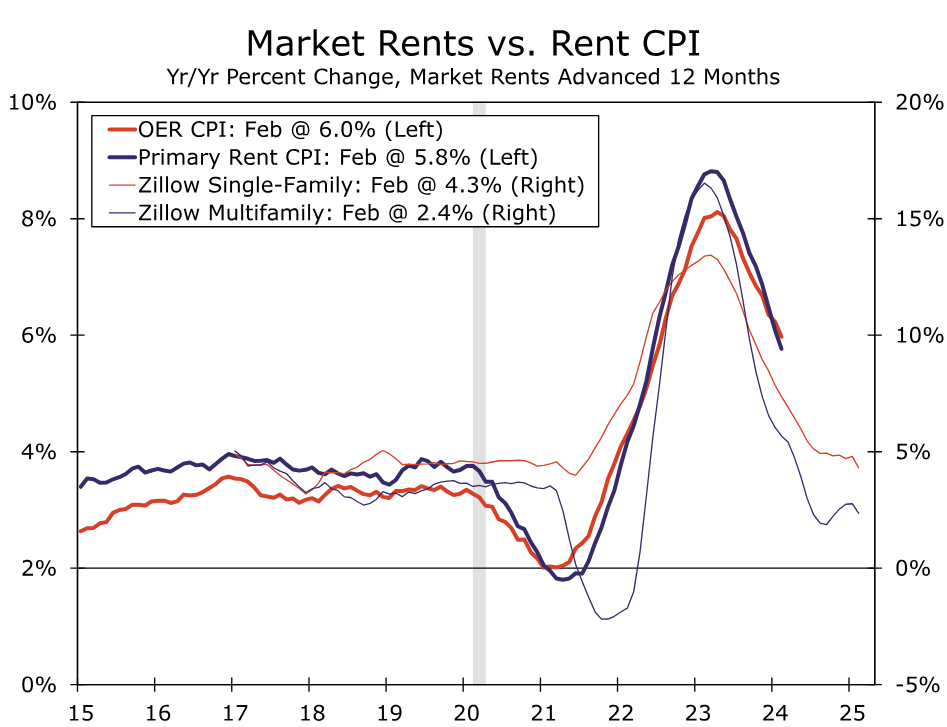
The timing and extent to which the gap between core CPI and core PCE settles back down hinges heavily on the path of shelter inflation given its current hefty contribution. While the moderation in official measures of shelter inflation has been painstakingly slow to materialize, we expect housing disinflation to continue this year with the year-over-year pace of primary shelter resembling its pre-pandemic pace of 3.0-3.5% by next spring. A host of private sector measures suggest apartment rent growth has already settled down, with rents for single family units having also slowed materially (Figure 10). That said, primary shelter has grown to account for an even larger share of CPI since 2019 (+2.5 pts), while the PCE share is little changed. As such, weighting effects are likely to continue to play somewhat of a bigger role on the CPI–PCE gap unless shelter inflation undershoots broader core inflation, an outcome that is plausible but unlikely in our view.
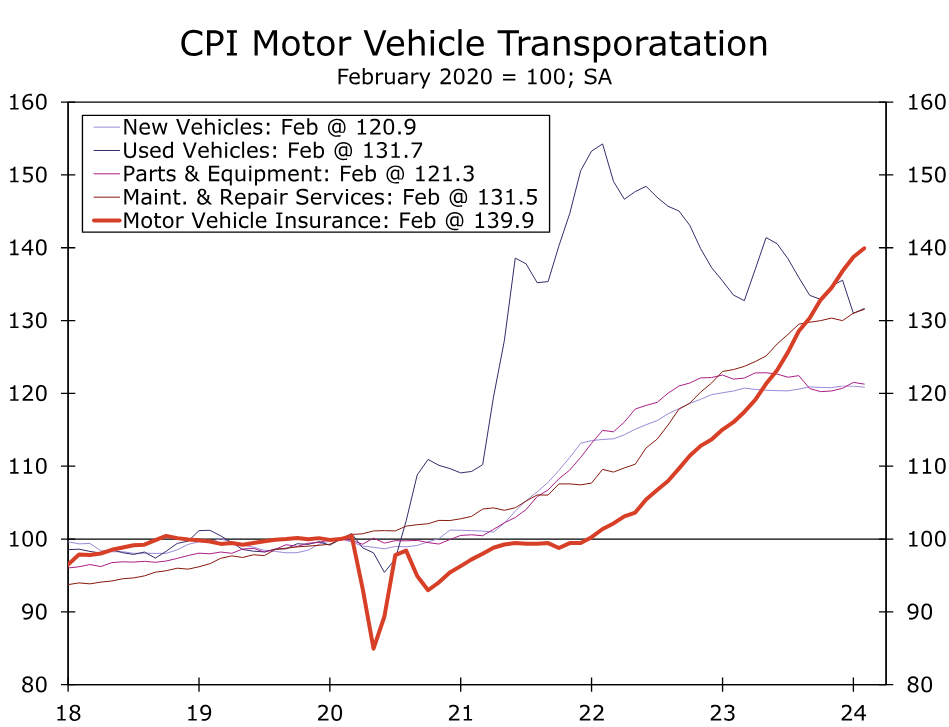
We also anticipate that the chasm stemming from motor vehicle insurance will narrow over the course of the year. Insurers have had to play catch-up to the spike in vehicle and repair costs following severe supply shortages in the auto industry, a process drawn out by the need for regulatory approval to raise premiums in most states. However, motor vehicle insurance premiums per the CPI have now risen more than the price of vehicles, equipment and repair services since the start of 2020, suggesting a diminishing need for premiums to continue rising at the past years' eye-watering pace (Figure 11). Recent months' data show tentative signs of the CPI for motor vehicle insurance already beginning to cool, with prices up 17% on a three-month annualized basis compared to 21% on a 12-month basis.
The expected narrowing of the inflation gap as shelter and motor vehicle insurance inflation slows is likely to be partially offset, however, by cooler price growth in categories currently providing an unusually-large boost to core PCE. As inflation pressures ease from more tepid demand and a balanced labor market, we expect slower price growth for healthcare, food services and other sundry services to reduce the outsized contribution “other core services” are currently providing to core PCE. Public transportation is also unlikely to reduce the inflation gap ahead as the CPI for airfares recovers from last summer's swoon.
Monetary Policy Implications: The Fed's Not Sweating the Gap
The relatively higher rate of CPI compared to the PCE deflator likely goes some way in explaining why consumers continue to reel from the current inflation environment, but Fed officials see enough progress to expect some policy easing later this year. Even as consumer sentiment has improved over the past year, it remains low relative to the strength of the jobs market as prices paid by consumers continue to rise at an unfamiliar speed.
Yet, while core inflation as measured by both the CPI and PCE price indexes remains too high, it has fallen more sharply over the past year when measured by the PCE deflator and is closer to the pace consistent with the Fed's inflation target (Figure 12). Furthermore, although the gap currently remains large, it is not unprecedented. A similarly sized wedge opened up in the late 1990s and in 2001 and 2009. As the pricing environment cools from its extreme state, the gap should diminish as well.
We doubt the Fed is too bothered by the CPI–PCE gap. The elevated rate of shelter inflation is the largest contributor to the wedge at present, but officials continue to espouse optimism that shelter inflation will ease further ahead. In the March 20 FOMC press conference, Chair Powell said that “There's a little bit of uncertainty about when that will happen but there's real confidence that [lower market rents] will show up eventually over time.”
While the wedge between CPI and PCE inflation does not appear to be a major source of consternation among Fed officials, it could make the FOMC's job of returning PCE inflation to 2% a little harder on the margin with cost of living adjustments and price contracts more likely to be based off of the stronger CPI inflation rate. In addition, the Fed does not solely look at the PCE deflator when assessing the current state of inflation. If the gap persists at recent levels and the drivers shift away from housing, it could contribute to some unease among policymakers about the risk of cutting the fed funds rate too early.
Nevertheless, we do not believe the current gap between the two most ubiquitous measures of U.S. inflation is causing any particular misgivings among the FOMC participants about the path of inflation ahead. With the Fed's preferred inflation measure continuing to grind lower, some easing of policy this year likely remains in the cards.
Bitcoin Remains Within Extended Range
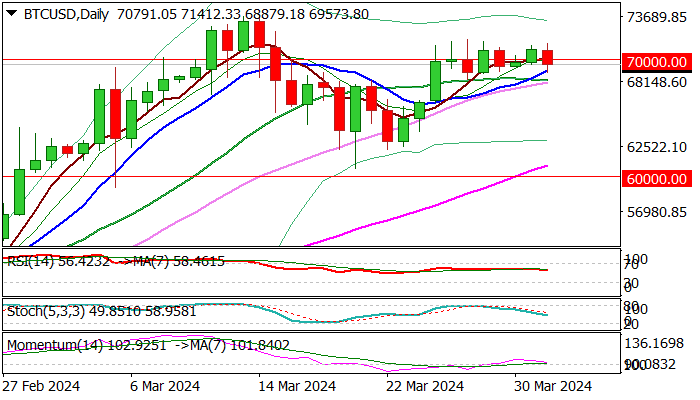
Bitcoin edged lower on Monday but remains within the longer range which extends into seventh consecutive day.
Near-term action remains sideways and looking for stronger direction signals, as daily studies are mixed (fading positive momentum / MA’s in bullish setup), with bullish but overbought weekly studies, adding to unclear near-term picture.
Last week’s monthly close above $70000 level could be a positive signal, however, bulls need to sustain gains above this level to confirm signal.
Traders’ sentiment is also mixed, with two opposite views that correction from new record high is over and fresh acceleration higher expected and that deeper pullback is still to be seen.
Firmer dollar on the latest soft US inflation data, which adds to expectations for Fed’s rate cut in June, could weigh on Bitcoin.
Initial support lays at $69055 (rising 10DMA) guarding more significant range floor, reinforced by 20DMA ($68250), loss of which would risk deeper drop.
Conversely, sustained break above $70000 to keep bias with bulls, though lift above range top ($71700) will be required to confirm bullish continuation.
Res: 70000; 70735; 71000 72406
Sup: 69055; 68250; 67813; 66216
USD/JPY Mid-Day Outlook
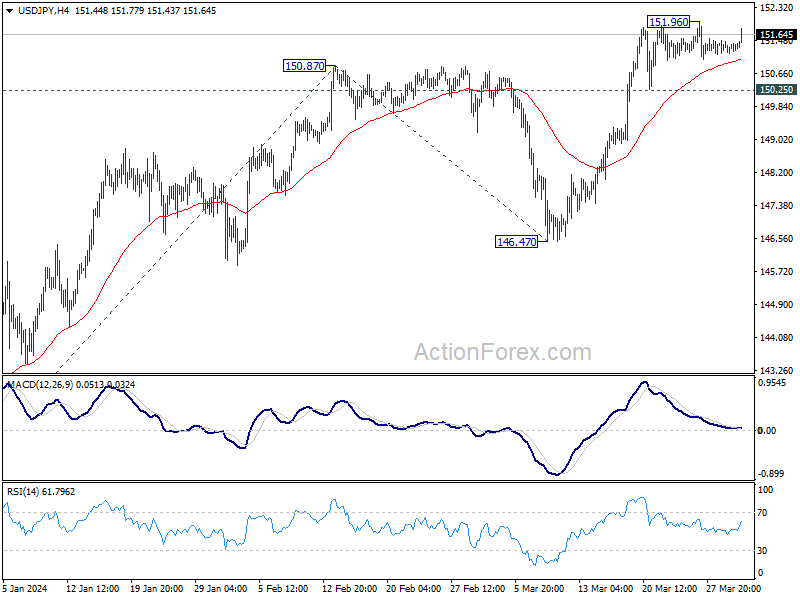
Daily Pivots: (S1) 151.18; (P) 151.34; (R1) 151.51; More...
USD/JPY is staying below 151.96 resistance despite current recovery. Intraday bias remains neutral first. On the downside, break of 150.25 support should confirm short term topping, and turn bias back to the downside for 55 D EMA (now at 149.25). Nevertheless, sustained break of 151.93 key resistance will confirm long term up trend resumption. Next near term target will be 61.8% projection of 140.25 to 150.87 from 146.47 at 153.03.
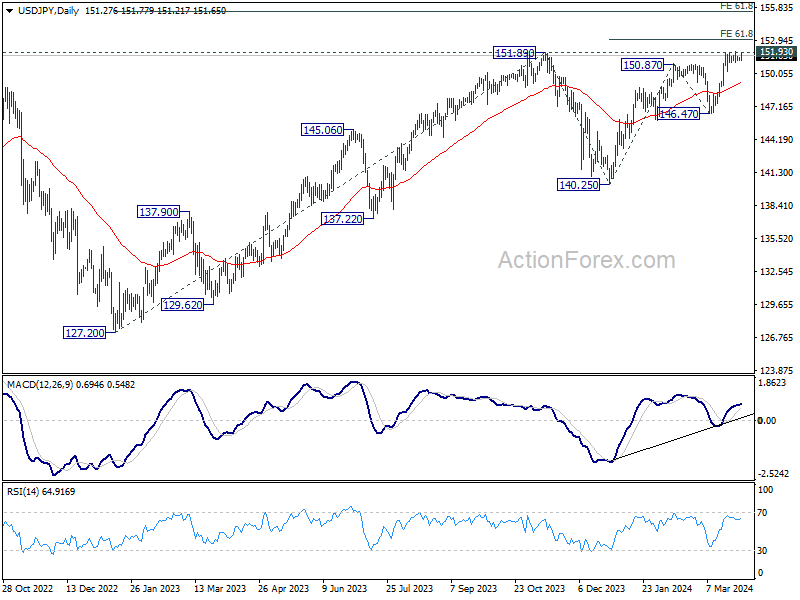
In the bigger picture, correction from 151.87 (2023) high could have completed at 140.25 already. Rise from 127.20 (2023 low), as part of the long term up trend, is probably ready to resume. Decisive break of 151.93 resistance (2022 high) will confirm this bullish case. Next medium term target will be 61.8% projection of 127.20 to 151.89 from 140.25 at 155.20. This will remain the favored case as long as 146.47 support holds, in case of another pullback.
USD/CHF Mid-Day Outlook
Daily Pivots: (S1) 0.9007; (P) 0.9018; (R1) 0.9029; More....
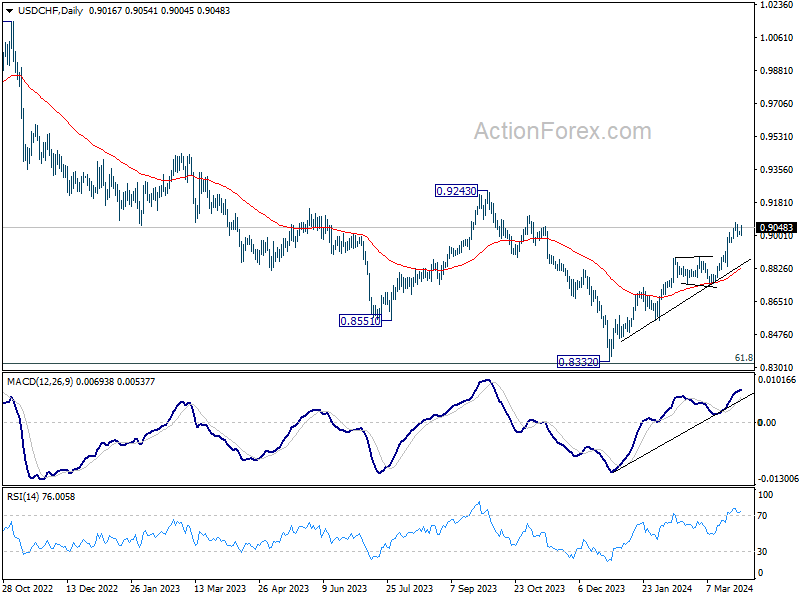
USD/CHF is staying below 0.9070 resistance despite current recovery. Intraday bias remains neutral first. Nevertheless, further rally is expected as long as 0.8964 support holds. Firm break of 0.9070 will resume larger rise from 0.8332 towards 0.9243 key resistance next.
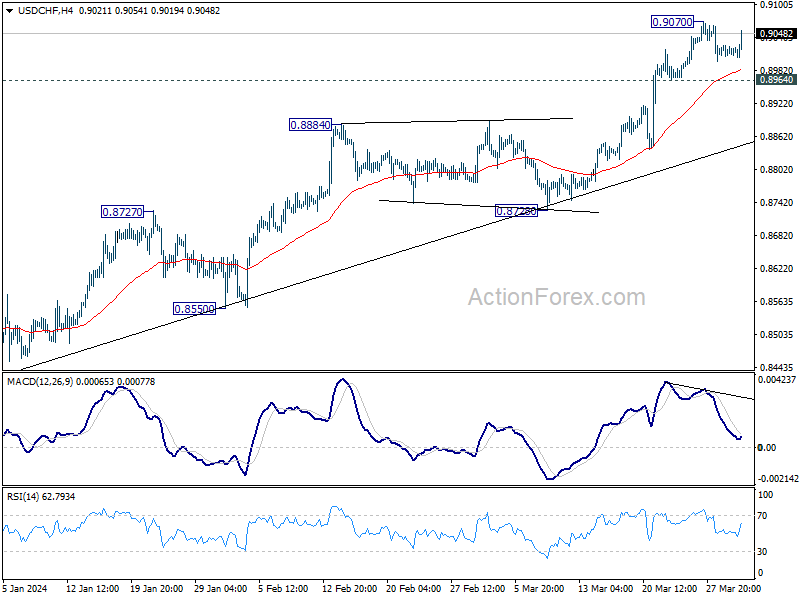
In the bigger picture, price actions from 0.8332 medium term bottom as tentatively seen as developing into a corrective pattern to the down trend from 1.0146 (2022 high). Further rise would be seen as long as 0.8728 support holds. But upside should be limited by 0.9243 resistance, at least on first attempt.
EUR/USD Mid-Day Outlook
Daily Pivots: (S1) 1.0772; (P) 1.0789; (R1) 1.0810; More...
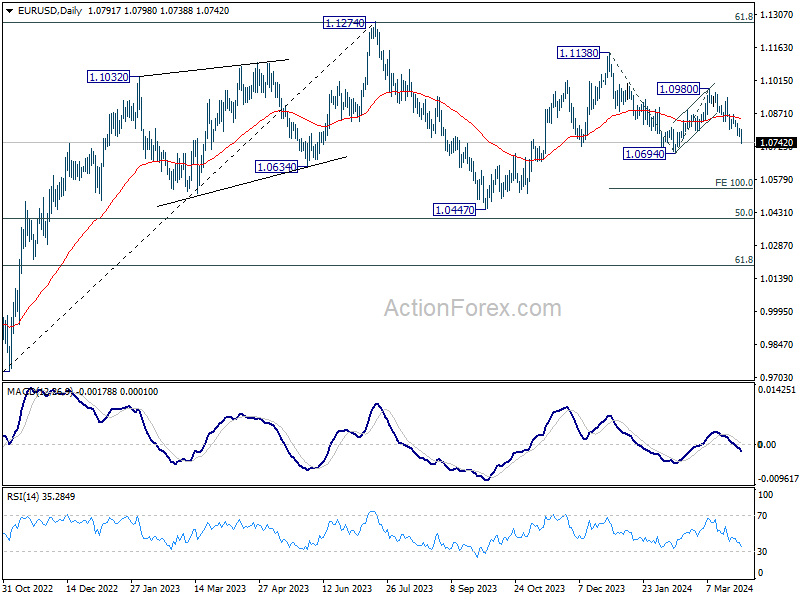
EUR/USD's fall from 1.0980 continues today and intraday bias remains on the downside. Next target is 1.0694 support. Decisive break there will resume the whole decline from 1.1138 and target 100% projection of 1.1138 to 1.0694 from 1.0980 at 1.0536. For now, risk will stay on the downside as long as 1.0834 support turned resistance holds, in case of recovery.
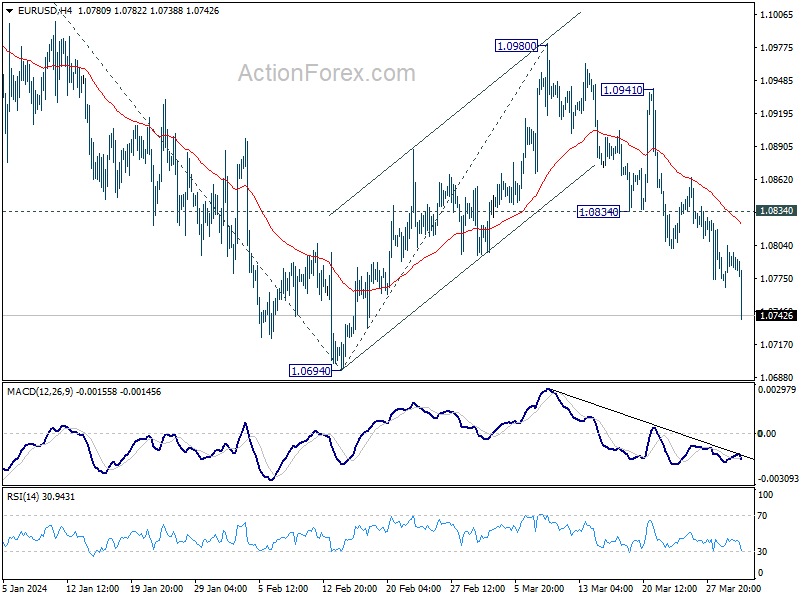
In the bigger picture, price actions from 1.1274 are viewed as a corrective pattern to rise from 0.9534 (2022 low). Rise from 1.0447 is seen as the second leg. While further rally could cannot be ruled out, upside should be limited by 1.1274 to bring the third leg of the pattern. Meanwhile, sustained break of 1.0694 support will argue that the third leg has already started for 1.0447 and possibly below.
GBP/USD Mid-Day Outlook
Daily Pivots: (S1) 1.2608; (P) 1.2626; (R1) 1.2643; More...
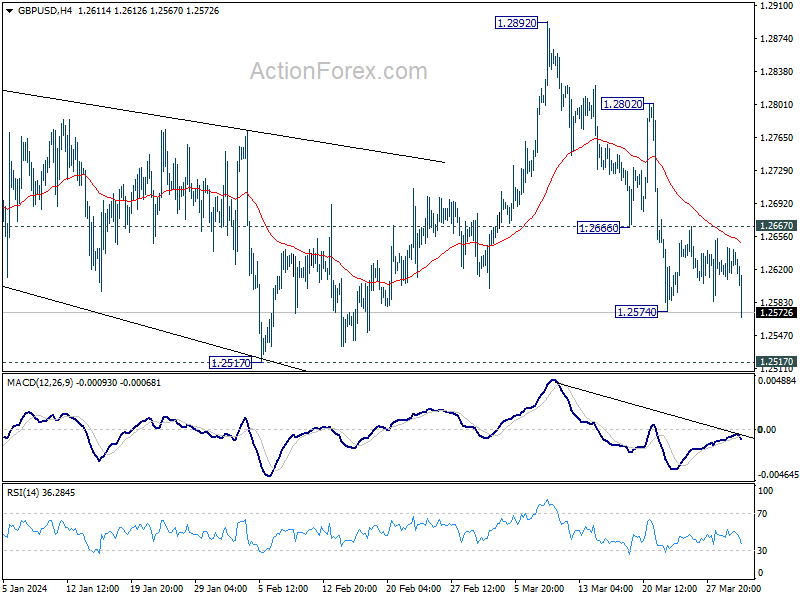
GBP/USD's fall from 1.2892 resumed by breaking 1.2574 support. Intraday bias is back on the downside for 1.2517 structural support first. Decisive break there will suggest that rise from 1.2036 has completed at 1.2892 already, and turn near term outlook bearish. For now, risk will stay on the downside as long as 1.2667 resistance holds, in case of recovery.
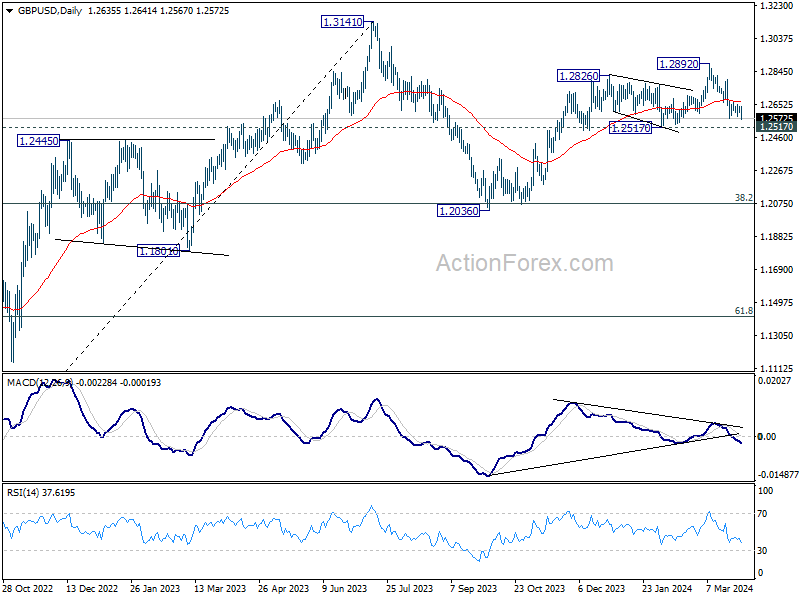
In the bigger picture, price actions from 1.3141 medium term top are seen as a corrective pattern to up trend from 1.0351 (2022 low). Rise from 1.2036 is seen as the second leg, which might still be in progress. But upside should be limited by 1.3141 to bring the third leg of the pattern. Meanwhile, break of 1.2517 support will argue that the third leg has already started for 38.2% retracement of 1.0351 (2022 low) to 1.3141 at 1.2075 again.
Post-Holiday Forex Awakening: Dollar Strengthens on Surprising ISM Manufacturing Expansion
The forex markets roared back to life from holiday lull in early US session, Dollar surges broadly as buoyed by unexpectedly strong ISM manufacturing data. This report marks a pivotal shift for the sector, which has transitioned back into expansion after 16 months of contraction. Additionally, the prices component of the report soared to its highest level since mid-2022. This resurgence poses the question of whether the greenback can sustain its newfound momentum, with further scrutiny from upcoming ISM Services and Non-Farm Payroll data anticipated later in the week.
On the day, New Zealand Dollar emerged as the weakest link, followed by Euro and Sterling. The Canadian Dollar, meanwhile, found itself as the second strongest performer, albeit at a considerable distance behind the surging greenback, with Yen not far behind. Aussie and Swiss Franc occupy the middle ground.
Looking ahead to the Asian session, two critical developments are anticipated. First, with Yen nearing the 152 handle against Dollar once more, market participants are on high alert for verbal (or actual?) intervention from Japan. Second, Australian Dollar is set to face scrutiny as traders digest RBA's minutes, seeking clarity on the central bank's stance of "not ruling anything in or out."
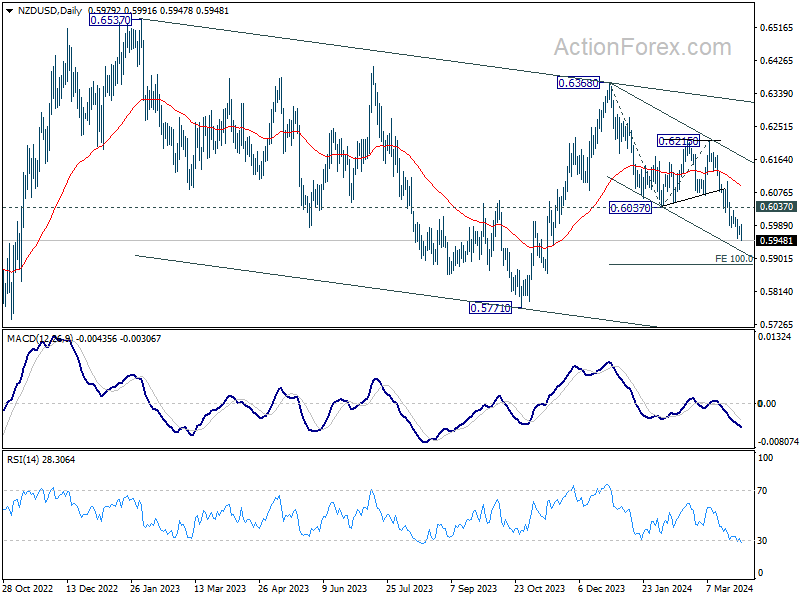
Technically, NZD/USD's decline resumes today and hits as low as 0.5949 so far. Near term outlook will stay bearish as long as 0.6037 support turned resistance holds. Next target is 100% projection of 0.63368 to 0.6037 from 0.6215 at 0.5884. Decisive break there will strengthen the case that whole decline from 0.6537 (2023 high) is resuming through 0.5771 low.
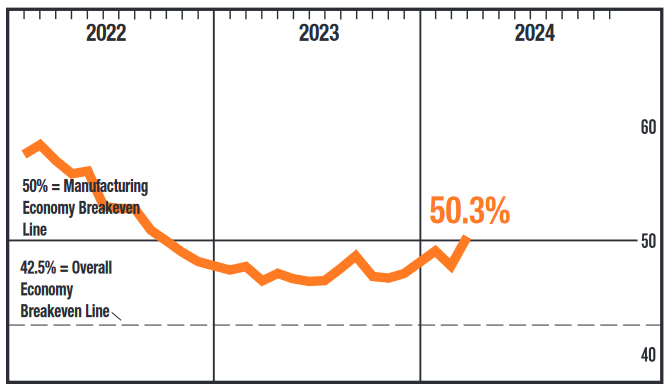
US ISM manufacturing rises to 50.3, first expansion in 16 mth, prices surge
US ISM Manufacturing PMI rose from 47.8 to 50.3 in March, above expectation of 48.5. The sector is now back in expectation for the first time since September 2022.
Looking at some details, new orders rose from 49.2 to 51.4. Production jumped from 48.4 to 54.6. Employment rose from 45.9 to 47.4. Prices rose from 52.5 to 55.8, highest since July 2022.
ISM said: "The past relationship between the Manufacturing PMI and the overall economy indicates that the March reading (50.3 percent) corresponds to a change of plus-2.2 percent in real gross domestic product (GDP) on an annualized basis," says Fiore.
Japan's Tankan survey: Service sector's optimism at highest since 1991
Japan's Q1 quarterly Tankan survey unveils mixed economic sentiment among the nation's large businesses. Service sector expressed their highest levels of optimism in over three decades, contrasting with a slight decline in confidence among manufacturers.
Large manufacturing index dropped from 13 to 11, still surpassing expectation of 10. However, outlook for large manufacturing firms saw modest increase from 8 to 10, slightly below forecasted 11.
On the brighter side, non-manufacturing index climbed from 32 to 34, exceeding expectations of 31 and marking the highest level since 1991. Despite this, non-manufacturing outlook remained steady at 27, falling short of anticipated 30.
Additionally, large all-industry Capex gauge, which measures capital expenditure plans across industries, is projected to grow by 4% in the new fiscal year. This figure, though positive, falls significantly below the anticipated 9.2% growth.
Japan's PMI manufacturing finalized at 48.2, worst of weakness has passed
Japan's PMI Manufacturing was finalized at 48.2 in March, up from February's 47.2, highest in four months.
Usamah Bhatti of S&P Global Market Intelligence noted that while the sector's performance remained "downbeat," there were emerging signs that the "worst of the weakness had passed". This observation is based on softer reductions observed in both output and new orders inflows.
However, it's important to highlight that the average PMI reading for Q1 stood at 47.8, indicating the weakest quarterly performance since Q3 2020, when it was 46.7.
Inflationary pressures "remained marked" Although the rate of input price inflation has moderated to its weakest in over three years, the challenge of high costs persists. In response to these pressures, selling price inflation has intensified to a three-month high, reflecting manufacturers' efforts to safeguard profit margins by transferring higher expenses onto their customers.
China's NBS PMI manufacturing rises to 50.8, first expansion in six months
China's official NBS PMI Manufacturing climbed from 49.1 to 50.8 in March, surpassing expectations of 50.1. This uptick not only marks the sector's first expansion in six months but also represents its highest reading in a year
Details showed notable increases in manufacturing production, which leaped from 49.8 to 52.2, and new orders, which surged from 49.0 to 53.0. Furthermore, new export orders rose from 46.3 to 51.3.
PMI Non-Manufacturing also showed positive momentum, climbing from 51.4 to 53.0, slightly above anticipated figure of 51.3. PMI Composite index, which encompasses both manufacturing and non-manufacturing activities, improved from 50.9 to 52.7,
Zhao Qinghe, senior statistician at NBS, attributed the March surge to increased production resumption efforts following Lunar New Year holiday, alongside improvement in market vitality.
China's Caixin PMI manufacturing ticks up to 51.1
China's Caixin PMI Manufacturing rose from 50.9 to 51.1 in March, above expectation of 51.0, marking the highest level in 13 months.
Wang Zhe, Senior Economist at Caixin Insight Group, noted acceleration in both supply and demand within sector with "overseas demand picking up".
Despite the overall improvement, employment continued "contraction. Additionally, "depressed price level worsened".
GBP/USD Mid-Day Outlook
Daily Pivots: (S1) 1.2608; (P) 1.2626; (R1) 1.2643; More...
GBP/USD's fall from 1.2892 resumed by breaking 1.2574 support. Intraday bias is back on the downside for 1.2517 structural support first. Decisive break there will suggest that rise from 1.2036 has completed at 1.2892 already, and turn near term outlook bearish. For now, risk will stay on the downside as long as 1.2667 resistance holds, in case of recovery.
In the bigger picture, price actions from 1.3141 medium term top are seen as a corrective pattern to up trend from 1.0351 (2022 low). Rise from 1.2036 is seen as the second leg, which might still be in progress. But upside should be limited by 1.3141 to bring the third leg of the pattern. Meanwhile, break of 1.2517 support will argue that the third leg has already started for 38.2% retracement of 1.0351 (2022 low) to 1.3141 at 1.2075 again.
Economic Indicators Update
| GMT | Ccy | Events | Actual | Forecast | Previous | Revised |
|---|---|---|---|---|---|---|
| 23:50 | JPY | Tankan Large Manufacturing Index Q1 | 11 | 10 | 12 | 13 |
| 23:50 | JPY | Tankan Non - Manufacturing Index Q1 | 34 | 31 | 30 | 32 |
| 23:50 | JPY | Tankan Large Manufacturing Outlook Q1 | 10 | 11 | 8 | |
| 23:50 | JPY | Tankan Non - Manufacturing Outlook Q1 | 27 | 30 | 24 | 27 |
| 23:50 | JPY | Tankan Large All Industry Capex Q1 | 4.00% | 9.20% | 13.50% | |
| 00:30 | JPY | Manufacturing PMI Mar F | 48.2 | 48.2 | 48.2 | |
| 01:45 | CNY | Caixin Manufacturing PMI Mar | 51.1 | 51 | 50.9 | |
| 13:30 | CAD | Manufacturing PMI Mar | 49.8 | 49.7 | ||
| 13:45 | USD | Manufacturing PMI Mar F | 51.9 | 52.5 | 52.5 | |
| 14:00 | USD | ISM Manufacturing PMI Mar | 50.3 | 48.5 | 47.8 | |
| 14:00 | USD | ISM Manufacturing Prices Paid Mar | 55.8 | 52.8 | 52.5 | |
| 14:00 | USD | ISM Manufacturing Employment Index Mar | 47.4 | 45.9 | ||
| 14:00 | USD | Construction Spending M/M Feb | -0.30% | 0.50% | -0.20% | |
| 14:30 | CAD | BoC Business Outlook Survey |
US ISM manufacturing rises to 50.3, first expansion in 16 mth, prices surge
US ISM Manufacturing PMI rose from 47.8 to 50.3 in March, above expectation of 48.5. The sector is now back in expectation for the first time since September 2022.
Looking at some details, new orders rose from 49.2 to 51.4. Production jumped from 48.4 to 54.6. Employment rose from 45.9 to 47.4. Prices rose from 52.5 to 55.8, highest since July 2022.
ISM said: "The past relationship between the Manufacturing PMI and the overall economy indicates that the March reading (50.3 percent) corresponds to a change of plus-2.2 percent in real gross domestic product (GDP) on an annualized basis," says Fiore.
Pound’s Pause Before Dive
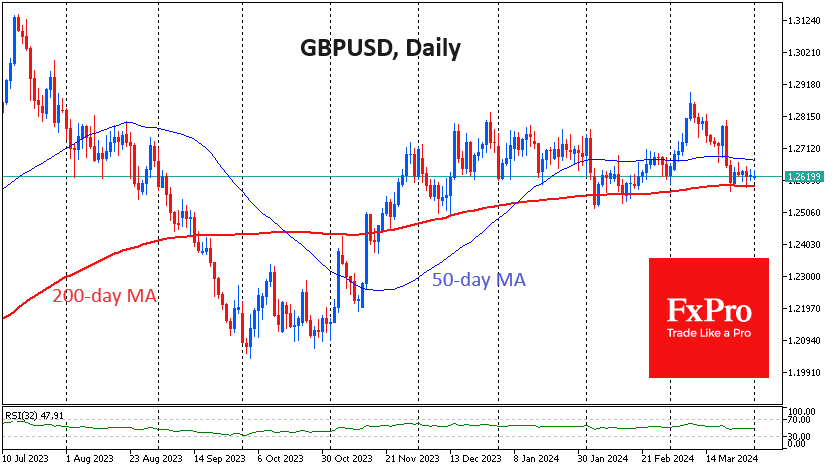
The British Pound has spent the past week in a tight 500 pip range but has mostly traded around the 1.2620 level. Attempts by the bears to send the GBPUSD into a downtrend like the EURUSD have so far failed, with the pair finding buyers on dips towards the 200-day moving average (now at 1.2590) since last November. It looks more like a temporary stalemate against the backdrop of the euro, franc and yen downtrends and the Canadian dollar’s unimpressive momentum.
In terms of moving averages, the uptrend was broken in the early days of February with a sharp dip below the 50-day MA. However, the dip below the longer-term 200-day MA lasted only a few hours. There was even a false attempt to bounce back from it in early March. But it was more of a false breakout, and the pressure on sterling quickly returned.
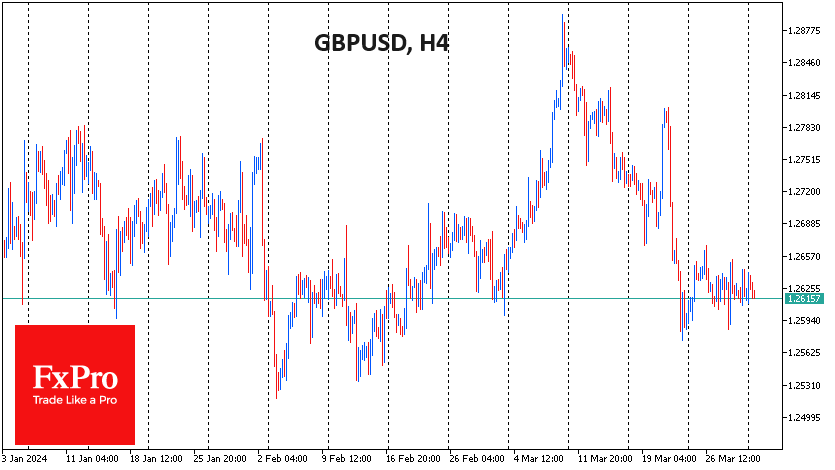
The market driver since the beginning of the year has been the comparison of monetary policy between the US and other developed countries. Last year ended with expectations of four or five Fed rate cuts, with the first in March; now, the probability of more than three cuts is estimated at 33%, starting in June (68% probability). Expectations for the Bank of England have not changed so dramatically. The first cut is still expected around the middle of the year, and for the whole year, 2-3 cuts are expected, down from 3-4 at the end of December.
A consolidation below the 200-day MA looks more like a matter of “when” than “if”, as the dollar tends to strengthen against its major peers. The Pound is in better shape than most of the major currencies, given the less dovish outlook for monetary policy. However, it can rarely swim against the tide for long. Europe has shown time and again that it can move quickly: the Bank of England started raising rates five months before the Fed, and the Swiss National Bank unexpectedly started easing at the end of March.
A GBPUSD fix below 1.26 will draw attention to the pound from those following long-term trends. A break below 1.25 will be an important signal that the market has decided its direction, which will signal the taking of a psychologically important level and confirm the breakdown of support in recent months.