Sample Category Title
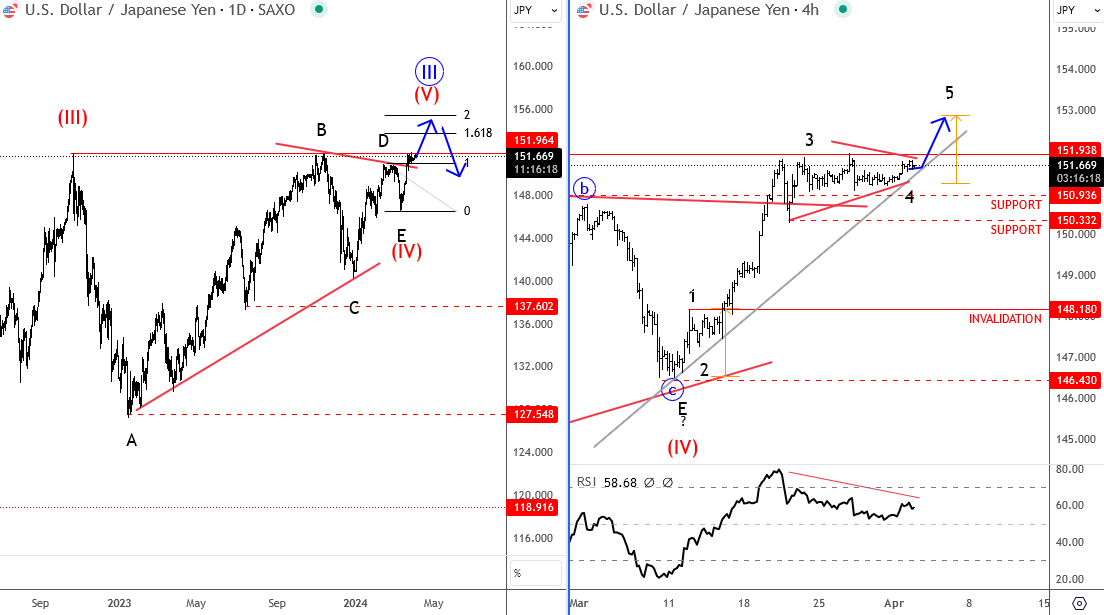
Elliott Wave Analysis on USD/JPY: Correction Within Uptrend
JPY came down across the board, even though BOJ decided to end its ultra-loose policy, by raising rates for 10bp in March. USDJPY is coming higher anyhow, with price breaking some very important trendline connected from 2023 highs. It can even represent part of a bullish triangle which is finished now, so USDJPY has room for much more gains, especially after current sideways price pattern. It looks like a wave four triangle here on 4h time frame, so more upside, and possibly final leg up can show up at the start of the month. Ideally wave 5 will hit 153.00 where bulls can slow down a bit.
WTI Oil: Brightening Demand Outlook Continues to Inflate the Price
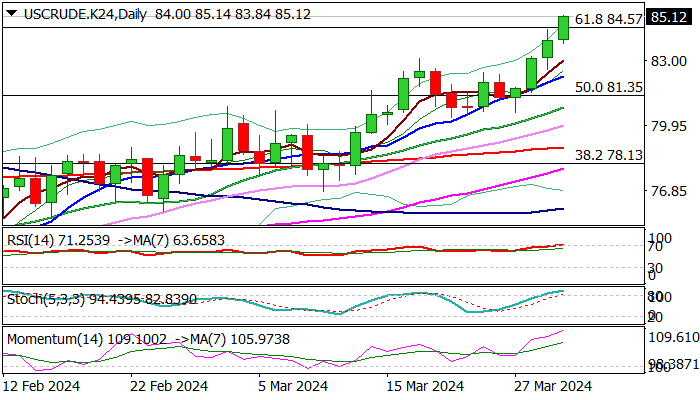
WTI oil price continues to trend higher and hit five-month high on Tuesday, probing above $85.00 barrier for the first time since late October.
The last bull-leg extends into fourth consecutive day, underpinned by brightening demand outlook on firmer than expected China’s and US economic data, as well as drop in OPEC oil production in February.
Fresh bullish signal is developing on daily chart after the price broke above pivotal Fibo barrier at $84.57 (61.8% retracement of $95.00/$67.70 downtrend), with close above this level to confirm signal and contribute to support from bullish daily technical studies.
Bulls eye immediate target at $85.87 (Oct 27 high), guarding $88.56 (Fibo 76.4%).
Former top ($8310) and rising 10DMA ($82.24) should contain corrective dips to offer better buying opportunities.
Res: 85.87; 87.00; 88.56; 90.00.
Sup: 84.57; 83.58; 83.10; 82.24.
EUR/USD outlook: Bears Eye 2024 low
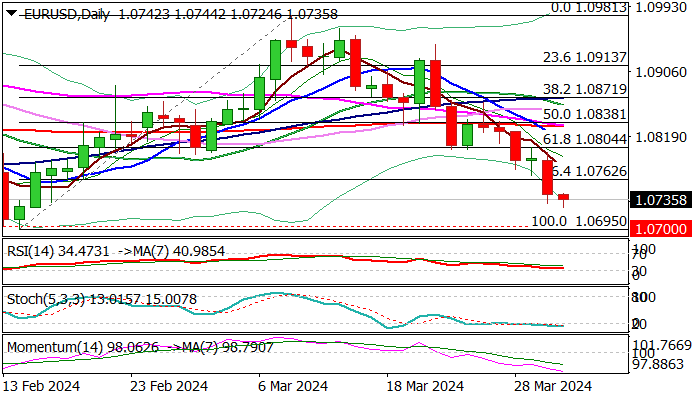
The Euro fell to new multi-week low early Tuesday, weighed by firm dollar and recent dovish comments from ECB policymakers, who see four rate cuts in 2024.
Monday’s 0.4% drop and close below 1.0762 (Fibo 76.4% of 1.0695/1.0981 upleg), adds to bearish near-term outlook and unmasks key support at 1.0695 (2024 low, posted on Feb 14).
Strengthening negative momentum on daily chart and MA’s in bearish setup (10/200DMA death cross and converged 55/200DMA’s about to form bear-cross) point to bearish technical picture, though oversold conditions may slow bears for consolidation.
Broken pivotal supports at 1.0800 zone (daily cloud base / Fibo 61.8%) reverted to solid barriers which should keep the upside protected.
Traders look fresh signals from today’s release of German CPI data and Eurozone inflation report on Wednesday.
Res: 1.0762; 1.0804; 1.0834; 1.0861.
Sup: 1.0724; 1.0695; 1.0611; 1.0585.
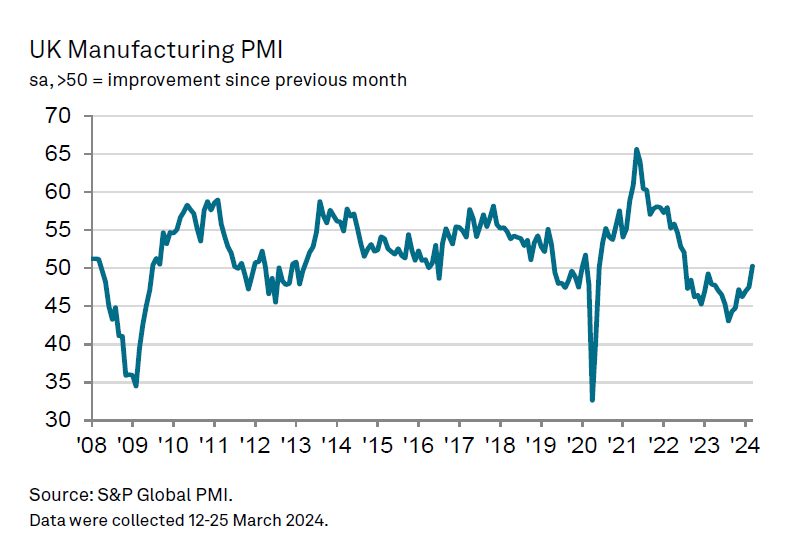
UK PMI manufacturing finalized at 50.3, signaling first growth since July 2022
UK PMI Manufacturing was finalized at 50.3 in March, climbing from February's 47.5 to mark a 20-month high. This development represents the sector's first move above the critical 50.0 threshold since July 2022, indicating a tentative resurgence in manufacturing activity.
Rob Dobson, Director at S&P Global Market Intelligence, highlighted, "The end of the first quarter saw UK manufacturing recover from its recent doldrums." This recovery is attributed primarily to revival in production and new orders, spurred by strengthening domestic demand. Despite the growth being characterized as hesitant, following year-long downturns, the shift towards expansion signals a turning point for the sector.
The resurgence in demand has also buoyed manufacturers' confidence, with positive sentiment reaching an 11-month peak. Remarkably, 58% of companies surveyed anticipate increase in their output over the coming year.
However, challenges persist, including "weak export performance and supply chain stresses," which continue to hinder the sector's full recovery potential. The EU market, in particular, has been identified as the "main drag" on overseas demand, compounded by ongoing issues in the Red Sea impacting supply chains.
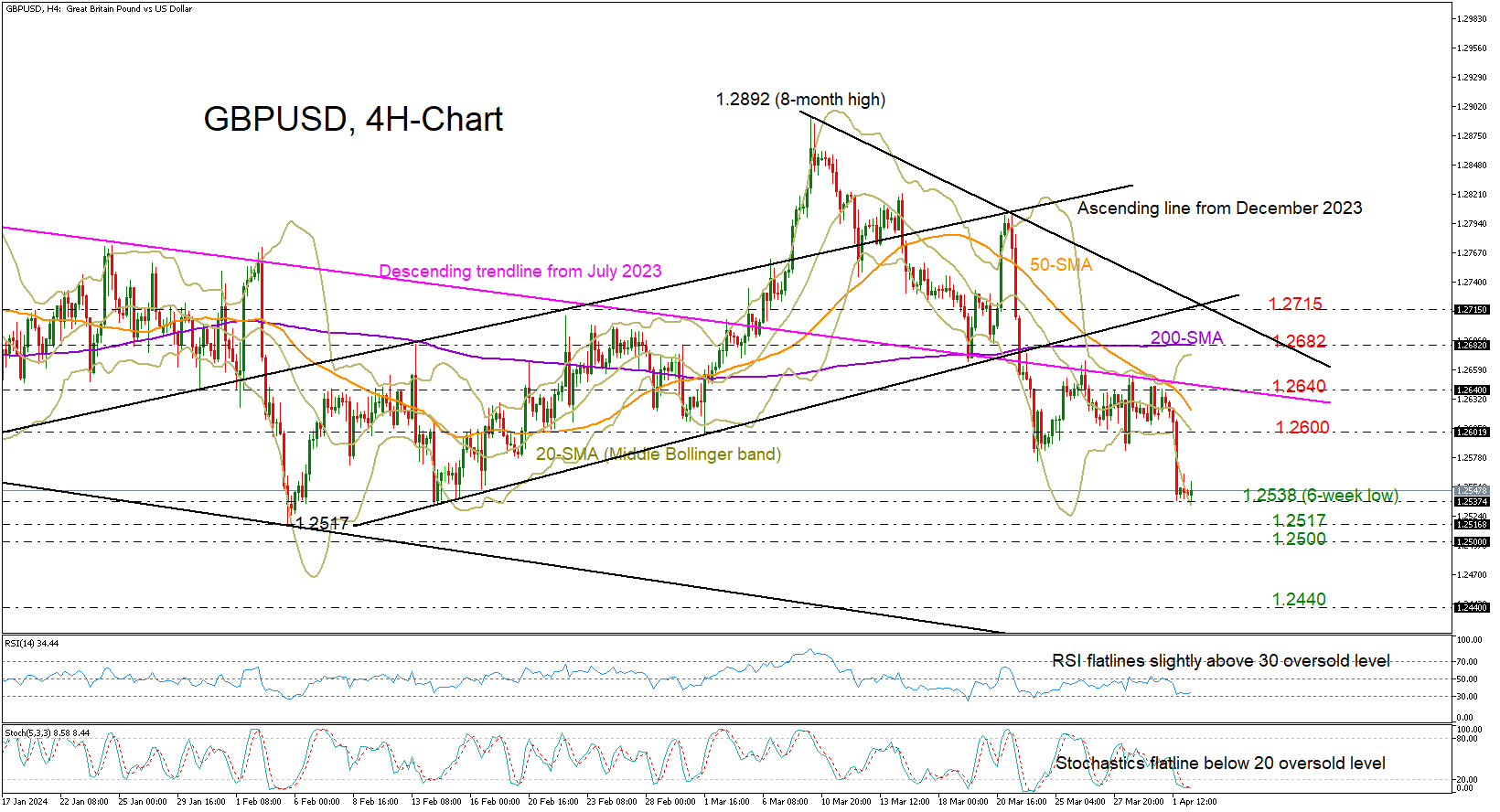
GBPUSD Starts April With a Drop
- GBPUSD moves sharply down on the first trading day of April
- 2024 neutral trajectory valid above 1.2500
GBPUSD plummeted to a six-week low of 1.2538 as investors returned from the Easter holiday break, re-establishing the downward pattern from the March high.
Given the price's position at the bottom of the 2024 range and around the lower Bollinger band, it will be intriquing to observe if the pair can avoid a bearish breakout even after getting another rejection from the December 2023 descending trendline.
Should sellers maintain control, the price might initially examine February’s low of 1.2517 and the 1.2500 psychological number before plunging towards the key 1.2440 constraining zone. Additional losses from there could soften somewhere between the 1.2400 round level and the tentative support line drawn from December 21 at 1.2380.
In the event the pair builds a firm base around 1.2538, traders might shift their attention to the 1.2600 mark, where the 20-period simple moving average (SMA) is located. A decisive move higher could face another challenging session near the December resistance line at 1.2640. The bulls will have to overcome that bar to meet the flattening 200-period SMA at 1.2680, a break of which is expected to direct the price towards the broken ascending trendline at 1.2715.
In summary, GBPUSD had a rough start to the month, though hopes for a rebound may not evaporate unless the pair exits its 2024 neutral trajectory below the 1.2500 region.
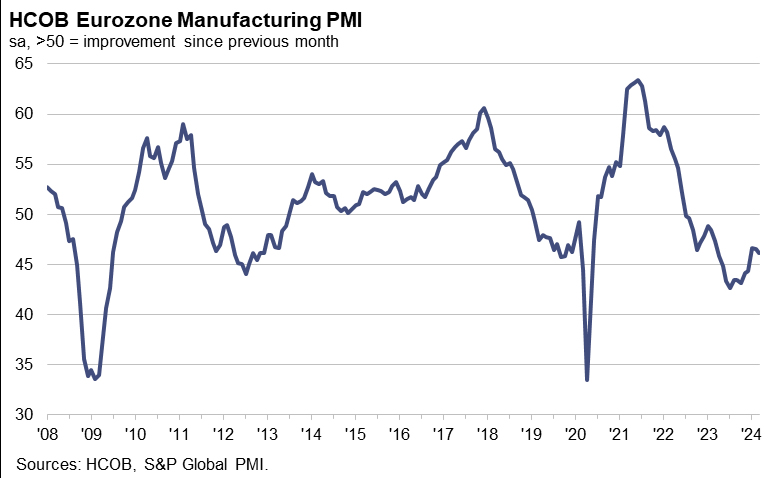
Eurozone PMI manufacturing finalized at 46.1, two largest cylinders out of action
Eurozone PMI Manufacturing was finalized at 46.1 in March, down from February's 46.5. Disparities across member countries continued, with Greece achieving a 25-month high at 56.9, Italy at 12-month high at 50.4, and Spain dipped slightly to 5.1.4. Meanwhile, Germany recorded a 5-month low at 41.9, and France fell to 46.2.
Cyrus de la Rubia, Chief Economist at Hamburg Commercial Bank, provided a grim outlook based on the latest PMI figures, suggesting that the recession in Eurozone's manufacturing sector is likely to persist.
De la Rubia noted that Eurozone's manufacturing industry, heavily reliant on the collective output of Germany, France, Italy, and Spain—known as the Euro-4 countries—faces significant challenges as Germany and France experience notable downturns. While Italy and Spain showed signs of recovery in March and February, respectively, their improvements have yet to offset the overall sector's decline.
While that the pace of decrease in incoming orders has slowed in the first quarter, yet the industry still records a net loss in orders compared to the previous months. This trend raises concerns that the sector may soon exceed the longest contraction spell for incoming new orders recorded during the euro crisis from 2011 to 2013. Such a scenario underscores the difficulties facing a swift reversal in manufacturing activity across Eurozone.
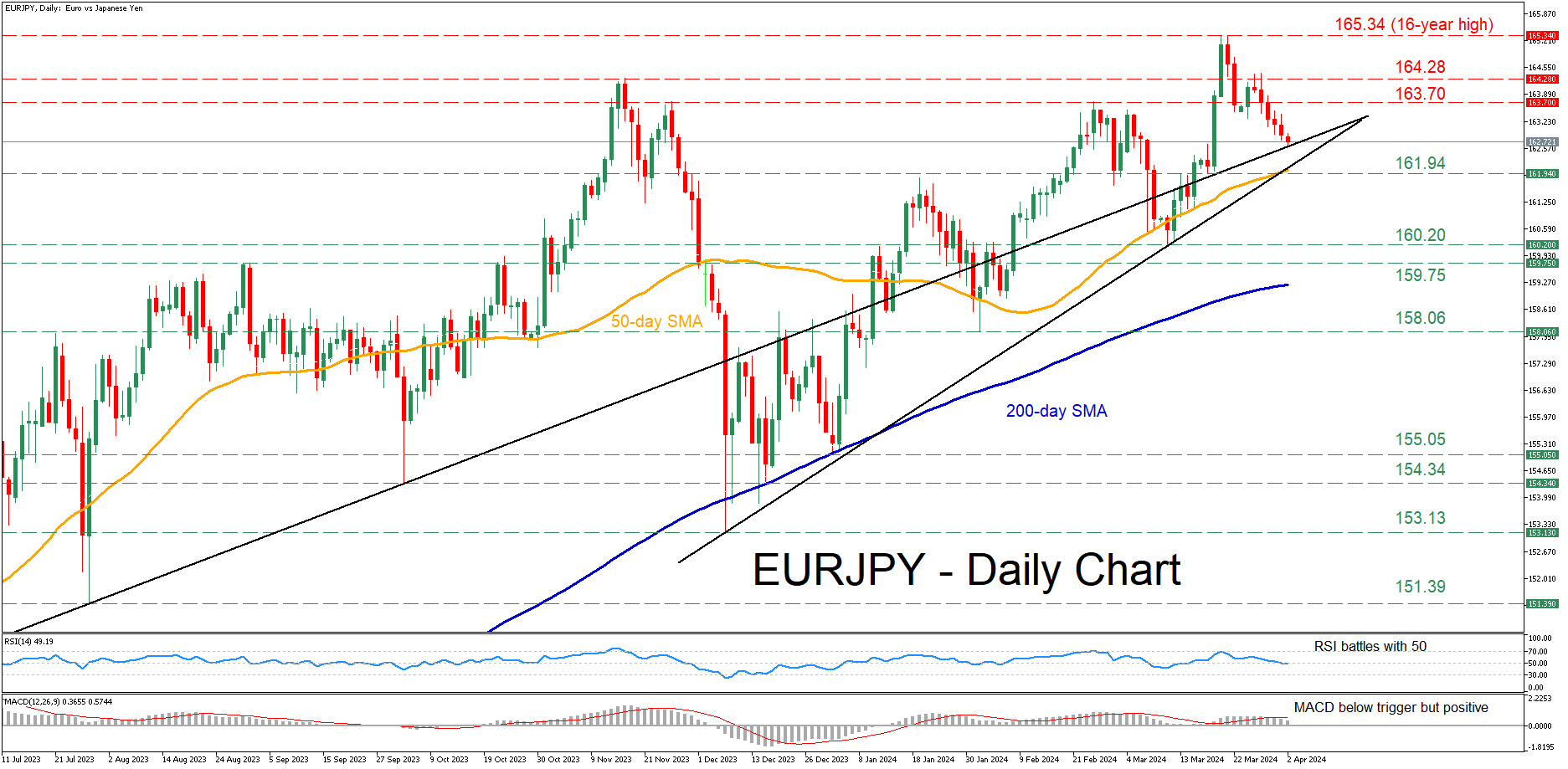
EURJPY Pulls Back Towards Crucial Trendline
- EURJPY retraces lower following a 16-year peak
- Tests ascending trendline drawn from July 2023
- Oscillators suggest weakening momentum
EURJPY had been in a steady advance since December 2023, peaking at a fresh 16-year high of 165.34 on March 20. Since then, the pair has been undergoing a downside correction, with the upward sloping trendline that connects higher lows since July 2023 currently acting as a strong support.
Should the trendline fail to hold its ground, the pair could slide towards the recent support of 161.94, which lies very close to the 50-day simple moving average (SMA). A violation of that zone could pave the way for the Mach bottom of 160.20. Further declines might then cease at the August-October resistance region of 159.75, which might serve as support in the future.
On the flipside, bullish actions could propel the price towards the February peak of 163.70. Conquering that barricade, the bulls may attack the 2023 high of 164.28. If that barrier fails, the price could ascend to revisit its 16-year high of 165.34.
In brief, EURJPY has been on the retreat in the past few sessions, experiencing a solid setback from its recent 16-year peak. For the bears to gain confidence for a sustained decline, the pair needs to break below the 50-day SMA.
GBP/JPY Daily Outlook
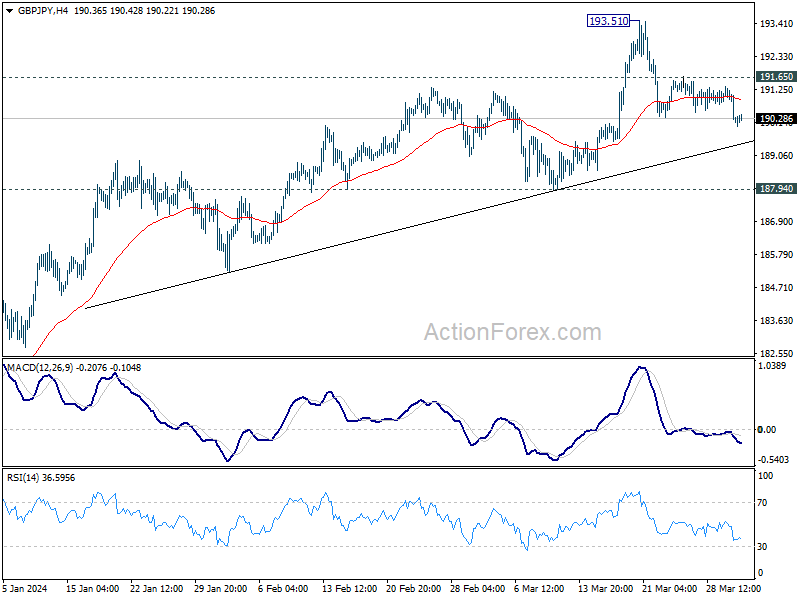
Daily Pivots: (S1) 189.90; (P) 190.63; (R1) 191.08; More.....
Intraday bias in GBP/JPY is mildly on the downside as fall from 193.51 short term top extends. Deeper decline would be seen towards 187.94 structural support. On the upside, break of 191.65 minor resistance will turn bias back to the upside for retesting 193.51.
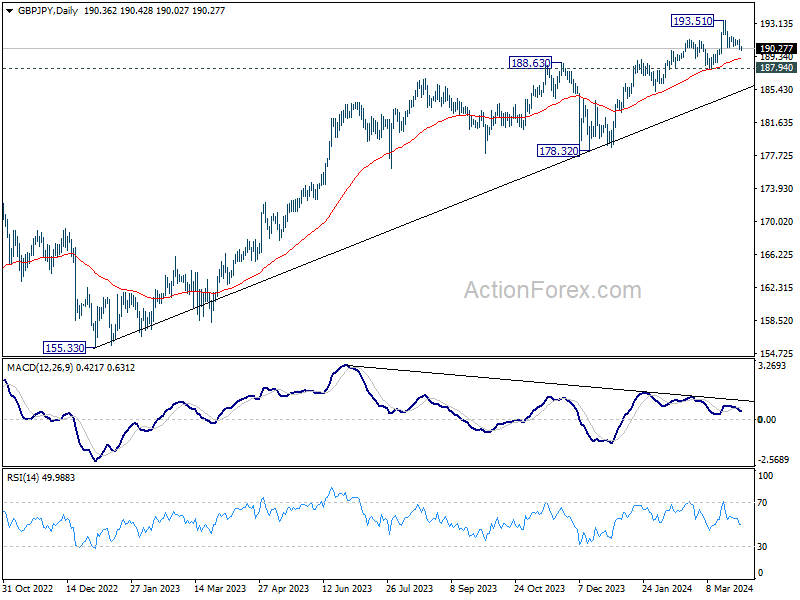
In the bigger picture, current rally is part of the up trend from 123.94 (2020 low), and is in progress for long term resistance (2015 high). Break of 187.94 support is needed to be the first sign of medium term topping. Otherwise, outlook will remain bullish in case of retreat.
EUR/JPY Daily Outlook
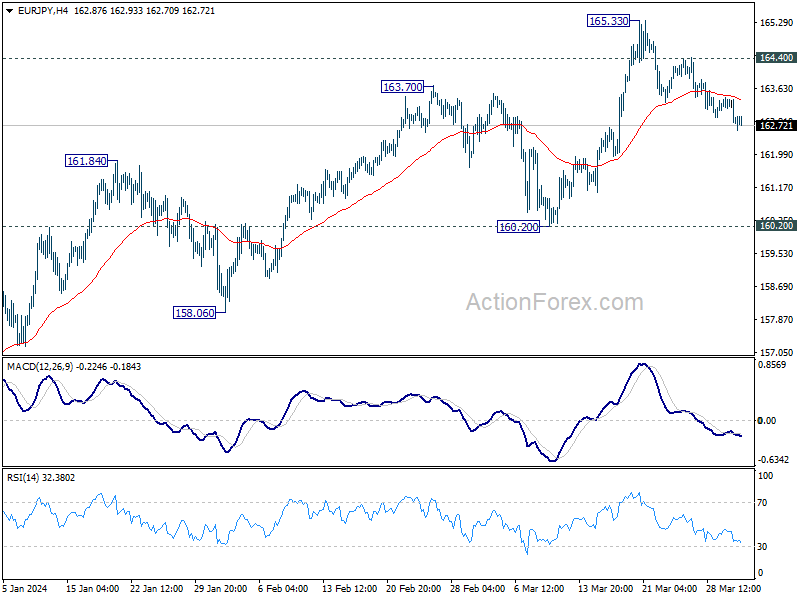
Daily Pivots: (S1) 162.65; (P) 163.05; (R1) 163.30; More...
Intraday bias in EUR/JPY is back on the downside as fall from 165.33 short term top resumed. Further decline would be seen to 160.20 structural support next. On the upside, however, break of 164.40 minor resistance will bring retest of 165.33 instead.
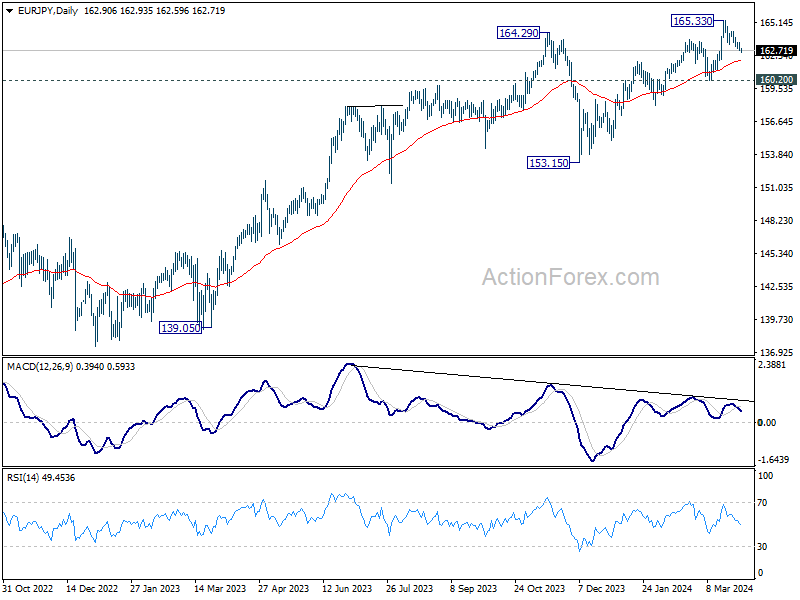
In the bigger picture, current rally is part of the up trend from 114.42 (2020 low), which is still in progress. Next target is 169.96 (2008 high). Break of 160.20 support is needed to be the first sign of medium term topping. Otherwise, outlook will stay bullish in case of retreat.
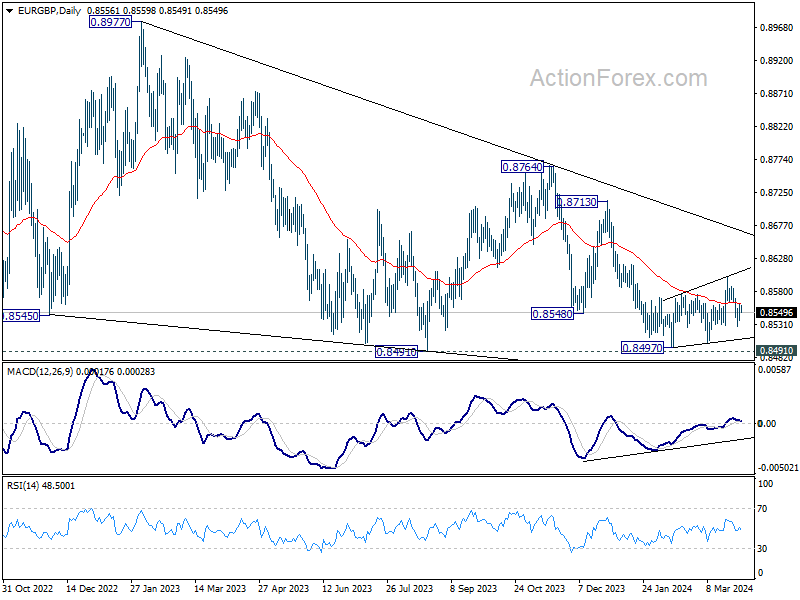
EUR/GBP Daily Outlook
Daily Pivots: (S1) 0.8545; (P) 0.8554; (R1) 0.8569; More...
Intraday bias in EUR/GBP remains neutral for the moment. On the downside, firm break of 0.8529 support will argue that the corrective recovery from 0.8497 has completed at 0.8601. Intraday bias will be back on the downside for retesting 0.8497 low next. On the upside, break of 0.8601 will resume the rebound instead.
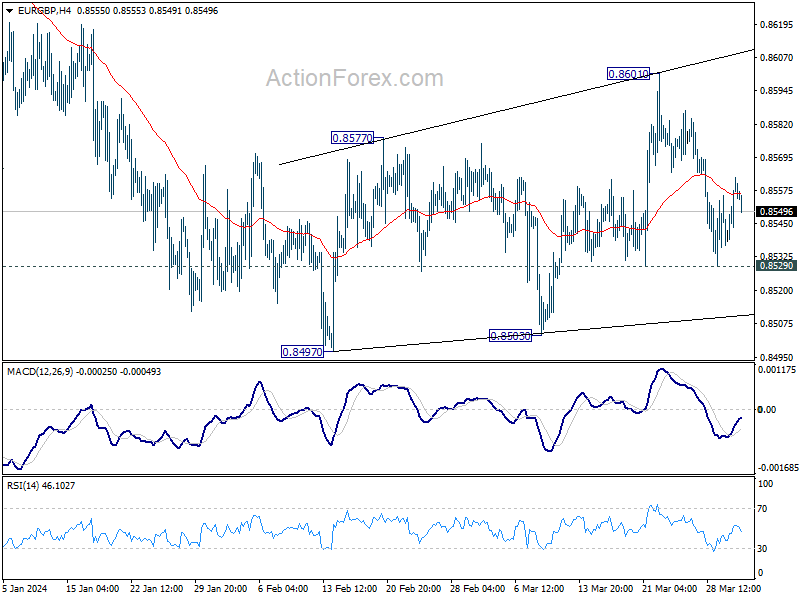
In the bigger picture, there is no clear sign that down trend from 0.9267 has completed, despite loss of downside momentum as seen in D MACD. As long as 0.8713 resistance holds, the down trend will remain in favor to resume through 0.8491 low at la later stage.